The Mill at Christmas in Second Life

The Mill; Inara Pey, December 2017, on FlickrThe Mill – click any image for full size

It’s always a pleasure to visit The Mill, the homestead region designed by Shakespeare (SkinnyNilla) and Max (Maxie Daviau). It’s a place we’ve paid numerous visits to, on account that it receives a seasonal rebuild, so when Shakespeare dropped an invitation for Caitlyn and I to drop in and see the Winter 2017 build.

The Mill; Inara Pey, December 2017, on FlickrThe Mill – click any image for full size

As is the tradition with The Mill, a visit commences at the titular location for the region:  the great stone mill, currently located in the south-east corner of the region. From here, track runs through the snow, circling a little café serving welcome hot drinks. From here, steps lead up and to the west, where a snowy little cabin sits, overlooking the region’s frozen river. An old pick-up truck is struggling to the cabin, trying to deliver a Christmas tree, having driven past a little row of houses beyond a rocky arch.

The Mill; Inara Pey, December 2017, on FlickrThe Mill – click any image for full size

Alternatively, a decorative bridge reached a short walk from the landing point offers a way across the river to where a church keeps watch on a deck built out over the ice, and a little carousel. Here the route divides once more, one track leading up a hill and under the boughs of a giant Virginia Oak to a house atop the hill, the other running around the base of the hill. This lower road follows the high bank of the river to where a set of stone steps leads up to the lower end of a sleigh run – the upper end not far from the hilltop house.   

The Mill; Inara Pey, December 2017, on FlickrThe Mill – click any image for full size

With riverside camps, hillside look-out points, horse, deer and sheep wandering throughout, The Mill presents a perfect rural winter scene, with plenty of places for people to enjoy taking photos or enjoy the setting. Accompanying the region is a superb audio stream in the form of Martini in the Morning – one on my personal favourites, and with which I share some history, having helped introduce Brad “Martini” Chambers to the world of Second Life.

The Mill; Inara Pey, December 2017, on FlickrThe Mill – click any image for full size

For those who prefer not to explore with the audio stream active (as we generally do), there’s a gentle ambient sound scape for the region, complete with some seasonal touches with the help of Nat “King” Cole, Dean Martin and  – I believe – Matt Munroe at the carousel.

As always, The Mill is a joy and a pleasure to visit – make sure you do, and don’t forget to offer a token of appreciation via the little bear by the landing point to help Shakespeare and Max continue to offer the region for visitors to enjoy.

SLurl Detail

  • The Mill (Pale Moonlight, rated:  Moderate)

A 1928 trip to the north pole in Second Life

1928 Polo Nord

Now open at Solo Arte, curated by Melania (MelaniaBis), is 1928 Polo Nord, the latest installation by Terrygold. Best known for her evocative avatar studies, for this installation Terrygold has turned to history. Working with the assistance of Melania and Annalisa Muliaina, she has built an installation commemorating the ill-fated polar expedition of the airship Italia in 1928.

Italian aviator, aeronautical engineer Umberto Nobile was one of the pioneers of airship design in the early 20th century. In particular, he was responsible for the airship N-1, the Norge, which, in 1925 was used by Norwegian Arctic explorer Roald Amundsen for a flight over the North Pole. Nobile helped arrange the expedition and served as the pilot. While it was a success, he and Amundsen fell out over who deserved the greater credit for the feat.

1928 Polo Nord

Possibly to cement his reputation as an Arctic explorer, Nobile decided to organise his own polar expedition, this time using the airship Italia, sister to the Norge, and which he also designed. After preparing the expedition over some three years, Nobile and his crew departed Svarlbard, the launch-point for the expedition on May 23rd, 1928. After a 19 hour flight, they arrived over the north pole in the early hours of May 24th. The plan had been to hover over the pole and drop off a team of scientists and equipment to establish a temporary polar base. However, strong winds prevented this, and after two hours circling the pole, the airship started on its return trip to Svalbard. It never made it.

Thanks to the strong winds and worsening weather, Italia crashed on the Arctic ice on May 25th. Seven crew were killed in the crash, one when the control gondola stuck the ice and was ripped away from the airship’s envelope and six more, who were in the envelope at the time of the crash and were carried away with in the winds, never to be found.

1928 Polo Nord

Seven of the surviving crew were eventually rescued in the world’s first combined polar air-sea rescue operation – although it took almost two months for all of them to be recovered (one man died of exposure). The survivors were able to use the equipment intended for the temporary polar base, equipment salvaged from the control gondola and – thanks to the quick wits of the chief engineer – additional supplies and equipment he threw out of the ruptured airship envelope, even as it rose back into the sky after the crash, carrying him and the others trapped aboard it to their deaths.

In commemorating these events, 1928 Polo Nord presents a two-part installation. At the landing point is a photographic record of the expedition, neatly displayed within the frame of an airship’s hull. Each picture is accompanied by text captions in English or Italian, which can be triggered in local chat by clicking on the appropriate country flag. The photos are of the expedition itself, the Italia, the crash site and the support ship, the Città di Milano the crew of which were partially responsible for rescue operations being delayed by a week as they failed to maintain a proper radio watch, and so didn’t pick up the SOS signals from the crash survivors.

1928 Polo Nord

At the forward end of the airship hull is a model of the Fokker Dr4 flown by Einar Lundborg of the Swedish Air Force, who effected the first rescue (Umberto Nobile himself, although he wanted Lunberg to take his injured mechanic). Lunbborg himself became stranded with the remaining survivors when he returned to attempt a further rescue, and his aircraft crashed.

A teleport is located in front of the ‘plane leads down the to second part of the installation – and Arctic ice where the survivors awaited rescue following the crash. This includes the wreck of the control gondola, the crashed Fokker Dr4 and the famous red tent which gave the survivors a degree of shelter. And don’t miss the poem by Judy Barton commemorating the crash.

1928 Polo Nord makes for a most unusual – but still engaging – installation.

SLurl Details

Home For Christmas at Calas, 2017

Home for Christmas

Open now and through until the end of 2017, is the Calas Galadhon winter regions offering visitors a traditional Christmas experience called – appropriately enough – Home for Christmas.

Spread across two regions, Home For Christmas has all the familiar touches from Ty Tenk and Truck Meredith those familiar with their Christmas arranges know and enjoy: the Christmas Pavilion, entertainment, sleigh rides, skating, balloon and reindeer tours. In addition, this year offers visitors the chance to ride Bento reindeer around the regions.

Home for Christmas

A visit starts on the southern side of the build. From here it’s a short walk to the teleport to go directly to the Christmas Pavilion; however, taking it means missing out on much of the scenery. Instead, we recommend a short walk along the path leading east from the teleport board to where the sleigh rides await.

As with previous years, there is a choice of sleighs, one for couples and the other for up to four people to share. Simply sit in a waiting sleigh, and when set, touch the back of the sleigh to start the ride. You’ll be taken around and through the regions, along the trails to eventually arrive at the Pavilion, where you’ll be dropped off. If you prefer, the balloon tour is also available short walk from the landing point, and four couples in particular be a romantic way to see the regions as you drift through the air above them.

Home for Christmas

Reindeer and horse rides can be found at barns in the regions, and I recommend that rather than relying purely on the tours and rides, people explore by taking a reindeer for a ride, or walking the numerous trails and paths between the trees and rocks – sign boards will ensure you don’t get lost. This is because there is much to see and  even if you take a tour there are places you’re going to want to stop and look around  / enjoy. There’s the snowy house, for example, offering snuggles for couples or the warmth of a fire as a break from the cold. Then there is also the old stone temple, where cuddles and dances can be enjoyed.

The core of the regions remain, of course, the Calas Christmas Pavilion, with the great tree before it in the middle of the skating lake, camp fires and seats, and Santa’s Schooner sitting just off-shore. Keep an eye out, as well, for the look-out points and the various critters around the landscape, and which bring in to life.

Home for Christmas

“Things have been crazy for us lately,” Ty informed me as we discussed the build. “It looks like, for the first time in nine years, we wont be able to turn the Calas sims to a winter theme as well. But there is plenty of snow and skating at home for Christmas, and we hope people will enjoy themselves there.”

We’ve little doubt people will enjoy a visit – and quite possibly more than one, because Home for Christmas is a fabulous place to enter into the Christmas spirit and ready yourself for the holiday season in a most traditional way.

Home for Christmas

SLurl Details

The Argument in Second Life

The Argument: Liquid, Sommer, Tim Timaru, Anke Zamani and Mistero Hifeng

Opening on Tuesday, November 28th 2017 is The Argument, a collaborative exhibition featuring eighteen artists, taking place at Serena Imagine Arts Centre (the exhibition space is south of the landing point across the water).

“It is the second competition I have run,” the centre’s curator, Vita Theas, informed me. “Its a way for me to give a little prize to the artists, to thank them for letting me share their art with visitors here. The theme is about how many unjust things are in the world today, and how many feelings of hostility are festering among our global neighbours.”

The Argument: Nino Vichan

The eighteen participating artists are Aldiladeisogni, Aniwitt, Birdguru, Dilligaf, Lilarya, Maura77, o0Crystal0o, Lin Carlucci, Mistero Hifeng,  Scotsgraymouser Janus, Daco Monday, Blip Mumfizz, Liquid Sommer, Theda Tammas, Otekah Timaru, Tim Timaru, Nino Vichan, and Anke Zamani. Each presents a single piece on the subject, either as 2D or 3D art.

Given this, the pieces on offer take the core subject from a wide variety of angles and offer a broad range of interpretations. There is a focus on the complexities of personal relationships  – the most direct form of argument – are represented through portrayals of domestic disagreements, the consequences of a rushed marriage, the question of who we really are within a relationship and the masks we wear. But broader “arguments”, those brought about by racial discrimination / genocide, and war are also tackled.

It’s an eclectic, diverse collection of images and pieces, each one offering a unique perspective on the subject matter, making this an interesting exhibition.

The Argument: Otekah Timaru, Dilligraf and Lin Carlucci

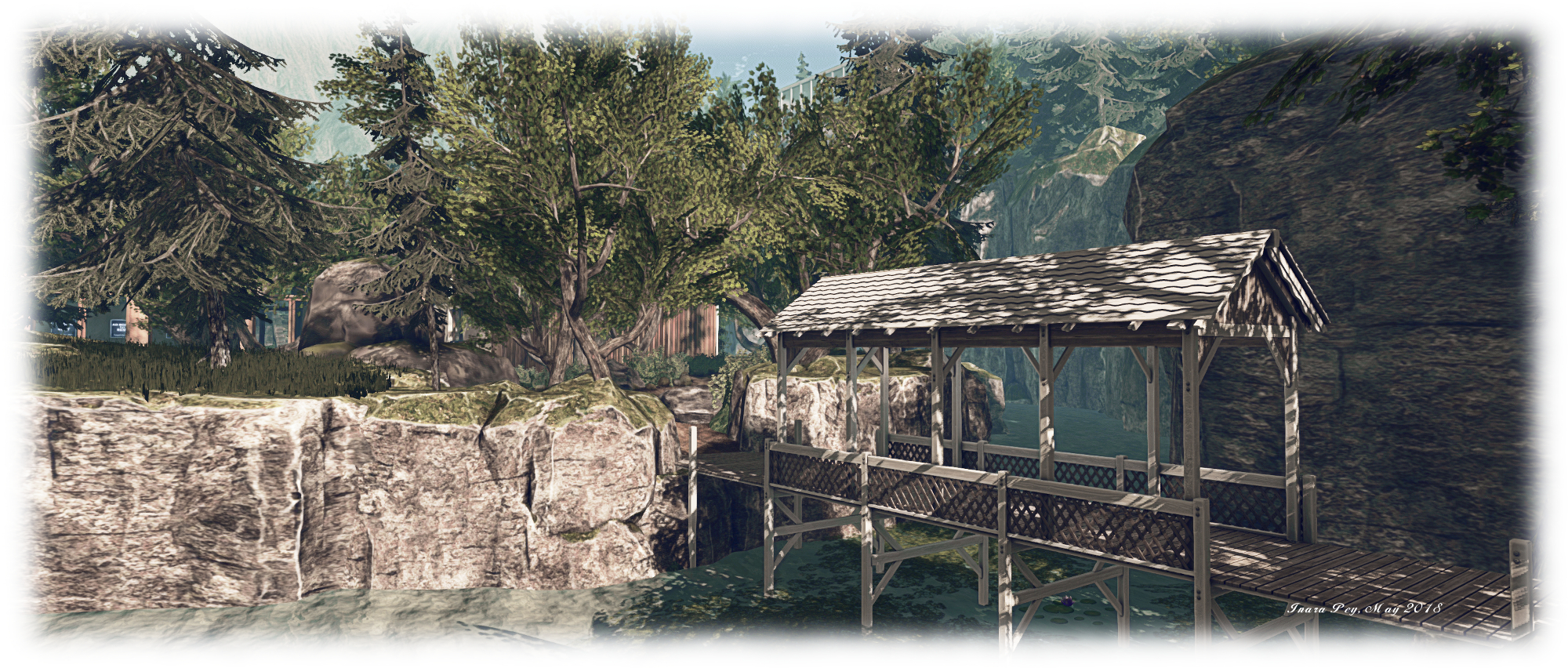
As well as participating in The Argument, Italian artist Aldiladeisogni – a favourite of mine, to be honest – is the subject of a second exhibition at Serena Imagine, located just across the water from the group display (take the covered wooden bridge and cross the island between the two display areas). Six of his extraordinary avatar studies are on display, one offering a direct link to The Argument, being a sister piece to his submission in that exhibit.

The island between the two exhibition offer a route to a reproduction of the French Château de Chenonceau, built by Louis-Jean-Marie de Bourbon (Cedric Hansome) and donated to Vita so it could live on in Second Life following his departure. This is a marvellous period build, and one not to be missed.

Serena Imagine Arts: Aldiladeisogni

SLurl Details

Winter at Cherishville in Second Life

Cherishville; Inara Pey, November 2017, on FlickrCherishville – click any image for full size

Cherishville, designed by Lam Erin, currently sporting a winter setting, has been openedfor around two weeks for visitors to enjoy and photograph.  Sharing a Homestead region with a private residence, Cherishville forms an L-shaped parcel running along the north and east sides of the region, which is surrounded by tall, snow-covered mountains but separated from them by frozen water.

There is no enforced landing point – although one has been set; as this delivers visitors on a snow-clad hill, I’ve offered an alternative land mark which – unless the landing point is enforced – will deliver you to the little parade of establishments on the east side of the region. It’s a charming, almost period setting, vehicles from the 1930s sitting on a snow-covered road, a steam train rolling slowly towards the local station.

Cherishville; Inara Pey, November 2017, on FlickrCherishville

Looking at this little parade, with its cafés and shops, I couldn’t help but be put in mind of Frank Capra’s It’s a Wonderful Life  – particularly when seeing the setting in black-and-white – to the point where I wouldn’t have been surprised to see James Stewart as George Bailey running along the little street shouting, “Mary! Mary!” In colour, the setting is cleverly themed, with red,  white and green window frames, gables and roof-tops matching the colours of the season.

Follow the road northwards and the buildings give way to a country road, bordered by fences on either side. Here the land is blanketed in deeper snow, trees frosted and white, dog roses offering clouds of red colour between tree trunks. A pick-up truck – of a later period than the vehicles at the village – sits on the road, which leads the way to a frozen pond. Here, skates can be obtained from a sign board. But when skating, do mind the lantern posts set out across the ice! Steps on the far side of the pond offer a way up to a band stands converted into an open-sided snug, comfortable armchairs ranged before a roaring fire.

Cherishville; Inara Pey, November 2017, on FlickrCherishville

The land above and behind the little row of shops – reached via a set of snowy steps rising from a pair of gabled gates or via snow-covered slopes – presents a broad open area, again deep in snow, with just a sprinkling of silver birch trees and pale bushes. A delightful little bar sits to one side, offering mulled wine and other hot drinks.

Further steps climb up to a further small plateau, where sits a house with – rather surprisingly – the entrance and exit to / from a subway station. The house is perhaps a little rough around the edges, however, it is furnished in something of a shabby-chic manner, a look which fits well with the aged look of the interior décor. Open to the public, one half of the house offers a small photo studio awaiting use – and it’s not the only place suited to photography. The little hamlet, the bandstand, the train – all offer backdrops for photographers to take avatar-centric shots, while the landscape itself invites photography. Those who do take pictures are asked to consider submitting to the Cherishville Flickr group.

Cherishville; Inara Pey, November 2017, on FlickrCherishville

Word is already spreading about Cherishville – and I’d like to thank both Shakespeare and Stavros Gracemount for alerting me to it being open so Caitlyn and I could visit – as such, it is proving popular with visitors. However, given it is only open to the public for a brief period, a visit sooner rather than later is recommended.

Just as a final point, a line of hills towards the middle of the region, running west to east and north to south to form another L, separate Cherishville from the private parcel on the region. This is protected by a security orb to maintain the owner’s privacy, so should you opt to visit, it would perhaps be best to treat the hills as the boundary without climbing them, and help the neighbours keep their privacy.

Cherishville; Inara Pey, November 2017, on FlickrCherishville

SLurl Details

Respect in Second Life

2Lei – Respect: Ciottolina Xue

Respect is the title selected for the 2017 2LEI art recognition of the International Day for the Elimination of Violence Against Women, marked on November 25th. Open now through until the end of 2017, this is one of the most involved art installations I’ve visited in Second Life, presenting the work of some 71 visual and music artists either directly or in supporting roles, with no fewer than fifteen primary art display areas.

While marking International Day for the Elimination of Violence Against Women, the subject for the installation casts a wider net for Respect – including as it does respect for women, children, individuals, sexual orientation, race, self, and those around us. This makes for a very involved series of installations which requires time – possibly over more than one visit – to fully take in and appreciate. To help with this there is a range of events scheduled through the rest of the year, details of which can be found at the 2Lei blog.

2Lei – Respect: Nino Vichan

With so many displays and levels, coupled with the quality of art on display, a comprehensive review of the installation would be extremely long-winded; similarly, picking individual elements for consideration is equally difficult. What can be said is that there is a rich mix of individual focus on the broader topics noted above, some of which are deeply thought-provoking, others are visually impressive while other may appear to come at their subject from a slightly unexpected angle and one or two, frankly, might confuse or perhaps seem more a generalisation than a focus.

The ground level features the works of fifteen artists, with 2D and 3D pieces ranged around a watery setting under a bright sun, together with the landing point, presentation theatre and teleport boards for reaching the fourteen sky platforms for the installation. Artists on this level include Rebeca Bashly, Dido Haas, Mistero Hifeng, Desy Magic, Ciottolina Xue, to name just a few.

2Lei – Respect: Lagu Indigo and Stardove Spirit

The teleport kiosks provide access to 14 sky platforms, each one featuring the work of an individual arts or a collaborative team. These are – in order of ascent through the levels: Theda Tammas, JadeYu Fhang, Pale Illusion, Laug Indigo and Stardove Spirit, Aneli Abeyanti, Patrick Moya, Nino Vichan, Daco Monday, Black Label Exhibitions Corner, Nevereux, Pol Jarvinen, TerraMerhyem, Red Bikcin and Mona Byte.

Each level is of a fixed size, which the artists have been able to use as they choose, arranged so that visitors arrive on one platform (with teleport options for returning to the ground), move through the display area and out to a second teleport options for returning to the ground or continuing up to the next level. As with the ground level, there are small 2Lei boxes alongside the artist name boards which will offer a folder with the artist’s biography and – perhaps – an outline / description of the work they are displaying.

2Lei – Respect: Rebeca Bashly

As noted, there is a lot to see here – and I admit that in viewing the sky platforms, I was particularly drawn to Nino Vichan’s installation, and the Black Label Exhibitions Corner piece. The latter, largely focusing on GlitterPrincess Destiny’s images. This is perhaps the most involved, and shows a considerable amount of expression on the subjects in an environment that is semi-interactive, requires exploration and offers a lot to see.

In all, a thought-provoking series of exhibits, rich in interpretation and presentation.

SLurl Details