Monsters, Demons and Chess in Second Life

Kondor Art Centre: Monique Beeb – Monsters, Demons and Chess

Monique Beebe – Moni to her friends – is one of the most expressive digital artists I know in Second Life. I’ve had the good fortune to follow the growth of her photographic and digital art skills since her first exhibition, hosted at Nitroglobus Roof Gallery back in early 2017 (see: Hidden Faces in Second Life), and have always utterly enjoyed exploring her work as it enfolds the sensual, the sublime, the emotive and more – always with a story to tell, a question to ask, or a subtle means of engaging her audience’s minds.

Through the years since that first exhibition, Moni has continued to enthral, engage and challenge through evolving styles and approaches, as is the case with Monsters, Demons and Chess, which opened at the Kondor Art Centre, curated by Hermes Kondor, on November 8th, 2022.

Kondor Art Centre: Monique Beeb – Monsters, Demons and Chess

To be honest, this is an exhibition I would have embraced even without having an admiration of Moni’s work which has only grown over the last five years, because it encompasses a form of art that is gaining increasing traction among artists engaged in Second Life: that of hybrid art, and specifically the use of AI processes – in this case the Midjourney AI art generator. I’ve outlined this open-source software previously in these pages, but I’ll let Moni – who has been using it for around six months at the time of writing this article – describe it:

It is software used to generate realistic images, based on Artificial Intelligence. It is used with text we can write down, and it creates some indications; it is not a random image taken on Internet, which corresponds to your text, your words really create something with a deep learning algorithm, giving birth to a new image.
[It presented] A complete new experience for me! In the beginning I was doubtful about it, and I did read a lot of discussions around this subject. It ended becoming a curiosity in my mind, and turned out to be a complete addiction. It [has] allowed me to search more about AI, to discuss it with users and artists, in what way they manipulate it to come to something they wanted at first or appreciate something they did not know about previously.

– Monique Beeb

Kondor Art Centre: Monique Beeb – Monsters, Demons and Chess

Offered across the two floors of the striking gallery building are some of the fruits of Moni’s labours with Midjourney: a striking series of 25 images that allow us to see into Moni’s journey with the software tool, a journey involving chess, monsters and demons, as she explains in her liner notes accompanying the exhibition:

My first use of this software was rather random, I was mostly discovering it. I took simple shapes, balls, and it ended in chess pieces. I made many of them, arranging the background, the lights, the perspectives … When I tried to make faces, I often saw irregularities in the way they were created. Distortions on the eyes or lips, strange shapes. Then I worked more, trying to identify why it came that way. I was at some point left with a gallery of “monsters” on my computer. Their unusual odd curves made me like them … I eventually edited them on Photoshop, and make them: beautiful monsters and quiet demons!

Monique Beeb

I don’t propose to delve into the pieces in depth – each and every one of them speaks clearly and beautifully for itself. The lower floor of the gallery focuses on the works featuring chess, and like that game, there a marvellous strategy at work within them as Moni takes the nuances of MidJourney’s algorithm and combines it with her own innate ability to frame a single-frame story which born of the aforementioned sensuality, subtleness and expressiveness.

The latter is also present in the images around the upper level, where Moni’s “monsters” and “demons” reside.  These may not be sensual in the conventional sense like those on the gallery’s lower floor, but there is a richness of expression, beauty and look that makes them as equally attractive and as rich in their own narratives.

Kondor Art Centre: Monique Beeb – Monsters, Demons and Chess

As a part of this exhibition, Moni asks a question that is not uncommon with the subject of hybrid art: are images generated through, or collated and manipulated by, AI (and other) means really art? She also enquires whether such images have a place in Second Life. My personal response to both questions is an unequivocal “yes”; traditional artists manipulate brushes, paints and inject their own eye and imagination in their work in order to create a piece of art; similarly, Second Life (and digital) artists also manipulate images with tools like  PhotoShop and GIMP and paint with digital tools to produce an end result.

The fact that tools like Midjourney rely on descriptive text elements or the manipulation of algorithms or alterations to their baseline parameters does not lessen the fact it is the artist’s eye and imagination, often assisted by additional tools that allow for editing and / or compositing – just as with other digital art forms, as noted above – guiding the entire creative process.

Kondor Art Centre: Monique Beeb – Monsters, Demons and Chess

More than that – I’d defy anyone to visit Monsters, Demons and Chess and not see the images presented as a richly artistic expression.

SLurl Details

Time in Tempelhof in Second Life

Tempelhof, November 2022 – click any image for full size

A fair while ago – January 2014, in fact – I dropped into the Full region of Tempelhof and spent time exploring and taking photos. However, I didn’t actually get around to writing about it. So it’s about time I put that to rights.

To be honest, I have no idea if Tempelhof today is under the same management as it was in 2014 – not that this is particularly important, admittedly. However, in its current iteration, the region has been designed by Misty Payne with the region’s group created by Caps Wertmuller. Utilising the Land Capacity bonus available to private Full region, the setting is most easily defined through its About Land description:

Once a highly fashionable coastal resort – now run down and forgotten by the world. Come see what’s left, explore – and pick a home here if you want to be part of our BDSM community – we often have interesting vacancies.
Tempelhof, November 2022

While the comment on the region being home to a “BDSM community” may initially put some off, I’ll just note that this is not in any way overt, and the public aspects of the region can be easily enjoyed.

What we do have is a setting which carries within it shades of World War Two. At the dockside, for example, sits a military Kübelwagen, whilst across the region sits a coastal defence bunker and accompanying blockhouse, sitting diagonally opposite a smaller waterfront area, the entrance to which lies blocked by the carcass of a Kriegsmarine U-boat, whilst two more are moored at the main quayside.

Tempelhof, November 2022

Given the signage on the buildings, it is clear this is somewhere in Germany or along the country’s coast. Perhaps it might be a  part of Berlin’s Westhafen – even if this is in the Mitte borough rather than that of Tempelhof-Schöneberg, as might be suggested by the region’s name; or perhaps it isn’t intended to represent any single place. Whatever the case, it is an atmospheric setting.

The outer sides of the region represent the core of the town, with cobbled streets, running between places of business and manufacturing and a mix residential properties, whilst the bulk of a theatre looks like it may have recently been struck by munitions of some description – although whether bombs or the result of shelling is unclear.

Tempelhof, November 2022

The centre of the region along with the east side is more open and rural in appearance, roads giving way to rutted tracks, houses mixing with trees and fields, ponds and the odd folly or two. The roads and tracks offer the most obvious routes for exploration and wandering – however, do remember that there are private residences scattered across the region, and not all of them might be houses standing in their own grounds so do be cautious about entering the buildings – not all may be open to the public.

Despite the possible wartime nature of the setting, there are multiple signs that life here is continuing as usual: the waterfront café  is still open for business, fishing boats still appear to be plying their trade out of the little port, and the waterfront red light bar remains open for business (or should that be morale?!).

Tempelhof, November 2022

Richly detailed throughout, with plenty of opportunities for photography and exploration, Tempelhof offers a lot to see – and, potential for those so interested – the potential of a place to live.

SLurl Details


Camels and Chameleons with Cica in Second Life

Cica Ghost: Camels and Chameleons, November 2022

November brings with it another foray into whimsy with Cica Ghost, as she offers an installation entitled Camels and Chameleons – which you have to admit is an interesting combination of beast and reptile!

As with recent installations from Cica, this one is extreme easy on the eye to view and offers gentle exploration on foot. The largely flat landscape offers a desert-like suggestion with adobe-style walls and structures for the most part not too far removed from the kinds of environments one might reasonably expect to find both camels and the desert varieties of chameleon common to the more arid parts of Southern Asia. These are interspersed with cacti which, whilst not common to the lands in which camels might be found, are certainly found within the more arid parts of the California, into which Chameleons have been introduced.

Cica Ghost: Camels and Chameleons, November 2022

Of the two types of creatures, the camels are the most numerous, with two of the three recognised “true” species represented: the single-humped Dromedary (aka Arabian camel), which accounts for around 94% of all camels and which is common to the Middle East, the Sahara Desert, and South Asia, and the two-humped Bactrian camel, common to Central Asia, including the historical region of Bactria, and also found in remote areas of north-west China and Mongolia.

Exactly which species of Bactrian is represented isn’t entirely important, but given their short-haired nature, I preferred to think of them as being the rarer Wild Bactrian of China / Mongolia. The chameleons, on the other hand, are fewer in number, and I can’t help but feel Cica perhaps missed a trick in not blending them more with some of the landscaping / other features within the setting (allowing for their size, of course).

Cica Ghost: Camels and Chameleons, November 2022

I qualified the structures within the setting above, because whilst most of them are styled in a manner in keeping with the desert / arid environments in which camels tend to be found when roaming free, there is a rather novel structure towards the centre of the installation. Comprising blocks and towers that are, at first glance vaguely reminiscent of a Middle-Eastern fortification, it also has a slight other-worldly feel to it, with some of the blocks suspended in mid air on horizontal planks bridging the gaps between other blocks, and many of them sprouting deadlock-like growths of cacti from their tops.

Rounded out with another quote from Dr. Seuss, Camels and Chameleons also includes a range of  places to sit and / or dance (including on a camel or tow!) and offers a further opportunity to appreciate Cica’s art in a whimsical and light setting.

SLurl Details

The Pillars of Hercules in Second Life

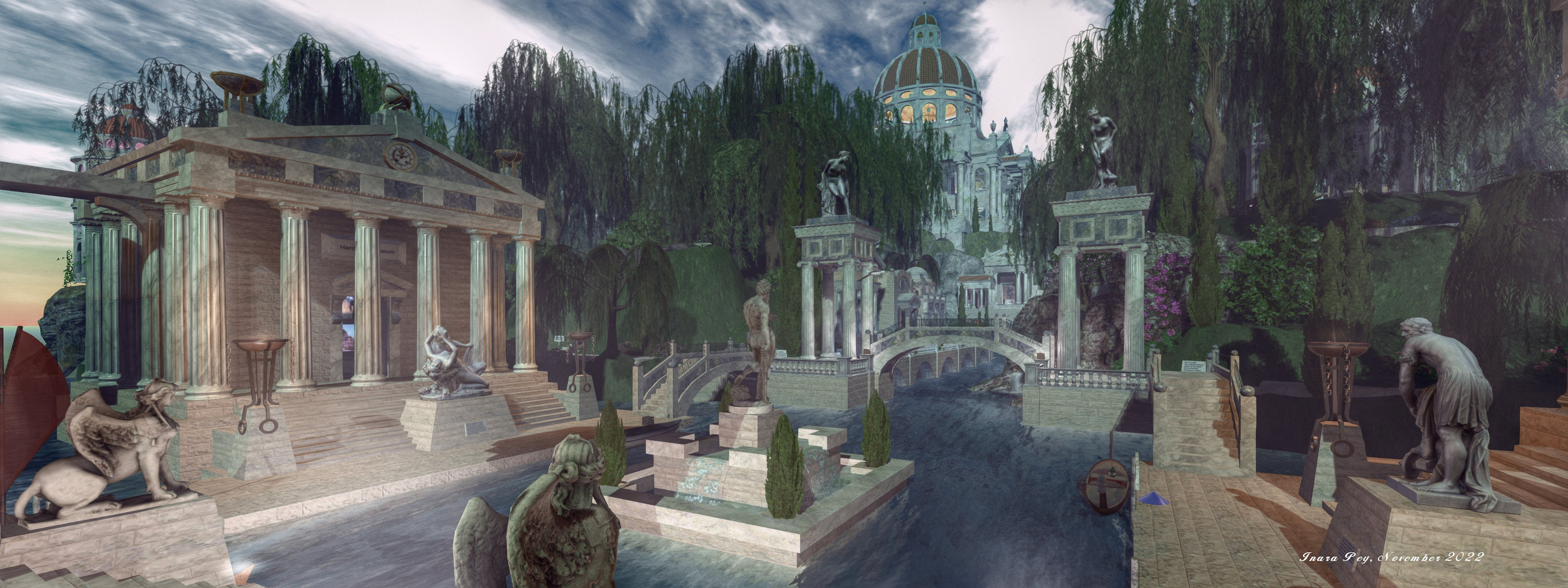
The Pillars of Hercules, November 2022

Once, in the days of yore in Second Life, Scottie Menges set out to build a place of romance with a sense of antiquity and – for those with the interest – of learning. Originally built entirely using prims in 2009, The Pillars of Hercules remained open for over five years as a place of exploration, meditation, dance, and photography, before closing its doors in late 2014.

Now the build is back; Scottie has spent around 10 months rebuilding a new Pillars of Hercules, one which retains much of the feel of the later iterations of the original as well as utilising newer designs for the likes of the great temple and adding a sprinkling of mesh elements in terms of some of the statues and some of the landscaping elements, and the setting opened to the public once more on November 4th 2022.

The Pillars of Hercules, November 2022

According to legend, the original Pillars of Hercules were the promontories of Calpe Mons and Abila Mons, said to flank the entrance to the Mediterranean Sea from the Atlantic. They marked the furthest west Hercules travelled whilst completing his twelve labours (as wrapped into both the Greek and Roman myths of Heracles / Hercules). Here the name might be seen of representing the fact that Scottie’s build wraps within it elements of both Greek and Roman mythology – including Heracles / Hercules himself, with the largest structure on the region raised as temple to him.

As with the original, the best place from which to start a tour of the region is at the southern harbour, which forms the main landing point. Here visitors can find a map of the new build, which includes direct teleports to the places indicated on the map. However, I would – in keeping with the signage – recommend exploring on foot before hoping around via teleport (or flying – some of the more remote locations may required visitors take to the air.

The Pillars of Hercules, November 2022

Also available at the harbour are boat and flying tours of the region – the former located alongside the landing point, and the latter on the far side of the harbour, where a pictorial history of both The Pillars of Hercules and Scottie’s other Second Life works can be found.

Exploring on foot will allow visitors to discover the more historical elements in the region – such as the reproductions of famous statues from Greco-Romano history – and the more hidden places within the build – such as the walk down into Hades and across the River Styx – just beware of the Gorgon who lies in wait; or the hidden way to the Underhill Library from the water garden (and vice-versa). Signage throughout offers the opportunity for visitors to learn about Greco-Romano mythology, such as the Greek god Astraeus or Hermes / Mercury, and touch briefly on the legend of Apollo.

Throughout all of this – and in keeping with the style of the original – are multiple poseballs offering places to sit and places to float. More modern sit points and places to dance also await discovery – both above ground and under water., whilst for amateur astronomers like me (and those interested in cosmology, the Tower of Astraeus is well worth the climb (or the TP…), as the uppermost floor presents a unique planetarium-style environment – and do be sure to sit at the telescope and switch to Mouselook; and I look forward to seeing what else Scottie has planned for these parts of the build.

Rightly “old school” in looks, the return of The Pillars of Hercules to Second Life is both a welcome harkening back to the first decade of the platform’s life, and the times when prims (and in-world individual and collaborative building) ruled the roost, and also a reminder of how awkward morphing the terrain mesh could be when trying to landscape large differences in elevation – and how easier things are today thanks to rigid mesh landforms, and items such as mesh rock formations, etc.

The Pillars of Hercules, November 2022

Rich in substance and history – both in terms of the human history it enfolds and in terms of the SL history it represents, The Pillars of Hercules makes for an engaging visit.

SLurl Details

Art for balanced thinking in Second Life

Third Eye Gallery: Zia Branner EUNOIA

Currently open at the Third Eye Gallery, curated by Jaz (Jessamine2108), is an exhibition of art by Zia Branner entitled EUNOIA, drawing on the ancient Greek word.

Essentially meaning “beautiful thinking, a well mind”, the word’s usage is more complicated than that. Originally, it was applied to the art of oration, and the need for speakers to cultivate a sense of goodwill between themselves and their audiences to encourage a better reception of their ideas and / or viewpoint. However, Aristotle used it to define the foundations for an ethical existence: the kindness and benevolence flowing between spouses. In this, it might be taken to mean approval, sympathy and readiness to help.

Both Isocrates, and (later) Cicero leaned towards a more political usage of the term (eúnoiã, in the case of the latter): as a means to describe an individual’s feelings toward party, or the city-state, and the benevolence in which the city-state or party so hold city-state should bear towards the honest citizens, and allow them their right to hold an opinion. Much more recently, it is used as a means of referencing good mental health and general good disposition.

Third Eye Gallery: Zia Branner EUNOIA

It is in terms of finding that mental balance and our desire / need / want / struggle to achieve it that Zia presents this collection of her art. Presented in her familiar mix of abstract and impressionistic work, these are piece in which – as the artist notes in her introduction to to this exhibition – the ebb and flow of colours (for Zia, red and blue) represent the ebb and flow of our emotions in that drive to try to achieve that sense of equilibrium.

In all lives from time to time it isn’t easy to have a mind in balance. We have our downs, we have our challenges. There is cold, there is warmth. Our strength then lays in our goodwill, in our kindness and with this the balance in our mind and our well being goes up again.

– Zia Branner

There is something faintly ironic in the idea that “balance” is something that should be sought after; the idea that we must strive for it through meditation or study or exercise or whatever so often can lead to frustration or annoyance that the calming balance we desire remains tantalisingly out of reach. Yet through art we can find that balance, be it as the artist or the witness. For the artist, the act of creating art can be a harmonising act; bringing the disparate parts of self together to present a finished work; for the witness, it presents the opportunity to become lost within the flow of a piece of art, to naturally put aside consciousness of self, and thus achieve that inner equilibrium.

Third Eye Gallery: Zia Branner EUNOIA
All of this is present in the 11 images offered in this collection. Whether you see the expressions of mood / emotion in Zia’s red and blue or other colours or whether to see the expression of a coastal scene or of a daydream matters not; these are pictures in which it is easy to lose oneself in the flow of colour or the contrast of hard and soft line – and in doing so, perhaps find a balance of thought for yourself.

SLurl Details

A writer’s retreat in Second Life

Come Write In, November 2022 – click any image for full size

November is a notable month for many reasons; however, for budding (and some established) writers, it is National Novel Writing Month (often shortened to NaNoWriMo) – a 30-day challenge to write a novel of at least 50,000 words. The brainchild of San Francisco freelance writer Chris Baty, the project was actually first held in July 1999, but moved to November in 2000 to take advantage of the “miserable weather”.

During its first year, the project saw 21 people take part. In 2000, 140 participated, and the project gained the attention of US national press and also bloggers such that by 2001, the numbers taking part had grown to 5,000; and things snowballed from there. By 2005, the project had been registered as a non-profit organisation in the US and had gained international status with budding writers the world over participating annually.

Come Write In, November 2022

I mention this because Kestrel Evergarden has established Come Write In – a Writer’s Retreat, a place where Second Life writers can visit, relax, hone their writing skills and develop their NaNoWriMo entry – or simply write for their own pleasure or talk writing. Occupying a cosy parcel on the north side of Heterocera, Come Write In offers numerous points of retreat, indoors and out, where writers might relax in-world and listen to the voice of their muse.

The home of a small, but growing community of writers – visitors are welcome to join the local Come Write In (CWI) group – the setting offers, in the words of its Destination Guide entry:

Private tents and communal space, games to unwind with, and an inspiring setting beautifully landscaped to call for your Muse … CWI offers prompts, resources, and more to help you reach that 50k in 30 days goal, and more.
Come Write In, November 2022

Nor is this purely a Second Life only adventure – Come Write In is an officially recognised NaNoWriMo virtual write-in location, open to writers from outside of SL.

From the roadside landing point, CWI offers a number of indoor spaces (one of which looked to be a new development at the time of my visit) built around a deck and open-air café. Alongside of these sits a terrace space for discussions, a games area with table-top games and a winding path that winds through a landscaped setting visitors and writers alike might explore.

Come Write In, November 2022

This meandering path wanders past a round pond fed by a stream that tumbles its way through the setting, passing under a pair of bridges which bracket the pond, before vanished into a tunnel. The path also offers access to the private tents mentioned in the DG description. These are available for short-term rental (L$50 a week, and provided with their own furnishings. These are offered for the purposes of unwinding and (again) retreats where one might exercise one’s writing muscles – or use as a place to toss around ideas with a close friend or two.

Rich in plants and wildlife, with plenty to see, CWI forms an excellent retreat for both budding writers and for those looking for a quiet, natural retreat.

Come Write In, November 2022

SLurl Details