Saint Phalle (Perpetua1010) La Serenissima, February 2023
Running through until March 11th, 2023 is La Serenissima, a two-part exhibition at the Venezia/Venice region in Second Life by Sophie de Saint Phalle (Perpetua1010). I say two parts, as the exhibition is split between indoor and and outdoor display area.
Sophie is an artist in the physical world who uses Second Life to reach audiences who might not otherwise encounter her work. She does this through exhibitions like La Serenissima and also through her own gallery/studio space Subcutan Art Gallery and Multimedia Centre. I’ve covered her work several times in these pages and have thoroughly enjoyed doing so; her art is rich in content and form, drawing as it does on many of her own travels and experiences – as with Infinite, a magnificent celebration of indigenous Australian art I reviewed a year ago.
Saint Phalle (Perpetua1010) La Serenissima, February 2023
Some of the pieces from Infinite are displayed in the outdoor section of La Serenissima, together with some pieces from an exhibition hosted at Niccoli Sweetwater’s Basilique region back in September 2020, and which formed my introduction to Sophie’s work. I point to both of these exhibitions not because I’ve written about them, but because the appearance of pieces from them nicely underscores the focus of La Serenissimia: a personal retrospective by Sophie featuring a selection of art she has produced over the course of the last decade.
A graduate of the Academy of fine Arts Vienna, Sophie is by turn also a cartoonist – having had a particular focus on political satire -, an author and a ghost writer for certain well-known comedians. As an artist, her focus was initially the nude body and abstract art, but her range and scope have since broadened, even reaching into 3D art within Second Life. She is very much an experimentalist and also an expressionist – as her work repeatedly demonstrates.
Saint Phalle (Perpetua1010) La Serenissima, February 2023
A red carpet leads the way to the indoor exhibition. Occupying three floors, this section features gouache paintings on the lower floor, watercolours on the middle floor and a selection of her nude studies on the upper.
All three levels are as captivating as the outdoor works, but I have to admit to being drawn particularly to the middle level watercolours as they depict Sophie’s travels through Italy and Switzerland. For me, they are pieces which capture the spirit of the places they represent in a fabulously minimalist and / or focused style.
Saint Phalle (Perpetua1010) La Serenissima, February 2023For those familiar with Sophie’s work through individual exhibitions, La Serenissima offers an opportunity to experience the breath of her work in a relaxed setting. For those who have not seen Sophie’s work before, I recommend a visit to this exhibition while it remains open, perhaps followed by a visit to Subcutan Art Gallery and Multimedia Centre.
Burrow Wood County, February 2023 – click any image for full size
Update, April 25th: Burrow Wood County has closed, and Monica has relocated to a one half of a Full region, now home to the twin builds of Burrow Wood by the Sea and Burrow Wood, Road to Nowhere, both of which have been built to Monica’s specification by Teagan Lefevre. SLurls in this article have therefore been removed – please see my updated blog post for more.
Occupying the north-east quarter of a Full region utilising the private region land impact bonus, Burrow Wood County is held by Monica Mercury as a ground-level public space, designed by Teagan Lefevre of Le’eaf & Co fame.
This fictional back-road Tennessee town was inspired by several amazing SL creations visited by the owner, and her real life ventures.
– Burrow Wood County About Land
Burrow Wood County, February 2023
A visit commences at the landing point, tucked into the south-west corner of the parcel and backed against the centre of the region. It is here, a short distance from the mouth of a tunnel from which a rutted track emerges, that the local bus stop sits, helping give the impression that visitors have just arrived by public transport.
From here, the track continues to where a bridge spans the local river; a bridge which marks the track as once having been a single-line spur of the local railroad, and perhaps the bus stop originally an end-of-line rail halt. Beyond the bridge, a dirt track dips down into a small hamlet sitting by the waters of a broad body of water, an off-region surround giving it the appearance of a river.
Burrow Wood County, February 2023
This is a place which has perhaps seen better days; maybe it was once a cosy little fishing village built along one of Tennessee’s many rivers. However, time has not been kind to it, leaving a couple of unpaved roads serving the remaining local businesses, marked by the presence of an ever-hopeful motel, and some scattered dwellings.
Almost all of the local businesses appear given over to food and beverages, from the bar of Frank’s Place through the diner and café shop to Carroll’s Oyster bar and shop, within only a little grocery store trying to break things up. Their presence suggests the motel may do better business than might at first appear to be the case, even if the entrance to one room is boarded up; or perhaps this sleepy little fictional corner of Tennessee is still popular among the fishing fraternity and holiday makers.
Burrow Wood County, February 2023
The latter point may be borne out by the presence of the little office sitting across from the motel proper. It sits ant the entrance to a small group of cabins and trailers sitting alongside one of the water channels. The OFFICE sign hanging on one of its outer walls suggests it is from here that the cabins and trailer sitting on the bank of the river beyond are available for rent by visitors who also likely contribute to the seasonal well-doing of the local businesses.
Ramshackle it might be, but the village still boasts a Sheriff’s Office, and there is no doubting it has a gentle photogenic air about it. The large pool sitting at the head of the river (which may have borrowed its name from either the song as a little joke – you do have to cross the river Jordan in order to reach the hamlet – or from neighbouring Virginia’s river of the same name), is apparently open for swimming, whilst kayaks are moored alongside what appears to be a rentals hut built on a deck extending over the edge of the water.
Burrow Wood County, February 2023
Those following the grassy path down to and around one side of the pool can make their way to where nature is slowly reclaiming the remnants of an old waterside barn – although a local artist also appears to be claiming it for their own use! Further back in the undergrowth lies an old schoolhouse in a greater state of being overwhelmed by mother nature.
Expressive and photogenic, Burrow Wood County is a pleasant, easy-on-the-eye visit.
For February 2023, Cica Ghost invites us all to visit her Happy Place, where we can all relax and have a little fun, wander through an exotic landscape and meet the equally exotic populace.
This is very much a green land, caught under a green sky, between which green-tinged clouds scud whilst on the ground spots and splashes of other colours might catch the eye and cause feet to wander. This ground is a strange mix of grass-like covering and what appears to be a natural quilt forming an interesting patchwork effect as it stretches over the humpbacked hills and lies on the flatter ground like a picnic blanket. Blue splotches within the quilt suggest pools of water – albeit sometimes at odd angles as the effect stretches itself over the uplands.
Across both grass and patchwork can be found tall grasses and clovers rising up taller than an avatar, smaller flowers of red and yellow and green scattered around them and across the landscape as a whole (some of which have much larger brethren away to the north of the setting) while trees in places rival the humpy hills in height.
Cica Ghost, Happy Place – February 2023
Nor is the shape of most of the hills their only distinguishing feature; many have had their tops sliced flat, allowing little houses and matching trees to sit upon their crowns (some have other little places sitting on their heads, but you should discover this for yourself). Some of these houses appear unreachable such is the steepness of the slopes rising to them; others can be more easily reached, thanks to the placement of ladders to assist with climbing.
Also across this strange yet welcoming landscape can be found the setting’s inhabitants. From sheep to bipedal monsters, passing by want of ants, ladybirds, a sleeping dragon, elephants and a Cica-like little girl tending a lone cow with what appears to be her cottage and pet fish close by. There’s even the suggestion, spread between two trees, that the setting might also be home to a giant human, although they appear to currently off visiting somewhere else!
Cica Ghost, Happy Place – February 2023
Although some are monsters, none of the inhabitants are in any way dangerous; the dragon snoozes peacefully and the monsters all appear to be here for the same reason as anyone else: to take in the scenery, to relax together and pose for photos and / or simply have fun. And given this is a build by Cica, there are obviously places for visitors to enjoy a little dancing, or to sit and pose for photos or to simply spend time together, both on the ground and in the air.
The setting comes with a popular quote which is often attributed to A.A. Milne / Winnie the Pooh. In fact, the words as given were never given to Pooh (or any other of Milne’s characters) to say within the books (although they may have been spoken in one of Disney’s film adaptations). But whether written direct by Milne or by a screenwriter really matters not; they encapsulate the magical wonder of childhood and the importance of never letting go of that sense of magic and wonder, but allowing it to permeate our lives in moments of fun, friendship and togetherness.
By allowing us into her Happy Place, Cica again invites use to to do just that: let the magic and wonder free as we explore, have fun with friends and share our time with them.
Kawaii City, February 2023 – click any image for full size
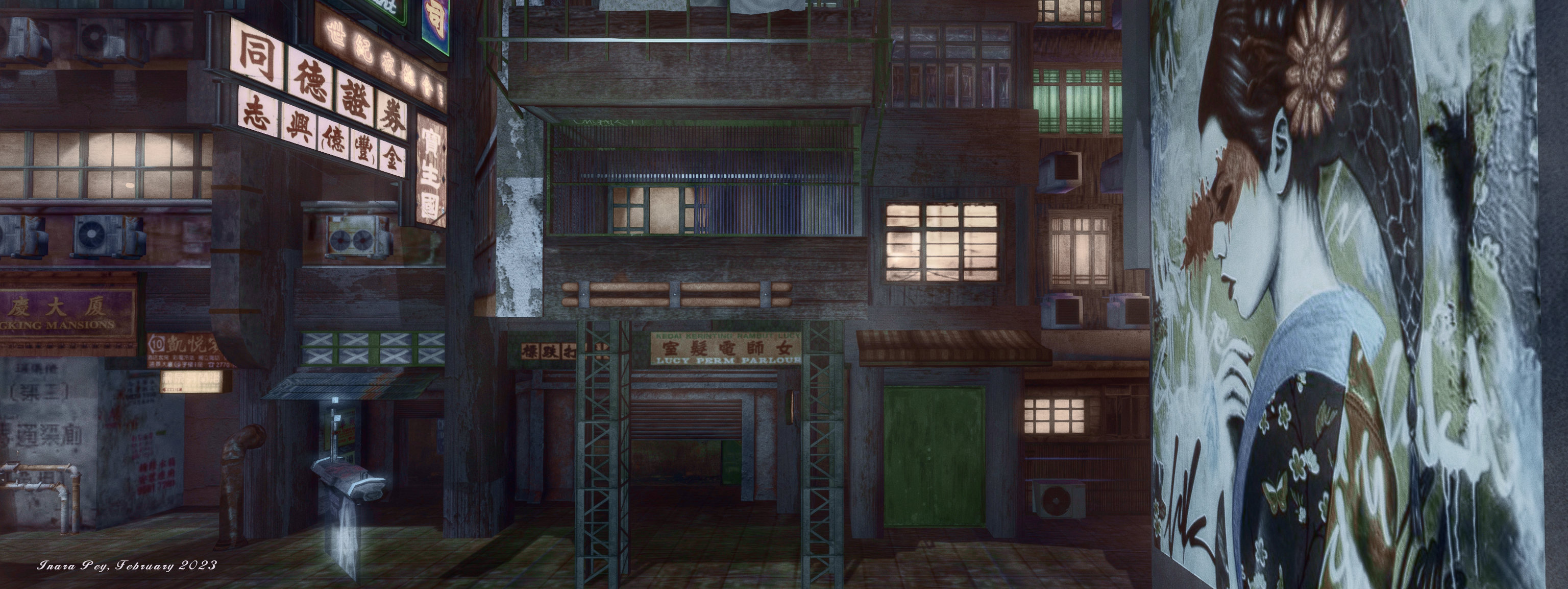
Kawaii City is a place of two halves, occupying as it does a pair of sky platforms. Built by Naru Darkwatch, the city is named for the Japanese culture of cuteness – although its dystopian-come-cyberpunk lean doesn’t perhaps at first match the more familiar appearance of Kawaii as exemplified by the phenomena of Hello Kitty and Pikachu, although it does resonate with manga / anime styles of cuteness.
Each half of the city – called simply Kawaii City and Kawaii City II – has its own landing point, and given they are both located in the same region, it is possible to move easily between the two, and noted below. Whilst there is a commonality of looks and backdrops between the two, each very much has its own character.
Kawaii City, February 2023
A place where you can come and chill and relax or roleplay in a cyberpunk post apocalyptic setting please respect the TOS and have fun.
– Kawaii City About Land
Kawaii City is the larger of the two builds, its landing point located on a broad street running north to where the entrance to the Kawaii Café can be reached up a flight of stairs and a covered auto teleport provides access to Kawaii City II. The café and the teleport require acceptance of the local experience order to reach / use either one, whilst the structures around the entrance and the street provide a mix of façades, places to sit, eateries and places with casual role-lay might take place.
Kawaii City II, February 2023
Further south, the street narrows to pass through a narrow, arched neck to become a warren of alleyways rising and descending, each with its own little attractions and the occasional dead-end.
The landing point for Kawaii City II sits alongside a small café at the edge of what appears to be an industrial complex of some description. Pipes run overhead and alongside the waters as they are channelled away from a large pool that sits as a barrel blocking the way forward. However, a freight elevator running horizontally on rails offers a way across the water for those who wish to explore further, and who may as a result find their way to a subterranean club. Alternatively, metal steps rise to an elevated walkway which also spans the water; beyond it, raised roads and alleys run between buildings and places of business, most of which are, like those in Kawaii City, façades which form backdrops for potential photography and / or role-play.
Kawaii City, February 2023
A single street opens off of the industrial complex, but doesn’t run far, wedged as it is between more façades. However, looks can be deceptive: those who look will find the entrance to a bar which looks like it might have send the Mandolorian walk into it. Close by, the narrow neck of an alley leads the way to where a decidedly deco-looking frontage of an old radio hall theatre has clearly seen better days. Another alley provides access to a further upper level forming an L-shaped brace of alleys in which RP might take place and where one might find the auto-teleport connecting it with Kawaii City.
I’m purposefully not saying too much more about the locations, as explorers and photographer will doubtless find their own particular points of interest, and there are elements what are better explored than described. Suffice it to say, Kawaii City and Kawaii City II make for an interesting diversion and offer the potential for a range of casual role-play activities.
Artsville Gallery: Chuck Clip – The Book of Caligula
Gaius Julius Caesar Augustus Germanicus was born in 12 CE into the Julio-Claudian dynasty. The son of beloved Roman general and hero Germanicus, he became popular with his father’s troops when, at just three years of age, he accompanied them on a campaign in Germania wearing a full miniature soldier’s uniform, right down to little versions of their hardy footwear. It was from these little boots that he would gain a nickname from the troops which would follow hi throughout his life: Caligula.
Caligula succeeded Tiberius – with whom he had a strange relationship as the second emperor’s “ward”-come-prisoner – in 37 CE to become the third emperor of Rome. His rule started as a time of get popularity: he seemingly put a stop to the terror of Tiberius’ treason trials with their executions and exiles; he recalled those exiled back to the freedom of Rome; he decreased the overwhelming burden of tax on those the most affected; he re-established elections to public service positions, and spent treasury money on lavish games and entertainments for the citizens.
Artsville Gallery: Chuck Clip – The Book of Caligula
Almost all of that largesse vanished barely eight months into his rule. Struck down by a sudden and potentially life-threatening illness, his recovery left him with a far darker, crueller demeanour, one which saw the return of executions and exile, a lust for money and power, the ruthless extermination of real or perceived threats, and a growing belief in his own righteousness. It is claimed that the latter reached a point where he allegedly demanded he be regarded as Neos Helios, the “New Sun”, and in 40 CE announced his intention to relocate his seat of power from Rome to Alexandria, Egypt, where he believed he would be worshipped as a living deity. Whether or not this is true is subject to debate; however it was later recorded as the primary reason for his assassination in early 41 CE, allegedly because such a move to Alexandria would result in Rome – and the Senate – losing its power and prestige as the seat of the empire.
History tends to regard Caligula as insane; but is this true? Certainly in the generations that followed, Suetonius and his contemporaries looked back on Caligula as such. But they based their views on the contemporaneous writings of Seneca and Cluvius Rufus – neither of whom may have had an unbiased view of the emperor; Caligula almost executed Seneca out of malice in 39 CE whilst Rufus was a conspirator in Caligula’s assassination – and of Philo of Alexandria. They also potentially took Seneca’s and Philo’s references to insanity out-of-context, as both couched the word in terms of Caligula being corrupted over time in his role as emperor, rather than being genuinely mentally unstable.
Artsville Gallery: Chuck Clip – The Book of Caligula
So what is the truth behind Caligula? Was he born a sociopath who would inevitably cave in to his own blackness of heart and be regarded as a madman? Or was he born of good heart and intent, only to be corrupted by the absolute power bestowed upon him as emperor? Or did the legacy of his upbringing – the imagined ancestral weight of the dynasty into which he was born, coupled with all he witnessed first-hand as the prisoner / ward of Tiberius – ultimately combine to drive him to excess? Or did all three combine within him over time?
Which of these might be true is lost to the passage of history. But while time may well have moved on, and the structures of family, society and power have changed, are we, as individuals and a society, really that far removed from Caligula and the Rome over which he held sway? These are the questions swirling through The Book of Caligula, an exhibition by Chuck Clip and hosted within a suitable Roman villa-like setting at Frank Atisso’s Artsville Galleries and Community.
Comprising 40 individual pieces (including three positioned to suggest a triptych), these are fantastical and not a little disturbing works offered almost as etchings, rich in detail. Each offers a window into Caligula’s life and times: the elevation of bloody gladiatorial games; the corruption born of power (be it emperor or the Senate); the mercurial swings between generosity and and brilliance and bloody, murderous intent, and more. Some, such as Incitātus, offer a very direct reference to the legend (if not necessarily the reality) of Caligula’s life. Others, like Mockery, offer a more subtle hint as to the foundations of the darkness in his heart (his young adult view that the nickname bestowed upon him by his father’s troops was intended as form of derision).
Artsville Gallery: Chuck Clip – The Book of Caligula
But within each of the intricate nightmarish twisting of form and content – almost Boschian in extent – each offers lies something deeper. Note only might they be seen as windows opening onto Caligula’s time, but also mirrors reflecting the realities of the human condition.
Yes, times have changed, as have the strictures of society such that murder, assassination and blood games are no longer considered openly acceptable and apart of the natural order of things; but are we not all still as potentially fallible as Caligula, whether through a failure of mental health or through the corruptions of society and (particularly) political power? Are we not equally vulnerable to excesses which can so easily swing our moods erratically from kindness and generosity to cruelty of word and viciousness of action? Does not power still corrupt, and do we still not, when perceiving ourselves as victims, all too often lash out viciously and blindly? In short, when all is said and done, are we really any more immune to the underpinning weaknesses and failings evident in Caligula’s rule?
Thus, as Chuck notes in the introduction to the exhibition, The Book of Caligula is not merely about the life and times of a fallible Roman emperor ages dead, it is about all of us, and the continued complexities and failings of the human condition.
Galerie L’autre Monde: Hermes Kondor – Pas de Deux
The pas de deux (“step for two”) is a dance for two people, generally male and female and most readily identified as a core element within a ballet performance.
Starting with the entrance (entrée), which is both the prelude to and opening of, the dance, the classic grand pas de deux comprises five parts. Once the principals have positioned themselves and the dance commences, so comes the adagio (or adage – “slowly”), in which the ballerina performs elegant, often slow and sustained movements, as she is supported by the danseur; he in turn strives to maintain poise and an effortless strength through lifts and turns whilst also being a graceful “mobile barre” helping her through the intricacies of her steps.
From the unity of the adagio, the dancers separate to perform their variations; dancing independently and perhaps almost competitively to one another, the danseur first, with the ballerina responding to him. Then comes their reunion within the coda (tail), playing back elements of the dance seen in the previous elements of the dance whilst building towards the final musical climax.
Galerie L’autre Monde: Hermes Kondor – Pas de Deux
With a ballet, the grand pas de deux is considered the highlight, performed by the principal dancers to great acclaim. For Hermes Kondor, the pas de deux is the focus of a new exhibition of his digital art, available for viewing at Galerie L’autre Monde, curated by Lady Anais (Anais Yuhara), at The Uzine.
Assuming it is not re-dressed for each exhibition – this was my first visit to Galerie L’autre Monde (“another world”), so I admit I’m unsure as to whether or not the setting was specifically designed for Hermes’ exhibition – the gallery itself is quite remarkable. It takes the form of what appears to be a series of bombed-out (or partially demolished) structures surrounded by trees and caught under a twilight sky, it presents a most unique backdrop for the exhibition, encouraging visitors to wander around and through broken buildings and deserted remnants to find what may be mounted on walls and within sheltered corners, hidden until onw comes upon them.
Galerie L’autre Monde: Hermes Kondor – Pas de Deux
Pas De Deux is another series by Hermes in which he utilises a combination of Midjourney AI and Photoshop o produce a series of digital images. I recently noted my personal reservations around how those behind the programme have a cavalier attitude towards matters of copyright – something we should all be aware of; but Hermes offers us another sterling demonstration of what can be produced as genuinely original art when care is applied, and which have a depth and richness which as a unique as anything produced completely by hand.
Appearing to have been etched into burnished metal plates, these are truly gorgeous pieces, partially atonal in terms of their use of black and white. Each comprises two figures caught in a moment of motion and passion. The fluidity and richness of their interplay of steps and moves is beautifully presented through the use of white upon their darkened, etched forms, a whiteness which also evokes spotlights against the darken backdrop of their stage and further enhances their fluidity as it is reflected liquid-like across the floor beneath their feet.
Galerie L’autre Monde: Hermes Kondor – Pas de Deux
This richness of motion is further emphasised with the bright colours of fire burning their way through each piece, a blazing trail of illumination tracing the motion of arm, leg or body, or billowing in a rising flame, visually underscoring the passion and life within the dance, and the heat and passion doubtless felt by the dancers, if not towards one another, but almost certainly between each of them and their craft. In this, I found some of the images evocative not just of ballet, abut also of the raw heat of the flamenco.
Beautifully conceived and executed, Pas de Deux is a glorious collection of digital images from a master in his craft.


[/url] by [url=https://www.flickr.com/photos/inara-pey/]Inara Pey[/url], on Flickr)