A beautiful land in Second Life

Hermosa Tierra, April 2021 – click any image for full size

A few days ago I received an invitation from Vally Lavender to pay a visit to her latest ValiumSL region build ahead of its official opening to the public at large.

Hermosa Tierra (Spanish for beautiful land) takes as its focus the lands of west Texas, as was the case for Vally’s previous design of MARFA (see: Deep in the heart of (west) Texas via Second Life). However, where MARFA drew on a actual place, Hermosa Tierra is born entirely out of Vally’s imagination, as she notes the the setting’s story:

Hermosa Tierra … is a fictional land on the West Texas border of Mexico and Texas (only separated by the Rio Grand River). It is loosely inspired by my impressions of the Big Bend National Park area, over 800,000 acres of desert, mountains, caverns, a vast and diverse range of flora, fauna and terrains.  The area is also rich in Mexican and American, specifically Texan, cultures.

– Vally Lavender, the Hermosa Tierra story

Hermosa Tierra, April 2021

This is an atmospheric build, both in design and in the tragedy of the backstory of Veleta, an artist, and her rancher husband and soul mate, Jorge. On arrival, I’ll confess that I felt I’d landed a lot further west along the border between the United States and Mexico; the setting with its surround of high peaks and mesas immediately brought to mind thoughts of The High Chaparral television series and its iconic theme song; so much so that I half expected Manolito to gallop past me at the landing point as he rode towards the Hacienda-style ranch house.

Hermosa Tierra, April 2021

However, west Texas this is, and of a time a lot later than the 1870s, as evidenced by the presence of two old pick-up trucks – although given one of these looks like it might date from the 1920s/1930s and the other the 1940s/1950s, we’re not really tied to a particular period of time, but can instead allow the story of Veleta and Jorge, and that of their great-great granddaughter, Vally, whisper to us a time it feels is best.

As one would expect from a region design by Vally, there is a lot to be discovered here. While a drought may well have led to the passing of the ranch – and of Jorge and Veleta – water has now returned to the land in the form of a fast flowing stream that bursts forth from a subterranean aquifer to the west, cutting its way northwards to vanish among the blocky mesa with their crowns of abode houses that stand guard over the land – perhaps reminders of the Pueblo way of life here.

Hermosa Tierra, April 2021
This stream, narrow and fast, is a natural drawing point for wildlife and domesticated animals alike (or semi-domesticated, in the case of the longhorn cattle). Cattle and horses, deer and bear are all equally drawn to the water, whilst a hopeful heron awaits, statue-like, the fortuitous passing of a fish. Stepping stones span the water, pointing towards the hacienda by way of a trail bordered by lavender and wild grass.

That times have been hard here can be seen in the decrepit barn siding the track up to the ranch, while the walls of the latter, doubtless once pristine and white, are showing their age and have become the home to ivy and vines. However, the house, the courtyard before it and a second barn a short walk from the hacienda’s gates all show clear signs of renovation and re-purposing, whilst the coral has also been renewed and is once again in use.

Hermosa Tierra, April 2021

Those exploring the land will find a lot to appreciate, from the smaller hacienda in the north-west that offers itself as a bar and places to rest, to the aforementioned wildlife and the various places to sit and appreciate the view. Travel far enough, and visitors might find themselves in a sinuous canyon, watched over by wolves and goats, whilst within the sheer walls, the hard work of a palaeontologist can be admired – but remember, look, don’t touch! When exploring, those who enjoy horse riding in SL can also perhaps get more into the spirit of the region by pulling on a wearable horse and trotting around.

Hermosa Tierra, April 2021

Hermosa Tierra is ideal for photography, and I recommend using the local environment settings when doing to – they are the idea backdrop. in fact, art is very much a focus for this setting, again as Vally explains:

Art is all around at Hermosa Tierra in a small way.  At the Hacienda La Veleta there will be rotating artists from the covers in Flickr group pool.  Since that has not begun, we start with a ‘Memories of Marfa’ exhibit.
At the large barn we will rotate selected artists from my Empty Chair Gallery.

Thus, this is a setting that is to be very much savoured and appreciated – and it will be available for people to do so for a while; the demands of the physical world mean that Vally is taking a deserved break from the pressures of region design and building, and will instead (hopefully) be able to appreciate her work as much as those who visit it.

Hermosa Tierra, April 2021

SLurl Details

Sakura Tales in Second Life

Neverending – Sakura Tales

One of the most familiar symbols associated with springtime is the cherry blossom, or sakura. In Japan, it is seen as both a sign of the end of the bleaker times of winter and also – in China at least – a time of renewal and also a life’s ephemerality.

I mention this because I recently took the opportunity to visit Neverending – Sakura Tales, the latest setting designed by Jayden Mercury and Valarie (Zalindah), a multi-faceted setting occupying a Homestead region that stands as a celebration of the sakura.

Neverending – Sakura Tales

Both Jayden and Valarie have a talent for designing settings that wrap a story within them – as can be seen with Adventures In Mad Wonderland, a location I wrote about at the beginning of 2021. Similarly, Valarie has been responsible for regions that both rich in narrative (see: Kintsugi: spiritual beauty and renewal in Second Life) and also with whimsy and nature (see: The charming whimsy of a Lightning Bolt in Second Life).

The story of the lost artist and poet Jay continued. He sat in front of his trailer at Mad Wonderland, thinking again of his life, grabbing his magical paper and pen, and started to draw again and a phoenix appeared. He knew he had to go and leave Mad Wonderland. He packed his stuff, his magical pen, and papers, went to say goodbye to his new friend, the Mad Hatter, who hugged him tight whispering: ´We will meet again in the future, my friend.’

– from the landing point at Neverending – Sakura Tales

Neverending – Sakura Tales

Within Neverending – Sakura Tales, Valarie and Jayden once again present an engaging setting that both embraces the full symbolism of the cherry blossom – renewal and  the celebration of life – together with elements than offer reflections of both Kintsugi and Lightning Bolt whilst also presenting a continuing of the narrative found within Adventures of a Mad Wonderland – just follow the clues for the story unfold.

The artist nodded, sighed, and joined the little boat. Excited to find out where the phoenix would guide him through the sea of Neverending, he sat and started to draw on his papers. Some flowers and trees popped up in his mind and on the horizon, he could see Sakura Tales – the new adventure of his story began….

– from the landing point at Neverending – Sakura Tales

Neverending – Sakura Tales

From the landing point, visitors are encouraged to seek out these clues whilst exploring land cut through by water, heavy with cherry blossom that shade grasslands awash with the colour of flowers. This is land with a distinctly Japanese in tone – not just because of the sakura, but in details large and small: from pagodas and Shinto shrines to lanterns, torii gates dragons and more.

The echoes of Kintsugi and Lightning Bolt can be found through a variety of touches- the mix of distinct highlands and lowlands, the use of water, and so on, whilst the cabin at the landing point carries a neat reference to Mad Wonderland. There are also numerous places across the region where visitors can sit and spend time, some of which are the stuff of dreams  – lying among the clouds.

Neverending – Sakura Tales

Whether it is by accident or design – I have no idea which it might be, but I suspect the former – Neverending – Sakura Tales also put me in mind of an iteration of the region, back when it was held by Amelie Knelstrom.

Back then it was called Neverending – Pigeon Island, and whilst it did not have any overt Japanese elements, it offered a spring-like setting rich in colour and cut by water in much the same way as Sakura Tales (see: Of pigeons and a Meaningless wander for more on that design). Thus, I couldn’t help but see something of a spiritual connection between these two very different designs.

Neverending – Sakura Tales

Restful, rich in detail and with plenty to discover, Neverending – Sakura Tales makes for a rewarding visit.

SLurl Details

The Summer of ’42 in Second Life

Summer of ’42
Hi Inara! I hope you’re well. I don’t know if you’ve ever seen the movie Summer of 42, but I’ve created a new region based on the story. I hope you can make it by one day.

– Justice Vought

So came the invitation from Justice Vought, owner of Oxygen (see: Getting some :oxygen: in Second Life) and also the engaging Once Upon A Time, celebrating Second Life’s most famous residents, the Greenies, and Chocolate Factory, a homage to both Willy Wonka and the Chocolate Factory, starring Gene Wilder (1971), and 2005’s Charlie and the Chocolate Factory, starring Johnny Depp.  Given this heritage, I hopped over to take a look as soon as time allowed.

For those unfamiliar with the 1971 film, it is a coming of age story written by screenwriter Herman Raucher, recalling the time when, as a teenager, he spent a summer vacation on Nantucket Island in 1942 and falls for a newly-married woman, Dorothy, whose husband has gone to England to fight in the war.

Summer of ’42

The film is noted for its haunting soundtrack by Michel Legrand and bitter-sweet story. It started as a means for Raucher to honour his childhood friend, Oscar Seltzer (“Oscy” in the film), who had been killed whilst serving as a medic during the Korean War. However, circumstance turned the story into a tale of the first adult experience of Raucher’s life.

The story uses a number of Nantucket locations – the town, the beach, the house where Dorothy shares for a short time with her husband before he departs for the war – and where Raucher most frequently sees her and has his final encounter with her (they would not have any contact for some thirty years after the – for Raucher – life-changing summer).

Summer of ’42

These aspects of the film are all engagingly interpreted by Justice within :Oxgyen: Summer of ’42, a homestead region directly adjoining :Oxygen: (you can cross between them via a wooden bridge, with the north side of :Oxygen: forming a backdrop to the landing point). Here, on the waterfront, stand the figures of two young boys – perhaps Hermie and Oscy from the film, possibly awaiting the arrival of their mutual friend Benjie.

From here, it is a short walk around to main street, with its post office, garage and movie theatre – which is showing Summer of ’42 alongside a film from the period of the film’s setting: Casablanca, and several other movies besides; some of which were actually made after 1942, such as It’s a Wonderful Life (1946), whilst others serve as neat little Easter eggs for Juctice’s work.

The street looks out over a wind-blown landscape with a smattering of trees, their backs bent against the wind that clearly passes over the setting. It’s a largely barren but photogenic view, dominated by a low hill on which a single wooden house stands, representing the house in which Dorothy lived and in and around which Hermie has his encounters with her. The house in turn looks down over a sweep of beach – perhaps the beach on which Oscy, Benjie and Hermie first saw Dorothy and her husband before the latter’s departure. The beach is again a photogenic setting.

Summer of ’42

However, it is inside the house that treasure is to be found, containing as it does touches that most directly draw on the the film’s poignant final scenes between Hermie and Dorothy.

These occur shortly after Dorothy has learned her husband has been killed in action and is dealing with her grief as Hermie arrives. These scenes are represented through the perfect use of props within the house – the record player, the table with ashtray and curling smoke, the mantelshelf photograph of a young US Army Air Corps pilot and another of his wife, sharing the space with a box brownie camera that may have been used to take one of them.

Summer of ’42

Most of all, there is the envelope, doubtless containing the telegram informing Dorothy of her husband’s death, complete with his service dog tags. Here, as can be found elsewhere on the island, are pointers to the film – a poster on the wall, and the soundtrack lying among a pile of records. A further nice touch is the book on the table with the letter, offering a reminder that as well as producing the film’s screenplay, Raucher also turned the story into a novel.

There are a few anachronisms to be found in the region – vehicles manufactured after 1942,  references to films films of the 70s, etc. However, these do not ruin the atmosphere of the setting; some of them can be put down to the availability of period props, whilst others – as noted – offer nice little Easters eggs for the things that have influenced Justice in his region builds, and the builds themselves.

Summer of ’42

And of course, the bridge to :Oxygen: means that the keen explorer can extend their visit by touring there as well. However, I’ll save that for another time.

SLurl Details

Downtown in Cravone City in Second Life

Cravone City, April 2021

Paradox Ivory has been responsible for some engaging region designs in Second Life (see my pieces D 0 X: an Island Fantasy in Second Life, Emerging from a Tokyo Street Subway Entrance and A return to Tokyo Street and a visit to Umi); little wonder then, that she was selected by Bhad Craven to bring into being his vision for Cravone City, his Full region that finds inspiration in the great cities of the US East and West coasts.

Utilising the land impact bonus available to Full private islands, Cravone City is place for SL business, being the home to brands like Bad Unicorn and Bhad’s own Scotch, and is open to both casual urban role-play and photography.

Cravone City, April 2021

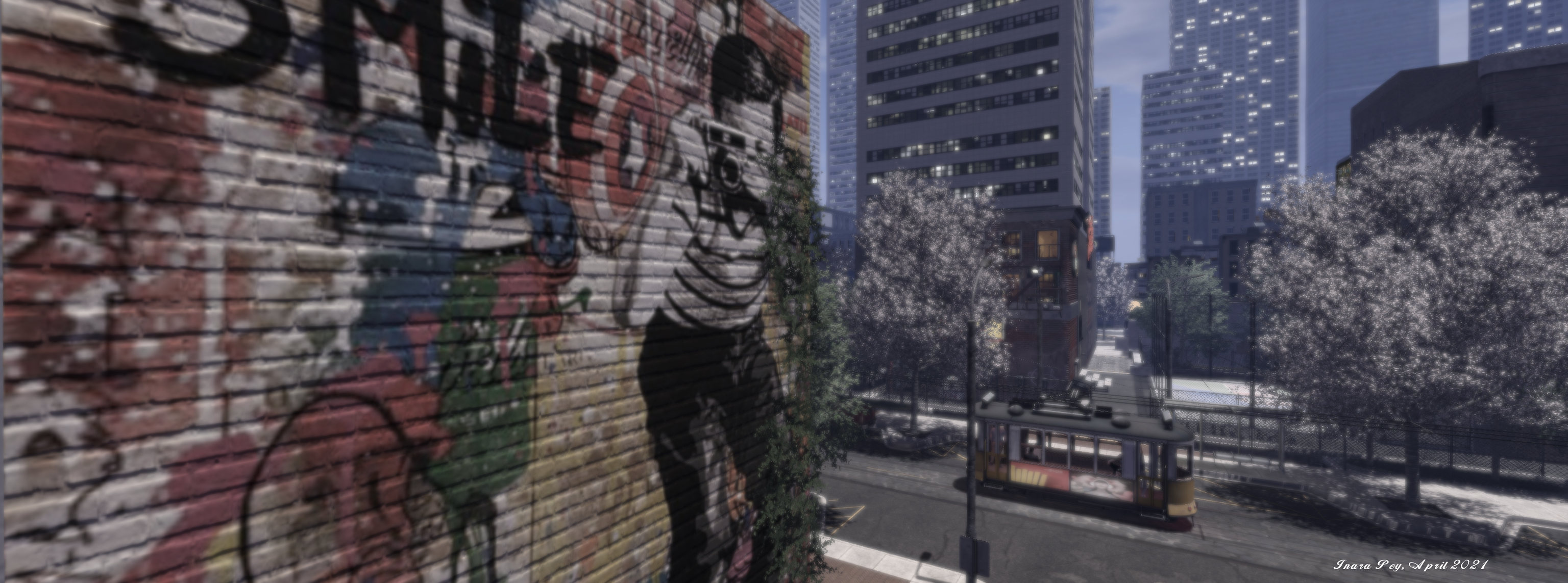
The  setting has the feel of being one of those downtown locations that can often be found a major cities: a place surrounded by the tall fingers of modern office blocks and apartments, but which retains the buildings and streets of an earlier age, a time when cities were beginning to grow vertically as space became an increasingly valuable commodity.

Cravone City, April 2021

Thus, this is a place of buildings five to eight storeys tall, with shops setting under town houses faced by wrought-iron fire escapes and sash windows that look out onto the world whether open or closed. It’s a place that commuters pass through on trains that carry them to the glistening towers of the “new” city at the start of the working day, then back out to their suburban homes in the evening, perhaps barely aware it even exists.

Which is not to say that the world is simply passing by this place without interest. The major roads are now wider than perhaps they once were, speaking to their update to detail with hight volumes of traffic, and there is a certain gentification going on: some of the building have façades that are younger than the rest of them, whilst here and there modern stores have moved in, and boutique cafés are making their presence felt.

Cravone City, April, 2021

All of this gives a certain richness to the setting. As with a real city the old rubs shoulders with the new, and while it is possible to tour what is here by keeping to the broad, sunlit main streets that dive the setting into city blocks, so to is is possible to wander off the beaten track and discover the older, narrower streets; places where renewal perhaps hasn’t reached, or where some might go to find more adult forms of entertainment.

So it is that Cravone City has about it a sense of life, here and there aided by the presence of static NPCs. But just where it might be in the world is entirely up to the imagination. There are clear touches of New York, Los Angeles and San Francisco to be found here, but away from the major roads with their American lean, this could easily be somewhere else entirely – thus offering a lot of opportunities for that free-form role-play.

Cravone City, April 2021

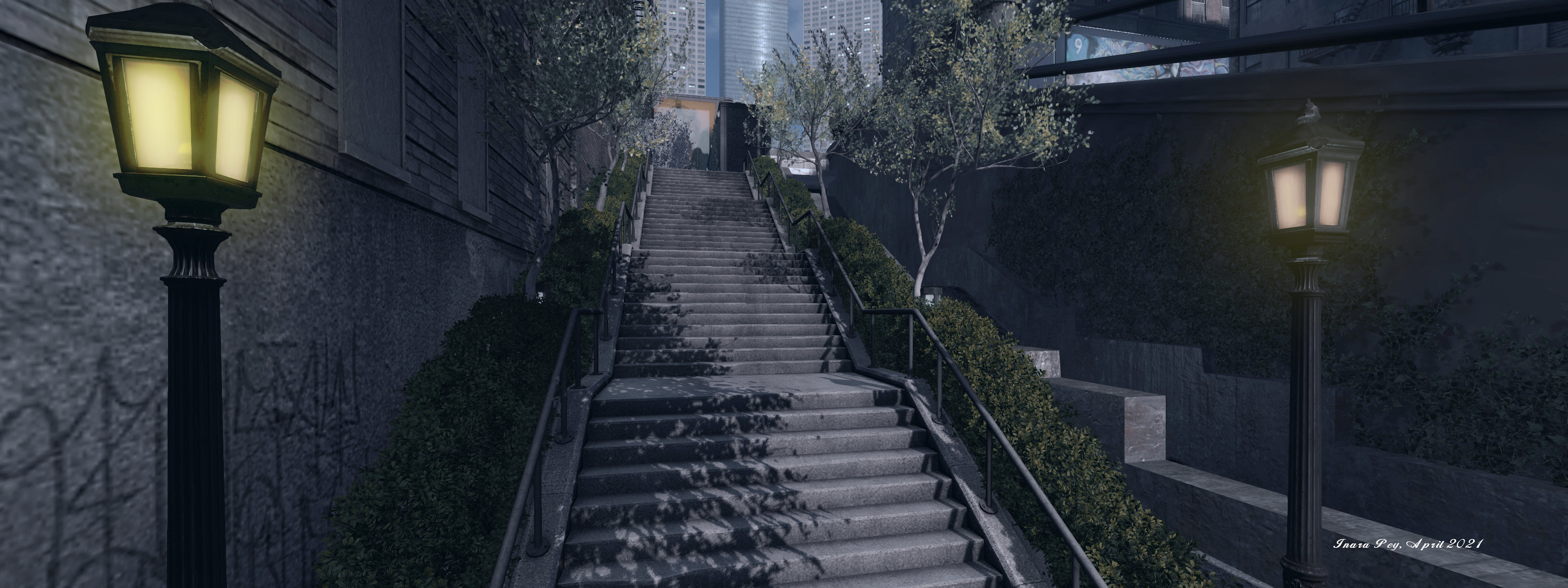
Opportunities for the latter and – perhaps more particularly for photography – can be found throughout, while the touches of detail – the graffiti, the manner in which life spills out of of some of the townhouses and onto their fire escapes, the corners turned into gardens, and so on add a further layering to the sense of lives being lived here.

I don’t know if any kind of urban role-play takes place in the region – I suspect interest was generated following it being highlighted in the Destination Guide in March – but there is no denying Cravone City’s photogenic charms, making it an interesting visit for the SL traveller.

Cravone City, April 2021

SLurl Details

A return to the Butterfly Conservatory in Second Life

Butterfly Conservatory, April 2021

In  2017 I visited the Butterfly Conservatory, the work of Ry Heslop. I found it to be an engaging visit – one you can read about in Of lepidopterans, owls, bugs and honey in Second Life. I actually lost track of the conservatory a little while after that visit, so was pleased to learn via the Destination Guide that it has made a return to Second life and has a new home and it went on the list for places to (re)check out.

Butterfly Conservatory, April 2021

Once again occupying a sky garden, the conservatory shares the space with the Merge Club, also operated by Ry. A mover is in operation at the landing point, so don’t be surprised if you find yourself being shuffled away on teleporting – this is presumably to keep those arriving for events at the club from stacking up on one another’s heads.

A  crossway on the footpath points the way to the three primary locations on the platform: a dining area under a pergola, the club, and the Conservatory – the latter unmissable in its impressive new building.

Butterfly Conservatory, April 2021

Within the building is a lush semi-tropical environment, home to a wide variety of flora and  – more importantly in this context – butterflies. These can be found circling the plants, while nearby signs offer information on the species you are seeing.

Butterfly Conservatory, April 2021

Following my initial visit to the Conservatory, I noted that it might be easier for those who have a hard time reading in-world text if the signs also acted as note card givers. As a result of that comment, Ry contacted me to say that’s exactly what would be done in the next update to the gardens – and it is an approach that has been continued through to this iteration; so do be sure to touch them as you follow the paths around to learn more about the butterflies that are to be found here.

Butterfly Conservatory, April 2021

The indoor gardens are beautifully laid out, with split level path leading visitors around them, a café, sculptures, water features and more. In addition, a branch of the path directs visitors to a wing of the building containing the Birds of Paradise aviary – a part of the Conservatory that I think is new to it; at least, I don’t recall it from my 2017 visit.

Butterfly Conservatory, April 2021

Outside of the main building are two further areas to be explored, one providing information on a number of species of beetles and bugs, the other on bees, and their importance to the world as a whole. With the latter – and again tooting my horn a moment – Ry has also followed through on my 2017 suggestion and provided more information on exactly why bees are such a vital part of the ecosystem.

Butterfly Conservatory, April 2021

What I found particularly pleasing about my original visit to the Butterfly Conservatory was its simple elegance in being both an informative and charming visit one can appreciate for both its content and the thought and care that has been put into its design and layout. This remains very much the case with this iteration as well; so if you’ve not been to the Butterfly Conservatory before – make sure to add it to your list of places to visit and enjoy; you won’t be disappointed.

SLurl Details

Letting off steam with Zany Zen Railway in Second Life

Riding Zany Zen’s Railway – April 2021

Back in April 2020, I wrote about Rydia Lacombe’s work in mapping all of Second Life’s railway networks (see: Mapping Second Life’s mainland railways). I ended the article by musing the idea of doing an occasional series about the Second Life Railroad (SLRR) network, even going so far at to contemplate a title for the series: From the Footplate. However, in June of 2020 the Lab launched a video series on the subject, prompting me to put the idea onto the back burner.

However, had I gone ahead with that series, I would have started with the Zany Zen Railway (ZZR), located in the heart of Jeogeot.

Riding Zany Zen’s Railway – April 2021

Created and operated by fellow “Brit” Zen Swords-Galway (ZenriaCo), it’s one of the most unique lines to be found in Second Life, being a) almost entirely scratch-built by Zen (with rolling stock scripting by Dizzi Sternberg, Janet Rossini and NightShade Fugu) and b) it is and narrow-gauge service, something of a rarity in SL. There’s also the fact it offers something of a celebration of UK in the most subtle of ways.

This last point can be seen on arrival at one of the two terminus points for the railway, Little Coverston, located in Gaori. Here, above a small Welsh coastal hamlet (complete with RNLI station) sits a stone built station, the entranceway to which is lined by posters advertising places to Ely, Whitby and the famous Rheilffordd Talyllyn – Talyllyn Railway, itself a narrow-gauge railway and Welsh tourist attraction that runs along the line that original carried slate from the quarries to the port of Tywyn. Incidentally, it was also the first narrow-gauge railway in the UK to be authorised by Act of Parliament for the transport of passengers.

Riding Zany Zen’s Railway – April 2021

It’s very much a passion project that grew into something I could never imagine. I’ve been lucky over the last few years to have some help with a few bits and bobs; the passenger carriage update last year couldn’t of been done with out a friend.

Zen discussing her Zany Zen Railway

Roughly three passenger trains an hour run along the ZZR, so if you arrive between services, you can take a wander along the street below and maybe pop into the Welsh Dragon to refresh yourself or, if it is open, the local corner shop to grab a sandwich or snack to enjoy on the train.

The rolling stock on the ZZR is all designed and built by Zen herself, and is incredibly well detailed

One of the reasons the service may appear slow is that – like many narrow gauge lines – the ZZR is predominantly a single track, one that is shared with goods trains. This means that passenger services often have to wait at the one double section of track to allow the freight service to pass. Not that this should be a problem; it simply gives passengers more time to appreciate their surroundings.

From Little Coverston the line runs east and then south, with a station at Seogyeo where that double section of line can be found, allowing trains to pass one another. The station is also home to the ZZR museum, offering a history of the line’s development that is very much worth hopping off the train to see – you can always catch the train once it has been down and back along the line to resume your journey. Also at Seogyeo is the chance to wander the streets of the local Welsh-themed village that is fully in keeping with the railway, and designed and built by RoaryCymru.

Seogyeo station, April 2021

After Seogyeo, the line continues south, passing over an extensive viaduct and then through a cutting to arrive at Ahndang, a little country station typical of a bygone era here in the UK, before continuing on to Somdari – actually the point where the line originally started. The ZZR’s engine sheds are here, giving visitors the chance to see more of the engines – all of which are beautifully designed (and there may well be a couple in the sidings along the line).

Another of an aspects of the ZZR that make it so engaging is the level of scripted automation and detail: station signs neatly display arriving services, levers shift as points change, carriage doors opening as closing as the trains sit alongside platforms, and so on. The ride can admittedly be a little rickety – but anyone who has ridden a narrow gauge knows that can be the case – as can be the tightness of the curves.

Looking back along the tracks on the Zany Zen Railway, April 2021

Zany Zen’s isn’t the longest or the fastest railway, nor does it have the biggest trains;  but that’s precisely the point. ZZR isn’t supposed to be big and bold and charging along; rather, it is an accurate interpretation of an English narrow gauge line that has been re-purposed from its original use to provide an engaging excursion people can enjoy – and one  I recommend you try if you haven’t already.

SLurl Details