A day in Provence in Second Life

Village de Roqueblanche, October 2022 – click any image for full size

On the advice of Shaun Shakespeare, I took a little trip to a corner of France here in Second Life, and found a setting rich in beauty and detail, offering a mix of public spaces and walks together with private residences.

Occupying a Full region utilising the private island land capacity bonus, Village de Roqueblanche is the work of Albane Claray (AlbaneClaray) and represents a corner of Provence, that region of France tucked between the Mediterranean Sea to the south and Italy to the east. Its location and topology offer a rich mix of climates and weather from the high slopes of the French Alps to the crystal waters of the Mediterranean.

Village de Roqueblanche, October 2022
I tried to reproduce a little corner of my country; a place with a Mediterranean feel very similar to Tuscany, Italy.  It’s a land of many small villages nested in valleys or on hills, surrounded by lavender fields and vineyards and that so special light Van Gogh reproduced on his paintings. A village buried in my memories, a village where my childhood memories are asleep, stones worn by the rain, burned with sun…

Albane Claray

Journeys through the region start in the south-west corner and a square of an island separated from the rest of the region by a watery channel, a second channel separating the island from the neighbouring Homestead, also held by Albane, but which was under construction at the time of my visit – so I did not cross the bridge to avoid getting in the way of any building work going on.

Village de Roqueblanche, October 2022

The exact location of the landing point is, appropriately enough, right outside the local tourist office offering a little slice of Tuscan styling and overlooking one arm of the channel separating the island from the rest of the region. Above and behind the landing point sits the rest of the village, with houses and buildings arranged around two large squares.  These have a Romanesque echo about them – something that is not entirely unnatural, given that Provence was the first Roman province established beyond the Alps, and its name is derived from the Roman name Provincia Romana.

A grand stone bridge spans the water to the western Homestead region, but to reach the rest of Village de Roqueblanche, it is necessary to leave the village on its eastern side and descend to where a small bridge gracefully arches across the water – the L’Auzon – to where a cart track winds its way through the rest of the landscape.

Village de Roqueblanche, October 2022

It is here that the private residences are located, so visitors should take care not to intrude. These houses are scattered to either side of the cart-tracks, but as each is marked by a large sign outside of the gates or steps leading to it, trespass is unlikely. Central to all of them is The Hamlet of the Mill.

Comprising a large farmhouse surrounded by tall walls and drystones which encompass a couple of the private residences, this is a place nevertheless open to the public, the farmhouse serves an a cosy restaurant visitors are welcome to visit; a place offering the first hint of the lavender Albane mentions whilst the wine served inside might have originated with the vines growing just outside of the surrounding walls.

Village de Roqueblanche, October 2022

This is a place where, no matter where you go, there is something to captivate the eye and offer opportunities for photography; a place that is a joy to wander and in which to pass the time.

My thanks to Shaun for the pointer and landmark, and to Albane for personally making me feel welcome.

Village de Roqueblanche, October 2022

SLurl Details

Miltone’s Fallingwater in Second Life

Fallingwater by Miltone Marquette, October 2022

It is no secret to my friends and regulars to this blog that I have something of a fascination with Fallingwater, the house American architect Frank Lloyd Wright designed for Edgar J. Kaufmann and his family in the mid-1930s.

Located in the  in the Laurel Highlands of southwest Pennsylvania, the house is one of Wright’s most iconic designs, sitting as it does within woodland and partially built over a waterfall on Bear Run, a tributary of the the Youghiogheny River. It’s hard not to fall in love with it when seeing it for the first time in person or in picture or film, and I’ve reproduced it in-world for my own use on multiple occasions.

In this, I’m hardly alone; there have been a fair number over their years built with varying degrees of accuracy. However, none – my own included – come anywhere close to the original as does the Fallingwater build by Miltone Marquette. It is exquisitely detailed and painstakingly accurate; and thanks to a personal invitation from Miltone, I was able to pay a visit at the start of October 2022.

Fallingwater by Miltone Marquette – the Great Room is true to the original as seen in photographs from the Kaufmann era, with one or two added details from Miltone!

Miltone has a long personal association with Frank Lloyd Wright’s designs  both in the physical world and in Second Life. In terms of the latter, he was one of the principal builder at the Frank Lloyd Wright Virtual Museum from its inception through until its unfortunate closure. his physical world interest reaches all the way back to his childhood, and has grown ever since.

Many years ago, my father would take the family on a Sunday drive around town and we stopped by the Dorothy Turkel house in Detroit; there was this reverence in Dad’s voice when he said, “This is a Frank Lloyd Wright house.”
In later years I discovered that a business associate was a big Wright-o-phile and took me around to some of the FLW houses in the area. I was hooked. Second life is a perfect place to explore Wright’s organic building concepts, and Fallingwater is the most perfect expression of those concepts; and while I build here to satisfy my own curiosity and interests, I do enjoy sharing my work with others.

– Miltone Marquette

With Fallingwater he has – like most who have sought to reproduce it virtually – focused on the main family house (the original property can be broadly divided into three structures: the family home, the Guest House sitting on the hill above and behind it, and the garages with staff bedrooms over, sitting perpendicular to the Guest House). In keeping with the original, the house is reached via the driveway as it passes over Bear Run on a single-track bridge to sweep around the house and under the car port alongside the front door, before (in the original) winding on up the hill and back on itself to reach the garages above.

Fallingwater by Miltone Marquette – the view from the bridge

Given Miltone and I worked from the same source material (albeit unknown to one another) and we both used the Erlanger scale in-world, our respective builds are very similar in terms of scale and size. However, when in comes to interior décor, Miltone has genuinely brought his build to life in a way I  never have. His  build is a house where every room is faithfully reproduced, from the Great Room through all of the bedrooms and bathrooms up to the uppermost balcony, and out through the kitchen and staff lounge and down into the basement rooms (the latter of which I never attempted to include).

All the furnishings have been reproduced to accurately represent their physical world counterparts, whilst the ornaments and fittings have been carefully selected to match those found in the house and on its terraces, as Miltone explained:

I would be remiss in not mentioning the decorative skills of SummerSails who studied photos and scoured SL for suitable furnishings. But I chose to use the dining chair design that Wright recommended, but which only got to be used in the Guest House; I much prefer Wright’s design over those purchased by Mrs. Kaufmann in Europe and used in the dining area. Also, the floor lamps are based on sketches left behind by Wright for lamps that the Kaufmanns never commissioned.

– Miltone Marquette

Fallingwater by Miltone Marquette – the master bedroom terrace

There are also some “non-canon” – so to speak – touches to be found in memory of Wright and of Miltone’s father. On the main landing, for example, a black-and-white photo of Wright at Taliesin (his home) can be found; whilst above the desk in the Great Room hangs a reproduction of a 2-cent postage stamp featuring Wright.  This is a copy of a stamp Miltone discovered in his father’s footlocker, and so forms a nice memento – although Miltone prefers to describe it as being “so folks can get my 2 cents worth of FLW”!

Across the river from Fallingwater are two more of Miltone’s creations reproducing famous Wright houses / house styles. Sitting alongside the local highway where they are periodically passed by tour pods, these are the Robie House of Chicago, and the Jacobs House of Madison, Wisconsin; both are  – like Fallingwater – US National Historic Landmarks.

The Frederick C. Robie House – generally referred to as the Robie House -, with its distinctive walls and roofs, is located on what is now the campus of the University of Chicago. It pre-dates Fallingwater, having been built between 1909 and 1910, and is today considered the finest example of Prairie School, the first architectural style of house considered uniquely American.

The Robie House by Miltone Marquette – also available for tours with Miltone

Meanwhile, the Jacobs House – also called the Jacobs First House, given Wright designed two houses for Herbert and Katherine Jacobs – is contemporaneous to Fallingwater, having been built in 1937. It is considered to be the first Usonian home Wright designed. Both it and the Robie House are again exquisitely detailed inside and out, and beautifully reflect their physical world namesakes.

In the physical world, the Robie and Jacobs houses are managed by the Frank Lloyd Wright Foundation whilst Fallingwater is in the care of the Western Pennsylvania Conservancy at the behest of Edgar Kaufmann Jr. Seeing all three requires planning, time and travel. Within Second Life they are all curated by Miltone as their creator, and visitors are able to tour all of them with considerably more ease. Should you wish to do so, please contact Miltone in-world via IM or note card, and he’ll work with you to arrange a mutually convenient time for a tour.

And just in case you need further convincing, I’ll leave you with a film by Suzie Anderton and available on her You Tube channel, which offers a taste of the beauty of Fallingwater in Second Life.

Again, if you would like to visit these iconic builds, please contact Miltone Marquette in-world.

Related Links


A stroll through Moorcroft Village in Second Life

Moorcroft, October 2022 – click any image for full size

It was off to Sansara for me once more for a little more mainland exploration, this time on the advice of Milo Collas, who suggested I might appreciate a wander through the streets and surrounds of Moorcroft, a place that defines itself as the queerest little village on the mainland.

Occupying a full region, Moorcroft is a join effort by members of the Show Society (a group dedicated to enhancing the equestrian community of Second Life through competitive events, shows, clubs, and classes) and their friends, with The Show Society’s founders, Ayame Kintsugi-Moon) (Stable Mum), Teagan Twospirit Kintsugi (DarlingTeagan) plus Pod Heartsong (Podruly Heartsong) leading the charge in mesh and prim pushing and terrain shaping.

Moorcroft, October 2022

In looks, the village appears to have its roots in a number of European countries (France in particular, with touches of Germany and elsewhere. It appears to be built upon the footings of what might have once been a mighty fortress, and is surrounded by the most genteel of countryside settings which blends into the region’s neighbours to the point where in a couple of places, visitors may not actually be aware they have strayed beyond the limits of the village and into the land of its neighbours.

The place I’ve selected to start a visit is the village square, just outside the Moorcroft Information Centre. The latter can provide visitors with information on The Show Society and the events they hold. Moorcroft is obviously an equestrian-friendly location, and the roads and trails winding outwards from the village are ideal for those who have a wearable horse – or who like exploring on foot.

Moorcroft, October 2022

Away from the main roads, the trails and single-track roads wind their way through the region, passing through and around the woodlands, with the longest of them running through the north extent of the region to where a little airstrip sits, which appears to be both a part of, yet separate from, the rest of Moorcroft. It also offers something of a challenging landing: the runway ending in vertical cliffs which tower over it!

The north side of the region is one of several areas which, at the time of my visit still appeared to be under construction (or possibly re-development). There are also one or two uneven points of landscaping within the woods – although these are largely hidden by trees, and the main trails that wind between the tree trunks avoid them and their odd pitfall.

Moorcroft, October 2022

Moorcroft is a place where people can come to level – there are various rentals awaiting discovery – and some of the locals have created some interesting perches.one of these is the Wizard’s Retreat away to the east and sitting high in the rocky hills to provide a commanding view down over the woodlands to the nearby coast.

Proudly LGBTQ+ friendly, offering a mix of architecture that is richly varied and suggestive of a lot of history lying in and around the village, Moorcroft offer plenty of opportunities for exploration and photography and is a charming little jewel sitting within Sansara.

Moorcroft, October 2022

SLurl Details

Serene Footman: one of the great hearts of Second life

Isle of May, October 2022

On October 2nd, 2022 Jade Koltai informed us that Serene Footman, her long-time creative partner in bringing together some of the most outstanding region builds witnessed in Second Life, passed away from cancer in August 2022.

To my regret, Serene and I were not closely acquainted in Second Life; although we did exchange IMs at times, and chatted on a few topics. However, I didn’t actually need to converse with him to hear his voice or appreciate his heart: both could be seen and felt through every single region build he and Jade presented to Second Life for the enjoyment of everyone who visited them.

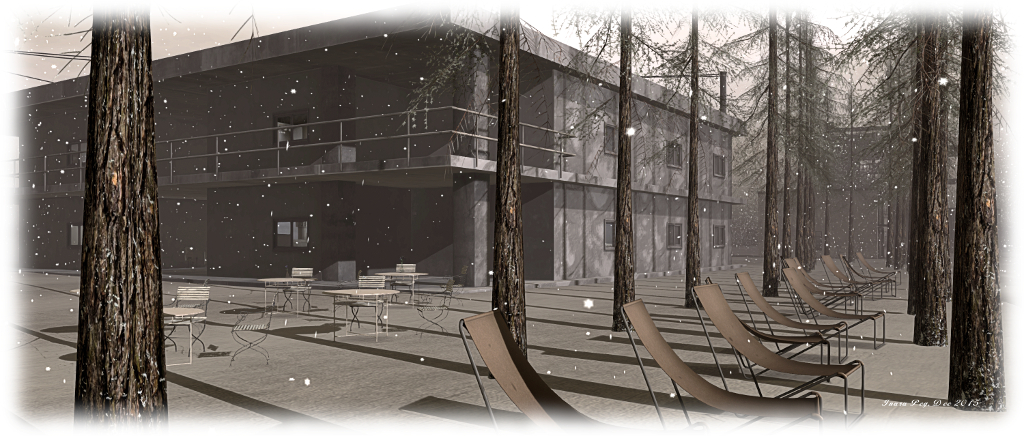
I first became familiar with Serene and Jade’s work back in 2015, when they opened Furillen, a Homestead region modelled on a small isle of that name and itself laying off the coast of Gotland, Sweden’s largest island. By turn a quarry, then a military installation and more recently a conference centre, Furillen’s history was richly and evocatively caught in Serene and Jade’s build  –  and build that set the tone for almost all of their subsequent designs, as well as loaning its name to Serene’s blog.

Furillen; Inara Pey, December 2015, on FlickrFurillen, 2015 – blog post

I say “almost”, because the next design the pair produced was very different to any physical world location (although it did include a reproduction of London’s Battersea power Station), as it offered an engaging and unique homage to English rock band Pink Floyd with Pink Floyd Ate My Sim.

But it was with the representation of physical world locations that Serene and Jade’s partnership became most well-known, with designs encompassing La Digue du Braek (found in France), Khodovarikha (Russia), Isle of May (Scotland), Louisiana’s Black Bayou Lake, Rummu quarry in Estonia, Chesapeake Bay, Ukivok in Alaska, North Brother Island, New York, to name just some – with both Serene and Jade also producing individual region designs also based on physical world locations as well.

Ojuela, May 2022 – blog post

The major points of all of these designs, alongside them being modelled on places people would likely otherwise have little or not opportunity to visit in the physical world, was the fact they were richly detailed and offered superbly imaginative interpretations of the places on which they were based, given the limitations (notably physical space) found within SL Homestead (and even Full) regions.

A further aspect of these builds which helped distinguish them from other region builds lay in the amount of additional information Serene would provide on them and their physical world namesakes through his Furillen blog which remains (for the time being at least), an excellent reference work in its own right.

Serene was also a gifted photographer, and his images were subject to exhibitions in Second Life, as with 2019 Retrospective, which I reviewed here, and which demonstrated Serene’s wonderfully understated and eye-caching technique.

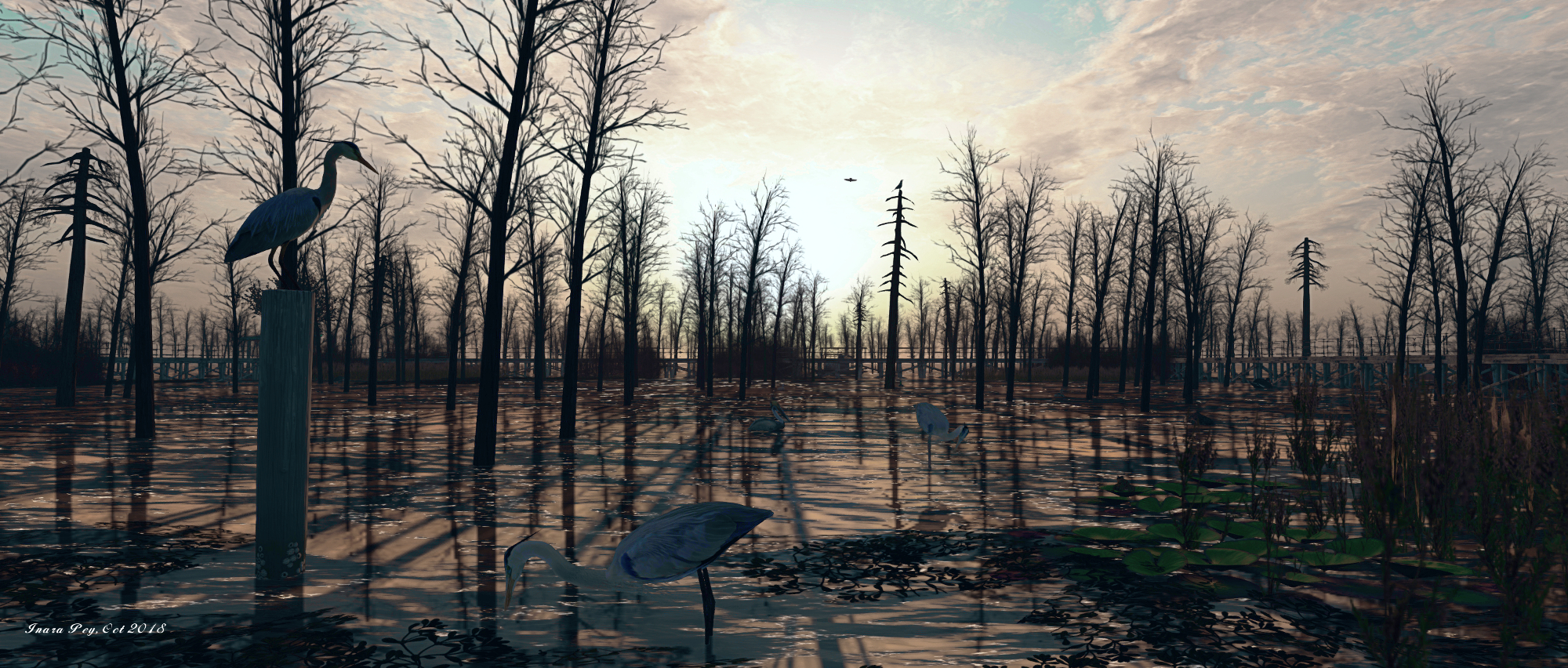
Black Bayou Lake; Inara Pey, October 2018, on Flickr
Black Bayou Lake, 2018 – blog post

To give people the opportunity to remember Serene, his work, and her partnership with him, Jade has returned Isle of May – one of Serene’s favourite builds – to Second Life, and visitors are encouraged to drop in and recall Serene’s presence in Second Life, the beauty of his work and the joy he brought to all of us in visiting these wonderful creations.

My condolences to Jade and to Serene’s family and friends.

Related Links

More about a Green Story in Second Life

Green Story, September 2022 – click any image for full size

I hadn’t realised that it’s been four years since my first visit to Green Story, the Homestead region held and designed by Dior Canis. Indeed, it might have been even longer before I hopped back to have another look, but for a poke from Shawn Shakespeare; admittedly, that poke was given to me at the end of June 2022, so even now I’m being a little tardy in just getting around to a visit and an article, given October is now peeking over the horizon at us!

At the time of my previous visit, which I wrote about in Stories and memories in Green Second Life, the region was very much a place of two halves, one in the sky and one on the ground, and both equally attractive, and which offered a continuity of theme and expression, one to the other.

Green Story, September 2022: “catch a falling star”

So far as I can tell now, Green Story exists in its current iteration as a ground-level build only; I certainly didn’t note any suggestion of a teleport to a sky platform – so if I did miss it, my apologies.  Both the 2018 iteration of Green Story and this are joined, however, by the fact that whilst each has its own landscape, neither is what might be said to be  contiguous location; rather, each exists to offer a series of locations – or vignettes, depending on how they are being utilised – scattered within a landscape which helps to link them as places to be found and appreciated.

In its form at the time of writing this piece for example, the landing point sits on a winding track running towards (or away from, depending on your point-of view), a little railway stations which has perhaps seen better days. Rain falls from a star-filled sky cut through with the ribbon of the Milky Way, and the shadowed forms of the station buildings, their mix of warm yellow lights and bright white platform illumination reflecting of banks of mist, beckon the new arrival with the promise of a warm reprieve from the downpour.

Green Story, September 2022: “the inner light”

This station is a strange hodgepodge of buildings platforms, music store, café, waiting room, and so on, which look as though they have all come together to huddle against the rain rather than being built with intent, a single rail car hunched at the end of one of the lines and suffering the rain in silence. The very oddness of the station buildings – which includes a very cosy artist’s studio floating above the rest as if daring gravity to say something – givens them a unique attractiveness which further draws visitors to them.

Travelling the other way along the track from the station takes the visitor past a little telephone booth before the trail peters on on a shoulder of the hills descending from the south and west to meet the north-facing coast, the course of the trail marked only by the march of a line of street lamps beyond where the trail’s guiding fences end.

Green Story, September 2022: “catspaw”

Further travel from here is either a case of climbing the rough slope of the hill or descending it towards the waiting shore. The way upwards can lead one to where the skeletal form of a cabin occupies an out-thrust of rock. Looking to be only partially complete (and a neat combining of builds by Wendy Keno and Cory Edo), the cabin is nevertheless cosily furnished and offers a comfortable retreat from the weather with an uninterrupted sea view. The path down, meanwhile, offers the way to where a deck sits over the water. Reached via stepping stone, it offers a view to the brilliant arc of the Milky Way as it rises from the north-east to arch over the region in a swathe of starry colour. Also visible from this deck is a little boat sitting far out on the water and laden with pillows and blankets as a further retreat  for visitors to partake.

And therein lines the raison d’être for this design: not s much as a place to be explored in the traditional sense, but as a place where people can come, relax, share (intimately, if they wish, given much of the furniture scattered around includes cuddles / adult poses), take photos of themselves within the various vignettes – art studio, cabin, deck, telephone booth and so on (several more await discovery as one wanders) – or simply remember or lose oneself in thought.

Green Story, September 2022

In this latter point, it doesn’t matter that the art studio floats over the back of the station buildings or a single window frame is suspended alone on a hill slope; what matters is how the mind, the eye and / or the camera opt to use the locations within this region, be it for expression or escape.

SLurl Details

A little Regency in Second Life

Vue Sur Mer, September 2022 – click any image for full size

Pleasure Ò Raigàin (vVEdanaVv) is one of the creative minds (and chief builder) behind Carrowmere, a Homestead region I visited with great delight back at the start of 2022 (see: A trip to an Irish corner of Second Life). Whilst that region is still active in Second Life, Pleasure has turned her mind to other projects as well, and recently invited me to pay a visit to Vue Sur Mer, a new parcel build she has opened to the public.

Occupying just 4096 square metres, this is one of those landscaping designs I tend to like because it demonstrates the fact that people don’t actually need a full-sized region (Homestead or otherwise) to create something special for themselves or which can be shared with others as a public space. Sitting within the north-east corner of its parent region (hence the reason for the parcel’s name), this is a parcel with a very distinct and cosily engaging theme, offering as it does a slice of Regency England in reflection of the US TV series Bridgerton.

Vue Sur Mer, September 2022

I confess to knowing next to nothing about the television series – I’m actually not a great fan of period dramas for assorted reasons; but that hardly matters here. Whether or not you are familiar with the show – or indeed Regency England – Vue Sur Mer offers an enticing and romantic corner of Second Life that is highly photogenic and easy to appreciate.

Whilst formally regarded at the period 1811 to 1820, when by Act of Parliament, George, Prince of Wales became Prince Regent as a result of his father’s (George III) worsening mental health and ending when the Prince ascended to the throne as George IV, the Regency period can more broadly be regarded as the final third of the Georgian era, spanning the years 1795 through 1837. It was a time of sharp social divide within the United Kingdom between the haves and the have nots, with the former enjoying a period of cultural and social growth (aided by Romanticism straddling the era and the early Victorian period), and seemingly oblivious (or uncaring) about the hardship faced by the labourers of the country.

Vue Sur Mer, September 2022

In its celebration of the period as seen through the likes of Bridgerton, Vue Sur Mer quite marvellously captures the grace and beauty that lay within the houses and gardens of the well-off. This is a setting where, to draw further on the period) Mr. Darcy and Elizabeth Bennet would find little amiss.

Presented as semi-formal garden environment in which is located a small summer house and even smaller pavilion, both constructed of neatly cut and squared white stone, it is not hard to imagine Vue Sur Mer as a places tucked away within the wildlings beyond the more formal gardens of a grand estate, a place where the romantically-inclined can slip away to for courtship conversations, unobtrusively observed by footmen; or which the estate owners might host a young artist or musician or poet, thus earning themselves further social kudos.

Vue Sur Mer, September 2022

Behind the summer house sits a shaded pond where courting couples might sit or a poet seek his (or her!) muse under the natural arch of two bent trees, this time watched over by Andromeda and Perseus. To the side of the house tea might be taken under a beflowered gazebo set over a carpet of pale blooms, the discussion perhaps revolving around Ms. Austen’s writings, given the books perched on the table. Nearby, the pavilion sits purely as a retreat for the menfolk, being set out with a range of brandy and whiskey bottles which share their table with a box of cigars.

Between pavilion and gazebo lie stone steps rising under a stone arch to reach a wildling garden protected by a snowy owl; a place where a budding painter might decide to set their easel should they tire of the confines within the little greenhouse on the far side of the little beach, converted as it is as a tiny art studio.

Vue Sur Mer, September 2022

Compact yet packed with detail (I’ve not really mentioned the care with with Pleasure has set the décor and furnishings within the house), and finished with a gentle soundscape, Vue Sur Mer is a veritable painting in its own right. And I leave it to you to decide whether or not to do so in period attire!

SLurl Details