Calas Galadhon

Dimrill Dale, Misty Mountains, South Farthing, Armenelos, Bay of Balfalas – to anyone familiar with the works of J.R.R. Tolkien, these are evocative names, along with Grey Havens, Gulf of Lune, Mirromere and Eryn Vorn. But within Second Life, these sims are not in any way a reproduction of Tolkien’s wonderful Middle-Earth (although I confess that’s why I was attracted to them in late 2010, when I made my first visit).

Calas Galadhon – or “Calas” to those more familiar with it – is the “parent” region to a 10-sim parkland estate owned, curated and offered to the people of Second Life by Tymus Tenk and Truck Meredith. Like the other regions in the estate, it should have drawn on Tolkien for its name  – Caras Galadhon – but for an opsie by Linden Lab. Not that the slip-up diminishes in any way the fact that it, and the other regions of the estate make for a must-see destination.

Calas Galadhon – winter scene

The core of the sims represents rural America in the early 1900s – but there is also a touch of the Mediterranean as well in the form of Armenelos, and even a hint of Atlantis. As such, there is much to explore and see, and the sims combine to make a fabulous setting for the romantically inclined or those that love SL photography.

At the moment, four of the ten sims – Glanduin, South Farthing, Dimrill Dale and Calas Galadhon itself – are given over to a winter wonderland, with snow covering the ground, frozen ponds and lakes for skating on, inviting lighting hanging from eaves and glowing through windows while snow-capped mountains make a stunning backdrop. Here you can take a balloon ride with your loved one and friends, or enjoy on your own, drifting serenely over the town before swinging out over Glanduin (where the sim crossing can be a little bumpy!) and the other sims in the estate.

Glanduin

Cross the bridge on the north side of Calas Galadhon, and you enter the summer world of Mirrormere and Grey Havens. Here you’ll find wooded parkland and hills to wander, all with their own secrets to reveal. There are places to sit down and meditate, places to dance with a partner and much on offer for the snap-happy. If you can turn your Draw distance up reasonably high (around 512m), there are some great landscape views to be captured and enjoyed, as well beautiful views across the water to the Grey Havens and Armenelos. Just remember to slide the Draw distance back down to avoid overloading the Viewer!

Walking through Mirrormere

Mirrormere is the home of the Calas Caverns – although to find them, you’ll need to keep a sharp eye open; the teleport point lands you close, but you’ll still have to take a little bit of a look around to find the entrance. The caverns wind under a part of Mirrormere, with little hideaways for romantic trysts, opportunities for swimming, and a tunnel that leads even deeper underground….although if you come via the bridge from Calas Galadhon, you may encounter the tunnel before the caverns…

Calas Caverns

The park continues up through Mirrormere into Misty Mountains, which has a wonderful series of trails and walks to follow, the best of them (to me) leading to marvellous views over to Armenelos, which can also be seen from the northern side of Grey Havens.

Armenelos itself offers an entirely different theme. Modelled on the island of Santorini, here you can climb the stairs to the cliff-hugging, whitewashed walls of the town and wander its narrow streets.

Looking across Armenelos from Grey Havens

The real Santorini – or Thēra, to give it its official name – was once an important trading point for the Minoan civilisation, prior to one of the largest volcanic eruptions in history devastating the island and resulting in the formation we see today, with the great lagoon and the broken rim of the caldera formed by the eruption. A popular theory has it that the eruption – 3600 years ago – gave rise to the legend of Atlantis.

Looking back from Armenelos to Misty Mountains

From Armenelos you can take a motorboat out onto the water, travelling out under the watery caverns of Grey Havens, or around the clifftop village and out into the Bay of Balfalas. As you do so, be aware that you are passing over another of the estate’s secrets: the Lost Gardens of Thera.

Here, in a nod to the legend of Atlantis and memory of the Minoan eruption, you can take the stairs down into the water, grab some scuba gear and explore a beautiful underwater world, moving among ancient ruins – and remnants from more recent times – where fish and rays swim and play.

Lost Gardens

wherever you go in the Calas Galadhon estate, it is evident that Tymus and Truck have gone to great lengths to present an immersive, enjoyable experience – one that extends to the sounds that are to be heard across the sims. In this regard, if you don’t have sound on as a rule when visiting SL, I strongly recommend that you enable it prior to visiting Calas Galadhon. The care with which Tymus and Truck have put together a soundscape to compliment the estate is incredible, and while there is much to be enjoyed without sound enabled, walking / riding through the sims with sound on, and being immersed in the soundscape really adds tremendous depth to the experience.

When you are exploring, keep an eye open for kiosks linked to the Bronx AIDS Services, the non-profit organisation supported by Tymus and Truck and make time to visit the AIDS & HIV learning Centre in Calas itself.

Calas Galadhon is an amazing place to visit and spent time exploring – I’ve deliberately not covered all ten sims here, as I wanted to leave you with places still to explore for yourselves. Given the care and attention put into the estate, it is little wonder that it rates so highly in several categories in the Destination Guide – so why not take time out this weekend and pay it a visit yourself?

Calas Galadhon

And why not visit the Calas Galadhon blog?

Related Links

Imagination in a Lost World

Update: Lost World has closed and Beguile no longer exists as a region name.

I’m the first to admit I’m not the world’s greatest SL photographer, but I love finding places in SL that are both interesting to explore and can make excellent backdrops / subjects for photography; and if they have a hint of a story of their own – so much the better.

One such place that combines opportunities for in-world photography with the hint of a mysterious back story is ! Lost World !, created by Lolmac Shan.

This is a fabulous build covering the region of Beguile that calls out to photographers and machinima makers alike.Here you’ll find the ruins of … what? a great house? An Abbey or religious centre? A castle? A once-thriving port? ..

Ancient ruins: ! Lost World !

You arrive in the middle of the ruins, standing at the crossways of two ancient walkways. Before you lies the ruins of a great hall (Lolmac’s store), the roof long gone, the supporting arches starting to collapse themselves. From here, it is up to you as to where you go…

Behind you, a short distance away, the ruins stand sentinel in a losing battle against the encroaching sea; aches stand in isolation, their winged gargoyles facing inland as waves crash against weathered and deformed stone carvings beyond, fallen columns and walls littering the waters, while here and there further fragments of whatever once stood here rise from what has become their own little islands in the fight against the incoming sea.

A little further along the coast stands another building, looking for all the world like a covered dock where ships may have once sought shelter while offloading their cargoes. Here is a hint of a possible religious element to the place: a great winged figure  – an angel? – seems to stand guard before the arches of the building, face set sternly towards the ocean…

Further inland, there are other hints of a religious nature, and what appears to be the remnants of a great abbey, complete with what seem to be a flooded cloisters…

Carved face

But look up and across the quiet, blue water, and the gigantic stone face staring back at you suggests that if this were a place of religion – it might just have been one that embraced violence and strange rites…

It is these contradictions that make ! Lost World ! so alluring; it is if nothing is quite what it seems. Having looked upon the great stone face, with its horned and barbed helm, it is hard not to look on the winged figure on the shoreline and not imagine it to have a more sinister purpose, or at the gargoyles atop the flooded arches without finding them somehow more menacing, as if standing guard to prevent anyone leaving this place…

Guardians – or guarding?

And there are secrets to find within this place, if you are prepared to look; and not all is in quite the ruinous state as seems to be the case…

But even with these sinister or mysterious edges, there is no denying ! Lost World ! is a mesmerizing place, and considerable thought and creativity has gone into its development, making it a marvellous location for filming and photography. The careful visitor is liable to find a veritable treasure-trove of detail while exploring on foot – although at times an airborne look helps one fully appreciate the build as a whole.It may not be as extensive as some, but the balance it exhibits is sublime.

This is a place I love to come to simply because it is so beautiful and yet thought-provoking. It’s a place I can visit and wander and dream up stories; it’s a place I love to photograph, and it’s a place where I can always find some corner or nook, and simply watch the passing world and quietly observe those who also come to visit…

And despite the undertones of sinister mystery, this is also a place for romance in all its many forms. Here you can sit with a loved one and whisper quietly to one another amidst the tumbled walls and pillars, or you can wander together through the trees and along the banks of the waterways, or dance together as the sun sets behind you…

But don’t simply take my word for it – why not pay a visit yourself?

Related Links

Calat Alhambra, Second Life

Update June 6th 2012: Sadly, Al Andalus Alhambra, Second Life, closed on June 6th 2012. My slideshow of the build will remain on this site as a reminder.  

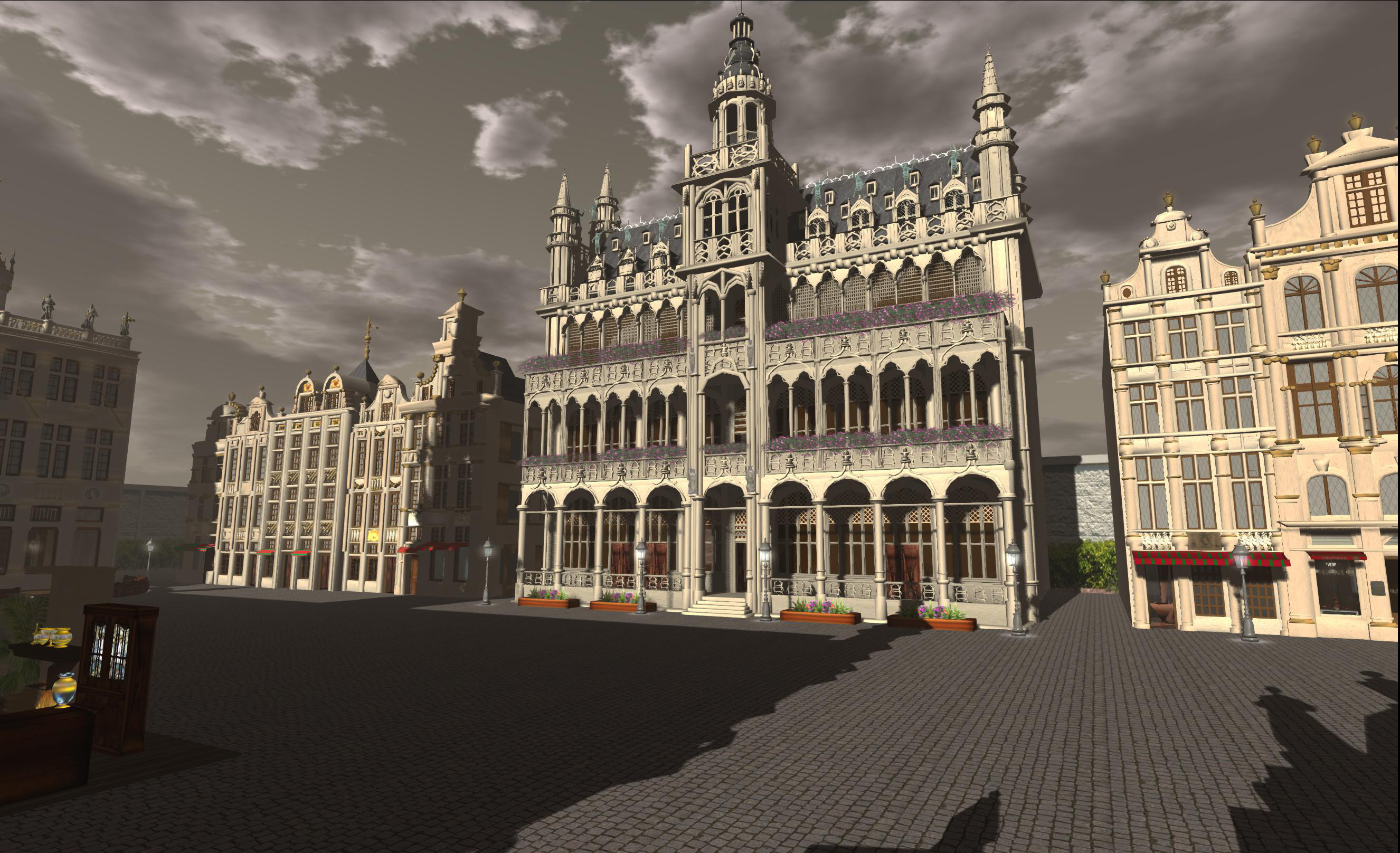
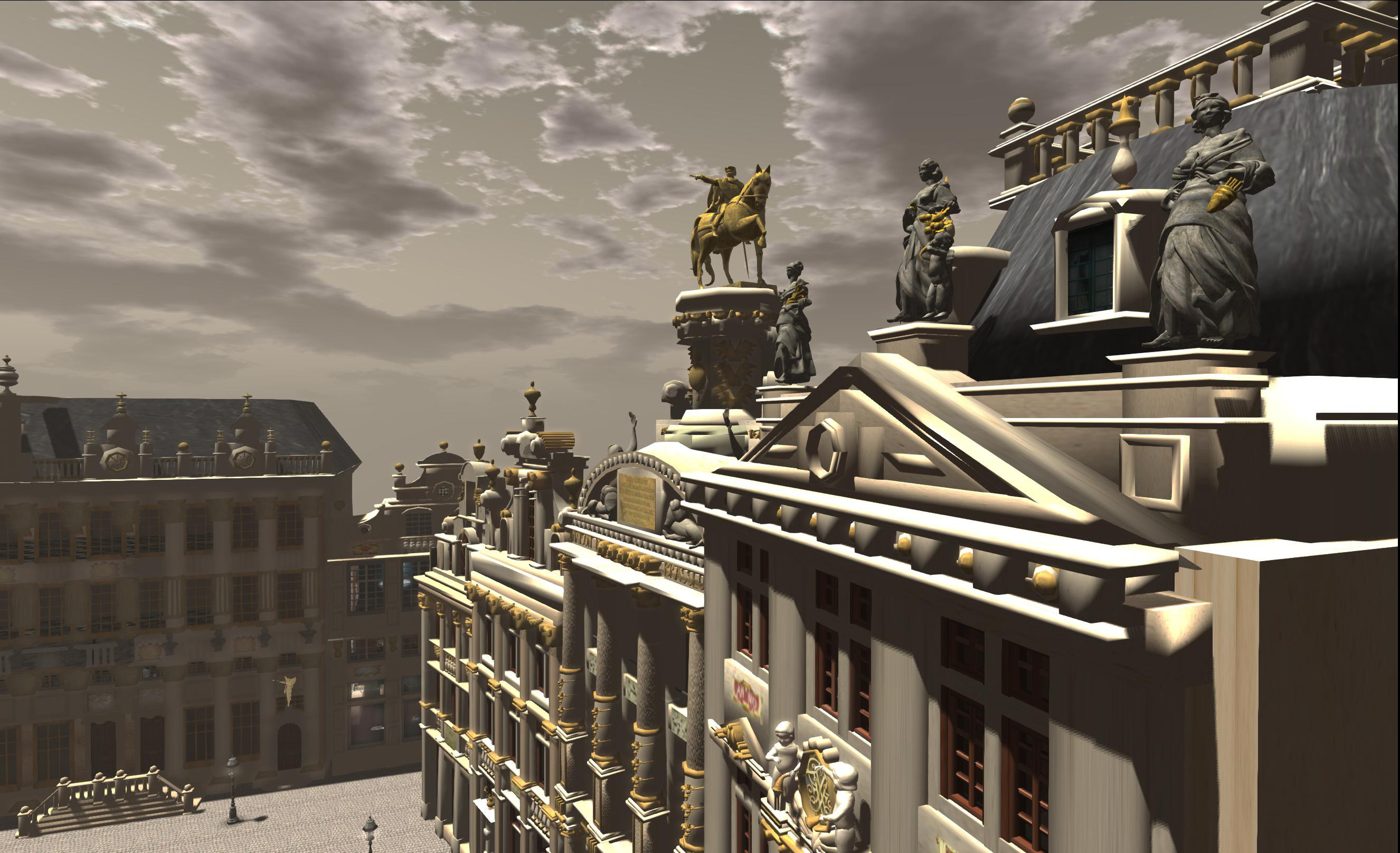
It is one of the most stunning palaces in the whole of Europe, one that brings together light, life, culture and geometry in a stunning tour de force of medieval Islamic architecture – albeit one forced to incorporate western European styles as exemplified by the Palacio de Carlos V. It is the Calat Alhambra, al-Qal‘at al-Ḥamrā’, the Red Fortress.

Occupying the top of the hill of the Assabica in southwestern Granada, the palace symbolised the height of the Islamic presence in Spain, with Granada itself the last of the great city-states of Islam within Spain to ceded itself to Christian rule when Ferdinand and Isabella conquered the city in January 1492.

Christian history would have us believe that the reconquista of Al Andalus – the Moorish name for Spain – was a Christian fight against an invading and oppressive Islamic nation – yet nothing could be further from the truth. Alhambra in many respects stood at the pinnacle of some 700 years of progressive Islamic rule in Spain which saw places such as Cordoba recognised as remarkable centres of learning for all – some 70 public libraries lay within its walls at a time when the rest of Europe saw books and learning the reserve of religion and those who ruled, while the teachings of ancient Greece – so thoroughly embraced by the people of Islam – were often regarded as heretical by the church.

al-Qal‘at al-Ḥamrā’ as it looks today

Alhambra takes its name from the rich red clays of the soil upon which it is built, rather than from any bloody elements of its history – although in some respects the fortress did initially grow out of bloodshed: following a particularly violent meeting between the Muladies and Arabs, the latter fled south to take refuge in a red castle on or near the site during the rule of ‘Abdullah ibn Muhammad (r. 888–912). In the 11th Century, and in a bid to preserve a Jewish settlement, the ruins of the red castle were rebuilt by Samuel ibn Naghrela, although accounts of the time state it was easily overrun.

However, the Alhambra we know today was started by Ibn Nasr, who fled south to avoid persecution by King Ferdinand III of Castile. In 1238, he arrived at the palace of Bādis and set about enlarging the Alhambra into a palace complex fit for a sultan.

And it is this citadel palace that is beautifully brought to life by the Al-Andalus Community Project. Spread across two regions, Al Andalus 1 and Al Andalus Generalife, which themselves reflect the layout of the Nasrid dynasty’s citadel, the build is quite simply stunning.

Calat Alhambra

The citadel comprises several distinct elements: the Royal Complex comprising the Patio de los Arrayanes (perhaps Alhambra’s most famous element), Patio de los Leones, Salón de los Embajadores, Sala de los Abencerrajes, over thirty watchtowers, living spaces for staff, as well as outlying pavilions located in the Palacio Generalife, or Garden of the Architect (Jennat al Arif in arabic). Much of this has been reproduced in the Second Life build, which avoids any of the reconstruction undertaken post-reconquista and attempts to represent the Alhambra at the pinnacle of its glory as a centre of rule and of culture – although there is a concession to another great Moorish building to be found within its walls.

There are a number of teleports to the build that can be found in Search. These include Patio de Los Leones, the auditorium (which appears to be under the Patio del Mexuar), and just inside the original entrance of the Puerta de la Justicia, in the la Plaza de los Algibes.

Where you roam from any of these is entirely your choice – there is a lot to wander around, and no set order in the direction you may opt to take. There are numerous notecard givers to be found around the citadel, each of which provides more detailed information on the section you are visiting.

Patio de los Leones, Alhambra

While there are some doubts that Alhambra’s growth beyond the original expansion started by Ibn Nasr was seen as a part of some over-arching plan for the citadel, the original royal complex was exquisitely designed over successive generations using a geometric progression based on a simple Pythagorean principle to achieve the stunning and harmonious design evident in the complex as a whole. The progression was based on the relationship between the length of a side in a square with that of its diagonal, and is elegant in its simplixity and magical in its meaning.

To explain: take a square and then measure the diagonal between two corners. This measurement becomes the long side of a rectangle with the same base length as the original square. Now take the diagonal of the rectangle and use that as the long side of another rectangle, again with the same base length as the original square. Now take the diagonal of that rectangle, and make it the length of the long side of a third rectangle.

When you do this, you get two intriguing results: the first is that the diagonals of all four progress through the square roots of 2, 3, 4 and 5. The second is that the third rectangle is exactly twice the height of the original square.

The unique geometry of the Alhambra is clearly evident in the Patio de los Arrayanes and the Torre de Comares beyond.

This approach to building the Alhambra is repeated around the original royal complex, and is perhaps most notable in the Patio de los Arrayanes, where the Torre de Comares rises behind it, to form a perfect geometrical and symmetrical design that is reflected perfectly in the water of the Patio’s infinity mirror. It lends the Patio an even greater feeling of sitting in harmony with nature.

The use of this progression is in evidence elsewhere within the royal complex, both in the buildings and in the layout of the courtyards and gardens. Similar geometry is also evidence in varying forms within the ornate wall coverings and carvings.

Patio de los Leones and the geometry of the Alhambra

It is also something that has been captured in some measure in the Second Life reproduction.

Take the Patio de los Leones, for example (right). Here the progression using the square and rectangle can clearly be seen. The lower section of the pavilion (up to the bass-relief) is the square. The diagonal of this square gives the elevation of the wall to the eaves of the pavilion. It’s a very subtle nod to the original, and it is sad in some respects that the nature of Second Life, where scale is compromised by things like the average height of avatars (7+ feet) and the default placement of the camera, that this ratio / progression isn’t always obvious or achievable throughout the build.

A garden of dreams at World’s End

Update: World’s End Garden relocated to its own region at Worlds End Garden.

Himitu Twine has a marvellous talent. No, that’s not right; Himitu Twine has many marvellous talents. Let me start over…

One of Himitu Twine’s many talents is the ability for find truly wonderful places in Second Life one can visit and enjoy. In the time I’ve known her, she’s introduced me to places that, to my shame and despite nigh-on five years in this incarnation in SL, I’ve totally missed – and would have remained in ignorance of, if not for her.

One such place is World’s End Garden. The work of Lucia Genesis, the garden is a haven for the lost or restless soul; a place for quiet contemplation, for thinking about life, and for romance.

World’s End Garden; come, explore

You arrive in a the stone ruins of once was clearly a huge building – but what was it? Abbey? grand mansion? Towering castle? Immediately the imagination is engaged – what was this place? Who built it? What is its story? Wander the ruins and seek clues; you might find them – you might not; it depends on your own imagination. But as you wander, you will discover things.

Across the water is the decaying remnants of what once had clearly been a house – this one made of wood and, it would seem, built much later than the ruins where you arrive. Furniture and ornaments sit within what is left, broken staircases climb forlornly to half-vanished rooms and empty sky. Does someone still live here? Why is the decrepit carousel still turning, the paint on the horses faded, cracked and peeling? Again, the visual cues are here to set your imagine running, curiosity well and truly piqued.

Is a house still a home?

The house also doubles as Lucia’s shop and features some gorgeous creations masquerading as household objects; I particularly fell in love with the rose in a glass bowl; simply exquisite – as are all of the designs.

Water is cleverly used to break the garden up into individual “islands” that attract the eye as one wanders the sim; but nothing is entirely unrelated here – or at least, that is the feeling the place gives. It is as if one is wandering the ancient estate of some great family, long past its prime or that once belonged to the church but now long abandoned, the land deserted and given over to the encroaching sea, the surf lapping about those parts still left, gulls crying distantly.

Wander on through the water and you’ll discover not all is forlorn or decayed; under the shade of a great tree you can sit and reflect the passing of days or play the ghostly piano that awaits you. If you are with a friend, you can dance to the music of the piano as the sun kisses the far horizon.

Dancing is also the focus of another “island” shaded by a tree, where stands a peculiar gazebo looking for all the world like a gigantic bird-cage, waiting to trap whosoever steps inside to waltz to the music of an old, horned gramophone.

Come sit, come play, come dance

The impression that the gardens are but a remembrance of a once great estate is heightened by the fading white of an old church, fighting a losing battle against moss and lichen and – just a short distance away – bleached crosses presumably marking the last resting place of the departed…

But were they members of a family or an order? Listen at the church and you’ll hear a deep, ghostly chanting…the last echoes of a forgotten brotherhood? Close your eyes and let your imagination paint a picture…

But this isn’t just a place to explore and look at – there are hidden secrets for you to find; gateways that lead Elsewhere. Is the sunlight falling through the ruined roof of the church and across the partially flooded floor simply sunlight, or does it offer something more?

More to see than may be apparent (click to enlarge)

What happens if you try to touch a beam of sunlight?

And is a cross simply a mark that death has passed this way – or it is also a gateway to another place and another mood?

Take these clues and discover what they hide for yourself.

It is this added dimension of exploration that is possible within Second Life that makes places like World’s End Garden a joy to visit; no only do you have so much to see and contemplate and enjoy from the moment you arrive, you also have much to discover, little mysteries to solve that lead you to new scenes, new possible revelations and a new sense of wonder.

Every scene in World’s End is beautifully designed and rendered; Lucia has clearly spent  many hours in developing the Garden and sculpting it to tell just enough of a story that it naturally draws you in; it is truly a visual delight. Just take the time to zoom in close to any of the trees down on the ground or elsewhere and examine the intricate detail of the textures used to create the foliage.

The Garden is a place this is very much alive as well – it evolves and changes over time as Lucia revisits and remodels, which means that over a span of months a returning visitor may find much has changed and shifted and there are new secrets to uncover.

But that is the beauty of art in Second Life: it need never be static; the artist and the creator are free to turn and change, and as a result the visitor and audience always has more to discover and share.

For my part, I have fallen in love with World’s End Garden, and will be returning often to wander, to dance …. and simply to sit and look.

Links and Hints

Reflections on The Looking Glass

The Looking Glass is the joint creation of Marcus Inkpen and partner Sharni Azalee, and is located on their sim of Horizon Dream. It’s a fascinating mix of elements brought together in an inspirational and highly photogenic feast for the eyes.

The Looking Glass

The arrival point sits on a small quay in one corner of the sim. From here you are free to wander and explore the region – or if you wish you can click on the Mystery Gift box and receive a clue designed to help you on your way to fining the gift itself. The clue is given as a verse from a poem:

The fields are all dried up, the corn’s all gone dead,
So he pulled up his post and to the shore he did head.
There are no crows there now, to bug him all day,
So he tries his best to scare the seagulls away.
An old crumbling tower lends his new home some shade,
And a little bird sings to him until the daylight does fade.

A sign swings from a post beside a rickety set of wooden steps leading up from the quay to a small town of indeterminate age. Here are discrete stores where you can purchase various creations by both Sharni and Marcus – some of which are in evidence around the sim itself. Careful where you walk however, as an exposed manhole cover hints there may be things going on below ground as well as above.

Wander through town and you’ll eventually come to the Looking Glass Amphitheatre, an open field where stands an ornate glass stage and a grand piano – a place for dances and other events. From here you can return to the town and climb the stairs to the huge Clock Tower that dominates the hill behind the town – or you can take a more direct route up the rocky side of the hill to reach it.

The Clock Tower and hall

The Tower’s hall is a gallery used to display work by other SL artists. During my most recent visit it featured a display by Skusting Dagger.

Several options for exploration offer themselves to you from the Tower, which you take is up to you. For my part, I walked out along the “bridge to nowhere”, as I call it, to appreciate Marcus’ imaginative sculpture La Mer. On my return, I headed up to the Temple Ruins – a place better reached by teleport, or by flying, admittedly.

La Mer by Marcus Inkpen

The Temple ruins is referred to as a particle stage, and is used to hosts various events on the sim; the most recent being by InterfaceD Dreamscape who presented a particle show, with music by Novulino.

One of the delights of The Looking Glass is the juxtaposition of themes and ideas: the town area seems to be old, but has hints of it having somewhat modern setting: the pool table in the bar, the television aerials poking up from chimney and rooftops, the no parking signs, and so on. As one walks through it, one cannot help but feel that while it may once have known better days, it is now running to seediness and no-one really cares about it any more.

That no-one cares is evidenced by the Forrest theatre, which appears to be still in use, despite having threadbare carpets, smashed glass in the front doors and the domed windows above, while the stage itself is exposed to the sky thanks to a partially collapsed roof, while the walls at the back of the building are broken and ruined. Whether the damage is the result of age and disrepair, or the result of a possible fire, is yours to decide..

Elsewhere, the buildings suggest something more medieval in tone, or at least leaning towards fantasy – something that is heightened by the wonderful Floating Islands that form a peaceful retreat within a peaceful sim. There’s even a touch of The Waltons, with a small farm-style layout from The Looking Glass Victorian Cottage range.

Wizard’s Retreat with Sky Gardens beyond

The mix means that The Looking Glass is very photogenic and makes an excellent subject for machinima; in fact it has already been the backdrop for a film by the ever-talented rockerfaerie on YouTube (aka ColeMarie Soleil in SL). If you are going to be taking photos of the sim, I’d recommend that you set the Sun to sunrise to generate the most dramatic results. At least it worked for me, I think – although I’m admittedly far from an expert in such maaters, and useless with Photoshop when it comes to post-processing.

The Sky Gardens

The sim may not be as complex as somewhere like Alpha and Omega Points, and when not hosting a live event, may appear somewhat quiescent – but to me, both of these facts actually enhance its appeal.

But this doesn’t mean there is not to discover. Even when you’ve finished above ground and taken a trip up to the Floating Islands or the Floating Victorian house, there is more to seek out – if you can find it. Just what is the history of the hidden throne room? And romantics won’t want to miss the crystal garden. I would offer a word of warning, tho, should you find your way underground; the teleport at the town’s manhole can be a little brusque in helping you back to the surface!

As well as exploring, this is a place one can come to when one simply wants to be in-world, but without the pressure of needing to “do” something; the sim invites you to wander, to sit and simply enjoy. It’s a place I come to when feeling reflective. It’s also an attractive visit because it is not only a work that expresses the talents of two well-known SL artists, it is a work that actively promotes the work of other artists as well.

Floating Victorian House

I have to admit I very much like the way in which products from The Looking Glass are presented as a part of the overall build – it is subtle but highy effective and demonstrates very clearly both the build quality involved and how the products can be used. It’s also a clever strategy in that it doesn’t leave items like vendor boards sticking out like sore thumbs. If you do see anything you particularly like, be it a house, a bridge, a street lamp or item of interior decor, it can be found in one of The Looking Glass stores in town. I have to admit, I’ve been sorely tempted by the Floating Island range, given the latest iteration of my own home is built into a floating rock. Truth be told, the waterfall from the Floating Island range still does call to me whenever I visit!

Lighthouse with the landing point to the right, and the Floating House beyond, left

Whether you are looking for a place to visit, somewhere to film or an inspirational location for your photography, The Looking Glass is a fabulous place to visit. Exploration here is easy, with an edge of mystery, and there is much to see and enjoy without it impinging on all your time.

Definitely worth a visit or three!

The Alpha and Omega of SL

Update: Alpha and Omega Points have both closed.

Alpha Point and Omega Point are two stunning builds in Second Life created by Masoon Ringo and Sweetlemon Jewell. Occupying a full sim and a Homestead sim, they form a marvellous build that combines fantasy and science-fiction in a way that simply demands exploration. Just make sure you give yourself plenty of time to do so; there is much to see – and much that can be so easily missed if you rush things.

I was introduced to the regions by Himitu Twine, who spends a good deal of time at both, wandering and exploring – and after the first time I joined her at them, I could well understand why. The combined build is simply glorious. Nor is it entirely static; Omega Point has altered over time, and I’ve no idea as to how permanent the current layout is. So, if you’re reading this piece six months after it is written, don’t be surprised if you follow the SLurls and find things have changed; it simply means you have a new experience to enjoy and will still have much to see and discover.

Alpha and Omega Points

Before you do pay a visit, make sure you turn your draw distance up as far as you comfortably can in order to get the fullest impact of the build; I recommend a setting of around 300m. Also, like a lot of regions nowadays, both Alpha Point and Omega Point have their own Windlight presets, and I recommend you keep to them after you’ve arrived.

The current teleport co-ordinates are such that whether you travel to Alpha Point or Omega point, you arrive at more-or-less the same place: an arrivals area that spans the boundary between the sims, high up and central to the build as a whole. While a marker clearly defines the sim boundary itself, I suggest you wait until things rez before moving around too much, least you find yourself bouncing off the boundary itself (although crossing between the sims, providing you do so at walking pace, is generally very smooth).

Once rezzed, cam out a little and orbit around your position. What appears to be a spired city, with trees and waterways below and a storm-laden sky above surrounds you, and you get the first indication of the complexity of the place. But don’t go camming too far out and peering into windows and doorways – you’ll simply spoil what is to come. This is a place that is best discovered through exploration.

The arrivals areas themselves have a series of teleport panels to get you to many of the points of interest and beauty in the build. At Alpha Point there are also a couple of flying options you can use to get around. However, I do suggest you ignore both flying and teleports to start with.

Teleport arrivals: Alpha (l) and Omega (r)

The arrival areas also have stairs and walkways leading from them, and if you really want to experience the build, then you should really start by using Shanks’ pony: take the stairs and start your explorations on foot.

At the time this article was written, the stairs from the Omega Point arrival area lead down to a lower level from which you could make your way to the huge central tower, crossing a gargoyle-lined bridge, or you could carry on down even further to other walkways, landings and stairways until, eventually, you reach the ground. From here, it is possible to wander among trees and fallen sections of the build, long forgotten and half-buried that point to a story yet to be told about the passage of time in this place. There is much to be discovered while down among the trees, so don’t be afraid to wander wherever you will.

“Climb the stairs, Jim!” – yes, that’s me at the top!

Take the long staircase down from the Alpha Point arrivals area, and you’ll come to a walkway that leads the way around a stunning view of a waterfall. Follow the walkway further, and you’ll pass back under the waterfall, and so enter the labyrinthine lower levels of the build. Here hang paintings and images high up along tall walls, each with a story of its own. Here too, are stairways leading both up and down…

Sims extensions – cleverly used (click to enlarge)

One of the things I love about this build is the imaginative use of off-sim phantom prims to create an even more fantastical realm. In places, it’s as if the build never actually ends; it simply continues beyond our reach, down a hall, along a path or around a corner. It’s so tantalising; the effect engages the imagination and leaves one with a sense of “if only”; if only we could walk around that distant corner and slip under that shadowed archway, or reach those distant doors! What would we find, what wonders would await us – what stories would we have to tell? Lying beyond our reach, these parts of the build demand we fill their hidden promise with people, places – and creatures…

Never knowing quite where you are going to end up is another reason I like visiting; follow a route down into the bowls of the build, and it is quite possible that if you take enough stairs and turn enough corners, you’ll find that the way you thought lead back to where you came from has actually lead you somewhere else entirely. Just do be careful where you do walk, however, some of the walkways appear to lead you towards a destination, only to end abruptly, as if a section has fallen away; whether through age or other reason is up to you to decide.

Flyers – a great way to get around

Should you tire of walking, but still have no wish to use the teleports, you can opt to take one of the flying options mentions earlier (so much more fun than free-flying on your own!). Find them back on either side of the Alpha Point arrivals area and teleports.

You can choose from a flying bubble or a craft that resembles a dragonfly for your aerial excursion. Each carries up to two people, allowing a friend to share the experience with you. Full instructions are provided via hovertext, and the usual keyboard controls can be used to control direction / height. Both craft are rez-on-demand from the master version, and will de-rez when you stand up from them. They are certainly a great way to see the build from above, and both perfectly match the theme and design of the place. While crossing  between the sims is very smooth for the most part, it’s worthwhile keeping an eye on your co-ordinates and taking things gently as you do reach the boundary between the two.

Romance or solitude also await those who seek them

Nor is the build short on romance. You can dance the time away in a ballroom or among the trees or beside the tumbling waters of a fall; you can cuddle quietly in one of many sofas and seats to be found throughout the build, or amidst the trees and grass of a floating garden; you can spend time admiring a waterfall, sitting on the banks of a river or sharing a raft as the water cascades down from high above…

There are also stories to be found as well, if you take the time to seek them – or at least, the hints of stories to be told – such as that of the storm and the shipwreck.

The wreck and the waves

Whither sailed the ship before the storm caught her and tossed her toward the rocks? What was her cargo? Did anyone from the shore witness her sad fate – and what of her crew? Did they live to tell of her loss, or did they perish in the unforgiving arms of the sea?

The start of the story is there for you to see – but how it should end is down to your imagination, and your imagination alone – but you’ll have to find it by exploring in order to settle on your own tale!

Even with the flyer options, however, there are some places here that are best reached via teleport. One of them is the fantastic “Village to Heaven”.

Set high in the sky and surrounded by perilous mountain peaks, this is another stunning build, rendered in ivory, marble and ice blue, with gleaming cloud-ships sailing by, and  lush woodlands below.

“Village to Heaven”

The scale and attention to detail here is equally as stunning as the build on the ground, including the use of phantom prims to extend the beautiful fantasy of the place beyond the limitations of the sim boundary, again giving the illusion of places we cannot visit and stories we cannot witness.

Take the path from the teleport, for example, and follow it through the doors leading into a huge amphitheatre – a feast for the eyes in itself – then cross to the other side and open the second set of doors. Just where does the path, sloping upwards and guarded by pairs of white-cloaked statues, lead? What lies beyond the gilded doors at the far end of the climb? You can never know for sure, as they lie beyond the edge of the sim – but as you walk as far as you can towards them, you can be sure your imagination will be asking questions as to what might be there, and who the robed statues really represent…

Another stunning use of a custom sim extension – where exactly does the sim end? Walk the path and find out…

Teleports are available here as well, but you should take the time to explore on foot, there is so much to see. The Village comprises parts representing the four elements: Air, Water, Earth and Fire – and I found that Air and Water in particular put me in mind of Tolkien’s Imladris – and I expected to hear the soft lament of elves if I turned on my sound.

Cloud ships

The key here is, again, to take your time with your explorations. When you have seen all you wish to see, look around once more. The chances are there is a path or stair or doorway you may otherwise miss.

When you are satisfied with all you’ve seen, return to the teleport point and climb the stone stairs. These lead up to the a Fall Pod platform. Here, every few seconds a ball will drop and roll towards a tunnel-like chute. Grab one quick with a right-click and SIT, and take a ride back down to the world below. It will reveal things that have so far escaped your attention as you return to the Alpha Point arrival area.

If there is one problem with this build, it is that when it comes to reviewing it, there is simply too much to see. This article is already around the 2000 word mark, and I’ve barely scratched the surface of the place. To try to capture everything in words and images would take a novella. But then, frankly, words and images alone do not do Alpha Point and Omega Point any justice. This is not something to be read about and looked at via static pictures; to do so would be like convincing yourself you’ve watched The Fellowship of the Ring on the basis of seeing and reading the film poster.

To really appreciate this build, it has to be visited; it is something that should be experienced, explored, enjoyed – and savoured – and I urge you to do just that. But be warned: once you have visited the Alpha and Omega of Second Life, you are likely to find yourself coming back time and again. The build is magnetic, inspiring…

…Addictive.

Omega Point

To further whet your appetite just a little more, here’s a machinina video JJCCC Coronet produced just over a year ago, showing how Omega Point looked back then.

Related Links