Frogmore: Swedish childhood memories in Second Life

Frogmore, August 2019 – click any image for full-size

Update, November 2019: Frogmore has relocated to a full region. The SLurls in this piece have therefore been updated to point to that location. A review of the new region location is available here: Frogmore: more Swedish memories in Second Life.

Frogmore – or to give it its full name, Frogmore Gamla Stan (“Frogmore Old Town”), is a homestead region designed by Terry Fotherington (of {PAPPADO} – read more here and Kekeland  – read more here – fame) on behalf of region holder Bengta. The region’s design serves a very specific purpose, as Bengta explains:

Frogmore Gamla Stan is a memory of life as a child in Öregrund, Sweden. The air is filled with the scent of the sea, old fishing boats, and smoked herring. A simple life filled with love and laughter.

Frogmore, August 2019

A quick check on Öregrund reveals it to be a small town (population 1,500-ish in 2010), on the Baltic coast of Sweden’s Uppsala County. It’s apparently a place that was largely ignored by Sweden’s 19th century industrialisation; other than bar iron passing through the town’s harbour en route to places like England, the town itself largely remained centred on fishing, although in the late 19th century it did became popular as a spa resort.

It is that history as a fishing town, as Bengta notes, that Frogmore draws a part of its inspiration, together with the rugged beauty of the Scandinavian coast, to form a wonderful little fishing hamlet clinging to a rugged coastal region / group of islands. Given that it is only inspired by childhood memories as visualised through the eyes of another, direct parallels between Frogmore’s look and Öregrund perhaps shouldn’t be made.

Frogmore, August 2019

Instead, it is better to simply wander along the single, cinder-topped road, passing between brightly-painted wooden places of business and cabins (none of which are furnished within, to allow the focus to be on the landscaping and overall setting, to where steps climb upwards and more inland. The waterfront cabins and buildings are literally that: right on, and sometimes over, the water, with steps and moorings for rowing boats, nets drying as they hang from walls, and sofas and benches set on raised porches.

More houses and places of business can be found on the stepped shoulders of rock rising on the landward side of the road, and with a little care and scrambling, you can make your way to where a primitive log bridge spans a narrow watery gorge separating the two largest islands. This is worth taking, as it leads the way past a superb little rocky stream that tumbles down from one pool to another which, presumably has an opening somewhere under the cold-looking waters to allow the flow to continue on its way. Created using one of Alex Bader’s new Animated River Building Packs (see here and here), it really shows what can be achieved with what is  – to me – the best mesh river system available in SL.

Frogmore, August 2019

Exploring the region can be both fun and a little frustrating. Fun, as there are little cinder trails to be found here and there, offering the way between rocks to cabins or down to little beaches and coves. Frustrating, because although there are a couple of paddle boat rezzers to be found on the different islands, the lie of the land means you can’t actually use them to get from the little town to the other islands or vice-versa, leaving flying the only alternative.

The other peculiarity I had with a visit was that on our first (exploratory) time in Frogmore, the region was backed by off-sim mountains. On my return for photos, these steadfastly refused to render (and I tried 3 different viewers and various tricks to try to force them to render). Hence why some of the shoots accompanying this article may be different to those of Frogmore you may have seen elsewhere. Chatting to a couple of other people on the region, I learned they were having similar issues between visits – sometimes the mountains would render, sometimes not.

Frogmore, August 2019

But, mountains or no mountains, there is no doubting Frogmore’s beauty or its uniqueness among public regions, not just because of its appearance, but because of its founding inspiration and the “third-party”, so to speak, interpretation of that inspiration by the designer.

SLurl Details

An Autumn’s Cherishville in Second Life

Cherishville, August 2019 – click any image for full size

Shawn Shakespeare suggested we make a further return visit to Lam Erin’s Cherishville over the weekend, noting it had been redesigned in readiness for autumn’s arrival in the northern hemisphere. So we hopped on the Second Life express and alighted at St. Bronxton Railway Station, a quaint little end-of-the-line station that is one of Cherishville’s many new features to capture the eye and the lens.

The region is now centred on a channel that cuts it neatly in two from east to north-west. With the stone-built banks topped by paved footpaths and spanned by a single bridge, the channel is bordered on either side by an assortment of buildings; so much so, that despite facing open water at either end, it has the look and feel of being the mouth of a small but navigable river, and the buildings on either side are the result of a estuary township, the people drawn here for the open seas and the opportunities for fishing and coastal commerce.

Cherishville, August 2019

This little township is distinctly of two halves. The west bank of the river, which includes the landing point and the aforementioned railway station (set back from the river’s edge) has – to me at least – a very English feel to it. With the buildings crowding the waterfront, I was immediately put in mind of a small river estuary in Cornwall or Devon; the stone-built houses and shops speaking of a place that had in the past grown up as a result of commerce along the coast. In fact, such is the look to that side of the river, I wouldn’t have been surprised if during our visits, Aram Khachaturian’s Adagio from Spartacus welled up in the background as the Charlotte Rhodes hove into view, James Onedin at the helm (Yes, a (possibly obscure) British TV series reference thrown in as well!).

Across the stone bridge, the east side of the river has a more American look and feel to it: posters advertise Connecticut and New England lobster, Martha’s Vineyard gets a mention and the fuel prices are in USD. Even the wooden buildings have the look and feel of rural Americana.

Cherishville, August 2019

But no matter what influences have been drawn into the design, both sides of the river have one thing in common – something also common to both sides of the Atlantic in the autumn: rain. To say this is coming down in buckets would be an understatement; for those so inclined, brollies, coats and wellies are the order of the day for a visit! Although truth be told, the rain (mesh elements places along the line of the river) add considerable atmosphere to the setting. It pounds the footpaths and board walks, given both a sheen that reflects lights (if you have ALM enabled!), while puddles set golden, red, orange and yellow leaves drifting under the influence of a gentle, rainy breeze.

Beyond the river and town, the land undulates in low, wooded hills or spread in flower-rich ground before dropping away to the water once more. A lighthouse raises a finger into the sky to the north-east, adding to the feel of this side of the river being  more American in setting, whilst on the west side, the land is cut in part by the tracks curving out from Bronxton Railway Station, whilst also easing its way to a shingle ribbon of coast looking south and out towards two smaller islands, each topped  by  a cabin.

Cherishville, August 2019

These cabins appear to be open to the public – at the time of our visit, the larger was unfurnished as well. However, as there are no obvious means to reach either of them save by swimming / flying, we didn’t venture any closer than the beach to find out, as we didn’t want to invade any privacy should either be for private use.

Not that any visit really is necessary: there is more than enough to see and photograph around the river front town and immediately behind its rows of buildings without every need to cross the water to the smaller islands. There are also plenty of spots scattered around when sitting and passing the time can be enjoyed – particularly along that southern ribbon of beach.

Cherishville, August 2019

There are admittedly one or two rough elements in the design. Some of these are somewhat down to the nature of the mesh beast – it’s possible in places to find yourself walking in raindrop splashes hovering at waist level. Others may well be because Lam is still tweaking the design – on my return run for photographs, he was shuffling buildings, sorting out hovering trees and carrying out some general furnishing.  Certainly, none of the is enough to completely spoil the setting or the autumnal feeling it imbues whilst wandering and exploring.

All told, another classic design from Lam, very different from its summer iteration (read here for more), but well in keeping with the upcoming seasonal change in the northern hemisphere (climate change allowing!), and very much worth the time to visit – as always, and photos welcome at the region’s Flickr group.

Cherishville, August 2019

SLurl Details

On the waterfront at Pappado in Second Life

{PAPPADO}. August 2019 – click on any image for full size

Shawn Shakespeare suggested we drop into {PAPPADO}, a 1/4 Full region parcel offering a waterfront design suggestive of somewhere along one of Europe’s Mediterranean coastlines.

Unlike most 1/4 region parcels, which tend to make up a square within a region, this one looks to be two 1/8th parcels that have been joined end-to-end to present a ribbon-like setting that runs entirely across the north side of the host region, east to west ,that in turn makes for an ideal coastal build.

{PAPPADO}, August 2019

On arrival, I was somewhat put in mind of two places we’ve vitised in the last year in SL – Little Havana, which we dropped into in December 2018, and Keleland, which we last visited a year ago, in August 2018. The resemblance to either is somewhat superficial – {PAPPADO} has a personality all its own – but in the case of Kekeland, it is perhaps understandable given the parcel’s principal designer is Terry Fotherington, who designed Kekeland alongside of Bridget Genna.

The landing point sits at the eastern end of the parcel, on an aged stone terrace bookended by the sea to one side and an old chapel-like building on the other. Both terrace and chapel share their stonework with an arched gateway that backs the terrace, all three suggesting that are all that remains of a large structure that once stood here – although the walls running from either side of the gateway are of a much more recent design, and the gates themselves suggest they are perhaps not the originals.

{PAPPADO}, August 2019

Beyond the gates is an old slipway; what it may have been used for is unclear, but the hulk of an fishing boat lies canted over on the sands close by, and another, seaworthy trawler sits just off-shore – the first hints that this is as much a working destination s vacation spot.

Running westwards away from the landing point is the broad ruler of a road sitting between sandy beach and seafront properties that would appear to cater to those on vacation – there’s a motel, a cinema, a little ice cream parlour and a cake shop. Arches and alleyway provide access to a cobbled street paralleling the beach-front road and which offers a mix of possible residential houses and smaller commercial units.

{PAPPADO}, August 2019

Mid-way down the road sits a further set of arched gates that slice across it and standing in defiance of any four-wheeled motor vehicles that might happen down the street. While the road does continue beyond the wrought-iron gates, the surroundings take on a far more businesslike look. The beach is replaced by wharves, the sand by rocks and shingle. Signs indicate this is a place were fishing is the order of the day – although given the rocks in the sea, I would not like to try to bring a fishing boat alongside the wharves!

The buildings here also appear a lot more careworn than those to the east, again perhaps an indication that enticing tourists or holidaymakers is not their primary goal. Beyond them, where the road meets its end, a path and little bridge cross a busy brook to provide access to another small beach area backed by a modern-style house (apparently open to the public), offering little spots on the sand for folks to enjoy at this end of the parcel.

{PAPPADO}, August 2019

Quite where in the world this might be is anyone’s guess. The gay colours of the buildings at the eastern end of the setting put one in mind of places like Havana, but the preponderance of Vespa scooters suggest somewhere on the Italian coast. However, and wherever you chose to see it, {PAPPADO} offers a pleasing diversion (although one or two of the props could perhaps benefit from some adjustment – a corner café has a few floating chairs, as does the beach!).

SLurl Details

Broken’s summer beauty in Second Life

Broken, August 2019 – click on any image to enlarge

We first visited Broken, the homestead region designed and held by Natalia Corvale, at the start of 2019. At that time, it offered a winter’s setting: a place lightly dusted in snow (see The beauty of Broken in Second Life for more). Now, eight months later, things have moved on and in keeping with the northern hemisphere seasons, Broken presents a landscape caught in the bloom of summer and caught under twilight’s full gleaming.

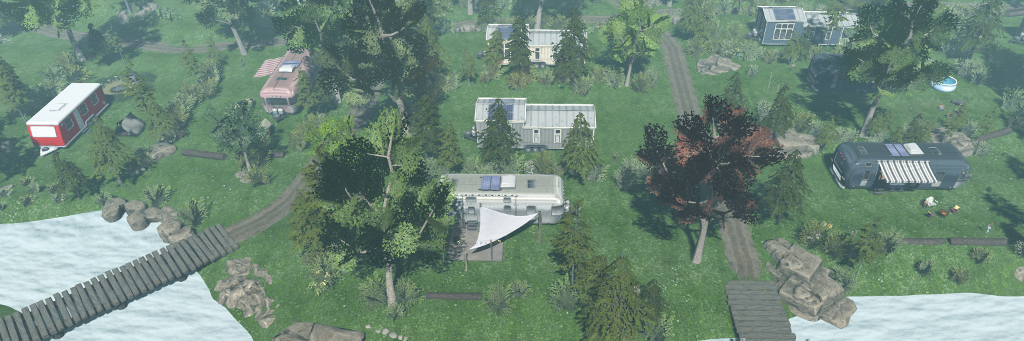
The land lies split into a number of islands, some connected by bridges, others perhaps best visited by the little swan boats that can be found a short walk to the north from the landing point. The latter sits within the largest island in the group, a low-lying, grassy location marked by the presence of a barn and several horses that stand idly around.

Broken, August 2019

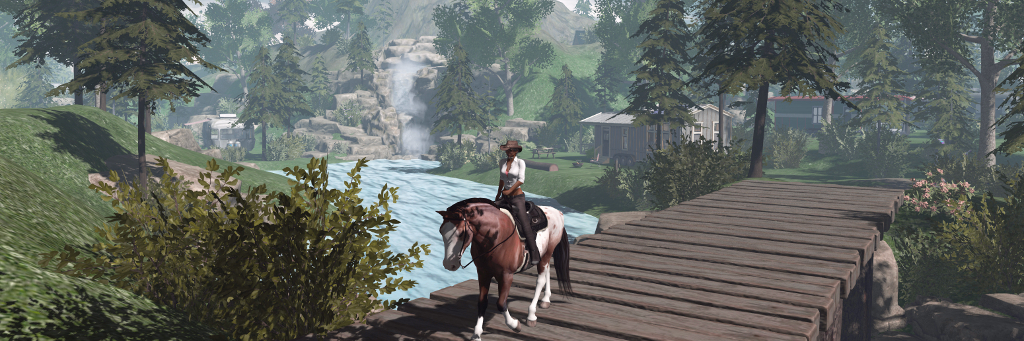
Examination of the horses will reveal they are in fact Water Horse Animesh animals available for visitors to ride; just click a horse to mount it (you’ll be offered a riding HUD – not a vital requirement – and removable stirrups). Use the Arrow or WASD keys for movement, with a double tap of W or Up to cycle through the walk, trot, canter and gallop options (and a quick tap on the D or Down arrow to cycle back down).

The HUD, for those who want to try it offers an option to dismount and lead the horse around, whilst standing from it de-rez the horse – don’t forget to remove the stirrups from your feet! (you can also find out more about the horses in my review The Animesh Water Horse in Second Life). I should also note using the horses can make it easier to cross to those islands in the group that are not linked by bridges to their neighbours.

Broken, August 2019

When writing about Broken in January, I noted that the region has the feel of being a personal design for Natalia. This still feels the case now; the dedication offered in the About Land description  – “for anyone who’s ever lost someone” – remains the same, and it continues to resonate with aspects of Natalia’s profile information. Further the very setting, with the twilight sky under its painter’s clouds, invites a mood of remembrance and / or contemplation.

Also as I noted in January, “lost” doesn’t necessarily refer to having suffered the passing of someone close. Rather, it encompasses the separation born of a relationship – be it as lovers or friends – that has run its course and which now lies behind us. Thus Broken perhaps offers a place where memories can be recalled, although this doesn’t necessarily make it a place purely for the melancholy of heart. Far from it; there are plenty of places where couples can spend time to be found scattered across the island, both indoors and out.

Broken, August 2019

These, and the very nature and placement of the islands one to the next, mean Broken ripe for exploration and photography. Some of the locations to be enjoyed are easy to find – such as the Hideaway cabin  tucked away to the south and west of the region and that offers a cosy little place to share and o perhaps ruminate. Others are a little harder to find, and often pop out at you unexpectedly, presenting a smile of delight on being discovered.

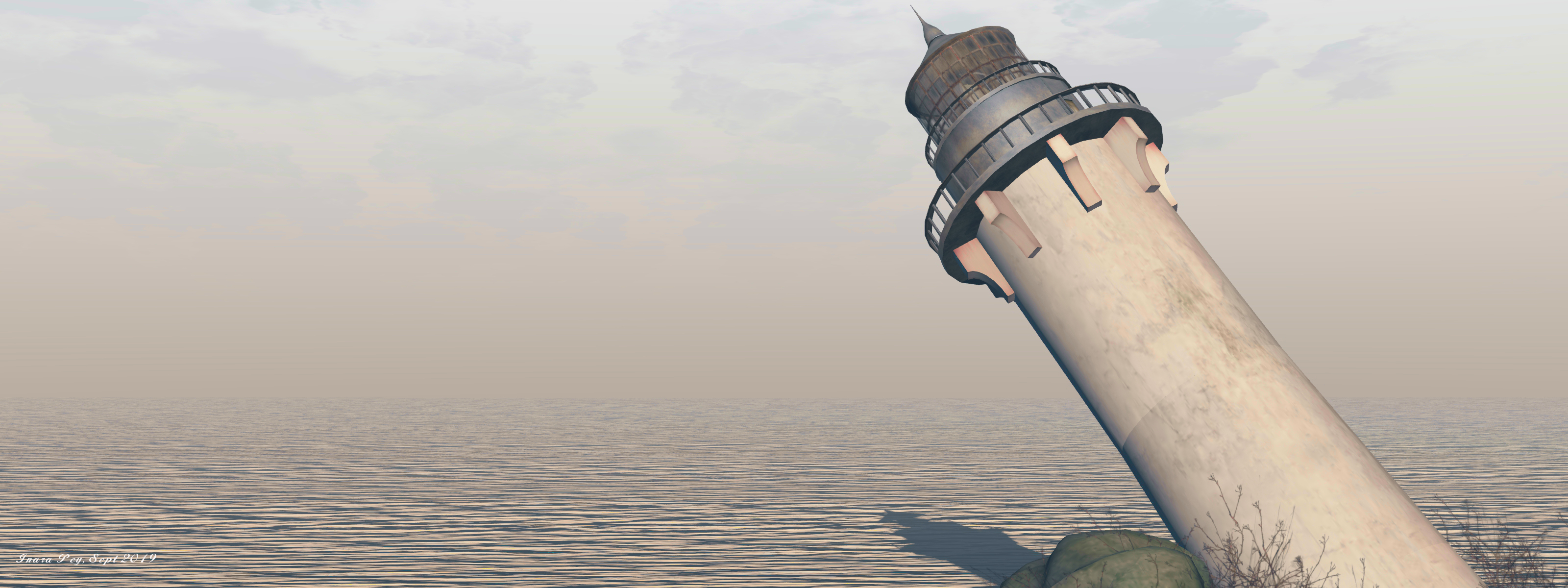
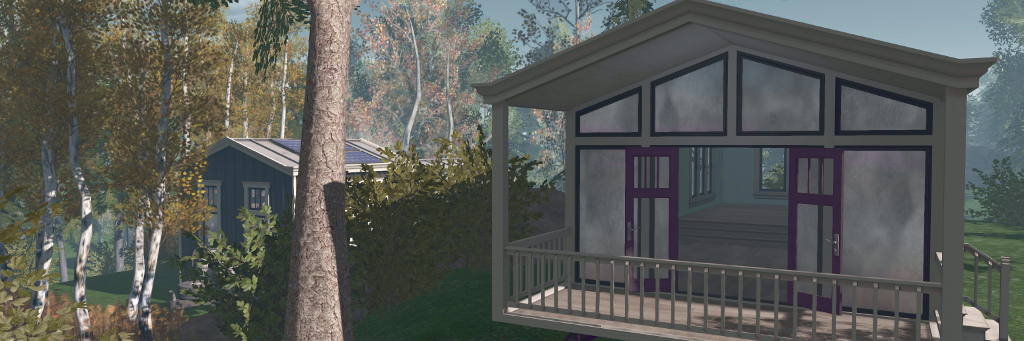
Large among the latter is the hilltop open-air theatre; more subtle are the swings beneath stout boughs or the raft floating quietly in the shadow of shoreline bushes.  Travel east and you might unexpectedly come across a little fish’n’chips bar; go north beyond the camper trailer visible from the landing point, and over the low hills beyond it, and you’ll come across another cabin, this one squatting above the open sea, its exterior careworn by the elements, its interior a cosy little retreat.

Broken, August 2019

All of this is just scratching the surface of Broken’s delight, much of which extends into the very landscaping of the region, particularly in the use of grasses and flowers across the ground. There is a natural beauty that shines throughout the region from grass to flowers to trees and buildings and individual locations, that make it instantly attractive, and that encourages the visitor to stay.

With thanks to all who suggested a re-visit to Broken: Max, Miro, Morgana and Shawn!

Broken, August 2019

SLurl Details

  • Broken (Farron, rated: Moderate)

A touch of supernatural role-play in Second Life

Clifton Forge, August 2019 – click any image for full size

Clifton Forge is a half Full region offering “modern supernatural para role-playing,” featuring humans, witches, vampires, and werewolves.

Supported by its own website, the setting is distinctly urban, representing a small city nestled within a mountain environment. It is intended to offer a place where, “blissful everyday living masks a darker and more turbulent truth”, the website setting-up a place where normalcy forms a blanket over a range of strange activities which those interested in role-playing within the environment can then take-up:

All manner of depravity conceals itself behind a flawless veneer here; the Hotel’s façade is cracked by stories of staff suicides, the Church here asks for alms – but whether it intends to divert these funds to charitable causes or fill its own coffers is unknown. A harried city cop turns Sheriff in what some might see as a peaceful retirement plan, while others wonder why she has escaped to a more pastoral clime. Everyone has a secret – what is yours?

Clifton Forge, August 2019

Like many RP environments in Second Life, the official landing point sits in the sky over the parcel in the sumptuous setting of a grand hall. Here visitors can contact the Clifton Forge administrators, and follow browser links to the RP back-story, rules and apply to join the group to participate in local role-play. Those arriving at the landing point will also be asked to join the local Out Of Character (OCC) group prior to making a visit down to the city proper. The group is free to join and helps mark visitors as non-playing characters during a visit, and you can always leave it following a visit if you have no interest in remaining a member.

Taking the main teleport to group level will deliver visitors to the east side of the parcel, and a further teleport board ready to take people onwards to some of the principal points of interest in the city which might conceivably be leaping-off points for role-play opportunities. These include some typical locations for any city setting: the local church, the hotel, the medical centre, the police station, places to sit and eat or find entertainment, and so on. However, the setting is far better seen by exploring on foot or by using the local bicycles available from the rezzer located close by.

Clifton forge, august 2019

The town is split into two, with the portion that contains the landing point also offering the main square, the city hall, the emergency facilities, various businesses and paths to some of the local residencies (note that some or all of the latter are available for rent, so do be aware of the potential to trespass into someone’s home when exploring). The second of the city’s districts – reached via a single tunnel – is home to the church and the hotel, together with further local businesses, before giving way to a more rural setting, of rocky bluffs and woodlands in which sit shacks and cabins.

Given the city only occupies a half region, attempts have been made to make use of elevation in places – notably the woodland area mentioned above, and with some of the rental properties and the church. This, together with at least one underground parking area both adds literal depth to the setting as well as making role-play more interesting by providing a sense of greater space than had things been kept more-or-less on the one level across the parcel.

Clifton Forge, August 2019

When exploring, notes that there are NPCs dotted around. some of these – such as the bouncer outside of the Castle House – will provide note cards when touched, and these cards contain game play information and local rules (e.g. such as player being frisked and fully disarmed before entering an establishment).

One or two aspects of the setting look like they might still be under development – I noted a couple of floating pieces of vegetation in the sky above the town, and the ground around Castle House looks like it might be awaiting further landscaping. However, the setting is, overall, as it is presented in the description: an urban environment representative of a small city; one that is awaiting a cast of role-players.  If you’re into the supernatural and are looking for a role-play environment that offers in in a modern setting, might be interested in taking a look – just note that for the purposes of this article, I did adjust my windlight settings away from the local default.

Clifton Forge, August 2019

SLurl Details

Wandering Highland Hills in Second Life

Highland Hills, August 2019 – click any image to enlarge

Highland Hills is the name given to a quarter Full region designed by EloiseBlake, and it is a place that packs a lot into it. Open to the sea on two sides, the parcel is described as the “Highlands of Scotland. A forgotten era. Ruined, rural and rustic. Where nature has claimed its home.”

As a representation of the Scottish highlands, I’d perhaps suggest the parcel is intended to offer some the many aspects of the highlands – the rugged hills, the rough, weather coastline, hints of glen-like slopes (al be they narrow), rushing streams, and so on – rather than any single place within them. In doing so, it presents a rough-hewn landscape that is entirely its own, one that invites exploration.

Highland Hills, August 2019

The ruins referenced in the description come in multiple forms, from the great round bulk of a coastal tower, sitting atop a shoulder of rock and protected on two sides by open sea – or perhaps intended to command an offensive view over the waters – to the squat rectangle of a castle keep brooding against the western cliffs of the land.

Between and around these two are multiple signs of what might have once been an extensive fortification – the ruins of curtain walls, ached entrances that might once have been guarded by stout gates, the remnants of a chapel, and so on. Are these all symbolic of a once might castle that dominated the landscape at some point in the past? Or are they indicative of multiple attempts to fortify and hold the land during different times in its violent history? That’s one of many questions the visitor might be tempted to ask, although the lay of the land perhaps points to the various ruins being somewhat separate in nature.

Highland Hills, August 2019

More recently, the land has become home to a small farm, the house of which sits in the lee of the great round tower, with a cattle barn sitting across the parcel from it, overlooking the eastern coast. The latter is intended to be the home for shaggy highland cattle, but the cows appear to have had other ideas, an open gate affording them the opportunity to wander down to the rocks sitting above the coastal waters.

Also down among the rocks can be found the detritus of human life: abandoned crates, broken rowing boats and so on – some of which offer places to sit. More places to sit and relax can be found scattered across the parcel, most of them easily reached from the landing point by following the dirt tracks that roll away from it. One of the latter will take visitors past the great tower, then the little farmhouse, and onwards to where beehives have been carefully set among the heather. Just to one side of these a great tree has, at some point in the past collapsed, its aged trunk now a convenient bridge by which to reach the rectangular castle keep.

Highland Hills, August 2019

In truth, getting around parts of the region can require a bit of scrambling and / or searching. Take the main steps up to the castle keep, for example. They link keep with an entry arch and one of the tracks running through the land – but the entrance itself is blocked by the stones that have fallen from the top of the arch, the keystone presumably having given way at some point in the past. On the one hand, this leaves visitors struggling to get over the fallen stones in order to climb the steps beyond, but on the other it cleverly encourages people to look for an alternate route – and those who do can be rewarded by further discoveries of hidden spots on their way up to the keep.

Similarly, finding the way up to the round tower is – without cheating – a little bit of a game of exploration. While it is possible to get up to it from inland, the easier route perhaps lies elsewhere. All I’ll say by way of a clue is that to go up, you first need to go down.

Highland Hills, August 2019

Finished with a sound scape fully in keeping with the setting, Highland Hills makes for a diverting visit with plenty to see without taking up a huge amount of time, and opportunities for photography, and pictures can also be submitted to the parcel’s Flickr pool.

SLurl Details