Ubay Island: racing the King Tide in Second Life

Ubay Island, March 2020 – click any image for full size

In October 2013, a 7.2-magnitude earthquake struck the province of Bohol, Philippines, inducing about 1m land subsidence to some of its small island communities. Now, the islands of Batasan, Pangapasan, Ubay and Bilangbilangan of the Municipality of Tubigon experience partial or complete flooding even during normal spring tides. Coming face-to-face with a hundred years’ worth of sea level rise, the island communities show that they are far more resilient than we think.

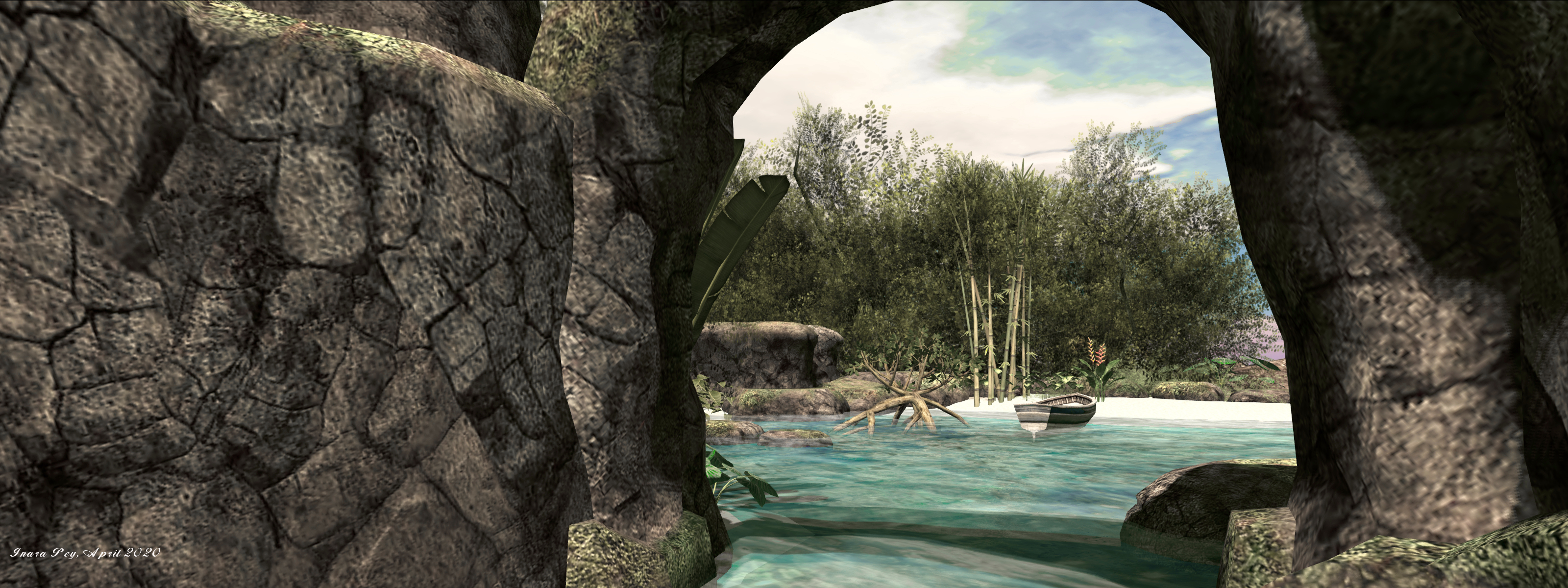
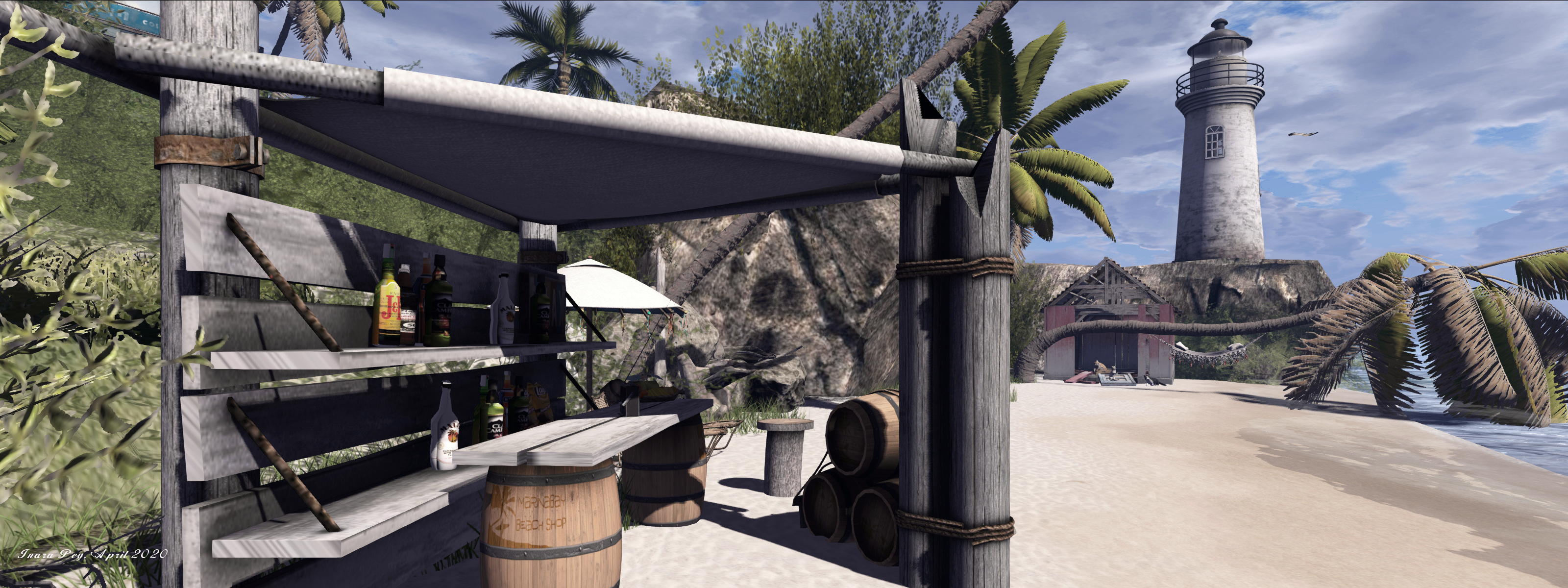
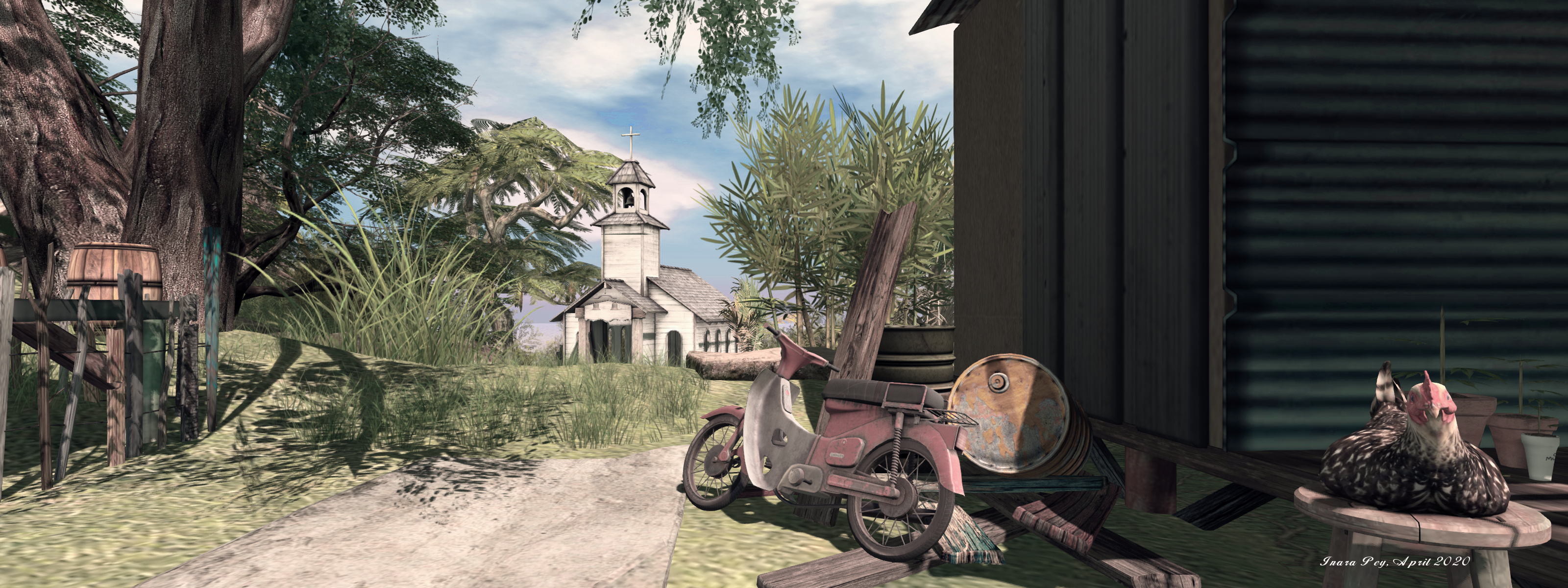
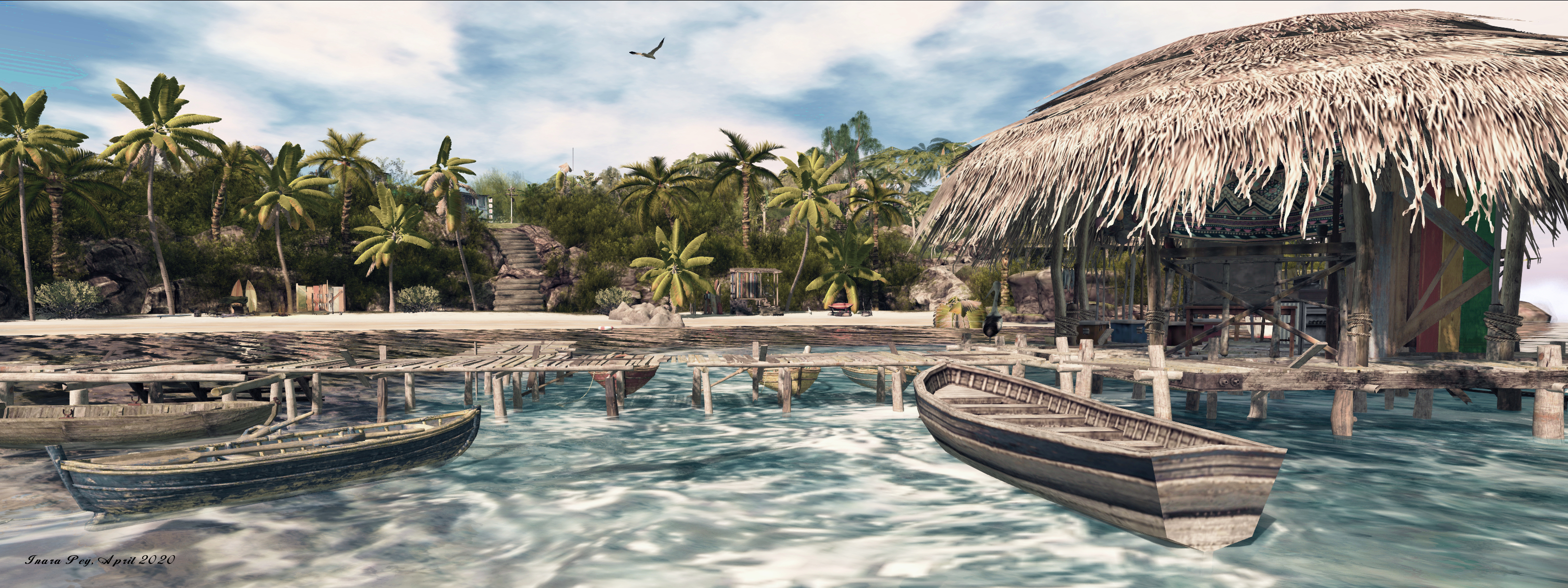
This is the introduction to Racing the King Tide, a film and website looking at the impact of the 2013 Philippines earthquake that was centred on the island district of Bohol had on the people and islands close to its epicentre. One of these islands – perhaps the most deeply affect of them all – is tiny Ubay, which is the central inspiration for Serene Footman’s latest region design in Second Life, and which opened to the public on March 3rd.

Called, appropriately enough, Ubay Island, the setting offers a marvellous reproduction of little Ubay – which is less than 4 acres in size – perhaps as seen in the the time period immediately after the earthquake had struck the region. As is always his way, Serene has provided a comprehensive blog post to accompany the build, and I cannot recommend enough that it should be read alongside any visit to Ubay in-world, as it really puts the build into perspective. Through his writing, Serene provides not only a lens through which to view the build, but also wider context on on the earthquake, its impact on the peoples of Ubay Batasan, Pangapasan and Bilangbilangan.

Ubay Island, March 2020

The build presents Ubay as it appears for around 130-140 days a year: flooded to a typical depth of some 45cm (1.5 ft) – although tidal ranges can make the actual waters deeper. The flooding is a combined result of both rising sea level de to climate change – and which ultimately threaten Ubay’s future – and the fact that the 2013 ‘quake saw a mean decrease in elevation of a metre (3ft) within the area where Ubay is located (an collapse that also gave rise to The Great Wall of Bohol on Bohol island itself), leaving the island’s maximum elevation when dry at just 2.32 m (7.2 ft) above the surrounding sea level.

Under the default windlight the water is a dirty, brackish grey / brown – a reminder, perhaps that flood waters can carry with them dirt, mud, animal manure and human wastes which can be hazardous to health – with wooden walk ways partially winding through the village streets in an effort to keep passing feet dry. In this, the setting has the feel of depicting Ubay not long after the earthquake struck; more recently, much has been done (starting with an imitative by the islanders themselves before they received external support), to raise the village footpaths above the average level of the flood waters.

Ubay,Island, March 2020

The landing point sits within the local school playground, a location which is both touching and somewhat ironic. Touching, as Serene has captured the graffiti marking one of the playground walls that reminds us of the lives the adults and children of the island face: This Is Where We Play. The irony is that on the actual island of Ubay, the playground was supposed to be the evacuation assembly point should the island be at risk of flooding – but in 2013, it was one of the first places to be submerged.

You might think that given the state of the island, it would have been long deserted – and you’d be wrong. Despite the earthquake, despite the continued and very real threat of rising sea levels as a result of climate change, the people of Ubay steadfastly hold on to their homes and way of life, up to and including the annual threat of typhoons wiping the village off the face of the planet.

Ubay Island, March 2020 (as it might appear under a brighter sky and the invasion of sea water)

This might sound like a case of local hubris, but it’s not. With some 74% of the population living below the national poverty line even before the 2013 earthquake, there is simply nowhere else in the Philippines where the peoples of Ubay and its neighbours can survive. This was proven in the period following the 2013 ‘quake when the 300-ish Ubay islanders were made to evacuate to the “mainland”, and almost all of them quietly moved back to island as it was the only place they could survive as fisher folk. In doing so, they have given Ubay its ray of hope.

Serene has tried to capture this sense of life as well: fishing boats lie in the waters around the village, chairs are set out on raised “porches”, ribbons festoon some of the village paths, clothes are set out to dry in the sun and breeze even as the waters pass under the lines on which they are hung, and so on. Someone has even enterprisingly set-up a stage for a music concert while boat repair yards are still in business. True, one or two liberties may have been taken (for example, the  Racing the Tide website, for example, infers that the half-submerged house that’s included in the build may be at Bilangbilangan Island rather than Ubay), but none of this spoils the setting in any way – rather, they enhance it.

Set as it is under a heavy sky, with its muddied waters and the ruins of buildings pulled down by the earthquake, and its shanty-like corrugated metal walls and roof tops, you might think that Ubay is a bit of a dismal place in SL to visit, but this simply isn’t so. Serene offers something that is once again captivating, poignant and with a depth of story behind it that should not be missed.

Related Links

Wizardhat Studios: longevity and beauty in Second Life

Wizardhat Studios, March 2020 – click any image for full size

We’re all familiar with the news of regions that disappear from Second Life – I’ve reported on a few that have announced closure myself. These disappearances can often be high-profile, leading too public upset and, and times, a reason for some pundits to blog about how they are further signs of SL’s “demise”.

What often goes unnoticed, however, are the regions that endure, sitting quietly tucked away, offering a place for people to visit year-on-year, unsullied by time. They remain a constant in the face of change over the passing of time, but can so easily pass notice by bloggers as we rush to seek the latest or new region design or setting.

Wizardhat Studios, March 2020

Take Wizardhat Studios, for example. I made my first visit to it almost seven-and-a-half years ago, in October 2012 (see: Wizardhat: dance, explore, contemplate, admire). At that point in time the region was already entering its fourth year, and it became a place I tended to jump back to semi-frequently over the next few years – although I confess that other than that one 2012 blog post, I’ve never actually written about it again in detail.

This fact had been playing on my mind over the course of the last week or so, a nagging feeling that as it’s been about 4 years since I last dropped, I should pop over and take another look. It’s a thought that was reinforced when reader and friend Miro Collas poked me via Twitter about the region. So, off I hopped.

Wizardhat Studios, March 2020

Designed by Karencreek Melson as the home of artist Wizardhat Mornington, the region is an atmospheric mix of reality, and fantasy, making excellent use of region surrounds and off-sim elements to create a great sense of depth. The default Windlight is perhaps a little bleak – I again found myself flicking to one of my preferred custom presets, but that’s about the only “complaint” I have with the region.

This is a place of coastal castles – one a home to Wizardhat’s photography and art, the other set as a home (but open to the public), where rough-faced cliffs climb to one side, water tumbling from them in places. This cliffs form a semi-circle enclosing the lowlands, their waterfalls forming streams that split the land with its mix of woods, flowers, and cart tracks, as the waters make their way to the sea.

Wizardhat Studios, March 2020

It’s also a place of whimsy: a steampunkian flying submarine floats alongside one of the castles, its interior perhaps triggering thoughts of Captain Nemo’s Nautilus and its vast undersea voyages. Not far away, polar bears take a moment in the sun, stretched out on the western beach; apparently the benefactors of a lottery win. Other animals roam free in the form of scripted agents, some of whom I recall from past visits, such as Happy Camper, others of which may well be new – or at least, relatively new. They wander about the lowlands and / or frolic in greeting while birds wheel overhead.

The animals are not the only perambulating occupants of the region. As you explore, you may notice that a couple of the trees appear to be locating themselves. Wait long enough, and you’ll see this is precisely the case, as one or another of the pair calmly uproots itself and goes for a wander, both of them again being scripted agents. It’s clear that these arboreal wanders are an accepted part of the landscape, as an owl is content to sit in the boughs of one as it takes to its roots and scurries across the land.

Wizardhat Studios, March 2020

What is particularly attractive with this region is that while it retains almost all of its original looks (for those of us familiar it from past excursions), it is also home to subtle changes that both maintain its look and appeal whilst also in part renewing it and making it worthy of return visits. Take the hillside turret to the north; once it looked out towards a storm that seemed to be approaching, now it faces stern-faced faced mass of rock sitting just off-sim.

Eclectic, rich in detail, with lots of opportunities for exploration, photography and dance, Wizardhat Studios remains an engaging visit, one given the added fact it is a place now into its 13th year in Second Life.

SLurl Details

A return to Peacehaven in Second Life

Peacehaven, March 2020 – click any image for full size

It has been just over three years since we last visited Pacehaven, a setting designed by PurrBlaize. At that time Purr had just made the move from a Homestead region to occupying a quarter of a Full region (see Peacehaven – A New Beginning in Second Life and, before it, The serenity of Peacehaven in Second Life). Since hat time, Purr has once more relocated, and gained something of a larger space in which to establish Peacehaven with a new look.

Now occupying almost a 1/2 region, Peacehaven retains all that has made it an attractive visit, whilst also sharing the space with a neighbouring parcel that offers live music and events to create a feeling of even more space. It is once again an environment that demonstrates you don’t need a full region in order to create an expressive place that offers a rich amount of exploration, being almost almost perfectly put together by Purr and her SL partner BluBlaize.

Peacehaven, March 2020

Offering an aspect looking to the west, the setting has a summertime, semi-tropical look as it runs inland from the western ribbon of beach, above which the landing point sits, to form a rugged, uneven and attractive landscape cut by paths, water channels and gorges that slice between and around two central plateaus, gorges and water channel alike spanned by bridges such that while smaller than a region’s full size, Peacehaven has multiple routes of exploration that make it feel as if it occupies an entire region.

Three paths point outward from the landing point and the graystone summer house that sits alongside it. The first runs to the north, the second due east, the third to the south and east. All three actually eventually link up one to another, providing a means to tour the entire setting – although as noted, they are laid out in such a way that they don’t feel as if they are “just” a simple loop. Quite the reverse in fact.

Peacehaven, March 2020

To the north, the first path runs alongside a water channel, passing a squat fort (home to a little rooftop café) and which stands guard over a man-made causeway the extends out over the water to a waiting lighthouse. Two bridges span the water channel, one linking the path to the fort, the second to connect it with another deck that offers moorings for boats. Beyond this, the path reaches a garden pavilion sitting on the north-side beach, crouched next to one of the region’s squat plateaus.

A fence separates the pavilion from the path, but a gate allows access, and rather than being a private space as the fence might suggest, the pavilion forms a small place to hang out, a second path running due south from it to eventually become the southern path back to the landing point. Along the way it branches with a west-pointing route, and also passes under a rocky arch and colourful flowerbeds.

Peacehaven, March 2020

The southern end of this route ends in a set of steps connecting Peacehaven with the neighbouring music venue that is also available for exploration, while an ancient pointed arch indicating the path running back to the landing point. This arch also sits under the shadow of one of the parcel’s plateaus – the larger of the two, in fact – which is home to a cottage that has been a motif throughout the various Peacehaven designs. It can be reached either from a further branch of the west-pointing path, one which gently coils upwards around to sides of the plateau, or the third of the paths available from the landing point, as it passes through the summer house and then climbs up to the cottage by way of stair and tiered garden.

A bridge connects the cottage with the second plateau – the one below which the hangout hides – which is home to a half-circle ruin, another motif from previous Peacehaven builds. This also forms a place to hang out and / or dance while a final path from here snakes down to meet the west path running from the landing point to beach summer house.

Peacehaven, March 2020

All of this barely scratches the appeal of Peacehaven, which remains as much an attractive and photogenic sitting as it ever has been, rich in colour, offering a warm, natural welcome and plenty of opportunities to simply relax and recharge.

SLurl Details

The closing of a Storybook in Second Life

Storybook Forest, March 2020

If you want your children to be intelligent, read them fairy tales. If you want them to be very intelligent, read them more fairy tales.

– Albert Einstein

I opened my 2018 travelogue for Nessa Zamora’s (Noralie78) Storybook Forest back in September 2018 following our visits to the Lost Unicorn regions (read more in Opening a Storybook in Second Life). Part of this quote is also used as an introduction to the region, so given news has come that the the Forest is shortly to close to make way for a new design, it seemed a fitting piece with which to open this piece.

Storybook Forest, March 2020

Designed by Noralie78, Storybook Forest is an utterly bewitching place that, if you’ve not visited before, you really, really, should before the end of day on March 3rd, 2020 (I’d have given more warning, but only got word myself following the Lost Unicorn post giving notice of the closure being published on March 1st). The design stands as a marvellous homage to fairy stories and a delight to all who still love the fables and tales they may have heard in childhood days or have enjoyed reading to their own children – or who simply like reading; while for photographers and explorers, it offers something to smile at around every corner.

This is a place where ornate, rounded castle towers rise from the surrounding trees while paths wind between tree trunks and under a canopy of wide-spread boughs; where exotic plants grow and sunlight dapples the glades and falls across the waters of a small lake. From the outset, it’s clear the is is a place where the imagination can be set free and the magic of books and tales has been given leave to run as they will – and we can run with them.

Storybook Forest

So it is through this winding path, passing from castle to castle, from glade to tower, that visitors may find Peter Pan pointing the way forward, Mary Darling standing below, even as Captain Hook, Mr. Smee and Tiger Lily row past on the nearby waters, a certain crocodile inevitably in tow. Deeper still are opportunities to gather with a group of dwarves, as Snow White lies under glass, the victim of the Wicked Queen’s apple, or to sit with Alice, a white rabbit and chap with an affinity for hats to partake of afternoon tea, while a lost boy wades the shallow waters of the little lake, gazing in wonder at the pile of books that rise from is midst.

Nor is this all; every turn in the path awaits the opportunity to offer a new childhood memory: Bambi and his mother, Cinderella, Snow White… the list goes on, and I’m not going to spoil things by mentioning all who are given a role within this forest.  And as well as these glimpses of childhood tales, Storybook Forest offers many places where visitors can sit and allow memories wash over them or have their imagination take flight – or rest their avatars while their camera roams through the woods, seeking out details that might otherwise be missed.

Storybook Forest, March 2020

And details there are indeed, from dedications to read through quotes from stories to places where a little interaction can be enjoyed, such as at the harpsichord sitting atop Cinderella’s tower. Even some of the characters have some unique aspects too them – take a look at the seven dwarves gathered around Snow White’s glass casket, for example! All of this is offered with a special dedication from Noralie, offered to all that wander Storybook Forest’s enchanted paths:

To the boy or girl who reads by flashlight
Who sees dragons in the clouds
Who feels most alive in worlds that never were
Who knows magic is real
Who dreams.

This is for you.

Storybook Forest, March 2020

As noted, Storybook Forest will be around until the end of of March 3rd, so make sure you capture any memories you wish to have of it before then. I confess, I will miss it once it is gone; it is a magical place. However, while it may soon pass into memory, so too are we given the promise of something new to follow – and so I look forward to returning and seen what new fruit has come forth to replace it.

SLurl Details

An abandoned vacation spot in Second Life

Dya’s Abandoned Vacation Spot, February 2020 – click any image for full size

An Abandoned Vacation Spot in the 30s. Sometimes you can still see the glamour of the past….

So reads a part of the description for Dya’s Abandoned Vacation Spot, a location we were drawn to courtesy of Maddy Gynoid. Designed by Dya OHare, this Homestead region presents a fabulous setting, an island sitting somewhere – possibly just off the coast or within the estuary of a broad river – that was once a place for holidays and fishing, but which has now faded well past its prime, the holiday makers long since departed, the water front now little more than moorings for fishing boats, but not a base of operations.

To say this is a beautiful setting would, frankly, be an understatement. The island has obviously been carefully considered and designed to present a setting that really could exist as much in the physical world as in the virtual. It’s made all the more natural through its single-track road which, just as might be expected of a vacation setting, neatly loops its way around the landscape, linking all the points of interest, and thus providing a natural means of exploration.

Dya’s Abandoned Vacation Spot – February 2020

The landing point sits in one of these aged waterfront buildings, one that is in slightly better overall condition than the rest, and home to Dya’s Gacha resale store.  From here, visitors have a choice: proceed on foot, take a bicycle from the rezzer a little further along the waterfront, or take the the steps down to the the piers where a motor boat rezzer awaits anyone who fancies pootling around the island by water.

The road runs both north along the the shore, and east. The former route fully brings home the faded nature of the island’s heritage, passing between water to the one side and buildings that are falling apart on the other, their signs and façades harking back to when the the paved street was alive with visitors – although a couple of folk appear not to have realised the bar is no longer serving customers!

Dya’s Abandoned Vacation Spot, – February 2020

To the north, through a local rain shower, sits a more business-like wharf and buildings, where also sits the carved hull of a submarine whose shape looks born more of the Cold War era than from the 1930s. It sits as a single incongruity in the region’s overall design – and yet it still fits the setting, suggesting that while this was a holiday centre in the 1930s, time has indeed moved on, and the island has seen other uses.

Two beaches mark the south and east side of the the island, separated from one another by a rocky headland dominated by an old wooden lighthouse.  Both of the beaches reflect the island’s long-passed heyday; flotsam is scattered along sands that have a tired feel to them under the overcast sky, the trees along them apparently dead, marker buoys just offshore warning passing fishing boats not to get too close to the shore where they might run aground (and also mark the region’s boundary for those using the local motor boats to get around).

Dya’s Abandoned Vacation Spot, February 2020

Both of the beaches are also overlooked by a ruins of an ancient church, a place that looks older than than the rest of the island’s structures. Neon signs hand from one end of this old building, advertising it as a hotel, but whether it ever served this purpose or not is open to question; there’s barely the space for individual rooms, so perhaps the signs – still flickering, and so under power, are meant as a joke by whomever still uses the island.

This ruin can be reached by following the loop of the islands-road, which also provides access to the beaches by means of board walks and steps. The road also runs past what is perhaps the last standing holiday home overlooking the sands and sea. It’s a modest place, the deck bigger than the house, but it is still in use, simply furnished and offering a sense of life within a place mostly given to the past.

Dya’s Abandoned Vacation Spot, February 2020

While it has no obvious connection other than the period in which the island had its heyday being close to that of the book, where exploring, I couldn’t help but feel it sits as some kind of seaward Valley of Ashes from The Great Gatsby, albeit with strong differences; a place that, rather than being a place of run-down businesses, secrets and eventual tragedy, through which the rich of East Egg and West Egg pass under sufferance, the island sits as a place to be passed by and occasionally used by fishing as they travel to and from richer ports of call whilst plying their trade.

Why my mind should jump to such a connection, I’ve no idea; but it just seems to fit. What I can say is that with its wildlife and horses, sound scape and cloud-heavy skies, Dya’s Abandoned Vacation Spot is a captivating place to visit, rich in its own romance and utterly photogenic.

Dya’s Abandoned Vacation Spot, Februay 2020

SLurl Details

A Little World with a touch of Voodoo Land in Second Life

Little World, February 2020 – click any image for full size

Back in September 2018 we visited Little Havana and its neighbour, Voodoo In My Blood. The former was a joint design led by Sofie Janic, the latter largely the work of Megan Prumier. You can read more about that trip here).  Given the length of time that has passed, together with catching an image taken by Cecilia Nansen whilst she visited the region set me to thinking a return might be in order.

Little Havana has now gone – possibly for a while, given the amount of time since our last visit – and it has been replaced by Little World, a design again led by Sofie, together with Abaracdabra, and that is apparently still under construction. It’s a place very different to Little Havana but it retains the same photogenic attractiveness that has already brought it to the attention of SL photographers.

Little World, February 2020

The landing point sits on the south side of the region on the bridge linking it to Voodoo Land (which was called Voodoo In My Blood back in 2018, and of which more anon). From here, a road climbs to the east behind tall buildings with their backs to the water, steps point the way north and up to where an urban scene sits under a default sunset sky.

Neon is very much the order of things here, bright signs thrusting out into a narrow street that is in places made narrower by parked vehicles. Street-side eateries fill the air with steam from cooking foods, while steel shutters denote places of business that have closed for the night. Overall, the sense that this is a little corner of Japan is strong along this street – but that’s not to say the build as a whole is meant to represent a location in Japan.

Little World, February 2020

A second north-south street is home to an open market, rich with fruit, vegetables, fish, flowers and, in a throwback to times past, VHS tapes. While the signage on the buildings either side might be Japanese, the price tags and signs in the market are distinctly western. Thus, the sense that Little World is a melting pot of influences in the way of so many urban centres around the globe so often are.

Connecting the two streets at their northern ends is a cobbled square offering an open air café and a space for music. West of this sits an echo of Little Havana in the form of a narrow ribbon of beach. Little fishing boats that look to be more for decoration then for fishing sit moored against a deck sitting over the waves.

Little World, February 2020

While the buildings are shells, Little World offers many opportunities for photography, with locations further brought to life thanks to the local “residents” – human and feline! Photos are welcome at the region’s Flickr group.

Across the bridge, Megan Prumier’s Voodoo Land remains much as we remembered it from 2018. There’s a “new” store area on the west side, with Voodoo still sitting on the east side of the region overlooking the bay. South of this, the region retains its run-down Americana look, complete with ageing buildings and its tired, open beach front that is packed with detail and extends around to a fun fair in the south-west corner.

Little World, February 2020

There are other subtle changes here as well – the high pier and boat moorings have gone, but a new English-style pub appears to have been plonked down on the hedgerows and paved paths on the west side of the region. I’m assuming this is a temporary location for the pub, and that it may yet be moved.  There’s also an underground section I don’t remember from 2018 – but that could have simply been missed during that visit.

Like Little World, Voodoo Land presents multiple opportunities for photography and exploration, with both making for an ideal joint visit.

Voodoo Land, February 2020

SLurl Details