The Borderless Project: immersive explorations in Second Life

The Borderless Project: Delain Canucci

Currently open within the region of Akimitsu, held and curated by Akiko Kinoshi (Akiko Kiyori) and forming a part of her “Akipelago” group of regions, is The Borderless Project, a multi-element, immersive exhibition that brings together a number Second Life artists known for their work in 3D spaces, and / or in using light, sound and immersion to create engaging and interactive spaces.

In the simplest terms, the Borderless Project is inspired by the work of Japan’s TeamLab, originally founded in 2001 by Toshiyuki Inoko, and which in 2021 marks its 20th anniversary with an immersive installation in Tokyo entitled Borderless, billed as “a world of artworks without boundaries, a museum without a map”, and which is the latest in their globe-spanning immersive experiences.

The Borderless Project: Betty Tureaud

As with TeamLab, the Borderless Project team – Betty Tureaud, Delain Canucci, Gem Preiz, Thoth Jantzen, Mitsuko Kytori, Blaise Timtam and Akiko herself – have created an installation that stands as a “gallery without a map” so to speak, through which visitors can wander and explore. Each artist has at least one space, each with at least one installation within it, the majority providing multiple elements within them.

The “gallery without a map” element comes from the fact that the various installation spaces  – located at different altitudes – are all linked by a teleport portals (touch or walk through to activate), which also link to the ground-level location I’m using here as a landing point. However, none of the portals are labelled in terms of artist or destination; therefore there is no implied hierarchy or order to the installations in terms of which should be seen “first”, etc., – visitors have utterly free choice.

The Borderless Project: Gem Preiz, tribute to TeamLab

What is key to spending time at the Borderless Project, is that you have your viewer correctly configured.

Of the recommendations given it is crucial you have Advanced Lighting Model enabled, (Preferences → Graphics → make sure Advanced Lighting Model is checked – there is no need to also enable Shadows), together with media (the button with the movie camera on it, top right of the viewer window) turned on – and note that there are times where you will need to toggle this off / on again in order to pick-up the sounds within individual elements (keep an eye out for the in-world text requests to toggle). Less important is having draw distance set to the recommended 250m+; given the size of the individual installations and the distance at which you’re seeing things, this is frankly overkill.

The Borderless Project: the gardens by Akiko

The “primary” installations are by Betty, Delain, Gem, and Thoth, with Gem and Delain offering the largest by area / content, including two “secondary” displays apiece (Gem proving a hat-tip to TeamLab via two reproductions of elements from their Borderless installation, and Delain a separate “dino cave” that comes with places to sit). The garden spaces by Akiko, Blaise and Miyduko also offer places to sit and relax, and opportunities to play with EEP and more.

Each of the installations is richly diverse in terms of elements, colours and sounds (both local and via media – remember to toggle this off / on as directed), with some of the artists including interactive elements that can be walked into / over or pushed around. In respect of the local sounds, it’s important you avoid running / flying, as the scripted object can take a second or so to fire-up and call the sounds to be played in the viewer, so if you run you could easily miss hearing them – and if you fly, you won’t hear them at all!

The Borderless Project: in one of Delain’s smaller vignettes

I’m not going into great lengths about the individual installations here, as frankly, they should be experienced first-hand, and people should approach them unburdened by my own perceptions and ideas. I will say that when visited the large cubist environment Betty Tureaud has created, make sure you follow the big white arrival at the arrival point and grab + wear the teleport HUD – you might have problems finding your way inside the cubes if you don’t! Also, keep an eye out for the poses within Delain’s vignette settings – they offer multiple choices for photography.

I admit to having a couple of niggles during my visit – notably as a result of the local environment settings within Delain’s main setting, where I found it so dark I walked back through a teleport disk when trying to leave the landing point (and no, I didn’t have Shadows enabled alongside of ALM). More particularly, the low light makes it hard / impossible to read in-world guidance notes in places. As such, it might be better to either make them Full Bright (if they are not) or to add a couple of point lights to illuminate them to make them more obvious.

But niggles aside, there is no denying the depth of content to be found within the Borderless Project, and I enjoyed the several hours I spent exploring, trying and poking (including playing god and shoving the solar system around!).

SLurl Details

Cica’s Summer Day in Second Life

Cica Host: Summer Day

Cica Ghost opened her latest region installation on Sunday, July 18th. Entitled Summer Day, it is, as always with Cica’s installations, accompanied by a quote; one that might possibly have more meaning when taken with the installation than may perhaps have been the case with some of Cica’s recent works, a point I’ll come back to in a moment. That quote is:

Sometimes you will never know the value of a moment, until it becomes a memory.

– Dr Seuss

The scene is quite simple – a rolling landscape under a deep teal sky, white horses gambolling and frolicking amidst the grass and under the shade of trees; a chap fishing on a little lake where he is watched by a swan, the fish under the water perhaps teasing him by ignoring his line and bait; and a woman (his wife?) sitting outside of a house, fussing a pair of geese, one of which is perched on her lap.

Cica Host: Summer Day

What is surprising is that unlike Cica’s other region-wide installations, Summer Day has few sit-points within it – just the bench with its white cat and the little boat bobbing off-shore, so far as I could see; and there are none of the usual animations / dances that tend to be a hallmark of her work. It is this lack of animations and sits, combined with the use of the quote from Dr. Seuss that led me to wonder if, perhaps, there is a message to be found within this Installation.

Seuss’ words remind us that memories grow from the experiences we have – or create – in our lives; so it is important we ensure we make time to have experiences – moments – that will result in happy, lasting memories – be it through engaging in something we enjoy, appreciating nature’s beauty or simply having fun. Otherwise, there’s a risk that when we page back through our memories, there is a risk that rather than having a richness of experience to enjoy, we find that all we have are a lot of “what if I had just…” memories.

Cica Ghost: Summer Day

So might Summer Day be a little poke Cica is giving us to maybe take a break from computer screen and keyboard and make time for the things that will give us happy memories? Those moments needn’t be complex: just space to enjoy a favourite past-time (the chap fishing), or to enjoy the touch of nature (the woman leaving the washing and fussing the geese) or simply taking time to play (symbolised by the horses), especially if we can share the fun with a friend or loved one.

Obviously, I don’t want to put words into Cica’s mouth, but I found it hard not to escape this feeling / sentiment as I wandered Summer Day, although it is true you might find it says something different. Which is why (as always with Cica’s work), I recommend playing it a visit yourself, rather than just relying on what is written here.

However, while you do so, please excuse me if I pop out to the garden for a moment, and make some memories playing with my cat 🙂 .

Cica Ghost: Summer Day

SLurl Details

Art in 3D at Sinful Retreat in Second Life

Sinful Retreat – Ciottolina Xue in the foreground

Since its first major event in October 2020 as a new centre for arts in Second Life (see: Unveiled: a new art experience in Second Life), Chuck Clip’s Sinful Retreat has become a genuine hub for art and artists, with continuously rotating 2D and 3D art exhibitions and permanent (or semi-permanent) displays and collections, many of which I’ve covered in these pages).

The venue covers two regions – Sinful Retreat itself and the neighbouring Artists Retreat – to offer a multi-level experience from the main galleries on the elevated level, complete with the airship Dionysus offering an event space, to the open-air 3D ground-level displays through to the additional 2D galleries both on the ground and higher in the air, all the way to the the UWA-like challenge space which is currently home to Sinners and Saints, which you can also read about here.

Sinful Retreat – London Junkers

From the main landing point it is possible to directly visit the Janus I and Janus II galleries, the 3D sculpture by Bryn Oh, Cica Ghost, and Walton F. Wainwright (Faust Steamer) entitled The Exquisite Corpse and the studio spaces in between, or use the numerous teleports to reach the open-air exhibitions of 3D art to be found across the two regions – which is the element of the setting I wish to focus on here.

Within Sinful Retreat it is possible to visit areas featuring the work of (at the time of writing – names may vary over time) Aequitas, Cica Ghost, Ciottolina Xue, Ilyra Chardin, Kraven Klees, London Junkers, Mariposa Upshaw, Melio Minotaur, Phenix Rexen, Pixels Sideways, and Toysoldier Thor.

Sinful Retreat – ArtemisGreece

Meanwhile, Angel’s Rest features the work of Alchemelic, ArtemisGrecce, Havit Neox, Sharni Alazee, Suzanne Graves, Thoth Jantzen and DB Bailey and Venus Adored, together with a display by region holder and Sinful Retreat owner / curator, Chuck Clip. Between all of these are various displayed of art that Chuck is displaying from his own collection, whilst two further sky galleries were, at the time of my re-visit, presenting exhibitions by Leo Bhalti (photography entitled Second Lives) and Wolfgang Ginka (poems and photography entitled Remembering Blue). 

In terms of the ground-level 3D art displays, I’d recommend picking one that grabs you and then when on the ground, using your pedal extremities to explore those across the rest of the two regions. This is because the sheer richness of the art on offer unfolds quite naturally, and it is possible to find yourself being call onwards from location to location on what becomes a voyage of discovery.

Sinful Retreat – art across Angel’s Rest

These include several blasts from the past – such as Ciottolina Xue’s exquisite Little Paradise in Second Life and Covfefe! The New World Disorder by Djehuti-Anpu (Thoth Jantzen), both of which appeared at SL15B (with the latter forming a part of the larger Moments of Immertia).

Also to be found within Angel’s Rest is Sharni Aalzee’s Never Say Never 2, a recreation of her 2014 UWA  Grand Prize winner in the 2014 Grand Art and MachinimUWA Challenge, Never Say Never – Love Transcends Borders. This sits on a plateau that forms both an art display area and a memorial garden that includes a remembrance to Ebbe Altberg and with candles lit to those whom Second Life has lost.

Sinful Retreat – Sharni Alazee, Messuno Myoo and the memorial garden

Such is the richness of the art on display – from Greenies getting up to mischief to giant lava dragons and parring by way of glittering cathedrals, little towns, figurines, robots at play, magical gardens and more – Sinful Retreat and Angels Rest are well worth taking an hour or two to explore. And should you feel in the mood for more art, there’s also Roxkstudio across the bridge to the west of Sinful Retreat – but I’ll save that for another day.

SLurl Details

Vibes of Painting in Second Life

Vibes Art Gallery

I recently had cause to drop into Vibes Art Gallery to witness a new exhibition of art featuring a trio of artists – Matt Thomson (MTH63), Zia Sophia (Zia Branner) and Wan (Wan Laryukov), entitled Vibes of Painting.

Curated by Eviana Raider (eviana Robbiani), as well as being a centre for exhibiting art, the gallery is also something of a statement of purpose in its own right. In developing it, Eviana has intentionally utilised industrial elements to create a space suggestive of a warehouse facility – three storage buildings with loading / unloading bays and areas, etc., – that has been repurposed  rather than invoking the carbon-costly process of demolition, clearing and replacing. As such, the setting is something of an immersive environment for art displays.

As the name of the exhibition – which opened on July 14th, 2021 – suggests, Vibes of Painting focuses on physical world art the three artists have produced. I was attracted to it for both this reason – I do appreciate the opportunity to witness art from the physical world in Second Life – and because one of the three artists is a name new to me, whilst another is someone who is perhaps more usually associated with Second Life photography, rather than painting.

Vibes Art Gallery: Matt Thompson (MTH63)

That person is Matt Thomson (MTH63). whose work I’ve appreciated through a number of SL exhibitions, and whose sense of humour I’ve enjoyed through reading and re-reading his biography at each of his exhibitions. Here, in one of the two smaller (and linked) warehouse units, he presents a selection of vibrant abstract expressionist pieces worthy of Jackson Pollock or Jean-Paul Riopelle without being in any way derivative. Far from it, in fact, given that Matt is himself an experienced abstract artist. As such, these are pieces that can be fully appreciated as being works by an established abstract art and for the statements they make (mostly in reflection of Matt’s sense of humour and self-deprecating manner).

In the neighbouring hall, Zia Sophia offers a selection of her always layered art. Working mostly with acrylics with accents in oil crayons and in, and to which she often adds materials such as paste, gel, sand, glue, bandages and paper to give her work a tactile sense before finishes with a layer of varnish to act as a binder, Zia produces pieces that have their own unique sense of life.

Vibes Art Gallery: Zia Sophia (Zia Branner)

Embracing a range of techniques and subjects, Zia here presents a selection of pieces that include the purely abstract to a study of a flower in bloom (and which is quite marvellously attractive) and with a slight focus on pieces that feature water and / or coastal scenes. These combine to offer an engaging cross-section of Zia’s art that perfectly sits within the exhibition’s theme and compliments Matt’s abstract pieces, just as his compliment Zia’s.

Occupying the largest of the three display space, Wan Laryukov offers both 2D and 3D work that is richly evocative and oft provocative in theme and content, and which covers multiple styles and genres. Expressionism, allegorical art, symbolism art, figurative art and more are to be found in the selection offered across the floor and on the walls of the hall.

Vibes Art Gallery: Wan (Wan Laryukov)

Presented in colour and black-and white, the 2D art is fascinating in content, with the strongest lean perhaps being towards expressionism, whilst the 3D pieces perhaps lean more towards symbolism in their themes. Both 2D and 3D work make for an engaging display which, when taken as a whole, also offers a stitching of oneirology that brings all of the pieces together as it offers a central point of appreciation.

SLurl Details

Nekonuko’s Endless Journey through Second Life

Onceagain Gallery: Nekonuko Nakamori
I’ve forgotten how long I’ve been wandering. In-world is infinitely large, disappearing and reappearing, and the roads are endless. My work is simple. I face with contemporary art in real life, but my work in SL is much simpler. I’ve always wanted to do that kind of work; all I have to do is walk around and click the shutter on “something”, a “moment” that resonates with me. Yes, it’s that easy and everyone does it.
I edit these photos, not to create another story, but to extract “something” from that “moment”. If you can relate to the “something” of my “moment”, then my wandering will not be lonely, and I hope you will enjoy that wandering with me. 

With these words, Nekonuko Nakamori introduces her exhibition at Onceagain Gallery, curated by Onceagain (manoji Yachvili). As is suggested by Nekonuko’s words, this is another selection of her travels through the the endless world of Second Life in a collection that comes to just shy of two dozen images presented across the two floors of the gallery.

I was first introduced to Nekonuko’s art around four years ago through a couple of exhibitions in 2017. I’m not sure if it is because she exhibits sparsely, or just that I’ve managed to somehow miss any exhibitions of her work between then and now, but I confess I was surprised that is has been so long since I’ve had the opportunity to write about her art, as it really is quite captivating.

Onceagain Gallery: Nekonuko Nakamori

Eschewing the more usual rectangular format of images that tends to dominate the SL photographic community, Nekonuko utilises a 1:1 ratio for her art. This alone sets her work aside from that of other landscape artists; but what makes it completely special is the manner in which she selects the focus of each piece, seeking out, as she says, a view that sets each image as a moment in time, made completely personal through the presence of her avatar.

A specialist in conceptual art in the physical world, Nekonuko’s skills as an artist are very much in evidence through these pieces. Her selection of angle, composition – off-centre views of skylines, fire escapes, tunnels and bridges, the gently brushed touch of post-processing that offers skies of dappled colour, hazy horizons and soft lines – may not per se tell a complete story, like all great works of art, they combine to capture attention and offer a hint of a tale, making the moment that that caught into something deeper.

Also folded within her images are hints of more classical art forms, notably impressionism and realism – the latter particularly evident in her broader landscape pieces. This does much to further capture the eye and imagination, again drawing the observer into each piece.

Onceagain Gallery: Nekonuko Nakamori

An altogether engaging exhibition from an artist who reminds us of both the ever-changing vastness of Second Life (a vastness that far exceeds either the physical size of the grid or the constraints imposed by the world map) and the broad uniqueness of this digital realm we regard as home.

SLurl Details

Plastic People and Dead Cities: reflections on Second Life

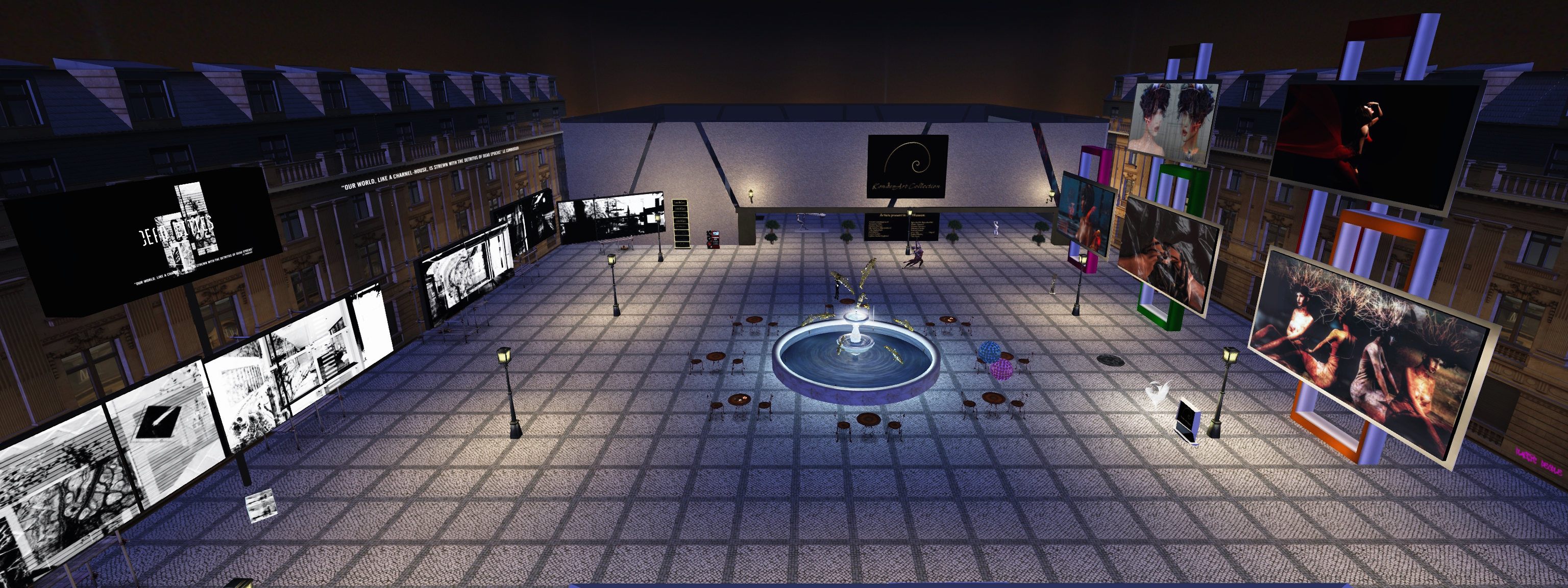
Kondor Art Square, Jul 2021: Dead Cities (l) and Plastic People (r)

Monique “Moni” Beebe and Traci Ultsch are among a group of artists whose work I find immediately engaging, and which I always appreciate being able to see and appreciate. So any new exhibition by either of them is going to get me hopping with interest –  and when they are exhibiting together, then I’m not so much hopping as I am leaping – which has very much been the case with Plastic People / Dead Cities, which opened at the Kondor Art Centre’s Art Square, curated by Hermes Kondor, on July 8th.

Now to be clear – this is not a joint exhibition in the sense of being a collaborative project between the two artists. Rather, and like their joint exhibition at Midgard Gallery in February 2021 (see: Moni and Traci at Midgard Gallery in Second Life), Plastic People and Dead Cities stand as two individual exhibition linked by theme and reflection, allowing them to be appreciated both individually and jointly, with certain truths to be found within them that may well be discomfiting to some.

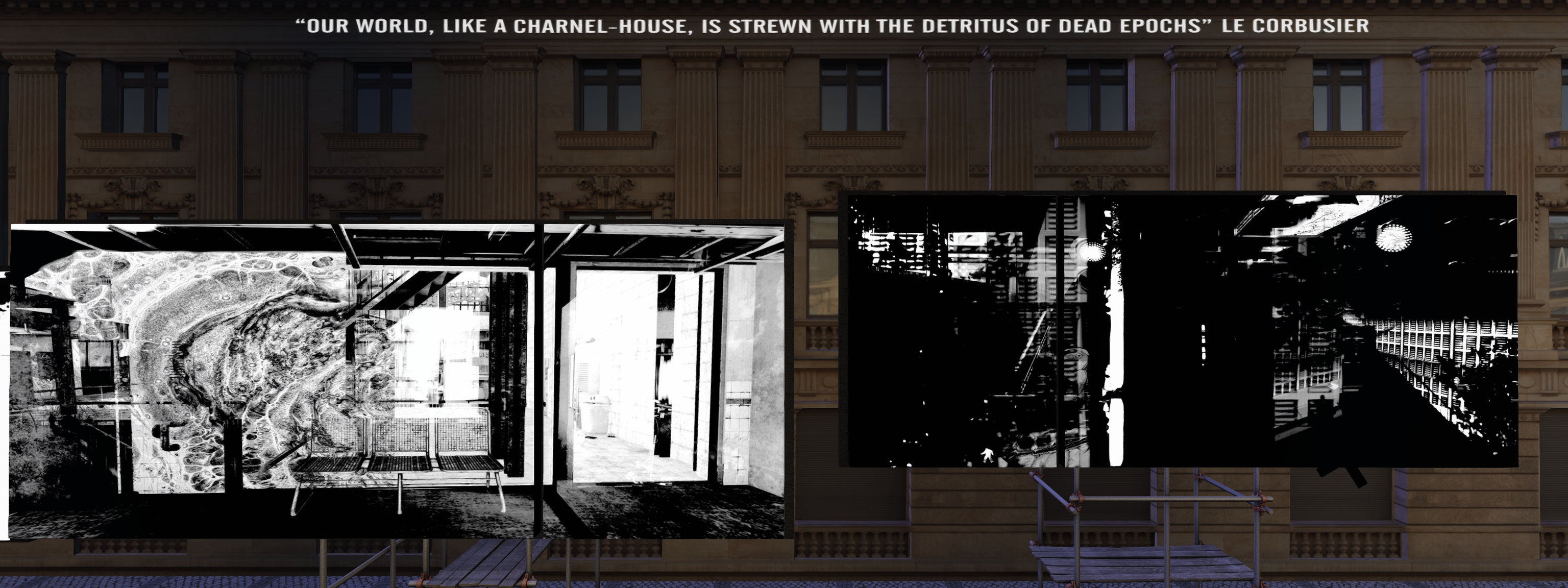
With Dead Cities, Traci explores the impermanence of Second Life through the dual medium of exploring the cityscapes that can be found throughout the grid and the medium of reflections on the ideas of so-called occultist Psychogeography as it relates to the city of London and as espoused through the work of Iain Sinclair and Peter Ackroyd.

Kondor Art Square, July 2021: Traci Ultsch – Dead Cities

In short, the latter might be said to be explorations of the myths and legends that claim much of “modern” London (e.g. from the 1660s onwards) was built on occultist practices, and the idea the “spirit” of all who have dwelt in the city combine to inform its nature down the centuries, and that “spirit” in turn informs the nature of those dwelling in it today.

Thus we are presented with a series of bold monochrome images that, rather than presenting “traditional” views of buildings, streets, and so on, are multi-faceted in the way they have been layered to present us with glimpses of buildings and structure together with the ghostly outlines of something more – that spiritual element to their nature, so to speak. Similarly, the use of scaffolding to mount the images, some of which also has skulls sitting on it, encapsulates the idea of the present being informed by the past.

In taking this route, Traci also underscores her theme of emptiness / impermanence: by presenting facets of structures in this way, with the dark and light obscuring as much as revealing, Traci points to the fact that, like it or not – and contrary to SL myth) – nothing in this virtual realm is in any way permanent; it survives and is constantly rebuilt – like a city as great as London itself – only so long as there are people to populate it. When empty, it might as well not exist – and when the novelty of the platform does finally wane, Second Life and its cities and places will won’t exist.

Kondor Art Square, July 2021: Traci Ultsch – Dead Cities

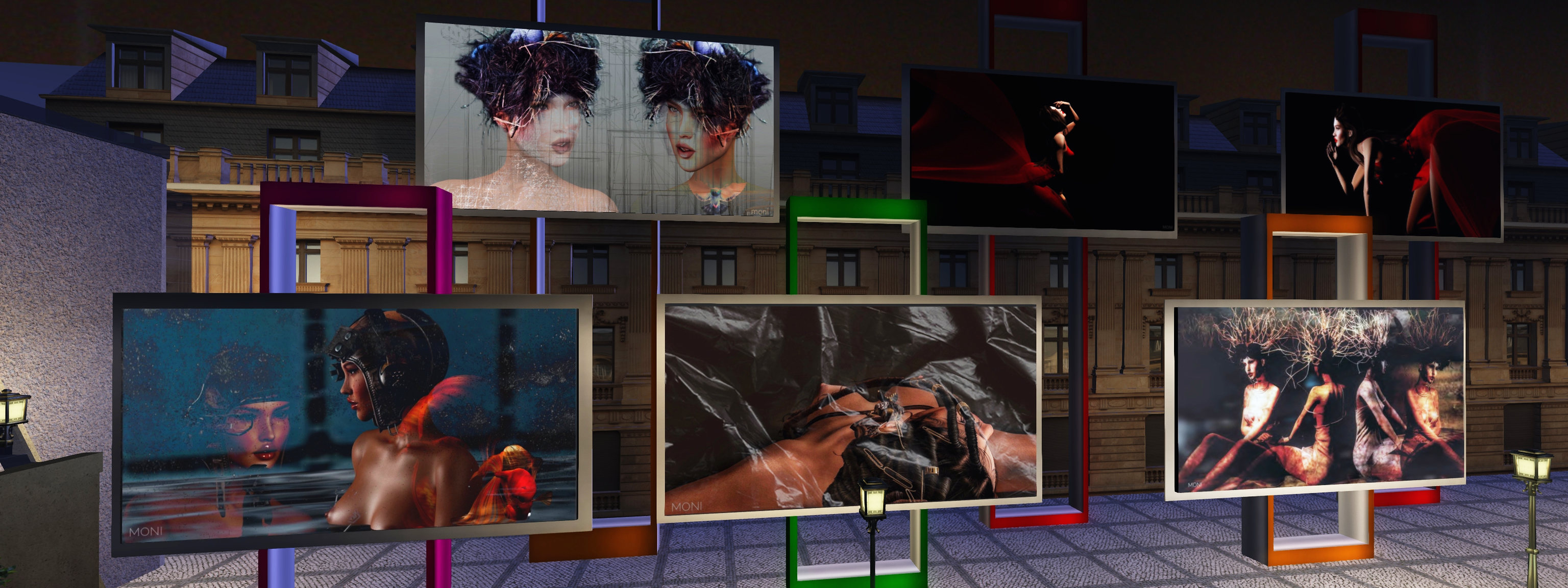
By comparison, Moni’s Plastic People appears to be an altogether lighter, brighter presentation, both in terms of being a series of images that do utilise colour, and in their general theme.

In short, this is the idea that Second Life is a plastic – perhaps malleable might be a more appropriate term – world which we can all bend and shape into whatever we wish, and in which we can express ourselves howsoever we wish, in keeping with the old SL tenet, Your World, Your Imagination. Thus Moni presents us with a series of avatar studies that when first viewed, appear to reflect this in their presentation of “classically” posed images, touches of sci-fi, fantasy and the platform’s more adult elements.

Kondor Art Square, July 2021: Monique Beebe – Plastic People

However, I say “appears”, because – to me at least – there would seem to be a further layer to Moni’s images, evidenced through her use of a stanza from Frank Zappa’s 1967 song, Plastic People within her liner notes for the exhibition:

A fine little girl / She waits for me / She’s as plastic / As she can be / She paints her face / With plastic goo / And wrecks her hair / With some shampoo.

That song was written as a manifesto against conformity and materialistic culture. So is its inclusion in Moni’s liner notes for the exhibition simply a reflection of the malleably of our avatars, or is it a comment on the fact that whilst founded on the ideal of individual expression, SL is increasingly becoming a place of homogenised, materialistic conformity for many? Just look at the way a certain avatar body dominate the platform, or the manner in which “creativity” now seems to be more about looking good and buying the latest fashion.

If this interpretation might be seen as accurate, then it begs the further question: just who are the “plastic people”, the avatars within Second Life, or those who operate them? I’ll leave that to you to ponder.

Kondor Art Square, July 2021: Monique Beebe – Plastic People

Through these two exhibits, Moni and Traci offer collections of images that are in and of themselves captivating, whether or not one wishes to look deeper into them. At the same time, they each hold up a mirror, one of which encourages us to reflect on Second Life is a whole as it relates to us, and the other asking that will look directly on  ourselves, and how we relate to the platform.

What we might discover in looking into either might not be comfortable to consider – but that does negate either exhibition. Indeed, I’d strongly recommend that anyone who likes to ponder on this virtual world in which we invest so much of ourselves, whatever the reason, pay a visit to Plastic People / Dead Cities, and spend time with the art and the artists’ own words.

SLURL DETAILS