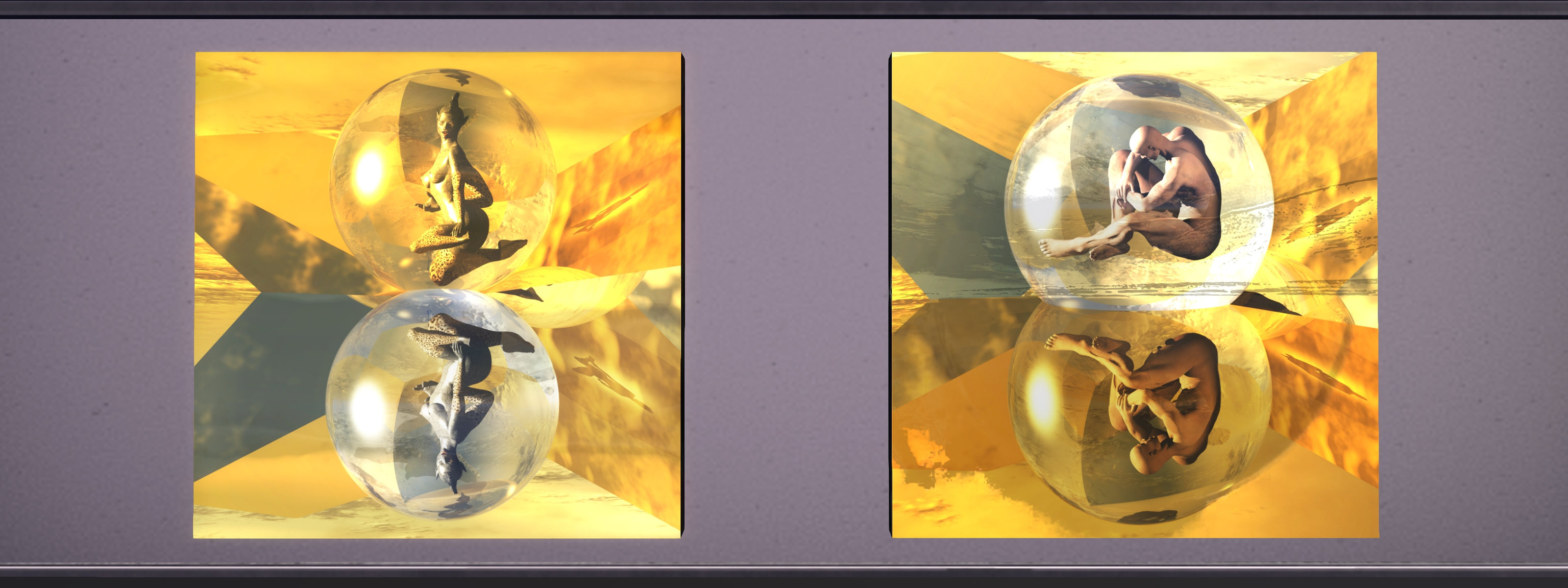
Kayly Iali at the the Windlight Loft in Second Life

Kultivate Magazine Loft Gallery: Kayly Iali

It’s been a while since I’ve had the opportunity to visit an exhibition by Kayly Iali in Second Life, so when Kultivate Magazine announced the opening of such an exhibition of her paintings within their Loft Gallery, I decided to make amends for this and hop on over.

Kayly is an artist in the physical world who uses Second Life as a means of reaching a global audience and present her work. She most frequently works with watercolours and oils, and describes herself as an impressionist in terms of her style of painting, utilising relatively small, thin, yet visible brush strokes, open composition with an emphasis on an accurate depiction of light and movement within her work. Her subject range encompasses still life, portraits and landscapes, and she has a reputation for producing engaging commissioned portraits of pets belonging to Second Life users, some of which have also featured in her in-world exhibitions.

Kultivate Magazine Loft Gallery: Kayly Iali

At the loft, Kayly presents a modest selection of her landscape art – twenty in total – featuring locations and sights to be largely (exclusively?) found within her home state of California. Whilst all of them are individual pieces, some might also be drawn together as themed sets or pairings – such as those featuring various landmarks in San Francisco, the “causeway” paintings, and the “Vacaville” pairing. The majority are presented in that impressionist approach noted above, although the “San Francisco trio”, as I’ll loosely refer to it and featuring Alcatraz and both the Golden Gate and Oakland bridges, also leans  towards something of an abstract styling.

Whilst all originating in the physical world, these are pieces that could just have easily had their inspiration rising from within Second Life. As such, they offer something of an artistic bridge between both the physical and the digital, reminding us that our two worlds, whilst never exactly meeting are nevertheless closely intertwined.

Kultivate Magazine Loft Gallery: Kayly Iali

These are engaging pieces which form an equally engaging exhibition; they are also – given the way the link our two worlds – pieces that will grace any Second Life home.

SLurl Details

Invisible Cities: The Future in the Present Overflows in Second Life

Artsville Galleries and Community – Debora Kaz:  Invisible Cities: the Future in the Present Overflows

Friday, May 26th saw the opening of Invisible Cities: the Future in the Present Overflows at the Artsville Galleries and Community, operated and curated by Frank Atisso. The work of Debora Kaz, the exhibition is a further instalment of her Invisible Cities series, which I first encountered in August 2022 when  Dido Haas hosted Invisible Cities: Fighting Women at her Nitroglobus Roof Gallery (and which is reviewed here).

With Invisible Cities: The Future in the Present Overflows, Debora once again tackles a societal issue and the lasting effect it can have on the lives of those subjected to it: violence, in all its forms, visible and invisible; physical and mental / moral.

In this exhibition, the idea is to suggest parallels between past, present and future of lived stories where violence is present since childhood. To bring out the need to talk about these stories, to heal, survive and protect. Violence as an instrument of power … brings with it disorders and dependencies, fragilities that need support, affection and respect. [This is] An exhibition to put you in a place less critical and more solidarity.

– Debora Kaz, introducing Invisible Cities: The Future in the Present Overflows

Artsville Galleries and Community – Debora Kaz:  Invisible Cities: the Future in the Present Overflows

However, before getting into things, there are a couple of points to note up front. The first is that it should be viewed using both the local environment settings (World → Environment → Use Shared Environment) and with Advanced Lighting Model (ALM) enabled (Preferences  → Graphics → make sure Advanced Lighting Model is checked); Shadows do not need to be enabled as well, so flipping ALM on (if you usually have it disabled) should not impact viewer performance.

The second is that the installation is multi-level, the three levels linked by a teleport system. This takes the form of an atom-like structure. Right-clicking on it will sit you and display a list of numbered destination options. While it is not implied by the ordering or within the introduction, I would perhaps suggest that in starting a tour, you first use the teleport to visit the elements labelled Past 1 through Past 6. These will deliver you to the uppermost elements of the installation, representing childhood and the past. Within each is a father / daughter combination, each with what appears to be a duality of purpose. At first, they might seem to simply represent a parent / child relationship – out walking, holding hands, a loving pat on the head, the gestures of nurturing care.

But look again, particularly at the likes Past 2, Past 6 and Past 1; note the body language of the child, the way the adult’s arm grips wrist or upper arm:  these suggest something less than loving and closer to restraint, control, subjugation. Now take the hand resting on the child’s shoulder and the apparent head-pat; are these actually gentle gestures of love, or might they also be further suggestions of restraint and subjugation aimed at the child?

Artsville Galleries and Community – Debora Kaz:  Invisible Cities: the Future in the Present Overflows

Thus, within these six dioramas is manifested the idea of violence present in childhood, the lances extending from these bubbles to the lower levels representing the way such violence can literally spear every aspects of a life exposed to it from that point on.

Between them, the mid and lower levels of the installation offer reflections (so to speak) of the present and future of a life spent in the receipt / fear of violence, with the lower level offering a series of rooms in a house which can either be reached via the teleport system or simply explored on foot once within them.

The house and its contents is a poignant tour-de-force of a life riven by fear – rational or otherwise – resulting from the persistent pressure of both physical and mental violence. It is a metaphor for both solitary comfort a home can offer  those so afflicted – and the prison it can be become, where fears can still haunt and the world beyond the windows seem full of threats.

Within it, the images reflect the fear – the flight reaction – under which those affected by prolonged violence of deed and word find themselves almost constantly feeling; the figures reflect the confusion, the sense of self-blame and guilt they feel for allowing the violence  they suffered and the fear they are now living with and their self-perceived weakness in being unable to cope within a world which too often tells them much the same.

Artsville Galleries and Community – Debora Kaz:  Invisible Cities: the Future in the Present Overflows
The victim is trapped within a cycle of violence that is almost impossible to get out of. The mental damage, the fragility, the feelings of impotence cause paralysis, guilt and frustration. And [while] while all the help in the world might be useless, [by] letting the victim know that she can count on someone may be the only hope for life. All together we can care and protect – and most of all, love.

– Debora Kaz, introducing Invisible Cities: The Future in the Present Overflows

Invisible Cities: The Future in the Present Overflows might not be the easiest installation to grasp or feel comfortable with; but that’s the point. This is a challenge to all of us living in a world increasingly riven by attitudes, outlooks and beliefs that are increasingly polarising and driven by the need to “other” those who refused to adhere to ideals and morals that are – frankly – immoral, and to foster violence upon them in the process, that perhaps we all should endeavour to rise above such actions and reach out, love and nurture our children and those around us because they are different, and that pain, ostracization and brutality of action and word should have no place in a civilised society.

SLurl Details

Re-visiting Strandhavet Viking Museum in Second Life

Strandhavet Viking Museum, May 2023

In April 2021 I visited the Strandhavet Viking Museum, curated and operated by Katia (katia Martinek) and sitting within Second Norway, the estate which has been “home” for the last few years. At the time, I enjoyed my visit (see Strandhavet Viking Museum in Second Life). Unfortunately, life being what it is, Katia had to close the museum for a time and relinquish the half island on which it stood. However, it appears that Odin himself may have appreciated Katia’s work, because when she felt she wanted to re-establish the museum, the entire island on which it originally stood was available for rent, allowing her to both return to the museum’s roots, so to speak, and make use of the increased space to revamp it entirely, expanding the exhibition spaces. So when she dropped a note to me explaining all that had happened I knew I’d have to make a return visit.

Visits commence at the southern end of the north-south oriented island, where a wharf (landing point) sits with a ferry alongside, as if the latter had just disgorged visitors. A broad paved walkway runs north from here, passing outdoor exhibit spaces before reaching the imposing form of a Viking long ship sitting outside the museum’s new main hall.

Strandhavet Viking Museum, May 2023

It is not unfair to say that the Viking culture and society has (notably from the 18th century onwards) tended to be romanticised, leading to the popular – if incorrect – conceptions that Vikings were predominantly violent, piratical heathens driven by a need to plunder and subjugate; attitudes which also happened to drive them to intrepid acts of seamanship and exploration. In the 19th century and during the Viking revival – which also saw attempts in Scandinavia to put the Vikings on a correct historical footing – this romanticising of myth and legend particularly came to the fore in the United Kingdom and in Germany; for example: the idea that all Viking men tromped around wearing horned helmets owes more to opera by one Wilhelm Richard Wagner (and perhaps, by indirect extension, the influence of Warner Brothers cartoons on young minds in the mid-20th century!) than anything factual.

Whilst the Vikings did wage war where necessary (who didn’t in those times?), their society was actually highly structured, with laws and codes of conduct, own art and architecture, writing (runes) and religion (later subsumed by the rise of Christianity – easily as bloody a religion as Viking paganism)/ The majority of Viking men tended to be craftsmen, fishermen, builders, farmers and traders first, and warriors second. In this regard, it was – like most civilisations – the desire to trade and explore that led Vikings to spread out from their Scandinavian homelands and achieve an impressively expansive presence right across Europe to Asia, Iran and Arabia in one direction, and the continent of North America in the other.

Strandhavet Viking Museum, May 2023

This desire to trade and explore is recorded in one of Viking-style structures sitting alongside Strandhavet’s broad path. Within a two-roomed house of typical Viking design, visitors can learn about the extensive travels of Viking ships and Viking traders. through a series of maps and charts. These trace the routes taken through The Baltic, down through Europe and onwards and eastward, via and and river. They also chart westward travels to Iceland and onwards to Greenland and then what we now call Canada and the United States, and the voyages that sent Vikings to Britain, France, and down and along the Mediterranean.  From the settlement formed by many of these expeditions arose the Normans, Norse-Gaels, Rus’ people, Faroese and Icelanders. Of course, conflict inevitably arose from this expansion, and some of this is also recorded with the “Map House” as well.

Across the path from the “Map House” and standing within a cobbled, open-sided courtyard between the excavated Viking long ship mound and the museum’s main hall, can be found a slideshow open for anyone to use. It offers further insight into one of the elements of Viking society – its spread across Europe as far as Miklagard (or Miklagarðr, from mikill ‘big’ and garðr ‘wall’ or ‘stronghold’) – the city also known as  Byzantium or Stamboul or Constantinople, and which we today call Istanbul. This slideshow is just one of several interactive elements to be found within the museum.

Strandhavet Viking Museum, May 2023

Within the expanded main hall of the museum there is much to be admired and appreciated. The lower floor has been divided into a series of topic-based exhibition areas through which visitors can amble. These cover subjects such as Viking mythology, Norse heroes, the role played by magic / ritual / religion, the use of runes, a timeline of the Viking era, insights into the Viking lifestyle, laws, beliefs, and the legacy left by Viking society.

Superb use is made of the increased floor space within the building, and Katia should be congratulated not just on the wealth of information she has drawn together (available through note cards obtains by touching individual display plinths and stands), but in the way she has brought together items from multiple Second Life content creators and use them to create miniatures and models, together with artefacts we might imagine to have been uncovered by archaeologists. These help to give the museum a mix of authenticity and immersion that builds on the legacy of original whilst also broadening it.

Strandhavet Viking Museum, May 2023

On the upper floor of the museum is what might be rotating displays related to Vikings. At the time of my visit, these included representations of the Överhogdal tapestries – textures dating back 1,000 years and in remarkably good condition, and which appear to incorporate both pagan and Christian influences within them. The actual Överhogdal tapestries are carefully preserved and displayed at Jamtli, the regional museum of Jämtland and Härjedalen in Östersund, central Sweden – and the reproductions within Strandhavet are nicely annotated as being “on loan” from that museum!

Also on display on the upper level is Viking Women, presenting the opportunity to learn about 12 actual Viking women of extraordinary stature in Viking society down the years.

Strandhavet Viking Museum, May 2023

Richly expanding on its original concept and build, Strandhavet Viking Museum’s return to Second Life is both welcome and deserved; the love and care put into it by Katia can only be admired, and a visit to the museum by any and all with any interest in medieval history is to be highly recommended (and do consider a donation towards the museum’s continued existence should you pay it a visit!

SLurl Details

Memories, Friendship, Love, and Art in Second Life

Terrygold: My Friends, May 2023

Terrygold has always been and complex and expressive artist, her work often touching on matters of politics, ecology, the environment and more, her installations often a treatise of a theme intended (and succeeding) in getting the grey matter going. Some of her more recent works – Empty Chairs, Rain, I Would –  have contained autobiographical elements and reflections on life.

Such is the case – if only in part, perhaps – with My Friend, an installation which opened on May 20th. Given that they are somewhat autobiographical, these more recent installations can be difficult to follow; not because the narrative is particularly confusing, but simply because the subject matter is so personal. Such is the case with My Friend; but also, like Empty Chairs, Rain, and I Would, it has a message that can resonate deeply.

Terrygold: My Friends, May 2023

However, before getting into the installation itself, a quick detour into viewer settings. Terry’s work relies heavily on ambience, and the local environment is an important part in My Friend, so make sure you have your viewer set to Use Shared Environment (World → Environment →), and that Advanced Lighting Model (ALM) is enabled (Preferences → Graphics). Terry also advises the Shadows are set to Sun/Moon+Projectors, which can place an additional render load on a system; however, as this appears to be for the projected lights – which work just as well with just ALM enabled, so don’t fret if your system cannot hand Shadows. For the benefit of other, do please remove any facelights.

The installation combines three elements – a story presented in text, 2D images, and 3D dioramas, which in turn are combined into three parts. In the first, the story and images continue the broader narrative found in Terry’s earlier instalments, the narrative mixing with images to present the opening idea of how life can be shaped by memories and dreams. From here, on turning a corner, the story segues into a different narrative, one which may well leave the more autobiographic elements behind. It deals with reflections and memories of a lost friendship – and what might have been a first, and ultimately unrequited / lost, love. Finally, and on the upper level of the installation, we are invited to share in some of the memories that form recollections of that friendship.

Terrygold: My Friends, May 2023

The darkened environment reflects both the subtext of dreams used to open the installation and the fact that for many of us, memories most vividly come at night, in the darkened period between the lights going out and sleep arriving, leaping out unbidden. Here, the darkness of the setting causes the images Terry uses to illustrate her story do much the same: their  muted colours leaping from wall to eyes, reflecting that way in which those memories mentioned above flash into being.

In travelling through the art and story, we are drawn into a tale of a precious friendship held by one person towards another, and the mixing of positive and negative emotions that so often ebb and flow through the interactions which mark that friendship, and its eventual – perhaps inevitable – end. I don’t want to spoil the story by saying too much; however, there are elements throughout that will doubtless echo with us as we progresses through the lower level – for who has not had a certain friendship / love that has become framed by regret? What I will note is that all of the images presented have been created in Second Life and sans post-processing of any description, instead relying entirely on the available environment settings.

Terrygold: My Friends, May 2023

At the end of the story, two round openings offer access to a stairway leading to the upper level and a parkland sitting in darkness, pools of light illuminating little vignettes reflective of the story below (most notable the two bicycles).

Exactly how autobiographical the friendship elements within the My Friend might be is not for me to say; they could just as easily be born of the imagination. That is for Terrygold to reveal (or not!). But taken as a whole, My Friend is an evocation and nuanced story in both art and words.

  SLurl Details

Cica’s Secret Garden in Second Life

Cica Ghost’s Secret Garden – May 2023

For her May 2023 installation, Cica Ghost has used the writings of Frances Hodgson Burnett for a source of inspiration – or perhaps that should be reference; specifically in this case, the third of her most famous works of children’s fiction The Secret Garden, published in 1911. Not that build lifts ideas directly from the novel; rather – and as is the case with Cica’s designs – she uses a quote from the opening of Chapter 25 in the novel to frame her design: And the secret garden bloomed and bloomed and every morning revealed new miracles.

However, whilst the novel goes on the wax lyrical robins and eggs and  the miracle of flight and (to children’s thinking) a house with 100 rooms “no-one ever goes into”, Cica offers us something equally engaging and magical: a place where butterflies flit, crows keep watch, flowers bloom (to themselves blossom into butterflies)  –  hippos frolic.

Cica Ghost’s Secret Garden – May 2023

Yes, hippos; a creature with a long history within Second Life, where they have been an unofficial mascot for a good portion of the platform’s 20-year history. Sadly, this association is perhaps something unknown to more recent residents, with even the SL National Hippo Day of February 15th no longer being widely observed; nor are they to be seen “skipping through SL stomping bugs”. However, evidence of this long association can still be found within the viewer as an echo of even the Lab entering into the spirit of things (CTRL-ALT-SHIT-H for those not in the know).

Given this, and the fact that 2023 marks the 20th anniversary of Second Life officially opening its doors to the public  – and, indeed, of the forum conversation that kicked-off the the unofficial adoption of hippos as a mascot, that they should be a part of Cica’s Secret Garden is highly appropriate.

Cica Ghost’s Secret Garden – May 2023

The hippos can be found right across the garden, both outdoors and within some of the garden houses to be found across the garden’s undulating landscape. Caught under something of a heavy sky, the garden has a slight feel of being a little untended, the shadows and low light adding to its mystery (perhaps another indirect reference to the novel?). This makes exploration more interesting – particularly if you are able to run the viewer with Shadows enabled (not a requirement, but certainly a nice-to-have), allowing things to slowly emerge from the darkness.

As is usual with Cica’s builds, there are multiple opportunities for sitting and watching visitors come and go, and for dancing and having a little fun. So, this being said: Happy Hippos – go enjoy!

Cica Ghost’s Secret Garden – May 2023

SLurl Details

Wicked’s monochrome Ocean Dance in Second Life

Heartsong Erotica Galleries: Wicked Eiren Ocean’s Dance

Wednesday May 10th 2023 saw the opening of a new exhibition of work by Wicked Eiren at the Heartsong Erotica Galleries owned and curated by Luanamae Heartsong. Entitled Ocean’s Dance, this is a small but utterly captivating selection of black-and-white / monochrome pieces is located in the West Gallery at Heartsong. All of the images feature the-artist-as-the-model, and all convey and emotional depth and narrative strength.

I first encountered Wicked’s avatar-focused SL photography in June 2022, when Dido Haas hosted Body Language/The Invisible Woman, an intensely powerful visual narrative focused on Wicked’s life as someone suffering from Complex Chronic Disease – also known as Central Sensitivity Syndromes (CSS) and it resultant psychological impact, in terms of both the condition and the reaction of others around the sufferer to their situation, it can cause (see Art and Complex Chronic Disease in Second Life).

Her condition has not robbed Wicked for her zest for life; she is passionate about the things she enjoys, and as a practicing Buddhist, she does her best to offer a positive, loving outlook in her interactions with all living things she encounters and refusing to allow the demands of CCD / CSS deny her her womanhood as much as she can.

Heartsong Erotica Galleries: Wicked Eiren Ocean’s Dance

This attitude is very much present within the images presented within Ocean’s Dance, a selection of 16 greyscale images, six of which are reproduced as  split monochrome works  on three free-standing displays, all of which feature oceanside settings. All are deliberately untitled (other than the name of the exhibition and a number), there only supporting text coming in the form of a single-stanza ode in celebration of the ocean’s call. In this, Wicked notes:

As a creator, I like the image to transcend the viewer into a memory or emotional that is purely of their own intimate personal journey inspired by my work [and] not to be formed from any “title” I might place on it. So please step in and don’t be afraid to dip your toes!

– Wicked Eiren

By leaving the pieces so open to interpretation like this, Wicked does indeed invite us to go where our thoughts opt to walk as when look at the images in this series – a freedom enhanced by the fact that there is not explicit order to viewing the pieces; just enter and appreciate and let go of your imagination.

Heartsong Erotica Galleries: Wicked Eiren Ocean’s Dance

For me, Ocean’s Dance is once again a celebratory story; the freedom visible in each of the pieces, be it expressed by pose or windswept hair or expression or scudding and seemingly roiling clouds or the foaming splash of a wave, is only too apparent. These are pieces that speak to the core desire of being free in and of oneself to express a vitality and sensuality of life and desire free from labels and unencumbered by thoughts of how the resultant images speak to an audience.

I could continue to was lyrical about Ocean’s Dance, but honestly, and as with Body Language/The Invisible Woman, this is an exhibition which deserves to be seen first-hand.

SLurl Details