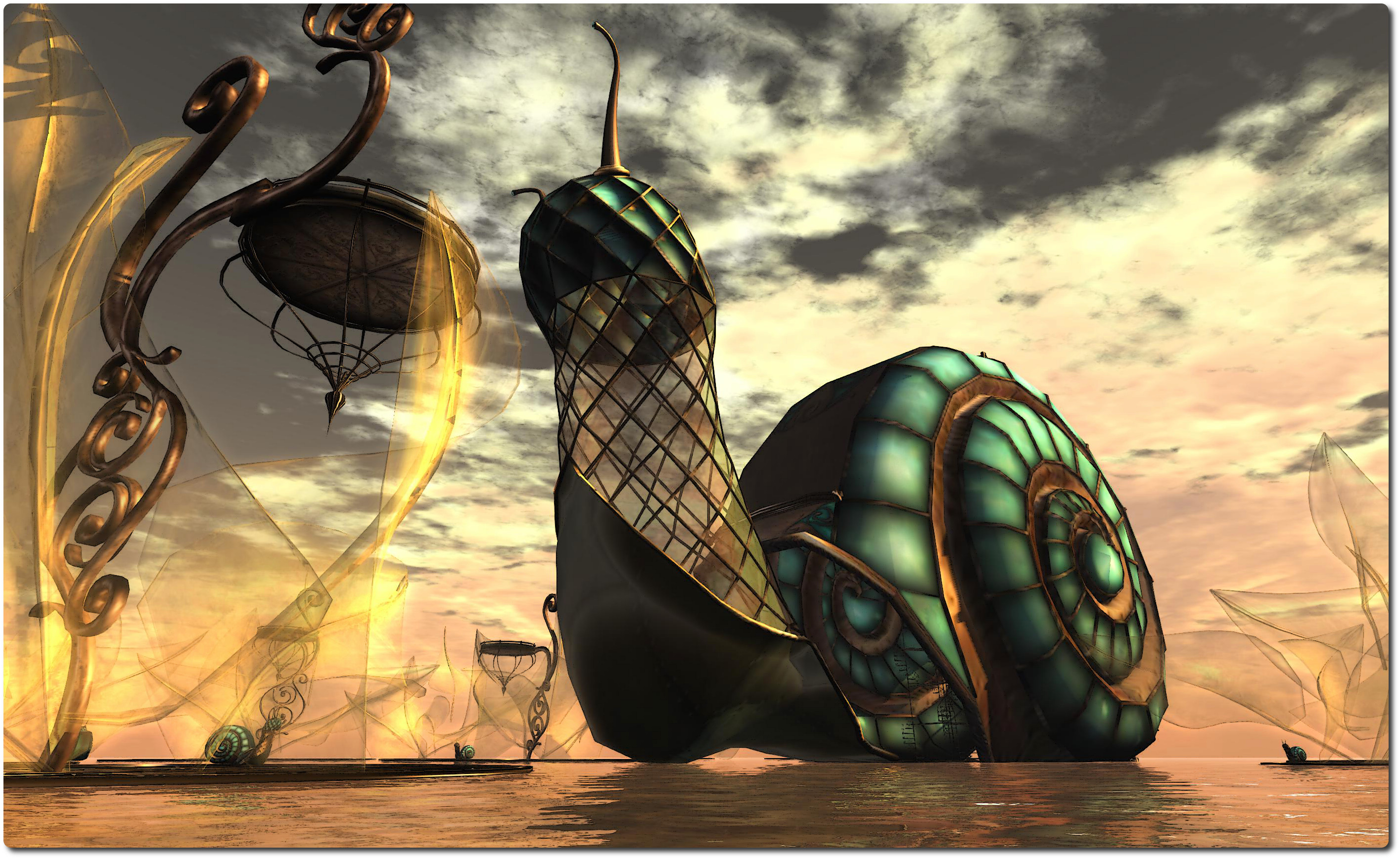
On Monday, January 15th, Ux Hax and Second Life partner, Romy Nayar, announced that their art region, MetaLES, would be closing at the end of the day. The announcement came in a simple statement passed through a number of art group:
After 8 years of art, fantasy and work MetaLES ..O.. closes its doors. Many thanks to all the artists, bloggers, friends and visitors who made it possible, The decision is for the lack of time to dedicate to the project.
Kisses and hugs
Romy & Ux
“Yes today is the last day,” Ux informed me. “We are sad, but the art in SL will continue!” He went on to say that the lack of time mentioned in the notices is related to a new physical world project he and Romy are involved in. However, he refused to be drawn into providing any specifics for the time being.
My first exposure to MetaLES was back when it was referred to as Per4mance MetaLES ..O.., and came with the installation Conformational Change by Selavy Oh. However, it wasn’t until 2013 and Cica Ghost’s Ghostville that I regularly started blogging about the region and installations hosted there.
From the start, MetaLES proved a popular venue for some of Second Life’s top artists – Selavy, Rebeca Bashly, Cica, Cherry Manga, Eupalinos Ugajin, Moya, Bryn Oh, Kicca Igaly, Nessuno Myoo, Igor Ballyhoo, to name but a few, together with Romy and Ux themselves. The depth of art displayed on the region speaks volumes on the esteem in which both Romy and Ux are held by the SL arts community. For my part, one of the great attractions of the installations presented through the region has been the depth of narrative in so many of them.
For example, both Haveit Neox and Igor Ballyhoo both explored ecological issues with The Haul and Tumor respectively; JadeYu Fang examined our anxieties through OpeRaAxiEty; Rebeca Bashly explored ideas of birth, growth and life, and renewal with Queens Gambit Declined, while Ux and Romy explored the tarot through a multi-part series of installation in Escenas / Scenes (see here, here and here).
Such is the richness of art displayed at MateLES over the years, that it is hard to pick out a personal favourite – I thoroughly enjoyed all of those mentioned above, as well pieces like the exploration of Gaston Leroux’s Le Fantôme de l’Opéra in A Bit of Red, by Kicca Igaly and Nessuno Myoo, and lighter installations like Romy’s Sparky’s.
MetaLES is currently hosting three exhibitions, all of which will end with the closure: Shattered, by Theda Tammas, Melancholy by Ini Inaka and Journey into Communication by Nevereux (see here). All three are well worth a visit.
SLurl Details
Journey into Communication (MetaLES, rated: Moderate) – only available until the end of Monday, January 15th, SLT.
Logos representative only and should not be seen as an endorsement / preference / recommendation
Updates for the week ending Sunday, January 14th
This summary is published every Monday, and is a list of SL viewer / client releases (official and TPV) made during the previous week. When reading it, please note:
It is based on my Current Viewer Releases Page, a list of all Second Life viewers and clients that are in popular use (and of which I am aware), and which are recognised as adhering to the TPV Policy. This page includes comprehensive links to download pages, blog notes, release notes, etc., as well as links to any / all reviews of specific viewers / clients made within this blog
By its nature, this summary presented here will always be in arrears, please refer to the Current Viewer Release Page for more up-to-date information.
Official LL Viewers
Current Release version 5.0.9.329906, dated November 17, promoted November 29th – formerly the “Martini” Maintenance RC – No Change.
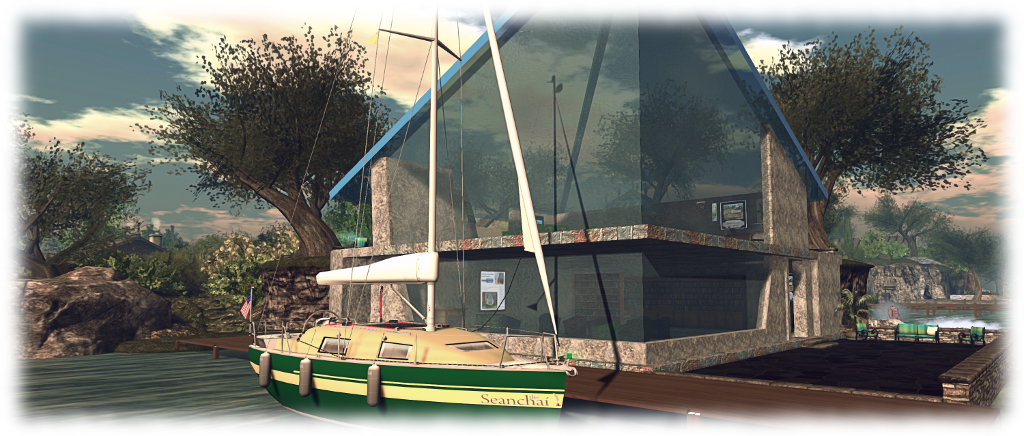
It’s time to highlight another week of storytelling in Voice by the staff and volunteers at the Seanchai Library. As always, all times SLT, and events are held at the Library’s home at Holly Kai Park, unless otherwise indicated.
Monday, January 15th 19:00: The Wolfen
Whitley Strieber is perhaps best known for his book for Communion, a non-fiction account of his alleged experiences with non-human entities. However, his is also a writer of horror fiction, with The Wolfen being his first published novel (1978).
When two New York Police Department uniformed officer are violently killed, detectives Becky Neff and George Wilson are tasked with investigating the incident and bringing the perpetrator/s to justice. The evidence reveals the two uniformed officers were quickly and brutally attacked by some kind of animal – so rapidly, in fact, neither were able to fire their service handguns – one even had his hand and gun ripped from his arm before having time to open fire on his attacker. Worse, both men were disembowelled, their organs devoured.
Gathering the evidence from the crime scene, Neff and Wilson start their investigation by trying to understand what kind of animal might have left the bloody paw prints around the bodies. This leads them down a path that touches on the issue of police corruption which involves Neff’s policeman husband is taking money from certain groups. As more bodies are discovered, Neff and Wilson are drawn into a world where the natural meets the supernatural: the forgotten parts of New York where the abandoned of the city live – and are preyed upon by the Wolfen.
Join Gyro Muggins as he takes us inside Neff and Wilson’s investigations.
Tuesday, January 16th 19:00: Fractured Symmetry
In the future and 1,000 light years from Earth, a woman of action works for a reclusive, enigmatic genius…
Blair MacAlister is an expert at Judo, a credible AI hacker, and a certified pilot of craft atmospheric and interstellar. Her favourite weapon is sarcasm, or failing that, her ever-present blaster. Her boss is Terendurr the Black Stone: technical wizard, expert in the ethnography of myriad races, fancier of rare foods and wines, and even rarer fractalites. An Entharion Quadromorph, exiled from his homeworld and under constant threat of assassination, he is also somewhat irritable.
Together they investigate mysteries based on science, in a setting that brings them into contact with all the main races of Civspace: The mysterious Junn, the affable but biologically intense Raylics, the chaotic and powerful Oro-Ka, the commercial minded Keret, and the cynical Phair.
At the centre of their cases are transformative genetic therapies, unlikely fossils, the linked neurology of symbiotes, and more. Terendurr is over 300 years old and has seen and endured the worst and strangest the galaxy has to offer. Will Blair prove as durable as her boss?
Join Corwyn Allen as he reads selections from Fernando Salazar’s 2017 novel.
Wednesday, January 17th, 19:00: Poems of Hope
With Aoife Lorefield.
Thursday, January 18th, 19:00: Star Wars: The Force Awakens
With Shandon Loring. Also presented in Kitely (hop://grid.kitely.com:8002/Seanchai/144/129/29).
Please check with the Seanchai Library’s blog for updates and for additions or changes to the week’s schedule.
The featured charity for January / February 2018 is Reach Out and Read, giving young children a foundation for success by incorporating books into paediatric care and encouraging families to read aloud together.
The following notes are taken from the TPV Developer meeting held on Friday, January 12th 2018. The video of that meeting is embedded at the end of this update, my thanks as always to North for recording and providing it. Time stamps in the text below will open the video in a new tab at the relevant point of discussion.
Viewer Pipeline
[0:00-4:24] The Nalewka Maintenance RC updated to version 5.0.10.330173 on Wednesday, January 10th, and the Wolfpack viewer has been withdrawn. This leaves the remainder of the SL viewer pipelines as follows:
Current Release version 5.0.9.329906, dated November 17, promoted November 29th – formerly the “Martini” Maintenance RC – No Change
Release channel cohorts:
Alex Ivy 64-bit viewer, version 5.1.0.511732, January 9.
Voice RC viewer, version 5.0.10.330039, December 12.
Project viewers:
Project Render Viewer version 5.1.0.511604, January 3, 2018.
Obsolete platform viewer version 3.7.28.300847, May 8, 2015 – provided for users on Windows XP and OS X versions below 10.7.
The Update to the Alex Ivy 64-bit RC viewer (Tuesday January 9th, and reported in Part #1 of this week’s updates) will be the last such update for that viewer as an RC, and it will most likely be promoted to release status in week #3 (commencing Monday, January 15th). There should be an official blog post accompanying the promotion when it happens, encouraging those on Windows who can upgrade their version of Windows to 64-bit / Windows 10 to do so.
[28:16-30:11] A reminder that Alex Ivy is Windows and Mac, and that the Lab has a separate project for Linux. This will require support from the Linux community to help move the Linux viewer build to a Debian package using system libraries, so allowing TPVs to add the dependencies they require for their flavour of Linux build. If help is given and the project is successful, the Lab will then maintain the Linux build, with the caveat that it will only be subject to cursory QA, and will continue to require support from the Linux community for fixes. A repository for code submissions will be made available, together with a blog post / open-source community notification on the specifics, after the 64-bit viewer has been promoted to release status. Those wishing to support the work will need to sign a contribution agreement with the Lab.
The Voice RC has no known outstanding issues, and should be ready for promotion once Alex Ivy has been promoted to release status and the Alex Ivy code has been merged into the viewer.
The 360-snapshot viewer is looking set to move from project viewer status to a release candidate viewer.
A new viewer branch is being prepared – the media branch, which will be specifically for Chrome Embedded Framework (CEF) changes and other media handling updates. This will likely appear some time after the Alex Ivy viewer has been promoted to release status.
A further viewer project on the horizon is a further update to the viewer build chain, and bring that more up-to-date with things like Visual Studio, etc.
Viewer Deprecation
[4:25] Once Alex Ivy is promoted to release status, the Lab will be deprecating all versions of their viewer not using Asset HTTP loading (e.g. viewers prior to version 5.0.6). At some point after this, work will then commence on removing all UDP asset messaging from the servers, so anyone still using a viewer not fully supporting Asset HTTP will be unable to load gestures, animations, sounds, etc.
Avatar and Object Rendering
[9:26-10:32] Work on revising the current avatar complexity and object rendering calculations is due to resume “in the next week or two”. It is hoped this will allow the Lab to adjust the formulas used to make a reasonable generalisation in the rendering cost of things, and whether or not objects are being reasonably accounted for in those calculations, although things may not change that much. However, the Lab is “determined to fix some of the bad incentives in the current calculations”.
Environment Enhancement Project (EEP)
Project Summary
A set of environmental enhancements, including the ability to define the environment (sky, sun, moon, clouds, water settings) at the parcel level; a new environment asset type that can be stored in inventory and traded through the Marketplace / exchanged with others; scripted, experience-based environment functions, an extended day cycle and extended environmental parameters. This work involves both a viewer updates (with a project viewer coming soon) and server-side updates.
Current Status
[33:32-35:06] Rider linden is making progress, with his next step being to get the new setting objects defined as assets which can be stored in inventory. Once this has been done, he will be comfortable with setting up test regions on Aditi ready for testing once a project viewer is available. The viewer will require new UI elements for manipulating windlight assets, the initial design work on which, Rider jokingly claims, has already given him a nervous twitch in his left eyebrow!
In Brief
[13:35-15:32 ] Group Notices failures: some work has been done on this, showing that problems can start to occur if the group chat servers are left running too long, so a round of restarts should hopefully prevent this. Work is also going to be put into making group notice delivery more robust when logging-in, and this will hopefully be out in the next few months.
[22:49-26:55] Viewer widget documentation & additional viewer documentation: the viewer web widget wiki documentation is currently out-of-date, and a request has been made to update it. The Lab doesn’t have any documentation on the viewer (e.g. design documents etc.), outside of what is available on the wiki.
[32:04-32:45] IMs to E-mail: there have been reports at the recent Web Group and Simulator User Group meetings that some IMs to e-mails failed over the holiday period. This has been investigated, and the issue did lie with the Lab. However, it has been rectified, and all IMs to verified e-mails addresses should work correctly.
[11:02-11:48 – in text+ voice comments] The next Firestorm release will not allow changes to the debug RenderVolumeLODFactor which go above 4 to persist between log-in sessions. People will still be able to set the value above 4, but will have to do so each time they log-in. [18:33 – in text] There is to be one more beta release of the new Firestorm, which should be followed in about a week’s time with a formal release (late breaking issues allowing).
Queen of Dragons? Surrounded by Animesh dragons by Wanders Nowhere and used by Lucia Nightfire as Animesh test models
The following notes are primarily taken from the Content Creation User Group meeting, held on Thursday, January 11th, 2018 at 13:00 SLT. For the purposes of Animesh testing, the meetings have relocated to the Animesh4 region on Aditi, the beta grid – look for the seating area towards the middle of the region. The meeting is chaired by Vir Linden, and agenda notes, etc, are usually available on the Content Creation User Group wiki page.
Medhue Simoni live streamed the meeting, and his video is embedded at the end of this article – thanks to Medhue, as always, for the recording. Where the video is referenced, time stamps to the specific point of the video are provided in the text – click on them to open the video in a separate browser tab at that point.
Animesh (Animated Mesh)
I like the name ‘animated objects’ because I think it’s unambiguous, but it takes a long time to type!
– Vir Linden joking about the name “Animesh”.
Project Summary
The goal of this project is to provide a means of animating rigged mesh objects using the avatar skeleton, in whole or in part, to provide things like independently moveable pets / creatures, and animated scenery features via scripted animation. It involves both viewer and server-side changes.
In short, an Animesh object:
Can be any object (generally rigged / skinned mesh) which and contains the necessary animations and controlling scripts in its own inventory (Contents tab of the Build floater) required for it to animate itself.
Can be a single mesh object or a linkset of objects (link them first, then set them to Animated Mesh via the Build floater > Features).
Has been flagged as and Animesh object in the project viewer, and so has an avatar skeleton associated with it.
Can use many existing animations.
However Animated objects will not (initially):
Have an avatar shape associated with them
Make use of an avatar-like inventory (although individual parts can contain their own inventory such as animations and scripts)
Make use of the server-side locomotion graph for walking, etc., and so will not use an AO
Use the avatar baking service
Will not support its own attachments in the initial release.
These are considered options for follow-on work, possibly starting with the notion of a body shape (to help with more fully-formed NPCs).
[2:08-3:58] Work is now starting on performance profiling for Animesh to determine suitable limits (e.g. tri counts, LI, etc.) when Animesh goes live. This is regarded as being one of the last steps before the project moves to the main grid. As a part of this, Vir has been adding the ability to control the triangle count limits for Animesh objects on a per region basis. This will be used to set different limits on different regions for the Lab’s internal performance profiling, and a region with the capability will also be made available on Aditi for public testing, and details will be made available once the region is up and running.
Object Animations And Animating Animesh
[43:13-55:34] A convoluted enquiry requiring a feature request in order to be made clear, but appears to be a request to provide a means for object animations to override an Animesh object’s own animations. So, for example, an Animesh hamster could be placed into a treadmill, and the treadmill either override the hamster’s in-built animations (stored in the hamster object’s Contents tab of the build floater) and cause the hamster to run, in much the same way as in-world objects can override avatar animations.
Such a capability could offer additional flexibility for Animesh – if a creator brings out a new toy for a pet (e.g. the treadmill, above), a means by which the treadmill could override the pet’s behaviour would avoid the need to update the pet as well in order for it to make use of the new toy. It’s unlikely such a capability will be considered for this phase of Animesh; however, Vir has requested a feature request on the idea is filed, so it can be considered alongside other work in a future Animesh update. Hopefully, any feature request will avoid the use of pseudo technical terms such as “faux permission system” and “reverse animation system”, which initially caused some confusion when the idea was raised at the meeting.
In Brief
[4:00-8:10] Performance (FPS) issues when camming on Animesh: there has been a report of some mesh items causing drops in FPS rates when converted to Animesh, leading to choppy camera motion for some. Vir has been looking at one of the models in question, and believes the problem lies with the recalculation of attachment overrides, which can be excessive and even be carried out when there is no change in the object itself. Improving when and how the calculations are handled should hopefully resolve the problem, which can obviously be exacerbated through models having more joint positions defined. The fix, once implemented – hopefully in the next Animesh viewer – may help with other instances where there is a performance drop-offs when camming / zooming.
[8:51-10:55] LOD Drop: this is not considered an Animesh specific issue. Essentially, Animesh objects are being treated by the viewer as if they are avatars, and so get a similar boost in LODs, which needs to be tweaked.
[31:02-33:29] “Dropping” Animesh objects (i.e. allowing avatar to put pets, etc., down on the ground, without having to detach them back to inventory first, then rez them in-world): as per my 2018 week #1 CCUG meeting notes, this is still considered too big a piece of work to add to the Animesh project, as it requires changes to a variety of elements: land impact calculations, physics updates, etc. It could also result in forcing users to re-log should a No Copy pet be dropped and fail to rez in-world, in order for it to correctly register in their inventory again. However, such a capability for dropping mesh might be looked at again in the future.
Bakes on Mesh
Project Summary
Extending the current avatar baking service to allow wearable textures (skins, tattoos, clothing) to be applied directly to mesh bodies as well as system avatars. This involves server-side changes, including updating the baking service to support 1024×1024 textures, and may in time lead to a reduction in the complexity of mesh avatar bodies and heads. The project is in two phases:
The current work to update the baking service to support 1024×1024 textures.
An intended follow-on project to actually support baking textures onto avatar mesh surfaces (and potentially other mesh objects as well). This has yet to fully defined in terms of implementation and when it might be slotted into SL development time frames.
This work does not include normal or specular map support, as these are not part of the existing baking service.
Current Progress
[8:21-9:25] Anchor Linden is working on issues around getting the appearance service updates out. These include on problems specific to Animesh attachments. A setting is also being added which means that the texture resolution increase (to 1024×1024) isn’t applied by the baking service until there is a mesh surface requiring it. Work on adding further baking servers is also required to manage the compositing / baking load at 1024×1024. However, the updates are now available on Aditi.
[11:04-21:12] A further explanation as to what Bakes on Mesh is, born from expressed confusion over the term “baking” in terms of 3D rendering, and the fact that the current work only applies to meshes worn by avatars.
[21:22-26:00] Bakes on mesh for Animesh: this would be part of any “phase 2” work that follows-on from the initial work on Animesh, once Animesh objects have a formal inventory structure. This would be required in order for the baking service to be able to recognise and use textures with Animesh objects. Includes a discussion on how the baking service currently works.
Other Items
[1:14-2:03] Mesh uploads: recognising linkset object names: as mentioned in my previous update, when uploading mesh objects, only the name of the root item in a linkset is recognised, everything else is simply “object”, rather than carrying over any naming convention used when creating a model (e.g. “dog”, “dog_head”, “dog nose”, “dog_tail”, etc., or some variation of more useful naming). Various requests have been made to change this for consistency of item naming. The Lab has been looking into this, and a problem is that the server itself ignores any linkset object names outside of the root object. This means that preserving object names is more complex than had been hoped, although investigations on what might be done are ongoing.
[38:08-39:20] *JOKE**: comments on mirrors and raytacing: do not take seriously! An explanation is supplied.
Gallery Cecile is a complex of eight display spaces for artists, curated by Cécile (Pierce Taurog). It is devoted to exhibiting art from both the physical world and Second Life, and from the former, is currently exhibiting selections of art by Salvador Dali (1904-1989) and Roger Suraud (1938-2016), which can be found in the gallery’s 0 and 1 exhibition halls (the latter of which forms the main entrance. Both are excellent displays, which the Dali exhibit offering links to the wikipedia pages. However, for this review, I’d like to focus on three Second Life artists: Dixmix Source, Rose Beaumont and Sakura Taurus.
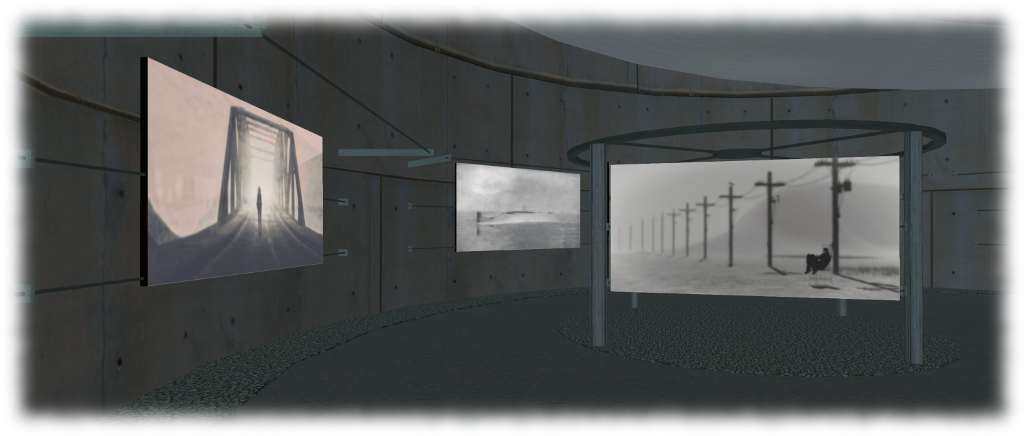
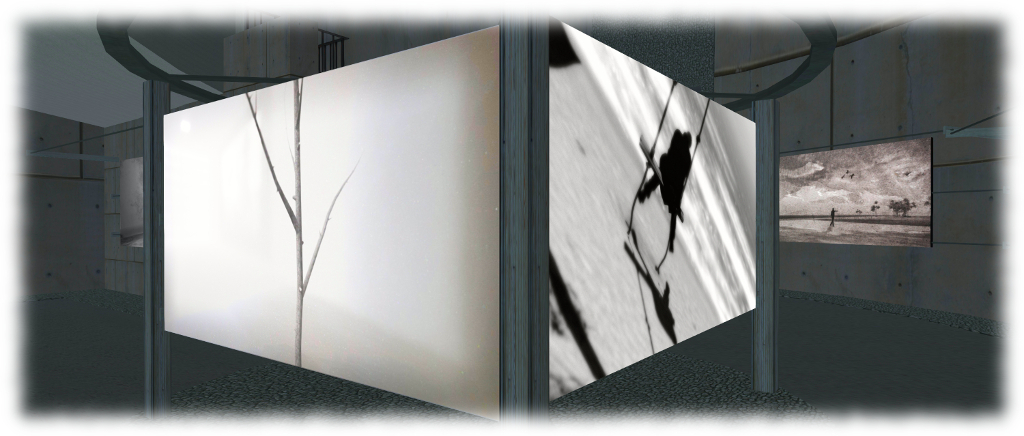
Dixmix Source can be found in exhibition hall 3 at the gallery. Entitled I Don’t Get Lonely When I’m Alone, his display features 10 minimalist black-and-white images, nine of which feature a single male figure, sometimes seen clearly, at others appearing slightly blurred or ghosted, framed within a landscape or setting.
At first look, there appears to be certain pathos in several of the images, which on closer examination slowly morphs into something else, which I can only describe as a sense of “all-one-ness”. While the figure may initially appear to be alone, lost within a setting, a second look reveals something else: a man who may be on his own, but who appears to be at one with his surroundings. There is a certain ease in the way he sits or stands; while some of his poses may suggest an attitude of “leave me alone”, so to do the images as a whole suggest he’s actually entirely comfortable with his condition and location. Simply put, he’s never lonely while on his own: his surroundings offer him all he needs.
The final picture in the series presents a different view of aloneness: what appears to be a tiny sapling (or perhaps a single twig of a tree) set against a white background, offering s singular image of the beauty of nature. As well as the images, Dix has prepared a soundtrack for the exhibition – click on the sign in the exhibition hall for the URL.
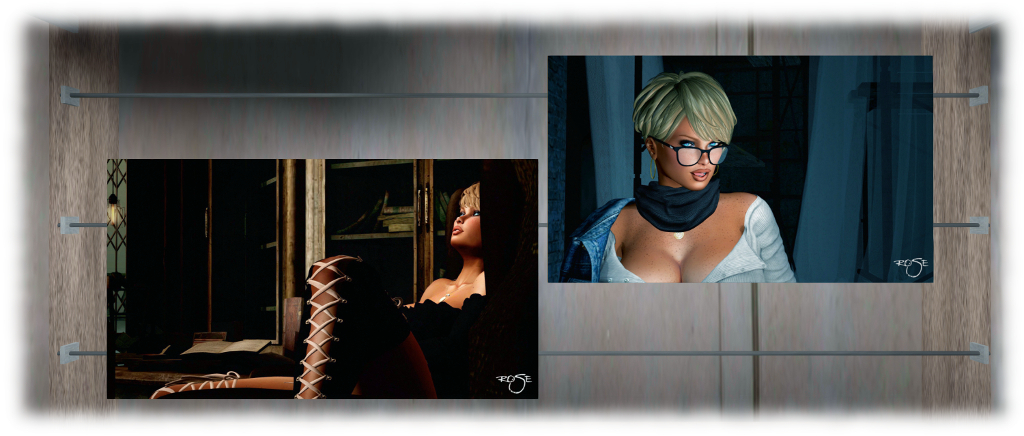
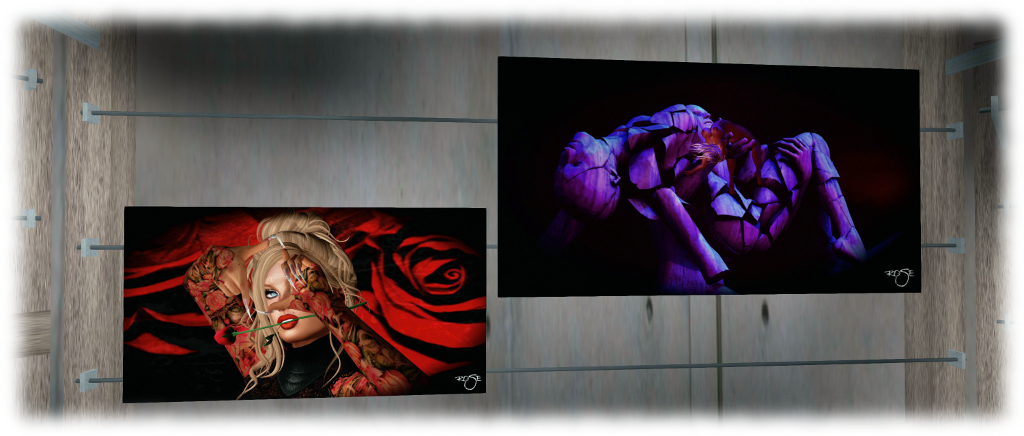
Above this, in gallery 4, is Eclectic Rose, by Rose Beaumont (Rose Bomse). A series of ten avatar portraits, these stand in strong contrast to I Don’t Get Lonely When I’m Alone through the opulent use of colour within most of them; however, they also in some respects continue the theme of individual studies offered by Dix.
“I like taking pictures that tell a story alone or with models,” Rose says of her work. “My tastes in photography are quite eclectic and vary with the inspiration of the moment and my mood but always with a concern for quality and details. Shooting is not like a job for me, but must be a pleasure and a nice moment to share.”
The majority of these images, if not all of them, appear to feature the same model (Rose herself?). Narrative is strong in most of them, with one at least carrying something of a self-statement – Picture This Rose – which I found to be both captivating and layered, incorporating Rose’s photography as a whole, her passion as a photographer (framing one eye as if looking through viewfinder), the repeated motif representing her name, the overall suggestion of sensuality and the idea that this is just one aspect of a multi-faceted personality.
As with Dix, many of these images suggest that being alone is not equitable to be lonely – some directly, others in a more subtle manner of posing and setting. The sentiments within each of the images are somewhat revealed by their individual titles, but this doesn’t stop the eye and the mind from using each title as a launching point for a deeper examination and consideration of each picture – and I confess to being quite drawn to several.
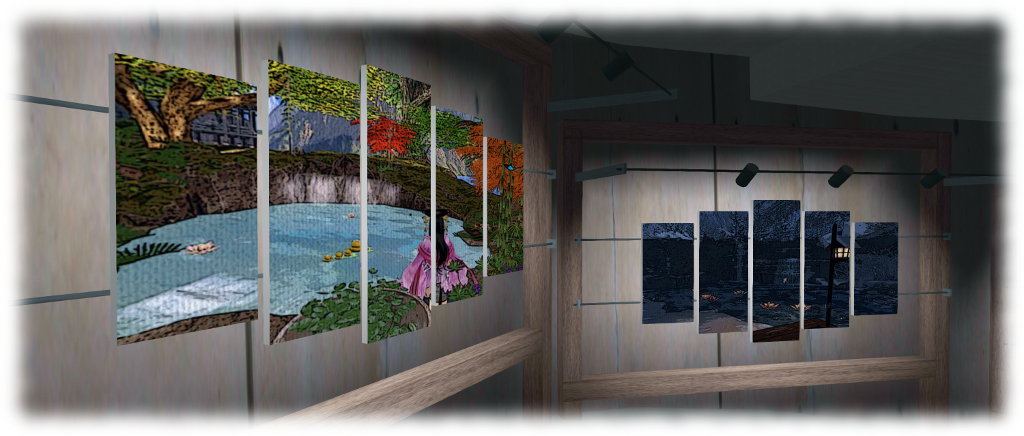
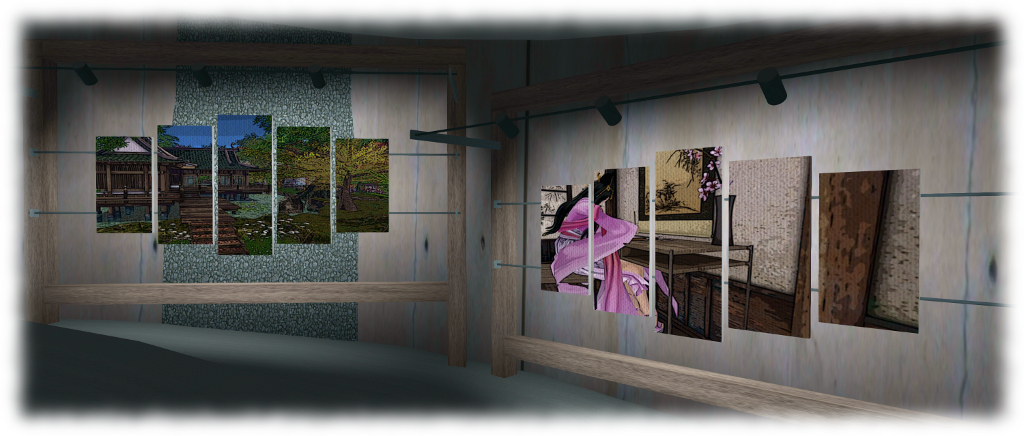
Taking the ramp upwards from Rose will bring visitors to exhibition area 6 (area 5 was empty during our visit), an exhibition by Sakura Taurus, entitled Pour la Postérisé! (For the Posterized!) – a celebration of the art of posterization. Five panelled images are presented, all with a Japanese theme and shot around Second Life (I think I recognise Collins Lands in one, but am not 100% sure). All are presented on multi-panel frames, and each has been gently posterized, in keeping with the theme of the display.
I’m personally not a fan of this form of art, but confess to finding the five images offered by Sakura attractive. I’m obviously biased towards anything oriental in nature, so this may be a part of it – but it is not the sole reason. All five images show a more nuanced, subtle approach to posterization than is perhaps more usually the case; so often the process is very “in your face”, so to speak, in the degree to which it has been used and in the use of colour. The five pieces presented by Sakura are altogether far more gentle in approach, to the extent that they suggest a blending of posterization and traditional painting – which ideally, in my opinion, suits their subject matter.
These, and the remaining exhibitions on offer make Gallery Cecile a very worthwhile visit – one deserving of having time put aside to appreciate the various displays fully.