2018 SL UG updates #13/3: CCUG summary w/audio

A rally of (Animesh) raptors on Aditi

The following notes are primarily taken from the Content Creation User Group (CCUG) meeting, held on  Thursday, March 29th, 2018 at 13:00 SLT. For the purposes of Animesh testing, the meetings have relocated to the Animesh4 region on Aditi, the beta grid – look for the seating area towards the middle of the region. The meeting is chaired by Vir Linden, and agenda notes, etc, are usually available on the Content Creation User Group wiki page.

There is no video to accompany this update, notes are taken from my own audio recording of the meeting.

Animesh Project

Project Summary

The goal of this project is to provide a means of animating rigged mesh objects using the avatar skeleton, in whole or in part, to provide things like independently moveable pets / creatures, and animated scenery features via scripted animation. It involves both viewer and server-side changes.

Current Progress

Vir now has a proposed revised land impact / tri count formula and test plan for Animesh. This will be going to QA, and if all goes well, the new formulas will be deployed on the Aditi Animesh test regions ready for public testing. No end-date for public testing on Aditi has been defined – the Lab want to ensure as many as are interested have to opportunity to test the new formula. Animesh attachment will remain limited to one per avatar, at least for the time being.

It is likely that server-side support for Animesh will reach the Main grid ahead of the project viewer reaching release candidate status – although this still won’t be for a while.

LODs and Streaming Costs

How Animesh Level of Detail (LOD) is handled is still being tweaked. Currently, Animesh objects sit between in-world objects and avatars in terms of the way their LODs are handled / swapped. The Lab is looking to adjust this, so that Animesh LODs are more consistently handled as they would be for in-world objects.

The broad plan is – for Animesh only – that the lower LODs will not affect streaming costs so long as they are not disproportionately large. Providing they get smaller by at least a factor of approximately 2 as they go down to the courser LODS, they will not impact streaming costs.

Note this work is not part of Project Arctan, which may lead to further changes in costs associated with objects at some point in the future – see below for more.

Project ARCTan

This is the code-name for the project to re-evaluate object and avatar rendering costs (e.g. Land Impact and avatar ARC), led by Graham Linden as a part of the overall rendering system work. The aim of is to have the costs assigned to objects and avatar more accurately reflect the impact they have on people’s viewer performance.

The hope is that overall, by making a careful set of adjustments, not only can client-side performance be improved, but creators can be given positive incentives to build more performant content (a problem currently being that providing good LOD models – high, medium, low and very low – for mesh content can actually penalise a creator in terms of upload costs / Land Impact, encouraging them to skip doing so).

This project is still in the early stages, and the Lab is fully aware of the risks and concerns involved in potentially making changes to things like Land Impact (e.g. undesired object returns), and so are approaching the work cautiously. Right now, data is being gathered and internal comparative testing is being tried. There are no plans to make any kind of changes in the immediate future. When changes do start to be made, they will be done so carefully to avoid disruption, and users will be appraised of what is happening and when.

Bakes on Mesh

Project Summary

Extending the current avatar baking service to allow wearable textures (skins, tattoos, clothing) to be applied directly to mesh bodies as well as system avatars. This involves server-side changes, including updating the baking service to support 1024×1024 textures, and may in time lead to a reduction in the complexity of mesh avatar bodies and heads.

This work does not include normal or specular map support, as these are not part of the existing baking service.

It is important to note that this project is still in its preliminary stages. Any release of a project viewer doesn’t mark the end of the project, but rather the start of initial testing and an opportunity for creators to have input into the project.

Current Progress

The project viewer is still with QA with a couple of outstanding JIRAs awaiting resolution. The hope is that it will be making a public appearance soon.

When issued, this viewer should work anywhere, as it doesn’t require simulator changes. However, only those using the project viewer will see things as intended. Anyone on a viewer without the Bakes on Mesh updates will see placeholder textures, rather than the intended baked textures, on avatars trying the Bakes on Mesh capability.

Bakes on Mesh will essentially use the three avatar elements used by the baking service – head, upper body, lower body, eyes, hair, skirt), and applies clothing bakes for those elements to specific mesh faces, effectively “hiding” the corresponding base mesh region. This means for example, a head bake can be applied to a mesh head, an upper body to the mesh upper body faces, etc.  It does not at this point allow for more finely tuned applications – such as an individual jacket layer, or just to the hands.

Environment Enhancement Project (EEP)

Project Summary

A set of environmental enhancements involving simulator and viewer changes, and includes some infrastructure updates.

Current Progress

Rider is still engaged on infrastructure work, which he hopes to complete Soon TM. Once that is done, he’ll complete the work on assets in inventory.

Custom Pivot Points

Work is being carried out to provide custom pivot points for mesh objects (see BUG-37617). This will most likely appear in a Maintenance RC viewer, once ready. The exactly implementation details weren’t clear at the meeting; it’s believed the data for the pivot point is coming from the corresponding data for the highest LOD in the uploaded .DAE file. However, the pivot point must be inside the bounding box of the object, and remains the centre of the object. Steps will also be taken to prevent pivot points placed outside of the bounding box simply causing the bounding box to increase in size (as did happen in a mesh uploader error), as this tends to both increase the objects LI by a factor of at least 2, and break the associated LODs.

Other Items

Texture Caching

Work continues on trying to improve texture caching in the viewer – which has already been an educational process for the Lab. There is nothing on the horizon yet in terms of updates for the viewer, as the work is not seen as a high priority when compared to other projects. However, there is a belief that there is room for “dramatic improvement” in the way textures are managed.

Permissions System

The question was asked if there are any plans to re-work the Second Life permissions system to be more supply chain driven, as is planned for Sansar. Short answer: there are no current plans to overhaul the permissions system simply because it is so complex. Currently the only thing being considered with permissions is extending them to allow scripted permission changes (formerly known as mod keys), which are seen as important for enhancing Animesh capabilities. However, here are current no time frame in when / if these will be implemented.

Firestorm RenderVolumeLODFactor Setting / Object LOD Confusion

Some appear confused by the recent RenderVolumeLODFactor behaviour change (see here) and what it is doing, believing it is part of a change to object LODs in Second Life.

Essentially, the Firestorm update is purely a viewer-side change only, intended to encourage users not to use over-the-top settings in their viewer which can affect performance, because changes to this value are globally applied, affecting all objects within the viewer’s field of view, not just a specific wearable or object.

However, this change does not mark any kind of change to the object’s LOD data held on the servers (the content isn’t being “changed” in any way on the back-end); it purely alters the way content is rendered by the viewer in terms of which LOD model of the object it uses.

Date of Next Meeting

There will be a CCUG meeting on Thursday, April 5th, as the normal LL internal meeting has been postponed a week.
Another trip on Route 66 in Second Life

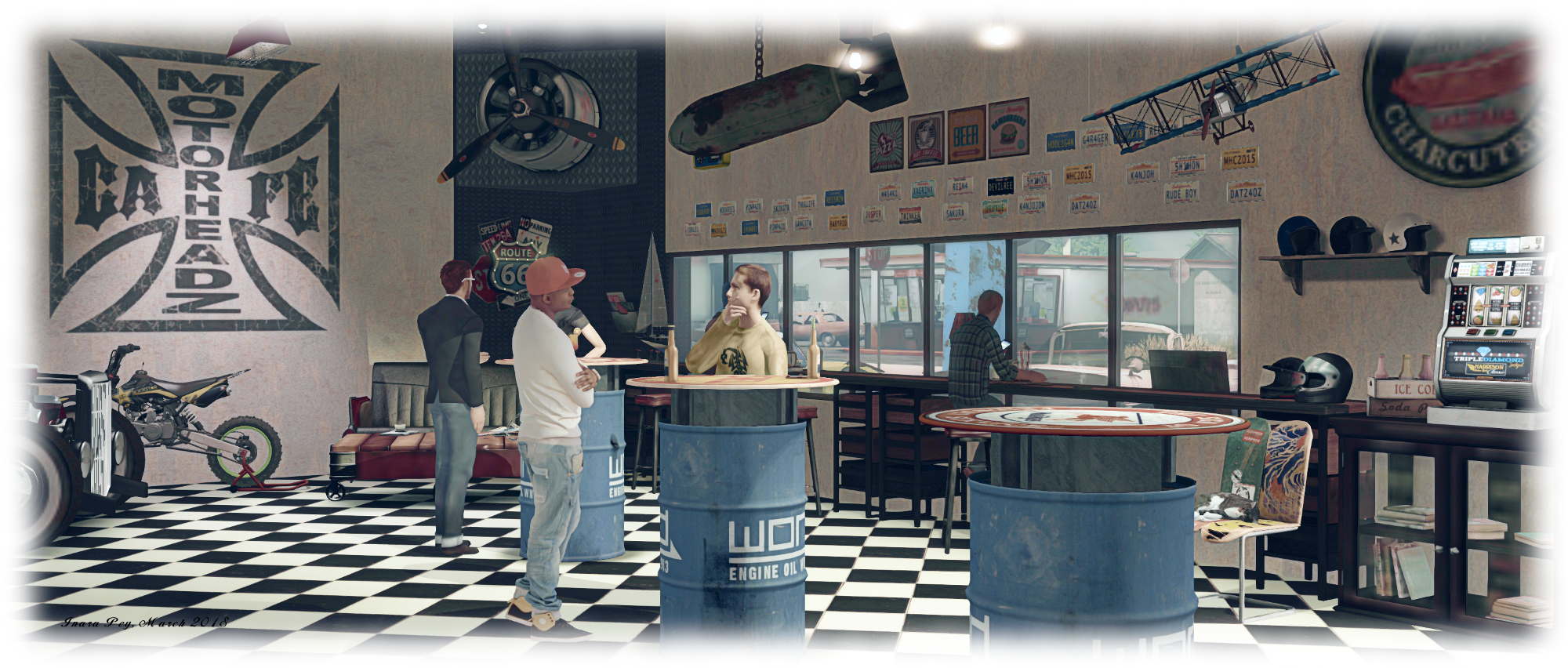
Motorheadz Café / Route6; Inara Pey, March 2018, on FlickrMotorheadz Café / Route66 – click any image for full size

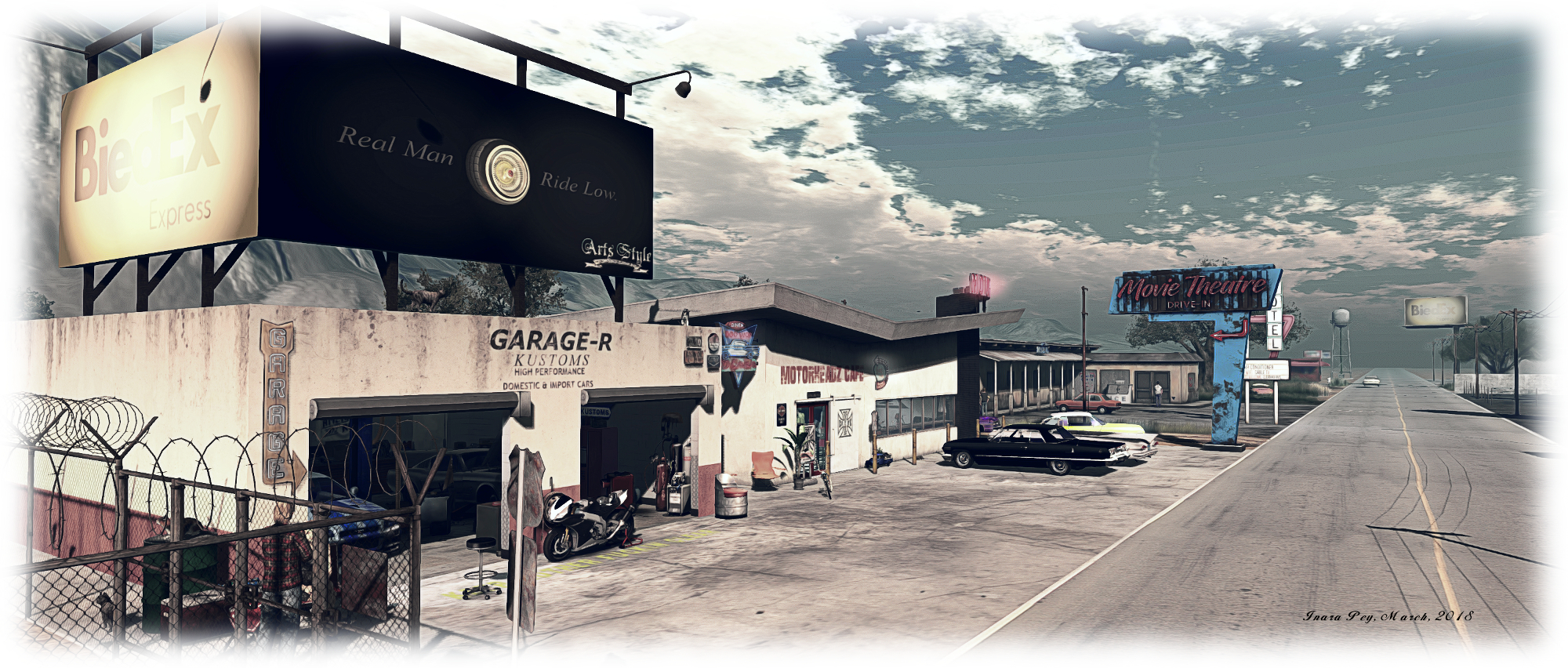
Route 66 has been a popular subject for region designs in Second Life over the years, and one of the more recent is called Motorheadz Café / Route66, which Shakespeare alerted me to recently. Designed by ROCKET (Rocket Biedermann), this Homestead region immediately put me in mind of  Mother Road, which Caitlyn and I visited in September 2017 (see here for more). Such is the similarity between the two, one might easily be the neighbour to the other.

Bracketed to the east and west by mountains, the region is dissected by the titular road, alongside of which sits the landing point. Take care on arriving – it’s easy to step out on the road, and as you’ll find out, this actually has traffic passing along it periodically – cars, pick-up trucks, police cars – even trucks towing semi-trailers.

Motorheadz Café / Route6; Inara Pey, March 2018, on FlickrMotorheadz Café / Route66 – click any image for full size

The road is straddled by a small township that seems to have grown up here as a result of pharmaceutical plant that apparently started operations in 1886. The security guard at the gate suggests it is still in use, but perhaps it is now more of a storage facility than anything (and part of it is off-limits to visitors).

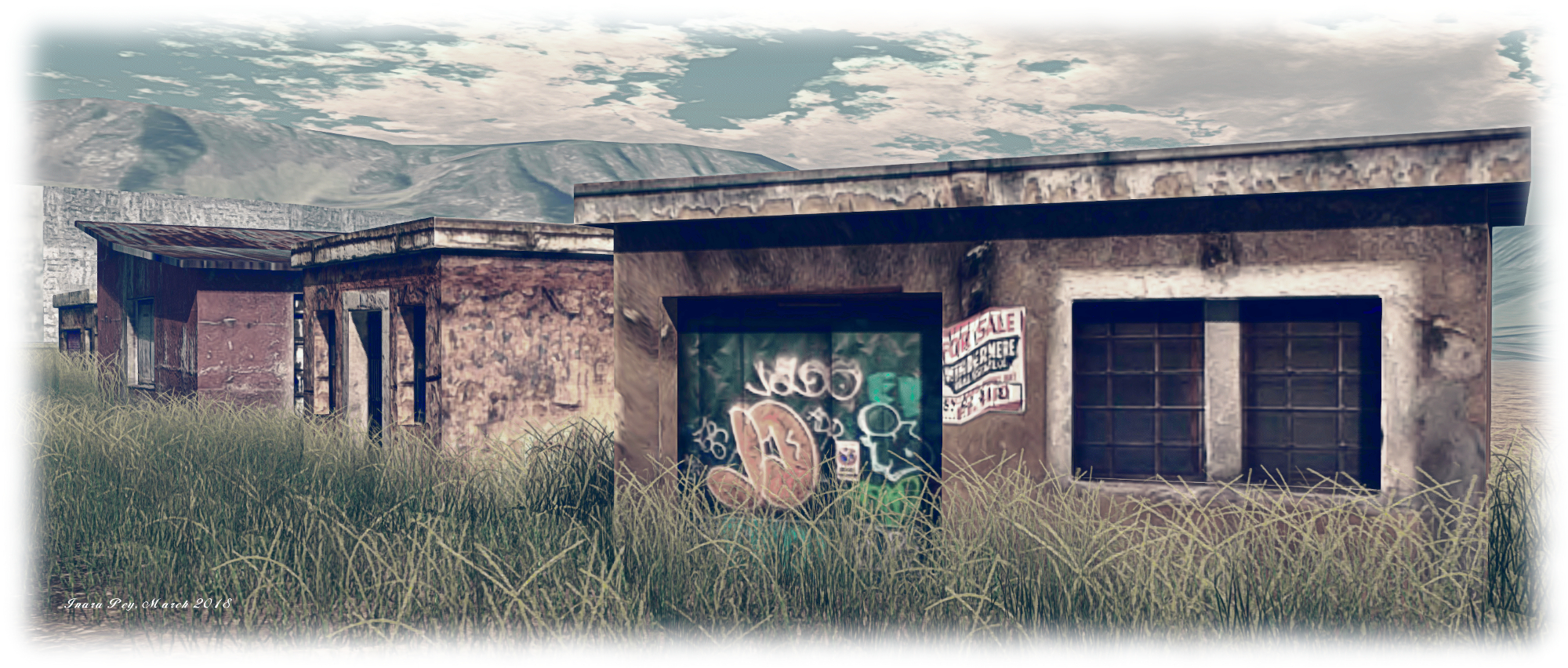
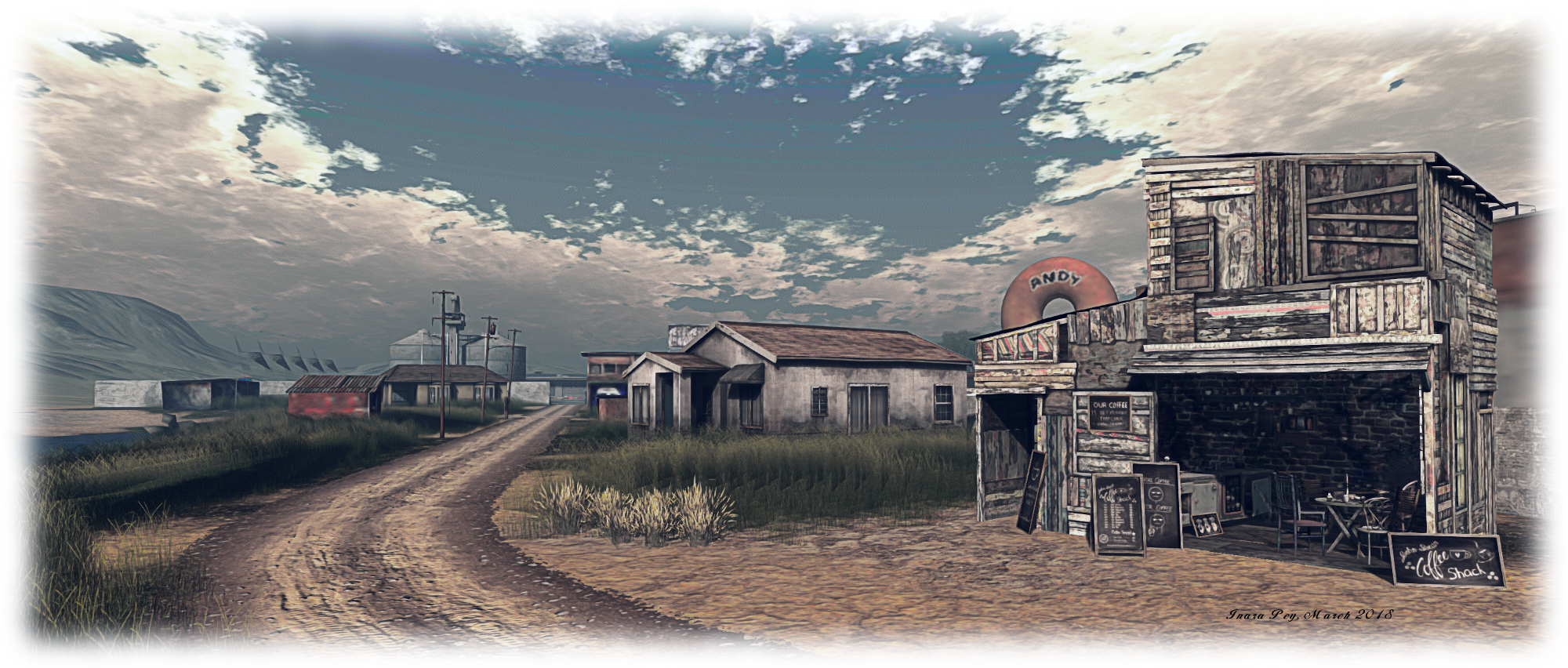
This might explain why the rest of the town is looking somewhat run-down; without a place of work, many of the local inhabitants may well have moved on to pastures new; what’s left is a handful of roadside business – an auto shop, the titular Motorheadz Café, a couple of stores, a doughnut shop offering competition to the café, and a run-down motel which hardly lives up to its name: Miami.

Motorheadz Café / Route6; Inara Pey, March 2018, on FlickrMotorheadz Café / Route66 – click any image for full size

Behind these, again on either side of the road, lay a scattering of houses and shacks. all of them looking more than a little run-down – but going on the cars parked outside of them, several are still considered home by the locals.

What makes this region a little different is the work that’s been put into making it appear to be “alive”. There are the aforementioned vehicles zapping along the main road, while scattered around the region are posed dummies. There’s nothing new in this – such characters often turn up in many regions; but rather than having such dummies individually placed – at market stalls, behind counters, etc., Rocket has brought them together in series of vignettes.

Motorheadz Café / Route6; Inara Pey, March 2018, on FlickrMotorheadz Café / Route66 – click any image for full size

There’s the couple outside of the auto shop, for example, apparently waiting for the car to be fixed; while outside the motel, certain negotiations appear to be under way. Further afield, the local motorbike gang are gathering at their club-house, and so on – but check inside the café for the best example of bringing these characters together to form a little story. Cats are also much in evidence, doing the things cats do – including perching themselves in locations that are unexpected – but typically cat-like.

Motorheadz Café / Route66 may not appeal to everyone, but I admit to finding it with its own charm. With rezzing open (5-minute auto-return), it makes an ideal environment for photographers looking for a more unusual backdrop, particularly if “extras” are needed. There’s also opportunities for photos in other parts of the region: alongside the train tracks, out in the fields, etc.

Motorheadz Café / Route6; Inara Pey, March 2018, on FlickrMotorheadz Café / Route66 – click any image for full size

SLurl Details

March 2018 Web User Group Summary

Grumpity and Alexa Linden host the Web User Group monthly meetings at Alexa’s barn

The following notes are taken from the Web User Group meeting held on Wednesday, March  28th, 2017.

These meetings are generally held monthly on Wednesdays, and are chaired by Alexa and Grumpity Linden at Alexa’s barn. The focus is the Lab’s web properties, which include the Second Life website (including the blogs, Destination Guide, Maps, Search, the Knowledge base, etc.), Place Pages, Landing Pages (and join flow for sign-ups), the Marketplace, and so on and the Lab’s own website at lindenlab.com.

Meeting Format

A point to remember with the Web User Group meetings is that they are informal discussions on things like the Marketplace.

While the Lab does give information on the work they are carrying out, plans they have in-hand for updates to web properties, etc., equally, a lot of what is discussed is ideas and the taking of feedback from attendees, and should not necessarily be regarded as statements from the Lab as to what will happen, it priority, or anything else.

Within these reports, I try to indicate those plans / actions / projects that are in progress, and offer a differentiation between “firm” plans and ideas under discussion.

Marketplace

  • Priority item flagging: under discussion at the Lab is the idea – put forward by Merchants at a previous Web User Group meeting – that “certified” Merchants priority in flagging and the Marketplace reports. This “certification” might be through the payment of a fee.
  • Survey: the Lab is considering a Marketplace survey in which Merchants can indicate their preferences around possible enhancements, etc., to the Marketplace and perhaps submit and idea of their own.
  • Feature requests: specific, well thought out idea for new features for the Marketplace (and Second Life in general) can / should be submitted via the Second Life JIRA.
    • It is preferable that only one idea (or a limited set of related ideas) for new features is submitted per Feature Request submission.
    • Feature Requests are triaged (reviewed) by the Lab on a weekly basis.
The Feature Request form is accessed via your JIRA dashboard – log-in via your Second Life credentials required. Select Create Issue in the top right of your dashboard to open the default Bug Report form. Then click on the Issue Type drop-down and select New Feature Request to replace the Bug Report form with the Feature Request form.
  • Marketplace search: the Lab is aware that there are issues with the MP search function, and hope to be able to improve it. However, reporting that search “is broken” is sufficiently helpful. If there are specific instances where search fails to work as expected which can be specifically defined, these need to be reported via a JIRA bug report, with detailed steps so that the Lab can see (and reproduce) the problem, then take steps to address the issues.

Destination Guide

  • The Destination Guide suffers from a large number of locations listed within it which have ceased to exist in one way or another (the region no longer exists, it has changed hands and been re-purposed; the owner has made it private with access control, etc.).
  • There is curation of Destination Guide entries, but this is described as inefficient as it doesn’t parse all the DG categories “very frequently”.
  • There is discussion at the Lab about automating the curation process to help with the removal of outdated locations, but nothing so far is on the road map for implementation.

Place Pages

For an overview / looking at creating Place Pages, please refer to my article: Creating Second Life Place Pages.

Further development of Place Pages is planned, with one of the first added features, possibly appearing in the near future, is support for land auctions, offering the same functionality as the current auctions. This will be expanded over time to offer resident-to-auctions.

Name Changes – Further Information

  • “Original / legacy” last names will not be re-opened for use.
  • New users joining Second Life will still be given the automatic “last name” of “Resident”, but have the option of changing if they wish.
  • The fee for name changes has not been announced, however, at this point the indication is that the fee will be in fiat currency (i.e. US dollars) not Linden Dollars.
  • One of the reasons the return of last names will take time to be implemented is that all of the SL web properties – like the Marketplace – have to be updated to recognise users as they change their names (something which applies across almost all of the SL services when you think about it).

Governance and DMCA

Issues around Governance, the Marketplace and the DMCA process continue to be raised.

Governance User Group?

Often at user-group meetings questions are asked around matters of governance or which may be related to legal / financial issues (e.g. fraud or alleged cases of fraud). All of these matters are overseen by teams outside of the technical personnel who attend the in-world meetings, and so – while it may be frustrating for those raising the questions – cannot comment on or address such issues.

There are discussions at the Lab about holding a Support / Governance user group in the future. There is currently no date as to when this may take place, or whether, if it does, it will be a one-off or one of a series. However, once the dates have been established, it will be announced through channels such as the User Groups wiki page.

DMCA Filing

Currently, the Lab’s Infringement Notification Policy requires that DCMA notices are filed with Linden Lab via mail or fax.In December 2017, it was indicated that this would be revised so that DMCA’s can be filed via an on-line form. The provisional date for implementing this change had been around January / February 2018, however, it has been subject to delay.

Oz and Grumpity Linden indicated the reason the form has yet to be deployed is twofold:

  • The original version of the form was subject to a change in requirements, and so had to be re-worked.
  • The submission process has to be robust enough to prevent abuse (e.g. repeated multiple filings from an individual on the same issue);has to have checks in place to ensure the submitter’s credentials can be verified; and has to meet the requirements for non-Second Life users to be able to file a meaningful DMCA notice (e.g. in the case of an external company finding copies of their copyrighted material is being sold unlicensed through Second Life).

It is hoped that form will be available in the near future.

Lighting the Way with SoCo in Second Life

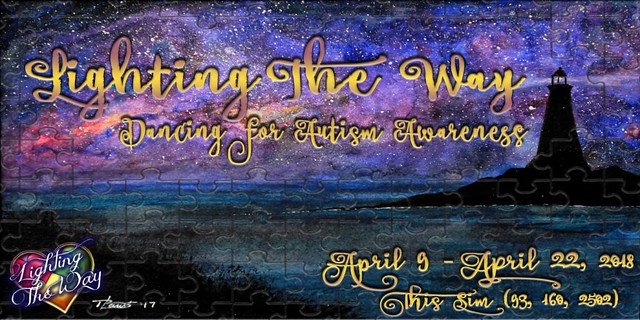
Lighting The Way Poster v3

Hello there! It’s your Dance Correspondent, R. Crap Mariner.

From the Wikipedia entry on Autism:

Autism is a developmental disorder characterised by troubles with social interaction and communication, and by restricted and repetitive behaviour. Parents usually notice signs in the first two or three years of their child’s life. These signs often develop gradually, though some children with autism reach their developmental milestones at a normal pace and then worsen.

SouthernComfort Magic (SoCo) organises and runs the Lighting The Way series of events as an awareness campaign for Autism, and here’s the announcement:

The past three years, the Lighting The Way Organisation within Second Life reached out to the dance community to take part in a weekend filled with dance and music for Autism. We have had such a huge response to this that we began running out of time slots. So this year, we will be having it on two separate weekends with many events running during the week. This year we will also have sponsors and business owners on the sim as well advertising their items.

The weekends for the shows will be Saturday, April 14th, Sunday, April 15th and Saturday, April 21st. The times for the shows can start as early as 6am SLT until 8pm SLT. If there is a specific time that works for you, just get with SouthernComfort Magic and we can work it out.

Not only are dance teams invited, but individual dancers and choreographers as well. We will have 2 variety shows during the 2 weekends. We will get everyone and anyone involved in raising awareness that would like to be a part of it.

Now, with that being said…. I would like to personally invite you to come and participate in this wonderful event. What I am hoping to accomplish again this year is for dance teams all over Second Life as well as individual choreographers/dancers to come together and perform for Autism.

That’s the TL;DR, but I want to learn more about the Lighting The Way event. What is it that got SoCo into raising awareness for Autism?

I know I want to know. So, let’s go exploring, shall we?

Lighting The Way To Lighting The Way

Lighting the Way

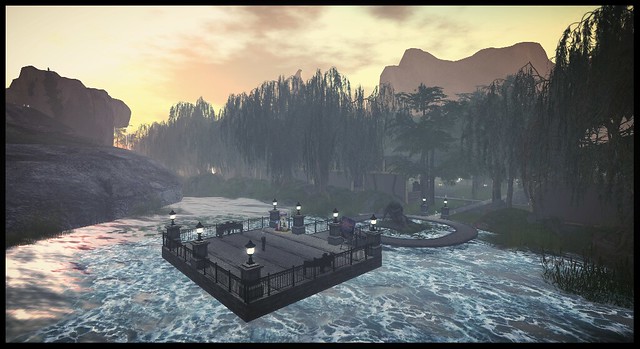
Soco teleported me over to the Lighting The Way build, which consists of a beautiful forest glade, a path that winds through rows of booths for event partners to show their support, and a performance stage with plenty of room for audience members to enjoy the shows.

(I felt a sense of accomplishment navigating around the water and fountain near the landing area, but SoCo told me that she’d put a transparent prim over the area to keep people from falling in.)

https://www.flickr.com/photos/isfullofcrap/41061762331/in/photostream/

https://www.flickr.com/photos/isfullofcrap/41061761791/in/photostream/

I asked her why she started Lighting The Way in Second Life.

“The reason I started Lighting The Way was because of my two children,” she says, “whom both are on the autism spectrum. It was during this time I craved a means in which I could play an instrumental role in lighting the path from darkness for people who were diagnosed autistic.  My son suffers from the most severe form of autism while my daughter has the milder form known as Aspergers, so I decided to utilize SL as my platform for building awareness.”

Autism is a general term used to describe a group of complex developmental brain disorders known as Pervasive Developmental Disorders (PDD).

“When my son was diagnosed with Autism at the age of 2, Autism affected 1 out of 150 children. Today it affects 1 out of 68 (1 in 42 boys). Over the course of 11 years, I have watched my son go through changes that I would never wish upon anyone. However, he is the most lovable child that I have ever known, he is truly an angel from heaven. He has taught me more about life & the person that I want to be more than I ever thought possible.”

So the next time You are at a restaurant or at a mall & You happen to see a child throwing themselves down on the floor, screaming and/or shaking things, stop & think before You judge. Not all disabilities are easily seen.  Sometimes all one might see is the symptoms & without knowing the full situation, You’re judging someone incorrectly & unfairly.

Where did she get the name “Lighting The Way” ?

“I needed to have an official name for raising awareness and I thought of a lighthouse,” she said. “It was strong, firm, always there, it’s beacon shining brightly for those who were lost. So I incorporated that into this event. We all come together to stand firm to help light the way for those on the spectrum.”

Continue reading “Lighting the Way with SoCo in Second Life” →

Eidola: reality and perception in Second Life

Eidola

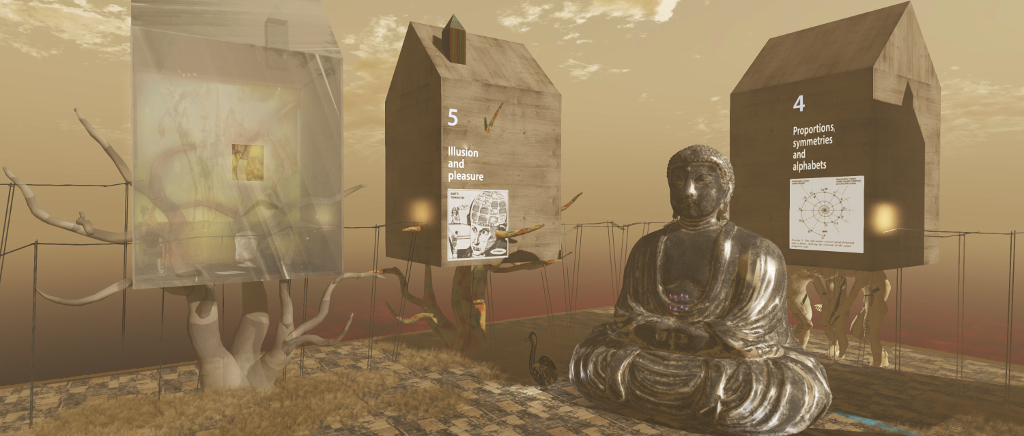
Eidola (a phantom; an apparition; an ideal) is a new installation by Livio Korobase, which opened on March 16th, 2018. It’s a daring, imposing – and possibly overwhelming – build; seeking to explore the eye and the idea; how vision has helped form our perceptions and understanding of the world around us.

It’s an ambitious subject, one that dates back at least to the time of Pythagoras, as is indicated in the installation’s liner notes. He believed that we could see because the eye emits rays of light, and that these rays gave a person information about colour and shape. From this idea through Democritus to Johannes Kepler by way of Da Vinci, and with a mention of gestaltism along the way, the liner notes provide a framework for understanding the installation, including the fact it uses, as a means of both presenting ideas and navigating it, the five chapters of Ruggero Pierantoni’s  1981 book, The eye and the idea. Physiology and history of vision.

Eidola

Visitors arrive at a near central arrival point, which offers significant reading – including an excerpt from Wassily Kandinsky’s ruminations on the geometrical elements which make up every painting, and the basic plane, the material surface on which the artist draws or paints. This sits alongside extracts discussing the nature of visible light and the brain’s reaction to light entering the eye.

From here, visitors are invited to make their way through six vast houses, most of which are elevated in varying manners – on the backs of great statues, atop basalt columns, up in the branches of trees. The first five houses reflect the chapters of Pierantoni’s book, and the sixth something of a conclusion.  These are linked one to another by raised ladders on top of scaffolds laid out as horizontal walkways. The first of these can be reached via a short walk over the landscape, or a teleport board is available for those short of time, or returning for a further visit and wish to resume where they left off.

Eidola

Each of the houses is packed with information on its specific topic: Myths of Vision; Space, Inside and Outside; Light, inside and Outside; Proportions, Symmetries and Alphabets; and Illusion and Pleasure. Some of the walkways are on a single level, some are there to be climbed in order to see the contents in a house, and one includes a teleport. Outside of the houses, the walkways offer views across the surrounding landscape. This is filled with what might at first appear to be curios watched over by gigantic humans – but they are all in some way related to the overall theme of the installation.

At the end of the elevated walkways, beyond the sixth house, is the frame of a house. Approach and enter this, and the frame is revealed at an animated work of art built in reflection of the themes from the rest of the installation: perception, perspective, line, point, and more.

Eidola

Trying to quantify this installation is not easy; it is one that needs to be personally experienced. The amount of information it contains can be overwhelming if trying to take everything in during a single visit. But there is a lot of food for thought to be found in the houses for those interested in science, philosophy, psychology, history or art; therefore more than one visit might be the best order of business.

SLurl Details

  • Eidola (LEA 24, rated: Moderate)

2018 SL UG updates #13/1: Simulator User Group

Soul2Soul River; Inara Pey, February 2018, on FlickrSoul2Soul River – blog post

Server Deployments

As always, please refer to the server deployment thread for the latest updates.

  • The Main (SLS) channel was updated on Tuesday, March 27th, to server release 18#18.03.14.513292, containing the new server capabilities (see below).
  • At the time of writing, the Release Candidate channels were all TBD regarding potential deployments. This report will be updated if the deployment thread provides further information on the RC channels.

New Capabilities

The new capabilities in 18#18.03.14.513292 for the Main (SLS) channel is the first part of a set of server and viewer updates.

  • The new IM cap is to overcome of off-line IMs failing to be delivered when a user logs in. Currently, these are delivered via UDP, whether or not the viewer is ready to receive them. With the new capability (once grid-wide and implemented within the viewer), the viewer will request off-line IMs, which the server will package and deliver to the viewer via HTTP.
  • The new abuse report cap will replace the need for the viewer to have AR categories hard-coded into it. Once fully deployed, and a viewer update released, it will mean the view will request the current list of AR categories from the server when starting up, making the management of the list easier, and hopefully reducing the number of ARs filed under outdated categories.

Updates to the viewer incorporating these changes will be made available by the lab in the near future.

SL Viewer

  • The Maintenance RC viewer updated to version 5.1.3.513630 on Friday, March 23rd.
  • The Media Update RC viewer updated to version 5.1.3.513644, on Tuesday, March 27th.

The remainder of the pipeline remains as:

  • Current Release version 5.1.2.512803, dated February 23, promoted March 1 – formerly the Nalewka Maintenance RC – No change
  • Release channel cohorts:
  • Project viewers:
  • Linux Spur viewer, version 5.0.9.329906, dated November 17, 2017 and promoted to release status 29 November – offered pending a Linux version of the Alex Ivy viewer code.
  • Obsolete platform viewer, version 3.7.28.300847, May 8, 2015 – provided for users on Windows XP and OS X versions below 10.7.

In Brief

First Name / Last Name Changes

This is still a long way off from being implemented, however, Oz Linden confirmed llDetectedName() will return the current name for an avatar, no matter what the change. However, it may take some time for it to change everywhere due to caches.

More on the return of last names and name changes, please refer to The return of Second Life Last Names – update with audio.

SL Messaging Layer

Simon Linden is looking into the Second Life messaging layer, which may be the problem behind a lot of “lag” issues. “There’s actually a number of small improvements I want to make, but I’m being careful to do them one at a time and have real data showing it gets better,” he said in providing an update on the work.

Friendship Offers Failing

Some are experiencing Friendship offers failing, even when the offer is accepted – see BUG-215977. According to Simon Linden, this might require a server-side update to fully correct.

Region Crossings

Simon Linden has been looking at vehicle region crossings alongside of  Joe Magarac (animats) testing with the viewer (See Firestorm JIRA FIRE-21915, BUG-214653, this SL Forum thread, this Google document, and my update here for more).

Part of the issue, a previously noted, is viewer / simulator communications. If these are suffering latency or packet loss, then things can get rough with vehicle region crossing very quickly. This is something Joe has been trying to compensate for by introducing a script that turns off physics and freezes the vehicle when received by a new region until it can confirm the associated avatar data has arrived.

Unfortunately, excising the viewer from region crossing data handling would be difficult, as it has to be involved to move and change its primary connection for an avatar. It would take a major protocol change to remove the viewer from the region crossing loop and separate connection hand-off from crossings. Further, if such a protocol change were to be made, it would require more work to support both new and old until enough viewers get updated.

Mainland Price Restructuring

While the Lab does not issue numbers, Oz Linden indicated at the Simulator User Group meeting that since the Mainland Price Restructuring, “mainland ownership is up quite significantly.”