Logos representative only and should not be seen as an endorsement / preference / recommendation
Updates for the week ending Sunday, January 17th
This summary is generally published every Monday, and is a list of SL viewer / client releases (official and TPV) made during the previous week. When reading it, please note:
It is based on my Current Viewer Releases Page, a list of all Second Life viewers and clients that are in popular use (and of which I am aware), and which are recognised as adhering to the TPV Policy. This page includes comprehensive links to download pages, blog notes, release notes, etc., as well as links to any / all reviews of specific viewers / clients made within this blog.
By its nature, this summary presented here will always be in arrears, please refer to the Current Viewer Release Page for more up-to-date information.
Note that for purposes of length, TPV test viewers, preview / beta viewers / nightly builds are generally not recorded in these summaries.
Official LL Viewers
Current release viewer version 6.4.11.551711, formerly Cachaça Maintenance RC viewer promoted on November 12th – No Change.
Release channel cohorts:
No updates.
Project viewers:
Love Me Render (LMR) 5 project viewer, version 6.4.12.553511, issued on January 7th, 2021.
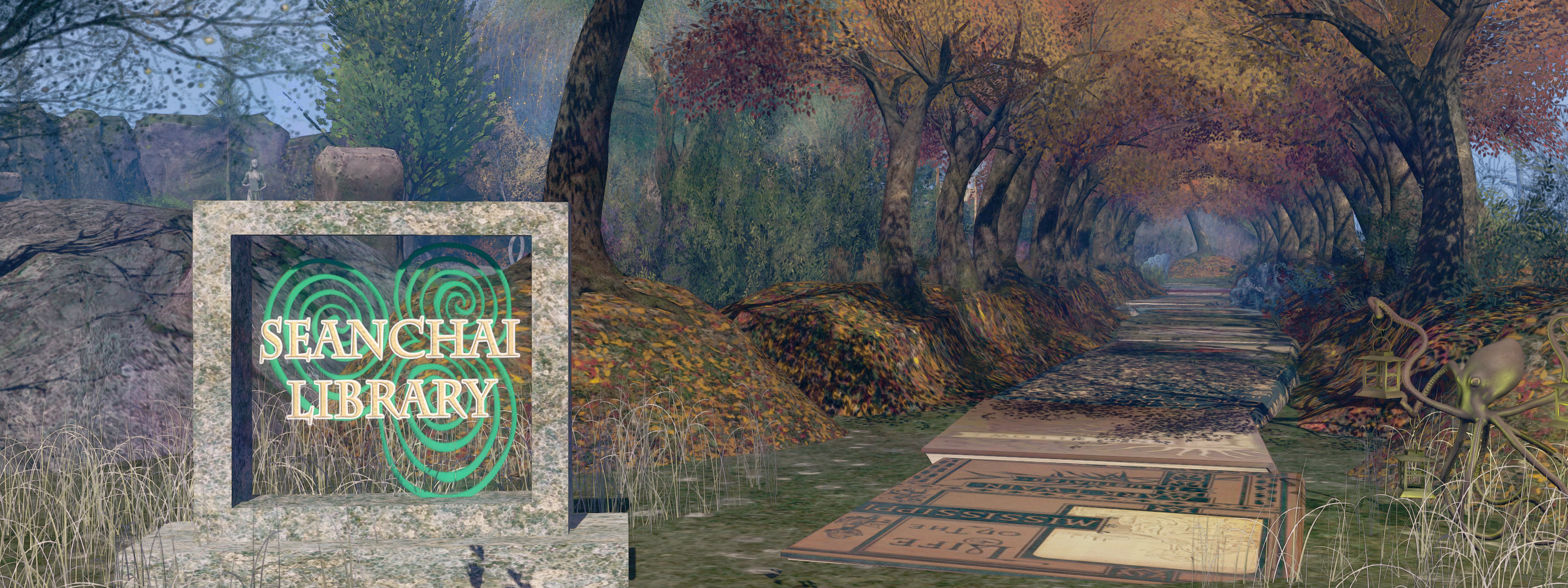
It’s time to highlight another week of storytelling in Voice by the staff and volunteers at the Seanchai Library. As always, all times SLT, and events are held at the Library’s home in Nowhereville, unless otherwise indicated. Note that the schedule below may be subject to change during the week, please refer to the Seanchai Library website for the latest information through the week.
Monday, January 18th, 19:00: The Dark Bright Water
Gyro Muggins reads Patricia Wrightson’s second novel charting the life of Wirrun of the Inlanders.
First encountered in The Ice Is Coming, when Wirrun set out on a quest to overcome the rise of the ancient enemy of Australia, the ice-bearded Ninya, the young janitor now has a reputation as a Hero among the Inlanders (Wrightson’s fantasy view of the Australian Aboriginals). It’s not a title he appreciates; he would much rather just get back to his janitorial work.
But the spirits of the land are restless: Yunggamurra, a river spirit is lost, so uses her siren-like powers of song to draw to herself those who might might take her home. Her singing come to Wirrun’s ears, and those of an elderly aboriginal emissary, and he realises he must journey to the very heartlands of Australia to better understand what he is feeling.
This he does, with the old emissary and his friend Ularra. Once there, he discovers that a storm is indeed rising within the domain of the spirits, and he is uniquely placed to both find Yunggamurra and prevent the coming storm. And so his new adventure begins.
Scattered among poor, desolate farms, the clans of the Uplands possess gifts. Wondrous gifts: the ability—with a glance, a gesture, a word—to summon animals, bring forth fire, move the land. Fearsome gifts: They can twist a limb, chain a mind, inflict a wasting illness.
The Uplanders live in constant fear that one family might unleash its gift against another. Two young people, friends since childhood, decide not to use their gifts. One, a girl, refuses to bring animals to their death in the hunt. The other, a boy, wears a blindfold lest his eyes and his anger kill.
In this beautifully crafted story, Ursula K. Le Guin writes of the proud cruelty of power, of how hard it is to grow up, and of how much harder still it is to find, in the world’s darkness, gifts of light.
With Willow Moonfire.
Wednesday, January 20th 19:00: In Walt We Trust
More from Craig Johnson’s Sheriff Longmire Series with Kayden Oconnell and Caledonia Skytower.
The Edge is Kultivate Magazine’s gallery space specialising in black-and-white photography exhibitions, generally hosting ensemble art displays by artists responding to calls for artists that are periodically announced by the Kultivate team.
Sunday, January 17th marks the first such exhibition at the gallery for 2021, featuring artists Jessamine2108, Maaddi, Eucalyptus Carroll, Johannes Huntsman, Moora McMillan, Blues Rocker, Tempest Rosca, Jamee Sandalwood, Veruca Tammas, Vita Theas and Myra Wildmist.
Kultivate The Edge: Veruca TammasAs tends to be the case with ensemble exhibitions, the art is wide-ranging in subject matter, featuring avatar studies, reflections on SL art, landscapes, and more. The majority of the artists are familiar to me, and and individuals whose work I always appreciate seeing – although I admit that both Maaddi and Moora are two artists whose work I cannot recall having previously witnessed – and I admit that I found the three pieces presented by Moora attractive in both their subject matter and presentation; Path Near the Sea in particular.
One of the aspects of monochrome photography I particularly like is the matter in which it can add a depth of life to a image, often more so than if the image had been produced in colour. In the latter the subtleties within an image can sometimes be overlooked as the eye is drawn to admire the way colours have been used or blended; within a monochrome piece, the use of light and dark, whilst obviously presenting contrasts, tends to allow those subtleties to be gently teased to the fore.
Kultivate The Edge: Jamee Sandalwood
This is certainly the case with the majority of the images here, so much so that singling any out is a little unfair, however, I do admit to fining Jamee’s and Tempest’s pieces to particularly demonstrate this. The central image of Tempest’s trio for example, appears to have been pulled from the physical world; had it been in colour, there is a genuine possibility that even allowing for post-processing, its avatarian origins would be apparent.
The one exception to the general themes offered through this exhibition is from Johannes Huntsman. John is an artist who never fails to impress as he constantly seeks to broaden both his art and his technique. Here he presents four pieces that he has simply called his Geometric Collection, but which carry within them a strong vein of cubism with a measure of abstraction, making them an engaging selection which – and in difference to my comments above regarding the power of monochrome images – would be as engaging were they in colour; so much so, that I look forward to seeing more of John’s experiments in this style of art.
Kultivate The Edge: Johannes Huntsman
But really, all the artists in this ensemble deserve recognition for the pieces they have selected for this exhibition – as you’ll be able to see for yourself in the coming month, or indeed at the formal opening of the exhibition, which takes place at 13:00 SLT on Sunday, January 17th, within the gallery.
January 19th, 2021 marks the 212th anniversary of the birth of American writer, poet, editor, and literary critic Edgar Allan Poe, and to mark the event, the week of January 18th through 23rd will include a series of special Poe-inspired events and activities organised by Shandon Loring for the enjoyment of everyone.
Born in Boston, in 1809 as Edgar Poe, he never got to know his birth parents: his father deserted mother and children (he was the second of two boys born to David and Elizabeth Poe) in 1810, and his mother died the following year. This led to Poe’s informal adoption by John and Frances Allan, from whom he took his middle name. It’s not clear how “happy” his upbringing may have been – his adoptive father apparently alternately spoiled him and disciplined him – but his adoption led to travel to the United Kingdom, where he received his education in both Scotland and London, before the Allans moved back to the United States in 1820.
As a young man, Poe attended the fledgling University of Virginia to continue his education. However, and despite the strict rules there against tobacco, alcohol and gambling, he ran up significant debts to the point were he and John Allan – now a wealthy man – quarrelled with him over his time there, eventually refusing to provide money to cover Poe’s debts or pay for his education and accommodation, forcing him to leave the university after just a year.
Edgar Allan Poe
Moving from job to job in an attempt to earn an income, Poe eventually turned to the Army, enlisting under a false name and lying about his age. He initially did well in uniform rising to the rank of Sergeant Major in 1829, just two years after his enlistment. However, this period also also saw the publication of his first book, Tamerlane and Other Poems, and whilst not a significant success (the book was only credited to “A Bostonian”), the 40-page volume gave Poe more of a desire to be a writer. This in turn prompted him to try to seek an early discharge from the Army – which proved difficult to obtain until his estranged foster father agreed to help – on the condition he attend West Point military academy.
However, fate again played a hand again as just before Poe started his West point studies in 1830, some of his poetry received a favourable review by the influential critic John Neal. This caused Poe to dedicate one of the poems in his second volume of work Al Aaraaf, Tamerlane and Minor Poems, to Neal. It also made Poe more determined to continue as a writer, in part causing him to have himself dismissed from the academy. This happened in 1831, almost coinciding with the publication of his third volume of poems.
Being a writer in the United States at that time was not easy. There were no international copyright laws, so US publishers preferred to print unauthorised copies of works by British writers rather than pay American authors for original pieces. However, Poe persisted, and managed to win a modest literary prize from a Boston newspaper. This raised his profile sufficiently to bring Poe to the attention of novelist and lawyer, John Pendleton Kennedy, who in turn introduced Poe to Thomas W. White, editor of the Southern Literary Messenger in Richmond, who hired Poe as assistant editor.
Thanks to Poe’s drinking habits, his relationship with White didn’t initially go well: he was fired within weeks for being drunk on the job, but was re-hired following his marriage to his 13-year-old cousin, Victoria Clemm, in1835. This marked the start of a career as an editor, writer and critic working for a number of publications over the next few years which enhanced Poe’s reputation as a critic of note and competent writer of short stories. At the same time, he published his first – and only – full-length novel, The Narrative of Arthur Gordon Pym of Nantucket, whilst increasing success caused him to – unsuccessfully, likely due to his drinking habits – try for a career in politics.
By the 1840s, Poe was well established as a writer, and the following years saw him publish what would become his most well-known works, including: The Fall of the House of Usher, The Murders in the Rue Morgue (credited as the first modern detective story), The Pit and the Pendulum, The Masque of the Red Death, The Black Cat, Lenore, and more. All of which led up to the publication of what is arguably his most famous piece, The Raven (January 1845); a piece which made him a household name at the time – although it only earned him $9 writer’s fee (about $308.23 today).
Victoria Poe died of tuberculous in 1847. Her death, together with the deaths of a number of women in his life, is often stated to be the driving force behind his literary focus on “the death of a beautiful woman”. Following her passing, Poe’s behaviour became increasingly erratic, and his attempts at with relationships with other women met with mixed success, although he did become engaged to former childhood sweetheart Sarah Royster in the latter part of Summer 1949.
However, before they could be wed, Poe left on a trip to New York in late September 1849, and on October 3rd, he was found wandering the streets of Baltimore, delirious and wearng clothes that were not his own. What he was doing there remains unknown, but he was taken to hospital, where he continued in an agitated, dire condition, finally dying on the morning of October 7th, 1849, after allegedly spending the night before repeatedly calling out the name “Reynolds” – although who that might have been, if true, also remains unknown.
One of the earliest practitioners of the short story, as well as later being regarded as leader of Romanticism and Gothic literature in the United States, Poe himself became a subject of Romantic and Gothic thinking as rumours about his death circulated, spurred by the mystery of of how and when he arrived in Baltimore and why he was there. At the same time, his reputation as a Gothic Romantic was cemented with the posthumous publication of his last complete poem, Annabel Lee.
To mark the anniversary of his birth, Shandon Loring will be leading readings of many of Poe’s most famous works in both Second Life and Kitely, supported by live video and audio streaming and the opportunity to read along with events. The celebration will also feature Seanchai Library alumni Dubhna Rhiadra, Corwyn Allen and Kayden OConnell, and include 24/7 audio listening rooms where you can hear Poe’s stories and poems, and stories and poems inspired by Poe at a time of your choosing – see below for links.
At the time of writing, the schedule for the event was as follows – please be sure to check the 2021 Edgar Allan Poe Celebration website (all times are SLT) for updates and additions to the programme:
Monday, January 18th
10:00
Stories and Poems
The Raven
The Fall of the House of Usher Lenore
Annabelle Lee
It’s taken me a while to get to write about Adventures In Mad Wonderland, Jayden Mercury’s twist on Charles Lutwidge Dodgson’s (aka Lewis Carroll) tales of Alice’s adventures. This is because, despite being a modest parcel covering just over 6,300 square metres, it is a setting that packs an awful lot into it – so much so that it is very easy to miss things in a simple walk through.
Using the theme of Alice’s adventures on which to build a setting within Second Life is not new; however, with Mad Wonderland, Jayden – assisted by Valarie Muffin Meow (Zalindah) – has created a unique take on things, as indicated by the location’s About Land description, which invites us to follow the Adventure through the Storybook of an artist.
Adventures In Mad Wonderland January 2021
Thus, what we have here is a take on Dodgson / Carroll’s timeless tale is a series of scenes from the tales – and more – that frame the tale of an artist – perhaps someone charged with illustrating a version of the story – with “chapters” waiting to be found at various points within the parcel (mouseover and left-click to read them).
The story commences at the landing point, and the artist’s studio that resides there. This takes the form of a small shack sitting on a narrow stretch of coast. Paintings are hanging on lines strung outside of the shack, whilst inside stands the artist’s easel and materials – although oddly, some of the latter appear to be paints for house decoration rather than conventional oil or water colours. Subtle use of a sofa with a cascade of colour in its covering and a corner gathering of lights adds to the impression that this is an artist’s retreat. There is more here as a well, so be prepared to mouseover the objects you find within the shack and be prepared to click on them.
Adventures In Mad Wonderland January 2021
The shack sets the tone for a visit: whilst walking the trail and exploring what it reveals, be sure to hover your mouse over anything that catches your eye, as it may contain the next chapter in the unfolding story of the artist. Such items vary in form, from a pen and notepad to the likes of multi-hued mushrooms – and some might be unexpected (“she said with a grin” – hint, hint!).
Also waiting to be found are obvious extracts from Alice’s journeys and other little vignettes. Chief among the former is a familiar tea party featuring a very Deppian Mad Hatter; one of the latter sits an an old piano, its wood faded by the Sun, a truncated quote from Alice In Wonderland chalked or painted onto the inside of its raised lid.
Adventures In Mad Wonderland January 2021
The end of the path is marked by wooden steps that rise to a white-walled castle that, with its angled towers, looks like something the Mad Hatter might build – or to look at it another way, a partially0inflated bouncy castle. Card guards outside of its gate suggest the Queen of Hearts may be waiting inside, as does the huge red heart on the wall above the gate. But is she? You’ll have to go inside and find out for yourself – particularly if you want to keep up with the unfolding story, as a chapter awaits discovery.
The castle may mark the end of the path from the artist’s studio – but it is not the end of the adventure. Those willing to look around carefully after exploring it might spot a little makeshift bridge leading to a shaded portal. Touch it, and it will carry you onward to the next stage of the story: a maze where more items await the touch of visitors, including one that will carry you even further, should you follow the familiar instruction to Drink Me when you find it.
Adventures In Mad Wonderland January 2021
I’m not going to give away all of the location’s secrets, but I will say that Mad Wonderland is a surprising and fun place to explore that taxes neither viewer nor mind, but does keep you engaged throughout. It is also one of those places I particularly appreciate within Second Life – the kind that demonstrate that you don’t actually need a full-sized region in order to create something special either for yourself, or to share with others.
Melusina Parkin opened her latest exhibition in Second Life Life on Thursday, January 14th at the Kondor Art Centre’s White Gallery.
Lockdown and Hope is a highly topical selection of art by Melu that takes as a part of its theme – as the name implies – something that remains on a lot of people’s minds as we roll on into 2021: the situation around the continuing threat of the SARS-CoV-2 virus / COVID-19, and the continuing grind, for so many of us, of being in a lockdown situation that brings limited opportunities to get out, interact with others or do the things we really want to do.
Melusina Parkin: Hope (v) 4 and Hope (v) 5
However, rather than focus just on the negative, Lockdown and Hope also looks to the future and the time beyond the shadow of the virus, when we can all resume largely “normal” lives with their attendant freedoms and activities as the various vaccines spread amongst populations, allowing us to, if not eradicate COVID-19 entirely, then at least bring it under control and diminish it’s threat.
On the surface, this is an exhibition of two halves: on the lower floor are 18 images that carry the title “Lockdown”, and very much focus on the impositions that have been placed on us as a result of the pandemic situation. Their dominant themes intertwine feelings loneliness, listlessness, boredom, the need for escape, and / or being cut off from the world. These are presented in Melu’s captivating style of focusing down on just a portion of a scene. It’s a technique I’ve long admired, simply because captured in this way, her images offer the opening lines of a story, leaving our minds to tell the rest based on the title of the exhibition and the point of focus in the image.
Melusina Parkin: Lockdown (v) 3 and Lockdown (v) 4
Take Lockdown (v) 16, as an example (seen in the foreground at the top of this piece). With its focus on the handle of a door, and the shadow on a distant wall cast by the light falling through a window, we’re given an image that clearly speaks to being shut-in. The door, so long a means of keeping others out so we can enjoy our own company, now a barrier to our ability to go out, the door handle caught in sunlight now a forbidden thing, the patterned shadow of an unseen window the calling of a world currently beyond our reach.
On the upper floor is a further set of 18 images that express the idea of Hope: that those freedoms we are temporarily without will return; that we will once again be able travel, to share, to appreciate nature, to enjoy a vacation on some remote shore and or enjoy the simple pleasures of walks along the coast or country roads. In contrast to those on the lower floor, these are offered as more expansive images – open spaces, broad skies, distant horizons – all of which are emblematic of freedom and the ability to roam where we will, and partake of all that life has to offer.
Melusina Parkin: Hope (v) 13 and Hope (v) 14
But there is more here as well; within many of the images on the lower floor offer not only representations of the isolation of lockdown, but also a glimmer of hope for the future. Again, to take Lockdown (v) 16. Whilst standing as a symbol of the need for us to stay isolated from those beyond our immediate bubble (if indeed, we have a bubble), it also offers hope: the very fact that sunlight is falling on the door handle suggests that the day will come when we can again open our doors to others and invite them in without fear, or pass through the door into the world beyond that is promised in the shadow falling on the wall beyond the door; indeed, the very fact that the door stands ajar suggests that time might actually be not that far away.
Elsewhere, Lockdown (v) 9 offers us a view of again being cut off from the things we would normally take for granted – cars parked outside the window with their promise of taking us anywhere we might desire, but for now beyond our reach. However, it also reminds us that despite all the impositions of lockdown, the cars are still there, waiting, and one day we’ll be free to travel wherever we would. Meanwhile,
Melusina Parkin: Lockdown (v) 8 and Lockdown (v) 9
This double focus can also be found in several of the images upstairs. Take Hope (v) 13 and Hope (v) 14 for example. Both offer use the promise of freedoms to be joyed – whilst the presence of the fences, open as one is and as relatively unobtrusive as the other might be in allowing us to see the sky, reminds us that the freedoms we’ll soon resume are not quite here yet, and restraint of action is still required.
From gowns cast across furniture out of possible frustration at being unable to wear them in public to the promise that nights out will yet return (Lockdown (v) 10) to a look towards a time when walks along sandy shores or country roads will again be ours to enjoy, but which is not yet upon us – hence the empty chair and bench Hope (v) 12 and Hope (v) 15); and with tales of separation and togetherness bound within the simple framing of a teapot, cups, decorative hearts and the placement of two chairs (Lockdown (v) 4). All 36 images within Lockdown and Hope have a richness of narrative, marking this as another extraordinary and engaging exhibition from Melusina Parkin.



 Inara Pey: Living in a Modemworld