Logos representative only and should not be seen as an endorsement / preference / recommendation
Updates from the week ending Sunday, January 16th, 2022
This summary is generally published every Monday, and is a list of SL viewer / client releases (official and TPV) made during the previous week. When reading it, please note:
It is based on my Current Viewer Releases Page, a list of all Second Life viewers and clients that are in popular use (and of which I am aware), and which are recognised as adhering to the TPV Policy. This page includes comprehensive links to download pages, blog notes, release notes, etc., as well as links to any / all reviews of specific viewers / clients made within this blog.
By its nature, this summary presented here will always be in arrears, please refer to the Current Viewer Release Page for more up-to-date information.
Note that for purposes of length, TPV test viewers, preview / beta viewers / nightly builds are generally not recorded in these summaries.
Official LL Viewers
Release viewer: Mac Voice hotfix viewer 6.5.2.567427, dated January 13 – NEW.
Release channel cohorts:
No updates.
Project viewers:
Mesh Optimizer updated to version 6.5.2.566858, dated January 5 (issued some time after January 10).
Logos via Linden Lab and High Fidelity respectively
Following the announcement that High Fidelity, the company co-founded by Philip Rosedale in 2013 and after his departure form Linden Lab, has invested money, patents and staff into the latter, the news hit a lot of on-line tech publications and even the Wall Street Journal – creating a buzz around Second Life that has so far, if we’re honest, somewhat eluded the Lab in the wake of all the broader “metaverse” chatter that has been going on.
Of these articles, the most detailed came via GamesBeat / VentureBeat (by the ever-informative Dean Takahashi), c|net and The Wall Street Journal (the latter via Archive to avoid the paywall)¹ that added butter to the bread of the original announcement, which I’ve summarised below, and which gave me further pause for thought.
To deal with the bullet point takeaways first:
The patents transfer from Hi Fi is for distributed computing, and include “moderation in a decentralised environment patents.”
In all some 7 members of the Hi Fi team will be moving to work alongside the Second Life engineering team, effectively increasing it by around 20%.
The move will mean that around 165 people will be working on Second Life and Tilia.
Two elements of the work Hi Fi staff will be involved in are:
SL’s “social aspects”, given as “avatars and digital marketplace”. I assume the former is a reference to things like “avatar expressiveness”, on which more below. And the latter potentially greater accessibility to SL’s Marketplace by users using mobile options, etc.
Oberwager also indicated that Hi Fi’s work will be to assist LL in developing “the tools to make virtual economies work” and a concept for “underpinning FinTech to metaverse” – which I assume is a reference to involvement in Tilia, per my original speculations on the investment.
Separate to its involvement with LL, High Fidelity will continue to develop its spatial audio capabilities, which have already been licensed by a number of other companies.
In terms of SL itself:
2020 still seems to be the platform’s most robust year, with the economy put in terms of a US $650 million GDP, with 345 million annual transactions (virtual goods, real estate, and services) and US $80 million cashed-out.
The platform boasts more than 1.6 million transactions per day and generates 1.8 billion messages (presumably user-to-user and Group IMs) per month.
Second Life won’t be moved to support VR headsets any time soon, simply because the latter need much more time to mature, both in terms of their technology and their market reach; something Rosedale believes (and I’d agree, for whatever that is worth) is unlikely to be reached in the next 5 years. However, once SL itself is more performant and better placed to naturally leverage VR hardware.
In terms of my own speculation, this primarily arise – and rather belatedly, given my own previous coverage of High Fidelity in this blog – as a result of a comment from Philip Rosedale in the piece by Dean Takahashi:
The tech changes are all about communication,” Rosedale said. “I don’t think it’s about pixels. I don’t think it’s about radical richness. I don’t even think it’s all about 3D. I think the problem and the opportunity is communicating with people in a naturalistic way where I can interview you.
We already know from Linden Lab’s own review of 2021, which includes a bullet list of deliverables planned for 2022 – that “avatar expressiveness” to Second Life that will bring “camera-based gestures and movement to your avatar for a whole new level of interaction and connectedness”. This is something that marries up to Rosedale’s comments above. More particularly, it is something High Fidelity started to develop back in 2014, when the company was working on its own decentralised virtual spaces – even producing an informal video that helped demonstrate that early work – and which I’ve embedded below.
Yes, the avatars are someone cartoonish is looks, but this work was carried out in Hi Fi early days and before their avatars developed into something SL users might find more appealing, so don’t get too hung up on that fact.
What’s important is to note that how the avatars (faces and hand movements) reflect those of the people behind them. Take, for example, Emily’s face as she emotionally responds to the lyrics she is singing, and the way Ryan’s avatar (with the beard) makes eye contact with viewers as it looks directly out of the screen, and they way his eyes / head naturally move as he also addresses Chris and Emily who are sharing the same office space with him – plus the capture of his real-time hand-clapping at the end of the song! (And as a total aside specific to SL “old timers”, not that the guy providing the backing vocals is none other than Andrew Meadows (once (and again….?) aka Andrew Linden.)
If this capability could be brought into Second Life – and again, I have no idea how much further down the road Hi Fi got in developing / enhancing it and am aware that SL presents a range of its own technical challenges (range of mesh heads, rigging /weighting, etc.) – then clearly, it could offer considerable depth to avatar interactions for those who would care to leverage them. Take the SL live music scene, for example, and the potential for performers to add gestures to their music and (like Emily) have the emotions in singing transferred to their avatars. (I’ve also submitted a question on this subject for consideration in the upcoming Lab Gab session with Brad Oberwager and Philip Rosedale.)
There is a lot more that might be unpacked from these articles – such as the idea of a “decentralised environment” and what that might mean for thing like SL and mobile device access, and a lot to chew on regarding SL’s approach to virtual spaces and how it stands apart from the recent headline-grabbers like Facebook / Meta. Some of these comments should give comfort to those concerned about matters of privacy and the like, and Rosedale at least has carried his view on things beyond talking to journalists, embodying them in some of his tweets.
Given what is available for consumption between the three articles, I would recommend a reading of all three rather than having me drone on further here, or dilute the core speculation I wanted to put forward as a possibility. As such, I’ll leave you to peruse them in your own time, if you’ve not already done so.
While there were other articles on the announcement, most were either baseline reproductions of the original press release (with a sprinkling of commentary in some cases) or re-treads of one of these three pieces.
In December 2021, I wrote about Eskol, Morlita Quan’s art and event space in Second Life (see: Eskol: music, art and sound (& a photo contest) in Second Life). Within that piece, and as referenced in its title, the review also included information on the Eskol Photo Contest Morlita was running through December to the start of January.
On offer was a single prize of L$5.000 to be awarded to a single winner, as judged by a panel of three judges – Morlita, Lanjran Choche and myself. To enter, photographers could submit up to two images taking using one of the six photo booths Morlita had set-up specifically for the contest.
Eskol Gallery: Eskol Photo Contest – one of the 6 photo booths
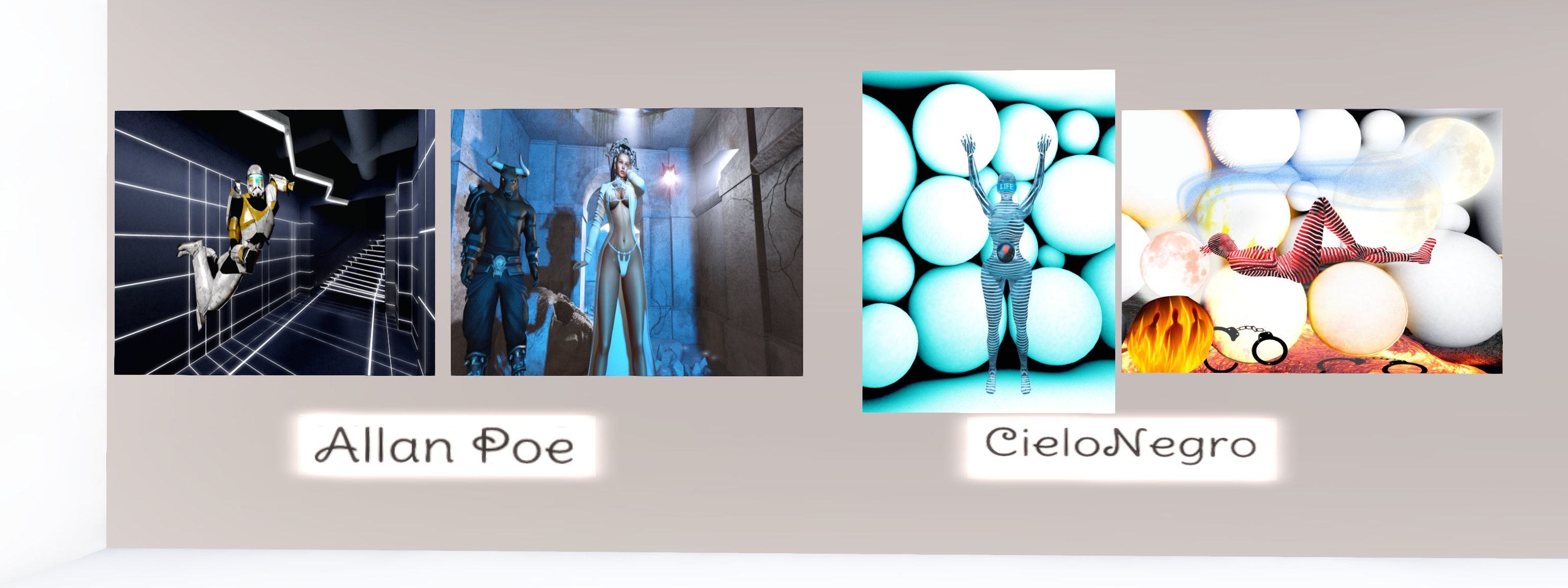
In all 12 photographers submitted entries, comprising Mo Trill (1 image), Mystera Bloodbane-Ragnarok (Mysteria0402 – 2 images), Lucid (Photodoll77 – 2 images), Rya Santana (2 images), 4pril Resident (1 image), WuWai Chun (2 images), 04Noir (C1haos Resident- 2 images), 01NoirA Resident (1 images), Allanpoee Resident (2 images), Cielo Negro (Cielonegro Avril – 2 images), Néstor (NestorXX Resident – 1 image), and Iono Allen (1 image).
Each of the six booths offered its own setting in which pictures could be set and framed, and photographers could dress them as desired, and entrants submitting two photos could either take them in one of the booths or use two booths.
Eskol Gallery: Eskol Photo Contest – Allan Poe and Cielo Negro
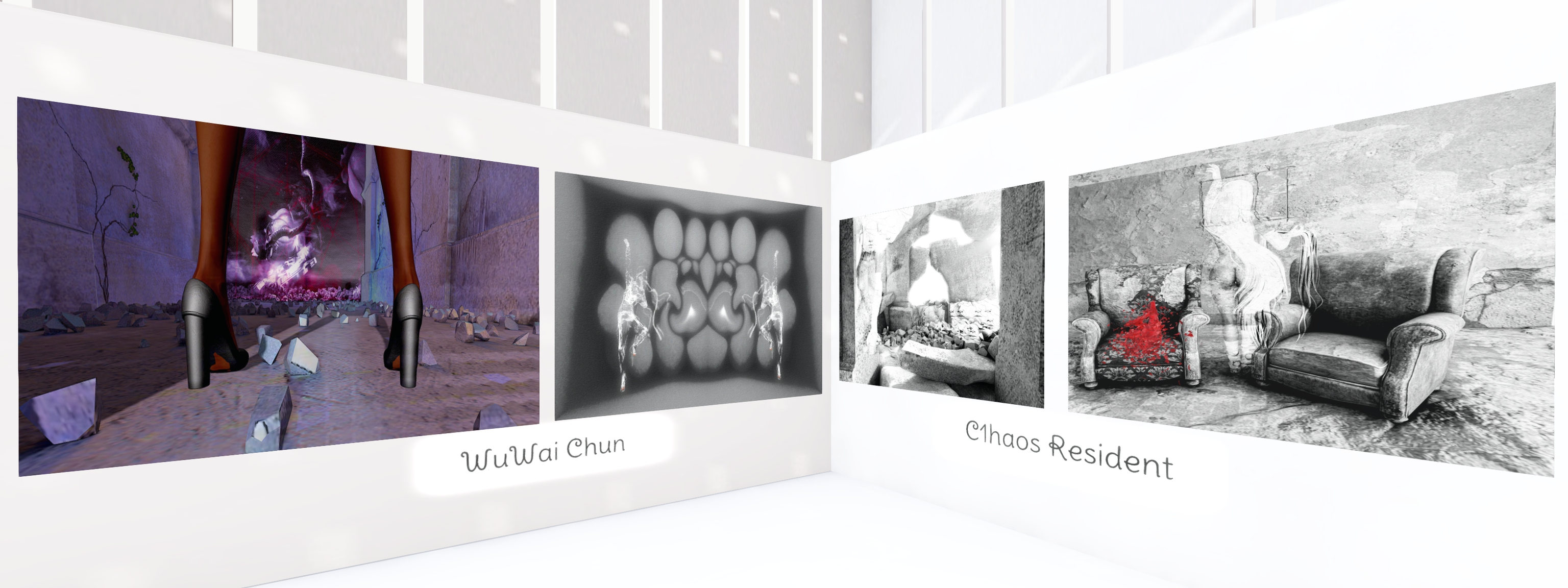
Unsurprisingly, most of the photographers opted to concentrate avatar-centric studies for their entries, with only a couple avoiding avatars entirely. Not that focusing on avatars lessened any of the entries; rather the reverse in fact: several presented very unique uses of the avatar and / or unique perspectives on a particular booth and avatar (as is the case with WuWai Chun’s Eskol 1 entry). whilst Iono Allen chose to offer a moment from a certain iconic 1969 motion picture (or as the director referred to it, “the proverbial good science fiction movie”).
While I cannot speak for the other members of the panel, I approached judging the submitted pieces on a set of criteria I’d settled upon before seeing any of them: composition (use of space, colour, lighting), framing, originality and narrative. However, given we all three each came up with a selection of seven initial finalists that were somewhat similar, I’d say we all used similar criteria. And certainly, the winning entry, C1haos Resident’s Eskol 2 was a piece we would all agree on as being a worthy winner.
Eskol Gallery: Eskol Photo Contest – WuWia Chun and C1haos Resident
Currently, all of the entries are on display at Morlita’s main Eskol Gallery, and will be until early February, so why not pop along and judge them for yourself?
It’s time to highlight another week of storytelling in Voice by the staff and volunteers at the Seanchai Library. As always, all times SLT, and events are held at the Library’s home in Nowhereville, unless otherwise indicated. Note that the schedule below may be subject to change during the week, please refer to the Seanchai Library website for the latest information through the week.
January 17th, 19:00: A World Out of Time
After being cryogenically frozen in the 1970s to await a cure for his (then) incurable cancer, Jaybee Corbell awakes after more than 200 years – to find his own body destroyed and his mind and memories transferred into the “mindwiped” body of a criminal. And that’s is not all that has changed: the Earth is now overseen by an oppressive, totalitarian global government called “The State”, and Corbell’s existence is to be determined by a “checker”; if he is found wanting, he will be discarded.
However, Peerssa, the checker, recommends Corbell as ideal fodder in The State’s attempts to seek out exoplanets suitable for terraforming – whether he wants to join the programme or not. Disgusted by his treatment, Corbell works out a way to take control of his one-person ship on its otherwise one-way mission, and heads toward the galactic core. Entering suspended animation, he is unaware his vessel skims close enough to the super-massive black hole at the centre of the galaxy to experience time dilation.
Emerging from his suspended state, and believing only 150 years have passed, Corbell returns to the solar system to find it again vastly changed: more than three million years have passed, and the Sun has become a bloated red giant, and Earth – well, Earth appears to have been relocated to an orbit around Jupiter, whilst humanity itself had endured extensive changes; and Corbell must face an entirely new set of challenges if he is to survive.
Join Gyro Muggins as he reads the 1976 novel (and originally a short story) by Larry Niven.
Klawde had everything. Sharp claws. Fine fur. And, being the High Commander of the planet Lyttyrboks (think about it if you need to!), an entire world of warlike cats at his command. But then he is stripped of his feline throne and sentenced to the worst possible punishment: exile to a small green-blue planet that is, as they say, “far out in the uncharted backwaters of the unfashionable end of the western spiral arm of the galaxy”, known to its dominant bipedal race as “Earth”.
On that planet, Raj is a young man who had everything: a cool apartment in Brooklyn New York, his three best friends living in the same apartment block and comics and pizza always within easy reach. Then, courtesy of his mother taking a job on the other side of the country, he finds himself exiled to the community of Elba, Oregon.
These two lost souls, one seeking friendship (and, hopefully, pizza and comics) but forced to join a nature camp, the other a cunning, brilliant feline emperor, both exiled and seemingly lost, are destined to meet. And when they do – whether Klawde likes it or not – the emperor cat will find his plans for revenge on those who would oust him from his empire running somewhat secondary to becoming Raj’s new Best Friend as the two of them become bound by a series of new and hilarious adventures.
With Caledonia Skytower.
Wednesday, January 19th: Poe Special
The Library opens for a special to mark the anniversary of Edgar Allan Poe’s birth on January 19th, 1809 – by presenting a story about the time shortly before his death.
On October 3rd, 1849, Poe was found delirious on the streets of Baltimore, “in great distress, and… in need of immediate assistance”. He was taken to the Washington Medical College, where he died in the early hours of the morning of Sunday, October 7th, 1849. Throughout his time at the hospital Poe remained too incoherent to explain how he came to be in his dire condition and wearing clothes that were not his own, although he was said to have repeatedly called out the name “Reynolds” on the night before his death. But to whom he may have been referring remains unknown.
In Beyond Porch and Portal E. Catherine Tobler, offers an unusual but interesting explanation of why Poe was found, and what had led him to that point of distress. Join Shandon Loring to find out more!
Thursday, December 20th 19:00: The Adventures of Young Indiana Jones
Join Shandon Loring as he recounts the early adventures of a young Henry Walton Jones, Jr., who would one day become the famous Indiana Jones.
Longing Melody, January 2022 – click any image for full size
Bambi (NorahBrent) is the owner of the Oh Deer brand and is also is well-regarded among Second Life bloggers for her Missing Melody region designs – I’ve reviewed several iterations of that region myself in these pages. However, in 2021, she launched a new region setting – Longing Melody – which I finally managed to visit at the start of 2022.
Utilising a Full region rather than a Homestead as seen with Missing Melody, Longing Melody presents three different but interconnected seasons / settings that offer little hints of England and the British Isles and plenty to see and appreciate.
Longing Melody, January 2022
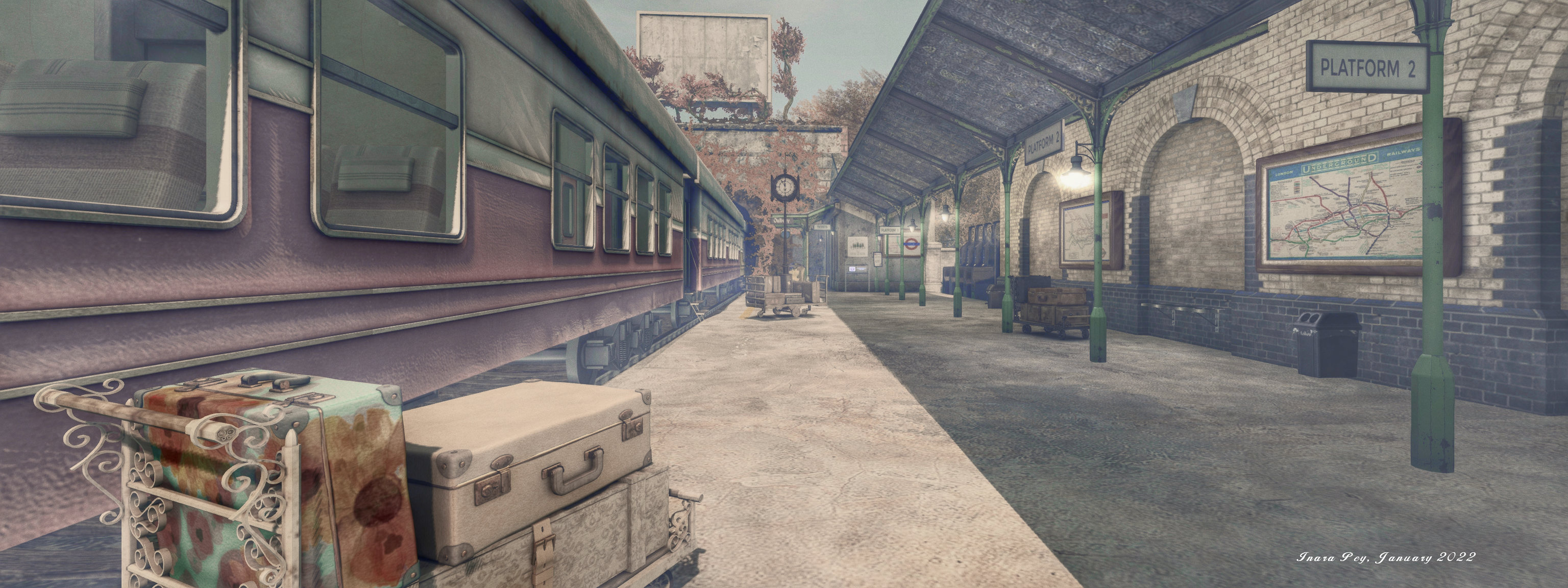
Visits start at the Longing Town train station, where a train with a decidedly continental lean sits at the platform to form the landing point. Exiting the train places new arrival on the platform (no surprises there), where two maps on the London underground are mounted on the platform walls. One of these is likely to be very familiar to users of the Tube, the other somewhat older and offers a more “natural” look to how London’s underground lines actually sit under the city’s roads and reaches. On a second wall is what might appear to be a further Tube map but is in fact a stylised map of the region that offers clues to a form of homage Bambi presents in the design. Alongside of this map in an information giver for the Second Life Nature Collective club.
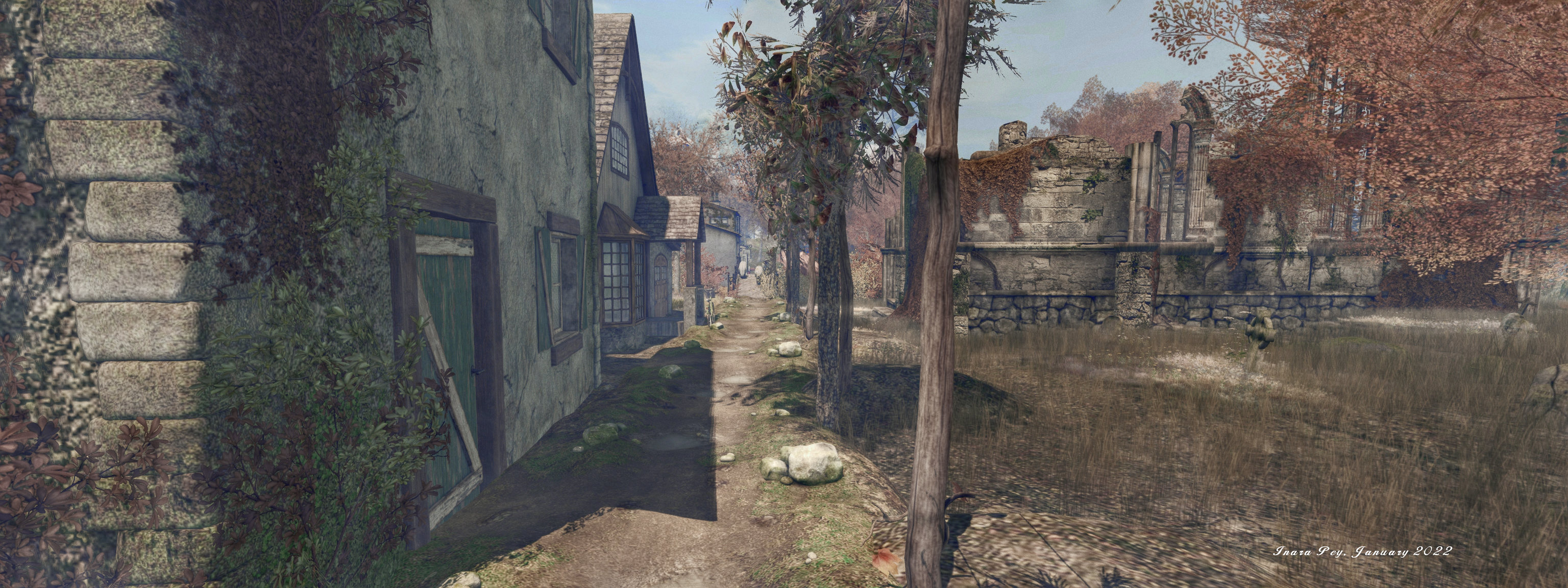
Beyond the turnstiles for the station sits Longing Town itself, there the homage mentioned above is largely located, taken the form of links to Liverpool’s Fab Four. The road leading from / to the station for example, is called Abbey Road, home of a certain recording studio and also the title of the group’s eleventh album with its iconic (and much imitated) cover photo – which is also reproduced in the forms of silhouettes of John, Ringo, Paul and George filing across the road.
Longing Melody, January 2022
Before reaching the silhouettes, the road also passes Penny Lane, an alley leading in to courtyard behind the houses lining the road. Beyond the four silhouettes, the road makes a 90º turn to the right continuing to to a waterside promenade called The Globe. This in turn might be a reference to The Globe Theatre, Stockton on Tees in the north-east of England, famous for being the venue for two Beatles concerts that effectively bracketed their “breaking into” the US market after a lot of resistance from US record moguls (and the first of which took place shortly after John F. Kennedy had been shot in Dallas, Texas).
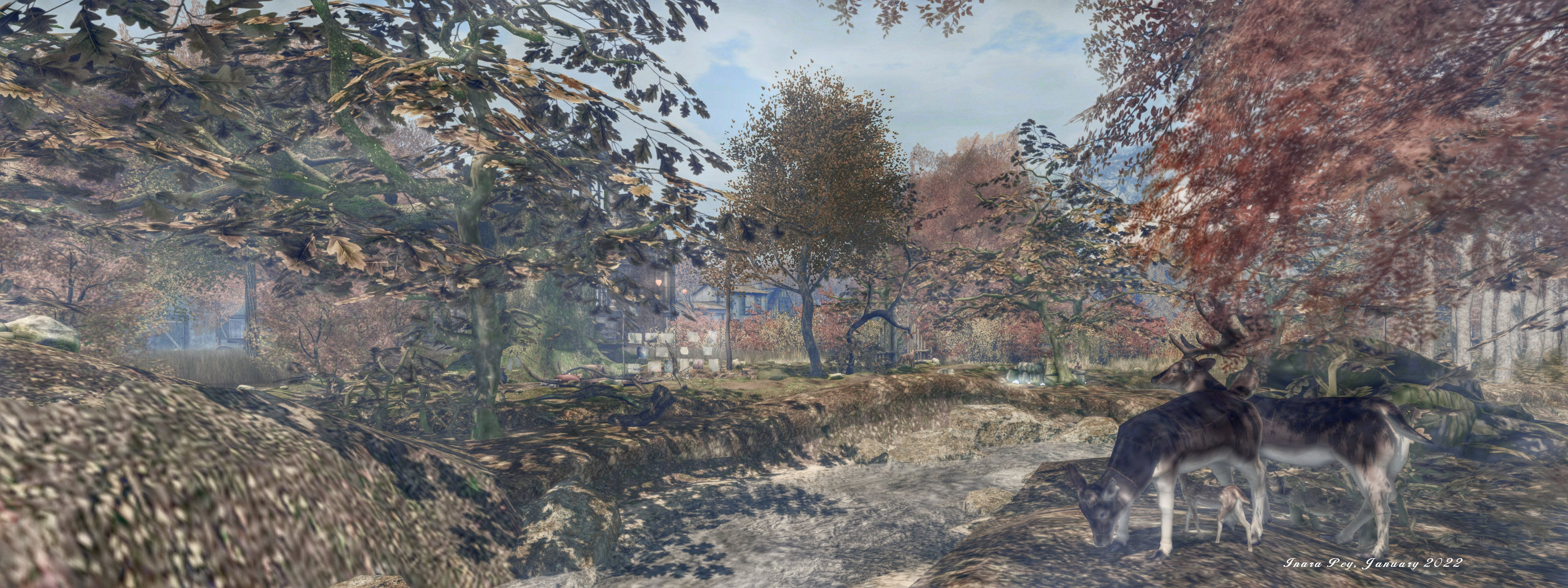
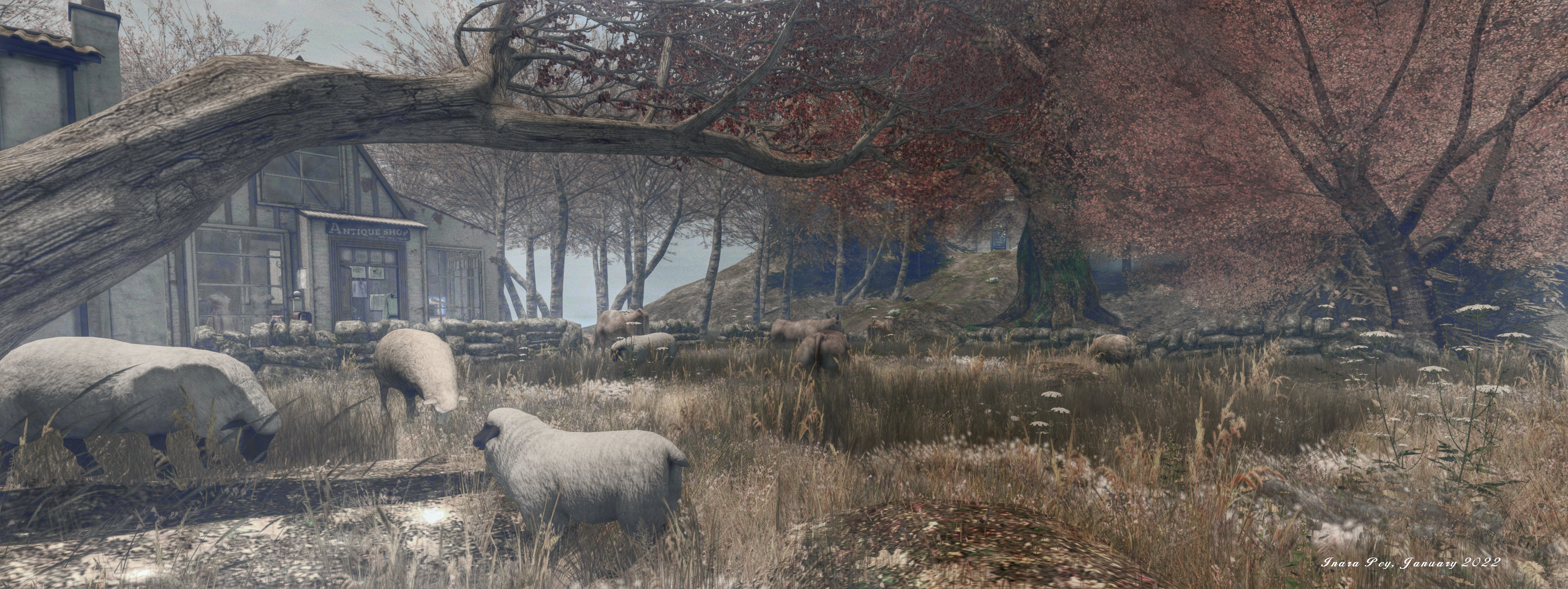
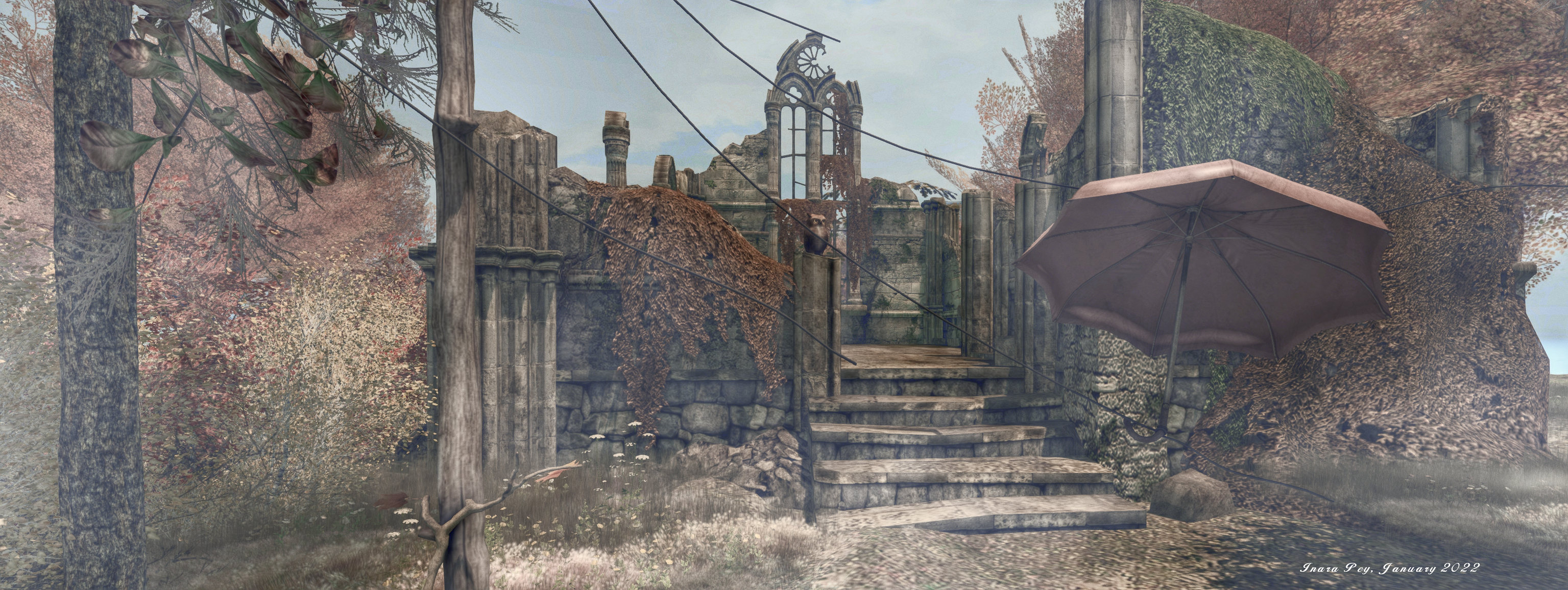
Outside of the town proper, and reached via an arched passage, is a further reference to the Beatles, in the the form of Strawberry Fields, a broad concrete path runs north to reach the second element of the region. Here, beyond the gardens of some of the houses is a more rural setting, a place of meadows, sheep, a bubbling stream, rough footpaths and ruins. And where the town might be thought of as being caught in a late summer, this northern rural area sits more in autumn, a place where the trees are turning a golden brown and sheep and deer roam free.
Longing Melody, January 2022
A canal cuts through this rural area; deeper than the local stream, it is crossed by a single hump backed bridge. The path beyond this continues eastwards, passing between more farm buildings and a large field guarded by drystone walls and home to sheep and cows. Once past these, the path starts a gentle climb to where a high brick wall bars the way, except for the open wooden door set within it.
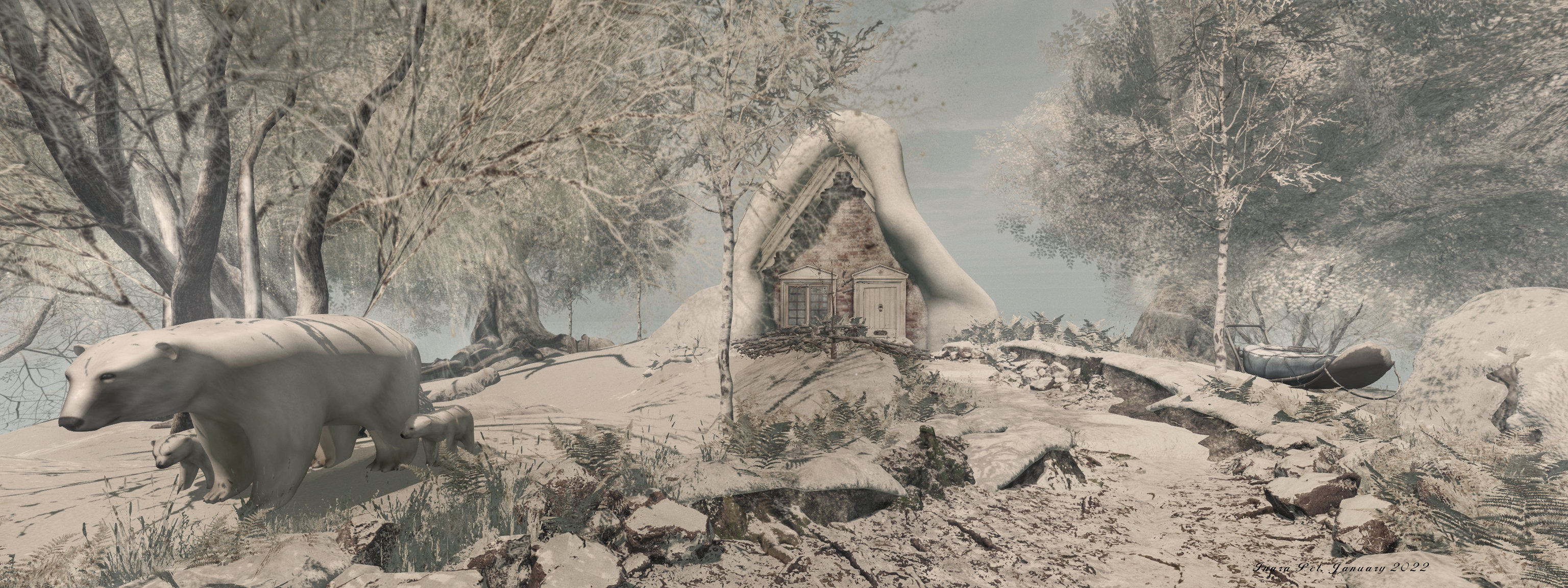
This wall marks the point where the third of the region’s seasons commences, the hills beyond the wall being blanketed in winter. Snow cover the land, a narrow path winding up between the hills. Here the trees are either fir or denuded of there leaves, all equally frosted by the snow.
Longing Melody, January 2022
Cottages and more can be found on the shoulder and crown of the hill; one of the former cosily furnished, the other a shell. Watched over by foxes, snowmen and polar bears, this winter area offers further places to sit and pass the time and further opportunities for photography.
All of the above just scratches the surface of things. In the town, many of the buildings are simple façades, other have interiors that can be viewed through windows or entered and explored. Similarly, the gardens, the promenade, the rural spaces, all offer places to sit and relax. and needles to say, the region in rich in opportunities for photography.
Longing Melody, January 2022
Sharing a spiritual design with many of the settings that have surfaced within Missing Melody, Bambi’s Longing Melody offers visitors its own richness and diversity that should be savoured during a visit.
In November 2011, I wrote about an intriguing exhibition of images by Guille (Antoronta) entitled Unseen Beauty, held at the Annexe of the Limoncello gallery. It was one of the the most unusual, engaging and informative exhibitions of photographic art I’d witnessed during the year, taking us as it did on a journey into the world of the microscopic (see: The art and beauty of the microscopic in Second Life).
While (at the time of writing) that exhibition is still open), I’ll delighted to say that the Desiderartum Gallery, managed by Peru Venom is hosting what might be regarded as the “part two” of a display of Guille’s work, in the form of Invisible Beauty, which formally opened on January 10th, 2022 (and my apologies to Guille for not being able to attend the opening in person).
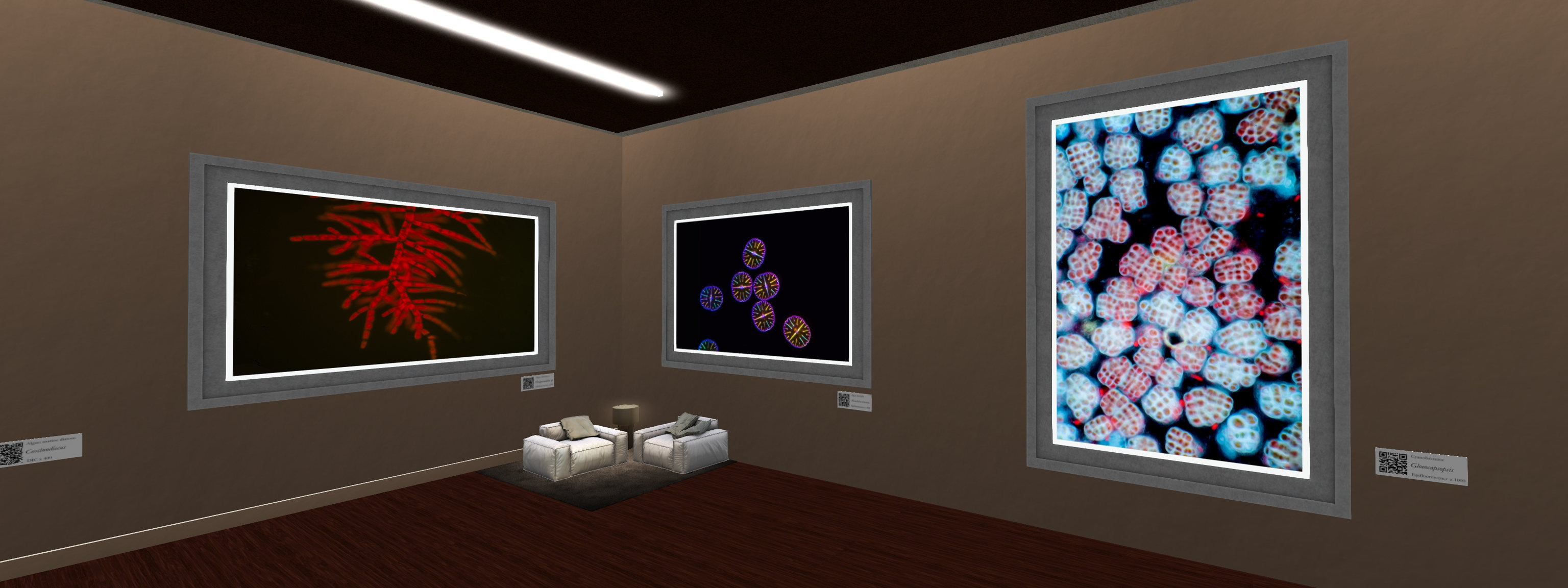
Desiderartum Gallery: Guille – Invisible Beauty
The virtual incarnation of Antonio Guillén, Guille is a doctor in Biology and professor of Natural Sciences, whose background is as fascinating as his art, given his research projects span the environment, microbiology and astrobiology. He also has a refreshing – almost holistic, one might say – perspective on art and science in which the two interact with one another sans borders, informing one another and helping to jointly educate students and the public at large.
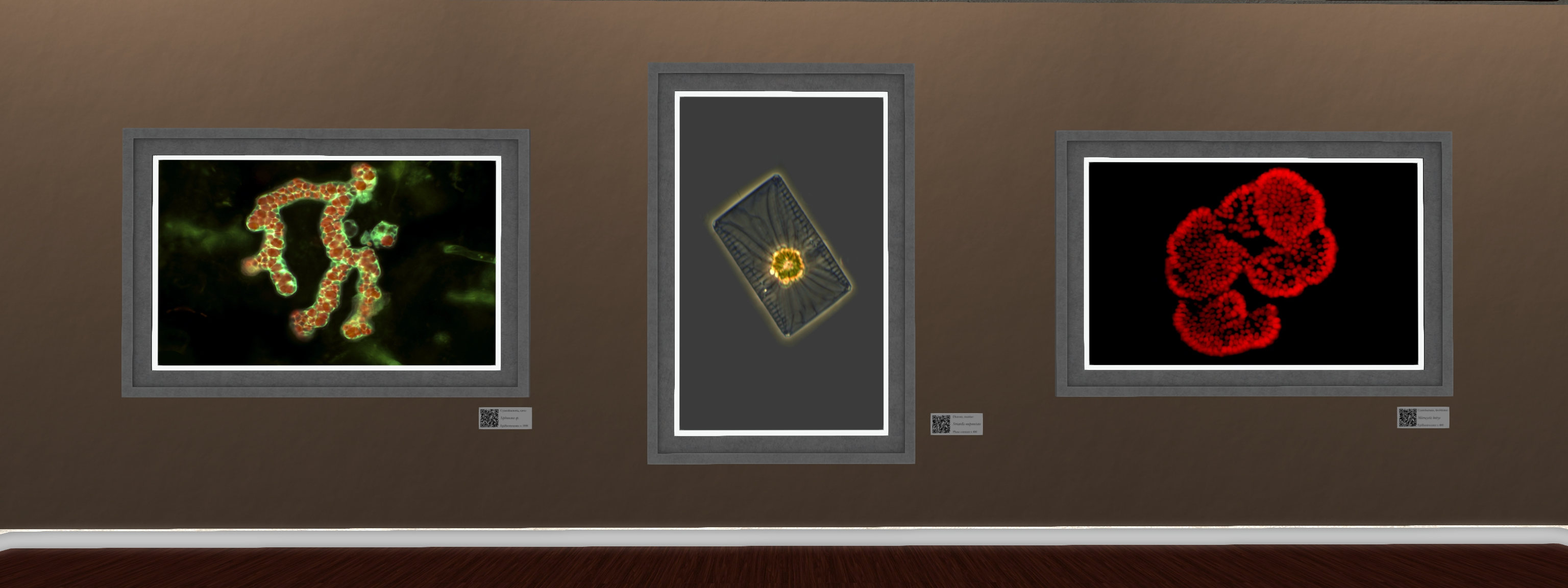
In particular, and given his professional focus on the microscopic, he has become a noted photographer-artist who captures the tiny worlds of micro-organisms – bacteria, fungi, archaea and protists – in all their exquisite beauty. And by “noted”, I mean precisely that not only has his photography been exhibited across his native Spain – including the National Museum of Natural Sciences, Madrid -, it has also garnered awards such as Spain’s National Prize for Scientific Photography and the Giner de los Ríos Prize, the country’s most prestigious educational award. In addition, his project The Hidden Life of Water received the first world award at a Google Science Fair (2012).
Desiderartum Gallery: Guille – Invisible Beauty
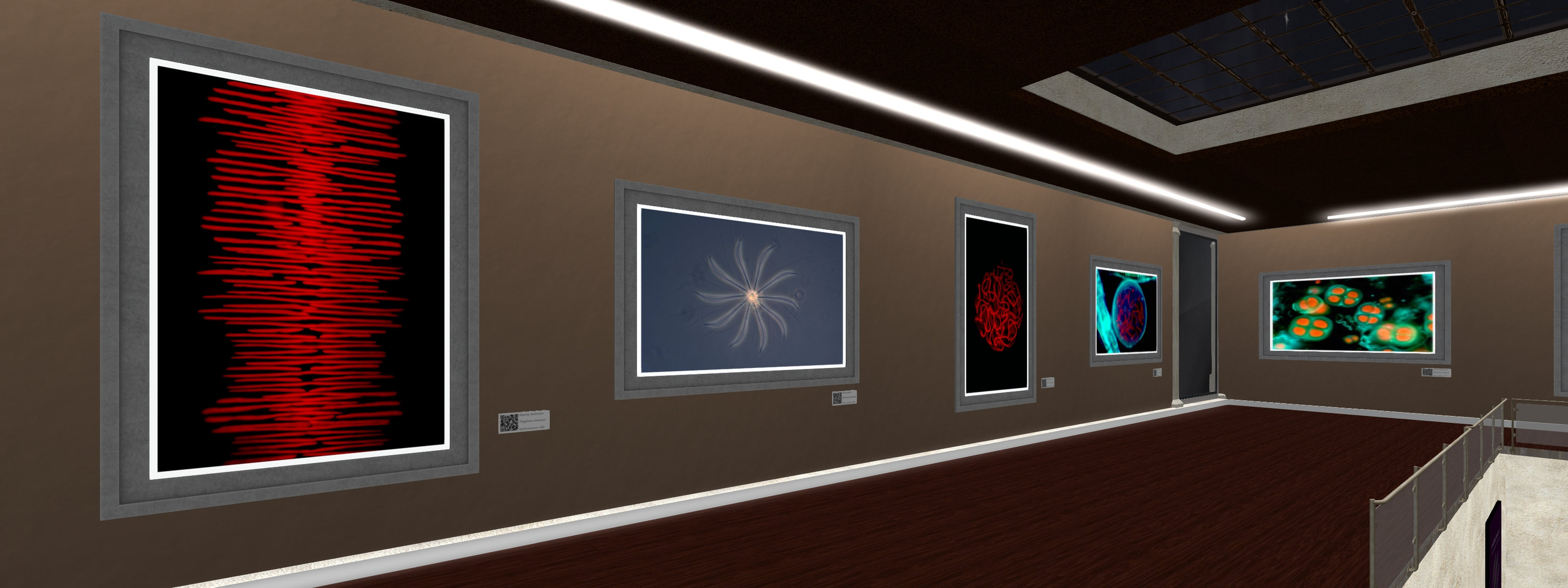
As I noted in November 2021, Guille’s work doesn’t just present images of these incredible, tiny and diverse living organisms, it takes us on a journey into their worlds, the images revealing them individually or collectively in the the most amazing detail, while the texts he has supplied to go with the images (obtained by clicking the title card either below or to the right of each image) reveal more of the realities of these micro-organisms – and not in in dry, scientific terms that are starved of emotion. Rather, Guille’s descriptions are wonderfully fluid, descriptive and in places poetic. It thus offers further life to the tiny creations his microscope has captured in still form, whiles also underscoring his belief that art and science should freely interact.
Like most of the algae of the desmids family “Euastrum” it seems to look at itself in a mirror creating a pair of green Siamese joined by the same heart in a game of symmetry in which survival today and that of the future are bathed of this simple and intense beauty.
A thick transparent layer, adorned with winding valleys, spines or sculpted buttons and made with cellulose and pectin protects the body from these beautiful algae and helps them to float and move slowly both floating and on the bottoms where they live.
Guille’s sparkling description of the supernova-like Euastrum Verrucosum
Split across the two levels of the gallery building, Invisible Beauty mixes some of the images seen within Unseen Beauty with those specific to this exhibition, providing a natural overlap between the two, and making a visit to both a natural experience.
In addition to the journeys into the worlds of prokaryotes and eukaryotes presented by Unseen Beauty and Invisible Beauty, more of Guille’s work can be found on his Flickr stream, whilst in-world, his has – with the support and assistance of Kimika Ying – created El Universo en una Gota de Agua (“The Universe in a Drop of Water”). There, visitors can see more of Guille’s photography as well as learning about the history of the microscope and about the study of micro-organisms – and even enter their world, where a human hair offered at a scale to represent its magnification by a factor of 10,000 helps put all of this tiny life into perspective.



 After being cryogenically frozen in the 1970s to await a cure for his (then) incurable cancer, Jaybee Corbell awakes after more than 200 years – to find his own body destroyed and his mind and memories transferred into the “mindwiped” body of a criminal. And that’s is not all that has changed: the Earth is now overseen by an oppressive, totalitarian global government called “The State”, and Corbell’s existence is to be determined by a “checker”; if he is found wanting, he will be discarded.
 Klawde had everything. Sharp claws. Fine fur. And, being the High Commander of the planet Lyttyrboks (think about it if you need to!), an entire world of warlike cats at his command. But then he is stripped of his feline throne and sentenced to the worst possible punishment: exile to a small green-blue planet that is, as they say, “far out in the uncharted backwaters of the unfashionable end of the western spiral arm of the galaxy”, known to its dominant bipedal race as “Earth”.