Logos representative only and should not be seen as an endorsement / preference / recommendation
Updates from the week ending Sunday, April 10th, 2022
This summary is generally published every Monday, and is a list of SL viewer / client releases (official and TPV) made during the previous week. When reading it, please note:
It is based on my Current Viewer Releases Page, a list of all Second Life viewers and clients that are in popular use (and of which I am aware), and which are recognised as adhering to the TPV Policy. This page includes comprehensive links to download pages, blog notes, release notes, etc., as well as links to any / all reviews of specific viewers / clients made within this blog.
By its nature, this summary presented here will always be in arrears, please refer to the Current Viewer Release Page for more up-to-date information.
Note that for purposes of length, TPV test viewers, preview / beta viewers / nightly builds are generally not recorded in these summaries.
Official LL Viewers
Release viewer: version version 6.5.3.568554 – formerly the Maintenance J&K RC viewer, promoted Monday, February 28 – no change.
Goatswood, April 2022 – click any image for full size
My first introduction to the work of Hera (zee9 – then known as Kora) came getting on for a decade ago, when I first visited Venexia and Goatswood, two separate builds developed for role-play. At the time, both were popular spots for visitors, with Goatswood possibly the more popular by virtue of its more general setting. However, both departed Second Life in 2015 and while Venexia has reappeared from time to time since then, I think I’m right in saying Goatswood has largely been absent the grid. At least until now.
As pointed out to me by Cube Republic, Goatswood is now back (for a time at least), sharing Hera’s region with an updated version of her Whitby build (which I wrote about in October 2021 (see Visiting Dracula’s Whitby in Second Life), which I hope to get to in the next few days; for now I want to focus on Goatswood.
Goatswood, April 2022
Welcome to Goatswood
Well it is that time again when I get the call of the wild and must return to Goatswood 🙂 . It is a virtual Victorian Gothic novel [and] was always my favourite region of all the ones we created for RP 10 or so years ago. For me it had a real heart and soul that the others lacked; many people passed through it and made homes there. The role play was IMHO as good as it gets. This version is very different as there is no game set up, but I feel that for me this version is better in many ways I hope you like what you find.
Hera (zee9)
Set in the period 1860 – 1900, Hera describes the village as being somewhere in the Midlands of England – although I always felt it to be closer to the Cotswolds, something perhaps referenced in the fact that Hera modelled the basic design of Goatswood on Castle Combe, Wiltshire. It was developed specific for easy-going role-play set within that era, and while that may not be central to this current iteration, there is little doubt that Goatswood very much retains the heart and soul of the original.
Goatswood, April 2022
As is common with Hera’s recent builds, Whitby and Goatwood share a common landing point, both being on the same region. However, for this iteration of the builds, the landing point has also undergone a change, now having about it a touch of Harry Potter, presented as it is as a railway station with two steam trains are drawn up to the platforms. The red train to the right (when looking at them) offers a journey to Whitby, while the green train calls at Goatswood. Just click on the carriage through the open door to be transferred to the required destination.
Those who recall the original Goatswood may well recognise elements of this version – the railway station, the Roebuck Coach House, the church – but these have some subtle difference within them. The Roebuck, for example, now has a grand carving of a stag above the main door, while the church no longer has a steeple atop its tower. These, together with other changes to the setting that allow this iteration of Goatswood to stand apart from its namesake as a quiet independent setting, rather than an mere copy.
One of the major attractions of the original Goatswood was the care with which it had been built; there was a real sense of place in the way the village and its surroundings had been put together. This is also present within the new iteration. Anyone familiar with the Cotswolds or, more broadly, the counties of Oxfordshire, Worcestershire, or Warwickshire as a whole will realise the beauty of Hera’s build richly replicates the beauty of the countryside through those counties.
Exploring the region is something for which a good deal of time should be apportioned. While many of the houses may be shells, there is nevertheless a richness of detail awaiting discovery along the paths of the village and along the gardens. Those buildings – such as a Roebuck Coach House, the church and manor house, plus a couple of places outside of the village itself (which I’ll leave to you to find 😉 ) – do have interiors waiting discovery.
Goatswood, April 2022
The setting also retains much of the mystery of the role-play that formed a part of it – including a couple of places I confess I don’t remember, which is not to say they weren’t present back in 2013/14, when I made my original visit. While these may not be present to encourage role-play this time around (Hera requests anyone wanting to more than explore and take photos contact her first), they nevertheless further help bring the overall mystique of the village to life once more.
Goatswood is the story I never got around to writing, about a place that never existed, where I would have loved to have lived. It is a world full of haunted places, Gothic folk tales and shadowy occult mysteries. It is set in a time when attitudes were just beginning to change due to advances in science and technology. And yet this advance caused a counter reaction in many, who tried to revive older folk traditions and beliefs in Magic.
In the countryside most people still carried on as they had done for hundreds of years. They still retained a strong belief in natural magic, folk tales and herbal remedies, and yet they had their feet planted firmly in the reality of a hard working life on the land. A really great example of this can be seen in the recent television miniseries “The Living and the dead”.
– Hera (zee9)
Goatswood, April 2022
Now I am an acknowledged “Hera fan” and so am obviously naturally drawn to her work. However, if you have never seen one of her regions before, or if you have never had the opportunity to appreciate Goatswood, then I urge you to take the opportunity to do so now. It is one of the great classics of Second Life.
La Masion d’Aneli: Nessuno Myoo – As Mammoths In the Middle Of Butterflies
Having opened on April 6th, 2022, Kicca Igaly and Nessuno Myoo present two intriguing installations at La Maison d’Aneli (curated by Aneli Abeyante) that stand a both individual pieces and as installations that might – in the mind of the visitor – also be intertwined in terms of theme and potential interpretation.
Before getting to the exhibits – both of which can be reached from the teleport disc at the gallery’s ground-level landing point – please note that to appreciate these installations fully, yo should ensure Advanced Lighting Model (ALM) is enabled and render quality is set to High (if your system can handle it) – both set through Preferences → Graphics, and that the viewer is also set to use the Shared Environment.
La Masion d’Aneli: Kicca Igaly – Pulsions
Within Pulsions, Kicca explores the idea that the human condition – the lives we lead and how we interact – is propelled by the decisions we make individually and collectively; pulsion itself being the act of driving forward (as opposed to being drawn forward involuntarily as a result of influences over which we have no direct control).
Within the setting, we are presented by scenes of everyday life: mothers with their children sharing a conversation; children at play, a mother and daughter passing a (presumably) homeless man asleep on a park bench; a tall man watching the children at play, and so on. Over the shoulders of each character float two little figures – their better angels (or positive pulsions) and darker demons (or negative pulsions) that drive their behaviour – whether or not a group conversation descends into gossip and rumour-spreading; whether a discussion remains calm and reasoned or descends into a heated, angry exchange; whether a game played remains friendly and fun or embroiled in bitterness on losing, and so on. By using the term pulsion, Kicca reminds us that the negative choices we make may not always be driven by a need to hurt or upset and so are not necessarily “evil” or “cruel” – although the tall figure watching the two youngsters also perhaps reminds us there can be intentional evil driving the decisions some make…
La Masion d’Aneli: Kicca Igaly – Pulsions
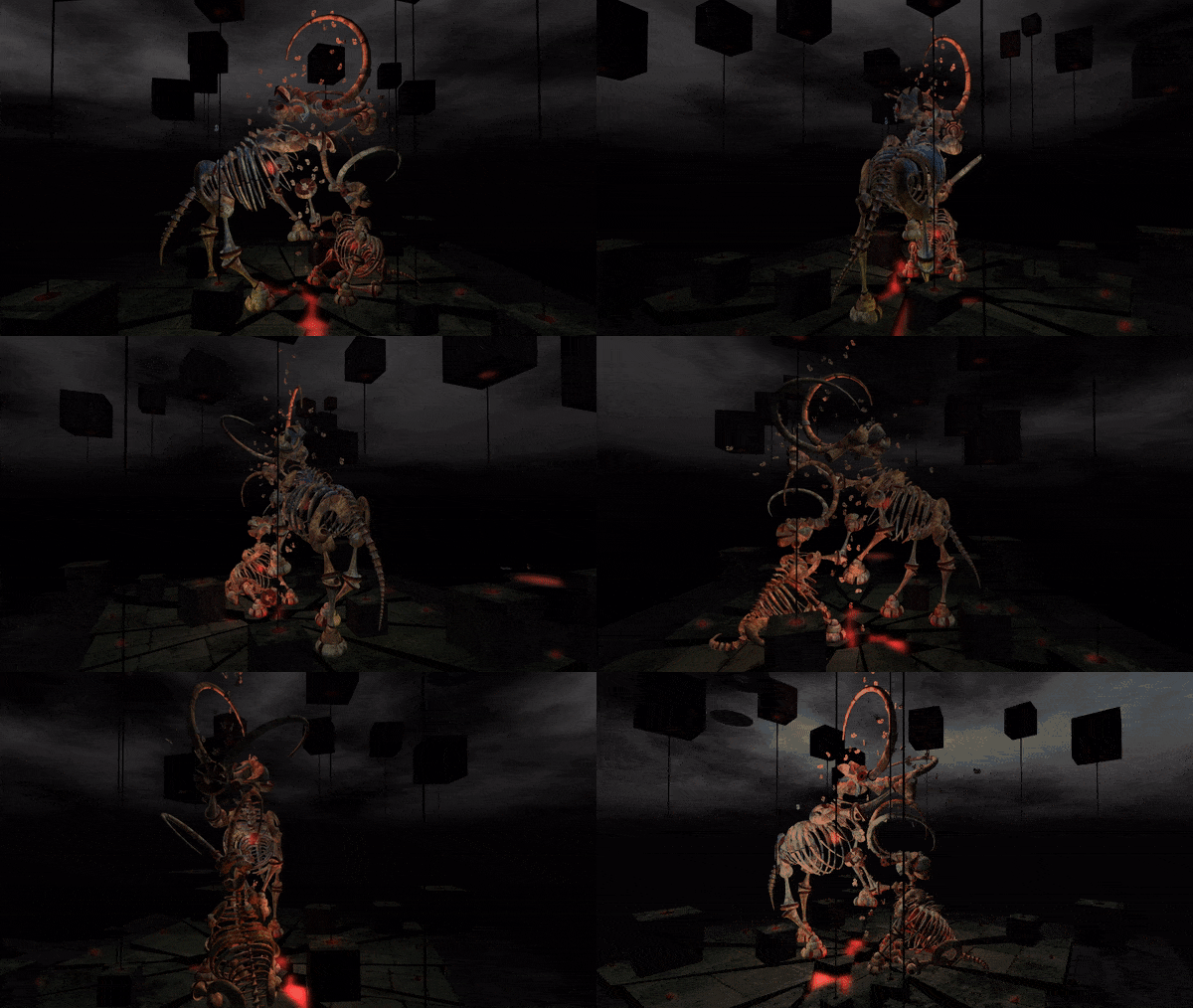
Within As Mammoths In The Middle Of Butterflies, Nessuno presents a single, stunning sculpture of the skeletal forms of two mammoths of unequal size apparently locked in combat, the smaller forced down onto its rear hunches and attempted to ward off a blow from the foreleg of the larger as it rears up on its hind legs in order to deliver the blow with greater force. Around both rises a cloud of butterflies, their peace and innocence shattered by the warring beasts.
Quite what we make of this is left entirely open to interpretation, the artist only stating At the sunset of existence, immersed in the wonder of its own nature. Thus, how we respond to the piece is entirely subjective. For my part, the use of mammoths (now long extinct) and the term “sunset of existence” suggests the piece can – and as with Kicca’s Pulsions – be taken on a statement about the human condition.
As Mammoths In The Middle Of Butterflies
That we are, for example, so polarised in views on subjects such as global warming and so focused on arguing about it, we cannot pause to address the fact that we really are disrupting the global ecosystem and hastening our own demise. Other might see it as a commentary on the the danger of the old truism “might is right”, that some countries have grown so arrogant in their own superiority and might, they care little about the manner in which the decisions they make can have shattering and disruptive impacts on others.
But rather than add further subjective thoughts of my own here, I’ll leave it to the sculpture to express itself to you. All I’ll say in closing is that once again, Kicca and Nessuno present two installations that engage both the eye and the mind.
Whimberly, April 2022 – click any image for the full size
It’s been some 18 months since I last dropped into Whimberly, the homestead region held by Staubi Reilig (Engelsstaub), so given the fact the last time I visited it was in the autumn of 2020 and we’re now in springtime, I thought I should hop back and have a wander once more.
Once again, the region sits within a ring of mountains and offers a mix of gentle lowlands and rugged low hills. To the north-east the lowlands hold a broad meadow, rich in yellow alirium, ringed by a dirt track. It sits as the widest point of the island, the rest of the landscape curled around a finger of water that reached inward to its centre.
Whimberly, April 2022
Waterfalls tumble from some of the higher ground to the east into what may have once been a pool of water all on is own, but which has broken out to the south and north to meet waters that may have once been a deep inlet to the west, to leave the centre of the region as a slender ribbon of land reached by a pair of humpbacked bridges.
South and west, the landscape forms the more rugged parts of the setting, a path climbing away from the landing point and the field to run over the top of the waterfalls to pass a hilltop cabin before dipping down to a roll through a bowl of land to either reach a watery terrace below the cabin, or offer a route on south around the region, both paths watched over by deer.
Whimberly, April 2022
Take the path on around the southern side of the land, and it will eventually bring you to another cabin sitting at the end of a tree-lined walk. But before getting to it, there is the option to take a right run and cross the waters via one of the dainty bridges and reach the middle island. Here people can enjoy tea on a deck extended out over the water or cuddle in the neighbouring rowing boat, or pass on a little further to where a more formal picnic can be enjoyed, together with time on the swings behind the blanket – just don’t upset the rabbits!
A second bridge allows people to cross back to the north-east finger of hills that border the field and landing point, offering a coastal walk to where the region’s “land office” is tucked away, complete with coffee on offer outside and a path back to the field and the landing point.
Whimberly, April 2022
The cabin to the south-west is perhaps the most substantial building in the setting, being a mix of stone and wood. One of Cory Edo’s distinctive designs, it looks out to the west and a shingle-and-rock beach that has a small bay of its own as the land runs northward once more between open waters and those flowing outwards from the middle of the region.
Both of the main cabins are cosily furnished for those looking for a temporary retreat and sit-down / cuddle, each with its own outdoor spaces – the watery terrace notes earlier and, for the southern cabin, a little coastal area below the house, complete with a pair of chairs for enjoying the view.
Whimberly, April 2022
Those who continue north along the peninsula extending away from the southern cabin will find another place to sit out on a little boat moored next to a rickety pier and beyond it, through a cut between two rugged hills, a little hut set out for fishing (which a little chipmunk appears to be enjoying!) and a chance for some hearty stew or some eggs whilst appreciating the view back over the water to the slender middle island.
As ever, Whimberly is again rich in details awaiting discovery, with lots of opportunities for photography, all rounded-out by a super soundscape. It thus retains its reputation as once of SL’s ever-popular public regions in which to spend time.
Ruben’s Art Gallery: Mareea Farrasco – Visiting Salt Lakes of Florence
Following my review of Landscapes – My Personal View, by Alexa Wulfe (Alexa Bouras) – see Alexa’s personal view of Second Life – I was contacted by Ruben (yvan Slade), who offered my an invitation to visit the gallery he operates and curates, and which is currently host to two very different exhibitions.
Ruben’s Art Gallery is located on its own sky platform. The gallery sits within a model, clean concrete structure with two levels and a walled courtyard outside. Both levels of the gallery offer the same amount of exhibition space and are linked via teleport disks, allowing them to exist as independent display spaces with easy access from one to the other. At the time of my visit the gallery was playing host to exhibitions by Mareea Farrasco and Zia Sophia (Zia Branner).
Ruben’s Art Gallery: Mareea Farrasco – Visiting Salt Lakes of Florence
Visiting Salt Lakes of Florence is a series of twelve images captured by Mareea of Gnaaah Xeltentat’s Florence region, which at the time Mareena capture it lay as a setting inspired by the Salin d’Aigues-Mortes (salts of Aigues-Mortes), Camargue, in the south of France, as interpreted by the talented Iska (sablina), assisted by Tippah.
As I noted in The pink salt lakes Of Florence in Second Life, the region is remarkable in the manner in which it captures the spirit and look of its namesake – and Mareea has fully captured the beauty of the region in these images that have been gently post-processed in order to give them the look and feel of watercolour paintings. Most of the images present the landscape of the region, although several offer a more personal look through the inclusion of Mareea’s avatar (and those of friends / others).
Ruben’s Art Gallery: Zia Sophia
On the upper floor, Zia also presents a total of 12 images, although these are drawn from the physical world, being copies of Zia’s fascinating paintings. Four of them are Zia’s coastal and sea views that have been features in some of her recent SL exhibitions and the remaining eight copies of her natural abstract paintings that are, as ever, rich an form and colour.
Both artists are very different in their choice of art – both are united in their eye for colour, tone, and mood, allowing these two exhibitions to stand individually whilst also richly complimenting one another. And for those who enjoy Zia’s work, a gift can be obtained via the artist’s easel within her exhibit.
Ruben’s Art Gallery: Zia Sophia
I’m not sure how long art displays run for at Ruben’s, but at Mareea’s opened in mid-March, I would recommend visiting sooner rather than later, just in case a case of artist is on the horizon.
My audio recording and chat log of the Content Creation User Group (CCUG) meeting held on Thursday, April 7th 2022 at 13:00 SLT.
The video recording by Pantera (embedded at the end of this piece, my thanks to her as always for recording the meetings) from the Third-Party Viewer Developer (TPVD) meeting on Friday, April 8th, 2022 at 13:00 SLT.
These meetings are chaired by Vir Linden, and their respective dates and times can be obtained from the SL Public Calendar.
This is a summary of the key topics discussed in each meeting and is not intended to be a full transcript of either. However, the video does provide a complete recording of the TPVD meeting, and timestamps to the relevant points within it are included in the notes below.
MFA RC viewer, update to version 6.5.4.569725, on March 24.
Performance Improvements RC viewer version 6.6.0.569349, dated March 14.
Lao-Lao Maintenance RC viewer, version 6.5.4.569191, issued on March 11.
Project viewers:
Performance Floater project viewer, version 6.5.4.569531, March 18.
Mesh Optimizer project viewer, version 6.5.2.566858, dated January 5, issued after January 10.
Legacy Profiles viewer, version 6.4.11.550519, dated October 26, 2020.
Copy / Paste viewer, version 6.3.5.533365, dated December 9, 2019.
General Viewer Notes
The focus is on fixing the bugs reported on the Performance Improvements RC viewer so that it can be the next viewer promoted to de facto release status. The RC version has been updated but has yet to be issued.
[Video: 30:53-31:55] This viewer also includes a fix for handling object occlusion.
The Performance Floater project viewer includes the auto-FPS capability that is similar in nature to Firestorm’s Auto Tune capability designed to help maintain a given viewer frame rate (see here for more), and the aim is to try to sync these two approaches up before the Lab’s viewer moves to RC status.
The server-side work required for the Legacy Profiles viewer had been deployed, so that viewer should be updated and appearing soon.
Providing the ability to import a glTF file with is single material within it containing all the textures / maps and colour parameters for a given face. Exactly which maps (normal, specular, emissive, roughness, albedo, occlusion, etc.) is still being defined.
When uploaded, the material then becomes an inventory asset.
When the asset is applied to the face of an object, it overrides the texture parameters for that face (diffuse, normal spec maps, full bright, etc.), with the options to edit these parameters in the Build / Edit tool disabled until such time as the material is removed from that face.
However, the face-related options – rotation, repeats per metre, offsets, etc., – would remain accessible.
This approach would faces to be textured under the existing system and have a materials asset applied so that viewers without the new materials code would render the “legacy” texture parameters for the object face, whilst viewers with the updated code would render the settings specified by material.
What is the benefit of this?
It moves SL towards proper support for PBR and the improvements that will bring.
Very simply put from an end-user perspective: it will help add depth to Second Life by improving the way surfaces appear be giving them improved surface texturing, reflectivity, and so on; and it will no longer require end-users fiddling around with textures and normal / specular maps to achieve something; they’ll have a simple asset they apply to (say) a wall, and that’s it.
The first pass of this work will provide support for Adobe Substance 3D Painter, and as such, LL are looking for feedback from creators who use Substance Painter in terms of how they use it, what kind of materials they are creating, and how they would like those materials represented in Second Life, what maps they would ideally like to see supported.
A concern raised with this approach is that glTF does not natively support non-PBR workflows, which is a problem for those who use Substance Painter “non-PBR” (such as clothing creators), and this needs to be taken into consideration.
One route around this is the suggestion that the materials actually be built at import time, rather than just built within Substance Painter and exported to glTF for import.
It was requested that some form of UI element should be added to the viewer to allow material assets to at least be inspected. While this is something that will be provided, it will not be in the first phase of the work.
Rendering for these “new” materials will be entirely separate to the existing rendering path for SL’s existing materials system, allowing for a more “industry standard” approach to be used with the new materials.
Whether or not a fee is to be charged for importing these materials is still TBD (and somewhat complex, if the importer is to support using texture files previously uploaded to SL, rather than having to import them again).
Longer-term the idea is at when PBR support is added, it will only work with these material assets; texture entries will continue to be handed as they are now (as noted above).
PBR itself is a complex issue both technically and in terms of content, and it is already envisaged that it will give rise to differing environments in-world (e.g. locations that are “PBR enabled” and require people to be running viewers capable of supporting PBR).
This is because SL content being what it is, there is no easy way to “PBR-ify” it all, and gain a uniform (or even desirable) result – particularly where content has been designed under the existing rendering capabilities to produce a specific result.
Given the complexities / impact of such a project, LL recognises there is a need to provide the means for ongoing real-time exchange of ideas / gathering creator input.
Neither the CCUG nor the SL forums are seen as a good fit for this kind of interaction.
The preferred option voiced in the meeting was to use Discord as a host. Server details TBD at this time, if this is selected.
From the TPVD Meeting
[Video: 4:41-9:10] It has been pointed out the 30-day validity period for an MFA token seems unusually long, and a request has been made to reduce it.
In particular, testing the MFA code and token refresh when looking at the viewer code is more difficult when the tester has to wait a month between tests and checks / retries.
[Video: 11:54-20:10] Beq Janus and Vaalith Jinn are working on “temp mesh” – a means to preview mesh and rigged mesh in-world without necessarily having to log to the Beta grid and upload there. As per the video, there are some issues (such as the temporary creation of linksets), but overall it is hoped with work will result in a usable capability.
This conversation folds into itself a broader discussion on purely viewer-side rendering (as opposed to rendering asset data coming via the CDN)
[Video: 20:12-25:16] Bandwidth setting confusion: A claim was made the turning up the official viewer’s network bandwidth setting improves texture download speeds for those on faster Internet connections, prompting a request for the default setting being turned up.
Given that the network bandwidth setting is supposedly only for UDP messaging, and all assets, including textures, are transmitted via HTTP via CDN(s), some understandable doubt was cast on this.
While not ruling out changing the bandwidth setting causing a degree of improvement, Runitai’s thoughts on the matter (through looking at the code) fall into two areas:
Any actual delay in texture fetching is more likely to be with some of the background thread handling which has yet to be updated.
It is more likely that issues in texture loading / handling may be related to a number of issues, including a) the viewer mistakenly believing it is running out of VRAM (due to some coding errors) and immediately loading / unloading textures on the background threats; b) changes in how texture are actually downloaded and passed to the decode thread as a result of the move to HTTP that may be having an impact.
[Video: 28:53-29:35] In respect of this last bullet point above, it was indicated that TPVs tend to handle texture decoding, etc., somewhat differently, this is not believed to be an issue. A request has been made for a TPV to consider making a code contribution on this, so that LL can investigate making similar changes.
[Video: 32:53-44:20] Further discussion on texture fetching and the way the viewer code is generally conservative in this area.
[Video: 36:41-41:28] (overlapping with the above)] there is a restatement of the concern that raising the UDP bandwidth setting “because higher is better” could trigger a microburst buffer overrun on the server-side routers were the setting to be raised across all viewers. It is believed the servers are fairly well protected, but this needs to be confirmed by the infrastructure team before any such change is made.
[Video: 25:55-30:48] VRAM detection / use: changes are being tested (on Windows at present) whereby rather than setting a minimum default for VRAM (512 MB, a long-time sticking point for many users), LL are shifting to having the viewer query the operating system as to how much VRAM is free.
As an example of the potential improvement this has given, a system with 10 GB VRAM will see the viewer use as much of that VRAM as is available, whereas previously, the viewer would get up to using around 1.5 GB and then switch to texture paging.
Finding a similar solution for Mac system is somewhat more difficult due to the fact the only reliable report OS X provides is on the amount of installed VRAM, not how much may actually be available for an application to use / how much a process is using.
[Video: 45:14-47:16] does increasing the bandwidth setting improve teleporting between region?
Anecdotally, this appears to be the case for some.
However, whether there is a direct correlation between increasing the UDP bandwidth and inter-region TPs improving is hard to prove, although it is possible a message packet related to TPs is hitting the throttle and getting dropped without any attempted re-try.
[Video: 49:11-54:43] custom chat ranges: server-side support for extending chat ranges within regions beyond the default 20 metres (seen as useful for venues hosting meetings, presentations, etc.), was deployed some time ago, but is currently only available on Linden-controlled regions.
Wider availability of the capability has hit some privacy concerns (e.g. people believing their chat is limited to 20m in a public region being overheard by someone on the other side of the region). As such, the capability is awaiting viewer-side updates that make it clear to people entering regions where the chat range has been extended that this is the case.
This information is actually being sent to the viewer (RegionInfo in the RegionInfo 5 block), but the IU to handle it has yet to be added (and TPVs may not have been aware of its availability so they could create their own notifications).





 Inara Pey: Living in a Modemworld