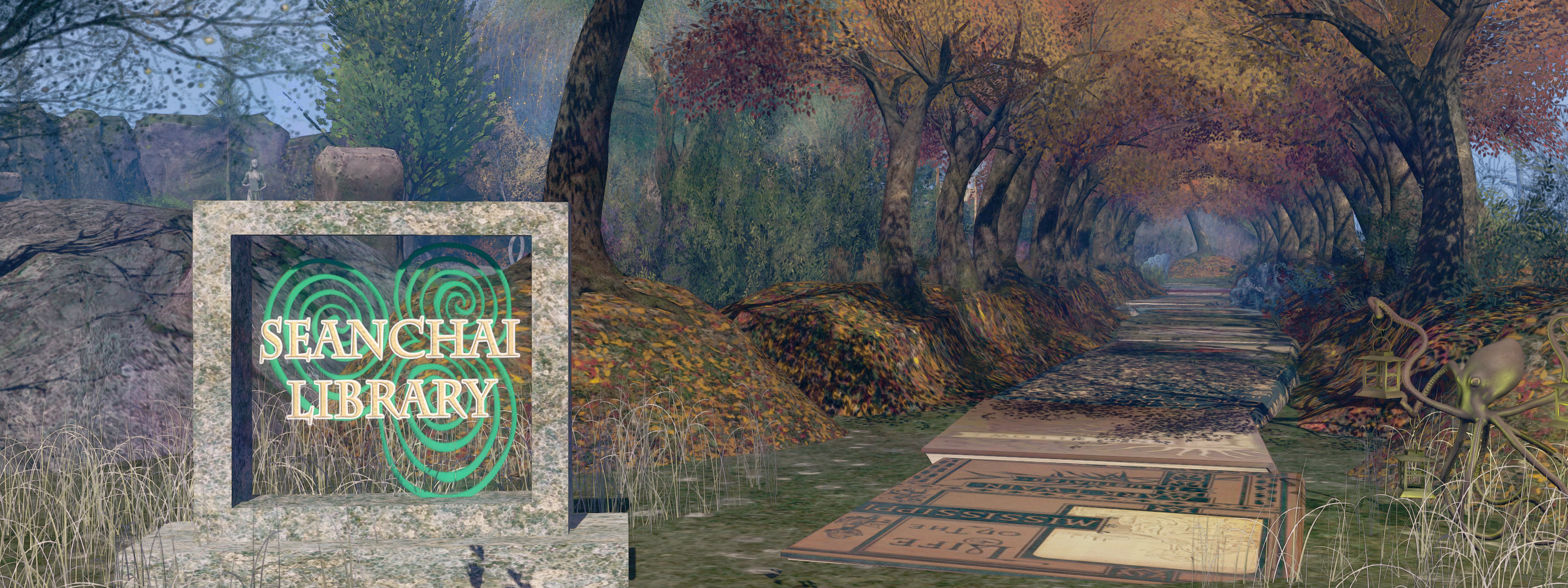
Seanchai Library: Stories of Halloween

Seanchai Library

It’s time to highlight another week of storytelling in Voice by the staff and volunteers at the Seanchai Library – and this week previews the launch of a very special event.

As always, all times SLT, and events are held at the Library’s home in Nowhereville, unless otherwise indicated. Note that the schedule below may be subject to change during the week, please refer to the Seanchai Library website for the latest information through the week.

Sunday. October 30th, 13:30: The Halloween Tree, Conclusion

On All Hallows Eve, young Pipkin is due to meet his eight friends outside a haunted house on the edge of town. But as he runs through the gathering gloom, Something sweep him away.

Arriving at the house in expectation of meeting Pipkin, his eight friends instead encounter the mystical Carapace Clavicle Moundshroud, who informs them that Pipkin has been taken on a journey that could determine if he lives or dies.

Aided by Moundshroud and using the tail of a kite, the eight friends pursue Pipkin through time and space, passing through the past civilisations – Egypt, Greece, Rome, the Celts – witnessing all that has given rise to the day they know as “Halloween”, and the role things like ghosts and the dead play in it.

Then, at length they come to the Halloween Tree itself, laden with jack-o’-lanterns, its branches representing the confluence of all these traditions, legends and tales, drawing them together into itself.

With David Abbott, Faerie Maven-Pralou and Caledonia Skytower at Haunted Hollow in Chestnut Hills.

Monday, October 31st

13:00: The Legend of Sleepy Hollow

On All Hallows Eve, how better than to get in the mood than with some classic tales of horror and spookiness from literature?

Perhaps one of the most well-known (and well-loved) stories of dark hauntings is Washington Irving’s The Legend of Sleepy Hollow, which is also one of the earliest examples of American literature of enduring popularity.

While setting his tale in post-revolutionary America in the year 1790, Irving in fact wrote the sorry tale of school teacher Ichabod Crane and his ill-fated encounter with the Headless Horseman in 1819 while visiting England, where his also penned Rip Van Winkle.

Both The Legend of Sleepy Hollow and Rip Van Winkle first appeared in print in his serial The Sketch Book of Geoffrey Crayon, Gent, which also marked Irving’s first use of that pen name. As with Rip Van Winkle, Irving claims he first heard about The Legend of Sleepy Hollow from “Diedrich Knickerbocker”, a fictional “Dutch Historian”.

19:00:  The Wolfen

Gyro Muggins reads Whitley Strieber’s 1978 debut novel.

Two New York Police Department detectives investigate a series of suspicious deaths across New York City. These are revealed to be the work of a race of intelligent beings descended from canids, called the Wolfen.

The novel is told from the point of view of the human characters as well from the Wolfen themselves. The savage killing of two New York City policemen leads two detectives, a man and a woman bound together by a strange, tough passion, to hunt down the wolfen – once called werewolves.

Tuesday, November 1st 12:00 Noon: Russell Eponym

With music, and poetry in Ceiluradh Glen.

Wednesday, November 2nd:

19:00: Seanchai Flicks – Dia de los Muertos

The Seanchai cinema space shares Halloween-themed video adventures.

21:00: All Souls

With Shandon Loring.

Thursday, November 3rd, 19:00: Cursed

Stories from the Anthology edited by Christina Henry. With Shandon Loring.

Bamboo’s Personal Aspect in Second Life

Bamboo Barnes: Personal Aspect

October 28th, 2022 saw the opening of an extensive retrospective exhibition of art by Bamboo Barnes at the Akiniwa region, a part of the Akipelago, operated and managed by Akiko Kinoshi (A Kiko), supported by 3D sculptures by Kerupa Flow. And when I say extensive – I mean just that: Personal Aspect occupies for main gallery buildings, at well as featuring three “outdoor” displays of her work.

Hailing from Japan, Bamboo is, as I’ve frequently noted, one of the most vibrant, evocative, provocative, and emotive artists displaying her work in Second Life. She is also an artist unafraid of plumbing the depths of emotion and introspection – as can be witnessed in some of the pieces in this exhibition.

Bamboo Barnes: Personal Aspect

Bamboo began her artistic journey within Second Life in 2011, initially working with  with avatar screenshots. In 2013, she became enamoured by in-world 3D art installations, a factor which dramatically altered her artistic trajectory, her work shifting to a format that often presents a 3D depth through the two-dimensional form of the artist’s canvas.

With this shift in direction also came an opening of style and structure to her work; there is a focus of emotional self-reflection within many of them, often expressed through the use of vivid colours. She also sought explore the more esoteric through her art – the nature of self; metaphysics; what constitutes reality; the nature of art itself – particularly her own art, and more.

Bamboo Barnes: Personal Aspect

Within this exhibition – which features pieces Bamboo has selected as her “favourites” from her extensive portfolio – we are invited to join Bamboo on her journey through art, a journey that extends from Second Life landscapes and reflections on the world of 3D art within the platform, through to pieces offering insight into her examination of the themes noted above, onwards to her original digital art and experiments with motion (animation) in art to offer further dimensional depth.

Art is never finished, just abandoned.

Bamboo Barnes

Bamboo Barnes: Personal Aspect

One of the many beauties of Bamboo’s work is that she doesn’t not offer her own thoughts on it; rather, she prefers to allow her art to speak directly to those viewing it. As such, I don’t plan to offer much of a personal exposition on this retrospective. What I will say, however, is that this is an exhibition that should be seen – and appreciated with the time it deserves; to hurry through the halls risks missing the depth of expression awaiting discovery.

In  this, Kerupa’s 3D work is the perfect accompaniment to Bamboo’s. Also hailing from Japan, Kerupa shares that heritage, while her art plumbs similar depths of expression and theme.

Kerupa Flow at Personal Aspect

Not to be missed.

SLurl Details

2022 week #43: TPVD meeting summary – with PBR updates

Raion No Su, August 2022 – blog post

The following notes were taken from Pantera’s video recording of the Third-Party Viewer Developer (TPVD) meeting held on Friday, Third-Party Viewer Development meeting held on Friday, October 28th, 2022 at 13:00 SLT. My thanks to her for recording it, and it can be found at the end of this article. Times stamps to the video are included where relevant in the following notes. These meetings are chaired by Vir Linden, and their dates and times can be obtained from the SL Public Calendar.

This is a summary of the key topics discussed in the meeting and is not intended to be a full transcript.

Official Viewers Status

[Video: 0:00-2:00]

Available Viewers

The Maintenance (N)omayo Hotfix viewer was promoted to de facto release viewer on Wednesday, October 26th, 2022.

  • This is an urgent fix for transparency “alpha” blending issues. In cases of many layers of textures that included transparencies, this would cause some of the lower layers to not render at all. There are no other functional changes.

The rest of the current crop of official viewers remains as:

  • Release channel cohorts:
    • Maintenance P (Preferences, Position and Paste) RC viewer version 6.6.5.575055 September 19.
  • Project viewers:
    • Puppetry project viewer, version 6.6.3.575529,  issued on October 12.
    • Performance Floater / Auto-FPS project viewer, version 6.6.5.575378, October 4.
    • Love Me Render (LMR) 6 graphics improvements project viewer 6.6.2.573263, July 21.

General Viewer Notes

  • The Performance Floater project viewer (which includes UI updates and the Lab’s new Auto-FPS feature) has been undergoing a lot of work to reconcile the Lab’s auto-FPS work with that of Firestorm is still expected to appear as a RC viewer Soon.
  • The Windows viewer built using Visual Stood 2022 is now awaiting its debut as a RC viewer, also expected Soon.

Github Changeover and Streamlining the Code Contributions Process

[Video: 2:56-8:08]

Github Work

As previously announced, there is an initiative to improve continuous update integration in the viewer and improve the viewer deployment process.

  • For TPVs and developers, the most visible aspect of this is moving the viewer repositories from BitBucket to Github. This includes the viewer code base and the other public code bases currently in BitBucket (Autobuild, LLCA, etc.).
  • There is still no firm date as to when the actual switch-over to using the new repositories will occur, but the viewer development team is working steadily towards it, and the plan remains to provide plenty of advanced warning to TPVs on when LL plan to cut over to the new repositories before making a clean cut-over.

Code Contributions Process

Alongside of this work, Linden Lab would like to streamline the current open-source code contribution process for the viewer. Under consideration for this are:

  • Simplifying the language within the contributor licence agreement (CLA) from the current version to something very much like this Github preview (top level here) – which has the backing of the Lab’s legal department.
  • Automating the acceptance / signing process, potentially by implementing a new pull process for contributions such that:
    • If the contributor has not signed the CLA, the request will be flagged as requiring a CLA and the contributor will receive a request to review and sign the new CLA using a bot process (possibly this one).
    • Once the CLA has been signed, the flag is cleared, the pull request is accepted, and the contributor’s details are securely recorded as having signed the agreement so there is no further need for them to review / sign the agreement on subsequent pull requests.
    • Note: as this will be a new CLA process with revised wording in the agreement, anyone who has previously signed a CLA with the Lab will also be required to sign via the new process the first time they submit a pull request.
  • The work is being led by Signal Linden, who has requested that anyone who contributes code to LL for the viewer contact him with any questions / concerns they may have with the proposed approach / language in the revised CLA.
  • Documentation on the new approach will be provided once the process has been finalised and is ready to be introduced.

Linkset Data (LSD)

[Video: 8:24-10:50]

  • As noted in my week #43 Simulator User Group (SUG) update, the planned deployment of the Linkset Data capability had to be postponed during a fall at the final QA hurdle.
  • At the time of the TPVD meeting, the deployment – the simhost RC channels – looks set to go ahead in week #44.
  • Additional notes:
    • A JIRA feature request has already been submitted asking for Linkset Data to be viewable through the viewer, and this will likely be added at some point in the future.
    • There will be an article on the significance of this change appearing in this blog following the RC deployment.

PBR: Materials and Reflections

[Video: 11:02-13:50]

  • Please also see previous CCUG meeting summaries for further background on this project.
  • Issues have emerged in messaging between the viewer in which materials are being manipulated and the simulator, and between the simulator and other viewers (so everyone is seeing the same thing), together with colour matching issues. These are currently being looked at by Runitai Linden.
  • The hope is that once these issues have been cleared, the viewer code should be in “pretty good order” for a formal project viewer to be made available for “open alpha testing” by all who wish to test the capability and offer feedback.
    • As with the “closed alpha” versions of the viewer, this will only work on the simulators on Aditi (the Beta grid) which have been updated with the PBR back-end support.
  • During the entire “alpha test” period on Aditi, LL reserves the right to completely wipe the test regions & desynchronise any viewers using them (to force viewer updates as bug are fixed / changes are made), so it is important the regions are only used for testing.
  • Once LL is confident with the back-end support and the stability of the viewer, then the simulator code will be extended to all of Aditi.
  • Once there is high confidence that the asset format will not have to change, the permissions system is being respected and there are no security issues, then deployment on Agni (the Main grid) will commence.

Reflection Probe Mutability

[Video: 15:15-28:00]

As per my week #42 CCUG meeting summary, there are concerns about reflection probes being used incorrectly / causing issues, particularly in the case of objects using their own reflection probes being sold as No Modify.

  • In summary:
    • Because the use of reflection probes is arcane and there is no guarantee those trying to employ them will do so “properly” – that is, creators will start adding them to all of their in-world products because they “look good”.
    • The issue here is, when all such products are put in one setting – such as a room – they effectively “compete” with one another, demanding viewer resources (whereas a single reflection probe within the room would do the same without being resource-heavy).
  • The above isn’t a problem where goods are sold with Modify permissions (allowing the user to make adjustments), but has been seen as potential problematic in the case of No Modify items sold with a reflection probe.
  • Therefore, the suggestion has been made to have reflection probes (and also lighting sources, which suffer a similar problem) mutable via check boxes within the build floater’s Features tab, so that users can disable what they see as unnecessary object-related probes and lighting within their scenes, even for No Modify items.
  • The general feedback during the week #42 CCUG meeting leaned towards this being viewed positively – although no conclusion was drawn; the idea was also looked upon with favour at this meeting.
  • In terms of disabling lighting, Runitai noted that disabling Full Bright would not be a part of making reflection probes / lighting sources mutable, as Full Bright has its own complexities.
    • This lead to a discussion on the pitfalls of Full Bright objects within scenes, breaking the visual fidelity of a setting (in the eyes of the observer) and the need to offer those viewing them a degree of control to eliminate them from their world-view, issues of how to control at the parcel level & the additional problem of dealing with avatar-attached Full Bright objects (although muting the avatar wearing the objects should eliminate this issue). Please refer to the video for specifics.

Removal of Forward Rendering and Possible Project Impact

[Video: 42:49-46:15]

  • As per past CCUG meeting summaries, LL had planned to disable all forward (non-ALM) rendering from the viewer with the release of the PBR Materials viewer.
  • Due to feedback voicing concern of this move, LL now plan:
    • To use November for further viewer rendering optimisation in order to try to ensure deferred (i.e. ALM enabled) rendering offers decent frame rates on as broad a selection of client hardware using SL as can be reasonably accounted.
    • At the end of this period of optimisation, a final decision will be made on whether or not to push ahead with disabling forward rendering or to maintain it.
  • If the decision is in favour of keeping forward rendering, then:
    • This will “almost certainly delay the release of the PBR Materials viewer”.
    • Should forward rendering be maintained, it will not have any PBR support going forward, and the Forward renderer itself would likely be changed so it is more like Forward+, and less like OpenGL Fixed Function.

In Brief

  • [Video 15:33-20:16 – via text] with the promotion of the official Legacy Profiles viewer, LL removed the means for uses to update their Profile pictures via the web feeds. This led to some upset among TPV users as the latter merged and released the code, as no forewarning of the change was given by LL for TPVs to pass on to their users. LL has noted the issue & will attempt to ensure clarification of such changes is given in advance in future.
  • [Video 28:04-37:37] a discussion on the merits (or otherwise) of trying to decrease the number of deltas between LL’s core viewer code and TPVs code bases in order to make merges and general code modification easier, particularly with core functionality.
    • This included a somewhat lengthy discussion on trying to standardise the use of things likes spaces and tabs in code headers, etc. (LL tend towards spaces and will likely continue to do so, at least some TPVs use tabs), and how best to achieve this – a discussion to be carried forward via the open source developers mailing list for discussion.
    • It was also noted that some of the deltas are the result of LL tending towards trying to keep the viewer “simple” to make it easier for newer users, and some TPVs trying to fulfil the needs of more established users by offering functions and capabilities LL have tended to retain as debug settings or turn down (if contributed), which can give rise to additional divergences in code, complicating merges – no definitive decisions were reached, and I refer readers to the video for the full context of the discussions.
  • [Video: 39:59-40:40] LL’s offices will be closed for the Christmas / holiday period from Friday, December 23rd through to start of business on January 2nd, 2023. This means week #52 of 2022 will be designated a No Change period without simulator official viewer releases, and a request the TPVs avoid releases that week. The US Thanksgiving No Change window is still TBA.
  • The last part of the meeting formed a general discussion on rendering, graphics, LL’s commitment to older hardware in common use as far as possible. Please refer to the video for the discussion;  however key points might be:
    • LL are not looking to “raise” the minimum specifications for minimum hardware required to run SL.
    • Rather, that are looking to revise the specifications to indicate what APIs are required in order to run SL (e.g.: Graphics: OpenGL 3.x (minimum); OpenGL 4.x (recommended).
    • The PBR Materials viewer will see OpenGL 2.x deprecated. However, it is estimated that less that 0.5% of Windows systems which use OpenGL 2 (OpenGL 4 has been available for more than a decade), and this is likely to be the result of a failure to update or the fact the hardware is being used by a bot service, rather than in any inability for it to support OpenGL 3 or later.
    • A reminder that Window 8.1 officially reaches end-of-life with Microsoft on January 10th, 2023, as so after that date will be regarded as no longer supported by LL.

Next Meeting

  • Friday, November 25th, 2022.

A touch of Venetian H.R. Giger in Second Life

Giger Dead Venice, October 2022 – click any image for full size

I’ve missed out on a couple of recent builds by Hera (Zee9) – her builds have a habit of coming and going with some rapidity -, so when she dropped me the landmark to her October / Halloween 2022 build, I tried to hop over as soon as time permitted in the hope a write-up would reach the pages of my blog in time for others to enjoy this latest outing.

Giger Dead Venice brings together one of Hera’s poplar builds wrapped into a science-fiction / horror theme that is perfect for the season. The build in question is Venesha, Hera’s take on Venice, and which has often been a setting suggestive of dark arts, vampires, and the undead. The S-F / horror theme is that of H.R. Giger, as witnessed through the original Alien film and some of his broader work.

Giger Dead Venice, October 2022

Reached by taking a gondola teleport from the region’s landing point, this is a again a build that is unique Hera – with the majority of the mesh elements used within it created by her and utilising over 200 new textures she also created for the build. This version of Venesha also brings with it an enlarged port area, reflecting a recent version of Venesha reworked as the port of Kar from the Gor novels – one of the builds that did not see much light of day before being removed.

In terms of the Giger re-dress, this is exceptionally well done, with a richness of references to his and his work on the Alien movie to be found throughout. In this, Giger Dead Venice – to me – surpasses Drune Giger City, her H.R.G. inspired re-working of her Drune city (see: Hera’s Drune Giger City in Second Life).

Giger Dead Venice, October 2022

I say this because of the rich layering of motifs and in drawing out some of the more sexual aspects found in some of Giger’s work and combining them with suggestions of fetish and BDSM – at this point, I should note that aspects of this iteration of Venesha (or Venice if you prefer) might be considered somewhat NSFW.

The sexual elements are perhaps most obvious in some of the genitalia-like entrances to buildings and the phallic, umm, extensions around the base of the remodelled cathedral. However, these are not simply gratuitous, they are fully in keeping with much of Giger’s art, which often included a combinations of sexual / horror elements (just take his original drawings for the head and tail of his Xenomorph, as a basic example).

Giger Dead Venice, October 2022

Within the cathedral are more direct references to the Alien films – face hugger eggs, sculptures of baby Xenomorphs bursting from the chests of imprisoned humans, and etchings depicting the alien and a humanoid similar to the one known as the Pilot / Space Jockey.

The cathedral is not the only interior to the buildings here. For example, to the north, the church-like building has now been replaced by a temple with a mystical star map at its heart, whilst to the south and east, within what had at one time been home to a library, sits a lounge bar that more directly combines the Giger influences with elements seen within some of Hera’s previous lounge and bar designs and BDSM and sci-fi motifs. As for the others, such as the café and bistro-style settings, I’ll leave them to you to find.

Giger Dead Venice, October 2022

Other touches suitable for the Halloween season might also be found by the keen-eyed, offering a clever mix of the classical with that of H.P. Lovecraft, and what might be seen as a subtle commentary on the modern-day horror of right-wing “Christian” politics which puts love of the gun above love of human life.

Caught under a lurid sky that paints the setting with an otherworldly green tinge – the build really should be seen under the default EEP setting – Giger Dead Venice has much with which to commend itself to visitors and photographers. With its waterside walks, alleys, sculptures, mists and symbolism, it is one of the more imaginative “Halloween”-type settings I’ve seen this year – and definitely the most imaginative builds Hera has offered.

Giger Dead Venice, October 2022

Hera notes that there is no strict dress code for the setting, “But latex, rubber, leather, and metal just about covers it, or not depending on your preference 🙂 .”

SLurl Details

2022 Puppetry project week #43 summary

Puppetry demonstration via Linden Lab – see below.  Demos video with the LL comment “We have some basic things working with a webcam and Second Life but there’s more to do before it’s as animated as we want.”

The following notes have been taken from chat logs and audio recording of the Thursday, October 27th Puppetry Project meetings held at the Castelet Puppetry Theatre on Aditi. These meetings are generally held on alternate weeks to the Content Creation User Group (CCUG), on same day / time (Thursdays at 13:00 SLT).

Notes in these summaries are not intended to be a full transcript of every meeting, but to highlight project progress / major topics of discussion.

Project Summary

  • Previously referred to as “avatar expressiveness”, Puppetry is intended to provide a means by which avatars can mimic physical world actions by their owners (e.g. head, hand, arm movements) through tools such as a webcam and using technologies like inverse kinematics (IK) and the  LLSD Event API Plug-in (LEAP) system.
    • Note that facial expressions and finger movements are not currently enabled.
    • Most movement is in the 2D plain (e.g., hand movements from side-to-side but not forward / back), due to limitations with things like depth of field tracking through a webcam, which has yet to be addressed.
  • The back-end support for the capability is only available on Aditi (the Beta grid) and within the following regions: Bunraku, Marionette, and Castelet.
  • Puppetry requires the use of a dedicated viewer, the Project Puppetry viewer, available through the official Second Life Alternate Viewers page.
  • No other special needs beyond the project viewer are required to “see” Puppetry animations. However, to use the capability to animate your own avatar and broadcast the results, requires additional work – refer to the links below.
  • There is now a Puppetry Discord channel – those wishing to join it should contact members of LL’s puppetry team, e.g. Aura Linden, Simon Linden, Rider Linden, Leviathan Linden (not a full list of names at this time – my apologies to those involved whom I have missed).

Bugs, Feature Requests and Code Submissions

  • For those experimenting with Puppetry, Jiras (bug reports / fixes or feature requests) should be filed with “[Puppetry]” at the start of the Jira title.
  • There is also a public facing Kanban board with public issues – those experiencing issues can also contact Wulf Linden.
  • Those wishing to submit code (plug-ins or other) or who wish to offer a specific feature that might be used with Puppetry should:

Further Information

Meeting Notes

Protocol Overhaul

At the previous meeting, Leviathan Linden noted the project team is going to overhaul the Puppetry/LEAP protocol. Since then:

OpenXR Support

Leviathan Linden asked for feedback on what the requested “OpenXR support” mean to those requesting it – e.g.: Is it to run an OpenXR app and have a VR experience in SL,  or is it to run an OpenXR app as a plug-in to provide measurement input to Puppetry?

The general response was a mix of both:

  • To generally provide the means for “proper” hardware support for motion capture such that puppetry isn’t just a “best guess” response via a webcam
  • To allow for more accurate interactions between avatars and objects; eventually moving to provide full support for VR headsets and controllers (requiring the ability to intact with scripted devices, operating levers, controls, etc., which could be correctly interpreted and acted upon by said scripts).

Currently, LL are more willing to consider OpenXR support as a part of the Puppetry work whilst regarding it as a potential step towards wider VR support in SL in the future.

Avatar Constraints / Interactions

The above question led to a broader discussion on avatar-to-avatar and avatar-to-object interactions starting with the avatar constraints / collision system.

  • As they are right now, avatar constraints and collisions within SL have been adequate for the platform, but lacking (collisions, for example have no concept of the avatars arms / legs, limiting interactions with them and other objects).
  • OPEN-368 “[Puppetry] [LEAP]: Location Constraints” is a feature request outlining the benefits of overhauling the SL avatar constraints system to allow better interactions with objects, etc. This is currently open to those wishing to add further comments and feedback.
  • The question was raised as to how “fast” / reliable the required communications (including all the required bone interactions) could be made in order to ensure adequate / accurate response times with actions (e.g..so when shaking hands, he hands of each avatar arrive at the same point at the seem time to be seen as  shaking in both viewers).
  • Also discussed was determining how “reactions” might best be defined – could it be as “simple” a pre-set animation?
  • One issue with this – interactions, OPEN-368, etc., – is that direct hooks from Puppetry to LSL had been seen as outside the scope of the project, simply because puppetry and the LEAP API are entirely viewer-side, and LSL simulator-side.  However, the discussion opened a debate on whether some means for this interaction should be provided, with two options being put forward:
    • Broadening the LEAP protocol, essentially using it to make the viewer scriptable with plug-ins that run on their own threads.
    • Providing a specific LSL function that would enable LSL to be able to communicate / interact with the LEAP protocol / JSON (as is the case with the RLV / RLVa APIs used by some third-party viewers).
    • Both of these approaches were seen as potentially “doable”, if beyond the intended scope of the puppetry project.
  • A further issue  with interactions and bone tracking (which would be required for accurate avatar-based interactions) as that bone tracking via LSL is as best limited to non-existent; this raised the subject of possibly using attachment points as a proxy.
    • An additional problem here is whether or not is possible to track the location of the attachment points in 3D space relative to any animation the avatar is playing (e.g. if an animation causes the avatar to raise their arm, is it possible to check the position of the wrist point)? This is currently something of an unknown, as it would either:
      • Require the simulator to inject a lot of additional calculations for joint and attach positions;
      • Or require a  new (optional) protocol where the viewer would just supply its in-world positions at some frame rate – which would require some calculation overhead on the part of the viewer;
      • Or – given work is in-hand to add the in world camera position relative the viewer, and also the avatar’s world orientation and look at target – provide a straight dump of the animation mixdown together with the skeleton data, enabling the processing to be carried out in a module rather than the viewer.
  • As a result of these discussions, time has been requested to investigate the various options (which will likely include a determination of what, if anything is to be included in the current project in terms of these additional capabilities).

Date of Next Meeting

  • Thursday, November 10th, 2022, 13:00 SLT.

Innovations in portraiture in Second Life

Innovations in Portraiture: Cayla (YumiYukimura)

Innovations in Portraiture is the name of a new gallery in Second Life which celebrated its formal opening on October 15th, 2022.

The gallery is the joint work of Cayla (YumiYukimura) and Addie (adeleberry408), and is intended to act as a showcase for their respective art. Despite featuring the word “portraiture” within the title, the gallery covers a far broader spectrum of art than portraiture itself.

Innovations in Portraiture: Addie (adeleberry408)

Addie is a relative newcomer to the Second Life art world, her work focusing on Second Life landscapes. Within the gallery she offers Scenes of a Virtual World, a collection of 18 images captured from around Second Life which share a raw beauty that is more than likely recognised by anyone who has become caught in the world of potentials offered by Second Life photography.

These are images very much “as-seen” by the the camera’s eye, reliant on only EEP settings and the artist’s viewpoint, and sans post-processing. Hence my use of the term “raw”; it’s not in any way negatively, but rather to emphasise the honesty contained within these images that – in an age where everything captured in-world is so often post-processed and enhanced – is genuinely refreshing, open and attractive.

Innovations in Portraiture: Cayla (YumiYukimura)

In the physical world, Cayla is photographer and graphics artist. In particular, she specialises in what might be referred to as hybrid art – marking her current spread of work at the gallery the second encounter I’ve had with the format in recent weeks (see also: A gallery of dreams in Second Life), although Cayla’s work offers a new dimension to the format.

Her art starts with AI images prompted by a descriptive and sensory vocabulary. While multiple images may be produced, Cayla selects one for further processing through Adobe Photoshop to produce either a standalone image, or a possible backdrop for use with her avatar portraiture. This combination of AI generated image and avatar photography adds an additional layer to Cayla’s hybrid work.

Innovations in Portraiture: Cayla (YumiYukimura)

Within the ground level of the gallery, Cayla presents a remarkable selection of highly sensuous flower paintings, generated through AI which are, to say the least, utterly stunning. They are bracketed by a series of character portraits on the ground floor of the gallery, and a richly engaging series built around the theme of elves – a subject always close to my heart.

Two very different artists linked by a common love of art and expression, Addie and Cayla offer a lot to see and appreciate (I do recommend Cayla’s essay on AI art as well, available through an easel in the gallery), and a look forward to future visits and seeing more of their work.

Innovations in Portraiture: Cayla (YumiYukimura)

SLurl Details