Logos representative only and should not be seen as an endorsement / preference / recommendation
Updates from the week through to Sunday, January 14th, 2024
This summary is generally published every Monday, and is a list of SL viewer / client releases (official and TPV) made during the previous week. When reading it, please note:
It is based on my Current Viewer Releases Page, a list of all Second Life viewers and clients that are in popular use (and of which I am aware), and which are recognised as adhering to the TPV Policy. This page includes comprehensive links to download pages, blog notes, release notes, etc., as well as links to any / all reviews of specific viewers / clients made within this blog.
By its nature, this summary presented here will always be in arrears, please refer to the Current Viewer Release Page for more up-to-date information.
Note that for purposes of length, TPV test viewers, preview / beta viewers / nightly builds are generally not recorded in these summaries.
Official LL Viewers
Release viewer: version 7.1.2.7215179142, formerly the glTF PBR Materials Maintenance RC, issued December 15, promoted January 8th, 2024 – numerous bug fixes and improvements – NEW.
Kondor Art Square, January 2024: Mareea Farrasco – Obscured by Clouds
Obscured by Clouds is one of the more uncommon (and perhaps underrated) of Pink Floyd’s studio albums. Released in 1972, it features much shorter individual tracks than found on other albums – particularly Dark Side of the Moon, the recording of which was paused in order to make way for Obscured by Clouds – with the lyrics focused on life and love. It was written and produced as the soundtrack for the 1972 French film La Vallee (also known as Obscured by Clouds), the story of an accidental voyage of self-discovery embarked upon by a young woman.
I mention this because it might help illuminate why Mareea Farrasco selected the title Obscured by Clouds for her latest collection of art. This opened to visitors on January 11th, 2024 within the Art Square at the Kondor Art Centre, operated and curated by Hermes Kondor. Like the film, Mareea’s exhibition is something of a voyage of introspection, each image a short refrain – or perhaps stanza or verse might be a better description – on life in modern times.
Kondor Art Square, January 2024: Mareea Farrasco – Obscured by Clouds
As Mareea herself notes, we are living in a world of confusion; a place where the norms of social discourse are being torn asunder; where people’s right to think for themselves, to hold views of their own is disintegrating under the demands to conform in some manner – be it religious or a simple matter of skin colour, or something else; a place in which decency, humanity, caring and concern for social equality is more and more sneered upon and disparagingly labelled whilst coarseness, violence are lauded. It is a world of distorted realities, where it is all too easy to lose sight of simple truths – and even of oneself -, at a loss as to who we are and where we are trying to go.
All of this is hauntingly and beautifully reflected in Mareea’s images. Each one forms a single-frame statement on these confusions and distortions and our need to if not confront them, at least have the wherewithal to move through and beyond them and try to regain what has become obscured before we lose it entirely.
Kondor Art Square, January 2024: Mareea Farrasco – Obscured by Clouds
Collectively, the use of post-process clouding and misting effects adds a depth of feeling to them, evoking that idea of trying to pierce the confusion and find reality – and provocative in their message. These are each images which deserve not so much to be seen but to be contemplated; viewed both through the lens of the world today, and as a lens through which we might better see that same world and understand how we might both escape it and – more importantly – seek to rebalance it; to rediscover the really important things in life and discover who we are as individuals and – perhaps – as a race.
Saturday, January 13th will see the 2024 edition of Hippiestock take place in Second Life. A day-long music event, Hippiestock was established in 2011 by Hippie Bowman as a way to for him connect directly with friends he’d made through the Second Life forums.
Whilst intended as a “one-off”, such was the response to that first event in 2011, the Hippie agreed to consider making it an annual event -and 13 years later, we once again have the opportunity to come together with fun and music and to embrace the “hippie philosophy”, once described by Hippie himself as:
[A belief] in peace as the way to resolve differences among peoples, ideologies and religions. The way to peace is through love and tolerance. Loving means accepting others as they are, giving them freedom to express themselves and not judging them based on appearances. This is the core of the hippie philosophy.
– Hippie Bowman, January 2011
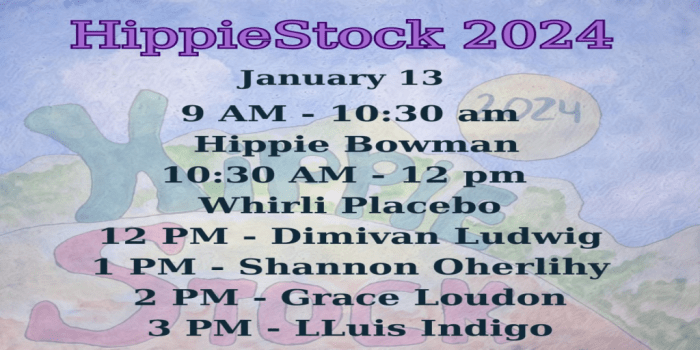
The event kicks-off at 09:00 SLT on Saturday January 13th, with the music line-up as follows:
The Hippiestock 2024 line-up
The venue has been designed to resemble the original Woodstock main stage, with a campground on the hills above it and a exhibition of art in keeping with the 1960s theme and presented by Ceakay Ballyhoo, who is also responsible for the overall build for the event.
So for some great music and the chance to peace out for the day, why not slip into something suitably flowing and emblematic of the period, put some flowers in your hair and join the fun?
Second Life History at the Primitive Museum campus
When it comes to the history of Second Life, there are many who may claim to hold some of the facts and figures and legends and tales. However, were the truth to be told, there is really only one person who has spent years carefully building what is perhaps the most complete history of Second Life’s long and growing history, and then synthesising it down in a manner that can be easily digested and appreciated: Sniper Siemens.
For the last decade (or more!) Sniper has been gathering, compiling and curating information representing as much of Second Life’s history as possible. Since 2014, this information has been displayed by Sniper in a series of installation at events and venues across the grid. I personally first encountered it that year, when it was hosted by the Linden Endowment for the Arts (LEA), and have also covered several iterations of the History since then over the years. So when Sniper IM’d me to tell me the History has a new (and hopefully permanent!) home, I knew I’d have to make sure it went to the top of my list of places to visit!
Second Life History, ground floor
This new home is on land graciously provided to Sniper by Xerses Goff , creator and curator of the Primitive Museum, of which the History now forms a part, sitting as it does within the campus alongside the Learning Lighthouse (itself part of SL’s history although currently being refurbished by Xerses) and just across the water from the original Primitive Museum (with the two connected by shuttle pod). In fact, the campus is an ideal location for the History, being located in Sansara’s historic Old World regions, and the hub of a developing educational project Xerses is bringing together.
For those unfamiliar with the Old World, it is the name given to what are many of SL’s earliest / original regions, including Da Boom. Also to be found within it are Rosedale, Kapor (for Mitch Kapor, the founding investor in Linden Lab), Omidyar with its eye-in-hand craved onto the seabed, and more besides. Similarly, a number of historic and important centres are also awaiting discovery / visit here – such as the Ivory Tower of Primitives, where many first learned (and continue to learn) the magical pleasure of shaping and trimming prims and then gluing them together.
Second Life History: the Beta Test monument
The History actually starts outside its main building, where a small garden acts as the landing point. Here can be found a number of artefacts, together with introductory boards easing visitors through the doors of the main building. It is flanked on one side by the dock where shuttles across the water can be obtained, and on the other by a large plaza presenting images, information and landmark givers for some of the historic locations around SL which remain available to this day for visits by the interested / curious.
Within the garden, Sniper offers a dip into a little of SL lore, providing the story behind the platform’s association with hippos. More lore (some of it perhaps known by many, perhaps new to others) can be found just inside the main building’s entrance, where boards provide short histories behind terms such as Land Baron, Prim Hogging and more, whilst revealing the history of Linden Bears and why those who have been in Second Life a very long time might still be awaiting receipt of their mule (does a pony really compensate?), the origins on Linden Bears and more.
Second Life History: the platform’s foray into streaming via OnLive’s SL Go
From the entrance, the history unfolds year-by-year as visitors travel around the building’s halls, with information imparted via written boards supported by images and interactive elements (be sure to mouse-over the different displays to see which might be clickable!). And in case you’re a veteran of past iterations of the History and so are tempted to hurry through the “early years” because you’ve seen it before – don’t! There are elements and information which are new to the History, and again the result of Sniper’s tireless investigations and research.
In all, the ground level of the History takes you from 1999 and The Rig, through LindenWorld to Second Life as it was in mid-2009. A teleport at the end of the level’s walk carry visitors up to the next floor, where 2009 continues before passing on to 2010 and the years through to 2021. Above this, 2022 and 2023 await, with the rest of the floor ready to be populated as 2024 unfolds.
Second Life History: the Burning Life / Burn 2 rooftop terrace
Throughout all of it, Sniper presents a rich and engaging mix of SL’s history, covering technical developments and innovations (server updates, viewer changes, capabilities from mesh to PBR, etc.,), through to many more of the legends and general history of the platform, together with looks at the (sometimes confrontational) relationship between residents and Lab; recalls some of those most notable for their impact on Second Life – Linden Lab personnel and residents alike; and remembers various notable communities and events. Each display area is carefully separated from its neighbours, allowing each to be focused upon without distraction, while the use of visual media is exceptionally well-considered and balanced throughout.
As well as the history of Second Life, the History building also presents a celebration of the Burning Life / Burn 2 celebrations held in-world in reflection of the annual Burning Man event held in the western United States – just take the teleport from the upper level of the History to the rooftop terrace to tour it. Plus, for those seeking more Second Life history, there is the Primitive Museum Teleport Trail, a trip through 25+ historical places across Second Life. Just look for the historic landmark sign to the front right of the History building, between it and the Learning Lighthouse.
Second Life History: marking the introduction of Senra in 2023
For history enthusiasts and / or those curious about the platform in which we spend so much of our time and how it got to be what it is, Second Life History is an invaluable visit / resource. Kudos to Sniper for the many years spent gathering and curating the information it contains, and thanks to Xerses for providing the land on which it can be hosted.
As I noted in my January 9th Simulator User Group notes, Linden Lab is in the process of moving Second Life away from using Atlassian’s Jira for bug reporting / tracking and filing feature requests, and on January 12th, this was confirmed in the first of a series of official blog posts on the transition.
The decision to move away from Jira is due to Atlassian changing their licensing model; traditionally, Linden Lab has been able to offer Jira on an unlimited basis to all SL users, leveraging the Atlassian Jira Server licence. That licence is being discontinued by Atlassian, making it fiscally impossible for Linden Lab to pay the licence fees associated with its many thousands of individual users who regularly access Jira. Therefore, a move to an alternate platform or platforms is required.
This being the case, going forward Jira will be replaced by what has been called a two-pronged approach to issue reporting and feature requests:
Github will form the new back-end for tracking and managing issues and requests (and is already being used for this purpose by LL), with all current Jira issues being migrated to it. In addition, technical users (such as TPV viewer developers, open-source contributors, etc.) who have accounts with Github, will be able to file ticket through it as well.
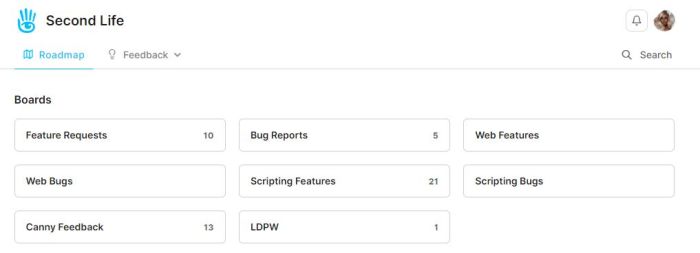
More generally, a new front-end feedback portal has been created for filing bug reports and feature requests by users at large.
Second Life Feedback Portal – current bug report form (l) and list of current bugs with search filters (top)
The latter is powered by Canny customer feedback software and tools. It was selected for a number of reasons, as the Lab note in their official blog post, not the least of which is the fact that Canny offers integration with Github, allowing requests and issues raised within it to be imported into the Github repositories (removing the need for cloning issues as is currently the case with Jira), combined with an improved set of triage tools. Other advantages with Canny are given as:
The ability to log-into the Canny tracking system via a user’s Second Life log-in credentials (as is the case with Jira now), thus maintaining its convenience of access / use.
Simpler forms for bug reports and feature requests, which may encourage more users to file issues / ideas.
Clearer navigation for non-technical users, making finding issues, etc., easier.
The use of multiple Boards to help categorise submissions and information.
Canny boards make navigation to specific subject areas – bug reports, feature requests, et. – easier
The ability to view a roadmap of activities and priorities.
Other advantages as noted by the Lab can be found in the official blog post.
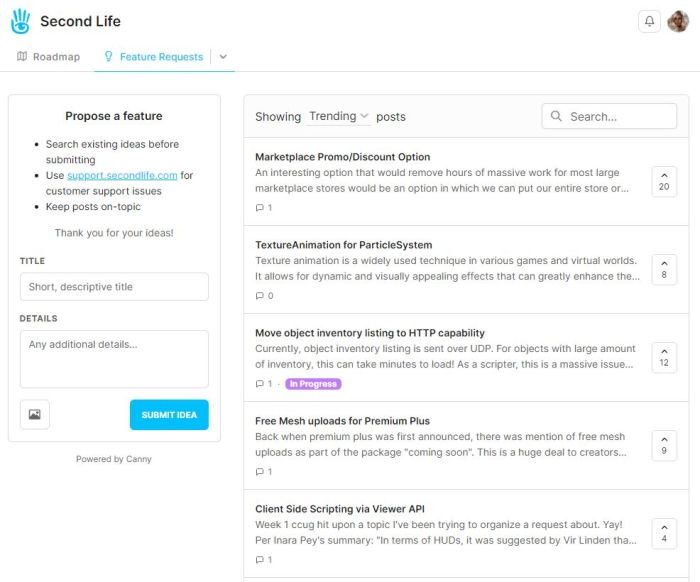
The system has been undergoing testing, which has involved selected users, and feedback on it has been provided – although not all of it is particularly favourable. Some of the issued raised (such as the lack of file format options for attachments with only jpg, png, gif and webp supported) are understandable, particularly given these are unlikely to change in the near-future (if at all); others might simply be the result of a natural reluctance to enforced change. In this respect, the Lab is at pains to note that Canny is not a one-to-one replacement for Jira, and will require changes to established behaviours; how people adapt to this in practice is only something time will demonstrate.
Second Life Feedback Portal – current feature request form (l) and list of open requests with search filters (top)
The switch-over to Canny / Github will now be rapid (by SL standards). The new Jira licensing is due to come into force in March 2024, and so the Lab has published the following timeframe for the transition away from it:
December 2023: generate a full archive of Jira and maintain until shutdown.
December 2023 / January 2024: migrate Jira reports to Github repositories. Soft launch of Canny and accept tickets via both Canny and Jira.
February 2024: provide information on accessing the Jira archive; shutdown Jira access and complete switch to Canny / Github.
Finally, as noted in the official blog post – these changes do not impact general Support / personal issues. These should still be reported to support.secondlife.com.
For my part, I have previously – with the Lab’s help – provided tutorials on filing both bug reports and feature requests. The not As the Canny front-end for filing either is considerably more straight-froward to use (and / or may be further enhanced based on user feedback), I will a) be disabling access to the Jira tutorials on this blog from mid-February; b) may provide a tutorial on using Canny, if this is found to be worthwhile.
Elvion, January 2024 – click any image for full size
January 2024 once more brings with it a further return of the ever-popular work of Bo Zano (BoZanoNL) and his SL/RL partner, Una Zano (UnaMayLi), with the latest iteration of their series of builds produced under their Elvion title. Once more ensconced within a Homestead region, the setting for early 2024 harkens back to some of the earliest designs Bo and Una put together for the enjoyment of SL explorers and photographers, presenting as it does a low-lying setting rich in Nature’s presence.
Designed around a large central body of water, this new iteration of the setting forms something of a circular route around the water, paths and trails meandering gently away from the landing point to the north and south, at times passing under the shade of trees and other over open grassland, turning gently with the flow of the land to pass over the waters either via broad bridges or narrow boardwalks. For the most part the land is flat, the only real “highlands” being a table of rock where water descends from a another large pool of water and into a wide inlet at the northern end of the setting and separated from the waters around which the land forms a broken ring.
Elvion, January 2024
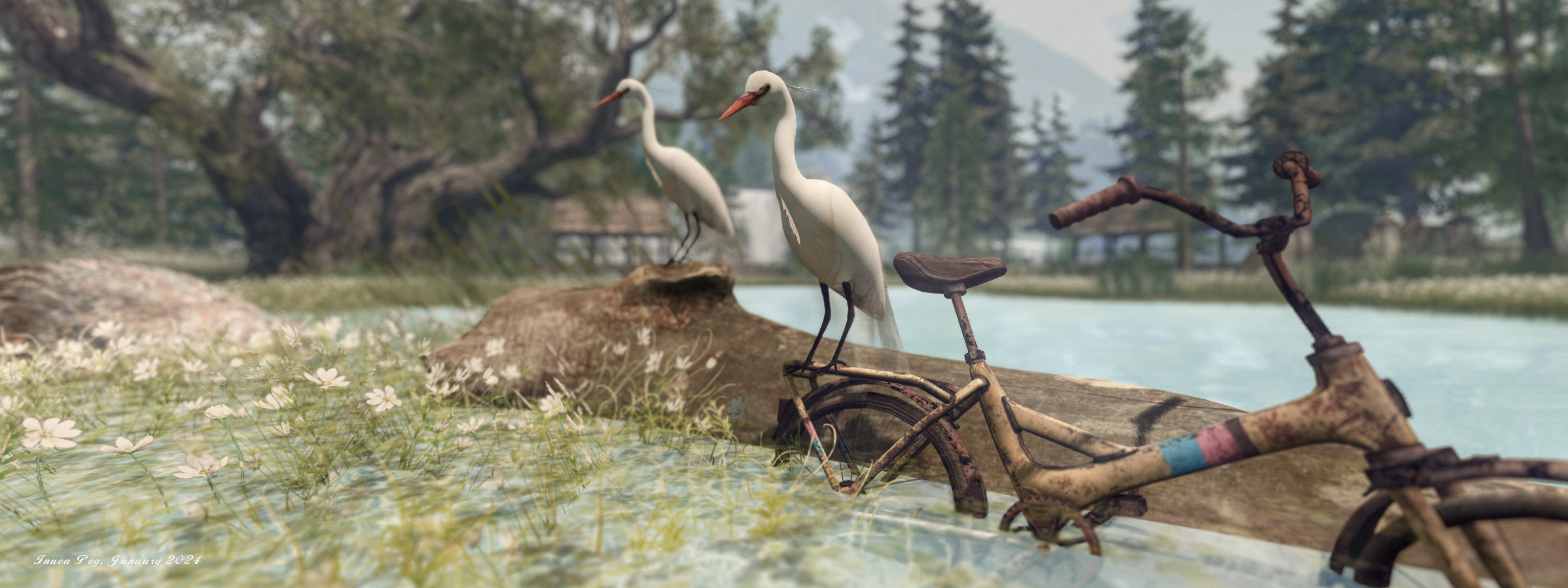
Stone steps make their way up the west side of this plateau, allowing visitors to climb to the top and admire the view – or wade across the shallow water to where a bench might be used to observe the local heron and egrets as they await the passing of an unwary fish or two. However, I’d suggest that viewing this area is best done from close to the edge of the waterfalls; that way, when looking back over the water flowing towards you, it is possible to see how it appears to flow outwards from the off-region slopes and mountain that form a backdrop to the north side of the setting, giving the impression Elvion is part of a much larger landscape.
Nor is this upper pool the only place where waterfowl might be found; both the inlet and the lake within the lowlands are being watched over by heron, pelicans and egrets, as ducks and swans and geese swim on them. Given the presence of the former three, it would appear that the waters here are rich in fishy meals waiting to be caught. A houseboat floating gently among the reeds to one side of the lake might further suggest this; whilst it is now be a cosy little retreat for romantics, its not hard to imagine it once having been a places from which rods may have been cast.
Elvion, January 2024
The houseboat isn’t the only structure waiting to be found; away to the north and east, a refurbished shack sits upon a deck extending over the waters of the inlet; a place where kayaks sit on racks awaiting their owners’ return to take them back out on the peaceful waters. For now, however, it offers a set of places visits can use to sit and pass the time, the walls of the shack neatly separating them around three sides of the deck.
Across the water to the west, is the largest of the setting’s buildings. Its outward face suggests it may once have been a barn; but if that were the case, the large front door openings have long since been altered to form picture windows standing either side of a front door, whilst the inside of the building has been refurbished as little games room, complete with a billiards table, Greedy Greedy game and a corner couch and armchair for quiet chats.
Elvion, January 2024This barn-come-cabin guards the way to the steps leading up to the top of the waterfalls, but it is not the only guardian here; just offshore a lighthouse sits as a sentinel atop a thumb-tip of rock rising from the sea, the carcass of a wreck boat in the waters between it and the shore indicating the purpose it serve is warning vessels away from the shallows.
The last of the structures within the landscape is to be found a stone’s throw from the boardwalk linked the old houseboat with the eastern shore of the lake.
Elvion, January 2024
Nestled with its back to one of the two large, mixed copses of trees occupying the land, and faced on three sides by an aging wood fence with old stone cobbles Nature is slowly reclaiming lying between them and its front entrance, it is another building which has been refurbished. Once a wrought-iron and glass greenhouse, it now forms a bath-house complete with a cast iron tub over which a shower rises, its piping solid enough to support a ring from which curtains might be drawn around the tub to prevent the water from the showerhead spreading too far across the floor.
Whichever way you opt to wander from the west side landing point, it is clear that this iteration of Elvion is intended to calm and relax. There is an easy-going, unhurried look and feel to it, aided by the gentle flow of water and the wheeling of geese on the wing overhead which simply encourages gentle meandering, whichever path one opts to follow. This is further enhanced by the many places tucked away on either side of the trails to encourage folk to just sit and let the time pass unhindered, while the local horses do their part in offering further opportunities for photographers to frame their shots – or for the more artistically inclined, an easel and tricycle-cart laden with paints await.
Elvion, January 2024
Rounded-out with touches here and there which might remind those who have previously visited Elvion of those past designs, this is genuinely a natural and evocative setting, clearly designed with love for nature and open spaces. As always with Una and Bo’s builds, it offers a warm welcome and offers multiple opportunities for photography under both the default environment and many others – I use a number within the pictures offered here as evidence.
As always, Elvion is a highly recommended place to visit.