Logos representative only and should not be seen as an endorsement / preference / recommendation
Updates from the week through to Sunday, July 2nd, 2023
This summary is generally published every Monday, and is a list of SL viewer / client releases (official and TPV) made during the previous week. When reading it, please note:
It is based on my Current Viewer Releases Page, a list of all Second Life viewers and clients that are in popular use (and of which I am aware), and which are recognised as adhering to the TPV Policy. This page includes comprehensive links to download pages, blog notes, release notes, etc., as well as links to any / all reviews of specific viewers / clients made within this blog.
By its nature, this summary presented here will always be in arrears, please refer to the Current Viewer Release Page for more up-to-date information.
Note that for purposes of length, TPV test viewers, preview / beta viewers / nightly builds are generally not recorded in these summaries.
Official LL Viewers
Release viewer: Maintenance S RC viewer, version 6.6.12.579987, dated May 11, promoted May 16.
Kondor Art Centre: Janus Falls – Auguries of Innocence
Having opened on June 29th, 2023 at the main gallery area of the Kondor Art Centre operated and curated by Hermes Kondor, is an evocative and provocative exhibition by UK-based Janus Fall.
Combining classical poetry, digital images, global current affairs, the increasing dichotomies of society, and reflections on human nature, Auguries of Innocence is a visual essay of juxtapositions and contrasts offered as commentary on the current downward spiral of intolerant, insensitive, judgemental otherism (of others) and denial (of others and also of things like our impact on matter of climate change, etc.) which is too quickly becoming the accepted state of being within large portions of modern societies (particularly those known for their previously more liberal lean), when we really should by now know better.
Kondor Art Centre: Janus Falls – Auguries of Innocence
The exhibition takes its title from the 132-line, single stanza poem of the same name by William Blake. Like much of Blake’s work, the poem did not gain recognition until well after his death in 1827; in fact, despite being written in the early 1800s and going to be frequently quoted (particularly the opening four lines), it didn’t actually see the light of publication until the late 1860s.
In content, the poem might be seen as a plea by the poet for humanity to do better, lest we lose all we have been given under the judgement of God. In this it contrasts the cycle of nature, wherein the world is constant reborn and remade, all the time growing in both nurturing innocence and experience / interconnectedness, with the cycle of humanity, in which we are born into that same innocence of nature, only to push it aside as we grow into adulthood, replacing it with self-serving corruption and inhumanity towards others and nature.
However, the poem is not only notable for its content, but also in its structure, which is as intentionally complex as the subject matter it contains. Throughout its length, Blake frequently switches both rhyming schemes (e.g. alternative rhyme to rhyming couplets) whilst mixing different forms of meter (e.g. trochee and anapest) with the predominant iambic meter, whilst also using a range of literally tools such as alliteration, repetition, metaphor and – most notably – juxtaposition and paradox.
Kondor Art Centre: Janus Falls – Auguries of Innocence
Within this structure, the opening four lines act as both an overall introduction to the poem’s concepts and also offer guidance on how the imagery within the rest of the poem should be interpreted. Within Janus’ exhibition, those four lines perform something of the same purpose; working with a diary extract written by a 16-year-old girl seeking to escape the war engulfing her country, they offer both an introduction to the images presented within this exhibition and give context in how they should be viewed both cognitively and physically. In terms of the physical, they – and the extract from the diary – are to be found on the left front wall of the gallery as you enter it, to form a potential starting point for viewing the mages, encouraging visitors to progress from there and around the lower floor to the stairs and the upper level, thence back down to complete the circuit and finishing at the artist’s final notes and Memorial to a Woman in a Field.
The images are striking, Janus reflecting the diversity of styles and techniques Blake uses within his poem within each of her images. Where he uses metaphor, alliteration and simile, she uses technical and artistic approaches such as motion blur, superimposition and Chiaroscuro. However, most strikingly, Janus matches Blake’s use of juxtaposition within her images, most notably through the placement of the natural beauty of the women in her images against their backdrop. Whether drawn from images initially captured in Second Life or the result of digital manipulation of images produced outside of SL (and possibly using AI toolsets?) matters not.
Kondor Art Centre: Janus Falls – Auguries of Innocence
There is so much to unpack in these pieces, that it is possible to end up writing a treatise. The aforementioned Memorial to a Woman in a Field for example, offers so much to consider, from the manner in which it presents what should be harmony between people and humanity and nature, through to the way it offers a subtle reflection of Blake’s deeply held Christian beliefs whilst rejecting the constructs of organised religion for the manner in which it encourages the corruption of self through the promotion of judgemental intolerance and denial of anyone who can be branded as “others” – something which we can still see only too well within modern society.
However, rather than ramble on, I think Janus herself does more than enough to present her work as it should be seen and understood. Certainly, Auguries of Innocence does much to offer a questioning challenge to us, one with which Blake himself would doubtless agree: given it is now over 200 years since he wrote the opening lines of his poem, isn’t it about time we finally started putting aside self-centred and social indifference / cruelty to one another and tried to be better, both for the benefit of others and the world as a whole?
On Friday, June 30th, 2023 saw the fourth in a series of Lab Gab special events take place for the SL20 Birthday celebrations, featuring featuring Patch Linden and the Moles of the Linden Department of Public Works (LDPW).
Unlike the other summaries in this series, this article focuses on the work of the Moles and the projects they are currently working on and which have recently been launched or will be launched in the near future. Broader questions on individual interests, hopes for the future of SL, subjects (such as the SL20B Sweepstakes) covered in more depth in other Sl20B Lab Gab sessions are not included below. As always, timestamps to the video are included within each topic / sub-topic, allowing comments made to be heard in full.
Short interviews with a number of the Moles covering what they do and how they became members of the LDPW team. These discussions fold-in to them some of the points below.
Who or What are the Moles?
Officially called the Linden Department of Public Works (LDPW), originally formed in 2008, Moles are residents from all over the world hired by Linden Lab as independent resident-contractors to undertake Lab-led projects.
Their work was originally focused on the Mainland, adding the infrastructure – road, bridges, etc., and the landscaping, as noted in the official LDPW wiki page, although they actually do a lot more than this.
Notable major projects carried out by the Moles include:
Development of residential centres such as Nautilus City and Bay City and Bellisseria; development of the Lab’s various games accessible through the Portal Parks.
Involvement in special development projects for both Second Life (e.g. Bento, Animesh, EEP, PBR), and partnership developments (e.g. Zenescope and Motown Experience), that latter under the banner of Second Life Studios.
In keeping with their name, Moles were originally given a mole avatar, complete with hard hat. However, over the years, most have moved to having a more individual and personal look, although some say with their Mole look.
As well as being paid for the work they do, Moles also receive and allowance from the Lab, which is primarily intended to go towards the cost of uploads (texture, animations, mesh objects, etc)., but which can also be put towards developing their individual looks.
How to Become a Mole
Positions in the LDPW are open to application by residents who believe they are qualified to work in the team, and the team may also approach specific residents and ask if they would consider joining them.
Applications are made by dropping a résumé (note card or email) of qualifications / experience (including links SLurls, Flickr, You Tube, etc.) to Derrick Linden (derrick.linden-at-lindenlab.com) or to Patch Linden (patch.linden-at-lindenlab.com).
Applicants have to go through a former interview process.
Successful applicants get to pretty much choose their hours of work – providing agreed tasks are completed on time.
As they are from around the world, this can allow some projects to move forward on almost a round-the-clock basis.
Those who are more fully-rounded in skill sets – content creation, scripting, etc., – are encouraged to apply, but LL will also take on specialists.
Motivated, outgoing, communicative people with a passion for SL and willing to self-teach themselves new skill sets are particularly considered.
Planning for SL20B started during SL19B, commencing with a review of what worked / didn’t work at SL19B, and initial discussions on the 20th anniversary theme.
The initial planning process for the theme (/build aesthetic) and size of the event took around 3-4 months.
The size of the event means there are 321 exhibits – many of them interactive -, compared to 150 just five years ago. The increase in event space has meant some exhibit parcels (around 100) could be offered at 4096 sq m.
The focus for the last few SLB events has been not only to encourage people to share in the theme, but to present exhibits that reflect their passions / interests: art, music, community activities, etc.
SL20B is also the first SLB event to include the Adult community (also at the Shop and Hop as well). To achieve this, there was a lot of direct canvassing / encouraging of Adult communities to come and participate, rather than just leaving it to people to apply. As well as the Adult region exhibits, there have also been events hosted on them.
Discussions within the LDPW team are already in progress to discuss how the Adult presence can be grown in future SLB events, including the possibility of having an “official” event stage within the Adult regions.
Patch Linden:
Given it is the 20th anniversary, the decision was decided to refresh some of the “core” SLB builds (such as the Tapestry of Time) and also the Shop and Hop regions to be more in keeping with the event theme and also to offer fresher designs for future events.
The New Shop and Hop region design will be retained and “themed up” for future events.
Dreaming Mole:
The concept of the Welcome Area was to present a setting which reflects both the theme of the event and suggests important factors for the future – sustainability, etc., whilst also acting as a natural information hub and viewing area.
The landing point was placed so that people would see the structure before them and be encouraged to walk towards it, along the Community Gallery Walkway.
The overall inspiration for the build was modern architecture and the work of architects such as Oscar Niemeyer.
Senra is the brand name giving to the upcoming new Bento / Bakes on Mesh complaint starter / new avatar series specifically developed via the Moles as a Lab project, and which were initially previewed at SL19B in 2022.
Come with a complete set of accessories: hair, skins, clothing, attachments, shoes, etc. All of which will be presented as a full library of content within the viewer (as a part of the overall Library).
The first phase of the release will feature two human avatars + accessories, etc., referred to as Jamie (female) and Blake (male).
The second phase of work has already started and will include anthro, allowing Senra to cross over into “other areas.”
The launch is provisionally targeting middle-to-late-July.
Prior to the launch, effort will be made to get the developer’s kit (devkit – covering clothing, accessories, skins, etc.) and licensing agreement made available to SL content creators who wish to develop content and sell it into the Senra ecosystem.
Screen caps of the Senra Jamie and Blake avatars. Note: as these are screen caps (as I was unable to be in-world for the session), noassumption as to the overall quality / looks of the Senra avatars should be assumed on the basis of these images
Initially grew out of a need to have somewhere to demo the Liden Home themes and styles for those wishing to “try before they buy” a Premium / Premium Plus account.
The grew into an idea to also provide further information on Bellisseria and from there grew into a complete Welcome Hub for new users.
However, the primary focus is to provide information on Bellisseria for existing resident and give insight into Premium Subscriptions via an in-world means.
BelliHub: Linden Homes demo area at the BelliHub
As they were in development at the same time, some of the work put into the BelliHub Welcome Area was used to inform the design within the the Welcome Centre at the new Welcome Hub.
The Welcome Hub with its nine regions is designed to provide a more complete experience for incoming new users, which in part came off the back of the fact that many people coming into SL will go through the older Welcome and Social islands and think that that was all there is to SL, and leave.
So the Hub is intended to both introduce new users to both the viewer and using an avatar and to encourage them to understand there is much more to discover about Second Life and the events and activities which take place in SL, while at the same time not locking them into a specific path or hierarchy of things they have to go through in order to better understand SL.
The above is very much assisted through the presence of mentors and the video and general info boards they can opt to use or skip over, depending on their knowledge and abilities.
The only really “key lessons” within the Welcome Centre of the Hub are moving, talking, and interacting with objects. The rest is intentionally free-form.
[Video: 50:23-51:00] The overall design of the Welcome Hub is intended to be modular in that options, features, areas, can be swapped in / out with others, and the overdesign expanded, etc., as required.
A question was asked about refreshing Mainland terrain textures. There is an off-shot of the current PBR Materials project to allow such materials to be applied to SL, and – with noted caution about ensuring consistency of appearance, etc., – this will include Mainland. Details of the PBT project and the terrain project can be found in my CCUG summaries; also see this official sneak peek. Image credit: Linden Lab
Who is Magellan Linden?
Magellan Linden is The Great Explorer of Second Life (who was once said to have vanished during his explorations, but does pop-up from time-to-time) is a construct, rather than an individual, but as revealed in the session, Abnor Mole loans his voice to Magellan!
Natthimmel, July 2023 – click any image for full size
It was back to the Homestead region of Natthimmel, held by Saskia Rieko to witness the latest design by her SL partner Konrad (Kaiju Kohime) after seeing a tweet by Laskya Claren (who also assisted with the notecard introduction to the build). To be honest, it’s a setting that would have attracted my interest, but Laskya’s tweet helped me to note it sooner rather than later, given it is by Konrad and Saskia – who are establishing a solid reputation for region designs representative of physical world locations (for example, see: A Night Sky with a touch of history in Second Life) – and the fact that for this particular build they mix three of my non-SL interests: astronomy, theoretical space science and science-fiction as the springboard for the imagination. However, Laskya’s tweet was timely in that it pushed me towards visiting sooner rather than later.
The astronomy comes from the use of the Gliese 581 system as a inspiration for the build and its associated story. This is a dwarf star (M spectral type) located some 20.5 light-years from our own solar system, and which in 2005 was discovered to have one of the smallest extrasolar planets ever found orbiting it. Called Gliese 581b (the “b” indicating it to be the first planet known to be orbiting the star, whilst “Gliese” referencing the 1957 catalogue in which the star was record – even though it has been observed well before that year). It is actually one of three planets currently known to be orbiting the tiny star, with three other potential planets – Gliese 581d, Gliese 581f and Gliese 581g – thought to have been discovered later proving to be the result of stellar upsets within the star affecting the instruments on Earth attempting to locate exoplanets around it.
Natthimmel, July 2023
From these fact, the region spins off a story of the future discovery of artefacts on the outermost of the three Gliese 581 planets, Gliese 581e (as all the planets in the system are tidally locked with their parent star, always keep the same face towards it, the observed artefacts could not be surface features moving as a result of Gliese 581e’s axial rotation). This discovery leads to a crewed mission to the system aboard the UESS Rocinante, thus bringing in the first sci-fi reference, the Rocinante being the hero ship from The Expanse series of novels and stories by “James S. A. Corey” and the associated TV series (as well as also being a classic literary reference to adventures, Rocinante also being the name of Don Quixote’s horse).
A second sci-fi reference also lies in the text with the reference to ansible communications – a term first coined (and subsequently built upon) by Ursula le Guin, and used by many sci-fi authors, including Orson Scott Card. It is also in the notecard that the reference to theoretical space science appears, the Rocinante using an Alcubierre Drive for interstellar propulsion.
Natthimmel, July 2023
This introductory notecard actually serves as a mini short story in is own right, rather than just and introduction to the setting. In doing so, it sets up the imagination, offering a framework by which we might – if we so choose – explore the setting: what actually happened aboard the Rocinante? Were the note affects on the crew the result of the indicated damage to the drive system or something else? What caused the vessel to crash on the planet? Systems failure? Human error? Deliberate malfeasance by a member of the crew? Were the logged reports of alien creatures the result of genuine sightings or further hallucinations?
Thus, visitors can opt to put themselves in the role of the recommended salvage / rescue mission; or, if preferred, as members of the Rocinante’s crew encountering this strange world on which they have been cast – be it Gliese 581e or somewhere deep within a rip in the fabric of space/time brought about by the failure in their drive system. Or, if preferred, visitors can simply use the eerie, other-worldly environment for photography; there are no rules here in that respect. However, one thing I would recommend is to visit using the local environment settings (World → Environment → Use Shared Environment) and with the viewer’s Advanced Lighting Model enabled (Preferences → Graphics → make sure Advanced Lighting Model is checked – no need to enable shadows).
Natthimmel, July 2023
A different but engaging location which, whilst entirely imaginary, nevertheless folds into it some nice touches of science fact and theory wrapped into an engaging visit.
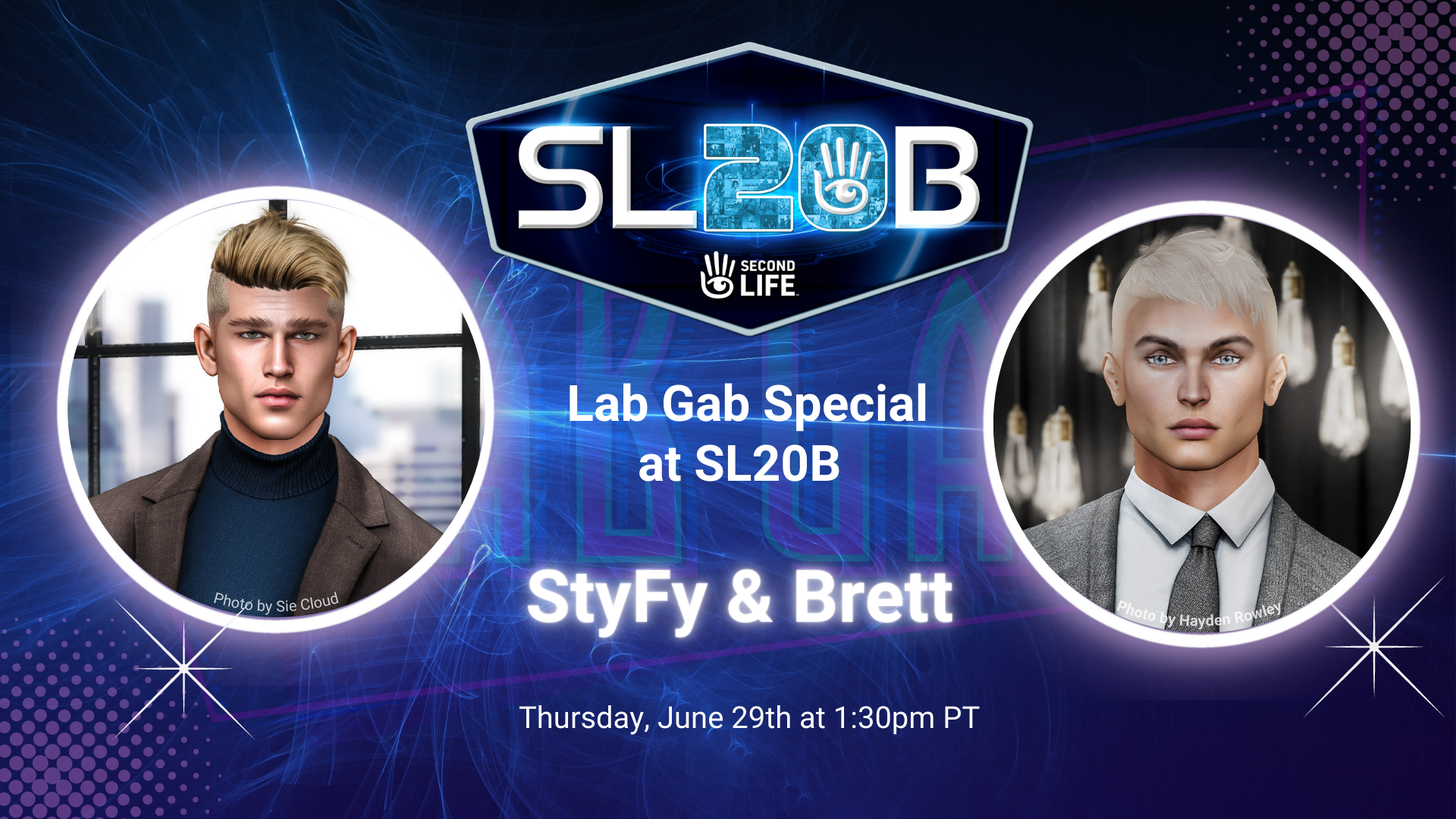
Thursday, June 29th, 2023 saw the fourth in a series of Lab Gab special events take place for the SL20 Birthday celebrations, featuring Brett Linden, the Lab’s Vice President of Marketing, and the company’s Chief Marketing Officer, StyFy Linden.
The following is a summary of the session covering the core topics raised. The full video is located at the end of this article.
Please note:
The session was built around questions submitted in advance of the session.
This is a summary, not a full transcript, and the focus is on those questions which offer insight into the world of the Marketing Team.
Timestamps are included against the topics discussed, so that those who wish can listen to the responses in full.
A Little Background
Brett Linden
As VP of marketing, Brett Linden manages the team responsible for developing media campaigns and strategic content partnerships for Second Life.
Has more then 2 decades of marketing and journalism experience, and has been at the Lab for 16 years.
In the past decade, he has produced numerous virtual and “mixed reality” events and panels on various academic topics with an emphasis on legitimising and better surfacing the many cultures and communities within virtual environments.
From Rolling Stone to Billboard, Brett has also written for major publications and managed multimedia initiatives for Amazon.com and RealNetworks. As a co-founding editor at Billboard.com, he interviewed Stevie Wonder, David Bowie, Peter Gabriel, Shania Twain, and Bjork.
Was drawn to Second Life after trying the platform during its first burst of media exposure in 2006 – specifically trying to find the CNN and Reuters bureaux that were active in SL at that time.
At the same time, he received a grant from the McCormick Foundation to run the Virtual Journalism Summit, some of which took place in-world, allowing him to meet Philip Rosedale.
He moved from being a resident to being a Linden in 2007.
He is as fascinated and intrigued – and sometimes frustrated – but always illuminated by the platform, the residents, the diversity of use and creativity, etc., today, as he was when he started.
StyFy Linden
Has been with Linden Lab for 18 months.
Has a broad background in marketing, including client marketing, retail marketing and running marketing agencies, and has also working within some major technology companies.
States that throughout his career, he’s never had as much fun as he is having at Linden Lab.
It has benefitted SL. In 2022,there were some major corporations sucking up a lot of the media’s interest in the “metaverse”.
However, the fact that SL has hit 20 years of open public access at a time when others have really been “flash in the pan” announcements around the “metaverse”, allowing SL to be positioned at the “gold standard” of virtual worlds.
Believes this is being reflected in the kind of press coverage the platform has recently received, and the fact that LL is no longer one “of six” calls reporters might make when writing about virtual worlds – they are the “only” call being made.
Work is understand to update / refresh the SL web properties; thew Destination Guide has received a major refresh, with more work to come [see below].
Notes that the community within Second Life does a lot to help keep SL fresh through content creation, building destinations and experiences, etc., and with their on photography.
The Marketing Team as a whole is expanding with new talent.
All of this is feeding back into the overall media / press interest in Second Life.
Believes that SL Mobile, once available, will offer further interest in SL.
StyFy Linden:
Time has been put into formalising they way in which feedback can be obtained from existing and new Second life users and communities within SL, and even potential SL users.
This is being used to help drive some of the ideas the Marketing Team and others within LL have in moving the platform forward, developing new initiatives, etc.
Marketing is being looked at more broadly; not just as a pipeline to draw new users into Second life, but also how it can be used to assist users during their journey through Second Life: how can Marketing help new users get acclimated to SL; how can Marketing help users to connect with one another; etc.
So the thinking is not longer siloed towards a single goal, but more broadly spread to benefit both the platform and users as a whole.
Brett Linden:
People thinking of Marketing in terms of acquisition only, but the involvement can be broader, as demonstrated with the new Welcome Hub, in which Marketing have played a significant role in helping define how they can help users beyond the pure acquisition stage of their experience with SL.
Very much sees helping to get users to “stick” with Second Life, from having a very good, comfortable initial exposure to the platform onwards, is something in which Marketing can offer considerable expertise.
Can understand why there are misconceptions, as users are not sitting side-by-side with the Marketing team.
Many misconceptions tend to be the result of people’s focus. For example, if they see SL paid ads, they assume the Marketing Team only does paid ads.
The overall strategy is far broader – wrapping into the Public Relations (including the use of an external company), the involvement in user acquisition and retention, etc.
Would also point out that Marketing is only one team within SL. They work extremely closely with Product and Product operations in particular, but this is sometimes misconstrued by users as to which team is doing what; sometimes Marketing will be operating in support of initiatives led by the other teams, sometimes they will actually be leading initiatives which may be perceived as being run by other teams.
StyFy Linden:
Would say the biggest misconception about Marketing is that “all” they do is form pipeline to acquire new users through mechanisms like paid ads, etc.
Marketing touches on many parts of Second life and LL in many different ways, from providing imput through to actively providing solutions for given requirements, and involved across the “entire resident journey”.
Strawberry Linden (as Social Media Manager at LL):
Main goal is to feature as much of the community as possible.
Spreading SL’s presence to multiple social media platforms, as has been the case with TikTok.
StyFy Linden:
Looking to add depth to SL’s current social media presence, particularly where new channels are opening up (as with TikTok, seen as particularly important due to the broadness of its user base).
Brett Linden:
Feels that the social media strategy is an excellent means to celebrate and promotion what the Second Life user community is doing.
Appreciates the ways in which users themselves are using social media to tell their own stories vis Second Life.
In terms of the future, feels video will play more of an important role for SL, giving the growth of platforms like TikTok and Kik.
User Created Content and Its Use in Marketing Campaigns
User created content is one of the biggest opportunities Market has thanks to its richness.
Sees the content available within SL as a cornerstone of those aspects of Marketing’s work geared towards user acquisition.
Would like to have specific feedback / ideas from the community on what Marketing can do to leverage the diversity of content within Second Life to help bring users into the platform / help communities within SL attract new users from beyond the platform.
Brett Linden:
There is a general e-mail address at the Lab which is monitored by Marketing and others to which users can submit general feedback and ideas [not feature request or bug reports – please use the Jira for those!] – feedback-at-lindenlab.com.
Would emphasise that the community is “at the core and heart of all that we do”.
The New Welcome / Community Hub: Goal and Continuing Development
The new hub is very much a “version 1” of the concept. As such it is an experiment, and the Lab is learning from it. As such it will be improved and iterated upon.
It particularly presents an opportunity to observe new users throughout their on-boarding to the platform and through their initial exposure to the world and other users, and take lessons from what is seen over time.
The work is critically important to the overall idea of bringing people into SL and to helping them engage with the platform and thus help ensure its continued longevity.
Notes that there are already community gateways which tackle the new user experience, and sees the Welcome Hub idea as augmenting the work they do.
In terms of strategy, the use of mentors and leaders within the Hub environment is as important as the environment itself, given they provide a friendly, helpful face to SL as new users come it.
StyFy Linden:
Would note that a lot of what is available within the Hub’s regions really flowed out from talking with incoming users about their experience, why / how they are encouraged to stay engaged with SL, who helped them and how, etc.
As with the press, SL was one of a number of “metaverse” platforms brands were looking to engage with in 2022. Now SL is part of a “much, much shorter list” of platforms brands are interested in.
This means SL is attracting a lot of interest; however, LL do not engage with entities simply for the same of creating a partnership; the focus is on partnerships that will add to Second Life and the in-world experience of users.
Because of this, it is likely there will be more partnerships similar to Motown – which itself will be expanded upon – in the future.
Elements of the refresh – such as the additional of search capabilities on the web version – are the direct result of feedback from users on the older Destination Guide look.
Future updates will include “population counts” (i.e. avatars actually within a location); the ability to bookmark / favourite locations, etc.
The architecture for the Destination Guide is actually complex: the version in the viewer isn’t simply the web version presented through the viewer, it is its own entity, driven by the same engine, and DG data touches on things like the official viewer message of the day, the map system, etc.
No timeline on when additional features will be surfaced, but the Destination Guide is “on our roadmap for the next 6 months, let’s say”.
Strategies for Attracting New Users and Content Creators / Artists
Content creation is such a core part of SL, that considering how to engage with the next generation of content creators and bring them in to SL is very much part of the Marketing focus.
Some of the ideas being discussed are “in-world apprenticeships” and partnerships with colleges and universities to help guide students into SL [through, presumably, art and content creation].
Hopefully more of these ideas will be fleshed out throughout the rest of 2023.
Great for 30+ age range. The challenge is 18-29-year-olds.
Feels that reaching this 18-29 demographic is not unique to SL; virtual worlds in general appear to have the same problem.
Time has been spent exploring the challenges involved in reaching this demographic and in looking at the channels through which they can be reached (e.g. TikTok).
There is also a working group “within SL” focus on the subject of growing the user base.
Hopes the platform continues to innovate and expand.
Would love the see SL continue to foster the development and evolution of on-line cultures whilst also scaling to greater numbers of concurrent users and also becoming more broadly available through Mobile.
Most of all hopes SL will continue to be known as a welcoming, creative space that is really honouring and respectful of freedom of expression and people’s individuality.
StyFy Linden:
The power of SL is its users and their creativity, and hopes that remains the cornerstone of what the platform is.
Hope people engage with the platform and how LL will engage with them will obviously change as technology changes, but does not believe what SL is known for is going to change.
Pemberley – May 2023, blog postThe following notes were taken from my audio recording and chat log transcript of the Content Creation User Group (CCUG) meeting held on Thursday, June 15th, 2023 at 13:00 SLT.
These meetings are:
For discussion of work related to content creation in Second Life, including current work, upcoming work, and requests or comments from the community, together with viewer development work.
Usually chaired by Vir Linden, and dates and times can be obtained from the SL Public Calendar.
Conducted in mixed voice and text chat. Participants can use either when making comments or ask or respond to comments, but note that you will need Voice to be enabled to hear responses and comments from the Linden reps and other using it. If you have issues with hearing or following the voice discussions, please inform the Lindens at the meeting.
The following is a summary of the key topics discussed in the meeting, and is not intended to be a full transcript of all points raised.
Viewer News
Maintenance T RC viewer updated to version 6.6.13.580700 on Wednesday, June 28th.
The GLTF viewer updated to version 7.0.0.580717 on Tuesday, June 27th.
The rest of the official viewers currently in the pipeline remain as:
Release viewer: Maintenance S RC viewer, version 6.6.12.579987, dated May 11, promoted May 16.
Project viewers:
Second Life Project Inventory Extensions viewer, version 6.6.13.580656, June 26 see my overview for details.
Emoji project viewer, version 6.6.13.580279, May 30.
Puppetry project viewer, version 6.6.12.579958, May 11.
In addition:
Maintenance T is likely the next RC viewer remains the next in line for promotion to de facto release status.
The Emoji project viewer is liable to see further improvements to the Emoji picker in the UI.
glTF Materials and Reflection Probes
Project Summary
To provide support for PBR materials using the core glTF 2.0 specification Section 3.9 and using mikkTSpace tangents, including the ability to have PBR Materials assets which can be applied to surfaces and also traded / sold.
Substance Painter is also used as a guiding principal for how PBR materials should look in Second Life.
Up to four texture maps are supported for PBR Materials: the base colour (which includes the alpha); normal; metallic / roughness; and emissive, each with independent scaling.
Given the additional texture load, work has been put into improving texture handling within the PBR viewer.
In the near-term, glTF materials assets are materials scenes that don’t have any nodes / geometry, they only have the materials array, and there is only one material in that array.
The overall goal is to provide as much support for the glTF 2.0 specification as possible.
To provide support for reflection probes and cubemap reflections.
The new RC viewer includes the automatic adjustment to make skies “PBR-ified” (so the checkbox in Graphics Preferences to disable automatically apply reflection probe ambience on skies that do not have it set, so they will be set to a default of 1). Probe ambience must now be set to 0 through the sky settings to deactivate HDR rendering (so no dynamic exposure so the sky is not brightened, and objects with PBR materials will appear duller than intended), and tone mapping is turned off.
However, there is a recognised bug related to probe ambience (BUG-234060 “[PBR] Simulator Clamping Environment’s Reflection Probe Ambience to 1”, and it is hoped a fix for this will be in the next simulator build – although it may take a while for the build to make its way into a deployment.
The-user supplied PBR content created on Aditi is being transferred to the PBR regions on the Main grid in readiness for more widespread viewing / testing.
The LDPW will be producing a PBR demonstrator which will be available through the viewer library.
The simulator-side support for glTF Materials is due to be expanded with further simulator RC deployments, which will notably include some sandbox environments.
However, it should be noted that:
Any glTF / PBR materials content created within these environments which is taken and then rezzed in any region that is not Materials-enabled, will become “material-less” in a non-recoverable way, and will need to be recreated.
Because of the above point, until the glTF support is fully gird-wide, any attempts to put PBR-enabled goods on the Marketplace will be sanctioned.
General bug fixing on both the simulator and the viewer is continuing.
PBR Terrain
Materials applied to Second Life terrains. Credit: Linden Lab
Per past meeting notes, Cosmic Linden is prototyping the application of PBR materials on terrain (see this blog post for more).
Further work on bug fixing, including correcting an issue with triplanar mapping to the for terrain repeats, particularly on steep elevation changes (so as to avoid the all-too familiar “stretching” seen with textures).
Important notes with this work:
It is not terrain painting. It is the application of PBR materials – terrain painting is described as “something that’s on the radar” at LL.
The work does not include support for displacement maps.
The work is currently only viewer-side, with no corresponding server-side support, the idea here being to prototype what might be achieved and testing approaches / results.
Level of Detail (LOD) Discussion
Level of detail (LOD) refers to the complexity of a 3D model representation. In short the idea is to reduce the load on the rendering system by reducing the complexity of the 3D object based on various of criteria (e.g. the distance of the object from the viewer / camera) and using various techniques.
Second Life uses the approach of Discrete Levels of Detail (DLOD) method – the use of discrete versions of the original with decreased levels of geometric detail to replace the more complex models using an algorithm primarily based on distance. This has both positives and negatives, some rooted in poor modelling practices by some content creators, others are inherent to flaws within SL itself.
In looking at glTF and mesh imports in the future, LL is considering moving towards more automated and better optimised means of creating LODs to try to reduce some of the current issues.
One idea under consideration to achieve this is to leverage Simplygon (or see the Wikipedia entry), which although a proprietary tool, is available as a plug-in for a number of 3D modelling towards (including Blender); the idea being the glTF importer consume whatever output is generated by Simplygon at the creator’s end of the workflow (it being noted that “simply” integrating Simplygon into SL isn’t feasible).
Such an approach would offer advantages of optimisation whilst leaving the current upload process in place for those wishing to continue to use it, together with the continued ability to manually create LODs.
Some concerns over this possible approach raised at the meeting were:
It does not address issues of avatar complexity, which is potentially the biggest viewer performance hit – although in fairness, avatar complexity is really an issue requiring its own focus / project.
The nature of some of the Simplygon licensing statements (concern about which might be a mix of the genuine and a basic misunderstanding of legal terms used with regards to “how the Internet works”, so to speak; an issue we had back when LL changed some of the terminology within the SL TOS in 2013).
While there are other optimisations tools available, given the state of flux with things within the open source environment, and given Simplygon is recognised as an “industry standard”, offering a means to take output from in and bring it into Second Life is currently seen as the best strategy by the Lab, subject to the concerns raised about the licensing requirements.
In Brief
There have been reports of Animesh objects changing / becoming stuck in their lowest LOD in various circumstances, including on region crossing (see BUG-233691 “Animesh re-renders at lowest LOD for extended interval after long-range llSetRegionPos” + listed duplicates). This is believed to be a bounding box issue, and a fix is being developed which should hopefully make it into the next update of the Maint T RC viewer.
For PBR, the questions was raised about converting older content with the current Blinn-Phong materials to PBR where the base colour map is not available. The recommendation is that the two are kept separate: if the base colour map is not available for conversion, that Blinn-Phong should continue to be used. No attempt on LL’s part will be made to try to combine the two (PBR / Blinn-Phong) through any kind of conversion tools, as the two are currently entirely separate, allowing creators / users to apply PBR to items which may already have Blinn-Phong, and if the results aren’t good, strip the PBR away and immediately revert to the Blinn-Phong materials. Any attempt to allow “blending” between the two approaches will immediately break this.
One consideration actively being worked on within the Lab is glTF licenses and Second Life being able to recognise these. Licences tend to be built-in to glTF complaint 3D models, so as the end goal of the glTF project is to effectively be able to take a glTF model from (say) Sketchfab and drop it into SL, this should be done in respect of the object’s licensing (e.g. if it has a Creative Commons Non-Commercial license, it can be imported into SL but not re-sold after the fact or placed on the SL Marketplace).
Next Meeting
Thursday, July 6th, 2023.
† The header images included in these summaries are not intended to represent anything discussed at the meetings; they are simply here to avoid a repeated image of a gathering of people every week. They are taken from my list of region visits, with a link to the post for those interested.



 Inara Pey: Living in a Modemworld