2024 SL SUG meetings week #19 summary

Blue Finch Blossoms Hollow, April 2024 – blog post

The following notes were taken from the Tuesday, May 7th, 2024 Simulator User Group (SUG) meeting. They form a summary of the items discussed, and are not intended to be a full transcript, and were taken from my chat log and the video by Pantera – my thanks to her as always for providing it.

Meeting Overview

  • The Simulator User Group (also referred to by its older name of Server User Group) exists to provide an opportunity for discussion about simulator technology, bugs, and feature ideas.
  • These meetings are conducted (as a rule):
  • They are open to anyone with a concern / interest in the above topics, and form one of a series of regular / semi-regular User Group meetings conducted by Linden Lab.
  • Dates and times of all current meetings can be found on the Second Life Public Calendar, and descriptions of meetings are defined on the SL wiki.

Simulator Deployments

  • On Tuesday, May 7th,  the Main SLS channel was updated with the back-end support for the the glTF updates available in the Graphics Featurettes viewer (e.g. PBR terrain textures 2K textures and mirrors).
    • Note that these updates require the use of the Graphics Featurettes RC viewer (available from the Alternate Viewers page), or a TPV that has merged with this code.
  • On Wednesday, May 8th, all RC channels will be re-started with no deployment or update.

SL Viewer Updates

  • The Maintenance C RC viewer, version 7.1.7.8820704257, was issued on Monday, May 6th.
    • The most notably update in this release is that resetting your avatar skeleton will now send the update to all viewers in your location, rather than people also having to reset your skeleton in their view as well.

The rest of the official viewers in a pipeline remain as:

  • Release viewer: 7.1.6.8745209917, formerly the Maintenance Y/Z RC ( My Outfits folder improvements; ability to remove entries from landmark history), dated April 19 and promoted April 23 – No Change
  • Release channel cohorts:
    • Materials Featurettes RC viewer, version 7.1.7.8883017948, May 2.
    • Maintenance B RC (usability updates / imposter changes), version 7.1.7.8820696922, April 29.
    • Maintenance X RC (usability improvements), version 7.1.6.8758996787, April 23.
  • Project viewers:

SL World Map Generator

Pepper Linden reported that a new version of the system responsible for world map tile generation has been deployed. This includes:

  • Fixes for issues where map tiles can become significantly out-of-date compared to the regions they represent.
  • A significant reduction in the time required for the daily regeneration of a complete map of the Main grid (down to 2 hours, from 11 hours).
  • Anyone noting any issues with the new map tile generation is asked to file a bug through the feedback portal.
  • This lead to a further general discussion on map and region crossings during the meeting.

In Brief

  • Leviathan Linden plans to have his Game Control event updates to be included in the Summer Fun simulator update (not Spring Break – which should be the next deployment – as originally hoped).
  • The meeting included further discussion on the SL Combat System updates + requests for additional work / options / capabilities. I’ll have an update on the SLCS work after the associated meeting (to be held on Thursday, May 9th).
  • Much of the the meeting formed a general discussion on a range of topics – PBR, region crossings, etc. Please refer to the video below.

† The header images included in these summaries are not intended to represent anything discussed at the meetings; they are simply here to avoid a repeated image of a rooftop of people every week. They are taken from my list of region visits, with a link to the post for those interested.

Caught within a Butterfly Effect in Second Life

The Butterfly Effect, May 2024 – click any image for full size

The butterfly effect is most commonly referenced as a part of chaos theory; it is the idea that a seemingly trivial action or change in one thing or place (such as the flapping of a butterfly’s wing) can result in a very non-linear and much larger change (such as a tornado) elsewhere. In this respect, the term is most directly associated with mathematician and meteorologist Edward Norton Lorenz, although he originally referenced a seagull flapping its wings to produce the change but was persuaded to change it to butterfly as the latter sounded more “poetic”, and the core idea goes back much further than Lorenz.

Within Second Life, the name has been selected by Vally Lavender for a full region she has designed along with Megan Prumier. However, the name should not be taken to mean that either Vally or Megan are offering any form of visual treatise on the effect itself – although one might be fooled into believing this might be the case when arriving at the region’s landing point (if you have local sounds on – and you should for a visit – just make sure the volume is turned down a little when teleporting into the region – the sound scape at the landing point is a little loud). Rather, they have sought to create a region which can mix themes, roles, outlooks and ideas – and perhaps offer a challenge to us in terms of who we are: change one thing, change everything.

The Butterfly Effect – Chaos Theory, May 2024

This challenge is displayed at the landing point, sitting on the side of a large stone archway. Walk under it and  – literally – into the light, and you will be collision teleported to the first of two settings located within the region. In doing so, the purpose of the region is revealed: to provide a locations that is photogenic, largely open to exploration by visitors, a potential home to those who might wish to live within it, and a club / event venue.

Called Chaos Theory in keeping with the overall theme, this first setting has been built by Megan. It takes the form of a rooftop environment over a city somewhere; a place where the building are so closely packed, it appears the gaps between them have been built over using decks and walkways to provide a new and continuous living and social space for the locals. Within it might be found shops, places of business, a café, places to live (including actual rental apartments scattered around – so please watch for the signs and be careful to avoid trespass onto people’s private retreats), places to sit and pass the time, and a lot to see and possibly photograph.

The Butterfly Effect, May 2024

One of the largest open spaces within the setting is the open-air club space, which I understand will be the home for DJ led events in the setting every couple of months and is the place where visitor touch down following a teleport from the landing point. From here one can wander the walkways and space, climbing and descending steps and iron stairs that might have once served as fire escapes only, but which now do far more, discovering all the little corners and details which come together to offer an intriguing mix of influences, suggesting in own part a Japanese lean, in another a more Parisian rooftop setting and elsewhere touches that feel distinctly American in origin.

There is a ramshackle beauty spread throughout these rooftop spaces that is admirable both in the level of detail provided and in the sense that this is a real, bohemian-leaning community of like-minded souls. It’s a setting with a real sense that music, art and creativity all flourish without ever being forced or artificially nurtured; somewhere where everyone lives more as an extended family than mere friends and acquaintances drawn together through shared interests.

The Butterfly Effect – Chaos Theory, May 2024

This latter point is well evidenced as one explores; garden spaces and little personal nooks and corners open off of the walkways and open spaces without any let or hindrance to those happening past them. Instead, they offer an invitation to come in, sit, share a drink and chat or play a game of dominoes or simply enjoy the company of the local feline community (of which there are a few!).

The club space is also home to a teleport door that will drop those left-clicking it down to ground level and The Butterfly Effect as designed by Vally.

The Butterfly Effect, May 2024

This is a very different location to The Chaos Theory, offering a pair of subtropical islands, one of which forms Vally’s private home and is thus not for uninvited wandering. It lies to the south of the region, separated from its larger sibling by a fast-flowing channel of water spanned by a single bridge (complete with sign noting it is private), thus making it hard to miss. Two further private residences are located within the larger of the two islands, one to the east and the other to the north-west; again, both are clearly signposted to help avoid accidental trespass.

There are a number of other buildings on the larger island, starting with the large greenhouse / landing point with its information board and teleport boards. Close to this is a smaller rotunda, where tea and cakes might be enjoyed, perhaps followed by a stroll along the beach forming the edge of a shallow cove to the island’s north side. More centrally, and within the ruins of what might have once been a small chapel, is a place where music might be enjoyed, whilst to the west are two further buildings worthy of additional mention: the Mariposa Bath House and the Quantum Coffee House.

The Butterfly Effect – Chaos Theory, May 2024

Both of these venues are reflective of the Adult rating for the region, in that nudity may be encountered in the former, whilst the art in the latter might be considered not suitable for work (NSFW) containing as it does images of female nudity. To avoid too much offence / confusion, access to the Bath House is restricted to Valium group members (joining fee L$250, which also grants rezzing rights should you want to use props for photography – but please pick them up when done!), and those not wearing the group tag will be given a polite but firm warning to remove themselves from the Bath House by the security orb there.

The Coffee House is open to all and offers a pleasant environment in which to pass the time, with plenty of seating on sofas and at tables. Many more places to sit and relax can be found through the setting, both on land and on the waters around and within the island, including within gazebos, under the branches of trees in the form of benches and swings, on the beach along the paths and terraces, and so on, with various elements available for photo poses as well (like the bicycles in their rack or the piano and harpsichord in the chapel ruins).

The Butterfly Effect, May 2024

The region does have a set of behaviour rules relating to it, and these are worth reading through  – click one of the information boards to obtain them. It is also finished with specific EEP settings, so I’d suggest visiting both Chaos Theory and The Butterfly Effect, I would recommend having your viewer set to Use Shared Environment, and my earlier warning about sounds at the landing point notwithstanding, do have local sounds enabled when exploring.

SLurl Details

The Butterfly Effect / Chaos Theory (rated Adult)

2024 SL viewer release summaries week #18

Logos representative only and should not be seen as an endorsement / preference / recommendation

Updates from the week through to Sunday, May 5th, 2024

This summary is generally published every Monday, and is a list of SL viewer / client releases (official and TPV) made during the previous week. When reading it, please note:

  • It is based on my Current Viewer Releases Page, a list of all Second Life viewers and clients that are in popular use (and of which I am aware), and which are recognised as adhering to the TPV Policy. This page includes comprehensive links to download pages, blog notes, release notes, etc., as well as links to any / all reviews of specific viewers / clients made within this blog.
  • By its nature, this summary presented here will always be in arrears, please refer to the Current Viewer Release Page for more up-to-date information.
  • Note that for purposes of length, TPV test viewers, preview / beta viewers / nightly builds are generally not recorded in these summaries.

Official LL Viewers

  • Release viewer: 7.1.6.8745209917, formerly the Maintenance Y/Z RC ( My Outfits folder improvements; ability to remove entries from landmark history), dated April 19 and promoted April 23 – NEW
  • Release channel cohorts (please see my notes on manually installing RC viewer versions if you wish to install any release candidate(s) yourself).
    • Materials Featurettes RC viewer, version 7.1.7.8883017948, May 2.
    • Maintenance B RC (usability updates / imposter changes), version 7.1.7.8820696922, April 29.
  • Project viewers:
    • No updates.

LL Viewer Resources

Third-party Viewers

V6-style

  • No updates.

V1-style

  • Cool VL Viewer Stable branch updated to version: 1.32.0.20 (PBR); and Experimental to version 1.32.1.2 (PBR) on May 4 – release notes.

Mobile / Other Clients

  • No updates.

Additional TPV Resources

Related Links

Visiting the Lenixus Project in Second Life

Lenixus Project ~ Chapter I : The Snail Princess, May 2024 – click any image for full size
I took some time to build something a little more ambitious I admit…I welcome you to this new edition, the first chapter of a long story. This story will evolve as the project does, so don’t be in too much of a hurry. Let’s not rush. Let’s evolve together in this adventure.

– Len Teardrop

With these words on her Flickr stream, Len Teardrop invites people to visit her Lenixus Project ~ Chapter I : The Snail Princess, an engaging installation occupying a sky build within a quarter (or thereabouts) of a Full private region.

This is intended to be an evolving story, told both visually and through prompts and sounds, with Len planning on presenting a new scene (a new chapter?) about every four months – although as she notes in the About Land description, the entire idea is still evolving, and so things might not be stable insofar as direction, updates, and so on, are concerned.

As it stands at the time of writing, the installation comprises a number of elements, starting with the landing point. This serves to provide an introduction to the story, present links to view the installation’s Group and Flickr and provide instructions on viewing the installation (essentially just set the viewer to Use Shared Environment and to which I would add, make sure that local sounds are enabled, as there are collision-triggered spoken word narrative elements in places); all perfectly presented as writing on a chalkboard and as drawing.

Lenixus Project ~ Chapter I : The Snail Princess, May 2024

Note, as well, that the EEP setting used within the installation are available as a gift leaning against one of the chalkboards for those who wish to take them.

That morning she had resigned herself to walking through the mirror. The unknown, which was hidden behind the pale reflection of its slim shape, frightened its reason with obscure doubts and uncertainties, but her curiosity and her need for constant flight made her heart beat with an arrogant rhythm that led her to fall beyond the mirror.
That morning it all started.

– Lenixus Project Chapter I introduction

From here, passage through the door drawn on one wall carries visitors through to the first major scene.

Lenixus Project ~ Chapter I : The Snail Princess, May 2024

Offered in the same white as the landing point, the first scene has a trio of vignettes, all laid out in such a way that they might be photographed as a whole, or as individual elements. Each has plenty of opportunities for taking avatar–centric image, and they should each be examined carefully, as there are a multitude of details which might help frame your perception of the tale being told.

Lenixus Project ~ Chapter I : The Snail Princess, May 2024

What that tale might be is really open to interpretation; I found myself led in a certain direction, but as this was likely a result of my own personal bias towards matters of identity, adolescence, maturity, and growth, I’m not going to say any more here because I rarely don’t want to impinge my thinking on yours.

All I will say is that there is, perhaps, an interesting question to be asked from the outset; one posed by the framing paragraph of the story as it appears on its chalkboard: is this a tale told from the perspective of a child or young person (as suggested by the drawings and the use of the term “princess”), or might we actually be witnessing the narrative from the point of view of a much older person, a woman perhaps looking back on days passed? This may well become clearer in future chapters – but the fact that the question might be asked can have an interesting effect on how the entire installation might be interpreted.

Passing from this initial trio of vignettes to the next scene is a case of following in the footsteps of that girl / woman – finding and then stepping through a mirror (follow the water to find it!) and into the unknown.

Here, under a bent lamp, sits the figure of a man – father? Grandfather? Stranger? You decide. Reading a paper, he acts as the anchor point for three surrounding scenes, with opportunities to sign the installation guestbook and offer a donation to Len’s work on either side of him.

Lenixus Project ~ Chapter I : The Snail Princess, May 2024

If there is an order to viewing the three scenes, it is one I didn’t see noted – but I would recommend taking the School first (indicated by the iron gate) the (possibly) indicative name Ecole Jeanne d’Arc mounted on the wall beside it, then move on to enter through the Castle gatehouse, and leave the road tunnel until last.

Once again I don’t want to say much about the School or the Castle. Both appear rich in symbolism and metaphor and offer multiple opportunities for avatar-centric photographs. All I will say is that to leave the School, pass back through the doors (they will be behind you on entering), and to leave the gardens of the Castle, pass back through the hole in the wall (again, behind you on entering).

Lenixus Project ~ Chapter I : The Snail Princess, May 2024

As with the trio of vignettes in their white space, both the School and the Castle / garden (which could perhaps benefit from a surround to block out the looming distraction of the residential skybox next door) are rich in content and elements which might be taken as either symbolic of the story, or metaphors to direct how we might interpret it (for example, rightly or wrongly, I found the manner in which the thorny brambles are breaking through the walls of the garden to be potentially symbolic of the story’s possible meaning).

The final scene, reached through the road tunnel, drops visitors into a more worldly setting which is in part literally under construction, with a couple of men putting up prims and slapping on paint. This offers the suggestion that the tale is to be continued here, although it also contains elements which might already be a part of the story, together with at least two potential exits-in-waiting for onward transition. As such, it offers both an enticement for what is yet to come and further opportunities for considering the story thus far and  / or taking photos.

Lenixus Project ~ Chapter I : The Snail Princess, May 2024

Imaginative, creative and with a near-perfect execution, Lenixus Project is engaging, intriguing, photogenic – and well worth visiting.

SLurl Details

Alone: an immersive literary experience in Second Life

Alone, May 2024 – click any image for full size

It has been a fair time since Sheldon Bergman (SheldonBR) has presented an immersive experience within Second Life; so when he contacted me personally to tell me he has a new installation available for people to visit, I was immediately intrigued, and as soon as time allowed, I followed his invitation and hopped over to Alone.

Often working in collaboration with Angelika Corral – with whom he once co-ran the always engaging DaphneArts gallery and arts centre – Sheldon earned a rightful reputation for developing immersive art installations leveraging the (then new) capabilities of SL Experiences. In particular, these installations sought to bring the work of poets and artists from the physical world to life within the virtual, with a noted focus on the life and works of Edgar Allan Poe (as covered in these pages, for example, by A dream within a dream: celebrating Poe in Second Life (2017) and Annabel Lee in Second Life (2019)).

Alone, May 2024

With Alone, Sheldon continues within this theme, presenting installation with a personal dedication to Angelika, featuring what is Poe’s most revealing – and potentially his best – verse. It may not be as well known as the likes of The Raven or Annabel Lee – in fact it wasn’t even published until well after his death in 1849, finally appearing in print in 1875, having been held within the possessions of a family in Baltimore – but what it does say does much to help our understanding of Poe’s nature and what lay behind his writing.

Exactly when the poem was written is unclear; the original manuscript was both untitled and undated. However, the year is widely taken as being 1829 – no doubt the result of the poem’s first publication being accompanied by a facsimile of the original manuscript and on which the editor of the magazine had taken upon himself to add the date “March 17, 1829”. As this does sit as the middle year of the three in which Poe’s poetry was at its most focused terms of annual output (the other two being 1827 and 1831), it’s potentially not unreasonable to pin it to that year.

Alone, May 2024

But whether it was 1829 or 1827 or 1831, the poem would have been written when Poe was in his early 20s; as such it shows a remarkable sense of self-awareness and personal perception. At its heart, Alone focus on themes of loneliness, isolation and – most particularly – of being different and apart from others. It marks how Poe had always known he had a substantially different outlook to those around him, one that has existed from a childhood in which he saw himself unable to see things as other children saw them, perhaps because of the tempestuous nature of his first two years on Earth, marked as they were by abandonment by his father, the death of his mother and his being taken into a strict foster care – as the poem directly references:

And all I lov’d—I lov’d alone—
Then—in my childhood—in the dawn
Of a most stormy life—was drawn

Alone, May 2024

This autobiographical element flows throughout the poem, right up to its open-ended final line in which the dash seems to state, that just as he past and present life had been, so to will be the future; whatever might pass as normalcy for those around him will forever be a foreign land to him, whilst his world will forever be beyond their understanding.

In this, Alone perhaps does more to shine a light on Poe’s short and tortured life than any amount of analysis of his work or examination of his death , both of which are too often the focus of any such analysis. Hence why, perhaps, Sheldon’s installation includes references to some of Poe’s famous works, both visually and through quotes: The Fall of the House of Usher (1839); The Black Cat (1843); The Raven (1845); A Dream Within A Dream and Annabel Lee (both 1849); doing so underlines the foundational element of understanding Poe’s view of himself any thus all of his writing.

Alone, May 2024

To appreciate Alone in its fullness, visitors should accept the local Experience after arriving at the landing point by clicking on the displayed poster. This will allow a HUD to be temporarily attached to the viewer – it will detach on leaving the region, but must be left in place through a visit – which will initially offer instructions on how to correctly view the installation. In short these are: use the local Shared Environment; make sure local sounds are enabled and you have Advanced Lighting Model (ALM) enabled via Preferences → Graphics. Once these points have been followed, clicking on the HUD text will deliver visitors to the installation proper.

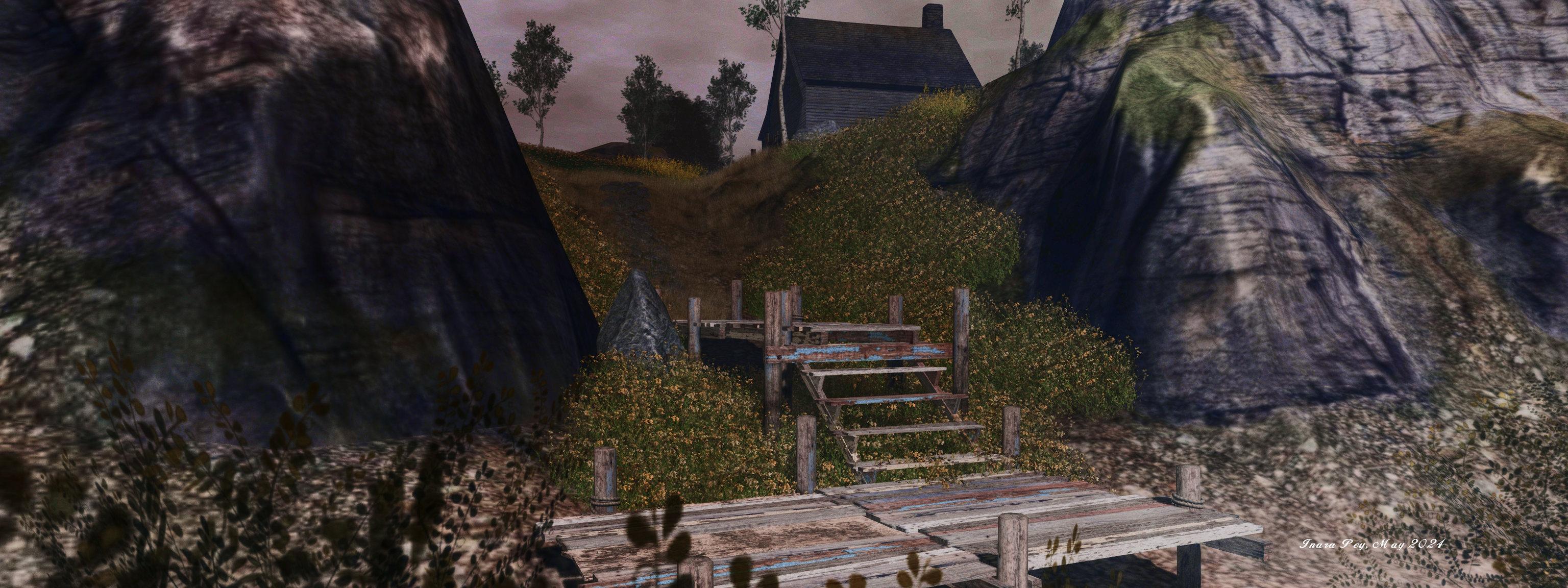
From here, it is a case of walking through the landscape from the landing point, up to the cabin sitting on the shoulder of a hill and then through it (upstairs and down), before exiting through the back door and following the path down to the waters and pier at the back of the cabin. In doing so, visitors will trigger visual elements at various points (such as the candles lighting to guide you up the hill) and text elements within the HUD, whilst also encountering reflections of the poems and stories the text references. Some of the latter might be obvious (such as the rave at the open bedroom window) others perhaps less so (e.g. the image on the wall of the cabin; the cabin and the wilderness in which it stands, etc.).

Alone, May 2024

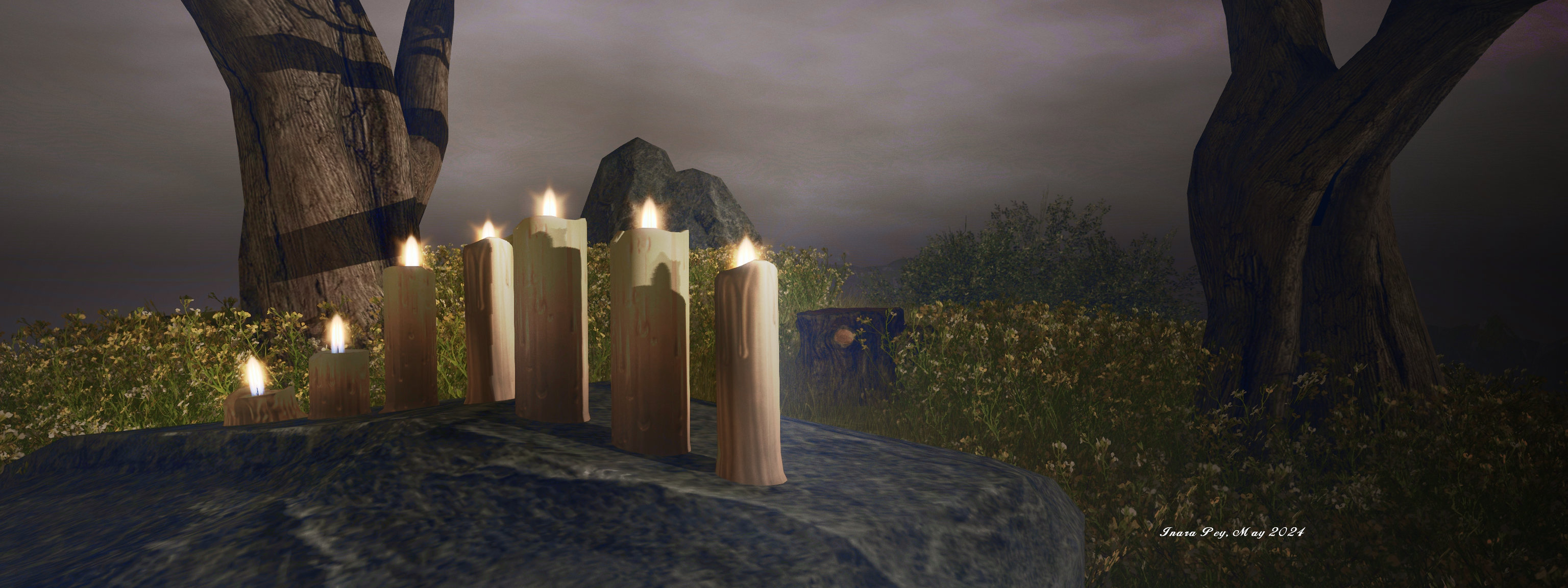
The final element of the installation requires climbing the ridge rising from the east side of the cabin (where the sheep are grazing) to run first south and away from the cabin and then back to the west as it rises to reach the top of a hill overlooking the landing point far below. Crowned by a trio of windswept trees standing as bent-backed guardians, the hilltop is home to a low, alter-like stone within candles and a tree stump seat. It’s a place I have little doubt the poet would have approved for the recital of his poem (triggered as visitors reach the trees), its isolation and position apart from the rest well suited to the poem’s themes. Further, in coming at the end of the experience, it offers another underlining of the poem as a means to better understand Poe and his work.

Alone might not be the easiest of installation to grasp, but for those with a love of poetry and the work of Edgar Allan Poe – and who indeed who might feel separated and apart from the rest of life for whatever reason – it is an engaging and potentially evocative one.

SLurl Details

  • Alone (Canary Islands, rated Moderate)

2024 week #18: SL CCUG summary

Venus by the Water, April 2024 – blog post

The following notes were taken from my audio recording and chat log transcript of the Content Creation User Group (CCUG) meeting held on Thursday, May 2nd, 2024.

Meeting Purpose

  • The CCUG meeting is for discussion of work related to content creation in Second Life, including current and upcoming LL projects, and encompasses requests or comments from the community, together with related viewer development work. This meeting is held on alternate Thursdays at Hippotropolis.
  • In regards to meetings:
    • Dates and times are recorded in the SL Public Calendar.
    • Commence at 13:00 SLT on their respective dates.
    • Are conducted in a mix of Voice and text chat.
    • Are open to all with an interest in content creation.
  • The notes herein are a summary of topics discussed and are not intended to be a full transcript of the meeting.

Official Viewers Status

  • On Thursday, May 2nd, the Materials Featurette RC viewer updated to version 7.1.7.8883017948.

The rest of the official viewers remain as:

  • Release viewer: 7.1.6.8745209917, formerly the Maintenance Y/Z RC (My Outfits folder improvements; ability to remove entries from landmark history), dated April 19 and promoted April 23.
  • Release channel cohorts (please see my notes on manually installing RC viewer versions if you wish to install any release candidate(s) yourself).
    • Maintenance B RC (usability updates / imposter changes), version 7.1.7.8820696922, April 29.
    • Maintenance X RC (usability improvements), version 7.1.6.8758996787, April 23.
  • Project viewers:

Graphics / glTF

  • Mirrors: Geenz Linden continues work on bug fixing (notably the fact that mirrors under Linden Water seem to break) and additional updates to improve usability.
  • PBR Terrain:
    • Cosmic has fixed an issue wherein 2K textures were not rendering on the mini-map.
    • In addition, she is looking into the ability to customise repeats in PBR terrain.
  • It is known that screen space reflections (SSR) do not work well on Linden Water, producing moiré effects. There has been talk within the Graphics team of “ripping out” SSR and replacing it with “something” – but no determination has been made as to what should be used, and it is pending work elsewhere within the graphics / rendering system.

glTF Scene Import

  • Runitai Linden is continuing to work on glTF scene import. This has reached a point where (on test viewers) it is now possible to preview a scene (tied to an in-world object) in-world.
  • Work is now being done to set-up a couple of test region on Aditi (the Beta grid) where this can be more widely tested.
  • The overall status of the glTF scene import work is described as “prototyping with much brokenness”, and the project is liable to continue through summer in order to get it into something of a more productive state.
  • The initial aim is to get to a point where scenes can be imported and seen, and nodes within them updated with both tools in the viewer and / or using LSL, and ensuring they stay in synch with the rest of the scene.
  • Once the above has been reached, then the plan is to start looking at performance, working out a Land Impact accounting schema, etc.
    • In as much as Land Impact is concerned, it is likely that nodes within a scene will have their own Land Impact, with those also involved in skeletal animation having an additional Land Impact.
  • Scenes are liable to use the MSFT glTF extension for Level of Detail (LOD), as this allows LODs to be set per node within a scene, providing more intuitive / consistent LOD switching management (based on screen coverage).
    • For automatic LOD generation, the first pass of work might only use the automatic LODs generated by Blender; if a home-ground automatic LOD generation system is used, it will “almost certainly” be Mesh Optimiser.
    • Overall, glTF scene support should leverage Blender’s LOD generation, as Blender is “way better” at this than LL are “any day of the week”.
    • Managing LODs (e.g. setting a default LOD Factor in the viewer is liable to become more firmly set and managed as glTF scene import becomes available (e.g. all viewers working to a fixed LOD of 3.00 or something).
  • The will be constraints placed on scene imports (e.g. will not be able to have a scene which exceeds the capacity of a region; scenes will not be able to span more than one region (so as to avoid issues with physics, etc.); and so on).
  • It was noted that glTF scene support will require a lot of work in areas such as physics management, update message handling (the object-based messaging currently used will not work with glTF scenes). Not of these aspects are seen as potential blockers – but solving all of them will take time.
  • glTF scenes will present more of a two-way street for creators, moving more seamlessly between a design tool such as Blender and SL when building and testing a scene and, following the upload of a scene, the ability to save it back locally again (subject to the SL permissions system where content has been subsequently added to a scene after its initial upload).

In Brief

  • Animations: it was noted that under glTF there is support for at least eight morph channels (with one vertex attribute being considered a channel, so it could be that 2 morphs change 3 attributes), making animation far more flexible in terms of use.
  • Some using the SL Mobile app have apparently been reporting that PBR terrain textures are not showing in that app, as it currently does not have PBR rendering support – this has been passed to the Mobile team.
  • It was noted that one of the reasons for LL adopting the glTF specification is that it is mobile friendly, so the Mobile team is going to be adding PBR, etc., support.
  • A lot of the meeting was taken up with a general discussion on matters relating to glTF scene import – LOD management, collaborative building, licensing matters (e.g. if an asset is available on a third-party asset store with a specifically licensed use, and importing it to SL potential break that license – should LL proactively block the asset from being imported?), etc., which have yet to be fully determined internally at LL, and so fall outside of this summary.

Next Meeting

† The header images included in these summaries are not intended to represent anything discussed at the meetings; they are simply here to avoid a repeated image of a gathering of people every week. They are taken from my list of region visits, with a link to the post for those interested.