Quartz offers a gem on Sansar, VR and Second Life

“come with me!” – in , Could the Oculus Rift help give Second Life a second life? Alice Truoung examines the promise of avatar-based virtual spaces

There has been another recent spate of articles on Linden Lab, Project Sansar, Second Life and the potential for avatar-based virtual spaces with the upcoming advent of VR. Even Moviepilot, whom I took to task in 2014, has been busy looking at what’s going on, while Gamasutra rushed out what is essentially a nutshell version of Eric Johnson’s excellent Re/code article examining the question of the metaverse, which I looked at here.

However, the pick of the latest crop has to be Alice Truong’s article published in Quartz: Could the Oculus Rift help give Second Life a second life?  While the title might sound Second-Life centric and suggestive of a piece looking at how it will faire under the Rift (“not very well”), it is anything but.

What is actually presented is a well-rounded piece on the future of avatar-based virtual spaces which uses Second Life as the measure of their mark and launchpad for their future. Within it, Second Life is examined from a number of angles and Sansar is explored, together with a nodding look towards High Fidelity.

Alic Troung: thought on virtual spaces and avatars in Quartz (image credit: Quartz.com)
Alice Truong: thought on virtual spaces and avatars in Quartz (image credit: Quartz.com)

As with most of the pieces which had appeared over the last month or so, little real news on Sansar (or SL’s development for that matter) is given out. This is hardly surprising, as the Lab does like to hold its cards close to its chest – the relative newness (and thus the difficulty in highlighting specific tablets-of-stone facts) of Sansar notwithstanding.

What makes this article a joy, is that it provides a solid framing for the subject of the Lab and virtual worlds, reaching back to 1999 and the original efforts with The Rig. This is nicely packaged and offers a solid foundation from which Ms. Truong expertly weave her piece. Some of the path she takes will be familiar, particularly where SL and Sansar is concerned. We get to hear about SL’s growth, revenue, the US $60 million collectively cashed-out of the platform by many of its users, etc.

We also get fair mention of the decline in the number of active users on the platform, but again, this is properly framed. At its peak, SL had around 1.1 million active users; eight-ish years later, that number stands at around 900,000. A decline, yes. but as Ebbe Altberg points out hardly any kind of “mass exodus”; and certainly nowhere near the dire haemorrhaging of users we tend to hear proclaimed to be happening every time the Lab makes what is perceived as an irksome decision.

For Sansar, similarly familiar ground is covered – the revenue model (and the comparison with SL’s model and its weakness), the promise of VR, the opportunity to grow a platform for “tens, if not hundreds” of millions of users, the aspect of much broader “discoverabiilty” / ease of access for Sansar in order to help generate more appeal, and so on.

Mention is made of the Lab planning to “commercially release” Sansar by the end of 2016. Given what has been said by the Lab to date concerning time frames for future work, and allowing for Ebbe’s comments of perhaps having something worthy of a “version 1.0” label by the close of 2016, I’m taking the comment to be more of a misunderstanding on Ms. Truong’s part than any revelation as to Sansar’s roadmap.

Hunter Walk (l), the Lab's former
Hunter Walk (l), the Lab’s former “Director of Everything Non-Engineering” as well as a founder of the company, and now a VC in his own right, and Bernard Drax, aka Draxtor Despres (r) offer thoughts on Sansar

Another enjoyable element of this article is that Ms. Truong casts her net wide for input; thus she captures both Hunter Walk and Draxtor Despres. Their comments serve to both offer the means by which ideas can be further explored in the piece, and serve to offer a measure of counterpoint to the assumed mass appeal spaces like Sansar and High Fidelity will have.

Hunter Walk, for example, underlines the most critical problem in growing users Second Life has faced throughout its lifetime – that of accessibility and use. As he states, “ultimately, the work you had to put in was, for most people, more than the fun you got out.”  Not only does this underline the essential truth about SL’s longest-running issue (it’s as true today for many as 2003/4), it lays the foundation for an exploration of some of Sansar’s fundamental differences to SL later in the article.

Hunter also passes comment on the idea of these spaces finding many millions of users, pointing out that “tens of millions” was always an unrealised dream at the Lab for Second Life; perhaps a cautionary warning about focusing on user numbers. He also seems to offer something of a warning on investment returns in such ventures as well, again referencing Second Life, although if intended as a warning, it is more relevant to High Fidelity (which has received around US $16.5 million in investment to date).

Draxtor similarly questions whether user numbers should necessarily be the focus / rationale for building these kind of virtual spaces. Like him, I’m far from convinced Sansar will have the kind of broad-ranging reach to draw in “hundreds of millions” (or, if I’m honest, even more than  the low tens of millions). I’ve explained some of the reason why I think in my review of Eric Johnson’s piece linked to towards the top of this article, so I won’t repeat them here.

Could the promise of 2mixed reality
Could the promise of 2mixed reality” technologies which combine VR, AR and physical world activities yet serve to keep avatar-based virtual spaces a niche endeavour? (image: Magic Leap, via the New York Times)

If I’m honest, my only regret is that while Ms Truong’s tone is (rightly) sceptical in places, there is no outright challenge to the idea that people will embrace avatar-based interactions on a massive scale just because VR is on our doorstep.

Right now, there is a lot going on in the world of technology: VR, AR, the potential to fuse the two; faster communications capabilities, much better mobile connectivity, and so on. All of these could serve to dramatically marginalise any need to persistently engage in avatar-based interactions outside of very defined areas. As such, the inescapable whiff of “will we build it, they will use it” (to utterly mangle an already oft-misquoted line from a certain film) which seems to pervade the talk of high Fidelity and Sansar does perhaps deserve a degree of challenge.

Perhaps I should drop a line to Peter Gray suggesting an interview on those lines…

In the meantime – go read Alice Truong.

Related Links

Ebbe’s fireside chat: Sansar, Second Life and VR

Nick Ochoa and Ebbe Altberg talk Sansar, SL and virtual spaces (image courtesy of UploadVR)

On August 3rd, Upload VR posted a video chat to YouTube which features a cosy fireside chat between Nick Ochoa and Linden Lab CEO Ebbe Altberg, which examines Sansar and virtual environments – touching on Second Life in some places.

The 30-minute  conversation is very relaxed and approachable; Ebbe is clearly at ease (possibly helped by the glass of red wine!) and Nick is a very competent host in his ability to keep a conversational flow going. The camera is a tad wobbly in places, suggesting whoever was holding it may have been enjoying a sip or six of the wine / beer (!), but not excessively so. A lot of ground is covered in the time, and while it may be frustrating that some items are passed on rather than followed-up, keep in mind that this is more a conversation than in-depth interview / QA, serving to offer a non-SL audience a flavour of what that Lab is up to.

In terms of Sansar, we do get to learn that times are running very slightly behind schedule, in that we’re still a “couple of weeks” away from the start of initial closed alpha testing under NDA, but everything else remains pretty much as stated: NDA Alpha ramp-up through 2015 into 2016 and a more public beta in 2016.

(image courtesy of UploadVR)

We do get to learn a little more about how the closed alpha will run: those invited to join will be able to install and application with hooks into Maya, the tool of choice for initial testing. They build their “scenes” (“experiences”)  in Maya and push a button in the application to “publish” the results on Sansar and obtain links they can share with others involved in the testing. Given Ebbe’s previous comments about “optimising” content for delivery across Sansar, I wonder if this approach will be how things are handled when Sansar is broadened to encompass other external content creation tools.

Beyond this, we get more on the Sansar / WordPress.com analogy, which first came to the fore in an article published by Variety online. This whole aspect of Sansar is a fascinating point of speculation to me, in that it suggests the platform is conceptually analogous to the concept of a Platform as a Service (PaaS), something which I think stands to make Sansar potentially far more powerful and flexible than people perhaps credit. However, as this is only speculation on my part, I’ll leave that to one side for now – but promise I will explore it further in a future article.

Within the UploadVR discussion, Ebbe’s focus on the WordPress.com analogy is tightly focused on the aspect  of “discoverability”. The idea that right now and with SL, people have to join the platform in order to discover the experience, whereas Sansar should be more like WordPress – where people discover the blogs and don’t necessarily care about the platform on which the blogs are run.

A clearly relaxed Ebbe gets into talking avatar dancing
A clearly relaxed Ebbe gets into talking avatar dancing (image courtesy of UploadVR)

Sansar’s revenue model gets a little more clarification, with the “sales tax” aspect clearly being applied to the platform’s GDP as a whole – which is Second Life’s case is an estimated half billion US dollars a year. Previously, there had been some confusion as to precisely where the “sale tax” might fall, particularly following an article in Xconomy.com, so the further clarification is welcome.

A direct parallel is drawn to on-line retail sites where up to 30% might be charged in commission. However, I wouldn’t take this to mean that’s necessarily what the Lab is looking to charge; Ebbe is making comparisons, not stating policy.

A more meaningful question to ask here is to how rapidly can Sansar realistically grow in user numbers order for such a model to be able to push the platform into the black? Unless there is some immediate and large influx of users, it could take a while for the Sansar economy to really get rolling; so conceivably, and depending on the associated overheads in providing the platform, the Lab could be operating Sansar as something of a loss leader for a time after it is “launched” to the world at large.

From here, the conversation broadens out to discuss the virtual opportunities that already exist in Second Life, from content creation through activities to monetization for users, to an overview of the many different communities present in-world, all of which almost seamlessly blends into more of a general chat on the potential and perils of VR which in turn bounces across health, the work of Jeremy Bailenson at Stanford University, and more besides. This actually makes for the interview’s most entertaining 10 minutes, as Ochoa and Altberg, obviously at ease, forget the presence of the camera as they chat.

Overall, this is a comfortable and pleasing discussion – not revelatory or packed with news, but one which is nevertheless interesting and within its own personal richness – not the least is the rapport which is clearly present between Altberg and Ochoa.


Examining the reality of the metaverse

Th obligatory Sansar promo image :) (please can we have some new ones?) - Linden Lab
Th obligatory Sansar promo image 🙂 (please can we have some new ones?) – Linden Lab

Eric Johnson has a thought-provoking article over on re/code. In Welcome to the Metaverse, he ponders the lot of avatar-based virtual spaces, past and future, and how a number of companies – the Lab included – are betting that the “new era” of VR is going to be the means by which such spaces will become mainstream.

It’s an interesting piece, offering plenty of food for thought, starting with an opening statement by the Lab’s CEO, Ebbe Altberg, on defining human life:

What humans do is create spaces. Some spaces are mobile, like a bus. San Francisco is a space that was created by its users. Whether you go into a pub, a bar, a classroom, a bowling alley, an office, a library … We create spaces and we have people come together in those spaces, and then we communicate and socialize within those spaces.

This is actually the first thing about the article that leaves me with a familiar feeling of feeling at odds with the prevailing view of all things metaverse, albeit for a slightly different reason. With due respect to Mr. Altberg, people didn’t come together as a result of building spaces. They built spaces as a result of coming together. However, as an opening gambit for a study of this thing we call the “metaverse”, it’ll do as an opener.

Eric Johnson, Associate editor, Gaming at Re/code (via LinkedIn)

From here, Mr. Johnson give us the pocket introduction to “the metaverse” via the obligatory (and rightful) nod to Neal Stephenson while simultaneously dispensing quickly with a look at the “past promise” of virtual spaces that didn’t in the end measure-up to the expectations.

This leads the way to a clever little nod to the book which has become this decade’s “Snowcrash”  in the form of  Ernest Cline’s Ready Player One (which is actually a very good read) – as a means to introduce the main three companies he sees as currently vying for space in “the metaverse” – the Lab,  High Fidelity and AltspaceVR.

Chances are the Sansar and High Fidelity are already well-known to people reading these pages, which AltspaceVR may have passed some unnoticed. As the article points out, they’ve been developing avatar-based VR for the last couple of years, focusing on shared spaces (watching a film with a friend who is halfway across the world for example), and scheduled events, including gaming weekends, etc.

AltspaceVR also has some ideas for business applications with their environments, which they are planning to offer on a pay-to-use basis. And while their avatars main have been viewed with disdain by some, there are a couple of points to bear in mind where the company is concerned.

The first is that as a result of watching some of AltspaceVR’s virtual interactions, Mark Zuckerberg caught the social VR bug, and Facebook went after Oculus VR, with the subsequent $2 billion acquisition (which was actually quite a modest punt when compared to the $19 billion the company had earlier spent on a proven technology in WhatsApp).

The second is that the company, which has been around about as long at Philip Rosedale’s High Fidelity, has almost raised a comparable amount in funding – around $15.7 million to date (SEC filings indicate High Fidelity has raised around $16.5 million), and both are working at solving many of the same technical issues – head and motion tracking, eye tracking, etc.,

Beyond this, others interested in making a pitch into the metaverse space, as Mr. Johnson mentions are IMVU, which has around 15% of it’s 130+ staff now working on trying to integrate VR into its existing spaces (a-la the Lab’s early effects with SL and the Rift), and a small New York based start-up, focusing on VR social games with around $300,000 in seeding money. called Surreal, the 4-person company is billing itself as “the first fully immersive virtual world”, which is focused entirely on using VR HMDs (Oculus, Gear VR and Cardboard).

Johnson attempts to split his examination of the metaverse into two views: the short-term and the long-term. In doing so, he inevitably points to the elephant in the room: Facebook. In this, he quotes Palmer Luckey, who gives a fair warning as to whether or not “the metaverse” is around the corner, and which stands as a cautionary warning, in more ways than one:

I think at this point the term ‘metaverse’ is a bit undefined. For any one company to say, ‘We are building the metaverse’ is pretty hyperbolic. Building all the pieces is going to be hard, and the way you imagine things in sci-fi doesn’t always translate over to the way things will be in the real world.

Palmer Luckey: precient words on
Palmer Luckey: prescient words on “the metaverse”?

He has a very valid point; and with today’s rapidly evolving pace of technology, it’s one worth keeping in mind; the technical issues people see today as only being surmountable through the use of avatars may not actually be technical issues a few years hence.

Interestingly, Johnson places this in the “short-term” view – although both Oculus VR and Facebook have always talked in terms of “the metaverse” still being around a decade away. For the longer term, Johnson looks in particular at High Fidelity’s work and also the Second Life revenue generation success (and, despite the naysayers out there SL is a commercial success, both for the Lab and its users, the latter of whom benefited with collective revenues of $60 million from the platform in 2014), before taking another look at AltspaceVR.

There is a lot to be digested in the piece, and it makes for a good read. However, for me, Palmer Luckey’s warning that how things don’t always match the real world tends to stand out a lot when a lot of the approach being then with avatar-based virtual spaces tend to smack of the “if you build it, they will use it” approach.

I don’t doubt for a minute that spaces will have a lot of applications among various vertical markets. It is no coincidence that the likes of Philip Rosedale and Ebbe Altberg talk much of the same language concerning them: education, training, healthcare, business; there is potential for avatar-based VR spaces in all of them. But I’m still not convinced that longer-term, such spaces are going to claim a much large market among causal consumers than is currently the case, for a couple of reasons.

The first is that the vast majority of people really haven’t seen the need to “climb in” to an avatar for their social interactions – and getting a shiny new headset (which Johnson quotes some rather interesting demographics about) isn’t actually going to change that. The second is connected to the headsets themselves.

High Fidelity and Linden Lab see the education sector as a major focus for their efforts – and neither is wrong. But are avatar-based virtual spaces really going to go consumer mass market?

Simply put, it would seem likely that this brave new world of VR could end-up delivering so many fantastic experiences and opportunities to the casual user, that the majority still won’t see the need to invest time and effort in creating a virtual alter-ego of the kind we desire (and we, as SL / OpenSim users are a niche), because so much else is being delivered to them pre-packaged and ready-to-go. Thus, as Palmer Luckey indicates, the chances are “the metaverse” could well arrive in our lives in a manner very different to that being envisaged by High Fidelity and Linden Lab, thus leaving their approach still very much niche-oriented.

Not that there is anything wrong with that either. As both Rosedale and the Lab can demonstrate, it’s done them rather nicely over the years. And it is fair to say that “niche” this time around a liable to be somewhat larger, simply because of the vertical market opportunities they’re looking at.

Even so, and as mentioned, there is this optimistic we “build / they come” aspect to the whole idea of avatar-based vertical spaces that it would be nice to see an article probing the pros and cons a little more. Perhaps that might be something for a follow-up from Mr. Johnson? In the meantime, Welcome to the Metaverse is a thought-provoking read, and for reasons I’ve not even scratched at here (such as the question of on-line abuse), as such, it’s not one to miss.

Related Links

With thanks to Indigo Mertel for the Google+ pointer at the weekend.

Upcoming changes to land damage in Second Life

secondlifeAs previously reported in these pages, in April the Lab made some changes to the behaviour of Damage settings on land. At the time, the changes caused a certain amount of confusion in the way they limited people’s abilities to set Damage compared to previous behaviour.

As a result, a number of bugs were filed against the changes, including BUG-9098BUG-9253 and particularly BUG-9422, prompting the Lab to acknowledge there are issues, and promise to look into matters to see if anything could be done to improve things.

As a result of this, the Lab has now come up with a proposal on how Damage can be managed at both the region and the parcel level (there are no plans to offer Damage settings at the estate level) in order to provide region and parcel holders the greatest flexibility on how Damage can be managed on their land, as identified in the various use cases offered through the bug reports.

One of the issues resulting for the April changes to Damage: if the Allow Damage option is disabled at the region level, it could no longer be set at the parcel level - click to enlarge (image courtesy of Whirly Fizzle)
One of the issues resulting for the April changes to Damage: if the Allow Damage option is disabled at the region level, it could no longer be set at the parcel level – click to enlarge (image courtesy of Whirly Fizzle)

The proposal was unveiled by Oz and Grumpity Linden at the TPV Developer meeting held on Friday, July 31st, and the detailed discussion of the changes can be heard via the meeting’s video (11:16 through 19:16). However, in essence, it is being proposed that:

  • The current Region / Estate > Region > Allow Damage function will remain, and is set to off by default – so damage will be disabled at the region level by default
  • A new setting, Allow Parcel to Override Damage will be added to  Region / Estate > Region, which will allow parcel owners within a region to set Damage for their land, even if it is disabled at the region level via Allow Damage. This will be set to on by default
  • The About Land > Options > Safe (No  Damage) option will be unchecked by default – so Damage will by default be on at the parcel level by default.

Thus, under this approach, and by default, parcel owners can still have Damage enabled if they wish, while the region owner can have it disabled in order to make places like public areas safe from unintentional Damage, for example.

However, region owners will be able to retain overall control for setting Damage on a region by unchecking Allow Parcel to Override Damage. This will cause the entire region to obey whatever is set via Allow Damage, and the Safe (No Damage) option in About Land > Options will be disabled / greyed-out for all parcels, preventing parcel holders from changing it.

In addition, further changes will be made to the viewer so that it will only display Damage icons in regions / parcels where Damage is enabled.

Currently, there are no times scales for when these changes (which will involve updates to both the simulator code and to the viewer) might be implemented; the idea at the moment is to gain feedback on the proposal as it stands. Furthermore, the Lab is still examining how they might ensure that any current settings for Damage people have on their land are correctly preserved when any changes are eventually rolled-out (although it is likely some people may have to manually readjust the Damage settings on their land once changes have been made, even with the best efforts on the Lab’s part to avoid this).

Once the changes have been finalised and time tabled for implementation, the Lab will hopefully communicate them ahead of release via a blog post / announcement and through the viewer’s MOTD. I’ll also be covering the changes when they are ready to be deployed.

VMM: RC viewer updated, Magic Box / XStreet shut down dates

secondlifeUpdate: The Lab has confirmed automated migration of all Direct Delivery items has now been completed, and the current plan is for the new RC viewer mentioned in this article to be promoted to the de-facto release viewer in week #32 (week commencing Monday, August 3rd).

The auto-migration of Direct Delivery items to VMM has been proceeding for a week, and mostly seems to be going smoothly.

However, the VMM code for the viewer has yet to reach a release status, primarily due to the VMM viewer release candidate having suffered from an elevated crash rate when compared to the current release viewer.

As a result, on July 29th, the Lab to issued a new version of the release candidate, version 3.8.2.303891. This does not contain any changes to VMM functionality, but is intended to reduce the RC viewer’s crash rate. Assuming it achieves the aim, it should mean the VMM viewer is once again back in the running for promotion to release status alongside the other RC viewers currently in the release channel.

End of Magic Box Support

Also on July 29th, the Lab issued a blog post announcing the ending of Marketplace support for Magic Boxes and the final shut down of XStreet.

In the blog post, Merchants using Magic Boxes for item deliveries are advised that they have until Monday, August 17th, 2015 to manually migrate those items to use the viewer-Managed Marketplace. After that date, Magic Boxes will no longer be listed on the Marketplace.

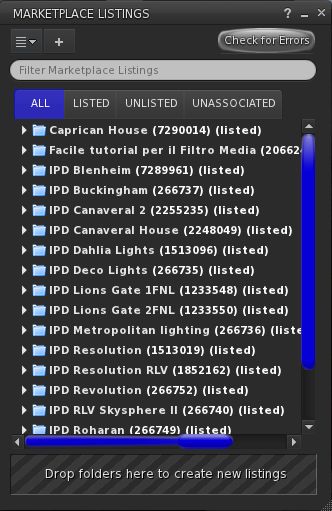
Essentially, manual migration involves moving the item into the Marketplace Listing panel, where the required folder hierarchy will be created, and then associating that item with an existing listing on the Marketplace. This is done by copying / pasting the listing reference number (that’s the number at the end of the item’s URL displayed in a browser’s address bar) from the Marketplace and pasting it into the Associate Listing option of the Marketplace Listing panel.

VMM includes an option to manually associate existing MP listings with VMM items in your inventory, which will help ease part of the the migration process for those concerned over automated migration paths
Manual migration in VMM involves moving the item into the Marketplace Listing panel, where the required folder hierarchy will be created, and then associating that item with an existing listing on the Marketplace, by copying / pasting the listing reference number using the Associate Listing option in the Marketplace Listing panel.

Once items in the Marketplace Listing folder have been associated in this way, and a check for errors run, in-world Magic Boxes can be deleted (just make sure everything you want to manually migrate has in fact had its listing associated with a  VMM item first!).

You can also learn about manual migration in the fourth part of the Lab’s VMM video tutorial series, which I’ve also embedded at the end of this article.

XStreet Shut Down

Following the cessation of Magic Box support on the Marketplace, XStreet, (which I think may still be in part used with Magic Boxes), will remain available through until Thursday, August 27th, after which it will finally be shut down. Presumably, this is to give any merchants who missed the August 17th deadline time to complete any remaining manual migration of Magic Box items & re-list them on the Marketplace.

Summary and Migration Video

So, once again the dates:

  • Magic Boxes will stop working on August 17, 2015, and will no longer appear on the Marketplace
  • Xstreet will be finally shut down on August 27, 2015.

And the Lab’s tutorial video on manual migration of listings to VMM:

Lab VMM Resources

Experiencing PaleoQuest, the Lab’s latest adventure in Second Life

PaleoQuest; Inara Pey, July 2015, on FlickrPaleoQuest, July 2015 (Flickr) – click any image for full size

The Lab has launched the latest in their series of adventures for residents as a further demonstration of Experience Keys / Tools. Entitled PaleoQuest, it can be accessed from the Portal Parks, and following the announcement, I trotted along to give it a try, along with a few friends and some of the folk from the Lab and the LDPW.

As the title suggests, the adventure revolves around dinosaurs and parks … but also features time portals, moles, Magellan Linden and  … Doctor Talpa! The adventure comes with a back story, which I’m not going to explain; I’m going to leave that to the official video:

Once you’ve reached a Portal Park, follow the PaleoQuest footpath to the portal itself. Here, you must explicitly join the adventure and assign certain permissions to it (displayed in a dialogue box). These permissions allow the adventure to act on your avatar (teleporting you, proving you with items, etc.) without you constantly having to accept them via further dialogue boxes.

When you have agreed to join the adventure, walk into the light and you’ll be transported to the Visitor Centre, your starting point. As you do so, a game HUD will be attached to your screen – don’t remove it, as you’ll need it to proceed. It will automatically be removed from your screen when you leave PaleoQuest (and all the permissions you have granted will be automatically revoked as well – all part of the Experience Keys system).

PaleoQuest; Inara Pey, July 2015, on FlickrPaleoQuest, July 2015 (Flickr)

The HUD is a combination communications unit – you’ll receive text instructions through it, and hear them on occasion from Magellan -, progress indicator and score keeper. How to it is explained in a tutorial video. Both it and the back story video can be watched at the Visitor Centre as well as on You Tube directly. As well as providing you with instructions (also available in note card form), the Visitor Centre is also the place where you can redeem the goodies you’ve collected along the way for prizes.

Beyond the Visitor Centre are the 5 individual quest zones, reached via the monorail system. Each of these zones involves you in two activities; the first is to undertake a specific task which must be completed in order to help thwart Dr. Talpa. These must be completed in order – you cannot do one, then skip one and go to the next. The second activity involves you collecting “common and rare items” for Magellan (he’s always been one to get others to do the work for him!). These are the aforementioned goodies which can be redeemed for your rewards.

PaleoQuest; Inara Pey, July 2015, on FlickrPaleoQuest, July 2015 (Flickr)

The five main tasks are fiendish, while the secondary task of collecting items Magellan will name for you isn’t easy either. There may well be rewards to be had when you’ve gathered them and got them back to the Visitor Centre, but as with the main task, there’s also a fair amount of death to be found along the way. Well, lots of death, actually, and in a variety of ways, all of them coupled with the chance of losing the goodies you’ve accrued.

This being SL, however, none of the deaths you may (that’s spelt w-i-l-l) suffer are permanent. Should rocks, darts, toxic water, evil creatures or other Unpleasantness get you, like Doctor Who, you will regenerate in a flash.

I’m not going to spoil the adventure by going into specifics of any of the quests; suffice it to say that this being a time mix-up, dinos won’t be the only things you encounter. There’s ancient Egyptians, pirates and more. What I will is that PaleoQuest is a lot of fun. Oodles of it, in fact.

PaleoQuest; Inara Pey, July 2015, on Flickr“Watch the birdie…” – PaleoQuest, July 2015 (Flickr)

Congrats to Patch, Shaman, Michael, the moles and all who worked on the project; it’s been worth the wait ever since Patch mentioned it at the SL12B “Meet the Lindens” event, and it really does deliver up fun by the bucket load. Or have I already said that?

Don’t take my word for it, however – go see for yourself. You’ll probably come across Whirly still trying to get across Nessie’s rocks ;). (Me? I took a leaf from Magellan’s book. I sat down had a drink or six and watched everyone else!)

PaleoQuest; Inara Pey, July 2015, on FlickrWhirly gets into the spirit of things – and makes an enticing snack for Nessie! – PaleoQuest, July 2015 (Flickr)

Oh, and do make sure you have the music stream enabled when visiting. Someone did a pretty awesome job there as well.

Related Links