Linden Lab has issued an important notice for international users who have a credit card filed with the company for the payment of services.
The blog post, issued on Friday, September 22nd, reads in full:
Due to some unexpected changes with our International Billing system, some Residents outside the United States with a Credit Card on file may have difficulty with their current payment method as of September 30, 2017.
In order to avoid any service disruption, we encourage all Residents outside of the United States to please take a moment to log into your account and re-enter your existing Credit Card information. Doing so now will prevent any disruption in in-world and Marketplace purchases, as well as recurring monthly billing for Premium Accounts, Private Regions and monthly Mainland maintenance. If you have difficulty with your payment method after September 30, 2017, updating your payment information will resolve the issue.
We apologise for this inconvenience and appreciate your patience as we continue to upgrade our billing systems in order to best service our Residents around the world. If you have any questions regarding this notice, please visit https://support.secondlife.com to contact our Support teams.
To re-enter your credit card details, go to your account dashboard at secondlife.com, click on Account (top left) and then on Billing Information on the list of options that opens. This will display your billing information summary (sample image below).
Make a note of the services the card is Used For on the right, then Remove your card details (option on the left) and then click Add A Credit Card (circled). This will open the form for you to enter your card details. Make sure to click Add Card to add the card to the system.
When your card has been recorded, you can check the details under Payment Method, then review the services the card is Used For. Should you need to change any of the latter, click on the Change option (circled under Used For on the right) to display a pop-up of services charged to the card and check / uncheck as required.
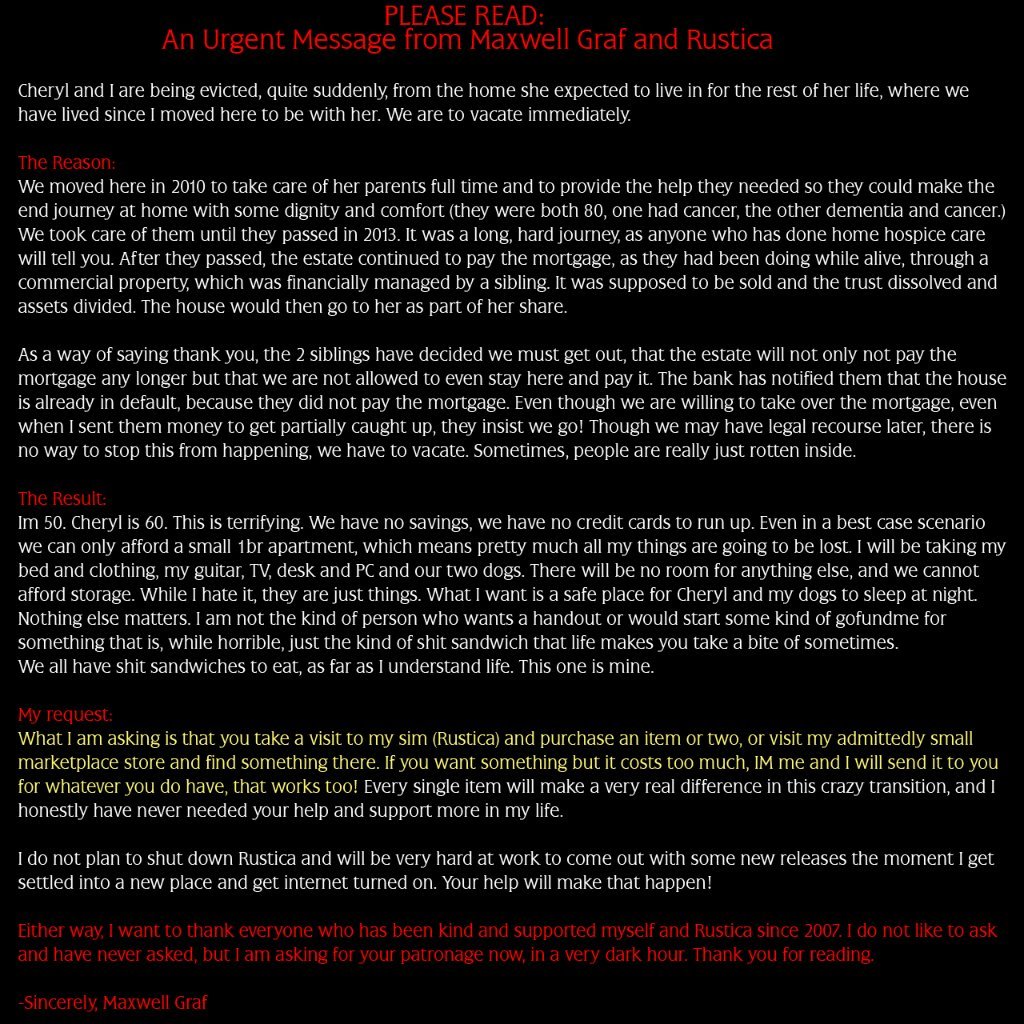
I’ve known Maxwell Graf – incredibly enough – since 2007. We’re not actually in the same social groups within Second Life and rarely hang out, but Max is the kind of person you can instantly feel at home with. We can go without talking for several months, and then an impromptu IM picks things up almost where they were left last time around. I’ve also been honoured that Max has, on occasion passed his written thoughts on subjects related to content creation, Second Life, etc., to me for thoughts and feedback – even though I’m possibly the least qualified to comment on matters of content creation.
Max is perhaps best known for his period furniture and buildings
It is as a content creator that Max is perhaps best known in Second Life. His Rustica brand is renowned for quality furnishings, building kits and more, particularly for those with a lean towards Medieval or fantasy settings – although his products are applicable to more than just these two genres. In more recent years he’s branched into steampunk and fashion (with his Bitch and Bastard brands of female and male clothing and apparel – including some magnificent facial hair options for the discerning gentleman!). He is also a superb sculptor of land and maker of landscapes – as anyone who has visited the stunning and beautiful Rustica, home of his brand, will agree.
… However he offers far more for period setting, role-play, home and avatar. His “Ex Libris” range of books offers “titles” of great benefit to SLers (we have them at home) and can be bought as a set or as part of an entire library displayed within beautiful modular cabinets
Nor has Max content with offering his creativity to just Second Life. He has one of the first into Blue Mars and also quickly active in Cloud Party. More recently, he’s been working in Sansar, building a five experience “chapters”, including some familiar names – LagNmoor, Rustica, and Neptune’s Revenge – those willing to dip their toes into Linden Lab’s latest venture can visit and enjoy (just follow the clues!).
Throughout all of this, Max has been a friend to many; honest, supportive, outgoing, and true. So when he puts out a plea on Plurk concerning a personal situation, those who know him rally round with re-Plurks, Tweets and blog posts (and my apologies to Max and Lyric for being a little tardy with this blog post, I haven’t been paying attention to social media of late – and my thanks to both Saffia Widdershins and Ciaran Laval for the indirect nudges on the matter).
The Rustica Maison de Maille at Rustica – see inside the store for a petite version
Max isn’t asking for donations or any kind of direct financial support via the real world. What he is asking is for people to buy something for their in-world enjoyment from his store. It doesn’t matter how big or small, how much or how little; in fact, as he says himself, if there is something you desperately want, but cannot honestly afford it, contact him, and he’ll try to sort something out with you.
As we’re currently re-building and replacing elements of Holly Kai Park to ensure all of the landscaping elements, buildings, accessories, etc., are held by a single account, we took the opportunity to zap to Rustica and pick up a set of Max’s PipeWork Electric Lamps, which are now installed in the snug lounge and around the dance floor at Caitinara Bar to add some lighting ambience with a unique look.
We added the Rustica PipeWorks Electric Lamps set to the snug at Caitinara as an ideal option for projected lighting, using the table lamps (foreground, left and on the tables) and wall sconces (over the bar) . Some have also been used around the dance floor and gallery seating area.
So please, do take the opportunity to help a talented creator and friend. Hop over to Rustica in-world or on the Marketplace and offer support by buying an item or two. I can guarantee you won’t be disappointed with the quality of anything you purchase from Rustica / Max.
Updated, September 25th: As indicated to me by Grumpity Linden, and following testing with the Second Life Wolfpack RC viewer update 5.0.8.329128, this issue should now be resolved.
On Friday, September 22nd, Linden Lab issued a warning to Second Life users on the Windows platform that for a period of time, they may get a Windows SmartScreen warning when installing or updating the official Second Life viewer.
As explained in the blog post, the warning from Windows SmartScreen is displayed when trying to install anything via the Internet and Microsoft is unable to verify whether the software is “safe” for installation.
The reason the warning is being generated against the official Second Life viewer was explained by Oz Linden at the Third-Party Developer meeting, with a similar explanation in the blog post. Speaking at the meeting, Oz said:
Unfortunately, our [Microsoft] code-signing key expired this week, and we had to get a new one, and that has caused Windows SmartScreen Defender to no longer believe in us. So it will warning you when trying to install any of the new viewers, including release candidates … so we’re putting out a blog post about that and putting in on the status page, so hopefully people will get the word.
In addition to this, the blog post explains why the warning will be displayed, even after the Lab has obtained a new code-signing key:
Until enough people install the application signed by the new key, it won’t have a good enough “reputation” with Microsoft to avoid the warning.
Oz further added during the TPVD meeting:
Hopefully, the number of people who need to install it [the viewer] to get Microsoft to believe in it is not too big; [but] we have no idea how long that will take.
So again, if you’re a Windows user (notably Windows 10), and you’ve downloaded one of the more recent viewers from the Lab’s web site, and you get the Windows SmartScreen warning, you can safely install the viewer.
Simply click on the MORE INFO link when the warning is first displayed. This will give you the application name and publisher’s name, together with an option to RUN ANYWAY. Click on this to install the viewer.
Windows SmartScreen warning – may be displayed when installing a latest version of the official SL viewer.
Remember, if the viewer has come from the Lab’s website or via the viewer’s own updater, it is safe to install.
Linden Lab has issued a number of blog posts concerning Second Life account security recently. All of them should be read with care and heeded. Most relate to external issues – so-call viewer wrappers, or links to website Phishing scams.
On Friday, September 22nd, the issued a further warning, again about a phishing scam, but which is being circulated in-world and which appear to be a pseudo-notification pop-up claiming that a user’s account has been compromised.
In the interests of clarity of reading and understanding, I’m including the full text of the post below. Please read it through in full, be aware of the scam and do not be fooled by it – and the blog post states. Linden Lab and / or their support agents would not attempt to contact users on account security in the manner described.
It has come to our attention that some Residents are sending messages – which may appear as pop-up windows in some viewers – informing other Residents that their accounts have been compromised and encouraging them to contact Support, using a phone number that is not associated with Linden Lab.
These messages are phishing attempts to gain access to your Second Life account. Neither Linden Lab, nor Second Life Customer Support, would attempt to contact you in this manner. You can always find Linden Lab’s official customer support contact methods within the following links:
As always, please be wary of suspicious messages and contact from other users. If you believe your account has been compromised, please contact us via support case at https://support.secondlife.com/
Tyrah and the Curse of the Magical Glyches – bonus region portals
On Monday, September 18th, 2017, Linden Lab announced the launch of their latest Experience Key based game for Second Life users to enjoy. Entitled Tyrah and the Curse of the Magical Glytches, it is something of a departure from previous games such as Linden Realms, PaleoQuest and the Horizons adventure. Not only is it grid-wide in nature (the first time Second Life experiences have been used on a grid-wide basis), it will in time also allow parcel holders to host the game on their land if they so wish – possibly attracting traffic to their locations.
I was able to see and try the game ahead of its launch, and thought I’d offer an overview and some feedback, as well as take the opportunity to ask a few questions of Dee and Patch Linden about the game and the reasoning behind it.
Tyrah and the Curse of the Magical Glytches is a combination hunt, capture game and first-person shooter. It builds on elements seen in previous games from the Lab, but is far broader in scope. There are two basic aims of the game:
Capture mischievous Glytches as they wander SL and perhaps gain gems from them, and / or an immediate prize of a Glytch – which might be a shoulder / head pet, held pet, or follower (all of which can be traded between users) or even complete avatars.
Collect coloured gems – which can be redeemed for weapons upgrades, and/ or access into the game’s bonus regions and / or prizes
A video outlines the game’s back story. I’m not going to say much on this other than, “alas, poor Magellan, I knew him, Horatio. A fellow of infinite drinking ability and most assured desire for food…” – or something (with apologies to W. Shakespeare, Esq).
Hartyshire
Game-play Essentials
There are several aspects to playing the game, which are covered in another video; but for those who prefer to read things, I’ve outlined them below.
Hartyshire
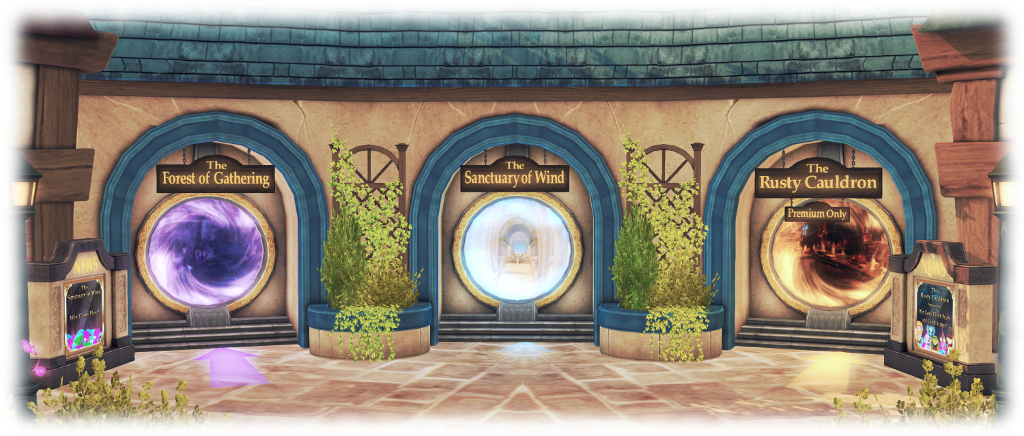
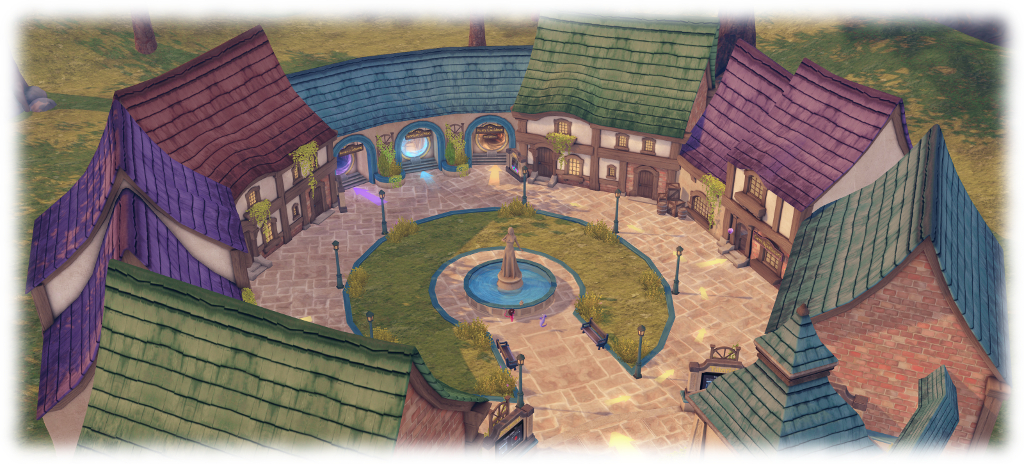
Hartyshire is the heart of the game. Reached via the Portal Park, it is the place where people can learn more through the aforementioned videos, and where players obtain their Glytch Starter Kit, can upgrade their weapons, claim prizes or – gem and weapons upgrades allowing – access the special bonus regions. There is also a range of free gifts for visitors, whether or not they join the game. There are three important areas in Hartyshire:
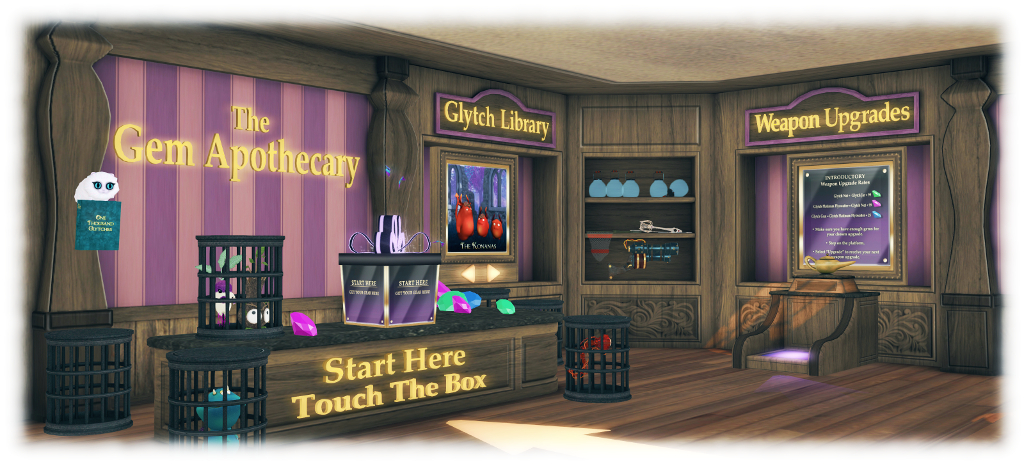
The Gem Apothecary is where players can:
Obtain a game Starter Kit: with everything needed to start playing: a note card of instructions, the game HUD (see below) and a jar – your first Glytch catching weapon. The kit is delivered as a folder to your Inventory.
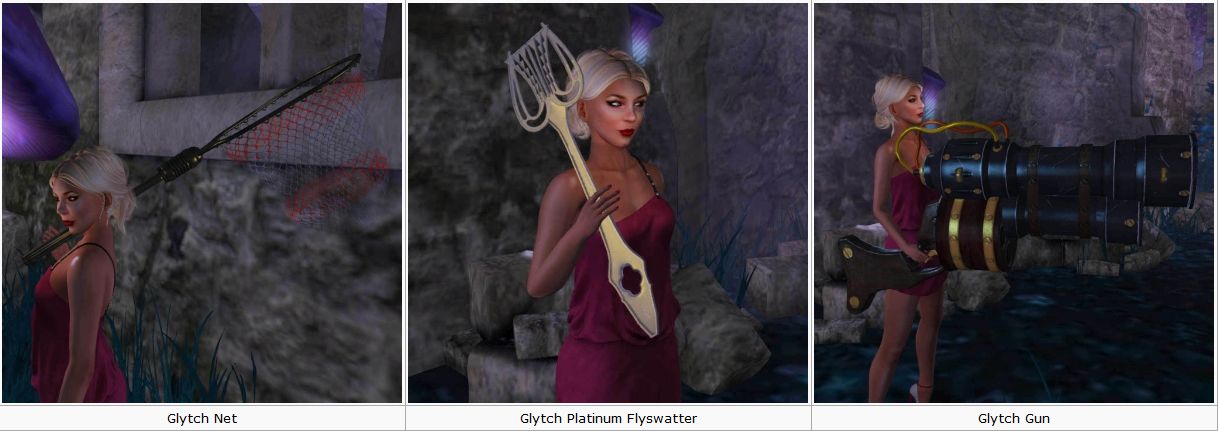
Upgrade their Glytch catching weapon: use gems given by Glytches to upgrade from jar through swatter and net to gun. Each weapon improves the chances of catching Glytches. Replacement weapons can also be obtained here.
Claim Gem Lottery Prizes: contains prizes from the Lab’s previous games, split into three groups – Common, Rare and Epic, corresponding to the three gem colours – Green, Pink and Blue. Prizes in each category can be obtained by redeeming the required gems of each colour.
Inside the Gem Apothecary – start kit, weapons upgrades and “captured” Glytches
The Gift Shop is where visitors to Hartyshire can collect game-related free gifts and hatch their SL14B gift egg to gain their first Glytch.
The Bonus Region teleport portals – of which, more below.
The Glytch catching weapon upgrades. Credit: Linden Lab
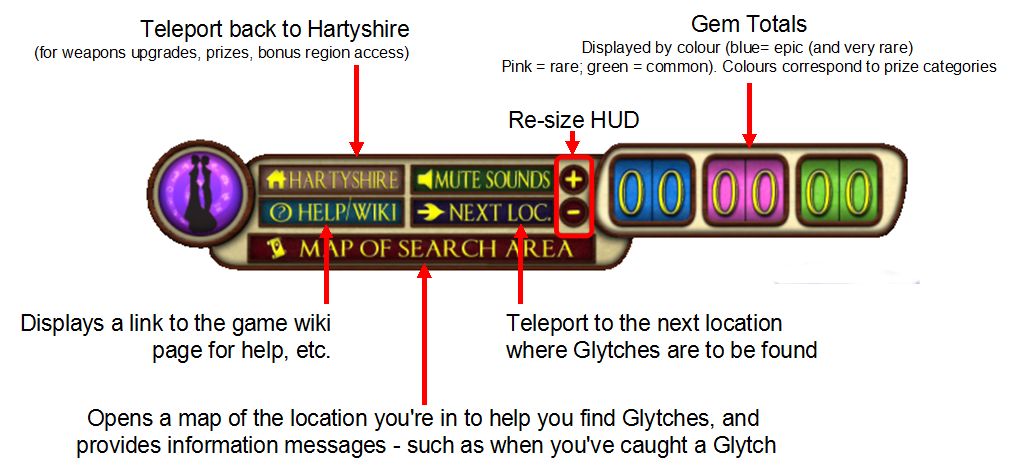
The HUD
To play the game, players must wear the game HUD. Removing this at any time stops all game-play, saving the player’s current status (e.g. gems taken, current weapon upgrade, etc). Players can re-join the game at any time simply by wearing the HUD once more; there is no need to return to Hartyshire in order to do so. The Glytch catching weapon can also be worn, although the game will also function without it.
The main game HUD
With the HUD worn, players click the Next Loc(ation) button to teleport to a location where they can hunt Glytches. On arrival, the Map can be opened to see where the Glytches are. A maximum of five Glytches can be caught per location, after which players should use Next Loc to move to another location to continue the hunt.
At the moment, Glytches can only be found on assorted Linden / LDPW regions and parcels. In the future, residents will be able to apply for their land to be added to the game – of which more anon.
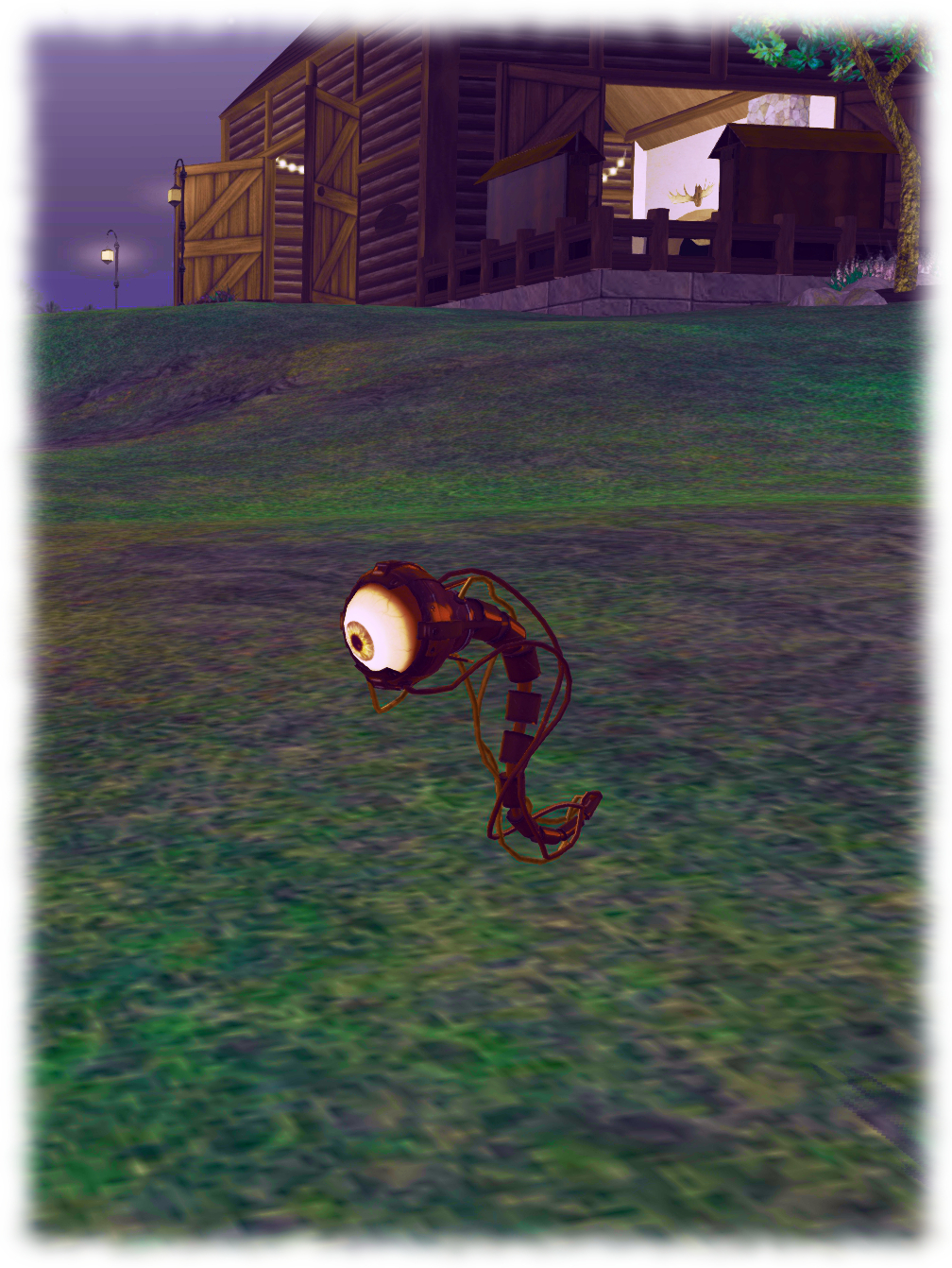
Glytches
A Glytch in the wild – is worth more in your cage
Glytches can be hunted in either first- or third-person view, but must be captured in first-person (Mouselook) view by clicking on them with the left mouse button. Note the range at which a Glytch can be caught varies with the weapon being used, and not all captures will be successful.
A failure to catch a Glytch can result in it casting a spell on the hunter. They’ll also use spells if startled or to protect one another. Spells vary from silly dances to anvils dropping on heads, but they will allow the Glytch to escape by de-rezzing (another will rez nearby).
A successful capture will result in a cage appearing around the Glytch and a message displayed on the game HUD. The Glytch may also offer you a reward. This might be gems or it might be a Glytch prize – or both.
Note that when a glitch prize is given, players must switch to third-person view (ESC) and Accept the Glytch via the notification displayed in the top right of the viewer window. Failure to do so may result in the prize being lost. If the notification collapses before it is clicked on, it can be re-opened via the Notifications tray.
To help keep the game fresh, new Glytches will be added over time A wiki-based Glytchopedia will also be published in due course, listing all the Glytches.
Ever since Sansar was announced in 2014, many have seen it as a sign that it is intended to be a “replacement” for Second Life – or if not, that the Lab is diverting all of its resources into Sansar at SL’s expense.
Neither assessment is accurate – asthe Lab has repeatedly tried to state. In fact, over the last three years, the Lab has continued to invest in Second Life, both in terms of features and improvements and in an overhaul of the Second Life infrastructure: hardware, network and so on.
On Tuesday, August 29th, Ebbe Altberg, CEO at linden Lab and the Second Life team outlined the future for the platform. Hopefully, it will further help further quell the doubts surround the Lab’s intentions for Second Life.
It’s been an exciting summer at Linden Lab. Second Life celebrated its 14th anniversary, and shortly thereafter we also opened Sansar’s creator beta to the world. In addition, we are thrilled to announce a set of investments into Second Life and its communities that will include enhancements to our engineering support, customer support, billing systems and upgrades, and customer acquisition outreach. In all, we’ve budgeted many millions (USD, not L$…) in the coming year to make SL even better, and we’ll keep everyone up to date on improvements as they roll out (or sooner).
The post then goes on to bullet-point some to the core aspects of these investments, some of which – such at animated objects / mesh (“Animesh”) and the Environmental Enhancement Project (EEP) to extend SL’s Windlight capabilities, I’ve been covering in the pages of this blog (see my Content Creation User Group meeting notes and my initial write-up on EEP).
The blog post also notes forthcoming new Premium account benefits will be announced soon. Hhowever, the two biggest aspects of the news are infrastructure updates and a new grid-wide Experience.
The infrastructure work has been on-going for some time – most recently the Lab has deployed a new simulator build using a more recent version of Linux, and a further operating system update will also be forthcoming. However, what is interesting about this blog post is that it confirms something first mentioned publicly by Landon Linden at SL14B – the infrastructure updates include moving Second Life to the cloud.
This work will not be short-term, but if successful, the Lab hopes for a number of benefits, including:
Making Second Life more performant for Residents across the world from us.
Possibly allowing the Lab to introduce new products with more flexible pricing.
The new Experience may not appeal to everyone, but it will see a new capability added to Second Life: grid-way experiences. This will initially be in the form of a new grid-wide game developed by the Lab; whether or not it will – in time – allow interested region / parcel owners participate in grid-wide Experiences of their own making remains to be seen.
However, the continued investment in Second Life infrastructure which perhaps stands as the greatest demonstration of the Lab’s commitment to Second Life, and I hope to be able to follow the work through these pages as the Lab provides updates and news.
 Linden Lab has issued an important notice for international users who have a credit card filed with the company for the payment of services.


 Inara Pey: Living in a Modemworld