As promised in the Second Life roadmap blog post of March 2018, the land auction system has been revamped, and is now live – although only for Linden Lab held Mainland at this point in time.
The announcement came via a blog post, A Face lift for Auctions, on Wednesday, July 11th. As per that announcement, the new auction system leverages Second Life Place Pages as the medium for presenting land up for auction and for placing bids, together with a new “cover page” listing available parcels up for auction. which can be found at https://places.secondlife.com/auctions.
As per the official blog post, there are a few things to note with the new system:
Currently, it is for Linden-held land only – Mainland parcel owners will be able to add their own parcels for auction soon.
Auctions of group-owned land are not supported at present.
When bidding, you must have the funds available in your account – under the new system, your maximum bid amount is immediately taken out of your account and held in escrow until you are outbid, or win the auction.
Winning bidders will generally be notified within one hour of an auction closing.
The new Places/Auctions page. Clicking on the link for a parcel available for auction will initially display a brief summary of the parcel (bid end time and current leading bid amount) before taking you to the auction page for the parcel – click to enlarge, if required
To help people get started with the new system, the Lab have produced an Auctions Walkthrough document, together with an Auctions FAQ – both of which should be read by those interested in place their parcels up for auction (when the system is open for people to do so) or who wish to bid on the parcels currently being auctioned.
Those wishing to offer their own land for auction (when possible) and who are not familiar with using Second Life Place pages, may want to read through my Place Pages tutorial. I will be updating this tutorial to additionally include information on how to create your own parcel auctions in due course.
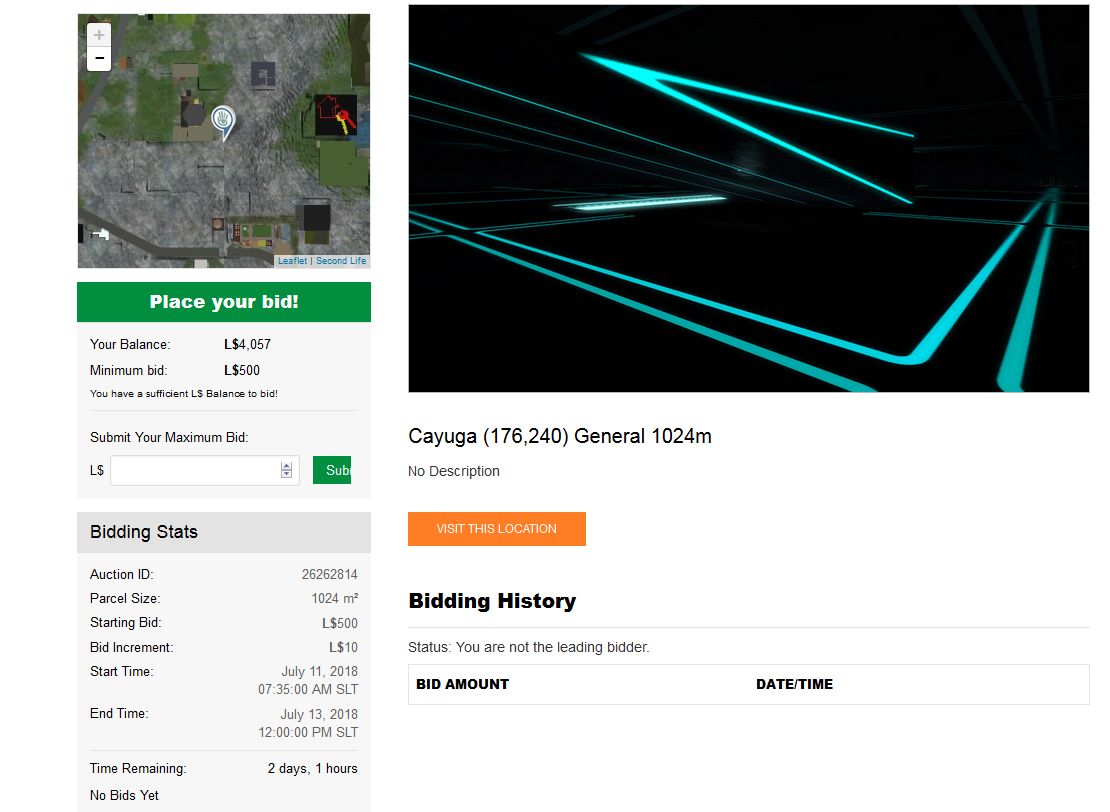
A parcel auction page – note the image on the right is a placeholder; those auctioning their land can include a photograph of it, taken from the parcel’s Place Page
A major goal at the Lab is to “re-balance” the Second Life economy – shifting the onus of their revenue generation away from a heavy reliance on virtual land leasing to distribute it more broadly across all fronts – land, Premium subscriptions, transaction fees, Marketplace fees, etc. Over the last few years we’ve seen some of this in action:
In April 2016, increases were made to all transaction processing fees and Linden Dollar processing fees (raising the latter by 30% to US $0.40 per L$ purchase).
In June 2017 increases were made to the maximum fee for processing credit transactions was raised to US $25, and the fee charged per L$ purchase was raised to US $0.60.
In November 2017, increases were made to L$ purchase fees (to US $0.99 per transaction) and to fees charged for transferring money via PayPal or Skill from the start of 2018, raising both to 2.5% with no maximum limit on the application of the fee.
Some of these increases were couched as being in part to meet the costs involved in the Lab handling the transactions and ensuring all proper fiscal and legal requirements for money handling are properly met. Doubtless, this was the case – the Lab has invested heavily in matters of compliance. However, it’s also not unfair to say that once the initial expense in performing this work has been recouped, these fee increases enable the Lab to both cover the cost of transaction handling and generate some revenue through such transactions (however modest on the individual transaction it might be).
On the other side of the scale, we’ve seen efforts to make virtual land more attractive – notably through the region buy-down offer of April-September 2016, and more recently the changes to Mainland pricing.
On July 2nd, 2018, the most ambitious change to private region pricing in Second Life came into effect: a reduction of 15% in private region maintenance fees (tier) for all current region types and reductions in the set-up fees for Full and Homestead regions (new OpenSpace (“water”) regions no longer being offered as a product from July 2nd, 2018).
These changes – it should be noted – come with a further increase in Linden Dollar purchase fees, which increase to US $1.49 per transaction.
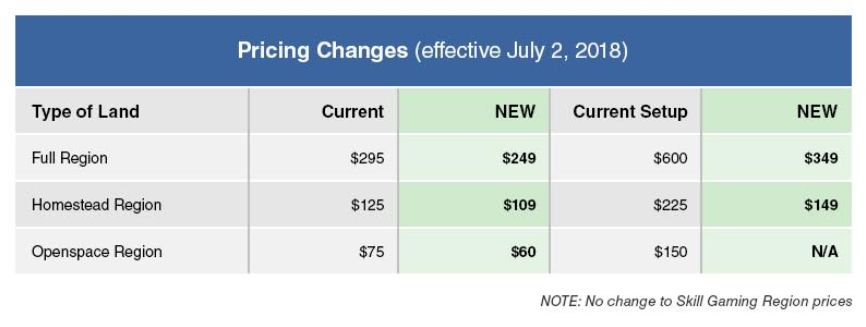
New Private region pricing structure. Note that as from July 2nd, 2018, new OpenSpace regions will no longer be available as a product, and Linden Dollar purchase fees increase to US $1.49 per transaction
It’s fair to say that any change of this kind, be it in land pricing or transaction fees, can generate heated feedback (witness this forum thread on the 2017 increases). The changes to private region fees have been no exception, with views being expressed via in-world groups, within assorted forums (such as SLU) and even in blog comments. Some have been upset over the L$ transaction fee increase; others – notably those in the virtual land rental business – have been upset by the change no extending to grandfathered regions; others apparently don’t see the move as “enough”, protesting that the tier rate should be cut to US $195 (or similar). And there has been a fair amount of reaction to the L$ purchase fee increase.
Obviously, time will reveal the outcome of these changes, but as is my want, I’d pass comment on a few things.
When it comes to the land rental business, it is hard to see why the exclusion of grandfathered regions is being taken so negatively. For one thing, these are already below the new tier rates, as the Lab states. Further, it is now 18 months since the buy-down offer closed. This should have been enough time to recover the up-front cost of converting regions to grandfathered status (US $600 / Full; US $180 / Homestead), and now leave rental companies in a position to enjoy a modest increase in income from such regions whilst also offering customers using them a degree of lower rent.
Which is pretty much also the opportunity they have with this tier reduction. Frankly, 15% is unlikely to have people leaping in droves to buy Full regions directly from the Lab. But what it might do is once again increase people’s desire to have Homestead regions as private homes. Given that these remain tied to holding at least one Full region, it’s not unfair to say that should it happen, land rental companies can only benefit. And even if the private land market remains relatively flat, such businesses should still be able to lower their rental rates to attract new customers without damaging their existing margins.
So it really is hard to see why some in the land rental business are so put out by grandfathered regions being excluded, or to claim they get “none” of the benefits of this fee reduction.
When it comes to the increase in Linden Dollar transaction fees (which with this increase will have rise by 198.4% since April 2016), the impact will perhaps be harder to gauge, simply because people can offset at least some of the impact by adjusting the amounts of Linden Dollars they purchase in a single pass. Just how much of an offset can be achieved depends on a range of factors – the amount of L$ someone buys in a single pass, how easily they might be able to consolidate purchases, etc. – but this doesn’t deny the fact it is precisely what people have been doing as a result of past increases.
Even so, it will in interesting to see what, if any, impact this has on actual spending in SL – although I suspect that changes to fees elsewhere that have been hinted at (such as with the Marketplace) might have more of a visible impact, if and when they come into effect.
There will always be positives and negatives to just about anything the Lab does. However, “the tier is too damned high!” has long been a mantra within Second Life and while it is “only” a 15% reduction in tier, this is a positive step towards addressing this mantra when it comes to private regions fees (and it’s not unreasonable to assume there might yet be more in the future – although they are unlikely to be even close to appearing over the horizon at this point in time). Similarly, while people are likely to continue to be put out by it, the increase in to the L$ transaction fee is a relatively “fair” move, as it spreads at least some of the burden of revenue generation for the Lab across a much broader section of the SL user base.
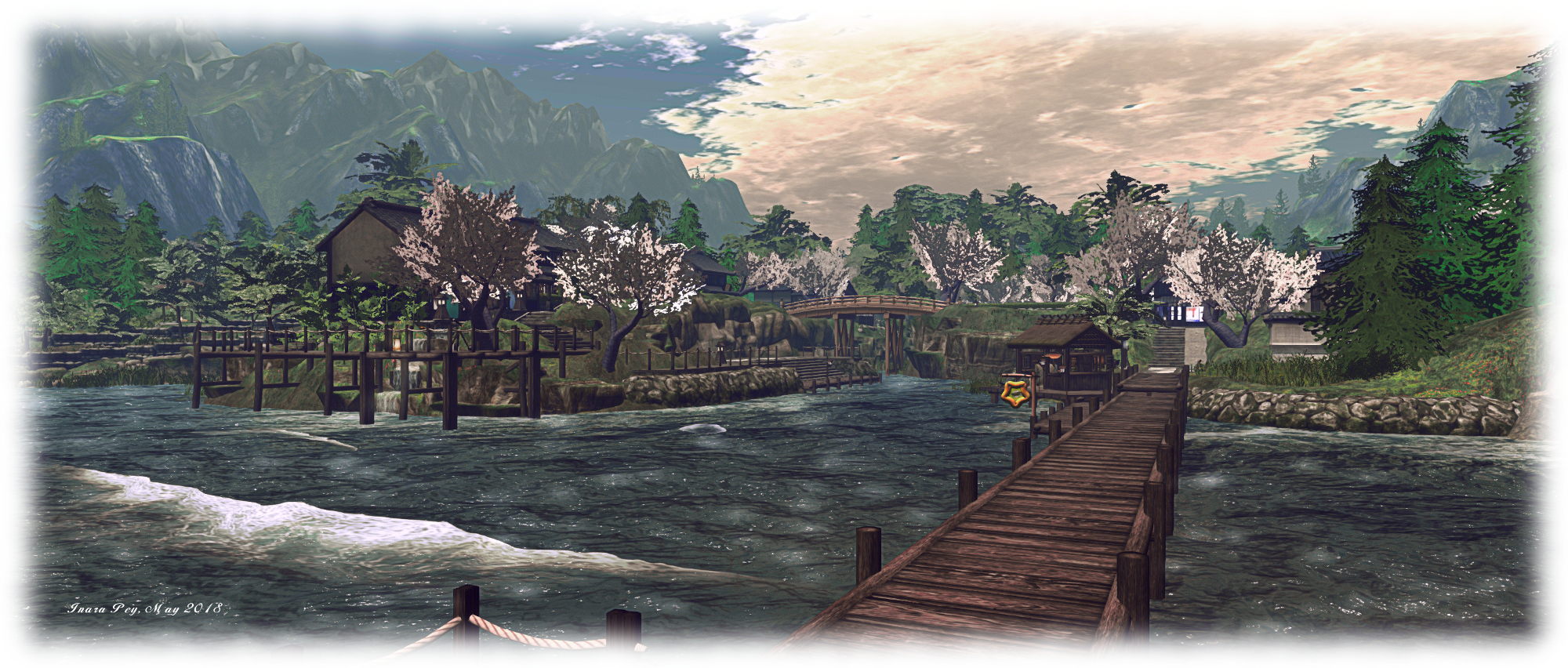
Private region set-up fees and monthly tier rates will be reduced from July 2nd, 2018 – see below (region pictured: Isle of May – blog post
Updated to include a quote from Ebbe Altberg
On Wednesday, June 20th, while speaking at the Meet the Lindens event, Linden Lab, and a a part of the SL15B celebrations, CEO Ebbe Altberg made a major announcement concerning private region maintenance fees (aka tier).
I’ve been saying for quite a while now that I think the balance between what it cost to have land versus what it costs to transact or buy and sell in the economy is a little off-kilter. Land is quite expensive but selling things in the world is quite cheap, comparatively speaking. So I a basically fell we have fairly high real estate taes but very low consumption tax. so we’re trying to adjust this so that it’s better. That was part of the Mainland price reduction, and today I can also announce we’re going to lower the cost of private estates!
Ebbe Altberg, Linden Lab CEO speaking at SL15B during his Meet The Lindens session.
As from July 2nd, 2018, private region tier will be reduced by 15% for full and Homestead regions. In addition, the one-time set-up fee applicable to Full and Homestead regions is being reduced.
This means that after July 2nd, 2018, private region set-up fees and monthly tier rate will be as follows:
New Private region pricing structure. Note that as from July 2nd, 2018, new OpenSpace regions will not longer be available as a product (see below for more). Table courtesy of Linden Lab. Remember set-up fees include the first month’s tier
There are some caveats to this restructuring:
Skill Gaming regions are not included in this restructuring.
This reduction does not include grandfathered / “bought down” regions as they are already priced well below these new rates.
From July 2nd, the OpenSpace (“water”) class of region will no longer be offered as a product – however, existing OpenSpace regions already in use on the grid will continue to be supported, and will be subject to the tier discount.
Education/Nonprofit (EDU/NP) discounted full islands will be re-priced to maintain their 50% discount off the regularly priced full islands, with the new tier rate of US $124.50 applying at the start of that island’s next invoiced billing term.
Linden Dollar Purchase Fee Increase
As noted above, Ebbe has previously indicated (see here for example), Linden Lab is attempting to re-balance how the company generates revenue through the Second Life platform to help reduce region tier pricing. This is being done by increases in fees charged elsewhere within the service.
Thus to help offset the revenue loss resulting from this reduction in private region fees, Ebbe also announced that the cost to buy Linden Dollars will be increasing to US $1.49 per transaction (compared to the current rate of US $0.99 cents per transaction).
Feedback
Over the last few years we’ve seen genuine efforts on the Lab’s part to try to ease the burden of tier for region holders.
In 2016, there was the region buy-down offer, which allowed private region holders to grandfather their regions for a one-time fee. This reduced the monthly cost of Full regions to US $195, and Homestead region to US $95.
As noted above, these regions are excluded from the 15% tier-rate reduction.
In March of 2018, the Lab reduced monthly mainland fees by 10%, while also doubling the amount of tier-free land available to Premium members (from 512 sq metres to 1024 sq metres).
(Note I’m excluding the 2011 Land Sale from this list, as it was a long time ago, and something of a different strategy compared to trying to lower tier costs.)
Both of these moves were very positively received by users, and given that requests to reduce tier have long been made, I’ve little doubt this announcement will be equally well-received.
One thing it should do is confirm the Lab is committed to trying to improve Second Life for users – not only in technical terms, but also in making the platform’s revenue generation something that is more evenly spread among all users.
Tyche’s tweet on the relative fall-off in region losses between 2018 and 2017
Even so, this is a bold move, and one that can only be taken to mean that recent moves to pivot some of the revenue generation away from land (e.g. through the transaction fee increases (March 2016, June 2017 and November 2017), possibly coupled with more recent uptake of premium user subscriptions, has given the Lab confidence that they can reasonably offset revenue loss from the tier reduction through other channels.
Certainly, it shows how far things have come since 2013, when it was hard to see any tier reduction not hurting the Lab’s bottom unless alternative revenue sources could be reliably built-up.
With Tyche Shepherd of Grid Survey fame reporting that the rate of decline in private regions continues to ease, it will be interesting to see how this announcement affects the overall interest among those wishing to acquire land of their own, either directly through the Lab or through any of the major land realtor operations in Second Life.
In the meantime, you can read the full text of the Lab’s announcement here.
My thanks to Xiola and Brett Linden for their assistance with this article.
On Friday, June 8th, 2018, Linden Lab announced that estate / region holders can now restart their region directly from their Second Life dashboard at secondlife.com, via the My Estates page.
The option to be able to restart their regions remotely is a capability private estate and region owners have been requesting for some time, as the Lab acknowledge in their announcement:
We’ve been listening to the feedback from our Private Region owner community and we know that sometimes it’s impractical or even impossible to access your region in-world to perform the more traditional in-viewer region restart using the Region/Estate menu. With this new feature, Estate Owners can pro-actively select and restart their regions directly from the website without needing to log in-world and travel to each region individually.
Private estate holders can now restart their regions view their Second Life dashboard
When using the capability, estate / region owners should make note of the following, as stated in the Lab’s blog post:
Since we know that sometimes the reason a region cannot be accessed easily in-world is due to active griefing scenarios, we have also included the ability to restart the region in safe mode, in which the region will be brought back up with all the scripts, physics, and collisions disabled, making it possible to enter and remove any lingering item that may be causing issues. To see the new features available to you as a private Estate Owner, just log in to SecondLife.com and visit your Land Manager page.
Please refer to the Lab’s blog post for further information on this update.
On May 25th, 2018 the European Union’s General Data Protection Regulation (GDPR) comes into force. While an EU regulation, the GDPR not only applies to organisations located within the EU but it will also apply to organisations located outside of the EU if they offer goods or services to, or monitor the behaviour of, EU data subjects.
Earlier in May, the Lab issued a blog post providing an initial outline of their compliance with the GDPR, which covers both Second Life and Sansar. In that post they promised they would provide further details on how EU citizens can exercise their rights under the GDPR. On May 24th, they issued an e-mail summarising updates to their Privacy Policy. The e-mail reads in full:
We value our relationship with our community and your privacy. We have updated our Privacy Policy to increase transparency and comply with the European Union data protection law known as the General Data Protection Regulation (GDPR), which goes into effect on May 25, 2018. We encourage you to read our policies in full, but here are some highlights of what’s changed:
We provide additional details about the types of data that we collect, the ways in which we use it, and the measures we take to keep your data safe,
We added information about new choices and controls for users to manage their privacy, and
We added information about user’s rights regarding their privacy.
The updates to our policies will go into effect on May 25, 2018. If you have questions, please contact us at privacy@lindenlab.com.
Thank you for being part of the Linden Lab community!
The Linden Lab Team
The specific sections of the Privacy Policy that have been updated are:
On May 25th, 2018 the European Union’s General Data Protection Regulation (GDPR) comes into force. While an EU regulation, the GDPR not only applies to organisations located within the EU but it will also apply to organisations located outside of the EU if they offer goods or services to, or monitor the behaviour of, EU data subjects.
The GDPR applies to all companies processing and holding the personal data of data subjects residing in the European Union, regardless of the company’s location. As such, it not only Linden Lab, who hold data on Second Life and Sansar users in the European Union, it can also impact those operating a business through Second Life and who collect data on customers which is stored outside of the servers operated by Linden Lab.
In preparation for the enforcement of the GDPR, on May 9th, 2018, Linden Lab issued a preliminary blog post on their compliance with the GDPR, which covers both Second Life or Sansar.
GDPR, in a nutshell.
Put simply, the GDPR puts in place new requirements for the collection, maintenance, and use of personal data for residents of the European Union (EU) and European Economic Area (EEA). It’s an important evolution in privacy practices, and one we’ve already started to account for: if you notice, our existing Privacy Policy already discloses the type of personal data we collect from you, how we use and limit any sharing of your data, and your rights to control our use of your personal data.
What you can expect.
In coming weeks, we’ll provide more information on how EU residents in Second Life can best exercise their rights under GDPR. In some cases, you may take actions through your account dashboard (to modify your personal data, for instance). In others, it may be necessary to file a support ticket and verify your identity (to better protect your privacy).
– Linden Lab May 9th blog post on the upcoming GDPR
The GDPR defines personal data as, “any information related to a natural person or ‘Data Subject’, that can be used to directly or indirectly identify the person.” This includes, but is not limited to: IP addresses, on-line identifiers (including avatar names), e-mail addresses, photographs, as well as the more usual name, address, bank details, medical data, etc.
In addition to defining requirements for how such data should be managed and protected by organisations gathering it, the GDPR also specifies a number of rights to Data Subjects who have their personal information stored by companies and other entities. These include, but are not limited to:
The right to be informed: Data Subjects have the right to know what data is being collected, how it’s being used, how long it will be kept and whether it will be shared with any third parties.
The right to access: generally speaking, organisations are required, within one month of receipt of a formal request, to provide a copy of any personal data concerning the requesting Data Subject.
The right to rectification: a Data Subject can formally request that inaccurate or incomplete information relating to them is updated, and the update must be made within one month (exceptions can apply).
The right to be forgotten: a Data Subject can request the erasure of all personal data relating to them in certain circumstances (e.g. it is no longer necessary to hold it; if the data was unlawfully processed or it no longer meets the lawful ground for which it was collected). However, there are certain exceptions to this.
(In addition, the GDPR defines: The right to object (to data being gathered); The right to restrict processing; The right to data portability; and Rights related to automated decision making including profiling.)
For those running businesses through Second Life or Sansar which use services – web sites, computers, etc., – outside of Second Life for the collection and storage of personal information on their EU Second Life / Sansar customers, the GDPR might have significant import – and exposure to the risk of fines. For such businesses, the Lab’s advice is clear and straightforward:
If you collect or process personal data of EU residents on a website associated with Second Life or Sansar, or create or make use of programs that retain information about Second Life or Sansar users or their computers, you may also have obligations under the GDPR. You should consult with your legal counsel for advice regarding your site(s) or program(s).
– Linden Lab May 9th blog post on the upcoming GDPR
To help people get to grips with GDPR, if they haven’t been aware of its arrival, the Lab offer a series of links to articles and FAQs. To these I would add:
 Update, February 26th, 2019: it is now possible for users to offer their own Mainland property for auction. See Mainland users can now auction their land and Creating Your Own Auctions.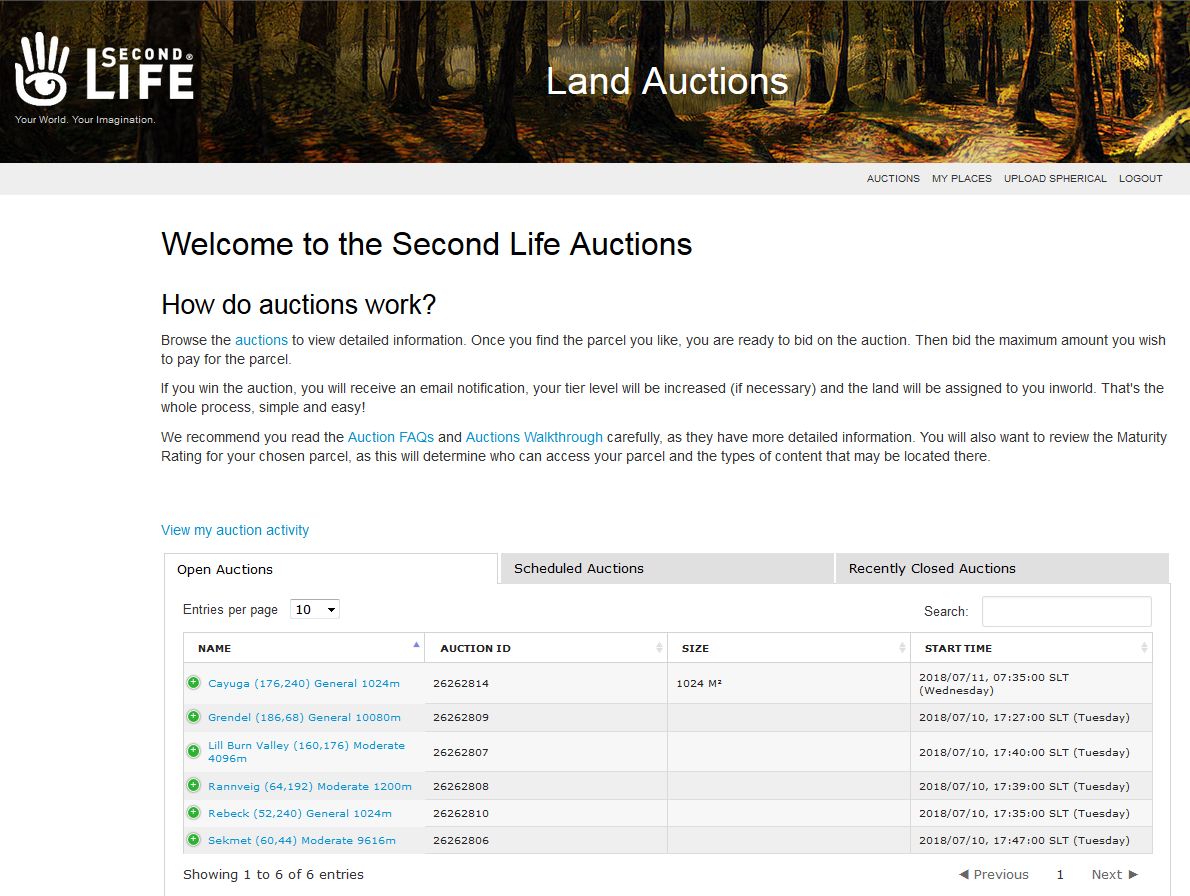


 Inara Pey: Living in a Modemworld