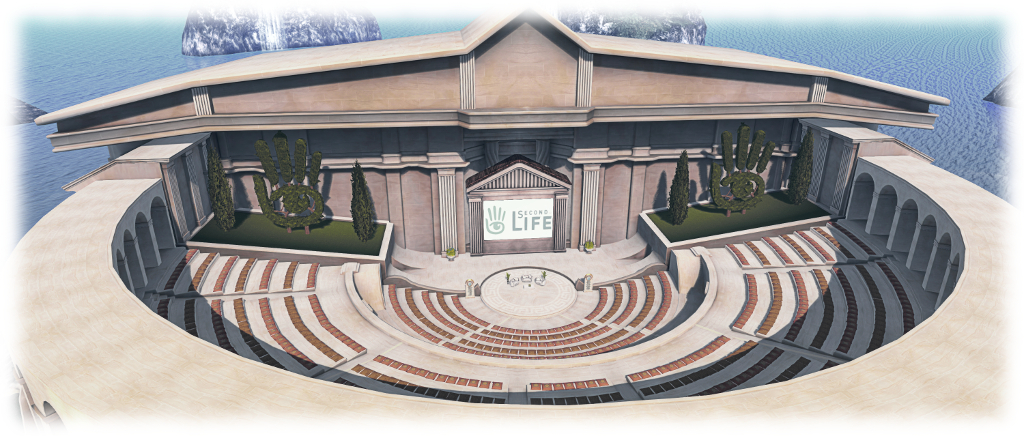
Lab takes an end-of-year look at Second Life

On Wednesday, December 19th, Linden Lab offered a look back at 2018 and something of a look ahead to 2019. There’s actually been a lot going on, although it is surprising to note that some of the bigger deliveries / anticipated deliveries actually first started to surface in 2017, when I reviewed / previewed them.

I’ll be taking a look through the major changes to Second Life myself in an upcoming blog post, so won’t delve too deeply into things here.

Unsurprisingly, Animesh is featured front-and-centre for the year’s delivery – although it’ll be early 2019 before we really start to see the impact this project has on the grid as a whole; many creators have yet to really embrace it, although there were certainly a lot of creative ideas put forward at the Content Creation User Group meetings.

The Lab’s post also focuses on the changes made to land pricing in SL – arguably the biggest set of changes in 2018. It’s fair to say  that overall, the response to changes both Mainland and Private regions has been positive. In fact, it could be one – and I emphasise one, because there are others – of the reasons people might be spending less: with limited disposal income, people may have diverted some of their Second life spending away from buying things and into premium memberships and  / or land.

For me, the big projects through 2018 and 2019 have been, and remain, the Environmental Enhancement Project (EEP) and the attempt to move Second Life to the cloud. The latter is hard to judge, as it is very much a behind-the-scenes move that has yet to really have an impact on the user-facing side of the platform. however, I fully expect we’ll be hearing more about it in 2019.

EEP, on the other hand, is something I think will help revolutionise the look of Second Life – even if not quite to the extent some may hope. As such, I’m actually more excited about this than Animesh (and have had great fun playing with EEP whilst it has been in beta testing).

In particular, it will finally bring environment control down to the parcel level, as well as allowing different environment settings at different altitudes. These two capabilities have, until EEP, been dependent on purely viewer-side support and limited to the use of the likes of Firestorm. With these capabilities now moving server-side, everyone gets to benefit from them, regardless of the viewer they’re using, and region / parcel holders finally get the opportunity to have users see their regions and locations as they desire (allow for people retaining the ability to override, viewer-side), and without having to request they change their viewer settings manually, or having to worry about whether or not the windlight they are using is generally available.

Again, EEP won’t be appearing fully until 2019, but the Lab’s blog post includes a nice little preview video by Silas Merlin that I’m taking the liberty of reproducing here.

For me, the most interesting part of the Lab’s blog post comes at the end, starting with a chart showing average concurrency over the last two years. It shows levels to be relatively stable.

Of course, there might be a temptation to offer contrasts between this chart and others that report more in the way of averages over shorter periods – such as those found on the Firestorm log-in screen or via infographics such as those shown on Tateru Nino’s stats pages (which appear to be recording again after having problems earlier in the year). However, given there is no actual benchmark for the Lab’s chart, such comparisons would be somewhat off-base; the chart isn’t designed to show averages or daily high-lows. It simply shows a 730-day period in which the peak daily log-ins (I would assume) have remained pretty constant, despite all the claims of falling numbers.

The Lab’s two-year concurrency chart

The flipside of this of course, is that equally, it’s hard to really judge such a broad trend like as this, simply because it is likely taken from one data point, be it peak daily log-ins or something else. For example: if it is tracking just peak log-ins, what were the daily minimums? How long per day were the peak periods? have there been any changes in this over the two years?

A more interesting stat is that for the amount of USD cashed-out. Put at $65 million, this is only $2 million less than that quoted for 2017, and still above the US $60 million for 2016. As such, it stands at odds with claims that the Second Life economy has been in some kind of slump during at least the second half of 2018, suggesting that things have been relatively stable overall. Which is not to say that some merchants haven’t seen a downturn in sales; but these could be the result of people shifting their spending habits more that not spending their money – see my comment re land, above.

The final two listings on the Marketplace and the Destination Guide make for interesting reading, but little more – although the fact that men’s apparel comes in 10th on the Marketplace  while women’s comes in second might be an interesting topic to plumb. Is it simply because there are fewer creators focusing on menswear, or is it a combination of fewer creators and male Second Life users perhaps being less driven by the demands of fashion?

As noted, I’ll have more on the technical and other updates to Second Life in an upcoming article, and for now will leave you to read the Lab’s summation in peace 🙂 .

Our Digital Selves: film festival nominee

via Monarch Film Festival

The Monarch Film Festival is an annual event held in Pacific Grove, California. It is intended to not only showcase the latest in International blockbuster achievements, but to also be a place where local filmmakers of any age can show their artistic vision on the big screen.

Among this year’s entrants in the Festival is Our Digital Selves: My Avatar is me, the documentary by Brenard “Draxtor Despres” Drax, the film focus on the work of Tom Boellstorff and Donna Z Davis (respectively Tom Bukowski and Tredi Felisimo in Second Life), who for three years were engaged in  studying the experiences of people with disabilities – visible and invisible – who are using immersive virtual spaces to represent themselves, possibly free of the shadow of any disability, engage with others and do things they may not be able to do in the physical world.

Released in May 2018, the film tells the story of 13 global citizens and their avatars as they transcend their various disabilities through artistic expression and making a home for themselves in the VR Metaverse – Second Life, Sansar and High Fidelity. You can read more about the film and Donna and Tom’s work in my articles: Our Digital Selves: living within a virtualised world (2018) and Exploring disability, new cultures and self in a virtual realm (2016).

As a part of this year’s Monarch Film Festival, Our Digital Selves is in the running for Best Documentary. As such, the film will be shown on Friday, December 7th, 2018: 5:35 PM, Pacific Time, And those wishing to attend in person can purchase tickets view the link at the start of this paragraph. For those who cannot see the film at the festival, it can be seen via Draxtor’s You Tube channel, and I’ve embedded it below as a reminder – if you’ve not see it before, now it your chance to catch up with a truly remarkable documentary.

The other nominees for Best Documentary at the festival are:

  • Moksha, by Jennifer Killian, a film that follows three Nepali women who have dedicated themselves to spreading the joy that mountain biking can give to women across the Himalayas.
  • Up to Snuff by  Mark Maxey, following the life of American musician and composer W.G. Snuffy Walden.
  • Who Killed Lt. Van Dorn? by Zachary Stauffer, recording the efforts of Nicole Van Dorn to discover what actually happened in the helicopter accident that killed her husband, Lt. Wes Van Dorn.
  • Rodents  of Unusual Size by Quinn Costello, Chris Metzler, and Jeff Springer, tracing the work of fisherman Thomas Gonzales as he faces the threat of hordes of monstrous 20 pound swamp rats that are eating up the coastal wetlands that protects Thomas and his town of Delacroix Island from hurricanes.

Congratulations to Drax and all involved in Our Digital Lives, and wishing them all the best for the film festival.

Related Links

With thanks to Eliot for the heads-up.

Second Life: open-source Linden Realms code to be open-sourced

The re-vamped Linden Realms and rock monsters. Credit: Linden Lab

During the Content Creation User Group meeting on Thursday, November 29th, Oz Linden announced that Linden Lab will be open-sourcing the code used within the Linden Realms game to content / experience creators.

The aim of the move is to make the code available to (Premium) users wishing to build interactive experiences / games within Second Life, so they might study it, re-purpose elements from it, and even critique it.

The release, when it is made, will be of the latest iteration of Linden Realms, which was updated in October 2018 to provide a completely new look and offer a broader range of game elements. It is also supported by end-user documentation on how to play the game, which might also be useful to experience creators in generating their own supporting end-user games.

Making content like this available to a wider audience is something that has been requested on numerous occasions during Content Creation meetings. The move also fits into the broader pattern of the Lab involving creators and users in the development of capabilities within Second Life – as Vir Linden noted during the meeting when Oz made his announcement. Given that the code is to be open-sourced, it means that updates and improvements to it – or new capabilities / options added to it – could be contributed back to Linden Lab, and thus to others building experience-based games.

Part of the re-vamped Linden Realms. Credit: Linden Lab

The move is also potentially in keeping the Lab’s hope to increase the Second Life user-base. Games are an obvious means of attracting new users to a platform, and providing the means for creators to develop and run more comprehensive games using mechanisms that both work and which can potentially be extended and enhanced. Coupled with the means to bring users directly into said games – such as by the new user API and / or Second Life Place Pages (although the latter do perhaps require further enhancements themselves to be more practical) – they might come to assist in attracting new users. Time will tell on that.

It’s not clear   exactly when the code will be made available; as Oz linden noted, it requires careful checking to avoid the risk of code that could be exploited to the detriment of Second Life. Hopefully, there will be an official blog post when the code is made available to all.

LEA announces restructure

On Thursday, November 29th, 2018, the serving committee of the Linden Endowment for the Arts gave notices that the LEA will be undergoing restructuring, which will include – for the initial part of 2019 – the closure of the 20 Artist In Residence (AIR) regions currently held by the LEA (LEA 10 through 29).

The core part of the announcement reads as follows:

Come January 1st 2019, the Linden Endowment for the Arts, known as the LEA, will be temporarily closing its Artists in Residence regions (LEA 10 – 29) to allow for a major restructuring.

Over the last seven years, these regions have been open for artists who apply to build their dreams, each for a six month grant. We have seen many great installations here – and some that have attracted controversy.

The nine Core regions (which include the Theatre, the Sandbox and Photohunt) will remain for the present, and short-term grants will still be available in these regions for community-inspired arts projects.

Discussions between the present Committee and Linden Lab about the future form of the LEA are ongoing, but it is anticipated that there will be a new organising committee when the AiR regions re-open.

KÖMA – LEA 22, November 2018 – read here for more

While it is undeniable the LEA has done a huge amount of good for art and artists in Second Life, particularly those who would not otherwise be able to amount large-scale events, it has also not been without its own controversy and for – in some circles – gaining a reputation for being something of a “star chamber” in terms of the committee’s method of operation.

For example, in 2013, just 18 months after the LEA was formed under the tenure of Mark Kingdon as the Lab’s CEO, the former Community Manager, Mark Viale, was forced to step-in after public concerns and reported irregularities with how the LEA was being run. That resulted in the formation of the LEA Committee bylaws. Intended to offer transparency, the bylaws perhaps resulted in the opposite by allowing what were effectively closed-door meetings, few of which generated public transcripts or notes. The bylaws themselves became in part a subject of controversy in 2015, when they were quietly removed from the LEA website when the committee of the time was challenged under them, after a committee member griefed an art gallery (for the record, the bylaws can still be seen via  the Wayback machine).

Second Life 1999 / 2017 – The Story – LEA 25, 2017 – read more here

Given this, some might feel reviewing and revitalising the LEA is something that is well overdue; a view I would share. I would certainly hope that any new committee – allowing for any ideas Linden Lab may have – that may be formed, should the LEA continue, would seek to better engage with the broader arts communities across Second Life, and seek to go about its work with greater transparency with meetings and through the keeping of public records.

In the meantime, those wishing to apply to use one of the core regions, which are available for 3-month grants (longer by arrangement) can do so via the LEA Core Sim application page.

November SL Town Hall with Oz, Grumpity and Patch – reminder

Just a quick reminder.

The next in the Lab’s in-world Town Hall series, featuring Director of Product, Grumpity Linden, Technical Director Oz Linden, and Senior Director of Product Operations, Patch Linden, will take place on Thursday, November 15th, 2018 at 10:00 SLT (18:00 GMT / 19:00 CET). The event will take place at the Town Hall meeting regions, with the landing point URLs as follows:

Selected questions from the Town Hall meeting forum thread (now closed) will be put to Grumpity, Patch and Oz during the session, and there may be an opportunity to ask questions from the audience, if time permits.

All things being equal, I hope to have a summary of the session up after the event, which will be similar in nature to my summaries of 2018 Town Hall meeting – see here for the September Town Hall with Ebbe, as an example.

Firestorm: fake website and downloads warning

There are always certain risks involved in on-line living. With Second Life, we’ve all likely seen or heard of various scams and attempts to either data-scrape or gain people’s account details through phishing and other means.

Another area of risk is using viewers from untrusted sources, making a careful checking of linking to TPV sites mandatory (e.g. by checking them through the Third Party Viewer Directory page on the SL wiki) – particularly when they appear in note cards or pop-up in group chat sessions, and so on.

I raise this because Firestorm has been the subject of fake accounts posting links to a completely fake Firestorm viewer website.

Group and individual IMs have been circulating from fake “Firestorm” accounts, pointing to a fake Firestorm website & viewer downloads – with the Windows download link infected

The website – note the addresses arrowed above – is a scam site that is particularly nasty, as the Windows download link is infected – see virustotal.com – and so should not be used.

For clarity, Firestorm’s actual web address is: http://www.firestormviewer.org/ – no “pro” or anything else in the URL. Furthermore, outside of their own support and test groups, Firestorm do not spam other groups or individuals with links for downloading their viewer.

Currently, the Firestorm team is trying to get the false site taken down, and Linden Lab are working with them to ban the fake accounts.

However, if you do receive an IM similar to the one shown above, fielding fake website URLs, or see a similar message in a Group IM or notice, please don’t simply dismiss it. Linden Lab have requested those in receipt on such messages / notices should file an Abuse Report.

When filing a report, make sure you take a screen shot showing the message / notice displayed in your viewer – the abuse report screen shot feature will automatically capture open IM windows, etc. Reports can be filed under the Harassment category.

If you need assistance with raising an Abuse Report, please refer to my Abuse Reports tutorial, written with the assistance of Linden Lab’s Governance team.