Premièring on July 24th, 2020: STÖMOL a Second Life Machinima

STÖMOL publicity image

Update: due to some last-minute changes, the public première of  STÖMOL is now slated for July 24th – details at the end of this article.

STÖMOL is an ambitious feature-length science fiction machinima filmed entirely in Second Life and due to première on You Tube on Thursday July 23rd, 2020.

Written, directed filmed and produced by Huckleberry Hax, who also takes the lead role of Epi Stömol, a private investigator. Also appearing in the film are Caitlin Tobias as Waarheid and who is also the film’s assistant director and publicist; Ylva as Verity Certain, Boudicca Amat as Istinito Tatsache, Anthony Wesburn as Adevaru) and Mich Michabo as The Quill.

Stylistically, the film is very much shot in the style of an animated graphic novel – think of the likes of Sin City and you’ll get the idea – that grew out of Hax’s writing and Second Life photography. In all it has taken some 18 months to produce, and involved filming in more than 15 regions around Second Life. These include Zee9’s evolving Drune builds, which I’ve featured in these pages on a number of occasions (see: Drune IV: an Aftermath in Second Life, and Drune: a further visit in Second Life, for example), and the (now sadly passed into history) Kun-Tei-Ner by Lotus Mastroianni and Fred Hamilton (see: Kun-Tei-Ner: a water world in Second Life) and Huntington Beach, designed by Jade Koltai, although it has also since passed into a the pages of history (see: A trip to Huntington Beach in Second Life).

Described as being about “history” in the form of climate change and “truth” – topics that should both resonate with an audience, given the current geopolitical situation in the modern world – STÖMOL  is framed around the search for a pair of missing coders, a boy and a girl called the Eye and the Quill respectively, who may hold the key to unlocking the truth about Earth’s current situation- or perhaps they represent something else.

Official history tells us the sky turned red after an asteroid hit the planet and a trillion particles of dust got blasted into the air. But some people say that’s a lie. They claim we did this to ourselves.
They can’t prove any of it. From 1990 onwards – seventy years of history – there’s official conglomerate media only. Systems today don’t recognise the file formats from back then. ‘Digital Hygeine,’ they tell us.

– From STÖMOL

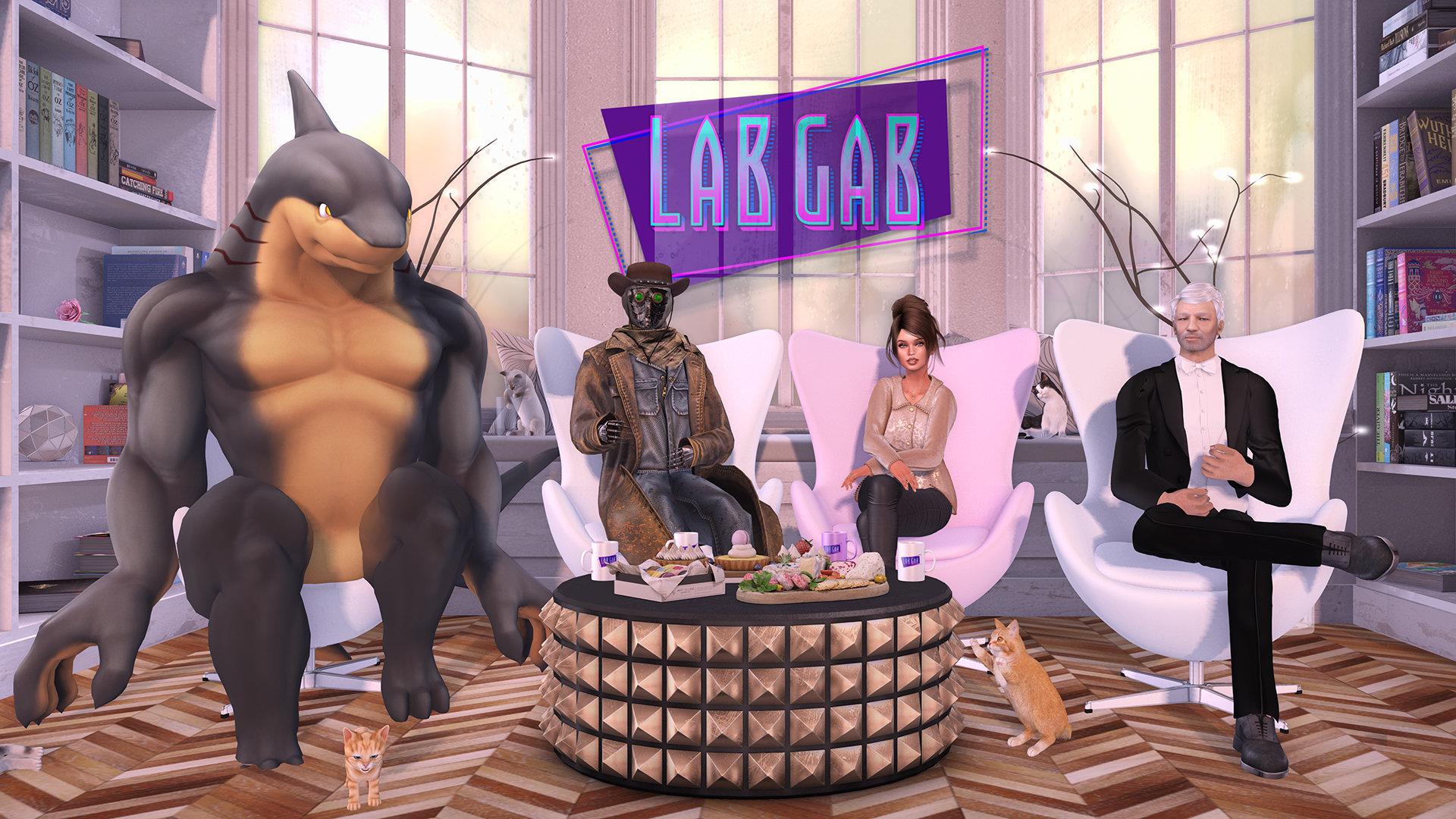
Despite these focal points within its narrative, STÖMOL is a film that came together somewhat organically, rather than building from a set story. Discussing the development of the idea during a segment of Lab Gab, Hax noted the the filming of scenes would take place as locations in Second Life were identified, with the structure of the story not emerging until some 50% of the filming was completed, the actual script / dialogue then following from that.

This is, to say the least, an unusual approach to shooting a film, and appears to be borne out of Hax’s experience with the National Novel Writing Month, an event that takes place globally every year and in which writers are encouraged to write a 50,000 novel across the 30 days of novel – but not to edit or revise as they write, instead allowing the story to shape itself.

Which should not be taken to mean STÖMOL  is in any way haphazard. Quite the reverse; the film demonstrates a high production quality, with many considered creative choices. It is also a film that carries with it a certain twist at the end (although the clue is there from the beginning – will you spot it?), whilst offering a certain amount of hat-tipping to the likes of Blade Runner and Blade Runner 2049 without ever feeling at all derivative.

However, while I’ve been able to see the film in advance of its release, I’m not going to go into further details here, as I have no wish to spoil the public première, the details of which are:

I’ll also have a personal review available following this public première. In the meantime, here’s a sneak peek, and you can catch more on the STÖMOL website.

Casting call for a new Second Life Documentary

Credit: unknown

Olivia De Camps is a freelance Dominican-American film student in her Senior year at New York University Tisch School of The Arts and a former intern at the New York based independent film production company, Killer Films Inc.

For her latest project, she has teamed with producer and writer Tom Sidi in order to produce a documentary examining the ways in which people use virtual worlds like Second Life, with their introduction to the project stating:

THROUGH A SERIES OF INDIVIDUAL STORIES, THIS DOCUMENTARY AIMS TO EXPLORE THE CORE OF BASIC HUMAN INTERACTION. FOR MANY INDIVIDUALS, VIRTUAL WORLDS NOT ONLY SERVE AS ESCAPISM, BUT ALSO MORPH INTO AN EXPANSION OF THEIR REAL LIFE – WHERE GENUINE FRIENDSHIPS ARE FORMED, ECONOMY THRIVES, AND OFTEN ROMANCE IS BUILT UPON AN VIRTUAL IMAGES THAT IS FREQUENTLY TRANSFERRED INTO THE REAL WORLD. USERS HAVE THE ABILITY TO IMMERSE IN THE WORLD THEY HAVE ALWAYS DREAMED OF LIVING IN, EXPLORING THEIR GENDER, RACIAL OR SEXUAL IDENTITY, AND CREATING STRONG BONDS WITH PEOPLE THEY MIGHT NEVER GET A CHANCE TO MEET OFF-SCREEN. AS WE HAVE BEEN SUCK AT HOME WITHOUT A POSSIBILITY TO PHYSICALLY MEET, THE IDEA OF A DIGITAL WORLD HAS BECOME EVEN MORE ATTRACTIVE.

– Olivia De Camps and Tom Sidi

Olivia De Camps

In order to make the documentary, the team are seeking Second Life users who are willing to to be interviewed and have their avatars filmed as they tell their own stories about their particular interest(s) in, and use of, the platform. In particular, they are interested in hearing from people who can represent the broadest possible use of Second Life, noting:

WE ARE SEARCHING FOR STORIES TO TELL FROM AN EXPERIENTIAL, NON-JUDGEMENTAL AND VISUALLY-DRIVE WAY. TELL US YOUR STORY! HOW HAS SL BEEN A WORLD FOR YOU IN QUARANTINE? HAS IT HELPED YOU FIND YOUR IDENTITY? DID YOU FORM A SPECIAL RELATIONSHIP ON THE PLATFORM? IF YOU ARE AN ARTIST, DO YOU COME HERE TO SHARE YOUR WORKS (DESIGN, CLOTHES, HOST VIRTUAL RAVES, TAKE DIGITAL PHOTOGRAPHY)? WE ARE LOOKING FOR PEOPLE WHO WOULD LIKE TO SHARE THEIR SL EXPERIENCES WITH US, DURING OR BEFORE QUARANTINE. YOU CAN CHOOSE TO REMAIN ANONYMOUS IF YOU WISH.

– Olivia De Camps and Tom Sidi

Those interested in taking part or wish to receive further information, should cotact either Olivia (oliviadecamps-at-gmail.com) or Tom ( t-at-boraxcfm.com) directly.

Linden Lab’s acquisition: sundry thoughts & speculation

via lawdonut.co.uk

It’s been a week since the news broken that Linden Lab is in the process of being acquired by new owners (see Linden Lab announces it is to be acquired, July 9th, 2020). Since then there has been a lot of comments and speculation ranging from the entirely positive to the inevitable “we’re doomed! / the sky is falling!”

Some have raised concerns that neither J. Randall Waterfield nor Brad Oberwager have experience with running games companies. However, having hands-on experience in running the type of company in which you’re investing isn’t actually a prerequisite for funding / representing / guiding it. Rather, what’s important is having the ability to understand the company, appreciate its value proposition and being able to contribute to its continued growth; and both Mr. Oberwager and Mr. Waterfield appear to have these abilities. In particular, J. Randall Waterfield, as CEO of the Waterfield Group, comes from an environment where long-term investment in companies to ensure their growth is very much the raison d’etre.

Waterfield buys and builds well-run American businesses.
We prefer basic businesses with a few years of proven, conservative growth. We avoid companies that are growing too fast. We believe slow and steady makes the race… We strive to be a good partner to existing management, are passive with regards to general managerial issues, and work hard to help our CEOs and their families’ realize their vision.
Waterfield’s investment timeframe is forever. We work to grow book value at a reasonable pace with no exit in mind.

– from the About / Investment Criteria page of Waterfield

Now, to be clear, it’s not the Waterfield Group that is investing in Linden Research, but rather a venture between Mr. Waterfield and Mr. Oberwager; but given Mr. Waterfield’s pedigree with long-term investment, is hard not to see him taking the same approach in his other ventures.

Nor should the fact that Mr. Oberwager has sold off three of the businesses he’s built be seen as a negative. Building a company from the ground up is a different matter to investing in an established, profitable entity, and selling the former in order to repeat the cycle isn’t automatically indicative of a intent to buy-in to an existing company simply to sell it on without a longer-term commitment.

Which is not to say a buy-out like this isn’t without risk; with the best will in the world on the part of incoming investors to a company, things don’t always go as planned or turn out as hoped – but planning for failure isn’t generally how investors set about acquiring profitable companies.

A further point to remember is that acquiring a company isn’t something that happens overnight; it can actually take multiple months or even years to progress from an initial decision to sell, through reaching an agreement in principle, to that final closure.

Due Diligence means investors are rarely unaware of the business they are about to invest in

One big part of this process is due diligence, a process designed to make potential investors precisely aware of what they are getting themselves into – things that might alter the deal, such as revealing unwanted risks or unwelcome financial exposure that they might wish to see properly mitigated prior to proceeding further. This means that incoming investors are rarely coming into a company flying blind or are suddenly going to find themselves facing an unwelcome wake-up call that might leave them re-evaluating their desire to retain the company.

On a more interesting – to me at least – level is that given the length of time an acquisition can take – even if measured over months, rather than years – is how closely the decision to sell Sansar might have been tied to the decision to offer Linden Research up for acquisition.

Simply put and despite the effort already put into Sansar, it still has a long way to go before it is likely to establish a sold income-generating business model, and therefore represents a significant revenue sink hole of unknown depth. As such, it would make sense for the Lab to divest itself of Sansar prior to putting itself up for acquisition; doing to removes the uncertainty around that platform whilst leaving the company with a demonstratively profitable product (Second Life) and a second that is just starting to show its potential (Tilia Inc.). Depending on the time frames of the two events, the sale of Sansar might even have been a pre-requisite put in place by the new investors to limit potential risk raised through the due diligence process.

Following the acquisition announcement, there were questions asked through the forums, etc., on why would a profitable company be put up for sale, and statements (such as can be seen in comments on this blog) that you “don’t sell a profitable company”.

Well the fact is that profitable private companies are routinely sold for a variety of reasons, and none of them are “bad” or “negative”. For example, and leaving aside the point that the fact a company is profitable obviously makes it more attractive, a sale can be because the current owners wish to exit the company entirely to pursue other opportunities; or they may simply want reduce their overall holdings in the company as part of a general change in lifestyle, whilst leaving the company with the ability to continue operating successfully (and in the case of the latter, still have their experience / expertise available, should it be needed).

I’m not about to try to second guess what reasoning is at work in the case of Linden Research, but  I am curious as to the shape of the board once the acquisition has been finalised. Will it be just the two new investors (which seems likely), or will one or two of the remaining board remain?

Obviously, how things pan out will only become clear over time, but overall (and such is my nature as a “glass half full” person) I lean towards the feeling that the coming change for Linden Research will prove to be positive.

Linden Lab announces it is to be acquired

© and ®Linden Lab

On Tuesday, July 9th, 2020, linden Lab announced it is to be acquired by “an investment group led by Randy Waterfield and Brad Oberwager”.

The acquisition is currently pending approval by financial regulators in the U.S., due to the Lab’s subsidiary, Tilia Inc., which forms part and parcel of the acquisition.

The full statement on the matter, which can be read on the Lab’s corporate website, includes a statement from Linden Lab CEO, Ebbe Altberg:

We’re excited for this new chapter to begin. We see this as an opportunity to continue growth and expansion for Second Life and our money services business Tilia. We’re grateful for the ongoing support from our community, business partners and investors. Now more than ever, there is increased recognition of the value and utility of virtual worlds to bring people together for safe, shared, and social on-line experiences.

Once the acquisition is finalised, both Mr. Waterfield  and Mr. Oberwager will join the Lab’s Board of directors.

Bradford Oberwager has founded and/or run five tech/CPG companies—Jyve, Bare Snacks (acquired by PepsiCo), True & Good! Snacks, Acumins/more.com (acquired by HealthCentral), and Blue Tiger/Open Webs (acquired by CarParts).

J. Randall Waterfield is Chairman of The Board & Chief Executive Officer of Waterfield Group, one of the largest private financial organisations in the United State, and occupies board positions on a number of other companies and organisations.

J. Randall Waterfield (l) and Bradford Oberwager (via Waterfield.com and LinkedIn)

Also commenting on the acquisition, Brad Oberwager states:

Both the company and its virtual world community have a unique culture and creative energy that remain important to the long-term success of Second Life. There’s a bright future for both Second Life and Tilia and we’re excited to help fuel these growth opportunities.

With the news breaking on Twitter, Altberg responded to questions on what it means for Second Life with a simple “Continued Greatness!”

I reached out to linden Lab on finding out the news, but was informed the company has no further comment on the acquisition beyond the press release.

However, given that the acquisition will see Mr. Waterfield and Mr. Oberwager joining the board, I would anticipate that – given the nature of acquisitions – it is unlikely there will be any immediate visible changes to Linden Lab, Second Life or Tilia Inc., and, and the company will likely to continue to operate in a “business as usual” mode with regards to both Second Life operations and the community for the immediate future. That said, there will likely be a lot of speculation as to the future of SL, together with concerns / fears as to what the longer-term future might be.

While it is purely speculative on my part, I would hazard a guess that the acquisition will take into consideration the increased interest Second life has witnessed over the last year(ish), and particularly as a result of the SARS-CoV-2 pandemic, and will see in inflow of cash for the company that will allow it to (hopefully) meet its immediate goals with both Second Life and Tilia Inc., and allow both platforms to continue to be developed.

This is certainly the belief held by Linden Lab’s co-founder, Philip Rosedale, who now heads-up High Fidelity Inc. Also quoted in the press release, he states:

Since its inception 17 years ago, Second Life has been a pioneer in the concepts of virtual societies, land and economies. I’ve known Brad [Oberwager] for 14 years personally and professionally, and I’m confident he will bring his passion and proven strategies to help Linden Lab achieve new heights in distribution, scale, and quality while remaining true to the original vision, creativity, and community that makes Second Life unique and special.

Source:  Linden Research, Inc. to Be Acquired, Thursday, July 9th, 2020.

With thanks to Whirly Fizzle for the pointer.

Second Life & COVID-19: a Digital Cultures study – call for participants

Tom Boellstorff and his digital alter ego, Tom Bukowski (image: Steve Zylius / UCI): launching a new study in Second Life

Tom Boellstorff (Tom Bukowski in Second Life) is a name that frequently pops-up in these pages. A Professor of anthropology at the University of California, Irvine (UCI), Tom has a long association Second Life as a part of his research – which has in the past produced two books – Coming of Age in Second Life: An Anthropologist Explores the Virtually Human, (Princeton University Press, 2008), and Ethnography and Virtual Worlds: A Handbook of Method (Princeton University Press, 2012). Most recently, I covered the transfer of his classes at UCI from the physical classroom to Second Life (see Tom Boellstorff: teaching digital culture in Second Life) and the result of that effort (see: Studying digital cultures in Second Life).

On Thursday, July 9th, 2020, Tom will be initiating a new round of weekly discussions on the subject of digital interactions and the impact of the SARS-CoV-2  / Covid-19 pandemic – and he is seeking the input of Second Life residents.

These discussion sessions form the core of a new study Tom is running, supported by the National Science Foundation, and which he explains thus:

The title of the study is The Role of Emerging Virtual Cultures in the Prevention of COVID-19 Transmission, and it is intended to examine the role of virtual cultures in the prevention of COVID-19 transmission.

As we know, this pandemic has been reshaping on-line interaction; as many have noted, what we call “social distancing” is really physical distancing, and because of it, an unprecedented number of people have been socialising on-line, in new ways and for new purposes. A better understanding of these new digital cultures will have consequences for COVID prevention: successful physical distancing will rely on new forms of social closeness on-line. It will also have consequences for everything from work and education to climate change.

– Professor Tom Boellstorff

Anteater Island: landing point

Central to the project is the examination of the implications of virtual worlds for new digital cultures, and a drive to answer questions such as how do such shared spaces using directed interactions through avatars transform things like intimacy, collaboration, the formation and extension of friendships, and help to expand cultural and social understanding / engagement.

Answers to questions like these might provide innovative strategies for preventing viral transmission, by forging new forms of social closeness in the context of physical distancing. It will also help us better respond to the transformed social lives we are all destined to encounter in the wake of COVID-19.

– Professor Tom Boellstorff

Sessions will be held every Thursday (unless otherwise stated) starting at 10:00am SLT at Anteater Commons, the central social area within Anteater Island. The series will open with a discussion on the subject of distance itself, with the session’s introductory notes stating:

One phrase we have learned since the beginning of the pandemic is “social distancing.” But as many have noted, this really means “physical distancing”; new social intimacies are forming on-line. How are they different from our on-line interactions before COVID-19?

And what does “distance” mean anyway? From its beginnings, the internet has been a technology to reduce distance. How is “distance” in Second Life different from “distance” on Facebook, Zoom, or email? How do we experience distance and closeness in Second Life, and how might this transform what we mean by “social distancing?”

Second life residents who would like to participate in the study are invited to join Tom and his research assistants on Anteater Island. Those attending should note:

  • Session are planned to last one hour, and will be held in Voice and local chat.
    • There is no requirement for attendees to use Voice if they do wish to, comments in local chat are acceptable.
    • However, attendee should have Voice enabled so they can hear all that is being said.
  • As this is part of a formal study, sessions will be recorded and text transcripts saved to help with the production of notes, etc., after each session. Screen shots may also be taken during sessions.
  • If any names, etc., of attendees are to be subsequently used in publication, permission to use names (avatar or personal name) will be sought. Those who are quoted will have the option of reviewing any statements they made  to ensure they are happy with their use.
  • The usual Second Life Community Standards / Terms of Service rules apply regarding use of language, avoidance of harassment, rudeness, etc.

I hope to be at least least some of the discussions, and may also be reporting on them and other aspects of the study through these pages.

Links to Tom Boellstorff in this Blog

SLurl Details

Name Changes update: new last name options released

© Linden Lab

On June 16th, I reported on the announcement that the first set of last names for the Premium Names Changes capability would be “retired” (i.e. removed from the list of options) at the end of Wednesday, June 24th, 2020.

Those names: Alpaca, Covfefe, Damballar, Float, Jazzhands, Mainsail, Nimble, Piggins, Plumday, and Yeetly – have all now gone from list of available last names.

They have, as of Thursday, June 25th, 2020, been replaced by a new set of names that have been added to the list of available last names. These are:

Vortex – Fluffpaw – Sassypants – Amethyst – Bloodrose – Aurelia – Starlight

In addition, and as announced by Linden Lab at the launch of the above last name options, there are three additional last names added to the list to mark Second Life’s 17th anniversary theme. These are:

Wayfarer – Rover – Wanderer

These three names will only remain available through until the name round of updates, at which time they will be retired.

Name Changes was introduced in April 2020, providing Second Life Premium subscribers with a fee-based ability to change both the first name and last name for their avatar / account.  If you are unfamiliar with the capability, you can read more here: Second Life: the return of last names, and some notes.