LL move to monthly blog updates?

(Copyright Linden Lab)

Given recent losses within the Lab – Amanda, Courtney, Blondin – it’s not surprising that the communications team are perhaps a little short-handed, even if news and announcements coming out of Linden Lab have been in short supply for a good while now.

So it is interesting to see that Featured News on the official blog appears to have moved to a monthly round-up / announcement, as exemplified by the “July Update” which popped up earlier today.

It is a fairly comprehensive piece, covering the implementation of new default avatar types – something Rodvik alluded to last month on Twitter; progress on fixing Group chat and the upcoming changes to web profiles I’ve given something of an overview to here, as well as news on changes to promotional e-mail and an update on the new Search system.

The new default avatars cover animals, robots and vehicles – all of which LL have received criticism for having previously “ignored”, and which will hopefully prove to be welcome additions.

I’m not entirely sure the comments on Group chat lag being a thing of the past are not going to come back and haunt LL; I’ve been in Group chats as recently as yesterday and witnessed the kind of issues referred to in the piece, and I’ve seen similar comments from others on the subject. So while things have undoubtedly improved, I’m not entirely sure its a matter of “case closed” just yet.

As to the web profiles, it is interesting to read the formal announcement of what is coming and see what appears to be the “smaller more integrated” in-viewer web profile window (see below).
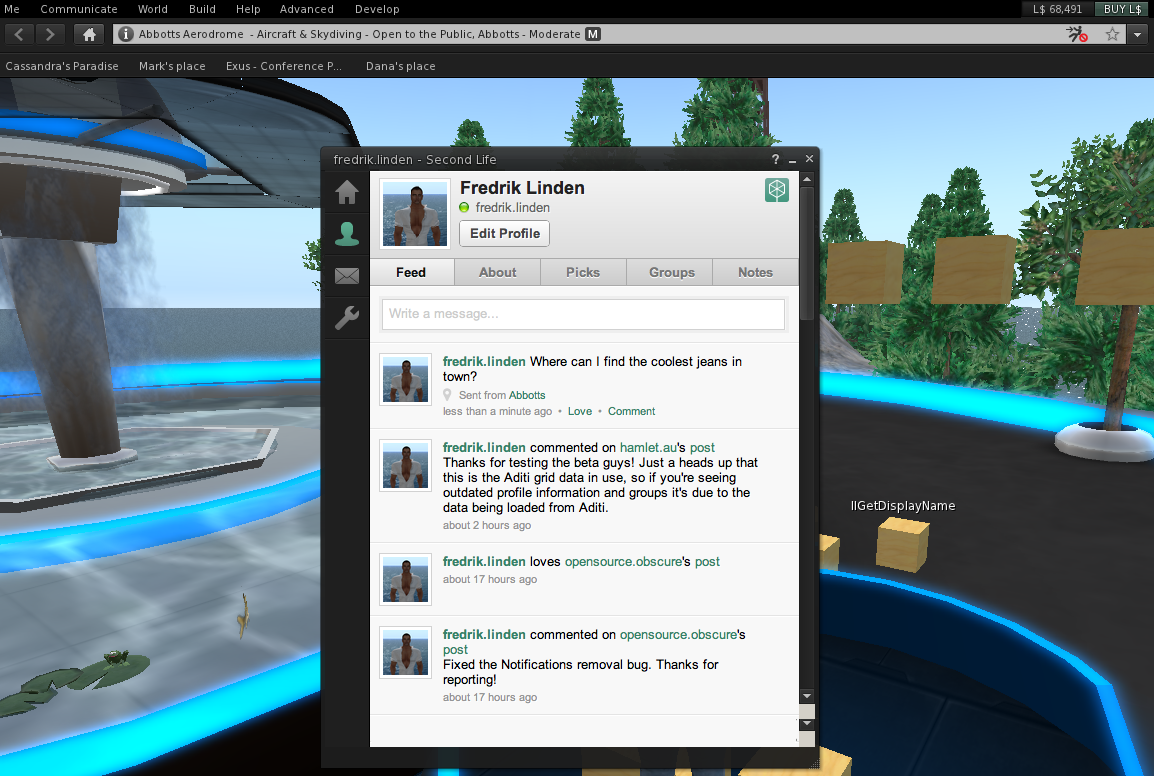
New Web profile window? (with thanks to Linden Lab)

While the window does appear smaller and less intrusive, I’m not sure that “more integrated” is the right description. As I’ve said elsewhere, “integration”, to me, suggests something that blends-in with the rest of the Viewer in terms of layout, skin, etc. This isn’t really the case with the in-viewer web profile view.

Possibly the most controversial item reported on in the update is the SL Marketplace, which has seen a series of on-going changes that have been met with frustration in some quarters and concern in others. Of these, the upcoming Direct Delivery system, which is currently in its “Alpha phase” and which will eventually replace magic boxes, is perhaps the focus of the majority of concern when it comes to the Marketplace. As I’m not participating in the Alpha phase of this system, I’m not in a position to comment (and probably wouldn’t be able to comment even if I were, given the NDA requirements around the project); suffice it to say others have passed comment on the new system, and their concerns do seem justified.

Stepping back from the details of the post, I have to say that I hope that this “monthly update” approach is not going to become the trend for all of LL’s blog posts. We get little enough communication from them through “official channels” as it is, and I’d personally rather get fed the news “as it happens” rather than getting it almost in retrospect (as is the case with some of the content of this update – the new avatars have been reported on elsewhere already, and the updates to web profiles have been the subject to a lot of chatter for over a week now).

It’s also a shame that LL are (again) pushing people out to Twitter in order to discuss news. For crying out loud, Rodvik et al – you’ve clearly spent time and money developing and rolling-out a “community communications platform” so why the hell are you guys not using it effectively?

OK, so fair enough, you also point people to the Technology Forum – but the fact is, this is also hardly ideal unless you start specific topic threads for each update that comes out – and even then, it’s hardly convenient. If you really want feedback and comments on what is happening, then give us the means to do so in as quick and convenient manner as possible.

By that I mean letting us us comment on your blog posts directly. It’s the way almost every other blog in the world operates when comments and feedback are allowed – so why not you? You used to at one time, but then you moved away from this approach, almost as if you were either afraid of what we might say, or didn’t want to hear what we were saying.

But the fact is, if you really want our feedback, you really should consider making it as easy as possible for us to do so, even if it does mean opening up your blog entries for comment once more.

I mean honestly, are we really that bad?
Web Profiles: Major updates ahead

I actually started writing this post back last week, but abandoned it for lack of in-depth information as to whether we were seeing something new or something abandoned that had accidentally resurfaced. However, after attending today’s mysecondlife.com User Group meeting, I’m now more confident in going to press – even if the news is now rather old!

Essentially, in the next few weeks our web profiles will be turning a lot more “social” in their look, feel and capabilities. With the “new” Profiles, people will be able to:

  • Link more closely to any other social networking identities they may have & which they wish to connect to their SL identity (e.g. Twitter, Plurk, Facebook, etc.)
  • Allow people to comment on their own and other profiles (subject to permissions being set) in a Twitter-like manner
  • Manage their Friends and Group lists through the web profile as well as in-world
  • Upload snapshots directly to their web profile.

Some of these changes can already be seen on my-demo.secondlife.com, although the more recent code updates appear to be only available if you actually physically log-in to the Beta grid and use the new profiles through the in-viewer browser.

Several of the new features look to be well-considered and have been much-requested: the ability to manage Friends lists for example. Others are likely to prove more questionable among the masses – and indeed are already generating concerns.

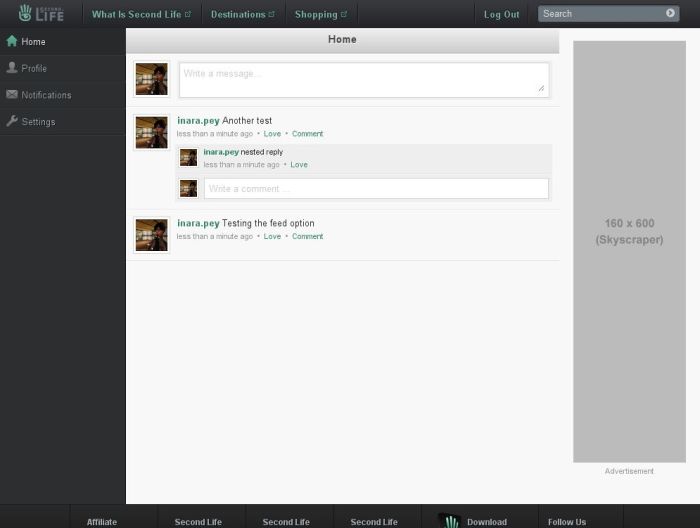
Feed option

The Feed Option

The Feed option is most analogous to Twitter in many respects. Essentially it allows those to whom you give permission (defined as a Friends only, or anyone in SL or anyone coming across your profile while browsing the web) to leave a comment on your profile. Replies to comments can also be made – as shown in the example above.

This has already given rise to concerns about spammers abusing the system and people finding their feeds filled up with ads for tat, tosh and trinkets. However, this can be mitigated against by adjusting the privacy settings for the Feed option (setting it to just “Friends” – which really, it should be by default).

Another concern with the Feed is that if it is used via the in-viewer browser and Viewer 2 / a V2 TPV, your in-world location is automatically appended to the message you send out. This is something that did not prove to be popular among those attending the my.secondlife.com user group meeting today, doubly so when it became apparent that the option to transmit your location is opt-out, rather than opt-in, and that there is currently no blanket opt-out option: you must do so message by message. However, Fredrik and Teddy Linden, attending the meeting on LL’s behalf, appeared to take concerns about the opt-out rather than opt-in situation on-board, with Fredrik commenting:

[11:41] Frederico (fredrik.linden): again, we want to help people socialize and stay up to date with what’s happening in Second Life. Location does that, and we want to push it. we’ll be sure to tweak the opt in/out before we go live to agni

Given that people will be able to comment on your profile, the new system includes options to notify you when someone does so – you can elect to be notified in-world and/or via e-mail and these options can also be set should someone comment after you or comments on a message you leave on another person’s profile.

Faster, smaller, neater

Fredrik (left) and Teddy Linden at the my.secondlife.com User Group meeting

A repeated complaint about the web profiles, and I’m as responsible as anyone here, is that they a) take far too much time to load when using the in-world browser (4 seconds on average for me – others have reported up to 10 seconds on busy regions) and b) they take up far too much screen real estate. Again, LL appear to be listening to these concerns, with both Teddy and Fredrik giving assurances that the “new” profiles will be faster on loading and “more integrated” into the Viewer.

The new profiles are not ready for prime-time as yet: the data used at my-demo.secondlife.com is from the Beta grid, and thus is very stale for many users (other than those who routinely spend a good deal of time logged-in to it). More work is required on various aspects of the new look – and both Fredrik and Teddy seemed keen to take on board as much feedback from the UG meeting as they could – presumably so that it could be fed-in to the development process in the lead-up to the release some time in the next few weeks.

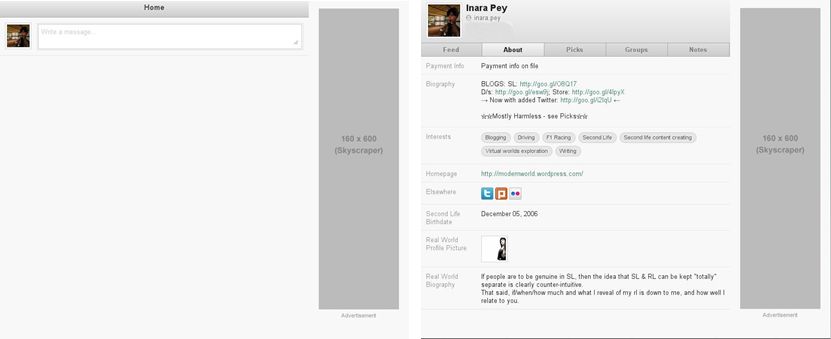
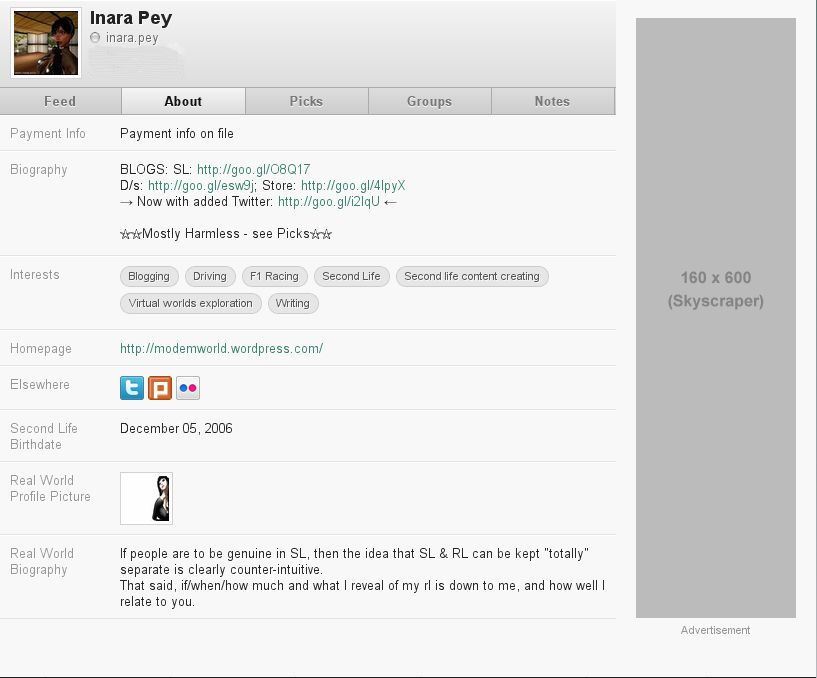
Right now it is unclear (at least to me) as to which page / tab will be the item others see when looking at your profile; “Home” would appear to be the obvious choice, but given this is essentially a blank page with a feed box in it, it would appear somewhat redundant. The ABOUT tab appears more informative – and it is actually hard to understand why this isn’t, by default, the “home” page for a profile.

Home page (l) and About tab

Overall, the new-look profiles offer much of promise and provide a set of potentially useful social networking options. A part of me wonders as to how effectively they will be used, however – those that want to extend some of their SL contacts and activities into the “pure” social networking space are probably already at home with the likes of Plurk and Twitter, and may not be overly attracted to the new profiles unless deeper integration with their preferred communications medium are available, or all their existing contacts can be persuaded to swap over or get involved. For many SL users however, there is a risk that these additional bits and pieces will be at best ignored, as they don’t have any place in their in-world lives, or at worst seen as a complete distraction.

For my part, I do find it hard to believe that things like the Feed will do much to pull me away from Twitter (and to a lesser extent, as I don’t use it so much, Plurk) – it simply isn’t as convenient a tool to use. However, I do like other aspects of the new profiles; overall the new tabbed approach is a lot cleaner and easier to grasp. I also look forward to seeing just how LL tweak the profiles for “better integration” with the Viewer as a whole.

I’m also curious as to how the Firestorm team will respond to these changes – if at all. Currently, Firestorm takes profile information and displays it in a Viewer 1-style window within the browser. This actually works a lot better than the in-browser approach – but will it be able to display all the new widgets and options, or will Jessica and the team opt to leave that to using web profiles through the in-viewer browser.

My Profile in my-demo.secondlife.com

Sharing Creativity

(Copyright Linden Lab)

“From a customer perspective, it’s a virtual world, [but] it’s a shared creativity tool.” So speaks Rod Humble during a recent Bloomberg interview I’ve commented upon previously.

A shared creativity tool. This is not the first time Mr. Humble – Rodvik to us all – has referred to Second Life in this way. It’s been his means of referring to the platform virtually (pun intended) since he arrived in-world and started pushing prims around.

And it is perhaps the most concise (if somewhat dry) description of the platform I’ve come across in recent times – at least where LL is concerned.

Yes, of course there are the obvious elements that underpin the description; Rodvik himself touches upon them when he refers to the fact that everything (well, almost everything!) within Second Life is created by the users for the users. All of us who spend any amount of time in-world get this, so on the surface it is perhaps easy for some to dismiss Rodvik’s comments with a, “D’ya think?!” shrug of indifference. There is also much that the description misses out on as well, such as the immersive, 3D aspects of Second Life; after all, a “shared creativity tool” could equally be used to describe something like Microsoft Sharepoint as much as SL.

But the fact is, his description uncovers a much deeper truth about Second Life that tends to render (no pun intended) the more obvious aspects of the statement (and what it potentially misses) moot. This truth is that SL allows us to create and share in ways beyond what might be called the “physical” aspects of SL – prims, sculpties, textures, and so on.

I’m referring to everything else that exists in-world, which is equally created by users for users, but which we rarely consider to have been “created” in the same was as our houses, clothes and attachments. Look at the Groups you belong to; look at the activities you join and enjoy when in-world; look at the opportunities presented to you to engage in activities, roles, situations and opportunities within Second Life that could never – for whatever reason – be a part of your “first life” or “meat life” or whatever you want to call it. All of these are part and parcel of the shared creativity tool.

This has always been Second Life’s USP – unique selling point – that it can be whatever we chose it to be, however we chose to come together and engage with one another and create both through the physical medium of prims and through the other capabilities presented to us through the Viewer. This is also something that Linden Lab themselves seemed to lose sight of during the “bleak years” between mid-2008 and the end of 2010, when the company appeared to focus solely on the coin rather than the creativity, ignoring the obvious connection between one and the other.

So it really is comforting to here Rod Humble publicly describe SL in terms we can all appreciate and agree with. It may not be as dynamic as Your world, your imagination and fails to rate as a strapline for advertising, promotion or (re)branding; but it is a step in the right direction. One that Linden Lab need to key an eye on as they and we move forward and things like mesh start to make their presence felt across the grid with the risk that it may well cut a swathe across the ability for many to create sellable content from within SL, simply because prim-based content cannot always compete with the look and “feel” of mesh-based creations.

But in the meantime, kudos again to Rodvik for cutting to the heart of what Second Life is and can be. Shared creativity tool may be a dry, “techie” term unsuited to actually promoting and selling SL to a wider audience – but if it helps the new LL Director of Communications and the Marketing Dept at Linden Lab to more accurately put a finger on what SL is and empowers them to by more dynamic around the concept when promoting SL, then Linden Lab just might find themselves getting further back on track when it comes to gaining and retaining users, and growing the platform.

Grid Survey: Second Life Gains 69 Private Regions in a Week

tycheshepherd Tyche Shepherd
#Secondlife grid grew by 69 regions this week to 31264, Private Estates up 69 to 24380. LL steady at 6884. 39 RFL backbit.ly/lVdWeN.

Last week, according to Tyche Shephard of Grid Survey, which gathers publicly available data on Second Life land, the grid gained 69 private islands, many of them from the RFL  and Dreamseeker estates.

As Hamlet Au is fond of trumpeting, private islands make up the vast majority of Second Life’s revenue, so this should, if we follow his reasoning, represent a substantial income gain for LL. In fact, to use his  exact words, “At standard rates, 69 private regions would annualize out to revenue of over $250,000”.

Of course, we probably won’t see any loud trumpeting from Hamlet on this overall gain in the way he has previously headlined end-of-month losses (not unless this piece shames him into publishing a commentary). Why? Well, because an over net gain in sims does not tally with his view that Second Life is “dying”. As I’ve previously mentioned, this is also why, when trumpeting sim losses and the like, he ignores Tyche’s week-to-week figures for grid size, which demonstrate that large-scale end-of-month sim losses are generally overcome the following month as new sims are added to the grid, leaving us with (overall) a slow but steady increase in the total number of sims available on the grid.

I’ll be curious to see if Hamlet does flag this gain up in any way. If he doesn’t, then it’ll simply confirm his own growing irrelevance when it comes to reporting on Second Life and Linden Lab.

SL Age Verification Revised

(Copyright Linden Lab)

Update, July 2012: This article is now out-of-date following a further change to the Age Verification process. See this post for details.

It appears that Linden Lab has launched a new Age Verification process. This is causing more than a few waves, as Tateru and Ciaran report.

While I don’t wish to blow my own horn, I’m not actually surprised that there has been a change; this is actually something Rodvik took the time to Private Message me about via Twitter earlier in June in order to obtain some perspective on changing the system (presumably because I’m involved in the Adult Community within SL) – and I’ve little doubt he PM’d others as well to get some feedback. While he didn’t specify how the system was to be changed, it was clear from the exchange that something would be changing.

The problem with the old verification process  – really – was that it was completely misrepresented through rumour, ignorance and assumption. It was also somewhat invasive (although to be honest, I had little issue with Aristotle Integrity and providing my passport details because I made myself go read-up on the system itself and understand what it was actually about).

Among the wild (and incorrect) claims made at the time the system was introduced were the following:

  • It was used to track US citizen’s voting habits / to target US citizen for political mailshots, etc. (a rumour generated because the software came from the same company that provides political trending software to the major US political parties)
  • The software was “against European law” (and yet 12 out of the twenty top users of the software were European Union countries, including Germany, France and the UK – three countries where the “against European law” cries were the loudest)
  • That the software stored personal information on-file and made it available to third parties for a fee (yet the software does no such thing: it operates on a look-up basis with nationally-held databases and simply acts a a “tick box” confirmation service)
  • That the software supplied personal information to Linden Lab (in fact the only information passed to Linden Lab was either a tick to say a person had been successfully Age Verified or a cross to say they hadn’t).

If genuine fault were to be placed with Aristotle Integrity, it was in the fact that it could easily be fooled. The system appeared to compare supplied data with a variety of databases with no actual cross-referencing. This resulted in people being able to fool the system by giving (for example) a valid Social Security number against the name Elvis Presley and end up being verified. In the UK and Europe people were able to give “old” data relating to themselves (such as a former home address and expired passport number) and get verified. Some even claimed to be able to give completely fictitious information together with a real name (say, Donald Duck) and get verified. There was also a problem for some in that even when genuine information was given, verification would fail, or the Age Verified flag would have to be periodically re-set (I myself have had to re-verify twice since my original verification after suddenly finding myself blocked once again from land with the Age Verified flag set (rather than the PIOF flag)).

Part of the fault here was clearly with the Artistotle Integrity software, although equally, much of the blame lay with the various government databases being checked, simply because they are not cross-referenced (and we probably all breathe easier as they are not).

However, all this aside, the fact that the system required the submission of passport numbers, Social Security numbers, etc., whether or not they were stored somewhere was extremely off-putting to many – and it was this evasiveness that gave Rodvik cause to PM on the subject, and indicate privately that he felt the matter needed addressing.

The result is a completely new system that simply requires you supply a date of birth and confirm the information supplied is true.

That’s it.

New Age Verification Process (with thanks to Tateru Nino)

Doubtless the new system is going to get people up in arms once it becomes widely known, and some people are going to rail against the whole thing being a “joke” and so on simply because the system is now so “easy”. Others will doubtless cry “foul” because of the information (SSN, driver’s license, etc) they have “given” to LL in the past (even though, as stated, no information supplied is actually retained by Aristotle Integrity or LL).

However, the fault here is not LL’s: they are simply conforming to the requirements set forth by the US Federal Trade Commission’s best-practices for age-verified access to adult content on-line. It may not be the best method in the world (but can anyone point to a system that does work without falling flat on its face at the first presentation of false data that doesn’t require invasive “background checks”?). It is however what the US government considers adequate in lieu of anything better.

If nothing else, it should put an end to the more ludicrous claims made around Aristotle Integrity and take away the very genuine headaches some people did have when trying to verify using it.

We’ve yet to see any formal announcement about the new system – the news has been “leaked” via SLU, where it appears some were given a heads-up that the new system was now available for testing and opted the break the news themselves on Friday. Whether they received word from LL or perhaps from Rodvik having also been a part of the batting of ideas I had been loosely involved in via Twitter, is unclear. Given that so much of late seems to be coming to light as a result of word-of-mouth rather than any official announcement, it would be nice to see something show up on the official blog about this come Monday.

Rodvik: Virtual Goods and LL’s Profitability

Rod Humble discusses virtual goods and virtual worlds in a brief Bloomberg interview. What are most interesting to note are the comments towards the end of the piece, regarding Linden Lab’s current profitability:

Emily Chang: The Tech IPO bandwagon is filling up. Is that something that you guys would consider or [are] considering?

Rod Humble:  We’re not looking for any further investment right now. We’re profitable, we’ve got [a] very good cash balance… So from our perspective, if we were to be able to deliver a large and measurable long-term return on new investment, then we’d certainly look at it. We’ve got a long runway of features that I want to put in place with our current very healthy cash and profitable business first, though.

Should this story be picked up, it is these words that are probably going to be the focus of attention – particularly among those who seem anxious to sink the Second Life boat, who will probably interpret Humble’s words as, “We’re not really attractive enough for IPO, and we’ve got to blow money to get there, ‘cos we have to make ourselves attractive somehow.”

Personally, I see his statement in a more positive light: LL are reasonably cash stable and are profitable, something I’ve commented on previously. Furthermore, there is a continuing upswing in sign-ups (still running at around 16K per day), which appears to be translating into a rise in user concurrency, which would indicate that new users are actually sticking around for longer and potentially getting more involved. Both of which are healthy signs.

What is key about Humble’s words, however, is the sheer pragmatism they carry, even in such a relatively lightweight interview. He recognises that while Second Life indeed “has legs”, and can, on current form, continue pretty much as is as a private company generating sufficient profits to demonstrate (presumably) a return reasonable enough to keep the original investors happy, it also has the potential to go much further in time. Thus, while IPO is definitely not on the cards right now, this may not be the case in the future, should things develop in that direction.

This is pragmatic on two counts. Firstly, it is allowing the company a degree of freedom in tackling the issues it currently faces – technical and otherwise – and solidifying its position without any ulterior needs or requirements overshadowing things. Given the company has undergone significant pain when ulterior motives have been the driving force behind matters in the past (e.g. the drive to convert SL into some form of “real world” business and applications platform), this is a wise move. Secondly, as Emily Chang states – the technology IPO bandwagon is fast filling up, but if we’re all absolutely honest, we’ve no idea where it is going. As such, not leaping onto it with everyone else is also something of a potentially wise move; especially if the wheels do come off the wagon, as LL get to avoid the resultant crash. However, if the bandwagon proves it can roll and roll, then LL could ideally be well-placed to pick-up on all those investors who might otherwise be kicking themselves from not being “in” on things from the start.

Taking this perspective and being willing to acknowledge both sides of the coin, so to speak, again demonstrates to me that Rod Humble is very much the right man in the right place at Linden Lab – and he’s hopefully carrying the board with him on this.