The Phoenix team have issued a blog post on a Viewer bug that affects setting permissions for Friends.
From the Phoenix website:
The Bug You can no longer change permissions for your friends while on a viewer which doesn’t utilize Web Profiles and whether you are, or are not on a viewer that uses web profiles the friend you are changing permissions for needs to relog after you have set the permissions through their web profile. I am assured by LL that they intend to resolve this issue as soon as possible but at this time they cannot provide a date when the fix will be rolled out. You can read the Jira report about the bug herehttps://jira.secondlife.com/browse/SVC-7104
The Work Around In the meantime, there is a work around. First, you must open the “Web” profile of the person you wish to change permissions for. This includes Map rights, Modify my objects permissions and Online status permissions. 1. Open the web profile of the person you wish to change permissions for using the following URL in your web browser.http://my.secondlife.com/firstname.lastname. Replace the first name and last name with the persons first and last name. If they do not have a visible last name dohttp://my.secondlife.com/firstnameinstead. 2. Once you have their profile open, click on the “ACTIONS” button near the top and to the right, then choose “Permissions” from the sub menu. 3. Give or remove the permissions you wish to change and click “Save”. 4. Now the person you’ve changed the permission for will need to relog in order for them to actually get the permission change.
OR
If you just want to remove all permissions for a friend to default, you can just remove them from your friend list and re add them.
Second Life received something of an indirect publicity boost today, having gained mention via an Emmy nomination. The Virtual Mine – an extension of Deep Down–A Story From the Heart of Coal Country, aired by PBS – has been nominated under the New Approaches to News and Documentary Programming: Documentaries category.
Deep Down–A Story From the Heart of Coal Country, first broadcast in the autumn of 2010, is an examination of the human consequences of our environmental impact. The film follows Beverly May and Terry Ratliff in Appalachian mountains of eastern Kentucky,, a region that has supplied the USA nation with coal for over a century, and who now find themselves in the midst of a debate dividing their community and the world: who controls, consumes, and benefits from our planet’s shrinking supply of natural resources? While Beverly organizes her neighbours and leads a legal fight to stop Miller Brothers Coal Company from advancing into her hollow, Terry considers signing away the mining rights to his backyard-a decision that could destroy not only the two friends’ homes, but the peace and environment surrounding their community. Through their eyes, the battle over energy and the wealth and environmental destruction it represents in through into sharp relief, and raises questions relating to humankind’s own morality, our connection to the earth’s resources, and most importantly, our link to people whose daily lives are far removed from our own and yet deeply impacted through our actions. Through a complex human story that cuts across environment, economics, public policy, and culture, the story of Beverly May and Terry Ratliff reveals the devastating impact of our energy consumption against an explosive backdrop: Appalachia’s centuries-old struggle over the black rock that fuels our planet.
The Virtual Mine, nominated for an Emmy today, was created as an adjunct to Deep Down, and launched on November 10th 2010 with over 40 people in attendance, including Second Life experts and environmental activists and educators. It is an immersive, educational 3D environment, game, and educational curriculum located within Second Life (Surl) for teachers, students, and anyone who’d like to learn more about mountain top removal, coal fired power production, alternative energies, and the amazing music and culture in the Appalachian mountains. The video below explains some more about the thinking behind the project.
The game can by played individually in in groups, with players progressing sequentially through the first three levels,to achieve “mini-game” outcomes at each level. Every level contains a video prompt leading players to begin the next phase of this energy story. The first stage of the game examines mining itself and the need for energy; the second looks at reducing our energy demands, and the third looks at alternative energy sources, while the forth chapter provides the opportunity for celebration and to learn about energy conservation.
For teachers, the game offers opportunities to explore a range of subjects with their students, including:
Identity, representation and empathy
Problem solving and collaboration
Exploration and environmental discovery.
Funded by ITVS and MacArthur Foundation, and developed at BAVC’s Producers Institute for New Media Technologies, the Virtual Mine is open for anyone to explore, and demonstrates the tremendous power of Second Life as an educational tool and also presents a unique and immersive means of supporting the original Deep Down documentary itself.
More information on The Virtual Mine can be found on the Deep Down website. An official press release on the nomination is available from Sand Castle Studios
Emmy winners will be announced on the 26th September 2011. Good luck to all involved, and congratulations on your nomination.
The new web profiles with their social hooks are heading our way and are likely to be here in the next few weeks. In the meantime, LL appear to be upping the Social Game with their latest e-mail to residents.
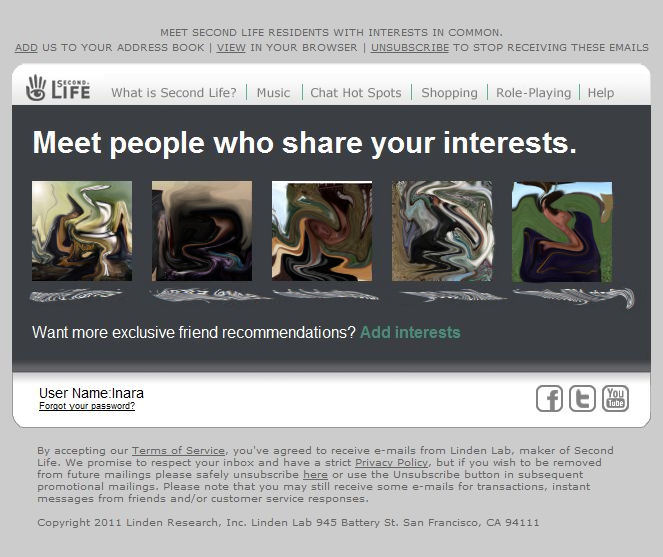
If you’ve filled out the INTERESTS section of your web profile, the chances are you’ve received (or will shortly be receiving) an e-mail from LL inviting you to make new friends, and offering you a few suggestions for people you’d like to connect with, like the one shown below.
Clicking on any of the images / names supplied in the advert will take you to the individual’s web profile, where you can look them over and even send them a friendship request.
I’m not sure how well-received this approach to making “connections” is going to be received. Leaving aside the fact that a “connection” and a “friend” are somewhat different concepts, this approach is fraught with basic problems.
On the one hand, those who have been in SL any length of time are going to be loathe to start sending out unsolicited friendship requests without any initial contact (although, of course, this approach doesn’t do anything to prevent a more “traditional” approach to contacting people listed in the e-mail prior to making friendship offers). Thus, there is every possibility such e-mails will be either ignored, or give rise to more people removing themselves from LL’s mailing list.
On the other hand, where this new service is used to start firing-off friendship offers without any prior contact, then it is liable to result in the vast majority of such offers being ignored by the recipients coupled with a rise in their annoyance at receiving such unsolicited requests. Hardly what LL are aiming for.
Thus, as well-meaning as it is, I can’t help feeling this initiative isn’t going to be as successful as LL hope (assuming it is going to being a regular thing). In fact, if LL want people to create networks of contacts using the new social media tools coming to web profiles, there are potentially much better ways of going about it.
One, for example, would be to give people the option to simply follow others in much the same way as Twitter. The would add considerable value to the Feed tool in the new web profiles – particularly if an individual’s Feed tab became a central point from which they could review comments and thoughts not just from Friends or those leaving comments on their profiles, but also from those they have elected to passively follow, without impinging on their virtual lives by repeated offers of Friendship.
It’s going to be interesting to see how these e-mails are received, and indeed, how long they last.
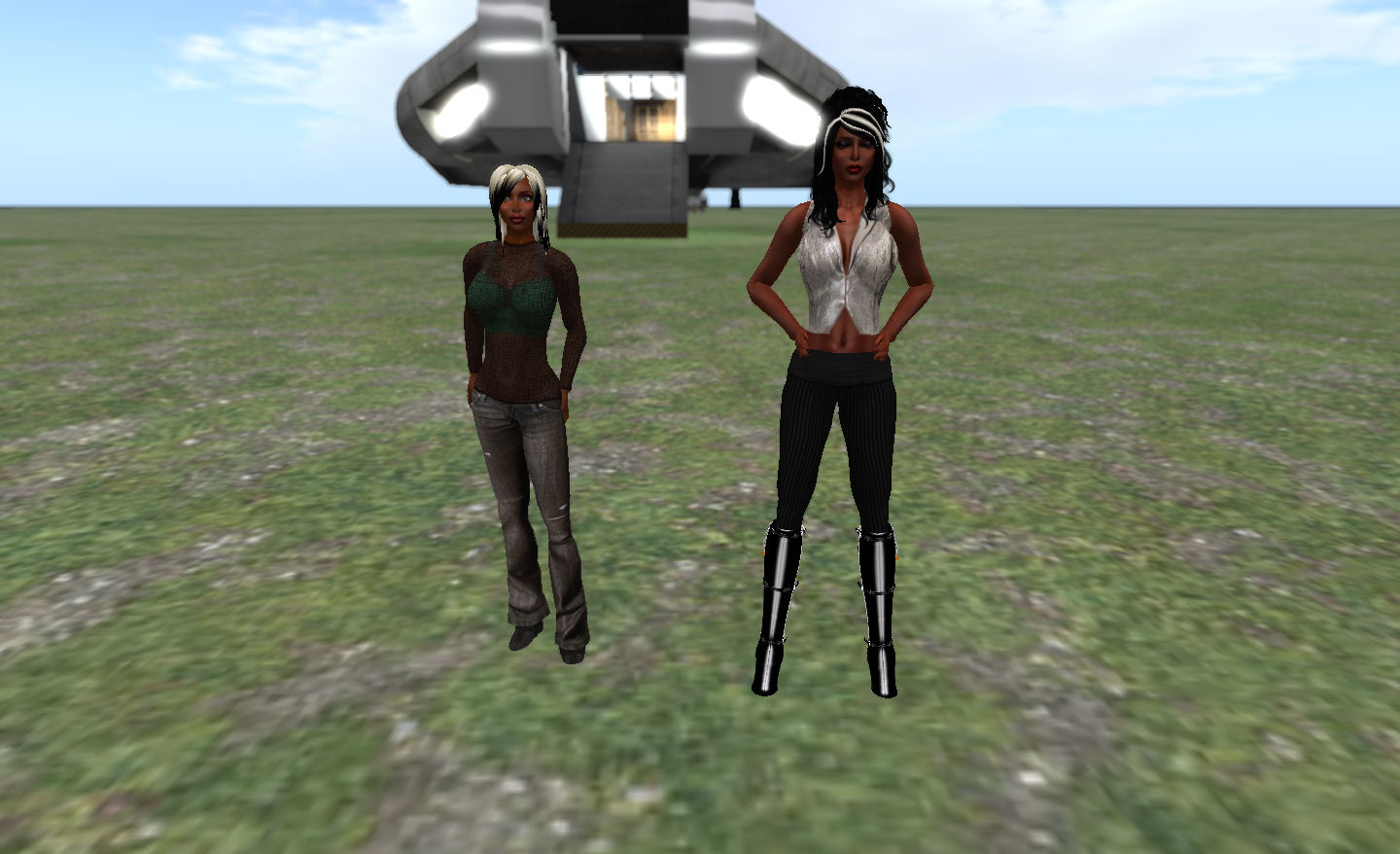
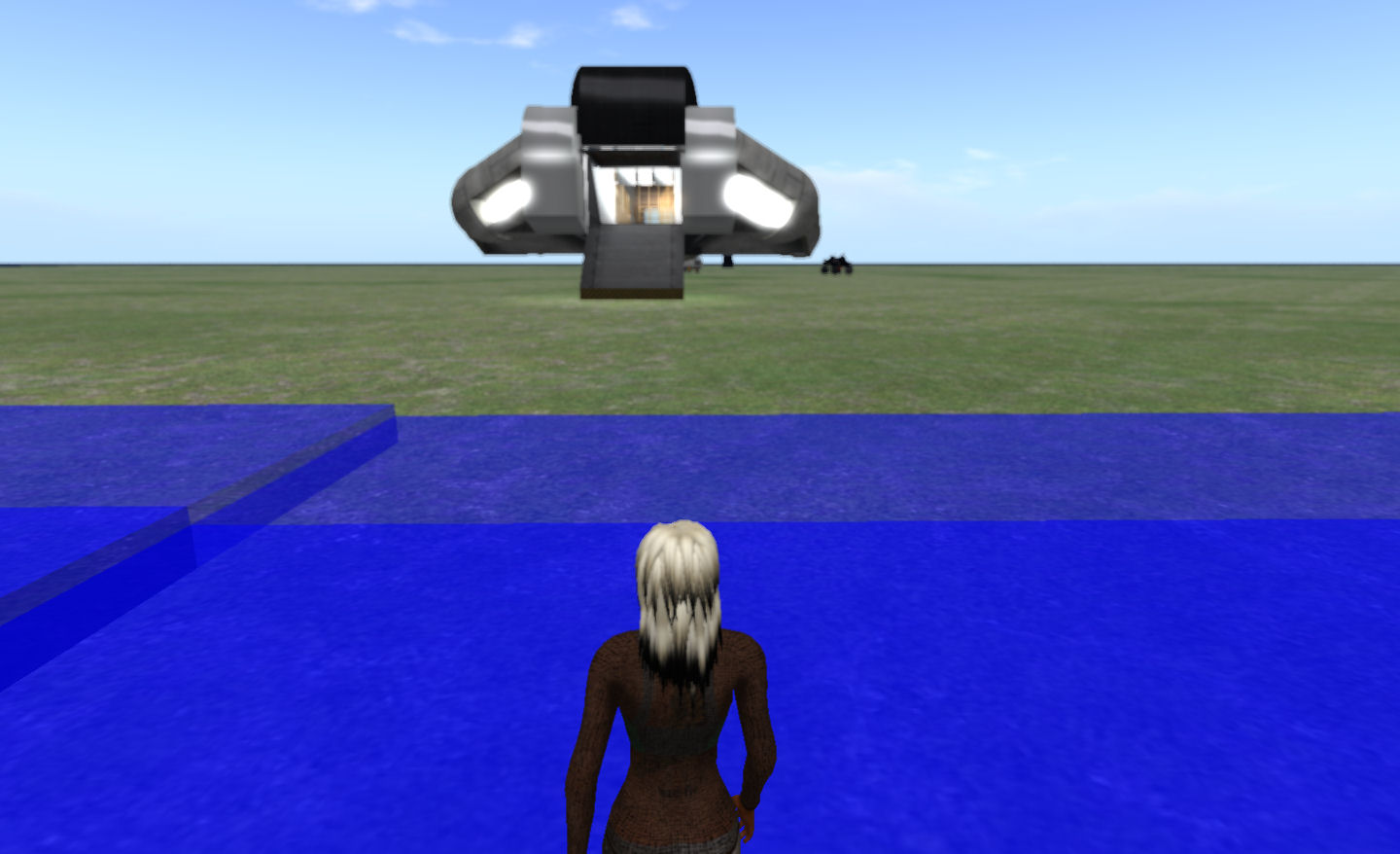
Standing outside the “Hidden Avatars Enabled” parcel
Privacy in SL is a nebulous thing.
We can employ banlines, security orbs and other systems; we can restrict parcel access to those without our own Group, or by access list; we can even resort to ban lists and systems that support them.
Whatever option we take, the fact remains that, unless we have our own private sim (Homestead or full), our privacy lasts only so long as someone who is so minded opts to step up their draw distance and use their camera to zoom-in and watch us.
The view from outside the “Hidden Avatars” parcel when someone is occupying it
The ability to “camera-perve” has long been an issue in SL. Indeed, it was one of the worries people had when the grid merger took place: while those under 18 may well be restricted to G sims, if they are on mainland, there is nothing to stop them from camming out of a G sim and into a neighbouring M sim and seeing something they shouldn’t.
Now even that might be about to change in the near future.
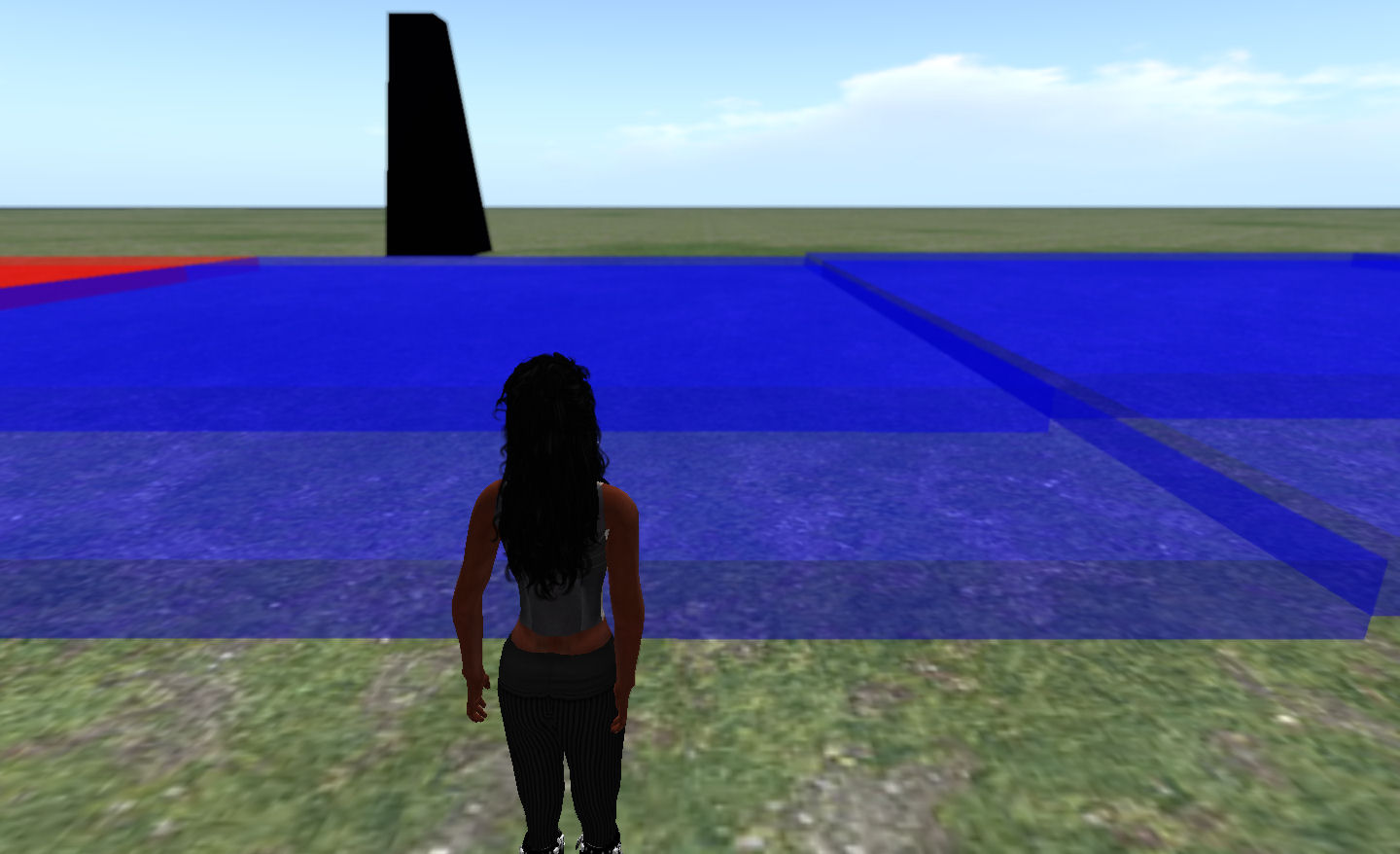
Standing inside the parcel, looking out – I’ve vanished as well!
A new parcel-level permissioning flag is currently being tested on the beta Grid, and could soon be rolled out to the main grid with a number of other new parcel capabilities. This is the Hidden Avatars flag, and when set against a parcel, it will have the following impact:
All avatars inside the parcel will not be rendered in the Viewers of those outside the parcel, however avatars inside the parcel will be able to see one another
Avatars outside the parcel will not be rendered in the Viewers of those inside the parcel
In either case, avatars will still show up on the map and mini-map as dots/icons as usual.
This isn’t an ideal solution to all matters of privacy; objects within the parcel will be visible and touchable by those outside the parcel, for example, and it may even lead to confusion for some (open chat conversations apparently popping out of thin air – the SL equivalent of hearing voices). However, this is a step in the right direction when it comes to increasing people’s personal privacy when combined with other privacy features such as the aforementioned security options.
It’s not clear when (or indeed if) this new option will appear on the main Grid; not everything tested by the Lab in the beta Grid winds up as being rolled out to the main Grid, but looking at it now, and limitations notwithstanding, there doesn’t appear to be any major reason why it shouldn’t find its way onto the main Grid in the near future. Indeed, one has to wonder why LL have been resistant to implementing it in the past, given it has oft-been requested by users over the years.
If you want to test Hidden Avatars for yourself, you’ll need to log-in to the beta Grid using the SL Viewer 2 (I found things didn’t actually work that well when I was running Firestorm, which is based on the 2.4 or 2.5 Viewer 2 code). Instructions for doing this can be found in the SL wiki.
Rod Humble once again demonstrates an adept hand and tongue when dealing with the media – this time the e-zine The Mark. It’s a fascinating piece that further demonstrates Rodvik not only grasps Second Life as a platform, he understands the importance of virtual identity. Take this extract:
The Mark: Do you think people existing in virtual worlds get closer to, or further away from, their true selves?
Rod Humble: I don’t have a clear answer on that, but I do have an opinion. There have been a series of high-profile people, from the head of Facebook to the Pope, talking about how social media should be about centering the individual – that it is all about your real life and ensuring that you don’t become a fractured person. I respectfully disagree with that.
I think that one of the healthiest things that technology can do is actually help us develop the different dimensions of ourselves that we portray in different situations. For example, the “me” at church is very different from the “me” who plays an online shooter game. The “me” talking to you now is very different from the one who will be at my parent-teacher-association meeting later tonight. We’ve always had that. I actually like the idea of enabling people to say, “In this community, I’m a completely different person, and I can hold views that aren’t going to seep into this other part of my life.” It’s a slightly heretical position, but that’s the one I take.
It may be a heretical position among his peers, but Rodvik hits the nail squarely on the head. No one in the world is ever “one” individual per se. Yes we may constantly present the same physical face to the world (although for those that wish to make use of cosmetic surgery, even that isn’t a given) – but the individual we present to different social aspects of our lives vary enormously. I am simply not the same person when among my family as I am when in the office environment of a major publishing house.
Of course, the “identity purists” will argue that this is not a matter of identity but rather of behaviour and personality; that while I may behave differently according to circumstances, my identity remains constant, as demonstrated by my having the same name on my office ID (when I have one!) as I do on my driving license. And in terms of ID cards and driving licenses they’d be right.
But they’d also be missing the point entirely. Identity is not distinct from either behaviour or personality. Rather it is intimately bound up with both, and that who were are and how we present ourselves to the world goes far beyond the a photo on a piece of paper or laminated card.
Facebook and, it now seems, Google Plus, would rather narrow the definition of identity to the two-dimensional aspects of name and photo, coupled with a verifiable address, as that better suits their marketing engines and their ability to generate revenues. I say “it seems” where Google Plus is concerned, because that situation is an unholy mess right now as regards “identity”, and it’s unclear how Google’s own tools may or may not be hooked-into Plus to reap data for their own use.
In taking this approach, the likes of Facebook are trying to enforce a form of conformity on their terms while remaining blind to the potential offered by virtual identities simply because the virtual does fit with the corporate modus operandi or world-view.
The fact is, “Inara Pey” is as much me as the person I present to business or to family and friends. In some ways she’s more “me” than the “real me” I am myself. Through her, I can integrate and publicly express facets of my personality that “real world” society would still deeply frown upon. I can, for example, mix my interests with fetish, D/s, etc., with my interests in business, psychology, politics, history, sport, etc., without (for the most part) being judged solely on the one aspect (fetish / D/s) some have determined to be “objectionable”.
She’s also a part of my psyche in other ways: she is an outlet for my writing on a variety of subjects; she represents me through Twitter and the like. In fact, I find it impossible – even discomfiting – to enter other virtual worlds without her, and so she existed in Blue Mars (as was) and exists in InWorldz, OSGrid, New World Grid, and Avination.
She only really differs in looks (although I’ve tried to mod her shape to be reasonably reflective of the “meat me”): I’m Caucasian in real life, whereas she is dark-skinnned. But even this is perhaps a subconscious reflection of elements of my “real” personality.
I say this because one side of my family’s history goes back to New Zealand, which has generated a deep interest in all things Maori in my in adult life. At the same time, I’ve been fortunate to spend a fair amount of time as an adult in Sri Lanka, and have developed a deep love for that country and its people. The fascination with both New Zealand’s Maori and the Sri Lanka people (Sinhalese and Tamil) seems to have influenced how Inara herself looks.
This genuinely wasn’t a conscious act on my part when I decided to give her a virtual make-over last year. However, the look evolved somewhat subconsciously over a period of several months, and has left me feeling that her appearance is a result of these various inner voices and aspects of who I am coming together to give her form. so to me, physical and virtual self, are deeply intertwined emotionally and psychologically; and I doubt I’m alone in feeling this.
And while she may not have a credit card or a driver’s license or a passport, it’s about time that big business caught on to the fact that she can still be a consumer (and again, that’s really what a lot of the kerfuffle about “real identities” is about: the ability to connect producer with consumer). This is because advertising, promotions, and the like that are directed at her still reach me. Certainly, they do screw with FB’s (and the likes) abilities to carry out wider data-gathering and limit their ability to gain “real” influence (in their eyes) over people – but the fact is, *if* I end up purchasing something, getting involved in something (either directly, or through my digital persona, and accept the receipt of on-going communications, etc., from a service, company or group – does it really matter if it came about through contact with my digital self rather than the “real” (in their eyes) me?
Blimey, and I haven’t even started on privacy concerns and handing over my “real” identity over to the suits and shirts of FB et al is akin to handing them power over me…
But to return to the interview with Rodvik: as well as identity, he dives into the many creative facets of Second Life and the myriad ways in which it brings people together and how they interact once brought together. As such, it not only shows (again) that he gets the value of Second Life on just about all levels, it provides interesting thought for consideration, both by those of us involved in this frontier – and, dare I say, by those who would seek to limit our ability to explore it by forcing us to restrict ourselves to their interpretation of what can be classified as a “real identity”. Not that I can see it causing them to re-think their position, sadly.
If I were to take issue with Rodvik, it would in his answer to a question concerning the future of virtual worlds and how people come together, when he replies:
“Good question. I think that something big is going to happen when it comes to online associations, which are going to run headlong into conflict – probably with some totalitarian country somewhere. It’s a broader thing than just Second Life.”
My take on this – while it is slightly out-of-context to the question asked, which set commercial aspects of virtual interaction to one side – is on the one hand he is more than likely right right in his assessment vis “totalitarian countries”. However, on the other, for those of us already living on the edge of the “new digital divide”, the conflict is clearly already here, with the totalitarian drive is coming out of “big business”. How that is resolved may actually render anything else moot for us.
I would, however, end this piece on a lighter note, and wag a teasing finger. My 40th birthday is rushing towards me fast enough as it is, Rodvik, so did you really have to go and push me into my “mid-40s” in the interview?! That’s two dances you owe me! 😉
There has been much to-do on the matter of Search. It’s perhaps the most consistently controversial element in Second Life in terms of ongoing debate, with many complaining that it has been “broken” since the birth of Viewer 2, and that Linden Lab have been slow in responding to issues and problems.
At the same time we have LL working to try to improve things, tweaking this, changing that, taking on feedback somewhere else – all of which has culminated in the arrival of the Search Viewer project and the “new” Viewer 2 Search – which people are saying actually isn’t half-bad.
I’ve been playing with the “new” Search since it was made available through the Firestorm Public Beta, and I have to say that in many respects, I like it: the opening screen is clean and clearly laid out, it recaptures some of what Search 1 had and earlier versions of Search 2 lacked, etc. In other respects I still find it a bloody annoyance.
So if I were asked, what would I like to see in Search, what would my answer be?
Home Page
Well, first the good – and I’m deliberately focused on the look and feel and use of the search window as it is presented to us, rather than digging into the intricacies of word lists, gaming and everything else that goes into making the wider subject for Search and Second Life such a hotbed of debate.
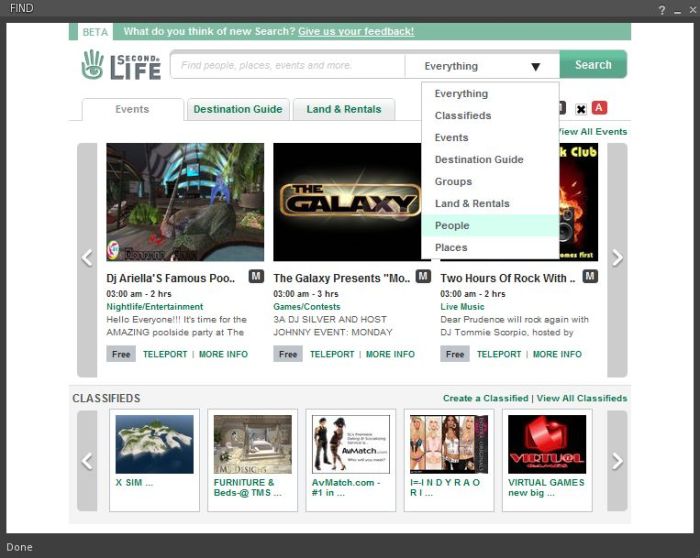
I’d certainly keep the new front page layout. It’s clean, it’s easy to follow, and it has all the core items required to facilitate a search. At the top of the page is the main search bar, withthe ability to define searches by category via a drop-down list.
The rest of the page layout is pretty much self-explanatory and easy to follow (although I am curious as to how ads for the “highlights” in Events, etc., tabs & in Classified are selected, and how frequently they are rotated for ads from other creators).
Wasted
After this, however, I’m less enthusiastic about how information is presented. The fact is, whatever the “under-the-hood” improvements that have been made, Search still wastes space and takes up more screen real estate than I personally feel is necessary.
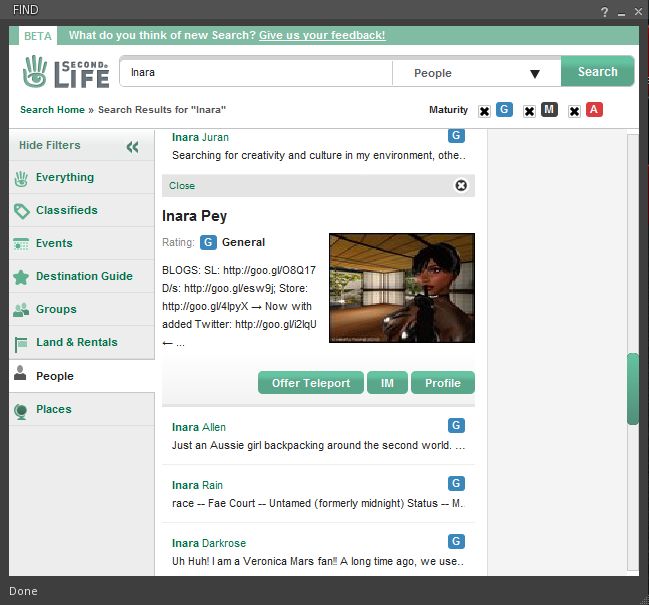
“New” Search – still wastes space
Look at the example above. There is much that is useful in it – the Filters on the left, the main results area, etc. – but the fact is it is poorly presented and wasteful. Why aren’t the filter options tabbed across the top, in keeping with the Events, Destinations and Land tabs on the home page? This is not only more logical, it frees-up the main section of the window to allow more information to potentially be displayed. Similarly, why the vertical column to the right for Classifieds? Why not use the bottom part of the window, again in keeping with the home page?
Then there is the fact that if you want to drill down to detailed information on anything, you get chucked out of the Search window and into the Sidebar. Sometimes (as with profiles) this might be useful, but given the dearth of information the Sidebar now tends to offer for things like Places, this is frequently a wasted exercise and so doubly annoying. Things are equally irritating when you’re searching through a set of results for something specific and wind up having to shuffle back and forth between Search and Sidebar, impersonating a tennis ball in the middle of a Nadal / Djonkovic rally.
Which is a shame, as it really needn’t be like this.
All it takes is a little forethought
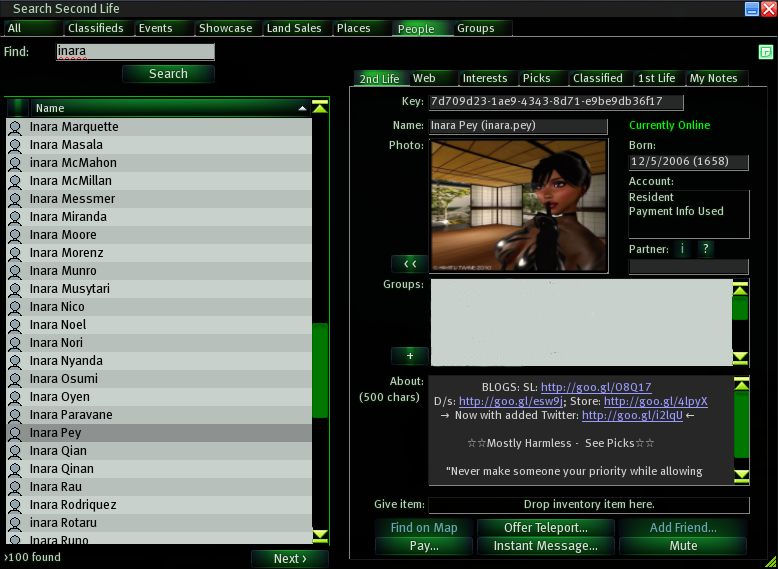
The “powerful” aspect of the Viewer 1 Search has always been the convenience with which results are displayed. For the majority of searches, everything is focused on a single window split into two panes: on the left is a list of initial results, on the right space to display focused results.
Search 1: convenient
This is not 100% ideal, but it does tend to give maximum bang to the buck on any given search. When running a search on people, land, places and the like, this is massively convenient, allowing you to quickly flick back and forth between a list of results and the details on each one without taking up masses of screen space (so you can even keep an eye on what is happening around you in-world).
My ideal Search
My ideal search would therefore take the strengths of Viewer 1 and the “new” Search (tabs, filters, home page, etc.) and (where appropriate) the two-pane design of Viewer 1 Search and bring them together in a Search window that avoids the Sidebar and presents information in a manner that is fast and convenient to use – as in the example I’ve cobbled together rather roughly below.
All-in-one: so much more convenient (Firestorm used for Profile image, due to lack of available images for the “new” web profiles look)
Of course, some of the tabs would need to be tweaked somewhat. Events, for example, would require an ability to search by event type, data, times, etc. – but this capability is already supplied in the left-side filters on the “new” search, and should be relatively easy to incorporate them in my revised layout as a drop-down series of options.
The image above isn’t perfect – I’m not terrifically clever with graphics, but I think it gives a reasonable idea of what could have been done, and even provides room here and there for things to be tweaked.
Can it be done? Well, why not? Will it be done? Probably not. But I can dream, can’t I?
 Deep Down–A Story From the Heart of Coal Country, first broadcast in the autumn of 2010, is an examination of the human consequences of our environmental impact. The film follows Beverly May and Terry Ratliff in Appalachian mountains of eastern Kentucky,, a region that has supplied the USA nation with coal for over a century, and who now find themselves in the midst of a debate dividing their community and the world: who controls, consumes, and benefits from our planet’s shrinking supply of natural resources? While Beverly organizes her neighbours and leads a legal fight to stop Miller Brothers Coal Company from advancing into her hollow, Terry considers signing away the mining rights to his backyard-a decision that could destroy not only the two friends’ homes, but the peace and environment surrounding their community. Through their eyes, the battle over energy and the wealth and environmental destruction it represents in through into sharp relief, and raises questions relating to humankind’s own morality, our connection to the earth’s resources, and most importantly, our link to people whose daily lives are far removed from our own and yet deeply impacted through our actions. Through a complex human story that cuts across environment, economics, public policy, and culture, the story of Beverly May and Terry Ratliff reveals the devastating impact of our energy consumption against an explosive backdrop: Appalachia’s centuries-old struggle over the black rock that fuels our planet.
 The Virtual Mine, nominated for an Emmy today, was created as an adjunct to Deep Down, and launched on November 10th 2010 with over 40 people in attendance, including Second Life experts and environmental activists and educators. It is an immersive, educational 3D environment, game, and educational curriculum