Ciaran Laval (once again!) lead me to an article on The Register concerning “Ten technology … FAILS” by one Tony Smith. Some of the entries will doubtless raise a smile or two or have some pundits nodding sagely and muttering, “Yep, said it would never work at the time…”
However, on page four of the item comes … Second Life, which is given a dismissive paragraph concluding, “And then, of course, they all realised that living one, real life was busy enough. And social networking was born…”.
Thus, Mr. Smith joins a growing clique of journalists all eager to proclaim that SL has not only failed, it is in fact like the proverbial parrot famed of Monty Python, “No more”. Not only is his view demonstrably wrong (to sum up what follows, “We’re still here, aren’t we?”), in pointing to Second Life, he again, like many who cite its “failure”, reveal a complete lack of awareness of the platform.
Ciaran asks why attitudes such as this prevail in journalistic circles. He points to an article on The Ancient Game Noob, which also attempts to address the question. Both raise fair points. However, there is really only one answer that matters where views such as those expressed in The Register are concerned, and it can be summed up in two words.
Lazy journalism.
Birth of the Myth
Anshe Chung and Business Week – success and hype
For a time, SL was undoubtedly the darling of the media – whether it be bold predictions of a new kind of “virtual entrepreneur” being the wave of the future. The hype, as I’ve covered elsewhere, began in late 2005, in an article which appeared on CNNMoney and which essentially catapulted Anshe Chung onto the cover of Business Week.
This saw the birth of a story which ran and ran, across more than a year through 2006 and 2007, when the media couldn’t get enough of SL – and nor, for a time, could big business – for reasons neither could fully understand (and nor, in fairness, could LL). All that was apparent, was that the bandwagon was passing by, and it was time to jump on or risk missing out – even though “jumping on” and “missing out” were never actually quantified.
And when it comes to media we’re not just talking the “traditional” forms of media, real or digital print; leave us not forget that CBS jumped aboard in 2007, working with Electronic Sheep to bring us a CSI immersive environment, and the appearance of Second Life (albeit rather badly) on a two-parter of CSI:NY. Other shows also jumped in as well, and even pop stars around the world got in on the act, with Duran Duran (2006) perhaps being the most notable (and still very present), while Italian singer Irene Grandi released her 2007 hit Bruci la città (“Burn the City”) with a video produced in part in Second Life, featuring an avatar based upon her.
I’m going to say this up front: I’m posting this without the subject’s knowledge, because I do know how hard it has been for her to promote herself. I hope she won’t be upset with me for doing so.
I’ll also say that while Whiskey Monday and I don’t know each other in-world, I know her through Twitter and via her blog at Whiskey Shots I have a great affinity with and respect for her views, thoughts and outlook – not because we necessarily have a lot in common, but because every word she uses is beautifully crafted, from the heart and rich with insight and emotion, all of which naturally draw me to her. Whiskey is quite simply, one of the most creative and caring people I’ve ever encountered; and I’m far from alone in saying that.
Whiskey’s heartfelt outlook and creativity also combine in her images, which day after day never fail to stir one’s emotions. They reach well beyond the traditional nature of virtual world images and are works of art, which sit both independently from, and very much a part of, the blog posts with which they appear.
Now Whiskey has – in response to repeated requests from friends – now crossed over the digital divide and is offering her images as fine art prints for sale in real life, supplied through Fine Art America. The images are supplied as high-quality giclee prints on art grade paper, and Fine Art America offer them in a range for formats and finishes, from greetings cards through to full canvas print options, each in a range of sizes and very reasonable prices.
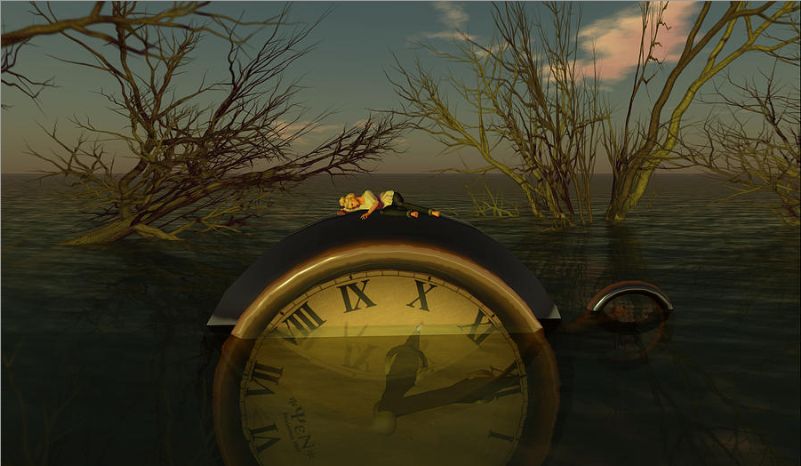
Once Upon a Time – one of Whiskey’s amazing shots, now available through Fine Art America
Each item Whiskey has selected for reproduction has not only been carefully chosen, it has been subject to very careful edited to remove every blemish and unwanted artifact which can otherwise result from tha vagaries of the snapshot floater / viewer image processing (such as the unfortunately tiling lines so common in high-resolution SL photography). The results are, even on the Fine Art America pages, stunning.
Pricing for items is given in local currency (and there is a converter on each page in case the website / your browser hiccups on displaying the required currency), and Fine Art America do ship worldwide. For those worried about their pseudonymity – relax! Fine Art America handle everything directly; as Whiskey herself says, “FAA handles all shipping and handling for me, so I’ll never see your real world or payment information. This seemed the easiest way to make prints available while protecting all of our interests.”
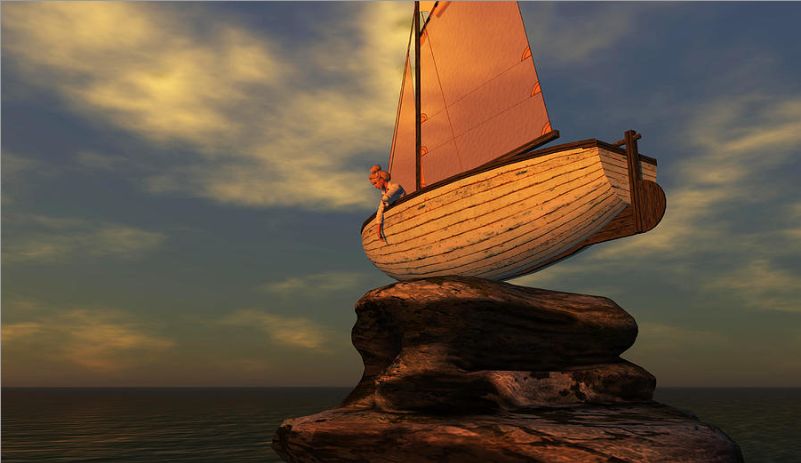
Depth Perception– one of Whiskey’s amazing shots, now available through Fine Art America
The initial set of prints on offer may seem small – but it stands as a huge amount of work on Whiskey’s part to prepare them, not to mention a huge leap of courage to make the crossing as she has. She is planning to expand the set further as time permits. In the meantime, if you are looking for that exception image, be it for a wall or a gift or as a message to send to a loved one / friend, Whiskey’s shots offer a very unique and beautiful way of doing so.
But don’t take my word for it; go see for yourself and read Whiskey’s blog.
Update, February 19th, 2014: Creatorvers and dio were discontinued by Linden Lab on February 19th, 2014. Links to their websites, etc., have therefore been removed from this article.
Details of a kind are starting to slip out about LL’s new product stream. We’re now already very familiar with Patterns and Creatorverse, the latter of which reached the Android platform at the start of the week, coming to it via the Kindle range of tablets.
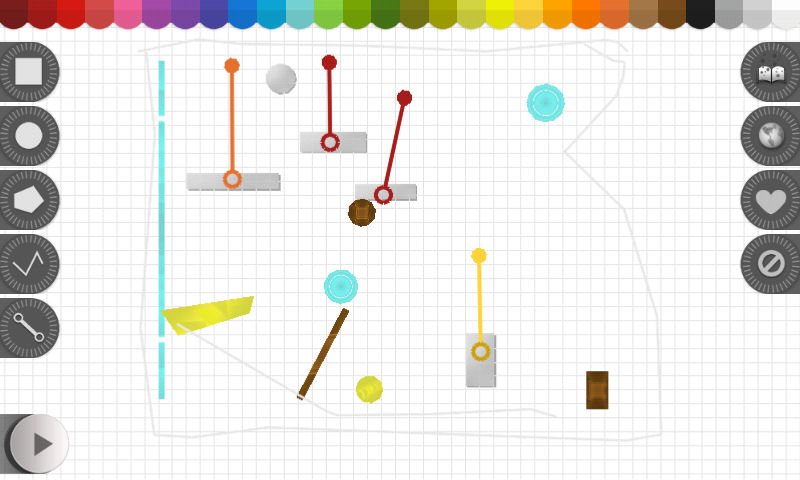
Creatorverse: iPad, Kindle and Android so far
An article in Techcrunch provides some more insight into the remaining two products of which we’re already aware, Dio and Versu.
The article starts off with a positive comment on Second Life itself:
Linden Lab, the company that created Second Life and grew that online community into one of the most colorful, varied online social networks in the world, is doing some very different things for the first time in many, many years.
Admittedly, this quickly slides into the murkier waters regarding declining user numbers, observing rather interestingly that “passive viewing becoming the dominant interaction method”, before bringing up that beloved subject of many a journo reporting on SL, that of its “sordid past”.
I’m not entirely sure what is meant by “passive viewing”, but I suspect that relates to many of the more populous venues in SL being clubs (of every sort) whereby avatars are dancing but most of the conversation is going on in IM, giving the illusion that everyone is sitting in silence watching avatars gyrate twist and turn individually or in groups, or twirl gracefully around the dance floor like pairs of professional ballroom dancers. While the image is true, I’m not entirely sure how representative of SL it is as a whole.
But I digress.
In the article, Rod Humble confirms the upcoming order of the remaining two initial product releases from the Lab, with Dio coming up next, followed by Versu.
“The next project is a web experience called Dio that’s really hard to explain, which I like. It’s sort of like Second Life without the graphics, or Facebook but trying to be more of a creative space,” Humble is quoted as saying in the Techcrunch article. He goes on, “So it’s a web experience and you create your space, but within the spaces, everyone has their own avatar and avatars carry inventory. The way you navigate from space to space is via doors, and you can make things like a MUSH [multi-user shared hack] or hobby space very easily.”
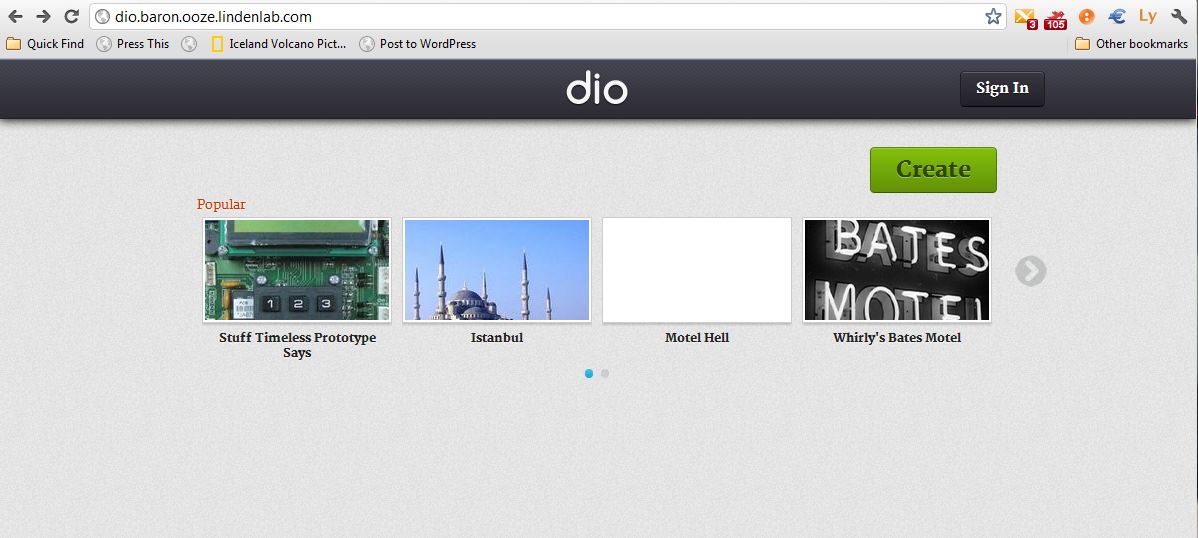
Dio: “webspace with avatars” (image from an early version of the Dio website, and not necessarily representative of how the finished product will appear)
During August / September a griefing object in the form of a “freebie gift” started circulating in-world. Called ”..::ExDepart::.. Gift Package 2012”, it is essentially a spoofing/griefing item which, when rezzed will create more items citing you as the owner, and attempt to pass them out.
Since it first appeared, the item has appeared in a number of variants, of which “-[L4L]- Gestures & Walkers (Freebies) <3” is one.
If you receive either item – do not rez it. Instead, file an abuse report, citing Governor Linden as the abuser, list any pertinent information on the object – and remember the person you received it from most likely did not create it, then delete it.
Similarly, if you receive any other item with a similar format of name, or which gives rise to suspicions on your part – particularly if the receipt of the item is unexpected – contact the person who sent it to you first and verify with them that they have legitimately sent you something before attempting to rez the item.
If you receive such an item and rez it, you will need to locate it and delete it – and you may find it has spawned several copies of itself. Typically, one rezzed, the item will move itself to around 4000m above ground, and will continue to spam you with items. To locate and delete the object(s):
Check the incoming dialogue pop-ups associated with the incoming items. These should provide the co-ordinates where the item is located. Alternatively, decline the object’s offer, and the co-ordinates should be recorded in local chat.
Position yourself on the ground using the X and Y coordinates for the object, then:
Either fly up to the Z coordinate for the object, or
Rez and cube, sit on it and use EDIT to elevate the cube to the Z coordinate, or
If you have a viewer which supports command line instructions, use gtp x y z – replacing X, Y and Z with the object’s coordinates
Once in the location, enable Beacons for Scripted Objects (CTRL-ALT-SHIFT-N). You should see a small box with crosshairs on the offending object
Go to Edit and drag a selection box around the object to select it.
Press Delete to remove the object.
Note there may be more than one copy of the object nearby, so you may have to repeat the steps above to remove all of them.
The use of the object is known to the Lab, with Simon Linden commenting at the Simulator User Group meeting on Tuesday 20th November that, “It’s pretty much an ugly social-engineering griefer ploy.”
Miro Collas, of the Phoenix / Firestorm team has put together detailed advice on the object and removing it on the Firestorm wiki, from which the instructions in this post have been drawn.
Kill Screen carries an interesting article on Second Life and Linden Lab’s direction under the leadership of Rod Humble. Provocatively entitled, Can Rod Humble resurrect Second Life? the piece examines Humble’s role as LL’s CEO and in particular his strategy in driving the company towards diversification.
A relaxed Humble with a memory of the past…
The latter has tended to divide people engaged in or observing SL, with some seeing it as a sign that LL have somehow “given up” on Second Life or are using it simply as a financial lever with which to churn out new products, and others taking a more moderate view of things. I’ve argued myself on a couple of occasions that diversification could actually be both beneficial towards SL in the longer term, and really doesn’t measure up in any way to LL having “given up” on SL. However, Humble’s view adds an interesting dimension to the discussion, as it is clear his thoughts possibly reach far beyond matters of “direct” user retention. The article notes in particular that:
One initial challenge, however, is its own core product. Building an object in Second Life isn’t easy. There are tutorials and message boards, but for someone who wants to pop in and simply make something quickly, Second Life is intimidating. In fact, that was part of the barrier to the community’s growth. Despite all its fanfare and media coverage, actually getting started was a hindrance to casual users. “Second Life is a highly complex 3D space. It’s a high learning curve,” Humble notes. “A steep climb but rewarding and deep.”
As we’re aware, bridging that gap is hard. There have been numerous attempts to help new users across it, from in-depth solutions such as the old Orientation, Discovery and Help Islands, through to the infamous “first hour” experience of Mark Kingdon’s day (which grew to encompass the “first five hours” when it wasn’t working out as planned) to the highly minimalistic (and questionable) Destination Islands seen more recently. Efforts have also included privately run welcome areas through to experimental orientation areas to something of a return to the more traditional approach.
Part of the problem here is that everyone tends to have an opinion on how it should be done. Many focus on the technical aspects, some on the social aspects, and well may have common foundations, then often build out in various different directions. This makes drawing a consensus as to what works actually quite difficult – as the Lab has learned.
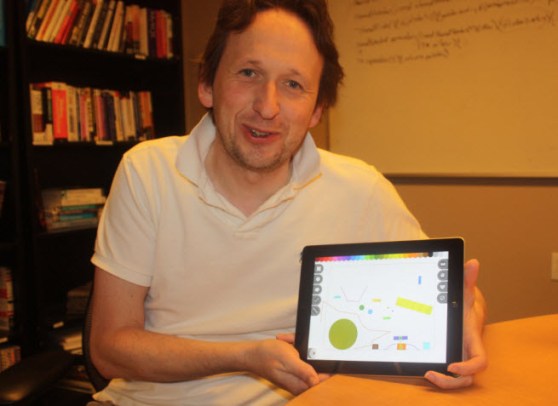
However, in launching the new apps – particularly Creatorverse and Patterns – Humble sees things differently; that by breaking down the creative process into easily understandable concepts and ideas that allow the user to develop a more intuitive understanding of the creative process – and perhaps then move on to more involved creative environments. As the Kill Screen article also comments:
The Linden apps strategy hopes to bridge the gap between the tactile joys of painting and the more guided pleasures of digital makers. More importantly, Humble’s ultimate goal is digital literacy. As he struggled as an amateur, he found that his appreciation of the masters was heightened. The jazzy rhythms of Kandinsky took on new life as he was able to speak the painter’s language. Humble hopes that games like Creatorverse will foster a greater appreciation of the creative process behind designing digital goods. “The hope is that the more people make things, the more they have a richer language to express criticism.”
Rod Humble: Creatorverse and Patterns – opening doors to greater user creativity
Whether this will lead people from the likes of Creatorverse to Second Life is questionable; but where Patterns is concerned, there is something of a path where this may happen; both it and Second Life are somewhat grounded in similar concepts, something a number of commentators – myself included – have noted. Obviously for it to be effective, there needs to be some pointing of the finger towards the doorway from either Patterns to Second Life, which is currently far from being evidenced; but then Patterns is also a long way from prime-time as well.
Perhaps more telling from an SL standpoint is a direct quote from Humble:
“I like rebelling against the tyranny of structured forms,” Humble says. Sims creator Will Wright’s approach to “software as toys” was an inspiration to Humble while the latter was at EA. The constraints that game designers typically place on their players are anathema to the more open-ended creative process that Humble sees as the future of play. “Instead of being told you need to do these tasks to proceed to the next air lock of fun, why not open those doors and give you the ability to fly around?”
This not only encapsulates the broader aims of the likes of Creatorverse and Patterns in reaching new audiences and (maybe) enticing them towards Second Life, it more particularly seems to point to why Linden Lab has, on the one hand, been pushing out new tools and capabilities on their users while on the other, seeming to step back from “direct” involvement within SL. That is, the company is simply trying to present users new and old with as wide a palette of tools and capabilities as possible (mesh, pathfinding, the still-to-be-completed advanced creation tools, the upcoming materials processing capabilities, etc.) they can use create and explore the 3D spaces offered by SL without feeling constrained by the constant presence of the company looking over their shoulder.
The Garden – a subtle use of Teleport Agent, an element of the advanced creation capabilities in SL, which is used ion the puzzle HUD
Doubtless there will be disagreements with this view and with Humble’s comments in general; however they do make interesting reading. For me, and despite all the problems which are looming on the horizon where SL is concerned, I can’t help but come away from it with a feeling that (again) neither Humble nor LL have given up on their core platform.
With thanks to Daniel Voyager for the Twitter pointer.
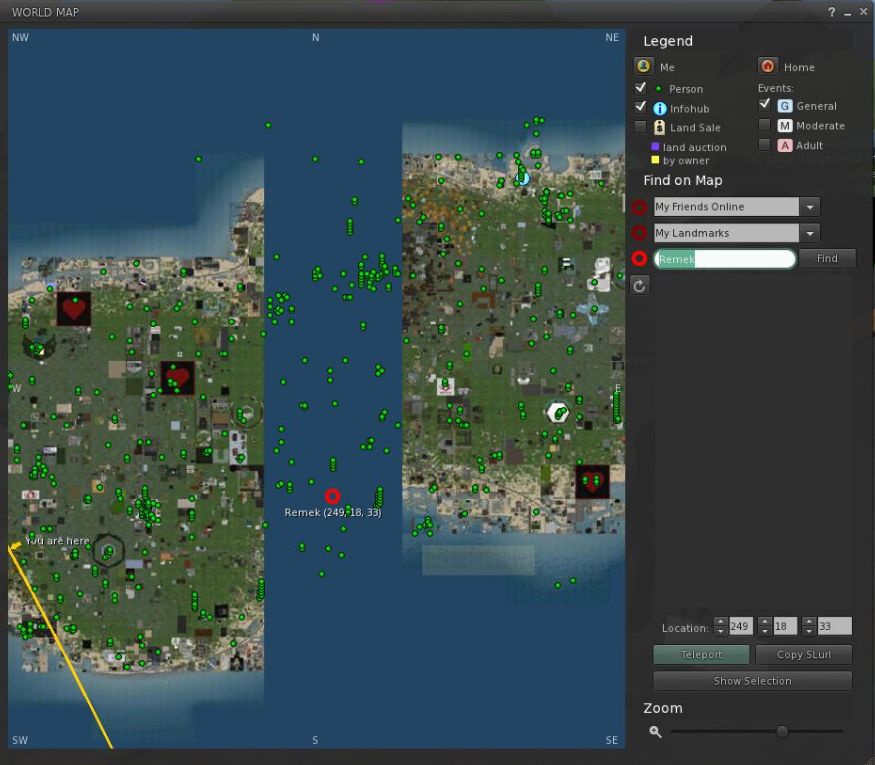
There have been ongoing issues with regions not rendering within the World map. The precise reasons why this is the case is currently unclear; Andrew Linden has been trying to look into the matter since it was reported at the last of the Friday Simulator User Group meetings on the 9th November, but work on Interest Lists has kept him busy.
The problems appear to be twofold: tiles for some regions either entirely fail to generate in the World map, or their appearance is linked to the level of zoom being used.
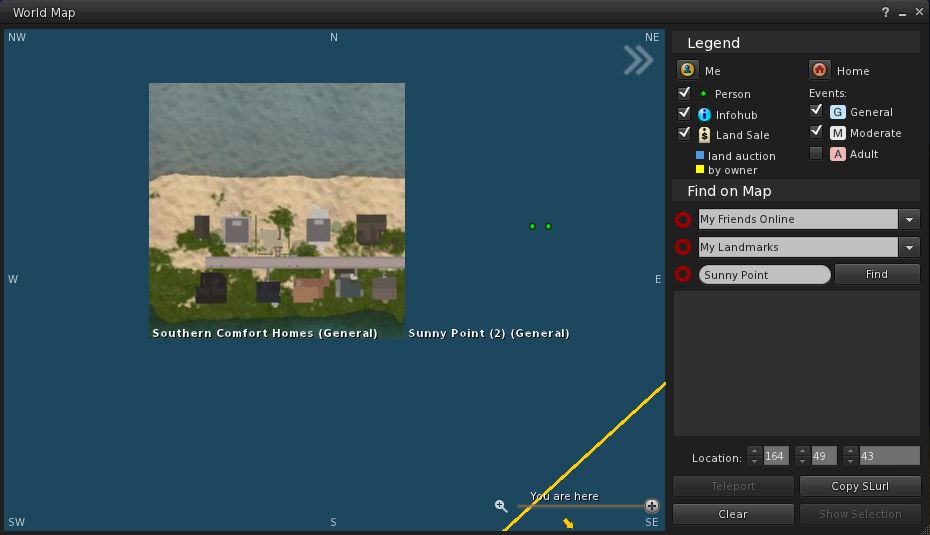
The first issue is demonstrated with the region Sunny Point, which simply does not appear on the World map at all.
Sunny Point – failing to appear on the World map
With the second issue, Qie Niangao reports that strips of regions on the World map can effectively vanish at certain zoom levels (see JIRA SVC-8115), with some regions of the Zindra adult content apparently never having been drawn at some zoom levels of the Map.
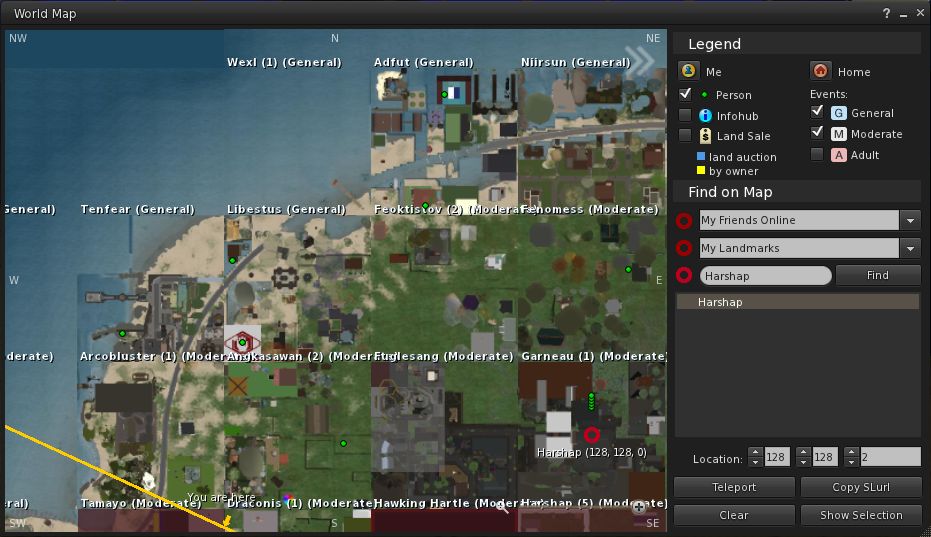
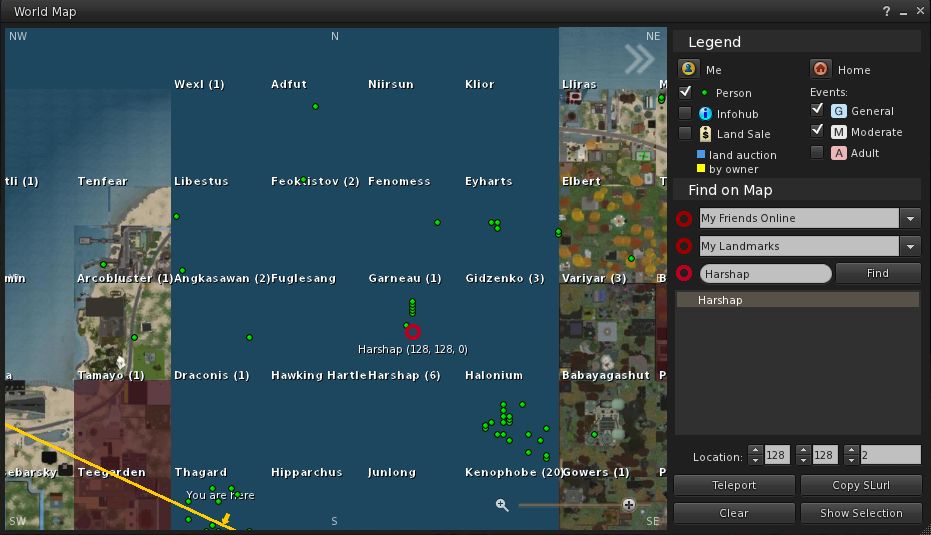
Regions located close to Harshap demonstrate a part of the problem, in that they will appear in the map when zoomed fully in, but step out once on the zoom, and a strip of regions will vanish.
Regions near Harshap: visible when zoomed in…
While the issue has only recently come up for discussion at the Simulator UG meeting, the problem appears to have been persistent for a good while, and some have reported the map is missing strips of region tiles from as many as eight different locations.
Harshap: step out a level with zoom, and a strip of regions vanish, and are not re-rendered.
The World map is generated via a process which images regions from an altitude of around 350m (hence why builds above this altitude do not appear on the map). The information is then scaled for rendering at a number of levels to represent the different zoom levels within the World map floater. Currently, it appears is if the problem lies with the generation of these different zoom levels, at least as far as the “missing strips” issues is concerned. The data from the process is also used for generating map images at maps.secondlife.com, with the result that issues can also occur when viewing map segments there.
As it stands, the possible causes for the problem are still under investigation by LL personnel. However, anyone encountering problems with their region(s) failing to render properly on the World map should consider raising a bug report and /or attending the Tuesday Simulator UG meeting (the Friday meeting is now discontinued).
Regions absent from the World map, as imaged by MartinRJ Fayray for the Simulator User Group meeting on Tuesday 13th November




 Inara Pey: Living in a Modemworld