Rodvik: Virtual Goods and LL’s Profitability

Rod Humble discusses virtual goods and virtual worlds in a brief Bloomberg interview. What are most interesting to note are the comments towards the end of the piece, regarding Linden Lab’s current profitability:

Emily Chang: The Tech IPO bandwagon is filling up. Is that something that you guys would consider or [are] considering?

Rod Humble:  We’re not looking for any further investment right now. We’re profitable, we’ve got [a] very good cash balance… So from our perspective, if we were to be able to deliver a large and measurable long-term return on new investment, then we’d certainly look at it. We’ve got a long runway of features that I want to put in place with our current very healthy cash and profitable business first, though.

Should this story be picked up, it is these words that are probably going to be the focus of attention – particularly among those who seem anxious to sink the Second Life boat, who will probably interpret Humble’s words as, “We’re not really attractive enough for IPO, and we’ve got to blow money to get there, ‘cos we have to make ourselves attractive somehow.”

Personally, I see his statement in a more positive light: LL are reasonably cash stable and are profitable, something I’ve commented on previously. Furthermore, there is a continuing upswing in sign-ups (still running at around 16K per day), which appears to be translating into a rise in user concurrency, which would indicate that new users are actually sticking around for longer and potentially getting more involved. Both of which are healthy signs.

What is key about Humble’s words, however, is the sheer pragmatism they carry, even in such a relatively lightweight interview. He recognises that while Second Life indeed “has legs”, and can, on current form, continue pretty much as is as a private company generating sufficient profits to demonstrate (presumably) a return reasonable enough to keep the original investors happy, it also has the potential to go much further in time. Thus, while IPO is definitely not on the cards right now, this may not be the case in the future, should things develop in that direction.

This is pragmatic on two counts. Firstly, it is allowing the company a degree of freedom in tackling the issues it currently faces – technical and otherwise – and solidifying its position without any ulterior needs or requirements overshadowing things. Given the company has undergone significant pain when ulterior motives have been the driving force behind matters in the past (e.g. the drive to convert SL into some form of “real world” business and applications platform), this is a wise move. Secondly, as Emily Chang states – the technology IPO bandwagon is fast filling up, but if we’re all absolutely honest, we’ve no idea where it is going. As such, not leaping onto it with everyone else is also something of a potentially wise move; especially if the wheels do come off the wagon, as LL get to avoid the resultant crash. However, if the bandwagon proves it can roll and roll, then LL could ideally be well-placed to pick-up on all those investors who might otherwise be kicking themselves from not being “in” on things from the start.

Taking this perspective and being willing to acknowledge both sides of the coin, so to speak, again demonstrates to me that Rod Humble is very much the right man in the right place at Linden Lab – and he’s hopefully carrying the board with him on this.

SL Birthdays and Missed Opportunities

(Copyright Linden Lab)

The Second Birthday week is a time of celebration, a time when people can express what SL means to them and promote how it can be used and enjoyed.

Throughout this week, and besides the inevitable parties and the like, we have a range of thought-provoking talks and presentations on a wide range of worthy subjects: disability, education, machinima, art in Second Life. The list is impressive.

Except that something is missing.

Take a look at the Main Auditorium schedule I’ve linked to above and the other major stage (Main and Cake) event pages. You’ll notice that the name “Linden” doesn’t appear once.

I’ve already commented on the lack of any real Linden presence at the SL8B opening, and while that may well be dismissed as grumpiness on my part, there is a bigger issue here.

SL8B represents a marvellous opportunity for LL to reach out to the user community and communicate with us – so where are they?

I’m not talking about glad-handing or getting involved in in-depth discussions about who, what, when, where, how and why; rather I’m talking about getting up on stage and giving an overview of what is coming down the road, things like:

  • What is happening with Viewer 2?
  • What is Mesh going to look like?  (Given many haven’t see the results from the Beta Grid)
  • What is happening around service improvements like Group chat and server-side lag issues?

These don’t have to be massive Q&A sessions (and can be set-up from the outset as such), but the opportunity to inform, particularly given LL’s reticence to actually consistently use its own “communications platform”, isn’t one to be sneezed at.

Again, I know that LL do turn out in force at SLCC year-in-year-out and talk about these very things but the fact is however you look at it, the SLCC audience is pretty closed-off. Even with videos of the presentations being streamed live & available for viewing after the fact, it’s fair to say that SLCC doesn’t quite have the reach or immediacy that SL itself potentially has.

In short, by not turning up at SL8B Linden Lab is again missing an opportunity for positive engagement with its users on a global scale. Lets face it – I can make it to SL*B events a bloody sight easier than I can make SLCC – and I think it fair to say that the majority of people who are involved in SL are in the same boat as me in this.

It’s not only a missed opportunity, it’s also somewhat ironic. It is not that log ago (a year, in fact), that Linden Lab were loudly touting Second Life as the tool for virtual meetings, and that given it now has media on a prim and other goodies, it makes a excellent tool with which to bring together people from geographically disparate locations and communicate with them.

So why on Earth isn’t the Lab using it’s platform to this end at an event  people want to attend (and are attending in droves) to actually get out there and be seen and to talk and engage?

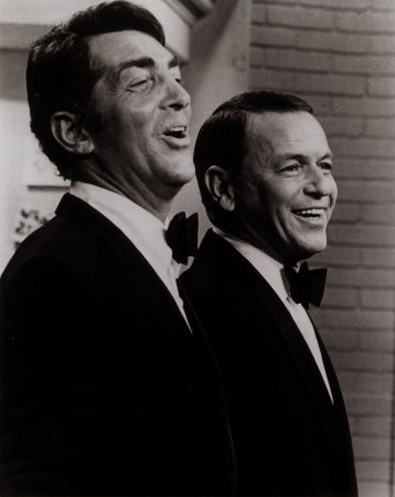
SL8B Main Stage 3:00pm SLT 23rd June – Move over, Dean and Frank?

As it stands, the only Linden presence in any official capacity this year seems to be Kim (who, with due respect, was gone in the blink of an eye) and Rodvik. Hardly a massive tunr-out.

And, with the greatest of love and respect to him – Rodvik is someone I genuinely admire enormously – I do have concerns with his appearance.

You see, he’s due on the Main Stage at 3:00pm SLT on the 23rd June. But that is also the time FedoraJones Popstar is due on stage,  which leaves me wondering if Rodvik’s appearance won’t actually be a quick duet before his is whisked off stage…

SL8B is a great opportunity for celebration; but it is also an outstanding opportunity for LL to be seen to be communicating and showing an interest in the platform, rather than hovering off to one side. And in this latter regards, they have once again failed to understand the medium at their fingertips.

My Ideal Viewer

OK, so over the years I’ve looked at just about every major Viewer to come out of the starting gate. Some I’ve reviewed in this blog, some I’ve chosen not to. I can’t claim to be intimately familiar with all of them, but I think I’ve used enough of them for long enough to determine what I would personally like to have in my Ideal Viewer.

Version and Installation

Right, well first off, I want a Viewer that can keep up with the latest developments  – or more particularly, improvements – churning out of Linden Lab. This means I want a Viewer that comes from the Viewer 2 Snowstorm code. Sorry, Viewer 1, but you’ve had your day. My ideal Viewer is one that installs cleanly and easily and tells me what I’m getting; I don’t want to be faced with a lot of tedious swapping of .EXE files, unpacking of additional folder and what have you – so again, bye-bye some Viewer 1 TPVs.

Frame Rates

Good frame rates

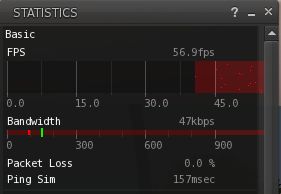
Frame rates aren’t everything, but they certainly smooth things for the better. As such, my ideal Viewer will consistently push out the best possible frame rates for my hardware. Given SL 2.6.4 banged things through at around 55 fps at a consistent rate when on my own (and over half that with other around), so it’s not unreasonable for me to expect that kind of performance on a consistent level (SL 2.7.1 has, for some reason now tailed off to figures below Firestorm on my machine after a good start during the first day or so I played with it).

Ideally, and allowing for the fact my graphics card and CPU are not cutting-edge and I only run Windows 7 32-bit, so have a RAM limitation – I’d ideally like to be able to run shadows without seeing my machine grind to a halt. Right now, only Viewer 2.7.1. and Firestorm Beta seem to be able to do that for me – and 2.7.1 does so significantly better than S21.

Top Bars

My ideal Viewer will minimise the impact of the top-of-screen navigation bars, etc., that doesn’t impact on their usefulness and which give me the option of being able to display my location information without compromise in terms of screen real estate or without the information vanishing just because I turn a bar or two off.

Firestorm’s top bars – note the location information right at the top, allowing me to turn off the navigation bar without losing information

On the subject of top bars – my ideal Viewer would have a pre-requisite that the Preferences shortcut button is employed in every skin variant.

Sidebar

My ideal Viewer will avoid the Sidebar like the plague; if it must use the Sidebar then:

  • It will do so without idiotic tabs cluttering up the right side of the screen and making things look unsightly
  • It will provide button-based access to all of the Sidebar tabs, either from the toolbar at the bottom of the screen (e.g. Firestorm) or via an optional floating palette (e.g Kirstenlee’s & Kokua)
  • It will be appropriately sized so as not to feel like an elephant is taking up residence on my screen
  •  Tabs detached from the Sidebar will given me the option of closing them (not minimising – closing) without having to re-dock them, and will then be persistent on opening thereafter (preferably via a toolbar button, but even by retaining the relevant right-side tab if necessary).

Communications

My ideal Viewer will properly integrate my communications options, be they local chat, individual IM sessions or Group Chat. It will present these options in a single, tidy reference-point and not force me into having to use the People tab of the sidebar to reach someone . It will also present my options for communicating without making large demands on  screen real-estate. So far only Firestorm successfully grants all of this.

Viewer 2 Communications: Top left – Viewer 2: limiting in extremis; Top right – Kokua: wasted space; Bottom left – Firestorm: perfect! (windows all default size)

Walking and Camera Movement

Movement and Camera Controls, please

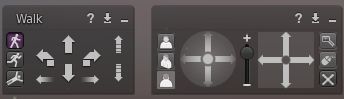
I like the camera movement options with Viewer 2 et al, even with a trackball rather than a mouse (although still a pain in the bum on my netbook’s touchpad). However, there are times when the camera controls and the movement controls are handy to have around. Therefore, my ideal Viewer would include both. Just like Kokua.

In-World Profile Windows

In-world Profile window

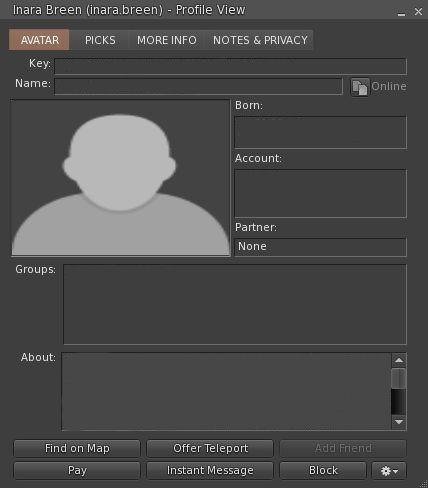
Yes, the new web-based profiles have their uses – but the fact remains, they are most frequently used in-world – and having to repeatedly have the Viewer web-browser thrown open, or to be chucked out into your external browser is on the high side of bloody annoying. It’s also slow at times. Therefore, my ideal Viewer will retain a “Viewer 1” style approach to Profiles (Firestorm) and include the option to use either it or the web-based view.

UI Flexibility

While Viewer 2 has come a long way over the last 18 months, some aspects of it remain something of a pain. Information can easily be missed, for example. It’s also fair to say that old habits do die hard and many of us have doing things a certain way ingrained ‘pon our souls for better or for worse.

UI Extras – it’s about choice

Therefore, my ideal Viewer would include options that allow some degree of customisation within the UI and provide people with options that help them feel more at home with the Viewer.

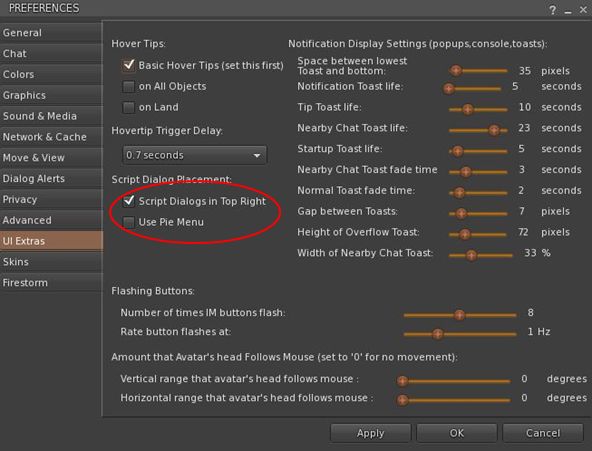
At the moment, Firestorm leads the way here – not only for the privacy options and the like, but for the fact it includes a UI Extras tab in Preferences, which not only includes some handy sliders with which you can carry out small adjustments to the UI, it also includes some options liable to put a smile on a lot of faces (circled) – although Kirstenlee’s Viewer, in fairness, offer the old-style pie menus as well, athough they are turned off by default, rather than on by default as with Firestorm. Indeed, the only additional option it needs here is one that will chuck system alerts and notifications up to the top right of the screen.

Context Menus

Proper context menus

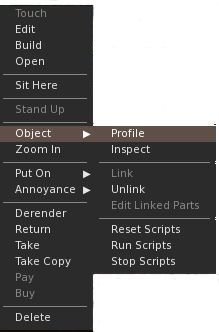
I prefer the context menus over pie menus. Done right, they are far more intuitive than hunting for the right slice of things & in keeping with the majority of computer applications. But they are not with fault. My ideal viewer would therefore consider what someone is likely to be doing wherever they are, and provide the menu options they are most likely going to want to use, whether they are building, shopping or whatever.

Firestorm blazes the trail here (no pun intended), and I’d definitely incorporate their approach into my idea Viewer. It’s fast and efficient and doesn’t require multiple step-downs to get to the things you want.

Built-in AO

Take the load off the server; give yourself client-side flexibility & lose the need for HUDs. My ideal Viewer is one that incorporates an client-side AO system that is comprehensive and easy-to-use. Right now, that’s Firestorm only, but doubtless Kokua will be following suit.

And the Rest

No Viewer would be complete without:

  • RLV  / RLVa (it’s not just about the BDSM, OK?)
  • Radar a-la Firestorm
  • 3D (only in Kirstenlee’s S21 Build 8 right now)
  • Comprehensive privacy options (Firestorm)
  • The ability to disable various blank screens (i.e. teleport)
  • Media filter Viewer 1 TPV-style TP indicator displayed whe teleporting & the Tp screen is disabled
  • Can easily be optimised for photography / machinima (as with Kirstenlee’s S21)

And that’s about it. There is nothing extraordinary here. Everything I’ve described above exists in various flavours of the Viewer right now. Question is, will anyone bring them all together into a single offering?

Naysayers and the Doom of Second Life

The world is full of naysayers; the virtual world doubly so. It seems we cannot get through a single week without someone raising a cry that Second Life is either dying, dead, or en route to the hospital while undergoing CPR.

This isn’t a new phenomenon; the doom of Second Life has been oft-predicted over the years, with a notable increase following the “boom” period of 06/07; the cry frequently being heard from both users and mainstream sources. More recently, self-styled virtual worlds /social media pundit Hamlet Au (Wagner James Au), rarely misses an opportunity to pronounce SL as having entered a phase of terminal decline (damn you, pesky users!).

The Chicken Little Syndrome

It cannot be denied that apart from the odd blip, Second Life has plateaued, concurrency remains fairly flat, and while we’ve been seeing a recent upturn in new user sign-ups, it’s unclear as to whether the sign-ups are new users (and if so, whether they are being retained), or whether they are existing users trying out the new sign-up process and creating alts for other purposes. On top of this, the economical stats, despite all the fiddling and tweaking that has gone on around them on-and-off for over a year new, remain relatively level outside of the SL Marketplace.

But, a lack of highly visible growth doesn’t actually equate to the platform “dying” in any way. As mentioned above, it’s very easy to take things out of context or be highly selective in which data you use to make a point. Take Hamlet Au’s recent “deathwatch” claim. On the surface it makes worrying reading: the grid is losing large number of sims (74 in one month!) representing large amounts of income for LL ($250,000!), all of which is “extremely significant” (i.e. “ominously bad”) for SL.

Except that as I pointed out, Hamlet arrives at this sensationalist viewpoint through a bad case of selective reading. The very source he quotes goes a long way towards undermining his position:  end-of-month sim losses tending to be countered by new sim leases the following month; the figures for March 2011 actually showing LL’s sim revenues increased by 1%, and so on.

Another thing somewhat taken out of context and used to paint a black picture of Linden Lab were last year’s layoffs. When announced, people preferred to pooh-pooh the Lab’s official line that the layoffs were part of a strategic restructuring, and instead sagely pronounced they were “proof” that the company was in deep financial do-doos. However, in doing so they tended to overlook the Lab’s history in the two years prior to the lay-offs.

Up until 2008, Linden Lab had, staff-wise, expanded at a pace which matched the growth of Second Life, to reach around 250 when Mark Kingdon joined the company as the new CEO. At that time, Philip Rosedale was, somewhat prematurely, talking in teems of massive expansion:

“We’re looking for someone who has experience with and a passion for growing this type of company — a software platform company — from 250 people to thousands of people, which is where we think it’s going,”

Sure enough, following Kingdon’s appointment, the company did start hiring at an impressive rate, taking on around 100 staff between March 2008 and June 2010 – a figure well ahead of any matching upturn in the take-up / use of Second Life in any market sector. While there was much ado during that period about the SL Enterprise product and Linden Lab trying to transform Second Life into a viable corporate business platform, it was questionable as to whether all the hires made during that period were actually required and sustainable.

History now shows us that the answer to that question has been “no”. Second Life has failed to come anywhere near being a credible business platform in the terms the LL themselves touted; the Second Life Enterprise product has been scrapped. As such – and while undoubtedly traumatic for those involved – the lay-offs do appear to have been driven by a strategic decision to refocus on the company’s core business and bring staffing levels back in line with the needs of the platform rather than any knee-jerk reaction to a financial “crisis”.

Money Talks

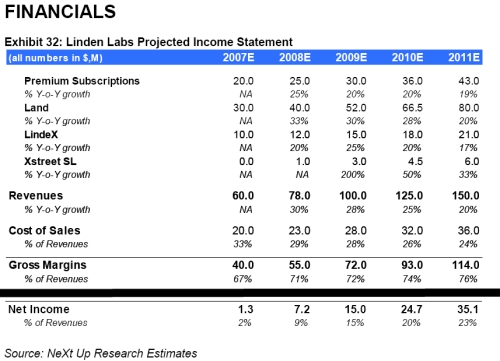
On the subject of finances, and while LL aren’t in the habit of giving out financial data, let’s again look at recent history. Back in 2008, and before his view of Second Life soured, Hamlet himself estimated Linden Lab could well be clearing between $40 and $50 million profit a year, based on an income stream of around $96 million.
Of course, since then, we’ve had a global financial crisis, the Lab itself has (see above) made unwise investments and tried to shift its focus in to unfounded markets which ultimately failed to pay off, and so on. By mid-2009, Mark Kingdon was candid enough to admit that while the figure wasn’t as high as Hamlet’s estimate, the company was still in good health, financially. Indeed, in that year, NeXt Up was estimating the Lab’s revenues could hit the $100 million mark. So while the company was undoubtedly suffering from increased overheads, a massive upswing in expenditure (staff increases, foreign offices, etc.) – is it really credible that by 2010, things had reached a state where the company was teetering on the edge?

I have a hard time accepting that. Even if profits were halved between 2008 and 2010, that still leaves Linden Lab generating a modestly-healthy $22 million a year, and that’s without taking into consideration the growth of the Grid itself (some 11,000 regions added), which helped generate entirely fresh income for Linden Lab. Indeed, in what was to be one of his last official statements for Linden Lab, Mark Kingdon went on record in June 2010, stating:

“The fact is our underlying financial health is very strong. We’re on pace this year for record revenue, record user numbers and record user-to-user transactions – among other positive indicators [my emphasis].

Now, “record revenue” may not automatically translate to “record profits”, but by the same measure, it also doesn’t mean the company has been losing money hand-over-fist. The truth is going to be somewhere in the middle, and liable to be the case that while profits were reduced during that period, LL nevertheless remained as healthy and as viable as it had ever been – which is again a long way short of falling off the cliff in terms of solvency.

Of course, this doesn’t mean everything is rosy in the garden of Second Life. People – the Lab’s Board included – have been expecting stellar things from the platform, and these clearly have yet to materialise – if indeed they ever will. There are issues that need to be sorted with regards to the scalability, stability and usability of the platform; there are equally valid questions around how LL can constructively engage with its user community and draw in and retain new users. There are even bigger questions to be asked as to whether or not Second Life and its ilk really do have a truly “mass market” appeal.

But none of these are indicative of a company that is teetering on the edge of financial disaster, and commentators who constantly try to slant things in that direction really aren’t doing themselves any favours.


Sincerely, Disgruntled of Second Life

Dear Linden Lab,

Things have never been easy in Second Life, for you, for us, for anyone. But once upon a time when you were about to start working on something that might affect us all in world, or when you discovered something was going borky, you’d have the decency to tell us. There would be a nice little blue pop-up appear in the top right-hand corner of the screen advising users of this, that or the other. When issues were resolved, there would be a nice little notice telling us so.

It was informative; it was helpful; it was reassuring to know you guys were out there, keeping an eye on things and letting us know what was going on. It gave us a nice warm fuzzy feeling inside. In short, it was communicative.

And then one day it stopped, leaving us with no option but to find out about Things Going Wrong or that planned maintenance had started by experiencing it the hard way: through teleports failing or transactions going astray or No Copy items poofing into the ether, never to be seen again.

Now, I appreciate that you cannot be on top of absolutely everything. The unexpected isn’t exactly predictable; that’s why it’s called “the unexpected”, right? I mean, I understand that. No-one can reasonably ask you to always get the word out before people start having issues and problems. But when you are aware of problems or when you yourselves are about to start Doing Things, is it really too much to ask that you actually, well, let us know in-world?

Yes, I know you try to keep us informed via the Grid Status Page and Twitter; but frankly, not everyone has a Twitter account. And even those of us who do find that having to keep one eye on it and one eye on the Grid Status Page tends to be a tad disruptive of the old immersive in-world experience we all know and love.

Surely it’s not that hard to renew the old in-world notices to all and sundry? After all, what is preferable: being told database maintenance is underway and that logins are suspended, or deciding to log out for a few minutes while you make a cuppa only to have the log-in screen gloatingly inform you you cannot now log back in?

I know which I’d prefer. So how about it? Pretty please?

Sincerely,

Disgruntled of Second Life.

Who is spamming?

We all hate spammers – you know the type, they pitch up in Group chat and fire off an IM, complete with Surl for some sale or event that has nowt to do with the Group itself. Groups with open enrolment are, sadly, particularly susceptible to these idiots.

Deeply annoying.

But, in the case of large Groups, equally annoying is the tirades that then follow said spammer as Group members proceed to gnash teeth, yowl, shakes their fists and generally react – sometimes for several minutes at a time, the comments scrolling up the Group Chat window, and, well, spamming the rest of the Group.

Yes, spammers are a PITA but I really wish people would remember that by the time they’ve pulled up the IM window, typed a reply and hit RETURN the spammer is long gone. They’ll have closed their IM window and sodded off somewhere else – if not left the Group entirely to find another target.

So, before jumping on the bandwagon of condemnation (however tempting it may be), please spare a thought for the rest of your fellow Group members who have been equally affected and try not to become as much an irritant as the original culprit.