I hate wagging the finger at Rodvik, I really do. But there are times when it has to be done; and this is one of them.
As has been the talk of Twitter, Malevay, the creators of Meeroos recently came under a form of attack: one day old avatar accounts with names closely approximating the official “Meeroo Resident” asset management account started to be used in attempts to cash-in on the Meeroo success – right under Malvay’s own noses. You can read about the situation in detail here.
As a result, the Malevay raised a series of tickets against the culprit accounts – and to cut a long story short, someone at LL’s Customer Support reacted in a totally lackadaisical and inexcusable manner and simply banned all account names looking like “Meeroo Resident” without thought or consideration as to the possible consequences. The result: the official Meeroo asset management account also got banned, with potentially serious repercussions for all involved.
How this came about is unclear, but what is apparent is that it smacks of sloppy enforcement and LL’s Customer Services end, and a lack of checks and balances to prevent avoidable mistakes occurring when dealing with people’s accounts. As Crap Mariner points out, are LL’s Customer Services incapable of carrying out the most rudimentary of checks on accounts prior to blocking them?
Insult was added to injury when the account was apparently reinstated on the QT withoutthe account holder receiving anycommunication from Customer Services. They simply found out when they another periodic attempt to log-in to the account and see if it was there.
Now, this is not the first time this kind of thing has happened; numerous people have reported they’ve experienced their accounts being suspended without warning, only to be subsequently reinstated equally without notification, for no readily apparent reasons.
Back when the new “communications platform” was launched, people – like Darrius Gothly – who accidentally violated the community standards for the platform were horrified to find members of the Customer Services team were publicly chastising them and using screen captures that clearly showed personal information – although why the heck Customer Services should need to capture screenshots was, and remains, a mystery. At the time, Amanda Linden tried to excuse the situation as “working out the kinks” in the new system. And explanation which, frankly, floated on the sea of scrutiny about as well a brick on the Atlantic.
This most recent incident involving Meeroos has many questions around it; to be fair, a lot of them are unrelated to LL’s Customer Service operations per se. However, it is and will be the actions on the part of LL’s Customer Services that will continue to receive a lot of attention – and a lot of criticism – both for the original account blocking error and the manner in which it was silently reinstated.
Had this been a one-off situation, people might be a little more forgiving, but it is not, as pointed out above. Rodvik identified customer services as being one of the Achilles’ Heels of Second Life. This situation with Meeroos demonstrates that this is very much still the case, and that it really is about time LL were seen to be tackling the problems, rather than people being left feeling they’re still only talking about tackling them.
As Botgirl Questi reports, the reason things have been so topsy-turvy on Google+ (some pseudonymous accounts being suspended then being reinstated; others being suspended and remaining so, others apparently being removed), appears to have gained some clarification.
It appears, to precis, that Google wants G+ to mimic how “ordinary people” interact in the real world.
Wow.
So innovation has now become a matter of mimicking, rather than enhancing or actually, well, being innovative. Givem all the possible options Google could opt to take when looking at building a genuinely innovative, progressive and encompassing social platform, the one that claim to have opted for seems to be little more than a wimp-out.
Obviously, there are clear reasons for this – as Tateru Nino commented the other day – in relation to capturing those who have been engaged in Facebook. This is also the possibility that Google’s conservative approach is because most people are, well, conservative, when it comes to making friends in RL. But in taking this approach, the fact is that Google is hardly likely to set the world alight – and they may actually be aware of this, hence the current flip-flopping over the matter of pseudonymity we’re currently seeing in terms of some accounts being reinstated as the beta progresses.
Even so, one cannot help but think that in taking up this stance, Google are potentially leaving a very large opportunity open for someone else to take-up.
Botgirl Questi closes her post with a quote from Marshall McLuhan regarding looking back at the future. I’d like to add my own to it, this one from Jim Steinman and made famous by one Marvin Lee Aday. It may not be as illustrious as the quote from McLuhan, but it still tends to sum Google’s position up:
Objects in the rear-view mirror may appear closer than they are.
Rod Humble once again demonstrates an adept hand and tongue when dealing with the media – this time the e-zine The Mark. It’s a fascinating piece that further demonstrates Rodvik not only grasps Second Life as a platform, he understands the importance of virtual identity. Take this extract:
The Mark: Do you think people existing in virtual worlds get closer to, or further away from, their true selves?
Rod Humble: I don’t have a clear answer on that, but I do have an opinion. There have been a series of high-profile people, from the head of Facebook to the Pope, talking about how social media should be about centering the individual – that it is all about your real life and ensuring that you don’t become a fractured person. I respectfully disagree with that.
I think that one of the healthiest things that technology can do is actually help us develop the different dimensions of ourselves that we portray in different situations. For example, the “me” at church is very different from the “me” who plays an online shooter game. The “me” talking to you now is very different from the one who will be at my parent-teacher-association meeting later tonight. We’ve always had that. I actually like the idea of enabling people to say, “In this community, I’m a completely different person, and I can hold views that aren’t going to seep into this other part of my life.” It’s a slightly heretical position, but that’s the one I take.
It may be a heretical position among his peers, but Rodvik hits the nail squarely on the head. No one in the world is ever “one” individual per se. Yes we may constantly present the same physical face to the world (although for those that wish to make use of cosmetic surgery, even that isn’t a given) – but the individual we present to different social aspects of our lives vary enormously. I am simply not the same person when among my family as I am when in the office environment of a major publishing house.
Of course, the “identity purists” will argue that this is not a matter of identity but rather of behaviour and personality; that while I may behave differently according to circumstances, my identity remains constant, as demonstrated by my having the same name on my office ID (when I have one!) as I do on my driving license. And in terms of ID cards and driving licenses they’d be right.
But they’d also be missing the point entirely. Identity is not distinct from either behaviour or personality. Rather it is intimately bound up with both, and that who were are and how we present ourselves to the world goes far beyond the a photo on a piece of paper or laminated card.
Facebook and, it now seems, Google Plus, would rather narrow the definition of identity to the two-dimensional aspects of name and photo, coupled with a verifiable address, as that better suits their marketing engines and their ability to generate revenues. I say “it seems” where Google Plus is concerned, because that situation is an unholy mess right now as regards “identity”, and it’s unclear how Google’s own tools may or may not be hooked-into Plus to reap data for their own use.
In taking this approach, the likes of Facebook are trying to enforce a form of conformity on their terms while remaining blind to the potential offered by virtual identities simply because the virtual does fit with the corporate modus operandi or world-view.
The fact is, “Inara Pey” is as much me as the person I present to business or to family and friends. In some ways she’s more “me” than the “real me” I am myself. Through her, I can integrate and publicly express facets of my personality that “real world” society would still deeply frown upon. I can, for example, mix my interests with fetish, D/s, etc., with my interests in business, psychology, politics, history, sport, etc., without (for the most part) being judged solely on the one aspect (fetish / D/s) some have determined to be “objectionable”.
She’s also a part of my psyche in other ways: she is an outlet for my writing on a variety of subjects; she represents me through Twitter and the like. In fact, I find it impossible – even discomfiting – to enter other virtual worlds without her, and so she existed in Blue Mars (as was) and exists in InWorldz, OSGrid, New World Grid, and Avination.
She only really differs in looks (although I’ve tried to mod her shape to be reasonably reflective of the “meat me”): I’m Caucasian in real life, whereas she is dark-skinnned. But even this is perhaps a subconscious reflection of elements of my “real” personality.
I say this because one side of my family’s history goes back to New Zealand, which has generated a deep interest in all things Maori in my in adult life. At the same time, I’ve been fortunate to spend a fair amount of time as an adult in Sri Lanka, and have developed a deep love for that country and its people. The fascination with both New Zealand’s Maori and the Sri Lanka people (Sinhalese and Tamil) seems to have influenced how Inara herself looks.
This genuinely wasn’t a conscious act on my part when I decided to give her a virtual make-over last year. However, the look evolved somewhat subconsciously over a period of several months, and has left me feeling that her appearance is a result of these various inner voices and aspects of who I am coming together to give her form. so to me, physical and virtual self, are deeply intertwined emotionally and psychologically; and I doubt I’m alone in feeling this.
And while she may not have a credit card or a driver’s license or a passport, it’s about time that big business caught on to the fact that she can still be a consumer (and again, that’s really what a lot of the kerfuffle about “real identities” is about: the ability to connect producer with consumer). This is because advertising, promotions, and the like that are directed at her still reach me. Certainly, they do screw with FB’s (and the likes) abilities to carry out wider data-gathering and limit their ability to gain “real” influence (in their eyes) over people – but the fact is, *if* I end up purchasing something, getting involved in something (either directly, or through my digital persona, and accept the receipt of on-going communications, etc., from a service, company or group – does it really matter if it came about through contact with my digital self rather than the “real” (in their eyes) me?
Blimey, and I haven’t even started on privacy concerns and handing over my “real” identity over to the suits and shirts of FB et al is akin to handing them power over me…
But to return to the interview with Rodvik: as well as identity, he dives into the many creative facets of Second Life and the myriad ways in which it brings people together and how they interact once brought together. As such, it not only shows (again) that he gets the value of Second Life on just about all levels, it provides interesting thought for consideration, both by those of us involved in this frontier – and, dare I say, by those who would seek to limit our ability to explore it by forcing us to restrict ourselves to their interpretation of what can be classified as a “real identity”. Not that I can see it causing them to re-think their position, sadly.
If I were to take issue with Rodvik, it would in his answer to a question concerning the future of virtual worlds and how people come together, when he replies:
“Good question. I think that something big is going to happen when it comes to online associations, which are going to run headlong into conflict – probably with some totalitarian country somewhere. It’s a broader thing than just Second Life.”
My take on this – while it is slightly out-of-context to the question asked, which set commercial aspects of virtual interaction to one side – is on the one hand he is more than likely right right in his assessment vis “totalitarian countries”. However, on the other, for those of us already living on the edge of the “new digital divide”, the conflict is clearly already here, with the totalitarian drive is coming out of “big business”. How that is resolved may actually render anything else moot for us.
I would, however, end this piece on a lighter note, and wag a teasing finger. My 40th birthday is rushing towards me fast enough as it is, Rodvik, so did you really have to go and push me into my “mid-40s” in the interview?! That’s two dances you owe me! 😉
There has been much to-do on the matter of Search. It’s perhaps the most consistently controversial element in Second Life in terms of ongoing debate, with many complaining that it has been “broken” since the birth of Viewer 2, and that Linden Lab have been slow in responding to issues and problems.
At the same time we have LL working to try to improve things, tweaking this, changing that, taking on feedback somewhere else – all of which has culminated in the arrival of the Search Viewer project and the “new” Viewer 2 Search – which people are saying actually isn’t half-bad.
I’ve been playing with the “new” Search since it was made available through the Firestorm Public Beta, and I have to say that in many respects, I like it: the opening screen is clean and clearly laid out, it recaptures some of what Search 1 had and earlier versions of Search 2 lacked, etc. In other respects I still find it a bloody annoyance.
So if I were asked, what would I like to see in Search, what would my answer be?
Home Page
Well, first the good – and I’m deliberately focused on the look and feel and use of the search window as it is presented to us, rather than digging into the intricacies of word lists, gaming and everything else that goes into making the wider subject for Search and Second Life such a hotbed of debate.
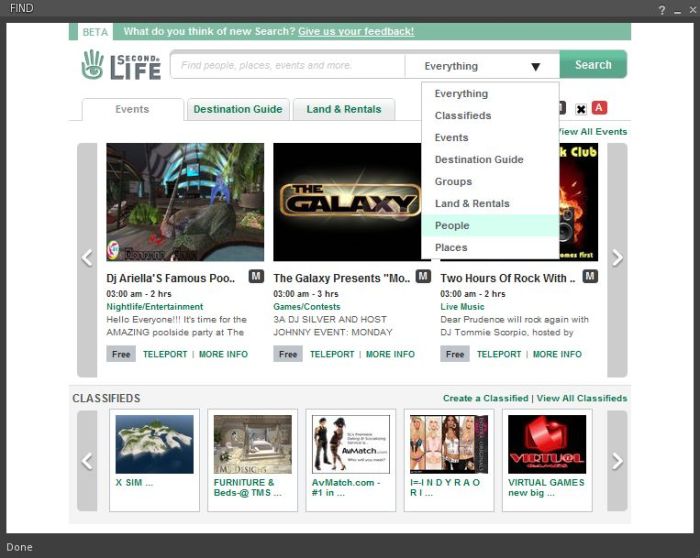
I’d certainly keep the new front page layout. It’s clean, it’s easy to follow, and it has all the core items required to facilitate a search. At the top of the page is the main search bar, withthe ability to define searches by category via a drop-down list.
The rest of the page layout is pretty much self-explanatory and easy to follow (although I am curious as to how ads for the “highlights” in Events, etc., tabs & in Classified are selected, and how frequently they are rotated for ads from other creators).
Wasted
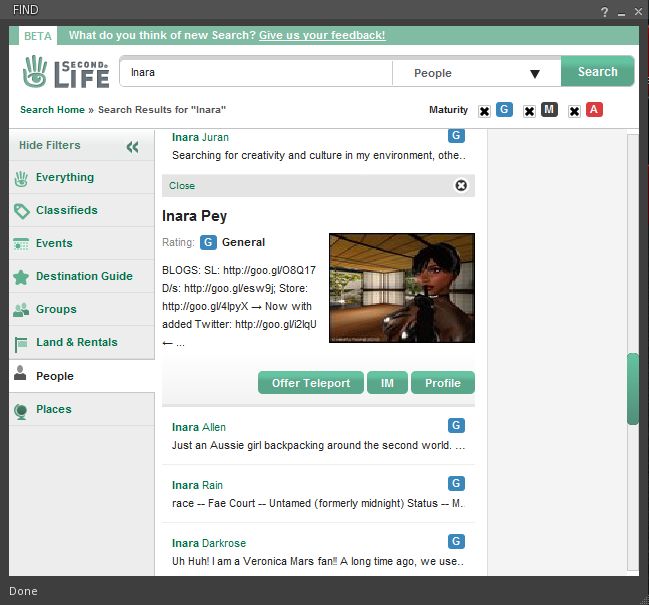
After this, however, I’m less enthusiastic about how information is presented. The fact is, whatever the “under-the-hood” improvements that have been made, Search still wastes space and takes up more screen real estate than I personally feel is necessary.
“New” Search – still wastes space
Look at the example above. There is much that is useful in it – the Filters on the left, the main results area, etc. – but the fact is it is poorly presented and wasteful. Why aren’t the filter options tabbed across the top, in keeping with the Events, Destinations and Land tabs on the home page? This is not only more logical, it frees-up the main section of the window to allow more information to potentially be displayed. Similarly, why the vertical column to the right for Classifieds? Why not use the bottom part of the window, again in keeping with the home page?
Then there is the fact that if you want to drill down to detailed information on anything, you get chucked out of the Search window and into the Sidebar. Sometimes (as with profiles) this might be useful, but given the dearth of information the Sidebar now tends to offer for things like Places, this is frequently a wasted exercise and so doubly annoying. Things are equally irritating when you’re searching through a set of results for something specific and wind up having to shuffle back and forth between Search and Sidebar, impersonating a tennis ball in the middle of a Nadal / Djonkovic rally.
Which is a shame, as it really needn’t be like this.
All it takes is a little forethought
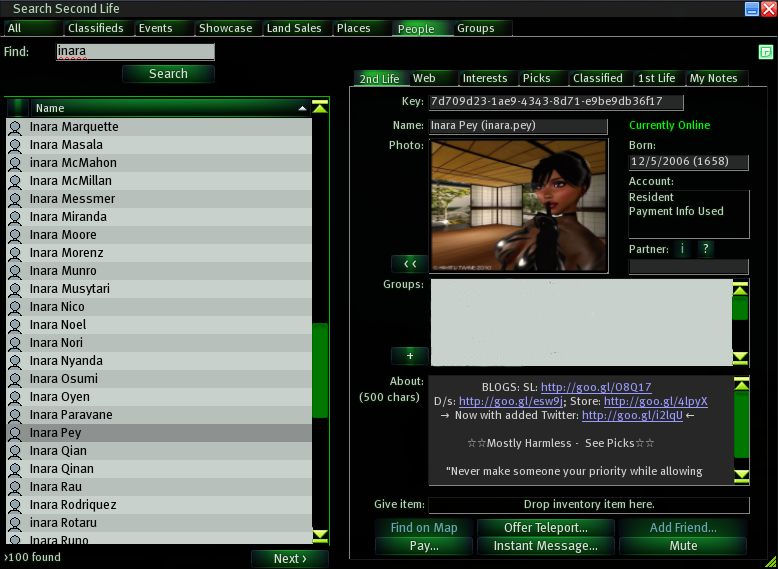
The “powerful” aspect of the Viewer 1 Search has always been the convenience with which results are displayed. For the majority of searches, everything is focused on a single window split into two panes: on the left is a list of initial results, on the right space to display focused results.
Search 1: convenient
This is not 100% ideal, but it does tend to give maximum bang to the buck on any given search. When running a search on people, land, places and the like, this is massively convenient, allowing you to quickly flick back and forth between a list of results and the details on each one without taking up masses of screen space (so you can even keep an eye on what is happening around you in-world).
My ideal Search
My ideal search would therefore take the strengths of Viewer 1 and the “new” Search (tabs, filters, home page, etc.) and (where appropriate) the two-pane design of Viewer 1 Search and bring them together in a Search window that avoids the Sidebar and presents information in a manner that is fast and convenient to use – as in the example I’ve cobbled together rather roughly below.
All-in-one: so much more convenient (Firestorm used for Profile image, due to lack of available images for the “new” web profiles look)
Of course, some of the tabs would need to be tweaked somewhat. Events, for example, would require an ability to search by event type, data, times, etc. – but this capability is already supplied in the left-side filters on the “new” search, and should be relatively easy to incorporate them in my revised layout as a drop-down series of options.
The image above isn’t perfect – I’m not terrifically clever with graphics, but I think it gives a reasonable idea of what could have been done, and even provides room here and there for things to be tweaked.
Can it be done? Well, why not? Will it be done? Probably not. But I can dream, can’t I?
“From a customer perspective, it’s a virtual world, [but] it’s a shared creativity tool.” So speaks Rod Humble during a recent Bloomberg interview I’ve commented upon previously.
A shared creativity tool. This is not the first time Mr. Humble – Rodvik to us all – has referred to Second Life in this way. It’s been his means of referring to the platform virtually (pun intended) since he arrived in-world and started pushing prims around.
And it is perhaps the most concise (if somewhat dry) description of the platform I’ve come across in recent times – at least where LL is concerned.
Yes, of course there are the obvious elements that underpin the description; Rodvik himself touches upon them when he refers to the fact that everything (well, almost everything!) within Second Life is created by the users for the users. All of us who spend any amount of time in-world get this, so on the surface it is perhaps easy for some to dismiss Rodvik’s comments with a, “D’ya think?!” shrug of indifference. There is also much that the description misses out on as well, such as the immersive, 3D aspects of Second Life; after all, a “shared creativity tool” could equally be used to describe something like Microsoft Sharepoint as much as SL.
But the fact is, his description uncovers a much deeper truth about Second Life that tends to render (no pun intended) the more obvious aspects of the statement (and what it potentially misses) moot. This truth is that SL allows us to create and share in ways beyond what might be called the “physical” aspects of SL – prims, sculpties, textures, and so on.
I’m referring to everything else that exists in-world, which is equally created by users for users, but which we rarely consider to have been “created” in the same was as our houses, clothes and attachments. Look at the Groups you belong to; look at the activities you join and enjoy when in-world; look at the opportunities presented to you to engage in activities, roles, situations and opportunities within Second Life that could never – for whatever reason – be a part of your “first life” or “meat life” or whatever you want to call it. All of these are part and parcel of the shared creativity tool.
This has always been Second Life’s USP – unique selling point – that it can be whatever we chose it to be, however we chose to come together and engage with one another and create both through the physical medium of prims and through the other capabilities presented to us through the Viewer. This is also something that Linden Lab themselves seemed to lose sight of during the “bleak years” between mid-2008 and the end of 2010, when the company appeared to focus solely on the coin rather than the creativity, ignoring the obvious connection between one and the other.
So it really is comforting to here Rod Humble publicly describe SL in terms we can all appreciate and agree with. It may not be as dynamic as Your world, your imagination and fails to rate as a strapline for advertising, promotion or (re)branding; but it is a step in the right direction. One that Linden Lab need to key an eye on as they and we move forward and things like mesh start to make their presence felt across the grid with the risk that it may well cut a swathe across the ability for many to create sellable content from within SL, simply because prim-based content cannot always compete with the look and “feel” of mesh-based creations.
But in the meantime, kudos again to Rodvik for cutting to the heart of what Second Life is and can be. Shared creativity tool may be a dry, “techie” term unsuited to actually promoting and selling SL to a wider audience – but if it helps the new LL Director of Communications and the Marketing Dept at Linden Lab to more accurately put a finger on what SL is and empowers them to by more dynamic around the concept when promoting SL, then Linden Lab just might find themselves getting further back on track when it comes to gaining and retaining users, and growing the platform.
#Secondlife grid grew by 69 regions this week to 31264, Private Estates up 69 to 24380. LL steady at 6884. 39 RFL backbit.ly/lVdWeN.
Last week, according to Tyche Shephard of Grid Survey, which gathers publicly available data on Second Life land, the grid gained 69 private islands, many of them from the RFL and Dreamseeker estates.
As Hamlet Au is fond of trumpeting, private islands make up the vast majority of Second Life’s revenue, so this should, if we follow his reasoning, represent a substantial income gain for LL. In fact, to use his exact words, “At standard rates, 69 private regions would annualize out to revenue of over $250,000”.
Of course, we probably won’t see any loud trumpeting from Hamlet on this overall gain in the way he has previously headlined end-of-month losses (not unless this piece shames him into publishing a commentary). Why? Well, because an over net gain in sims does not tally with his view that Second Life is “dying”. As I’ve previously mentioned, this is also why, when trumpeting sim losses and the like, he ignores Tyche’s week-to-week figures for grid size, which demonstrate that large-scale end-of-month sim losses are generally overcome the following month as new sims are added to the grid, leaving us with (overall) a slow but steady increase in the total number of sims available on the grid.
I’ll be curious to see if Hamlet does flag this gain up in any way. If he doesn’t, then it’ll simply confirm his own growing irrelevance when it comes to reporting on Second Life and Linden Lab.





 Inara Pey: Living in a Modemworld