Friday 24th August marked the start of another of the regular pushes by LL to encourage people to sign-up to Premium accounts, with the usual banner headline “Save 50% on your membership when you sign-up”. This time the offer runs through until Friday 31st August.
As per usual, the discount comes with strings: it only applies the Quarterly plan and only to the first quarter’s payment. This tends to make a bit of a mockery of the “Save 50%” headline (which should more correctly read, “Save 50% on your first payment” – but that doesn’t really have the same ring to it, does it?).
The promotional page again features the same list of benefits and the same glitzy video, and still carries the same overall question marks around it.
While I’m Premium myself, I admit that there is much about these ads I find objectionable and misleading, particularly the “more” statements, something I touched on when reporting the last Premium offer. But that’s the major problem with Premium; when all is said and done, it actually offers little in the way of tangible benefits outside of Mainland ownership and Customer Services support. Even stipend, it might be argued, is little more than a refund of money already paid to LL.
A Personal Opinion
I re-upped to Premium at the start of November 2011, and went through getting a Linden Home and trying-out the Premium Sandboxes. If you’re considering Premium, you might want to give those articles the once-over. However, before you do so, consider your options carefully.
If you need a decent amount of space in-world (anything over 2048 sq metres and allowing for the 512sq m free tier option), you’re probably not going to get much out of upping to Premium. Similarly, if you’re a builder and have your own space in which to build, you’ll need to weigh-up how often you need to use a public building space and whether or not non-Premium sandboxes are really that bad when you do.
However, if you are downsizing in SL, the Premium may well offer benefits: the Linden Home may not be a state-of-the-art build, but it comes with an available prim allocation / land capacity of 117. This is enough to provide reasonably comfortable living space, particularly if you’re not downsizing with a view to leaving, but simply don’t want the expense of land rental. Even at $22.50 a quarter ($7.50 a month before your refund … er, stipend …), Premium does offer value-for-money if you want to maintain a modest home without the hassle of weekly tier (and $7.50 is an amount you can easily pay out per week elsewhere for a small parcel of land). Just make sure that, as per my item on getting a Linden Home, you have a good look around – and don’t forget that if the first place you get doesn’t suit, it’s easy to abandon and try again.
The end of October marks my first full year since re-upping to Premium. I’ll be offering more thoughts and feedback then.
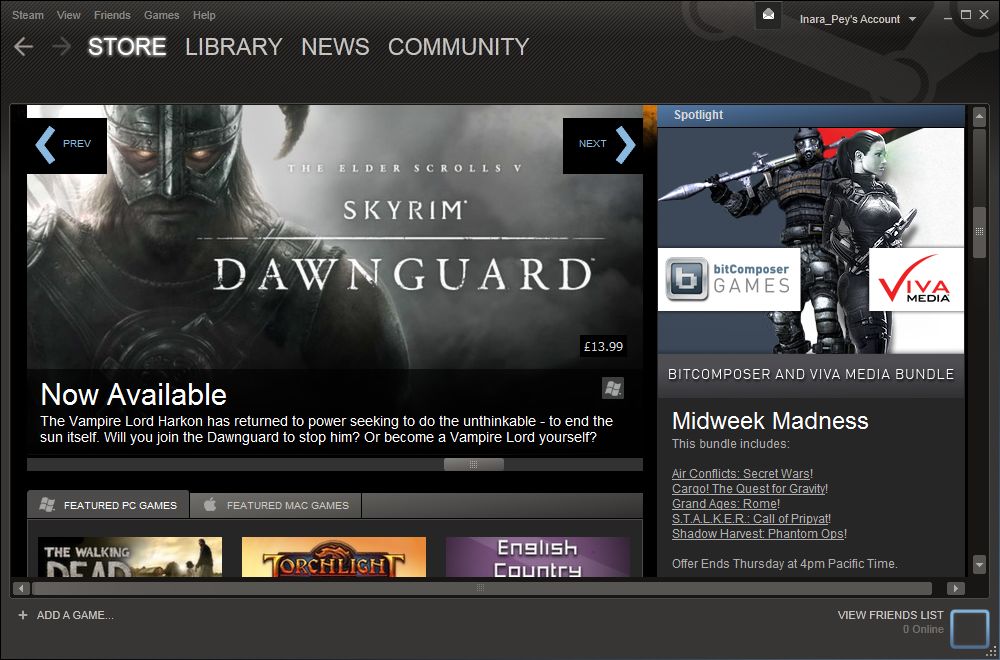
There has been a lot of humming and hawing since the announcement of SL’s forthcoming dip into the world of Steam. I passed brief comment at the news, but refrained from saying too much because a) I’m not a “gamer” and b) I’d never used Steam (although I did sign-up as a result of LL’s announcement to see what things are like for myself).
Steam client
Some of the feedback has been downright thoughtful and thought-provoking, as with Darrius Gothly’s take on things. Others have been the expected doom-laden predictions.
Sure, there is a potential for some trouble to come as a result of the link-up. Some will find temptation calling and coming into SL with the express intent to cause trouble; but I seriously doubt the amount or impact of outright griefing, will be anywhere near as bad as the doom merchants predict. What is more likely is that the vast majority of Steam users will like as not ignore the arrival of SL on their collective doorstep, either because they are too busy doing other things like knocking seven bells out of a digital foes somewhere, or because their preconceptions about SL are such that they have no interest (beyond, perhaps, poking their nose in to confirm those preconceptions).
As to those that do decide to take a leap of faith and sign-up for SL, why do people automatically assume they’ll do little than turn up and stomp all over our virtual daisies? As Darrius notes in his piece. A lot of SL users are also gamers themselves. They manage to bridge the “divide” between SL and games without issue – so why can’t people coming from the other direction do the same? Not every gamer is a hoodlum looking for the digital equivalent of a forehead to nut.
Steam is Also Opening It’s Doors
The negative bias expressed by those unhappy with the link-up seems to be born out of an assumption that Steam is all about playing games. It’s not. While games are the central emphasis, Steam is far more a community of people interested in a wide range of activities that reach beyond shooting up the next zombie or six. There are 3D modellers, content creators, machinima makers, and so on. In fact, such is the breadth of interest among users that Value, the company which owns the site, recently announced that they’ll be launching a new “non-game” software service on Steam. In the official press release announcing the move, they state:
The Software titles coming to Steam range from creativity to productivity [my emphasis]. Many of the launch titles will take advantage of popular Steamworks features, such as easy installation, automatic updating, and the ability to save your work to your personal Steam Cloud space so your files may travel with you.
More Software titles will be added in an ongoing fashion following the September 5th launch, and developers will be welcome to submit Software titles via Steam Greenlight.
Ergo, when considering how SL will be promoted and where the appeal will lay, it’s worth remembering that there is an even chance it will not be placed within the “game” categories within Steam, but rather in the “creativity” category – something which immediately puts a different spin on how it will be perceived.
This would additionally fit with the fact that – for now at least – Second Life isn’t ready to be promoted as any kind of “game platform” (or as I prefer to term it, “game-enabling platform”). Oh, true enough, almost the entire thrust of LL’s development with the platform over the last 18 months has been to make it far more capable of supporting games and game-play environments; it doesn’t take a particularly keen observer to spot that. However, the platform isn’t there yet, not by a long shot. As such, it would be foolish for LL to push the platform as some kind of wonderful new game development tool or gameplay environment for a while.
The Needs of the Not-So-Many
I’d also tend to suggest that far from seeing the link-up with Steam as a means of trying to bring gazillions of users (“gamers” or otherwise) into SL, again as some have suggested (and others have blown raspberries at), Linden Lab are looking for something far more modest – again, at least to begin with.
There’s been something of an ongoing discussion over the ever-excellent Metareality concerning the viability / attractiveness of a “new” Second Life – that is, a platform wherein Linden Lab starts over to present something new and overcomes the shortcomings of the SL grid as we know it today.
It’s an interesting – and entirely hypothetical – discussion point. Just how viable would a new Second Life be (if we assume the money was there to develop such a beast), both in terms of Linden Lab’s development of the platform and in people’s acceptance and use of it?
Well, some of the benefits that might come from such a product would be technical; doubtless things like the creaking mass of the asset server infrastructure could be addressed and made a lot more robust / scalable. Potentially the region / sim code could be completely overhauled to both improve stability and remove much of the “band aid” code that has, due to the nature of the platform, had to be applied to deal with various issues and bugs over the years rather than LL being able to dig deep and resolve them at source.
A new Second Life grid could also, I assume, be better geared towards handling the likes of mesh and other capabilities. Similarly, the Viewer could be revamped – and while this may draw boos and hisses – be kept closed, or perhaps licensed, to better control the growth of features and to ensure Viewer and server code remain better integrated.
There might also be the opportunity to directly address issues of accessibility through other means – tablets, web pages and mobile devices.
Would an “SL 2.0” allow the mobile / tablet markets to be better leveraged? (image: Lumiya for Second Life running on a Samsung Galaxy S2)
Social aspects might also be better integrated into the platform as well, for those who wish to use them. These are no to everyone’s cup-of tea, but that’s no reason to exclude such extensions / capabilities.
All of this could be massively to the good; but what about those of us already engaged in Second Life? Are we likely to leap onto the bandwagon of a “new” Second Life? Some undoubtedly would; but many of us probably wouldn’t for much the same reason as we don’t take a deep plunge into existing SL alternatives: we have an awful lot of what amounts to personal investment in our inventories, and if we can’t take it with us, the likelihood is, we aren’t going to go – not unless forced out of SL itself (which might easily see us giving LL the one-fingered salute and disappearing somewhere else entirely).
Of course, losing the current user base (or a good proportion thereof) might be seen as part and parcel of the risks involved in developing an updated platform – after all, with 16K-a-day sign-ups for the current platform, there is opportunity for LL to address initial retention head-on and harness a good percentage of that 16K and so not actually miss those of us who stay behind.
On the other hand, offering a migratory path from “SL 1.0” to “SL 2.0” would obviously be one way of alleviating issues around existing users, allowing LL to retain them and their loyalty while also avoiding initial issues of growing a new user base.
SL 2.0: The potential for better avatars?
However, offering such a path might itself create issues. One of the biggest potential benefits in an “SL 2.0” would be the ability to incorporate the infamous “avatar 2.0”, which has been the subject of speculation on-and-off since around mid-2007. This is something that is unlikely to happen within Second Life as it is because of a myriad of dependencies means a dramatic overhaul of the avatar could break things. As such, developing a new avatar form for “SL 2.0” could end up breaking compatibility with “SL 1.0” and render migration either problematic or (worse case) pointless.
Perhaps the biggest issue with any “SL 2.0” though, is not technical, but physical (so to speak). At the end of the day – and as Qarl comments in a recent Metareality podcast – a lot of issues relating to SL are actually centred on the relationship between users and Linden Lab itself. These take a variety of forms, some are justified (such as people feeling the company could be more forthcoming within consistent and more open communications and dialogue with the user base), others are completely unjustified (such as claims that LL are out to “kill” aspects of Second Life or that they act “maliciously” towards users).
Regardless of how justified or otherwise claims and arguments about LL are, the fact is that whatever the platform LL provides, the issues and arguments will likely continue. As such, there is a risk that any “new” SL could be taken to be “same s***, different shovel” by both sides of the relationship; users will continue to bemoan LL and LL will continue to feel they are in an uphill battle facing the same criticisms and complaints they face at the moment. This in turn could lead to both sides asking the question, “Why even bother?”
Over all of this, however, lies the biggest question of all: what, exactly, would LL achieve by taking such a route? It’s unlikely that “SL 2.0” would achieve any grater success than the current Second Life has achieved or has the potential to achieve, allowing for all the new capabilities being developed. Thus, any new variant of the platform is liable to end up occupying precisely the same niche as the current product, with more-or-less the same attractiveness to users and possibly the same grumbles and gripes – and this renders any idea of an SL 2.0 developed by LL pretty much moot. Far better that they focus efforts on improving and enhancing the current platform and in maintaining / increasing its relevancy.
Nevertheless, the idea is still an interesting discussion-point – well, for me, at least!
The continuing decline in the number of private regions in Second Life, as documented by Tyche Shepherd, is giving rise to no small amount of concern, some of which is taking the form of calls for Linden Lab to reduce tier.
Region losses: uncomfortable reading
Certainly, Tyche’s figures – a loss of 1138 regions in the first 22 weeks of 2012 – are sobering; but is cutting tier really the solution at this point in time? Is it actually possible? If not, what are the alternative?
On the surface, reducing tier might seem to be a logical option. We’re all aware that tier in SL is high – but just how practical would it be for Linden Lab to lower it? If truth be told, the answer is actually, “Not very” – and for a number of reasons which may not be entirely palatable to some, but which are nevertheless unavoidable. First and foremost is the fact that, like it or not, tier accounts for 80% of Linden Lab’s revenue, so any reduction is going to hit them very hard – and will do so for some time to come.
As it stands, the current decline in private sims amounts to around an average monthly drop in tier revenue of 0.8% per month to date through 2012 – a figure which includes the fact that tier revenue did in fact increase in March by some 1.1%. While this may sound a lot, the fact remains that overall, it is a gradual downward swing. A cut in tier is not; it is an immediate and lasting loss of revenue. Drop tier by 20% and that’s 20% of your revenue gone in a blink – and with absolutely no guarantee you can compensate for it.
Of course, it will be argued that any drop in tier will lead to an uptake in land sales which will compensate for the initial loss. However, the reality is that this is very far from guaranteed. Just because tier is lowered does not automatically equate to a sudden growth in land sales. Let’s face it, private estates are already struggling to fill their available land (and the fact that they are is also likely to be a factor fuelling the number of regions being returned to Linden Lab) – so why would they rush out to obtain even more sims on the strength of a tier reduction when the population currently isn’t there to warrant them doing so?
The one possible exception to this might be with Homestead sims. These might well enjoy an initial boom period as people opt to take advantage of the lower tier and migrate to them. However, this would be somewhat tempered by an increase in the number of surplus full regions being returned to LL that would also result from such a migration. Thus, while land may appear to grow as a result of the increased number of Homesteads, any corresponding growth in revenue for LL is liable to be much smaller, and unlikely to compensate for the tier cut itself.
The same goes for commercial enterprises: any cut in tier is an immediate increase in revenue for them – but it doesn’t mean they will rush out and set up even more stores across the grid. Why should they when the teleport can instantly bring people to their existing store? Additional stores don’t automatically translate into increased revenue – but they do incur increased costs, thus undercutting and gain made through a tier reduction. And while some might opt to take the plunge and expand – or even open new product lines in new stores – it is unlikely, overall, that a tier reduction is unlikely to bring about the renaissance of the mall in SL, for example, much less a quantifiable boost to the economy as a whole.
The cold hard truth is that however much a reduction in tier might individually benefit those of us who hold land within SL, it’s actually not going to do that much to stimulate the economy – and it will stand to benefit Linden Lab even less.
Nor is being “radical” the answer. While it is true that the one way of stimulating growth in SL is to grow the user base through increased user retention, etc., this has to be tempered with the fact that the infrastructure itself can only support so much. So while Second Life does need more users and a sustainable upswing in user retention, calls for LL to try to pull-in “millions” of users are misguided and will remain so until such time as the platform can handle large volumes of avatars in close proximity to one another on an ongoing basis. Bold and radical are only useful if they are actions taken with clear intent and realizable goals.
Which is not to say something shouldn’t be done to safeguard the future. The question is what that something should be.
And it is a question Linden Research has already taken steps to address – although not in the way many have guessed. Because the answer isn’t in the company trying to reduce tier – not yet, at least – or in doing anything else with Second Life itself. Rather, they are seeking to address it through their drive to diversify.
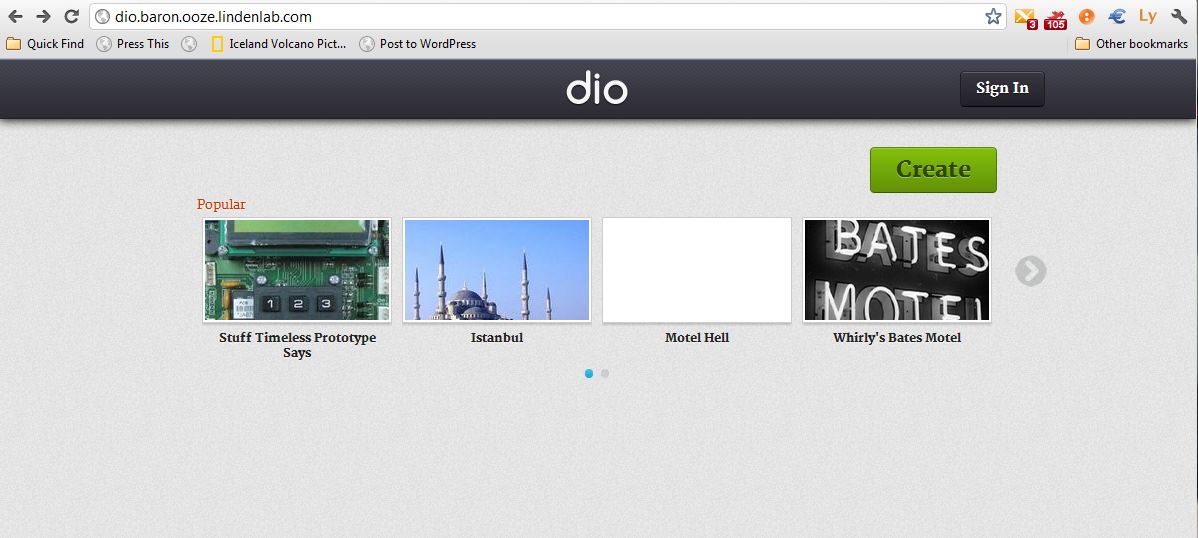
As has been reported far and wide across SL and other blogs, Linden Research is in the process of developing a portfolio of non-SL products, at least one of which, called Dio, is nearing readiness for closed beta testing. These products that are important for two key reasons:
They will open up new revenue streams to the company, thus reducing the strain on SL as the company’s single source of revenue, potentially allowing the company to be far more flexible in how it handles the platform fiscally;
They make Linden Research a far more attractive proposition for investors.
Dio: Linden Research closed beta almost ready?
Of course, it will take time for the revenue streams from the new non-SL products to mature. But as it stands, Linden Research perhaps has that time at their disposal, despite the current sim losses. In March, during a discussion on her blog, Tateru Nino estimated that the break point for LL in terms of private regions losses would be around 6,000 fewer sims than were on the grid at that time. Assuming the rate of decline in regions continues at its present rate, then LL will reach that break point about 24-30 month from now – which is potentially more than enough time for the revenues from these new products to make their presence felt.
Not that the company actually needs to wait that long. As mentioned above, the new products have the potential to benefit the company more immediately through inward investment through them. This is unlikely something that has been lost on either the management team or the board, especially given the mounting interest in, and speculation around, a new era of narrative games.
This may be of scant comfort to those of us feeling the pinch in Second Life right now – but the fact is that when it comes to tier and LL’s revenue, there is no easy answer, and any solution that is offered up is unlikely yield the anticipated benefits. Nor can the SL revenue model be easily or radically shifted. As such, the move to diversify into new product lines is perhaps the one means by which Linden Research can remodel its revenue streams without harming itself, and bring about the means by which it can take a more flexible approach to the management and operation of Second Life. If this is the case, then the company has perhaps shown itself to be far shrewder than people are prepared to credit.
Starting yesterday, Premium members began to receive a survey via e-mail from Linden Lab seeking ways to improve the Wilderness Regions. I’ve actually no objections to surveys to a point – they do tend to point to linden Lab trying to seek some input from users, even if the surveys are somewhat weighted in a certain direction.
The focus of the survey was to gain feedback on how to make the Wilderness Regions more popular, and included a range of suggestions, thus:
LL’s suggestions for improving the Wilderness Experience
I’m not going to go anywhere near the suggestions themselves, as tempting as some of them are for poking at (I appreciate that people do come to SL looking for “dates” etc., but speed dating? In a jungle?!).
I’m also not going to offer up any suggestions on “improving” the current Wilderness regions myself per se, because Alex Hayden has pretty much hit the nail squarely on the head on that subject of offering up improvement ideas.
My only real response to Linden Lab on the subject of providing anything like the Wilderness Experience on a permanent basis is: stop it. Period.
I’ve no problem with these ideas being rolled-out as a means of previewing new capabilities that are coming into Second Life (as was originally the focus of the Linden Realms game). I’ve no objection to such previews being offered-up to Premium members ahead of the rest of the SL populace. This is worthwhile as it gives people the opportunity to get a look and feel for things ahead of roll-out, see how they might be used, etc. Combined with test areas where people can fiddle and play with new tools as well (as with pathfinding), then the preview idea has a lot of merit. Indeed, it is because I thought the Wilderness Experience was a means to preview pathfinding, I avoided being overly critical when it was launched.
However, I’m firmly opposed to LL sprouting “attractions” of their own all over the grid. As I commented on Twitter last night:
Which I don’t think is an unreasonable stand-point, given it is precisely how Rod Humble has described what should be the case.
Yet the company keeps muddying the waters. On the one hands, they’re hands-off for SL9B to the point of refusing to even provide a modest number of sims, on the other they’re tipping the table somewhat to assist a major reseller while also offering-up environments that, quite frankly,while novel in their own right could be done a hell of a lot better by users.
Again, I’ve not going to delve into the broader argument on LL’s approach, as Alex really has said just about all that needs to be said on the matter – and I again strongly recommend you read his piece.
There is another aspect of this that does annoy me however, and this is however you look at the survey, it reads as an attempt to seek feedback from us in order to make the Wilderness Experience more attractive to new users. Indeed, when you look at the Premium package as a whole, there is very little, that has any practical appeal to the established SL user for reasons that have been covered ad infinitum elsewhere including this blog).
There is actually nothing wrong with this – up to a point – and there are certainly valid reasons for making the Premium package appeal to those coming in through the door (not the least of which is helping to relieve the burden placed on tier for revenue – tier still accounting for around 80% of LL’s revenue). The problem is in the way that everything is skewed towards the new user at the expense of the established user.
There’s actually nothing new in this per se. Linden Lab hasn’t been focused on the question of actual user retention for years; their focus has been solely on churn and maintaining equilibrium. Whether this is the right policy or not is itself a major point of debate; it is also one I’m deliberately not going to enter into here, simply because it is complex, controversial – and somewhat outside the focus of this article.
Suffice it to say that as it stands, there is little within the Premium package that would encourage the vast majority of established Basic Account users to upgrade. Sure, I did last year, after a long period as Basic. But I knew going in that I was taking a calculated gamble, and the attraction wasn’t the benefits; simply put, if LL were going to start previewing stuff to Premium users (as with linden Realms), I was prepared to take a punt in order to be able to blog on such things. Sure, I’ve been somewhat positive to some of the benefits since that time – but the benefits alone would not have caused me to re-up to Premium last November.
Linden Homes: limited occupancy time?
Alex offers some very practical suggestions on Premium in his post; some simply – and sadly – won’t happen. Others – such as setting a time limit to how long people can occupy a Linden Home – are viable options, and entirely in keeping with the original intent of the scheme – although I would caveat the idea as Alex expresses it. As I said in reply to his piece:
While broadly agreeing on Linden Homes – there should be a time limit on occupancy in order for them to function as Jack Linden originally claimed, to get people started on the property ladder – I would caveat it on a couple of points:
Offering people a larger alternative prim-wise is not sound; it does tip the playing field and could have a further detrimental impact on private estates.
What do you offer users “in place” of the Home benefit at the end of the year? In order to encourage people to renew their Premium, something needs to be offered as an incentive.
Personally, I’d prefer to see Linden Homes made available for a period of 3 months & a mechanism put in place by which estates wishing to do so can advertise their offerings (through the “community hubs” within the various LH “estates”, for example), presenting those coming to the end of their time with the opportunity to browse and then go see what is on offer and make a choice. Three months strikes me as ideal, as it fits with encouraging people to take the quarterly membership package which LL is so keen to push, so it gives the option of downgrading at the end of the period & it is sufficient time for newcomers to get to grips with having a home in SL and familiarising themselves with concepts such as rentals as they prepare to make a move elsewhere.
This still leaves the question as to what to offer as an alternative incentive. A rise in the stipend back to the old L$500? probably not enough on its own, so something more substantial needs to be offered, or people will simply downgrade.
The key point in this idea is that by providing the space for private estates to advertise their offerings to those whose time in their Linden Home is about to expire, and leaving it up to estates as to whether or not they advertise / provide information, Linden Lab is continuing in its role as a provider while avoiding being seen as to be tipping the table in favour of one estate or another.
Another option LL should perhaps consider – and which was suggested a while back by Will Burns – strike deals with branded IPs to provide genuinely exclusive and desirable items for Premium members. Obviously, there are some sticking points in the idea (do any branded IPs see any remaining value in SL?), but these hardly negate exploring options.
The overall problem here, of course, is that we’ll all have our own views on how things can be improved in terms of Premium membership – and the majority of these views will differ. I’m actually prepared to be somewhat flexible on matters, but as I said, benefits weren’t what drew me into re-upping – although I’ll also say that unless something drastic happens elsewhere, they are not enough to keep me at Premium.
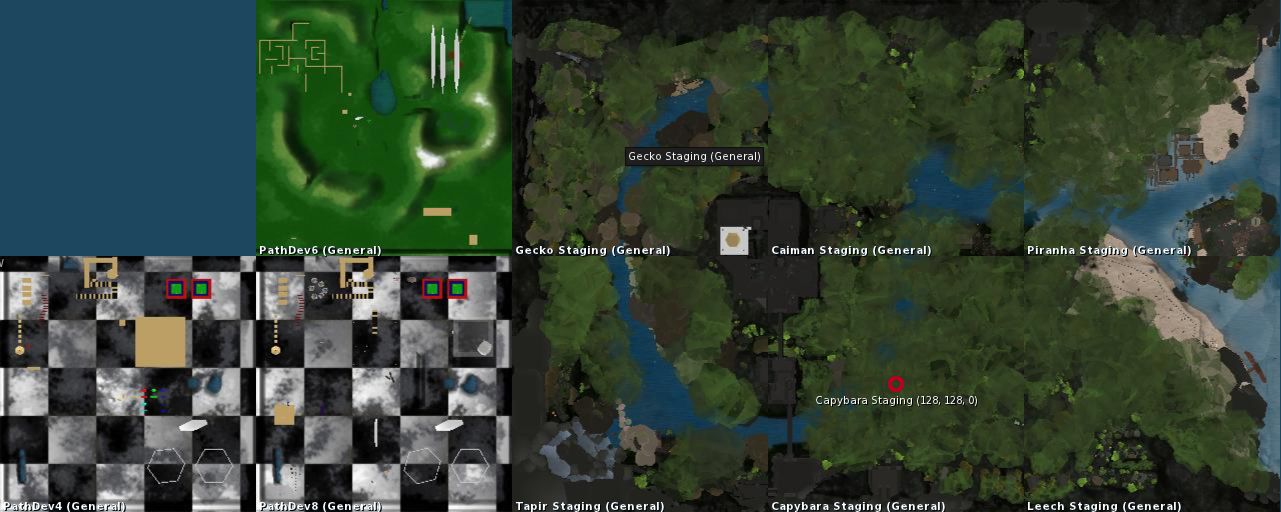
The Wilderness “staging” regions (now closed, as with the “public” Wilderness), alongside the pathfinding sims
As to the Wilderness Experience, I can only repeat what I said in the survey and at the top of this post: LL, do not make it a permanent feature, or try to expand it. You’ve closed it and the “staging” version off to public access. Keep it that way until you have something genuinely new and exciting you wish to showcase, then re-vamp and re-open the regions. Indeed, keep them available for precisely this purpose: showcasing new tools, new capabilities and the like – but limit their lifespan in each case. Don’t go trying to hang trinkets and baubles on them in an attempt to dress them up and make them attractive. It won’t work.
Frankly, you’re far better off doing what you purport you want to be doing: providing tools and a platform on which to use them. Leave the actual content creation to the experts.
On Friday, I drafted a piece on the lack of direct feedback from Linden Lab vis-a-vis the recent rounds of maintenance carried out on the 8th, 9th and 10th May. I held off publishing because I opted to wait until Close of Business in California to see if anything would be forthcoming. Then I got involved in other things, and completely pushed the post out of my head.
In the meantime, Tateru has, with her usual incisiveness asked the question I was planning to ask, but far more succinctly and directly. It’s a good read, and I suggest that if you haven’t you go read it – if only to save yourselves from hearing the same old, same old from me.
Elsewhere – well, Nalates Urriah’s blog to be precise – it may appear that the poor state of communications isn’t restricted to the amount of information flowing out of the company to the users, but many extend to internal communications within the Lab. In her piece, and in reference to the maintenance periods, she reports that Andrew Linden commented:
I think part of that is an operating system upgrade on some hosts, not network level maintenance, but I’m not sure. We’re definitely working on migrating to later versions of Debian, but there will be a few upgrades along the way before we arrive at Debian/Squeeze.
Andrew, together with many of the other Linden staff involved in User Group meetings usually try to be as informative as possible. Following the outage of the 26th April, for example Oskar attempted to provide some explanation via the forums, as Jack Abraham pointed out on this blog, and Daniel Voyager later reported via his.
So when you do see normally forthcoming staff using terms like “I think,” and “I’m not sure,” when describing a situation that impacts the entire SL service, it’s a little disconcerting, and might be seen as suggesting internal communications at LL may be lacking. After all, Andrew is a part of a group of LL staff who do face users, and who are likely to get asked the hard questions when something major is going on, so you’d perhaps expect the company to ensure they are furnished with sufficient information to be able to field such questions with a measure of clarity.
There was a time when we would see blog reports related to upcoming service improvements, and posts on outage postmortems. But no more. Instead, we’re left hanging or having to resort to scrabbling around the forums in the hope that someone has had the foresight to say something. And while it is great that news is frequently passed out at User Group meetings, not everyone attends these, so the message tends to go more unheard than heard.
Simply put: there is no substitute for clear, open communications – and however you look at it, the SL blogs are the best place to communicate when it comes to major announcements and service issues. In these cases, all other channels should point back to the blog, not used in place of the blog. As Tateru points out, the Grid still isn’t the most stable of environments following the recent work; we have no idea as to what the general status of the grid is or what is going on – and that leaves us guessing.
Going on Andrew’s comments, we may not be the only ones. Either way, it would be nice if someone at Linden Lab stepped up to the keyboard and took a little time to let their users and customers know exactly what is / has been going on, and how things stand.







 Inara Pey: Living in a Modemworld