Sliding, but not yet dead

A little while ago, Nalates Urriah pulled together a set of statistics from diverse sources (all of which are duly credited) which help to paint a decent picture of where SL stands away from all the hype over falling region numbers, etc.

When taken together, the stats – which cover daily sign-ups, concurrency (daily / monthly), region numbers and even forum usage, all for periods of at least a year – present an interesting picture of Second Life which Nalates interprets in her own inimitable way. While they show that Second Life has in many respects been on a steady downward slide (particularly in terms of overall usage), the situation is far from unrecoverable. Indeed, some of the figures are, at least for a moment, trending upwards again – although without more detailed data and a wider breakdown, it is impossible to draw any conclusions as to what this might signify in the short-term and thus how it might be projected in the medium-, or long-term.

There are significant gaps in the data (through no fault of those who gathered / present it – the information simply isn’t available). For example, while sign-ups can be shown to have been at least constant (or have increased slightly) through the 2-year period, there is no practical context to the figures in terms of users actually being retained. A further problem with the figures is that there is no indicator as to the percent / proportion of these sign-ups actually being alternate accounts, rather than actual new users (although LL does apparently have a mechanism in place for distinguishing between the two).

Daily sign-ups, as reported by Tateru Nino and extrapolated and presented by Nalates Urriah, with monthly concurrency for 2012 inset  – click

Certainly, Rod Humble did state at in his first (and last) SLCC address in August 2011 the rise of user sign-ups did coincide with an upswing in identifiable uniques (i.e. genuine new users, rather than alternate accounts), which he clearly defined as people signing-up, downloading the viewer and logging in to SL.

The user concurrency chart is somewhat more meaningful, in that it charts concurrency for a more extended period from December 2009 through to the present day. As such, any trend shown is liable to be somewhat more reliable, although there are still problems in interpreting the data as a whole. For example, it does show a consistent downward trend in concurrency since the late “boom” period when SL was at the height of its own Hype Cycle “peak of over-inflated expectations”; but precisely what this means is still somewhat open to interpretation.

Daily concurrency, Dec 09 through Jan 2013, from Tateru Nino, as extrapolated by Nalates Urriah

Less Doesn’t Automatically Mean Fewer

A decline in concurrency doesn’t automatically mean a substantial drop in overall user numbers (although it is hard to completely divorce the two). There have been a number of factors which have contributed to some aspects of the decline outside of falling user numbers. Linden Lab caused something of a decline when they clamped-down on the use of bots. More recently, factors such as changing demographics and changing user habits appear to have also contributed to falls in concurrency.

These latter points were indicated again indicated by Rod Humble in his SLCC 2011 address, when he drew attention to the fact that the overall demographic of SL users was shifting, age-wise, more toward people in the mid-to-late 20s, and that they were collectively logging-on to SL for shorter periods. He also indicated that LL had charted a noticeable increase in the way SL users were interacting without actually going in-world – through the mechanism of profile feeds, for example.
Continue reading “Sliding, but not yet dead”

Tier cuts: looking from the Lab’s perspective

Apologies to those who may have received notification of an early version of this post being published at the weekend. Slight error on my part hitting the wrong button when trying to clear-up some old drafts.

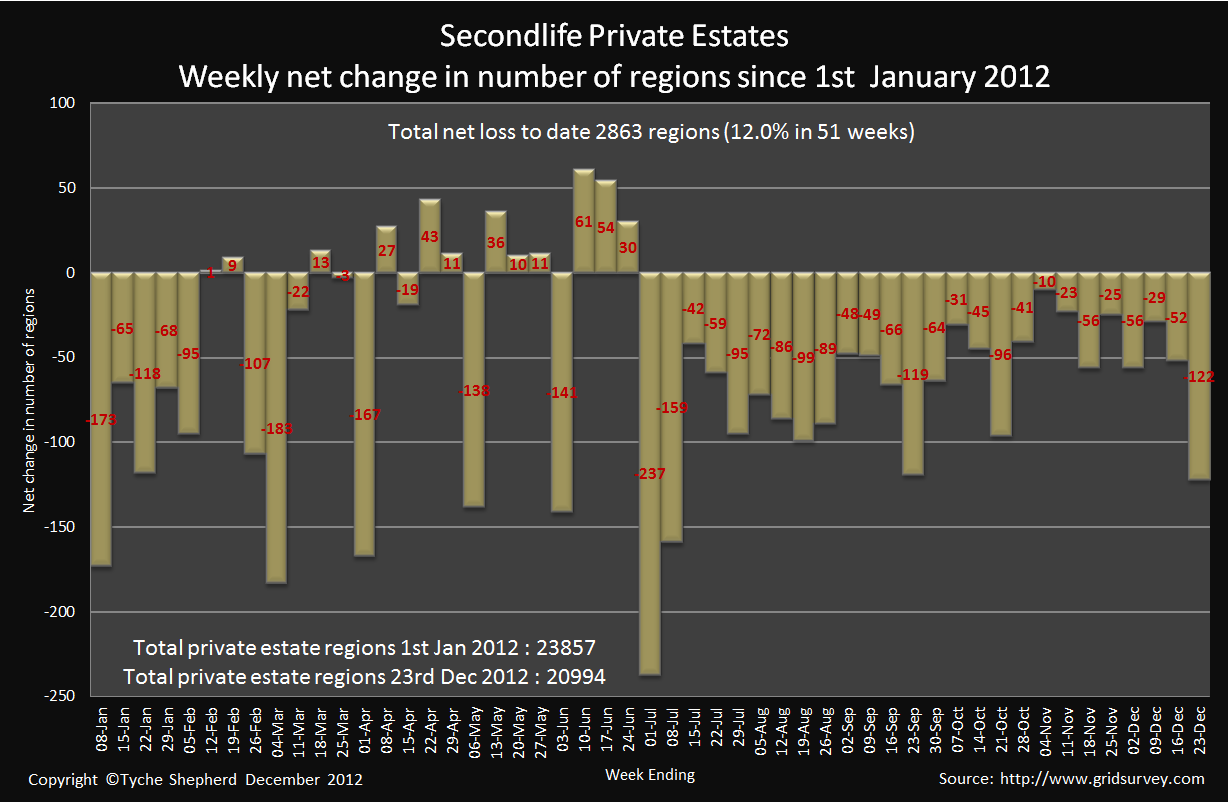
Tier has long been an issue within Second Life, one which has been exacerbated over the last 24 months by the ongoing decline in private region numbers, which form the greater proportion of LL’s revenue. The decline has been tracked across the weeks and months by Tyche Shepherd via her invaluable Grid Surveys. In 2012 alone, the grid has suffered a loss of around 12% in private regions. Such is the concern over tier that it gets raised following articles which may not be related to the subject – such as LL moving to promote SL through Amazon.

This decline has been subject to many calls for the Lab to reduce tier, with some recently advocating it should be cut by one-third. However, as both I and Tateru Nino attempted to explain in June 2012, while cutting tier may appear the obvious thing to do, it may not actually be the easiest or most comfortable thing for the Lab to do.

Crunching Some Numbers – the Lab’s Perspective

While I have covered some of this ground before, I thought it interesting to look at some numbers purely from the Lab’s perspective, using Tyche’s Grid Survey and survey summaries as reference.

Private regions losses through 2012 (click to enlarge)
  • As of December 31st, 2011, monthly private region revenue for LL was approximately $5,006,000, with a margin of error of +/-$60,000
  • As of December 31st 2012, monthly private region revenue for LL was approximately $4,244,000 per month, with a margin of error of +/- $53,000
  • While acknowledging we have yet to see Tyche’s 2012 end-of-year survey, that amounts to a drop of $762,000 through the year, or an average of $63,500 per month

If there is no reduction in tier, it is probable that the current decline in private region revenue will continue at or near the 2012 monthly average of $63,500. However, were the Lab to cut tier by one-third, they immediately slash monthly private region revenue by $1,400,520. That’s equivalent to 4,747 full private regions vanishing from the grid – 1.6 times more that the total number of private regions (full, Homestead and OpenSpace) lost in 2012.

Even allowing for the tier cut stimulating the demand from new land (and there are problems with that, as discussed later in this article), and assuming set-up fees remain unchanged, it means the Lab would need to see the equivalent of 1,337 full private regions added to the grid in the first month following the cut just to match the revenue loss suffered had they not cut tier (i.e. the difference between $1,400,520 and $63,500).

Continue reading “Tier cuts: looking from the Lab’s perspective”

The Amazon deal: LL demonstrating they can’t see the wood for the trees?

On Friday 4th January, I was one of many who reported on the “unexpected” (given the move had apparently been made of December 10th, 2012) move to make Second Life available via Amazon following a tweet from the official Second Life account. Ciaran Laval was perhaps the first (certainly that I know of) to blog on the matter, and Tateru gave a very pithy commentary on the nature of the packages and on promoting SL as a “game”, which drew considerable commentary on Plurk as well as on her blog.

The tweet announcing the promotion / "expansion"
The tweet announcing the promotion / “expansion”

For my part, I resisted passing direct comment on the move in my original piece, in keeping with my attempts to avoid colouring any “news” items with personal bias. However, I have to say that the Amazon deal leaves me feeling that – once again – the Lab has bungled an opportunity, or at least failed to launch it fully and properly or in a manner liable to serve Second Life and themselves particularly well; although perhaps not for the reasons others have cited.

In difference to many critiquing the move, I have no problem in Amazon presenting SL as a game. Not that I’m saying I think SL is a game, I most certainly don’t, per se. I simply have no problem in Amazon presenting it as such, and for a couple of reasons:

  • Whether we like it or not, SL is largely referred to by the broader media and the more specialist (dare I say gaming media) as a “game” (even if the latter does make some attempt to sub-categorise SL in some way) – ergo, the wider perception is that SL “is a game”, whether we agree with that perception or not
  • More directly, and as Uccello Poultry comments on Tateru’s piece, the simple fact is that “game” is probably the only listing option in Amazon’s catalogue they consider to be the closest “fit” for SL – and it is a little unreasonable for us to expect them to develop a dedicated category on the basis that we find the “game” label offensive.

At the end of the day, issues over the listing category could be overcome had time been taken to give a reasonable explanation / description of the product itself. Sadly, and as demonstrated by the pages for the Viewer, the Lab has done the barest minimum required. Rather than providing insight into the platform through a mixture of text and screen shots, all we have are five bland bullet points which fail to leverage SL’s potential or appeal. The effort does, being brutally honest, leave me wondering once more if there is anyone working at the Lab who actually a) has real, hands-on marketing experience, b) is capable of writing attention-grabbing promotional material, and c) actually grasps what SL is about for themselves.

For me, this lack off effort on LL’s part is more damning than Amazon’s sin of promoting SL as a game.

Vehicle Packages: opportunity missed

Turning to the vehicle packages themselves, I have to say I don’t necessarily agree with all the criticism levelled at them – SL actually can be quite good for using some vehicles / craft, as I’ve personally discovered as result of receiving the Premium sail boat, which is one of the “vehicles” in the packs.

Again, from my perspective, the crux of the matter is that the packages are indicative of thinking at the Lab which is at worst, simply lazy, or at best, demonstrating an inability to think an idea through in terms of its potential to benefit the platform and by extension, LL’s own bottom line.

In short, in opting for the packages on offer, rather than being a little more ambitious, it would appear the Lab has missed an opportunity right from the get-go. That is to address, at least in part, the perennially thorny issue of user retention.

Continue reading “The Amazon deal: LL demonstrating they can’t see the wood for the trees?”

When griefing crosses the line

It’s a fact of life that griefing is part of the subculture of Second Life. It’s not necessarily an agreeable subculture or one we particularly want or need, but it is there all the same. I say this not to excuse what goes on, but to underline the fact that right or wrong, most of us in hearing about it tend to shrug our shoulders and then carry on with our lives.

There are times, however, when griefing – which is actually crossing the line each and every time it occurs – crosses a the line not only in terms of resigned acceptance, but also in terms of criminal behaviour.

The fashion world in SL has recently been subject to this latter situation. This saw an SL user  already complicit in copying skins and shapes, and whose profile boasted they had scant regard for the ToS together with outright threats against content creators, start to use griefing as an attempt to extort money from others. They did so by crashing large fashion events and then demanding payment in order to not crash future events.

extortion

Much of what happened in this matter appeared to go unreported outside of fashion circles – few blog (this one included) reported on the matter, despite the problems apparently occurring over a span of months. The Lab also appeared unwilling to engage in the matter, despite extortion being a criminal act. In the end, many of those affected by the situation saw no other choice than to themselves disrupt in-world user group meetings in order to try to voice their concerns and frustrations directly (if unfortunately inappropriately) to the few remaining Lab employees users can actually contact nowadays.

(I say “inappropriately” not as an admonishment here, but because those who were confronted by this extortionist were demanding direct action from those Lab personnel the least well equipped to provide meaningful feedback on matters.)

In the end, the approach did appear to work, inasmuch as the account of the individual concerned was banned from Second Life and all content relating to it (apparently ripped from other merchants) was removed from the Marketplace.

Of course, in an age and situation where alt accounts are freely available, the removal of a single account is no guarantee the individual responsible has actually been removed from SL – or more particularly that their modus operandi will not be repeated elsewhere by others.

Yordie Sands brings word that the latter appears to have happened, and the use of extortion has been taken up elsewhere. Writing yesterday, she details a situation where Junkyard Blues, a renowned SL blues club run by Kiff Clutterbuck and Dina Petty, has been recently subjected to repeated griefing attacks which comprised, in Kiff and Dina’s words, “Multiple griefers with blinding graphics card attacks and sim lag/crashes … In some instances the computers of many staff and patrons actually shut down or rebooted as a result of the attacks.”

Such was the frequency of the attacks that patrons began staying away from the venue. However this was not an “innocent” (if such a term can be used with any form of griefing) attack. Junkyard Blues were contacted and informed that if they handed over cash, the attacks would stop.

This is again extortion, plain and simple.

As a result of both the threats and the attacks, Junkyard Blues has been forced to resort to restricting access to their club to “members only”, which impacts both their business and their customers.

Continue reading “When griefing crosses the line”

LL look back at 2012. Will they learn to communicate in 2013?

Linden Lab  published a blog post on December 20th looking back over the last twelve months and looking ahead to 2013.

This year hasn’t been a particularly sexy year for Second Life in terms of Big News. The Lab has been more focused on working “under the bonnet (hood)” to sort out a lot of the mechanical aspects, as it were, of Second Life. It matters not as to whether some of what they’ve been working on are things people feel should have been “sorted out years ago”. The fact is that the Lab are working on long-standing issues and is also trying to bring new capabilities to SL which do serve to improve out in-world experience, and that is deserving recognition.

However, it is when there have been “major” deployments through the year that the Lab’s inherent weakness and seeming inability to learn from its mistakes comes to the fore. In particular, the blog post points to three major roll-outs in 2012: advanced creation tools, pathfinding, and Direct Delivery. While one of these, the advanced creation tools, did initially hit problems when first deployed to a Release Channel, the matter was quickly dealt with such that they could be safely deployed and properly announced by the Lab. True, we’re still waiting on the updates to the permissions system, but at least we did receive decent and widespread notification of their deployment.

Pathfinding: let down by poor Lab communications

Alongside the advanced tools, pathfinding was one of the “big things” for SL in 2012, trumpeted by Rod Humble himself. In many respects, pathfinding was potentially a “bigger” release than the advanced creation tools, so one would have thought it would be more prominent in the Lab’s communications with users.

Not so. While we did get a sneak peek in September, the Lab relinquished all attempts to communicate the project to their wider user community, leaving it almost entirely up to bloggers to carry the message. And while no-one set out to deliberately misinform people, the fact remains that pathfinding was so complicated that the lack of clear-cut information from the Lab did lead to misunderstandings which in turn led to reports that it would result in a “Tsunami” of problems or would have a huge adverse impact on SL as a whole once deployed.

In both instances, people at the Lab did move to try to clarify matters and redress the misunderstandings. However, by the time they had, the damage had been done. In abdicating all major responsibility for communicating with their users, the Lab had opened the door to misunderstanding, misconceptions and mistrust, with the result that the negative perceptions of pathfinding continue today, with the functionality remaining disabled across many private estates.

With Direct Delivery, the situation is somewhat worse, with everything from the initial deployment through to mounting issues across the Marketplace as a whole becoming something of a catalogue of errors in which a complete unwillingness on the part of the Commerce Team / Linden Lab to engage in a decent level of communication with merchants has played a major role. Even Rod Humble’s own intervention in matters on two separate occasions, the first via Twitter,  the second time on the Commerce forum itself, have proven hollow. Despite all assurances to the contrary, communications on the ongoing issues with the Marketplace remain minimal, with little indication that matters are approaching any form of resolution.

Failed subscriptions for August - courtesy
Listing enhancement issues have been a repeated cause of upset for merchants through 2012, one of a litany of errors and problems occurring within the Marketplace during the year; some of them apparently as a result of the introduction of Direct Delivery  (image courtesy of Ry0ta Exonar)

Both of these situations point to a need for Linden Lab to be more openly proactive in communicating with users – and there really is no excuse for them not to do so. A recent response from the Lab to the question of why they don’t routinely blog any more was that “no-one reads the blogs”. However, this is hardly an explanation – it is an excuse. Keep the blog reasonably up-to-date with information, be it news or periodic updates, give people a reason to read it – and they will.

In 2013, we’re promised some more new capabilities and options which can and should significantly improve th look and feel of Second Life and do much to improve the overall user experience. Things like materials processing and server-side avatar baking. These are all to the good and will hopefully be “nice to haves” when they arrive.

What would also be nice to have in 2013 is more proactive and widespread, informative communication flowing out of the Lab. Sadly, the cynic / realist in me is not holding her breath in anticipation.

Phoenix: hard truths

Update 17th December: The video of the meeting is available on You Tube (and embedded below). Links have also been added to the official announcement and a transscript of Jessica’s presentation given at the start of the meeting.

PhoenixJessica Lyon and members of the Phoenix Firestorm Team hosted an in-world / streamed meeting on Saturday 15th December, 2012 to discuss the future of Phoenix.

As expected, the core of the news was the Phoenix has essentially come to its end of line. As from December 31st, all official support provided by the Phoenix / Firestorm team will cease.

There are many reasons as to why this step is finally being taken, but they all have their roots in the fact that in late 2010, the decision was taken that to ensure future ease-of-development and enhancement of the viewer, it would be more in the Phoenix Team’s interest to develop a viewer which could more easily keep pace with LL’s development curve, rather than attempting to continually backport new code and features into a viewer that would be based on what would become an increasingly outdated code base. Thus, Firestorm was born. Whether one agrees with this decision or not is actually moot. It was a decision the Phoenix Team were entitled to make.

Jessica Lyon (stock image)

The major reason as to why the team has opted to formally announce the end of line for Phoenix now is because Linden Lab have notified TPVs of the forthcoming roll-out of server-side avatar baking in 2013.

As I’ve explained in a recent blog post, server-side avatar baking is a significant change in the way Second Life operates and which should see an end to the major issue of avatar bake fail. However, it brings with it not only changes to the server-side of Second Life, but very major changes to the viewer itself.

Such is the complexity of these viewer changes that Linden Lab has sought to provide TPVs with an eight week window in which to implement and test them. Given the overall status of Phoenix, it simply is not possible for the Phoenix Firestorm team to implement the changes in Firestorm and backport and integrate them into Phoenix (together with all the other changes required to get Phoenix back on a par with LL’s viewer development) in that time frame. The reason why it is vital for all TPVs incorporate the new code is because without it, avatars will fail to render correctly – so if Phoenix does not have the code, it simply “won’t work” when the new service is deployed.

Avatar baking 2013 and Phoenix in brief: These images show the impact of the new avatar baking service on viewer which are not updated to the new code. (l) as I appear on a viewer without the code, and someone on another viewer (regardless of the code it is using) looks to me. On the right, someone running the new code, and how I look to them - a never-rezzing cloud.
Avatar baking 2013 and Phoenix in brief: These images show the impact of the new avatar baking service on a viewer which is not updated to the new code. (l) as I appear on a viewer without the code, and someone on another viewer (regardless of the code it is using) looks to me – a “grey ghost”. On the right, someone running the new code, and how I look to them – a never-rezzing cloud.

Please use the page numbers below to continue reading this article