Whatever happened to Second Life? – “Doing rather nicely, TYVM”

On Friday 21st June, the BBC once again asked, “Whatever happened to Second Life?“. It’s not the first time they’ve asked the question, a link on the page takes you back to 2009, when they asked the same question.

At that time, the Beeb looked at SL form a largely corporate perspective, highlighting some of the pitfalls of the platform (not all of which were of LL’s making; there is a certain amount of blame to be placed with the media for spinning the hype to such an extent that corporations were foolish enough to all leaping without looking).

In the latest piece, which takes the form of a video cast, the Beeb again largely retreads the same theme, seeing SL purely in terms of being a corporate tool. While the piece starts off somewhat positively, looking at the in-world music group, Redzone, and highlighting how they can reach a global audience at minimal cost, it quickly ramps down to kind of narrow-focus piece which tends to typify the fact that, as Draxtor Depres has commented in our Drax Files conversations, much of the media is actually too lazy to make the effort to actually report on SL, and is far more content to retread old themes.

In the BBC’s case, this takes the form of once more banging the corporate drum as to how companies poured into SL, “spent millions”, only to subsequently pull-out and raised the idea that “everyone” who used SL has “moved on” to other social media platforms (as if it is a case of one or the other).

The general observation that corporations are somewhat more cautious nowadays when investing in social media is actually a fair point to make. However, as an attempt to address the question of “whatever happened to Second Life”, it is at best lopsided, once again generating the impression that simply because “big business” failed to understand and exploit Second Life, the platform itself has passed its sell-by date.

LL's infogrpahic on SL's 10th anniversary (click to enlarge)
LL’s infographic on SL’s 10th anniversary (click to enlarge)

It’s an unfortunate angle to take, one which suggests that the BBC consider Second Life to be something barely worth the effort of addressing beyond the scope of past reports, despite this weekend marking the platform’s tenth anniversary. And it is hardly likely that the Beeb weren’t aware of this, given the press release and infographic (rright) the Lab issued earlier in the week on the subject.

In fact it’s fair to say that rather than managing to answer the very question they ask in the title of the piece, the BBC seem content to raise several more questions about SL – and then leave them hanging. Which is a shame, because had they bothered to make something of an effort instead of opting the “rinse / repeat” route, they may have discovered some surprising answers.

Making something of an effort is exactly what Benny Evangelista, a tech and business writer at the San Francisco Chronicle did. No doubt spurred-on by the Lab’s press release and infographic, Evangelista interviews the Lab’s CEO, Rod Humble. In doing so, he is able to present a piece which is informative, providing some interesting insight into goings-on at the Lab and Humble’s own thinking on the future. In doing so, it goes a heck of a lot further in answering the question marks left in the BBC’s piece.

Take, for example the issue of corporations and business in SL. The BBC point to IBM and others with the attitude, “they came, they failed, they left – game over”. However, when raising much the same point with Humble, Evangelista gets a very different answer which presents a much broader and fairer perspective:

Evangelista: There was once great talk about companies coming in and setting up virtual shops, and it being a potential source of revenue for them. And then they pulled back.

Humble: And it was taken up by amateurs or people who specialized in it. So (of) the people who make money now within Second Life, there are people who sublet land, and they help maintain the land.

Humble: providing some insight and answering some of the critics
Humble: providing some insight and answering some of the critics (image courtesy of Bloomberg)

And there are people who make good money – and by good money, I mean hundreds of thousands of dollars a year – making hair, making virtual pets and animals. So it’s those people who are used to the virtual world, rather than big, established companies who are like, “OK, we’ll have a showroom within the world.” So I think (the promise of virtual commerce) was realized, it was just in a very different way.

I always hate waxing pretentious, but indulge me for a moment. I do think there’s a shift within the worldwide economy of people making money in more diverse ways. The nature of work itself is changing. In the same way that people make a good livelihood making objects in Second Life, you’re starting to see people generate significant revenue from posting their cat pictures on YouTube. Now you get an ad-sharing thing. That’s a trend that’s going to continue, and it’s certainly helped propel Second Life.

Humble also offers an alternative view to the idea that SL has perhaps failed because it is not as easy to navigate and understand as the Internet, and hence not as popular as social networking sites:

It’s different for sure. I think there is something (about) being within a 3-D space that’s entirely user-created that is more magical than looking at an image on a Web browser.

Usually it’s around that sense of place. But also there’s a sense of intimacy when you’re talking with someone in a virtual world, and at any time you can walk around, and you get to see what they’ve chosen to represent themselves, that I think is different from pushing a text message somewhere. I don’t know why it’s different, but it is.

Elsewhere in the article, Humble touches on the future and the fact that LL are still investing in Second Life and “virtual worlds”, although – and as he stated a while back in this blog – whatever they’re working on is still a few years down the road. We also know they are investing in at least one other virtual world development: Philip Rosedale’s High Fidelity (scroll down the page of the list of investors).

Continue reading “Whatever happened to Second Life? – “Doing rather nicely, TYVM””

ToS changes, FinCEN and speculation

secondlife

Update, May 10th: Alex Kadochnikov has posted a further piece on the recent FInCEN interpretive guidelines on virtual currencies.

The recent change in the ToS affecting the use of third-party exchanges for L$ transactions was apparently accompanied by an e-mail from the Lab to such exchanges asking them to cease trading / cease trading in Linden Dollars.

So far, and as reported on Hypergrid Business, around eight exchanges have suspended trading in Linden Dollars while seeking clarification from the Lab as to whether / how they can continue to provide a service to users. Whether the suspension turn into an outright cessation of trading / operation obviously depends on the response obtained from the Lab.

Additionally, Oz Linden contacted TPV developers via the Opensource Development mailing list, stating:

Linden Lab has made a change to the Terms of Service – see the blog post at

http://community.secondlife.com/t5/Featured-News/Updated-Second-Life-Terms-of-Service/ba-p/1996185

If you are a viewer developer, and your viewer includes use of a third-party exchange for functions like ‘buy L$,’ it will need to be changed to use the LindeX instead. 

Some are speculating that the move is as a result of the FinCEN issuing a set of interpretive guidelines on virtual currency (which I commented about in April), possibly related to limiting the Lab’s exposure where other exchanges are concerned. As I’ve stated in comments following-up on the news piece on the change – and while, inevitably, IANAL), I’m not altogether convinced by those arguments per se, because there is nothing in the FinCEN guidelines which appears to fundamentally impact LL’s exposure in this regard – rather, they and third-party exchanges appear to be in the same boat where FinCEN’s guidelines are concerned.

US Treasury's FinCEN: examining virtual currencies
US Treasury’s FinCEN: examining virtual currencies

However, this is not to say that I think LL’s move is entirely unrelated to the FinCEN guidelines being published in March. Again, as I’ve commented both in this blog and elsewhere:

I would add that where there is a potential overlap between the two (the FinCEN guidelines and the SL ToS change), inasmuch as by attempting to limit any exposure of L$ to third-party exchanges and confine trading to LL’s own mechanism (the LindeX), the Lab might be trying to strengthen their position that the L$ is a “gaming token” rather than a “virtual currency” – which cuts to the heart of the core difference in their interpretation of the Linden Dollar’s status, and how FinCEN might regard it.

Of course, even in doing this, the Lab doesn’t escape FinCEN’s view that they are effectively a Money Service Business (MSB) and as such, are required to register as such with the US Treasury and meet regulatory requirements and adhere to anti-money laundering and other periodic reports. Some have suggested that the Lab may as a result face escalating costs in attempting to meet these requirements which may render the Linden Dollar, as we know it today, unviable to the company. However, as I stated back in April:

… there would appear to be questions as to how justified concerns over compliance (and the cost thereto faced by the Lab) actually are.

When it comes to money laundering in particular, Linden Lab already has a number of safeguards in place. Whether these are compliant with any requirements specified by the US Treasury is open to debate … However, it would seem unlikely that such safeguards would be without reference to any legal / regulatory compliance, even  if they only meet the bare minimum required.

Thus, how much additional work and expense would be required on LL’s part should they have to become a registered MSB isn’t that easy to ascertain; so dismissing them as being unable to comply, or that cost of compliance would be something the company would be unable to bear would appear to be perhaps premature.

However, it is reasonable to suggest that if this move is related to FinCEN, then quite possibly it is just an initial step, one which may well be followed-up in the coming months by further changes as the Linden Dollar’s overall status is further clarified as a result of dialogue between LL and FinCEN. Whether such additional result in the Linden Dollar becoming a closed currency without “real” value is entirely open to debate and beyond the considerations of this piece.

There is another question to be asked here as well. Which is this: while it might be unwise to totally dismiss FinCEN as having nothing to do with LL’s change in policy, are there other reasons why LL would make this move?

Well, yes there are. Here’s a couple:

  • It could actually have arisen as a result of the discovery of a fraudulent activity or situation which simply could not be ignored, and the Lab had to take drastic steps in order to ensure the door was firmly slammed shut on the matter
  • It might simply be an attempt to ring-fence the buying and selling of L$ for direct revenue gain. As WolfBaginski Bearsfoot points out, LL are potentially missing out on around $500,000 in transaction commissions going through VirWoX alone. While this may sound trivial, it could go some way to offsetting declining revenue from tier (which in 2012 amounted to approximately $762,000).

Then there is the way in which the change has been announced. If the reason behind it is purely a response to FinCEN setting out its stall in relation to virtual currencies, why couldn’t the Lab have indicated this to be the case? At the very least, and with more considered up-front communication blog-wise, it would have avoided the current levels of confusion, angst and speculation. And why the need to act in such an abrupt manner? It seems odd that if this course of action has arisen from the moves by FinCEN, the Lab explain the situation to users and third-party exchanges alike and give both X number of days to prepare for the changes to come into effect. Were they perhaps afraid that doing so would lead to a run on demand for L$ through third-party exchanges?

It is possible that whatever prompted the change to the ToS may never be known – particularly if it was, as mentioned above, related to a specific fraud-related situation or activity which the Lab could not afford to ignore.As such, this one change –  allowing for the current confusion and speculation it has created – is liable to be the end of things,

However, if it is as a result of the rumblings coming out of FinCEN as they cast their eyes across virtual currencies, then this might just be a foretaste of further changes to come.

Related Links

Reaching out: SL as a platform for “outside” events?

Following on the heels of this year’s Fantasy Faire, follow blogger and Lord of Dee Ciaran Laval comments that Outside Companies Should Create Their Own Second Life Faires. In it, he examines how external companies and authors – notably in the fantasy business – could use Second Life as a promotional tool and could, together with the Lab and SL itself, greatly benefit from doing so.

Fantasy Faire: demonstrating the viability of SL as an events platform?

And he has a point. As Zander Greene pointed out in The Drax Files special on Fantasy Faire, when all is said and done, Second Life is one of the most cost-effective mediums for fundraising – and the same is true of global outreach. Yes, the cost of server space isn’t cheap, but when compared to the cost of venue hire, etc., and the scope of what can be laid-on, it is an intensely cost-effective medium.

In his article, Ciaran looks specifically at the case of fantasy and the opportunities of fantasy-focused MMOs and authors. However, I’d suggest that the potential reach here is far greater – and while some may shudder at the thought of SL returning to the bad old corporate-focused days of 2008-2010, this needn’t necessarily be the case.

Rather, there are mechanisms which, although dormant / disbanded / forgotten, could actually be revitalised and used to the benefit of both the Lab and the platform.

For example, for several years, the Lab ran the Solution Providers programme. This provided a means by which corporate entities could get in contact with people with expertise both within SL and a range of other disciplines they could harness to help develop an in-world presence. Such a scheme could be implemented by which those organisations could connect with in-world content creators and sim builders who can develop the necessary in-world environments on which their could host faires and promotional events.

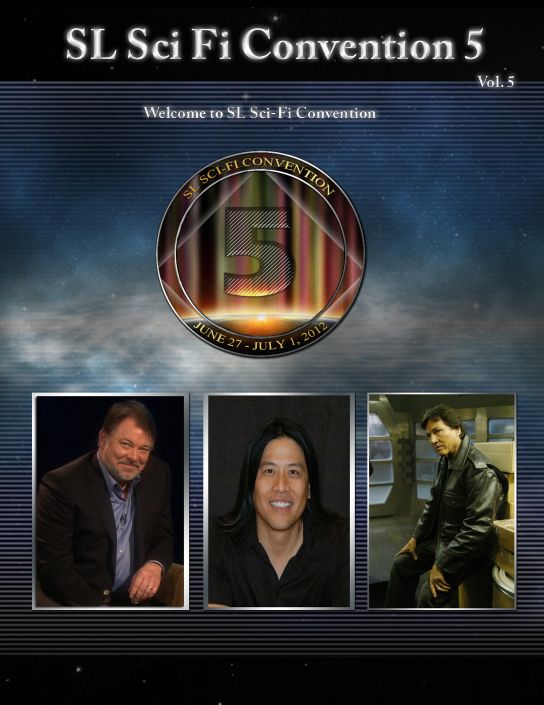
The promotional poster for the event
The SL Science Fiction convention in 2012 saw real-world TV personalities Jonathan Frakes, Garrett Wang and Richard Hatch appearing in-world. SF conventions are a major crowd-pulling draw

A collaborative marketing venture by which LL would seek to promote SL as a venue for conventions / faires and such-like and which demonstrates its viability as such, specifically targeted at key market audiences while at the same time folding-in the in-world expertise of the community to make things happen, could be enormously beneficial to all.

Of course, things would have to be carefully managed, and additional capabilities put in place. LL would, for example, have to be willing to handle the marketing effort and work to overcome the more negative perceptions many have of SL as either being “unsuitable” for their market or “dead”. They’ve also have to work creatively to demonstrate the power of the platform as a promotional medium and suitable venue for such events and be willing to work cooperatively with sections of the community.

More practically, things like how the prospective visitors for a focused faire could be readily brought-in to Second Life and not only arrive at their intended destination, but also understand the basics of avatar  / viewer use would need to be carefully considered. However, these are not insurmountable issues. In terms of avatar use, it’s likely that in the case of MMOs and the like, users will already have a grasp of basic movement controls, and the rest could be simplified through the provision of a specialised viewer, possibly based around the old “basic” viewer (but with a few enhancements). And if that viewer includes a means by which the user can opt to download the “full” viewer (even as a separate install option) by which they can explore the rest of Second Life, then potentially so much the better.  And putting in place a sign-up process which successfully delivers incoming users to a desired venue also shouldn’t be too hard to achieve.

Obviously, everything would require careful management – not the least, as Ciaran again touches upon, the possible reaction of some sections of the SL community itself – and this might not be considered worth the time and effort by the Lab. There would also need to be some careful balancing of the scales – for example, I personally wouldn’t wish to see something like Fantasy Faire, with its very clear focus on RFL, being usurped by a more commercial endeavour.  However, I do believe that the idea has merit and that the Lab would be foolish to pass completely on at least investigating the potential here.

The possible benefits are clear: SL would gain broader recognition; there could be an opportunity for LL to establish another modest revenue stream which may actually attract more users into Second Life (with the additional benefits that would bring). Those companies utilising the ability to use the platform as a promotional environment get to stage a rich, immersive and global outreach opportunity which may equally gain them users and expand their networking opportunities without being tied to a more costly investment in SL which may not gain them the same level of return in attracting users, etc., and so on.

As such, the idea could well be worth exploring. Danko Whitfield comments on Ciaran’s post that there is a degree of this kind of promotional activity already occurring within OpenSim. So why shouldn’t the Lab look into the feasibility of grabbing something of the market, particularly as they could be well-placed to attract some of the big players?

Related Links

The Linden Dollar: token or currency? The US Treasury ponders …

secondlifeA recent set of interpretive guidelines (PDF) issued by the US Department of the Treasury’s Financial Crimes Enforcement network (FinCEN) is starting to see questions asked as to the possible future status of the Linden Dollar.

In short, since April 30th, 2010 the Linden Dollar has, under the Lab’s Terms of Service (ToS), been classified as a “token” rather than (as was previously the case, a “currency”). Section 5 of the ToS states:

5.1 Each Linden dollar is a virtual token representing contractual permission from Linden Lab to access features of the Service. Linden dollars are available for Purchase or distribution at Linden Lab’s discretion, and are not redeemable for monetary value from Linden Lab.

However, under the guidelines issued by FinCEN, the Linden Dollar actually meets criteria specified for being recognised as a virtual currency in that: it operates through an “official” exchange, the Lindex (as well as some third-party exchanges); Linden Lab falls under FinCEN’s view that they are both “an administrator and an exchanger of virtual currency”; and Linden Dollars effectively have a real world exchange rate (around L$260 to the USD).

US Treasury's FinCEN: examining virtual currencies
US Treasury’s FinCEN: examining virtual currencies

Alex Kadochnikov, who has been looking into virtual currencies and the FinCEN guidelines as they might affect them, has blogged on the possible ramifications for the Lab should FinCEN’s view move beyond guidelines. He notes that while the guidelines should not have any significant impact on casual SL users (i.e. you and me), the situation may not be the same for LL:

Linden Lab does not want to consider the Linden Dollar as a virtual currency. Second LIfe’s terms of service refer to Linden Dollar as a transferable license. Also according to Linden Lab, when a player “sells” the Linden Dollar, that player transfers a license, not currency. However, Linden Lab terms of service will play no role in FinCEN’s decision to classify Linden Dollar as virtual currency.

FinCEN goes by the approach “If it looks like a duck, and quacks like a duck, it is a duck.” And Linden Dollar sure does “quack” like one. Linden dollar is a virtual currency because it has value in real currency.

As such, should the guidelines result in a more regulatory stance being taken by the US Treasury towards virtual currencies, then it is unlikely the Linden Dollar (and Linden Lab) will be entirely unaffected. Again, Alex Kadochnikov comments:

It matters for Linden Lab because they are now both an administrator and an exchanger of virtual currency.  Both of these are a Money Services Business (“MSB”) under the treasury regulation. An MSB must register with the Treasury Department and make Anti-Money Laundering and periodic reports. These reports are not little one page chores a trained monkey can do. There is a reason corporate compliance departments are stacked with lawyers and accountants. As you can imagine both of these items cost a lot of money.

This has led some commentators to the opinion that it’ll set the Lab back a pretty penny, while others speculate it is the reason behind “rumours” of a possible sell-out to Amazon.

Money laundering - a significant threat to Second Life?
Money laundering – a significant regulatory threat to Second Life?

But there would appear to be questions as to how justified concerns over compliance (and the cost thereto faced by the Lab) actually are.

When it comes to money laundering in particular, Linden Lab already has a number of safeguards in place. Whether these are compliant with any requirements specified by the US Treasury is open to debate; I’m certainly not conversant with the details and therefore not in a position to comment reliably. However, it would seem unlikely that such safeguards would be without reference to any legal / regulatory compliance, even  if they only meet the bare minimum required.

As such, the potential impact on the Lab may not be as great as imagined. There are also arguments to suggest that despite the apparent size of the SL economy, the safeguards the Lab have already put in place make the platform unsuitable for “serious” money-laundering operations.

There is another aspect to these guidelines as well, which hasn’t been really touched upon – the flip side of the coin, if you will pardon the expression – and which is perhaps more positive.

Were the Linden Dollar to become a recognised digital currency, it could encourage further transparency in terms of how the Lab manages the SL economy, and make it and the Linden Dollar more trustworthy. In turn, both of these factors could in turn make SL a more viable proposition for potential investors and / or those wishing to utilise the platform as a business enabler.

However one looks at the FinCEN document, it is evident that virtual currencies are very much in the US Treasury’s sights, possibly more so now due to the meteoric rise of Bitcoin over the last few years. Doubtless, they are also going to be the subject of more detailed thinking on the part of the EU and others. As such, this isn’t a matter which is liable to go away. Whether this is a good or bad thing for Second Life is still very open to debate.

Related Links

With thanks to Mona Eberhardt and Trinity Dejavu

Linden Lab comments on new advertising moves

LL logoAdvertising on SL has been something of a minor theme on this blog of late. Most recently, I returned to the idea of LL using machinima collaboratively with users (via a competition) to help promote Second Life to the world at large. Prior to that, and paralleling Ciaran Laval, I’ve touched on the topic of the SL websites being perhaps a means for the Lab to leverage revenue through advertising as a means of helping to offset falling tier revenue  – something which the Lab actually embarked upon recently.

The move has been met with mixed feedback from users, with many objections being raised (unsurprisingly) and some mistakenly believing they were somehow “milking” their own userbase – as if the revenue generated from the ads was coming directly out of their own pockets. Some of this negative feedback may have been driven by the initial ads displayed on things like people’s dashboards to start with, although it is evident now that LL are seeking to more robustly curate the nature of the ads with show up – not always successfully, but the improvements are there to be seen.

Advertising on the SL dashboard has raised mixed responses

Some of the backlash against the new move appears to be on the grounds that advertising somehow devalues the SL brand. However, as Gywneth Llewelyn points out, the SL web properties potentially offer a rich vein of revenue flow which could significantly assist LL (with a potential beyond anything I admit to imagining).

Obviously, given my own stance on the matter, I’m supportive of the move – and have actually suggested it should be broadened to incorporate other SL web properties such as both our profile feeds (which already advertise SL in a case of “preaching to the converted”) and  the Marketplace. The latter is something some have drawn the line at, alongside the use of people’s SL dashboard. Although objections to the use of former have been given with caveats, the idea of excluding either would appear to be counter-productive to the aim of helping to generate revenue for LL – simply because of the amount of traffic they generate.

Possibly in response to the wider negative reaction to the move, and in confirmation that LL very clearly see their web properties as a valuable source of revenue generation, the Lab has issued a Featured News blog post on the matter, covering both the current advertising and the moves to expand it, confirming that as of the 12th March, advertising will encompass the SL marketplace. The post reads in full:

As you may have noticed, we recently added some banner ads to SecondLife.com. Today, we’ve also added them to the Marketplace, and we’ll soon expand the program to other Second Life web properties as well. The placement of these ads is designed to be unobtrusive, as we don’t want them to interfere with your Second Life experience on the web, and we’re taking care to keep the content appropriate.

These ads are a great opportunity for advertisers to reach the large, global audience that visits the Second Life web properties every day, and we want to extend that opportunity to Second Life merchants as soon as we can. For Merchants, advertising on the Second Life web properties will be a new way to get their offerings in front of potential customers, while at the same time making the ads extremely relevant to every Second Life user who sees them.

We have some work to do before we can make the ads purchasable by Second Life business owners, and it’s too soon to say precisely when we’ll be able to, but we wanted to let you all in on this plan early on. We’ll blog again when we have more info to share, so keep an eye on this space!

Ads now on the SL Marketplace - although initial offering suggest some refinement of the filters might be in order
Ads now on the SL Marketplace – although initial offerings suggest some refinement of the filters might be in order

That the ad spaces will be expanded to include user-run business should amount to good news, and help mitigate objections relating to ads appearing on the various SL web properties. Allowing SL businesses to use the capability (assuming they are in a position to do so) brings both added relevance to the ads and helps SL businesses promotion themselves to SL consumers across an even broader front.

Obviously, with regards to the Marketplace in particular, some careful consideration needs to be given to how advertising for SL business will sit alongside existing aspects of Marketplace promotion, such as listing enhancements. If merchants using the latter feel that the advertising option is undermining the listing enhancement options, then it is likely that there could be a wider withdrawal from the latter than has been experienced in the past when the scheme has hit problems.

Some have called for those with Premium accounts to escape the advertising. There’s actually some merit in this – other websites offer “advertising opt-outs” on payment of a fee, so given that Premium members have already paid out, then automatically opting them out from any advertising campaign of this nature is liable to go down very well (and potentially make Premium accounts a little more attractive than offering-up cars, boats, planes and other trinkets). Certainly, I wouldn’t be against seeing the ads vanish from my views of the various SL website – although I don’t actually see them as actually impinging on my SL experience as it is.

Whether such an “opt out” could actually be easily achieved, however, is perhaps a matter of debate. As we’ve seen in matters of logging-in etc., the various SL web properties are perhaps not as well-integrated as they first appear, making any attempts to “ring-fence” Premium accounts from the advertising, even were LL so minded (which I actually doubt) potentially harder than may first appear.

Given the initial reaction to the advertising move, it’ll be interesting to see what the response to the news that the programme is being expanding is liable to be.

Related Links

The Machinima effect take two and adding some Steam to the mix

In launching The Drax Files recently, Draxtor Despres has caused some bloggers to re-open the question of promoting of Second Life through the use of machinima, with Ciaran Laval in particular asking could LL follow Draxtor’s lead and can resident-made machinima be used to promote Second Life?

These questions were actually the focus of some thought on my part back in 2011, when – having been prompted by a tweet from Crap Mariner, I mused on advertising SL: the machinima effect, and it seems worthwhile both revisiting those thoughts and updating them with a few further ideas and thoughts.

The video that prompted my original post on the subject may not be focused on Second Life, but it is ample proof of how machinima can be used to promote a product. What’s more it is fun.

Back in 2011, it prompted Crap to tweet: Linden Lab needs to make some ads like this for Second Life – something which caused me to reply: Or #LL should work with the machinima folk for suitable ads: say a competition; top 3 promoted on YT, SL.com, etc., which inturn prompted my original post on this idea,

Today, as Ciaran points out, and as I’ve covered for the last few years in this blog (albeit haphazardly), the University of Western Australia holds an annual MachinimUWA Challenge, which this year sees a prize pool of L$1.1 million for machinima makers submitting entries on the theme of “Reflections”.

MachinimUWA VI: showing the potential for machinima as a promotional tool

What makes MachinimUWA particularly relevant to this discussion is that not only does it showcase machinima as an art form, it actually promotes the University of Western Australia. The promotion may actually be very low-key, and a somewhat secondary consideration in terms of storytelling for those entering the competition, but it is there. This year, for example, entrants are required to film in “At least one of the 3 major spaces of Reflection at UWA … (The Reflection Pond, The Sunken Gardens, The Somerville Auditorium).” With the rules going on to note that entrants “may choose to film in any other area of the campus …  or … include all 3 locations.” Thus, the UWA’s in-world facilities form the nucleus of the competition in terms of providing the backdrop for whatever stories entrants opt to tell.

Continue reading “The Machinima effect take two and adding some Steam to the mix”