Oculus VR confirm: consumer headset to ship Q1 2016

On Wednesday, May 6th, Oculus VR confirmed the consumer version of their headset will commencing shipping in the first quarter of 2016, with pre-ordering due to start later in 2015.

  The news broke via a press release from Oculus VR, and Tweets from Oculus VR, Palmer Luckey, and the company’s Vice President of Product  Nate Mitchell (shown on the right).

The announcement ends months of speculation on when the consumer version of the headset might be available, with many originally predicting it would be ready for Christmas 2014 and then Christmas 2015. Despite such speculation, Oculus VR has always carefully avoided mentioning any approximate idea release dates. As I reported in these pages, even as recently as November 2014, Oculus VR Brendan Iribe was playing down any idea of any (then) near-term release of the headset:

We want to get it right. We really do. We’ve gone out there and we’ve set this bar and said, “we are going to get it right, and we’re not going to ship until we get it right” … We’re getting very close … We want it to be a beautiful product; there’s no reason it can’t be a beautiful product … so we still have a way to go, and we’re still working on a number of things, but we’re getting much closer. We like to say it’s months, not necessarily years, away [but] it’s many months, not a few months.
Click for full size

That something might be afoot by way of announcements was initially hinted at in a May 5th Tweet in which Palmer Luckey commented I love it when a plan comes together!

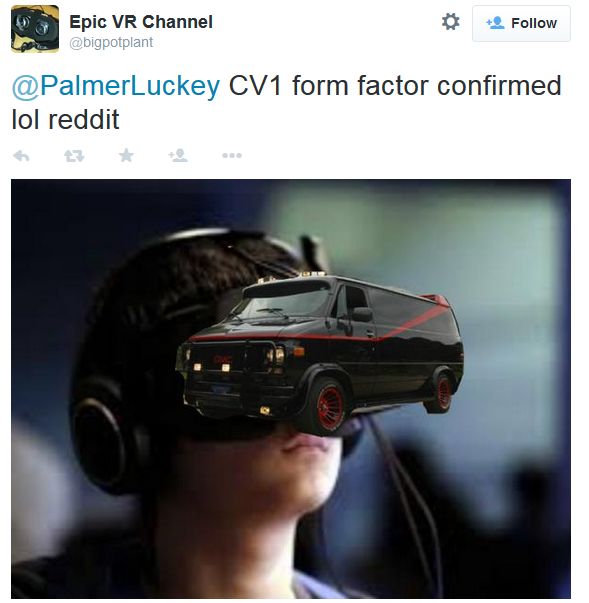
This brought an inevitable run of replies, many seeing it as a hint about the Oculus CV1 (as the consumer version of the headset has sometimes been referred to), including the humorous response seen on the right regarding the headset’s form factor.

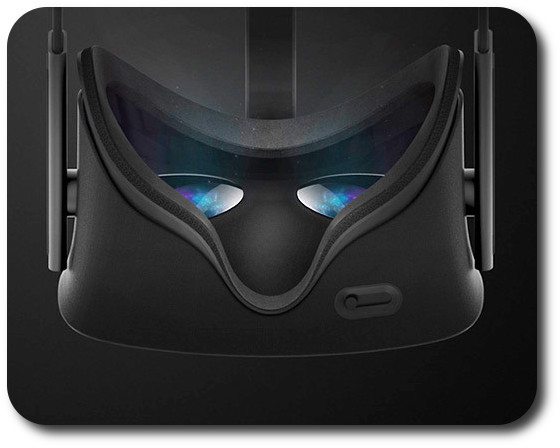
Details of the headset are rather scant in the announcement and the images a little on the dark side (I’ve lightened the contrast on them below), with the release merely stating:

The Oculus Rift builds on the presence, immersion, and comfort of the Crescent Bay prototype with an improved tracking system that supports both seated and standing experiences, as well as a highly refined industrial design, and updated ergonomics for a more natural fit.

No details on pricing or quite when in 2015 people will be able to start pre-ordering the headset, and there are certainly no details on the technical aspects of the headset. However, one potentially interesting aspect of the announcement has already sparked some speculation, as it refers to the upcoming release as, “a fully-integrated hardware/software tech stack designed specifically for virtual reality”. This has prompted Techcrunch to comment:

There’s no mention of a third-party computer necessary to power the Rift, which previous Oculus developer kits required. That means the Rift might ship with a game console-esque device to handle computing for the headset. An all-in-one box could make virtual reality much more accessible to consumers, especially those who don’t own a high-grade gaming PC.

A front view of the Oculus consumer version (courtesy of Oculus VR)

In terms of specification, the announcement was equally enigmatic, stating, “we’ll be revealing the details around hardware, software, input, and many of our unannounced made-for-VR games and experiences coming to the Rift”, with the last part of this statement leading Techcrunch to also speculate whether Oculus VR might also announce a line of in-house developed games to go with the launch.

Given the backgrounds of many of those involved in the company, such an idea might not be wild speculation. As it is, it is already known that Oculus VR is helping to develop immersive movie experiences. Furthermore, in February 2015 it was confirmed that Facebook is developing VR apps, with Chief Product Officer Chris Cox saying that experiences as varied as flying a fighter jet to sitting in a Mongolian yurt would serve as inspiration, and describing the technology as “sending a fuller picture … You’ll do it, Beyoncé will do it”. Ergo, Oculus VR-branded games are not beyond the realm of possibly.

What the announcement does more-or-less mean is that unless something unexpected happens, the Oculus Rift will definitely be available after HTC / Valve have started shipping their own Vive headset, which looks set to hit the market around the same time as Samsung’s  (Oculus-enabled) Gear VR2, towards the end of 2015.
A view from under the Oculus consumer version (courtesy of Oculus VR)

While there has been a lot of hype about the possible demand for what is effectively a first generation headset from Oculus VR, there have also been some notes of caution sounded in some quarters. As gamesindustry.biz notes, Ben Schachter, a Macquarie Research analyst wrote to Facebook investors, stating:

While there is not yet any info on pricing or available units, we expect relatively small number of units and think that the initial device will be supply constrained. We think that the early versions of the device will be more about showing what is possible from gaming and other entertainment genres, and build demand for later versions of the device.

Mr. Schachter isn’t alone. While price may no longer be a limiting factor in obtaining a headset, Jacki Morie, herself a VR pioneer (and whose work has been featured in this blog a number of times) recently warned that care should be taken in how the potential for VR is promoted, in particular pointing to things like an Oculus VR sponsored art contest as a means to send out completely the wrong message about VR to a wider mass market audience and potentially damaging the technology’s credibility as a useful tool.

I actually doubt the wheels will seriously come off the cart with VR this time around, bad marketing campaigns and the like notwithstanding, although Jacki clearly has a point about getting the right message out there in the first place. However, I do tend to think that Mr. Schachter’s comment about the build-up of demand is well put. VR will profoundly alter many ways of doing things for all of us in time; but the the speculation and hype that will not follow Oculus VR’s announcement aside, it’s still going to be a few years or so before we see VR as being as ubiquitous a piece of technology in our daily lives as we do the mobile ‘phone today.

Skill Gaming: CapEx moving to the Internet, with important changes

Capital Exchange has seen activity in its stock market simulation game frozen since the November 1st enforcement of the Lab's Skill Gaming Policy
Capital Exchange has seen activity in its stock market simulation game frozen since the November 1st enforcement of the Lab’s Skill Gaming Policy

As regular readers know, I’ve been reporting on the Skill Gaming Policy changes, including the situation involving the stock market simulation game Capital Exchange (CapEx), operated by Skip Oceanlane.

Since my last report in December 2014 there have been a number of updates from Skip on the matter to keep CapEx members informed of progress, of which the April 18th, 2015 is the most important.

If you are engaged with CapEx, and you’ve not already done so, please ensure you read the April 18th update in full. What follows is a very high-level summary:

  • With as yet no confirmation or rejection of the CapeX Skill Gaming application by the Lab, the decision has been made to move the game to the Internet and away from Second Life
  • This does not mean, at this point in time, that CapEx is ceasing trying to gain approval as a Second Life Skill Game Operator (SLSGO)
  • A new website is being developed to support operations, and once available, all existing CapEx URLs (www.onlinecapex.com. slcapex.com and capex.biz) will redirect to it. It is planned to have this up and running in June, 2015; until it is officially announced, users are requested to keep using slcapex.com until otherwise directed
  • As a game of skill under United States law, the new Capital Exchange website will not be accessible to people reisding in the following state: Arizona, Arkansas, Delaware, Florida, Kentucky, Louisiana, Maryland, South Carolina, South Dakota and Tennessee
  • Game players will be able to register via the website, with the option to connect to a virtual world avatar if they choose to do so – but it won’t be mandatory
  • A valid e-mail address will be required for registration with the new website – players who have not entered an e-mail address against their current CapEx details are asked to add one now, to ease transition. Instructions on doing so can be found in Skip’s update
  • The Linden Dollar will be replaced with the new CapEx Dollar (CD$). The value of the CapEx Dollar will initially be pegged at 250 to the US Dollar, in order to ensure stability with existing stock values
  • The new website will operate using HTTPS, and will be connected to a merchant account linked to VISA authorize.net to allow payments using major credit cards
  • The initial means of cashing-out will be via PayPal. The cash-out fee is liable to be “significantly” less than the current 3.5% fee with the Linden Dollar
  • Future options may include the ability to support additional currencies – GBP, the Euro, etc., and other virtual currencies such as Bitcoin, Litecoin, etc.
  • At a future date yet to be determined, the CapEx Dollar will be freely traded on a currency exchange, and CapEx may may allow multiple currency exchanges to free float CD$
  • Should Linden Lab grant CapEx authority to operate in Second Life as a Skill Game, the Linden Dollar may be accepted, and thoughts to how this might be done have been given. However, it is currently Skip’s intention to operate CapEx without support for the Linden Dollar
  • There are significant changes coming to CapEx ATMs and funds held through them (see below)
Skip Oceanlane - moving CapEx to the web and away from SL. Projected launch date: July 2015
Skip Oceanlane – moving CapEx to the web and away from SL. Projected launch date: July 2015

The new service currently has a projected start date of July, 2015.

An important aspect of this news is that all existing CapEx ATMs are to be withdrawn from Second Life on Sunday, May 10th (unless CapEx gains authorisation to operate as a Skill Game in SL before then). Users can opt to withdraw their L$ amounts held by CapEx ATMs ahead of that date, or can opt to leave them on deposit. L$ values will then be used to purchase stock in a yet to be named fund, and stock in this fund will eventually be able to be sold once trading restarts. In stating this, Skip goes on to note:

Now for you “old-timers” I already know what you are thinking – this is what was done when SL banks failed in 2008 at the old “SLCapEx” as well as a defunct fund at a defunct exchange called the “World Stock Exchange”. Deposits were converted to worthless stock, and no one ended up getting their Lindens back. Well this time, it will be greatly different. I will be maintaining a Buy Order at roughly 5% above the value of what was created/purchased. So anyone that wishes to “cash out” will actually make a profit, if they do not withdraw before May 10. It’s also an incentive for people to stay with Capital Exchange, and to continue playing the game. Note that I plan on adding assets to this fund, so it will be generating a monthly dividend.

Continue reading “Skill Gaming: CapEx moving to the Internet, with important changes”

A perspective on avatars and identity

Veronica Sidwell in Second Life (image: Veronica Sidwell, as used by VICE)

On Wednesday, April 15th, Xiola Linden Tweeted about an article that appeared in the Motherboard section of the VICE web magazine which makes for an interesting read.

Avatar IRL is a piece  by Cecilia D’Anastasio focusing on the question of avatar identity, and how it can work both ways – not only does it allow us to create and project an identity into virtual mediums, be they immersive worlds like Second Life, MMORPGs or through “traditional” text-only chat forums, it can sometimes be that the impact of engaging in such environments can often have an impact back on our real-world selves; shaping and influencing who we are in the physical world in what is broadly termed “identity tourism”.

Cecilia D'Anastasio: writing on identity in the digital age
Cecilia D’Anastasio: writing on identity in the digital age (image via Twitter)

The term has it roots in the 1980s, when it was used to “examine the ways in which tourism intersects with the (re-)formation and revision of various forms of identity, particularly ethnic and cultural identities”.

In the 1990s, Lisa Nakamura, who gets a fair mention in the article, broadened the term to encompass the way in which on-line activities – notably MMORGs – were encouraging more and more people to experiment with matters of identity and self-definition. It is her work which appears to have given D’Anastasio the idea for Avatar IRL.

The article is a part of a wider series within Motherboard entitled Goodbye Meatbags, which focuses on “the waning relevance of the human physical form”.

In order to frame the piece, D’Anastasio placed a request in the SL forums asking if people would be willing to share their own stories on the issue of identity tourism. At the time, the request provoked a mix response (indeed the article itself has provoked much the same). From the responses she received, D’Anastasio selected the story of Veronica Sidwell, a male-to-female transsexual, to serve as the introduction and initial examination of self-identity and the deep sense of identification many have with their avatar – and how that identification can loop back into their physical lives; in this case, allowing Veronica to seek to transition her physical self, adopting the name of her avatar in the process, in recognition of the role she feels it played in allowing her to do so.

Veronica’s story is related with respect, and serves to springboard the article into its wider discussion which, as mentioned above, reviews Lisa Nakamura’s initial studies into matters of identity (which also delved into aspects of stereotyping and negative reinforcement which did – and still can – occur), before moving on to look at the work of Nick Yee and Tom Boellstorff, and their ongoing studies into the myriad questions of identity and self-definition which arise from our increasing ability to interact through a wide range of digital mediums and the levels of anonymity that often afford when doing so.

Nick Yee (l) and Tom Boellstorff

Both of these names will hopefully be familiar to regular readers of these pages. I covered Nick Yee’s work back in January 2014, and his book  The Proteus Paradox: How Online Games and Virtual Worlds Change Us– and How They Don’t, is a recommended read for anyone interested in the increasingly complex matters of identity and our relationships with our digital selves and how we relate to the digital identities of those around us. For those not enticed by his book directly, I’d recommend at least reading Virtual worlds Are Real, a piece he wrote for Slate magazine from January 2014, and which served as the springboard for my article on his work.

I’ve similarly made mention of Tom Boellstorff in the past. His research has covered many aspects of identity and the question of self in the digital arena, and he has written two books on the subject directly focused on Second Life, Coming of Age in Second Life: An Anthropologist Explores the Virtually Human, (Princeton University Press, 2008), and Ethnography and Virtual Worlds: A Handbook of Method (Princeton University Press, 2012, co-authored with Bonnie Nardi, Celia Pearce & T. L. Taylor), and he is also known for his involvement in the story of Fran Seranade / Fran Swenson. Tom also featured in a Drax Files Radio Hour interview which, if you haven’t heard it before, I do recommend.

D’Anastasio covers both Yee’s and Boellstorff’s work as a means of illustrating the osmotic process which can work both ways: that as much as we seek to build and define our digital identity, so the experiences we gain, the interactions we have through those digital projections can also seep back into the flesh and bone, influencing us and further shaping our self-identity.

Avatar IRL has been critiqued for focusing on matters of “sexuality” rather than “identity” – D’Anastasio also relates the experience of Dale, a male-to-female transsexual engaged in World of Warcraft. I’m less than convinced such critiques are valid given the overall context of the article. More to the point, what is a person’s quest to explore, understand and ultimately to be their desired gender, if not a matter of identity?

While there are no ground-breaking revelations in the article – at least for those of us already engaged in environments like Second Life and World of Warcraft, etc. But the piece does provide a good opening for those who might be curious about identity in the digital age, and who might want to delve a little deeper into the subject.

Could the Lab use Amazon AppStream to “replace” SL Go?

Sl Go proved itself very popular among SL users running low-end hardware
SL Go proved itself very popular among SL users running low-end hardware

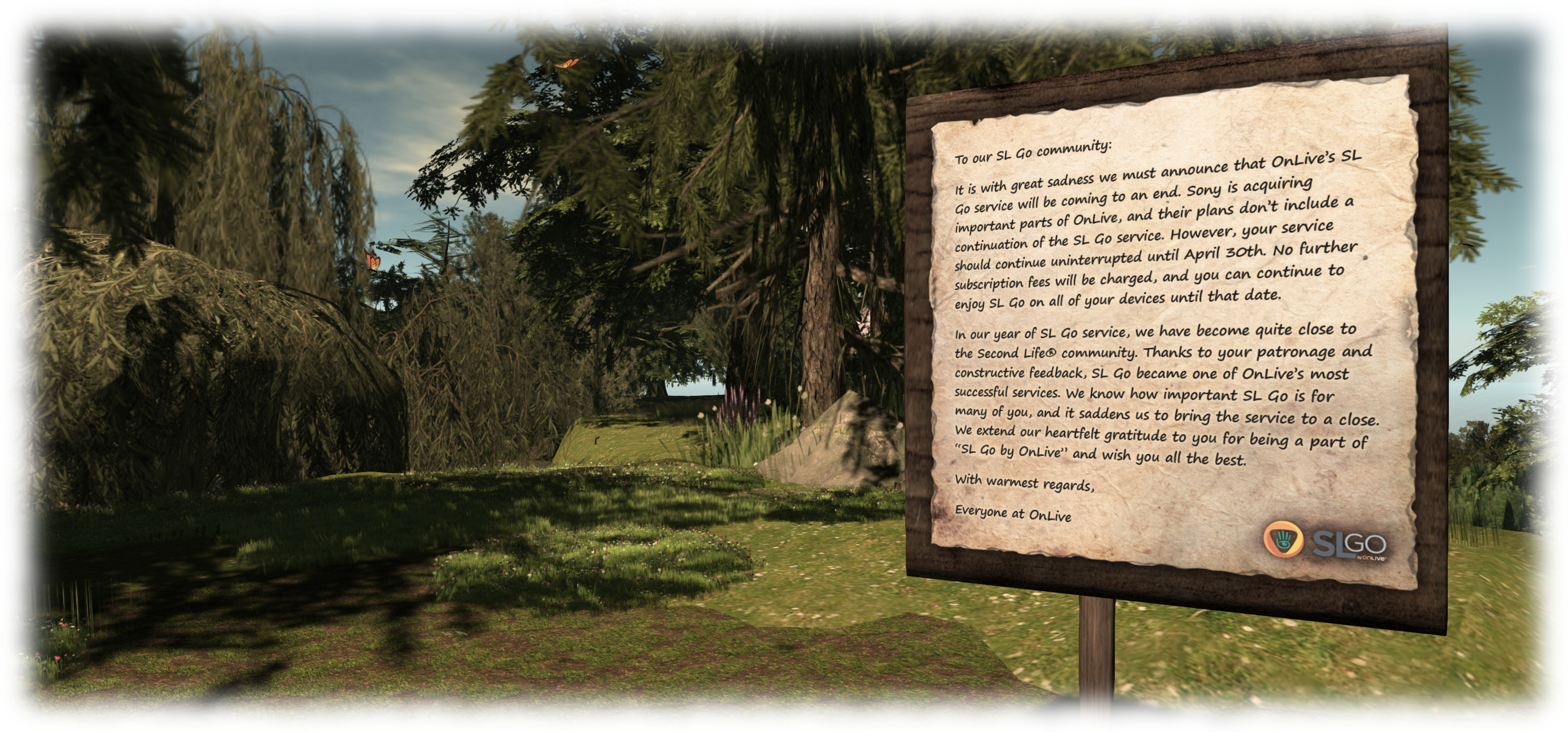
On Thursday, April 2nd, it was announced that SL Go, the streaming service for accessing SL  provided by OnLive, is to shut-down on April 30th alongside OnLive’s other consumer services. The reason for this is because OnLive has sold the IP and patents associated with the services to Sony Computer Entertainment.

Since the news broke, there have been numerous calls made for Sony to maintain SL Go as a service, including  an on-line petition. However, as painful as it is, all such calls and petitions to  Sony are unlikely to succeed, as I explained in a recent blog post.

In that article, I also considered whether or not the Lab might invest time and effort in offering something that might fill the void. At the time, I thought the answer to this would most likely be “no”, as the Lab seem to have enough on its plate already with Second Life and its next generation platform.

But the more I think about it, the more I feel that the Lab should endeavour to offer some kind of “SL Go replacement”.

One potential means by which they might do so could be via Amazon AppStream.

Obviously, there are issues involved in providing such a service beyond the physical provisioning. Anything which requires some form of external hosting is going to incur costs, for example. However, the flip side to this is it’s fair to say the SL Go has demonstrated that if users believe they are getting a beneficial service, they are willing to pay for it, providing the price is not prohibitively high.

Certainly, there are a wide range of potential benefits to be had from such an endeavour, particularly if implemented through something like Amazon AppStream:

  • It offers an easily scaled means by which the Lab could provide an “SL streaming service” to users on low-end hardware and those on mobile devices – something long demanded by SL users
  • It could provide the means by which SL could be accessed through web browsers – again, a long-desired means of attracting new users to the platform who might otherwise be put off by having to download and install the viewer
  • It obviously means that those SL users on low-end systems can enjoy the full graphical richness of SL in the manner LL would like to see all users experience it
  • It could help those preferring to run older operating systems – such as Windows XP – to continue accessing SL even after they might otherwise be unable to even install the viewer
  • It might even help the Lab map and test options which might be beneficial for their nascent next generation platform.

While developing such a service might not necessarily be easy, the Lab isn’t entirely without any experience in this area. As I and many others have pointed out, in 2010 they did experimenting with streaming the viewer, using the Japanese company Gaikai (coincidentally purchased by Sony Computer Entertainment in 2012), which delivered the viewer to web browsers, as shown in the video below. If there is anything remaining of this work at the Lab, it might possible to put it to work through something like Amazon AppStream.

That said, there is a lot for the Lab to consider in attempting to fill the forthcoming void that will be left by SL Go. And while I would not be at all surprised to learn they are already doing so, they might still require some encouragement to take things beyond just considering options. Something which might encourage them, or at least demonstrate to them that there really could be a worthwhile demand for such a service, could be for users to politely speak up.

One way to do this might be to add your name to the existing petition – I would hope someone at the Lab is keeping an eye on it.

Another could well be to leave a positive and polite comment on the subject following this article, as (and all ego aside) I do know eyes at the Lab pass over this blog (just as they do many others).

There is no guarantee that Lab will move to provide some kind of “SL Go replacement”, but on the other hand, as someone once said, nothing ventured, nothing gained.

Why SL Go won’t continue, and OnLive opted to sell

Farewell SL Go; one of OnLive's most successful services, but nevertheless one unlikely to be saved
Farewell SL Go; one of OnLive’s most successful services, but nevertheless one unlikely to be saved

Since the announcement that OnLive’s gaming services are to shut down at the end of April, there has been understandable upset from within the SL community (and from some OpenSim users as well, given Firestorm on SL Go can be used to access OpenSim grids).

Following the news, there were a plethora of requests made to Sony on social media that they continue to provision SL Go as a service and an on-line petition was started in the hope of achieving the same end. Unfortunately, these requests and the petition overlook one thing.

As OnLive made clear in their statements on the future of their gaming services, and as I attempted to point to in my original article on this news, Sony didn’t actually acquire OnLive’s services. They took the opportunity to purchase the IP and 140 patents the company held relating to cloud gaming and other “assets” (which would most likely appear to be the additional 135 patents related to cloud gaming  OnLive had pending), without actually buying OnLive’s services. So technically, there’s nothing for them to “continue” to offer SL Go users.

What’s more, as Dennis Harper, the SL Go Product Manager at OnLive, made clear in these pages, taking the IP and patents is akin to taking the heart and lungs of OnLive’s services; without them, a service like SL Go cannot easily be continued by someone else. At least, not without money changing hands and someone having the infrastructure by which they can deliver the service.

So, are Sony the Big Evil for doing this? did they gobble OnLive’s patents to stifle competition? Is this, as was dramatically stated in some quarters as the news broke, some kind of first shot in a forthcoming “VR battle” between corporations? Well …. No.

From the start, OnLive was well ahead of the curve, and even though we're reaching a point were the viability of cloud-based gaming can be demonstrated, it seems few are yet willing to take a gamble on taking-on the kind of services OnLive have offered
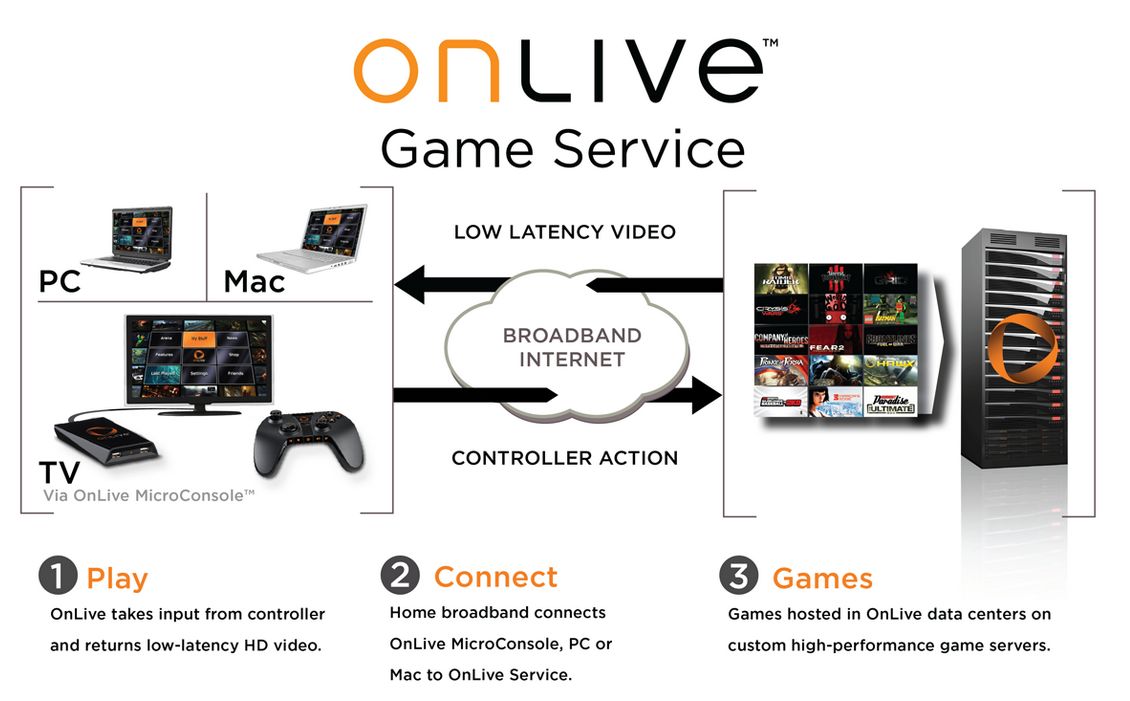
From the start, OnLive was well ahead of the curve, and even though we’re reaching a point were the viability of cloud-based gaming can be demonstrated, it seems few are yet willing to take a gamble on taking-on the kind of services OnLive have offered (image courtesy of OnLive)

The truth is that OnLive put itself on the market.

That this is the case can be found in another post on the company’s blog entitled, A Bright Future for Cloud Gaming At Sony. As well as containing useful historical information, the post underlines the specific issues the company’s management had been forced to face:

Since 2012, the company has dramatically improved its technology and business models such that all of its 5 services are gross margin positive, ranging from 43% to 86% margin … The company also was able to achieve conversion rates from free trial to paid of between 64-78% for its services. Despite these positive metrics, the lifetime value (TLV) of a subscriber was still less than the cost to acquire subscribers (CPA), but they were converging. While we knew we could not get to break-even on our own, we believed that there were many large companies who would be able to get there.

In other words, in order to get to a break-even point,  OnLive’s management felt the company needed to be offered-up for acquisition, albeit hopefully as a going concern.

Perhaps the first fully public hint that this was the case may have actually come in a blog post issued a couple of days ahead of Sony deal being announced. Of course, by the time the post appeared, the deal was undoubtedly cut and dried; nevertheless, The 2015 Case for Cloud Gaming and OnLive, could almost read as the company laying out its stall in order to attract a suitable investor / acquirer.

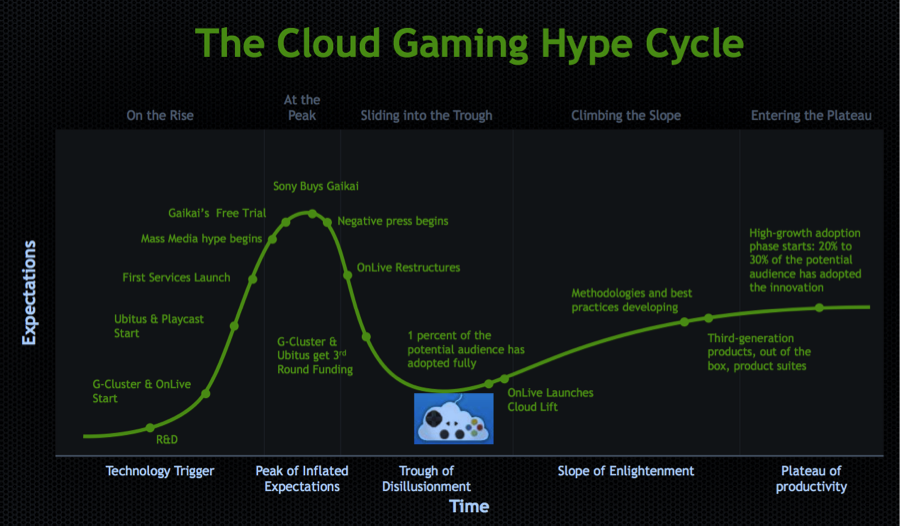
Despite the fact the Nvidia suggested OnLive themselves were helping to lift cloud gaming out of the Trough of Disillusionment towards its Plateau of Productivity, no-one was interested in acquiring the company as an operational concern when OnLive decided to seek outside assistance (image: Nvidia via OnLive)

Unfortunately, despite all the positive indicators they could show, the Cloud Gaming hype cycle had bitten hard; no-one OnLive approached was willing to take them on as a going concern. Not even the fact that Nvidia had indicated the worst was behind the sector, and that OnLive itself was helping to push the technology up the Slope of Enlightenment, could encourage anyone to acquire the company outright. Thus the deal with Sony for the IP and patents sale was agreed.

Why didn’t Sony acquire OnLive as a whole? Because they already have their own cloud gaming service, PlayStation Now, which came out of a 12-month beta programme in January 2015. The OnLive patents understandably offer more value when put to work within PlayStation Now than Sony would be liable to find in buying-out OnLive as a whole, so they didn’t bother.

Interestingly, and entirely coincidentally, PlayStation Now has its own link to Second Life. It is built on the back of Gaikai, a Japanese streaming game provider acquired by Sony in 2012. Gaikai is the company Linden Lab worked with in an attempt to provide the means of streaming Second Life to web browser, a service which underwent a limited beta run in 2010, as the video below demonstrates.

But to draw things to a close; however “unjust” it might appear, all of this means that SL Go cannot really be saved. The patents which enabled it to function are gone, and the services upon which it runs are closing down. The only real options are for someone else to come along and offer a similar service of their own, or for LL to work with a partner to provide such as services, as they once attempted with Gaikai.

Both would seem unlikely; in the case of the former, SL perhaps represents too small a community of users to be worth catering for (and remember, SL Go came about in part as a result of rather unique circumstances). And while I tend to lean towards LL having an interest in cloud-based streaming, I don’t think that interest is with regards to Second Life, so I can’t see them getting directly involved in trying to provide a streaming solution for SL access. If nothing else, they’ve likely got enough on their plate already.

SL Go was a great and brave experiment. It is a shame that its days are drawing to a close; but OnLive, through their services as a whole, have proven what might be achieved. In that respect, they are right when they proclaim that cloud gaming has a bright future.

Lab presents spring Premium membership offer – with a slight twist

We’re all familiar with the Lab’s periodic Premium membership offers: every once in a while one will pop-up offering a discount for those who up their membership from Basic or who are signing-up to SL for the first time.

I’d actually been expecting such an offer to pop-up around mid-March. However, it was announced on Friday, April 3rd, with a blog announcement,  and runs through until the Monday, April 13th, when it expires at 08:00 SLT.

As the blog post notes, there is no Premium gift offer this time around, instead the lab point to their recent announcement of  a Premium perk:

Being a Premium Second Life subscriber carries many benefits – from weekly L$ stipends, to your own Linden Home, expanded live customer support options, exclusive gifts, and more. Just last week, we added a new perk for Premium subscribers, and we’ll be adding even more benefits and features for Premium members throughout the year.

premium spring-15
This time the 50% discount applies to the first month’s payment on the Monthly plan

None of this is what makes the offer particularly interesting. As I’ve noted, they do pop-up periodically. What is interesting however, is hinted-at in the body text of the post:

If you’ve been waiting to upgrade to a Premium account, now is a great time, because today we’re kicking off a great new sale: from today until April 13, 2015, you can upgrade to Premium subscription for less than $5 for your first month! That’s a 50% discount off the regular rate, and this offer won’t last long. Upgrade today and start enjoying Premium benefits at our lowest-ever monthly rate.

Up until now, these offers have applied to the Quarterly billing plan, where the 50% discount is applied to the first quarter’s billing, reducing it from $22.50 to $11.25 (excluding VAT, where applicable). However, this time the discount applies to the Monthly billing scheme, as the notes at the end of the blog post further confirm.

Quite why the switch has been made is unclear; while I’ve never myself been convinced as to how well-received these offers are (that’s purely supposition, without any basis on fact), I’d say that the Quarterly plan discount represents a more appealing offer than just cutting the first month’s fee. Perhaps the Lab were finding that even with the first quarter’s bill cut by half, people weren’t overly enamoured with the offer, and are trying to mix things up a little. If so, I’d venture to suggest perhaps offering two months on the reduced rate might be a tad more appealing.

But really, the problem with Premium membership is not so much how much it costs – but what it brings. For the majority of people who can otherwise enjoy and contribute to SL free of charge (emphasis intentional, as “free” doesn’t equate to “feeloading”, as  is sometimes made out to be the case), Premium membership really isn’t that attractive. Hence why the Lab have in the past tried to spice it up with gifts. The problem here is, as I’ve recently explored, actually coming up with a Premium package that does offer the kind of incentives that are likely to have really broad-based appeal among users actually isn’t that easy.

In the meantime, if you are a Basic member and are considering upgrading, might I offer some thoughts (as long in the tooth as they might be) as someone who has bounced from Premium to Basic and back again?