An opportunity in Australia with a little help through Second Life

Image courtesy of Carmsie Melodie

FreeWee Ling is perhaps best known for her tireless work on behalf of the University of Western Australia (UWA), and co-organiser and curator of the UWA’s art-related projects, activities and galleries within Second Life.

At the end of 2014, she rightly gained recognition from the Australian Department of Education for this work, and was awarded an Endeavour Executive Fellowship that allowed her to travel from her home in the eastern United States to spend four months at the UWA in Perth, Australia, where she was based with the UWA’s Department of Physics.

FreeWee was encouraged to apply for an Endeavour Executive Fellowship by colleague Jayjay Zifanwe (Jay Jay Jegatheva in the physical world, Manager of the School of Physics at UWA) and her application was supported by a letter of recommendation from UWA.

Now, JayJay, FreeWee and the UWA are encouraging other Second Life residents to take the opportunity to follow in FreeWee’s footsteps, and applying for a 2016 Endeavour Executive Fellowship and, if selected by the Australian Department of Education, travel to UWA.

News of this was passed to me by Carmsie Melodie, who Tweeted me to point to a write-up on her blog. The same write-up is also available on the UWAinSL blog, where FreeWee has also written about her experience as a Fellowship awardee – so if you are interested in applying, do make sure you read FreeWee’s article.

What is the Endeavour Executive Fellowship?

The Endeavour Executive Fellowship is one of a number of Endeavour Scholarships and Fellowships offered by the Australian government to international applicants from participating countries who are considered high achievers in business, industry, education or government.

The Endeavour Executive Fellowship is a 4-month study period in Australia, focusing on learning and building skills and knowledge through a host work environment in the applicant’s field or area of expertise, rather than through formal enrolment in a study programme. It offers financial support (up to  Australian $18,500) towards professional development opportunities for the successful applicant, and an opportunity to study at UWA for four months.

Image courtesy UWA
Image courtesy UWA

Commenting on her experience in applying, FreeWee said:

The Endeavour application process was fairly easy, all done online. You need to describe what you want to do, get a couple of people to write recommendations, get certified copies of transcripts, etc. But it’s all carefully laid out in the online application. I’m happy to answer any questions you might have about it. You can’t win if you don’t enter!

Once I was notified that my application was approved, the program turned me over to a caseworker who supported me from leaving for Perth to arriving back home. My caseworker was great, always responded quickly to any concerns I had and monitored my progress throughout my stay.

To find out more, please read the Endeavour Scholarship and Fellowship lead-in from the Australian Government,  which also includes a link to the applications forms.

Should you decide to apply for the Executive Fellowship, please be sure to contact Jayjay (in-world via IM or note card or via e-mail to: jay.jay-at-uwa.edu.au) and / or FreeWee (in-world via note card) for advice and support on how the UWAinSL can assist you in your application.

Do note as well that submissions for Fellowship applications close on Tuesday 30th June, 2016.

With thanks to Carmsie Melodie for the pointer via Twitter.

Linden Lab raise group limit to 60 for Premium accounts

On Thursday, May 28th, Linden Lab announced that with immediate effect, Premium Members can now join up to 60 groups – raising the limit for them from the previous 42.

This increase is only, for now, a pilot programme, for reasons explained below. However, all things being equal, it will hopefully become a fixture of the Premium account package.

The news came via an official blog post, which reads in part:

Today we’re thrilled to be rolling out another perk for Premium members: now you can be a member of 60 groups! Groups have been a consistently popular feature among the Residents of Second Life. It may not be obvious, but group membership can have an impact on the performance of a number of systems. That’s why in Second Life’s early days, Residents could only join a maximum of 10 groups. Over the years, we’ve made improvements that enabled us to raise the group limit to a maximum of 42, but we know that for some power users, even that isn’t quite enough, and today we’re happy to raise the bar for Premium subscribers.  We must make sure that the recent gains in group performance are not jeopardized, so for now the new limit is a pilot program. If there are no problems, we will look forward to raising the limit further (stay tuned!).

Simon Linden:his work on group chat has contributed directly to the announcement on group limits being raised for Premium members

The “gains in group performance” referred to in the quote above are related to the recent improvements made to the Group Chat service. These have been going on for almost a year now, spearheaded by Simon Linden, who has been working hard to bring about significant improvements to the entire group chat service, front-to-back.

One of the key aspects of these changes relates to how  various “update” messages, created every time someone logged-in or out of SL, etc., and which required updates to be sent to every group of which they were a member, could actually interfere with the group chat system sending and displaying actually messages being members.

At the time Simon was working on these changes, it was indicated that the Lab might consider raising the limit on the number of groups people can join if the work proved successful – so kudos to Simon here for all his hard work – and kudos as well, to the Lab for approaching things cautiously, and recognising that should the new limit prove detrimental to the performance gains that have been achieved with group chat, they are prepared to roll them back.

There is also news in the post for those who take advantage of the increase in the group limit, and then subsequently opt to downgrade their membership to Basic:

Premium members can immediately take advantage of the new limit. Downgrading from Premium membership will not remove you from any of your groups, but it will mean that you cannot join any new groups until you remove yourself from enough groups to get below the Basic account limit, which remains at 42.

This is a further change to the Premium account package that sees things continue to pivot away from the idea of quarterly “gifts” and the like, and towards offering options and abilities that users are more likely to find of use and thus appreciate more. Again, as the official blog post states, expect further updates to the Premium account offering that continue to move in this direction.

Ebbe Altberg: “The Future of VR is User-Created” (a look at SL + Sansar from the VR perspective)

Now into its second year, the Silicon Valley Virtual Reality (SVVR) Conference opened on Monday, May 18th. Among the presentations and panel discussions that marked the day’s events was a 20 minute piece by Linden Lab CEO Ebbe Altberg, intriguingly entitled The Future of VR is User Created.

Ebbe Altberg: address the 2015 SVVR audience on May 18th, 2015

The presentation can be found in this official SVVR video, starting at the 39:00 mark. It was also recorded by Ruthalas Menovich, whose video I have taken the liberty of embedding below. Timestamps in the summary that follows in this article refer to Ruthalas’ video.

Those who may have been hoping to gain more of an insight into the Lab’s Next Generation Platform (aka Project SANSAR) will perhaps be disappointed by this presentation. As the title suggests, it isn’t so much focused on the Lab’s NGP, but rather on user generated content (UGC).

Thus, it forms something of an exploration of the potential of UGC within VR environments, as seen through the focusing lens of Second Life, and what Second Life has taught the Lab about some of the potential constraints posed by both supporting UGC and Second Life itself, which the Lab are now seeking to address. In doing so, it also touches upon some of the broader challenges facing platform providers as well, particularly in areas such as the state of VR technology itself, issues of monetisation for users, etc.

I’ll likely have some comments of my own on SANSAR in an upcoming article. For now however, I’m restricting this piece to a summary of Mr. Altberg’s presentation, with timestamps to the relevant points in Ruthalas’ video for those wishing to listen to them in full.

00:31 – 02:28: Democratising Content

The premise here is that the power of VR will be in democratising content – making VR such that those who wish to can create and share content among friends and audiences; not just necessarily in having it fed to consumers by high-end organisations with considerable technical skills.

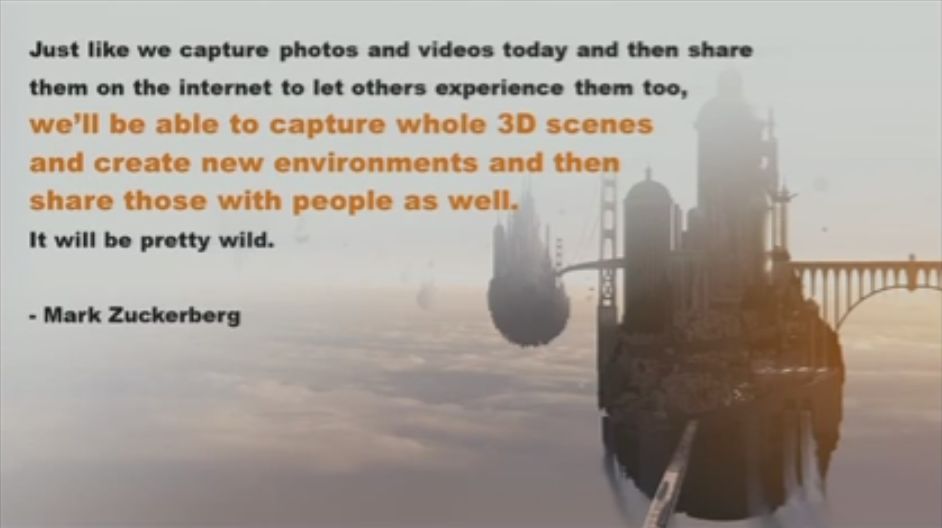
As a demonstration of this, he quotes Mark Zuckerberg, and points to the idea that just as self-expression is a natural part of our physical lives – how we decorate our homes, the clothes we wear, the interests we pursue – so too is it important for VR to allow us similar levels of self expression, such as through the freedom to create the environments we enjoy. In support of this view, he also points to the enormous popularity of sites on the Internet which today enable us to express ourselves through the content we crate, be it video, photography, the written word, or other mediums.

Mark Zuckerberg on VR's potential, quoted by Ebbe Altberg at SVVR
Mark Zuckerberg on VR’s potential, quoted by Ebbe Altberg at SVVR

02:28 – 14:30: UGC in Second Life and the challenges within SL

The focus moves on to Second Life and the challenges faced by anyone looking to enter the immersive VR environment with UGC.

Here he covers the rich diversity of user-generated content, which not only covers a huge range of interests and activities – social, educational, training, healthcare, business, entertainment, etc., and fulfils a massive variety of needs – homes, fashion, hobbies, landscaping, and so on -, but which is extraordinarily successful for both the company operating the platform and those providing the in-world content and services. In this he again cites the fact that in 2014, creators and providers redeemed some US $60 million from Second Life. The varying business models and their limitations – such as land – are mentioned.

The Lab’s work on making SL compatible with the Oculus Rift headset is touched upon, and a fair caveat is given on the aspect of performance. Ebbe notes that the work has to date really been more a useful tool for demonstrating to creators the difference between witnessing their creations on-screen and being immersed within them.

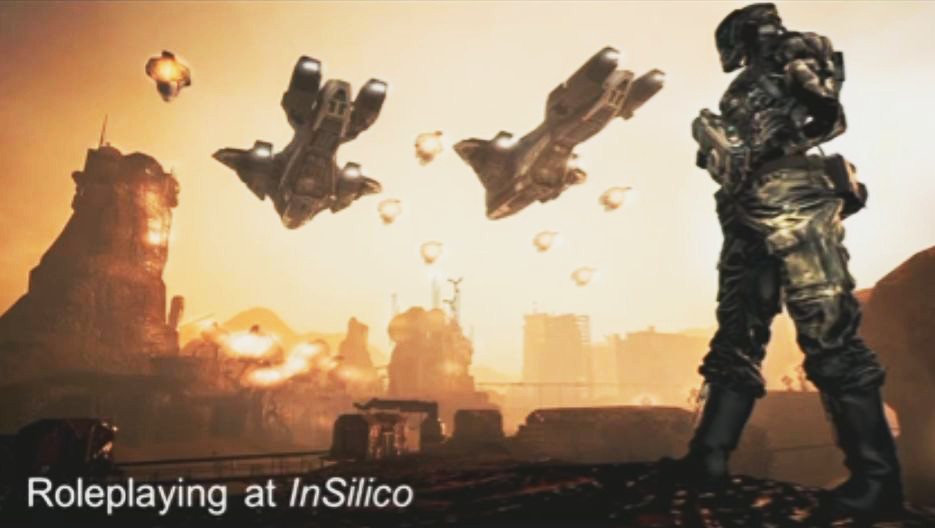
The InSilico RPG was mentioned to help illustrate the wide variety of SL content
The InSilico RPG was mentioned to help illustrate the wide variety of SL UGC

The limiting factors of Second Life are also discussed. Again, the land revenue model and its limitations (including scalability) are mentioned, as are the limits of region concurrency numbers and the challenges of trying to hold really large-scale gatherings in-world. The fact that user-generated content can itself be a problem is also mentioned; that users don’t necessarily know how to properly optimise their content to be efficient in terms of rendering and running, so the Lab will need to find a way to optimise that content.

Broader challenges in presenting an environment which allows everything that Second Life already does are also touched upon – such as issues of compliance and control given what are collectively vary large amounts of money flowing through the platform (with a GDP of half a billion US $ a year) supported through a floating exchange used to convert real-world currency into game tokens and back again, in order to ensure money laundering, etc., isn’t an issue.

Ease of use is also touch upon; not just in terms of SL’s own notorious learning curve, but also in the fact that VR itself is still very much a fluid environment in terms of technology and the devices which might be used within it – controllers, headsets, peripherals, etc – It simply isn’t clear (outside of head mounted displayed themselves) as to exactly what will come into commonplace use and what, out of all that is being suggested, developed, trialled or hyped, will fall by the wayside.

Continue reading “Ebbe Altberg: “The Future of VR is User-Created” (a look at SL + Sansar from the VR perspective)”

Next Lab meet-up: Basilique Town – Thursday, May 14th

Basilique Town - selected as the venue of the Thursday, May 14th Linden meet-up
Basilique Town – selected as the venue of the Thursday, May 14th Linden meet-up

On Friday, May 8th, Xiola Linden extended an invitation to users to suggest the location for the next in-world Linden meeting-up.

Many suggestions were forthcoming for the event, which has, since it’s resumption, taken place at “Mole Town”, aka Meauxle Bureaux (see my report on the last gathering).

However, the venue for the next meet-up has now been confirmed. Scheduled to take place from 13:00 on Thursday, May 14th, the gathering will take place at Canary Becks’ outstanding Basilique Town.

The Basilique Theatre
The Basilique Theatre, Basilique Town

For those who have not visited Basilique before, you’re in for a treat. Frequently featured in blogs as a place of outstanding beauty and design. There’s a host of things to see and do here, and the region hosts events of its own and is, of course, the home of the Basilique Performing Arts Company, who has staged the outstanding Romeo + Juliet and ground-breaking Paradise Lost at the threatre occupying the south-east corner of the region.

With its mix of architecture, outlining islands and backdrop of rugged peaks, Basilique presents a wonderful Mediterranean look which blends a cosmopolitan feel with more coastal, rural look which simply invites exploration.

So, even if you don’t make the Linden meet-up, and have not visited Basilique Town before, make sure you add it to your itinerary!

Related Links

Join Hands to help Nepal

Join Hands: raising money to help the WFP's aid work in earthquake-struck Nepal
Join Hands: raising money to help the WFP’s aid work in earthquake-struck Nepal with Fashion for Food

Valsnia and Ruby Ornamental, two Second Life residents and bloggers, have recently formed Join Hands, a virtual group they would like to see  “make a difference to the real world we live in. Not dedicated to a single mission but the spirit of Humanity.” As the inaugural activity for Join Hands, they are organising a four-day fund-raiser in support of the people of Nepal following the devastating earthquake of April 25th.

Fashion for Food SL is aimed at raising money which can be put towards the UN’s World Food Programme (WFP), which is focusing its efforts on bringing assistance and relief to the outlying regions of Nepal, allowing the government there to co-ordinate efforts along the Kathmandu Valley. The WFP  estimating US $116.5 million is required to provide food for 1.4 million people for a period of three months – that’s US $27 per person per month.

Fashion for Food will showcase items from top SL designers in a special fashion show on Wednesday, May 13th

Measuring a peak moment magnitude (Mw) of 7.8Mw , with an epicentre one the the village of Barpak in the Gorkha district of the country, the initial earthquake was followed by  a series of aftershocks, some almost as powerful as the original ‘quake,  which are still continuing.

The result is a disaster which has left over 8,000 dead and 18,000 serious injured at the time of writing, and around 3.5 million people in need of food, water and assistance, including 1.7 million children in need of medical support. Aid agencies around the world have rallied to the call, but there is mounting concern over providing care and assistance with the fast approaching monsoon season, and the real risk of epidemics among survivors due to the shortage of clean water, the makeshift nature of living conditions and the lack of toilets.

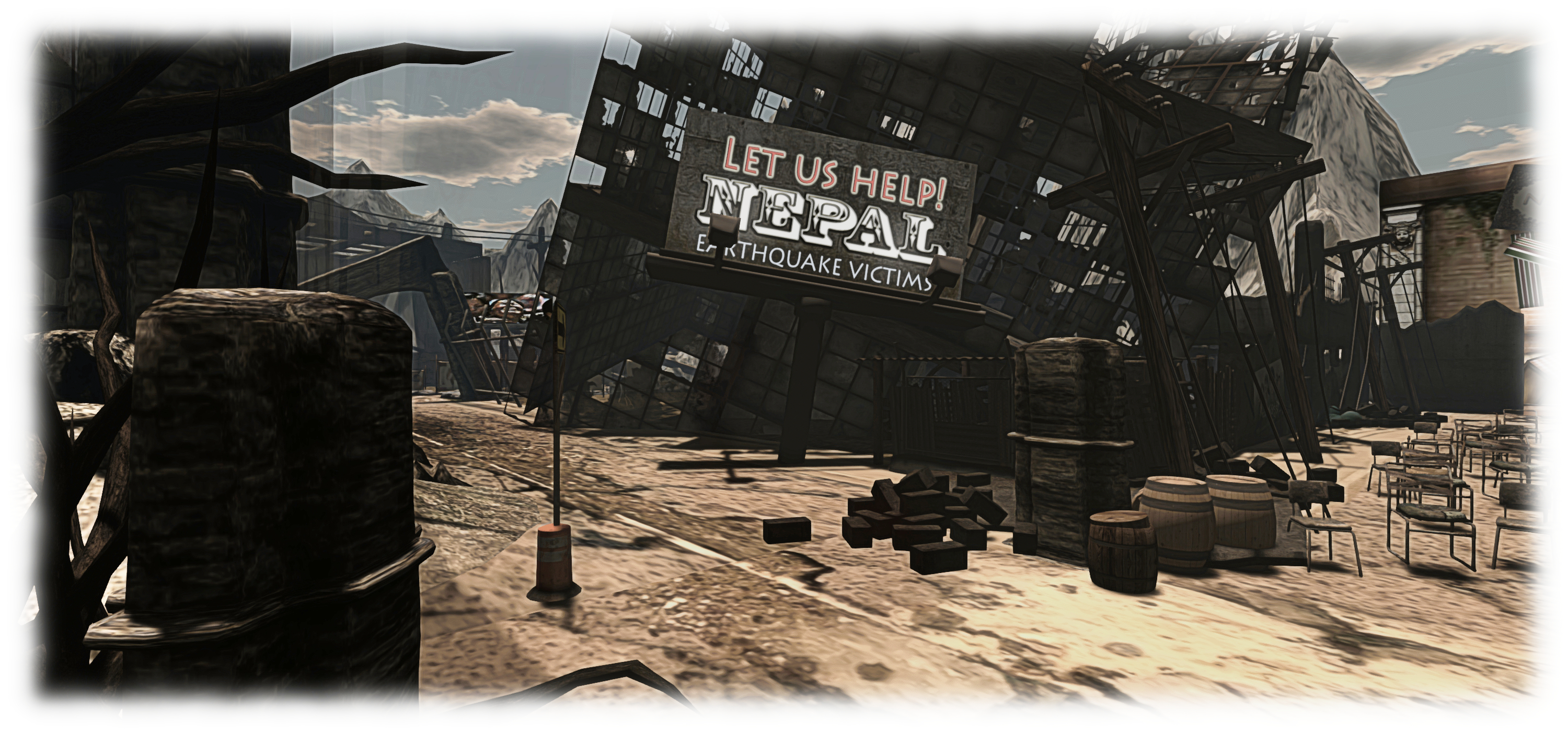
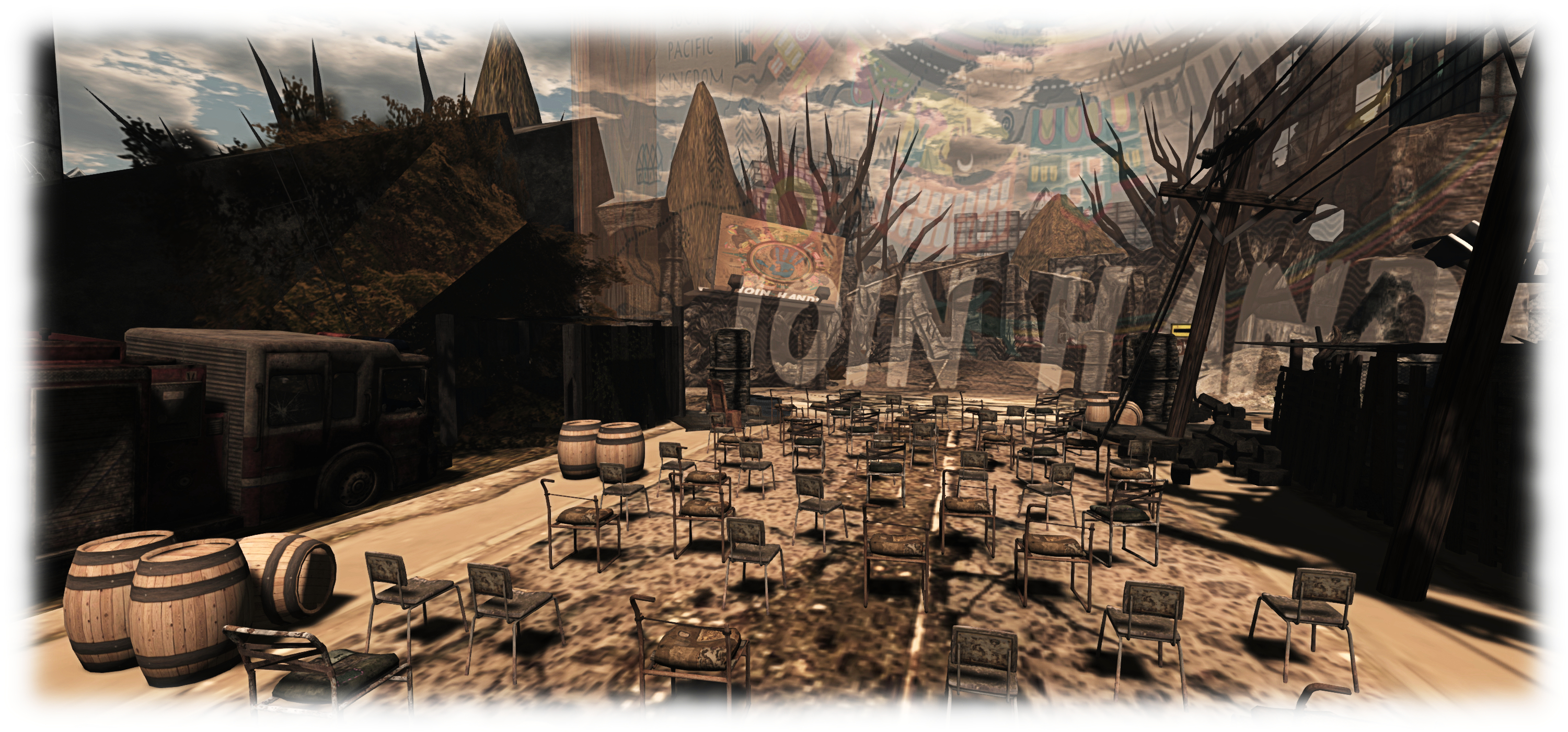
the Fashion for Food event area recreates an Earthquake shattered environment to help people better understand the devastation wrought in Nepal

Fashion for Food launches at 14:00 SLT on Wednesday, May 13th, with a special fashion show by SCALA™. It will be followed by an after-show party hosted by  DJ Seashell Dench from SCALA™. Clothing and jewellery from participating designers can be purchased from the vendor boards throughout the region, with all proceeds of sales, as well as all donations received going directly to WFP in support of their work in Nepal.

Designers from across Second Life are donating to and participating in the event, the list comprising:   69Park Ave GQ, Amarelo manga, Ana Markova, Astralia Alice Tartaglia, Aura Yeu, Ayiki, – AZUL -, Baboom Couture, CIRCA Living, CORPUS Motion,  Dulce Secrets, ~ghee~,
~~ Glitter Girls ~~ and In-Pose,  Glitterati by Sapphire,  Hawker’s House, ImmateriA,  J’adore poses,  JCNY Collection, .:JUMO:.,  K E L I N I Haute Couture,  Lazuri.  Look @ Me Design,
LUXE,  Lyrical Bizarre Templates, Mâchoire,  M&M Clothing,  Me Sew Sexy,  Moondance Boutique,  NYA’S Shop,  No 7,  Petit Chat,  Prey,  Prism Designs SL,  PROMAGIC, RAPTURE, Athena Couture,  SF designs,  Silken Moon,  ::SG SLackgirl ::,  Snowpaws, TASHI,  Totally Random,
Vestige Poses, Xen’s Hats and Zanze.

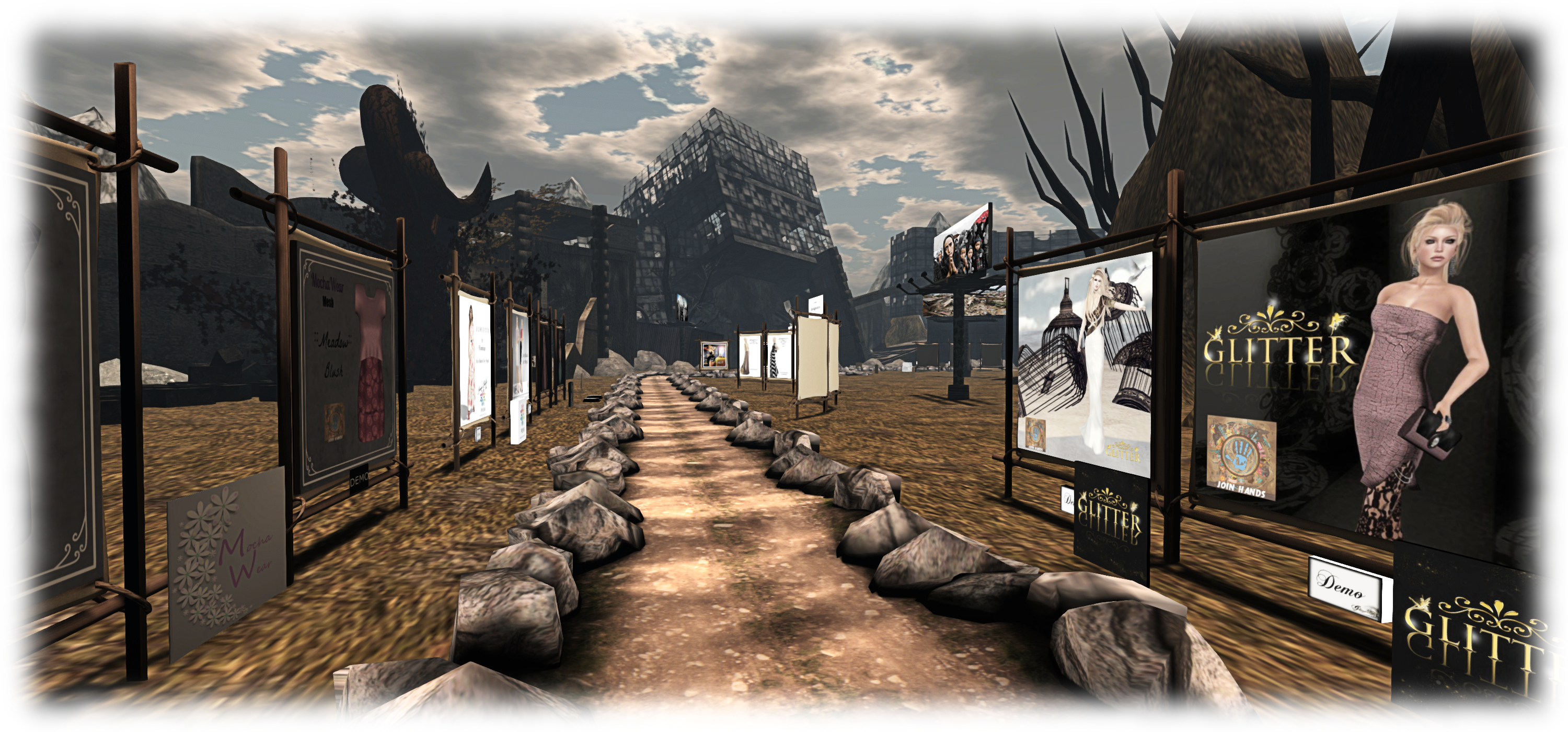
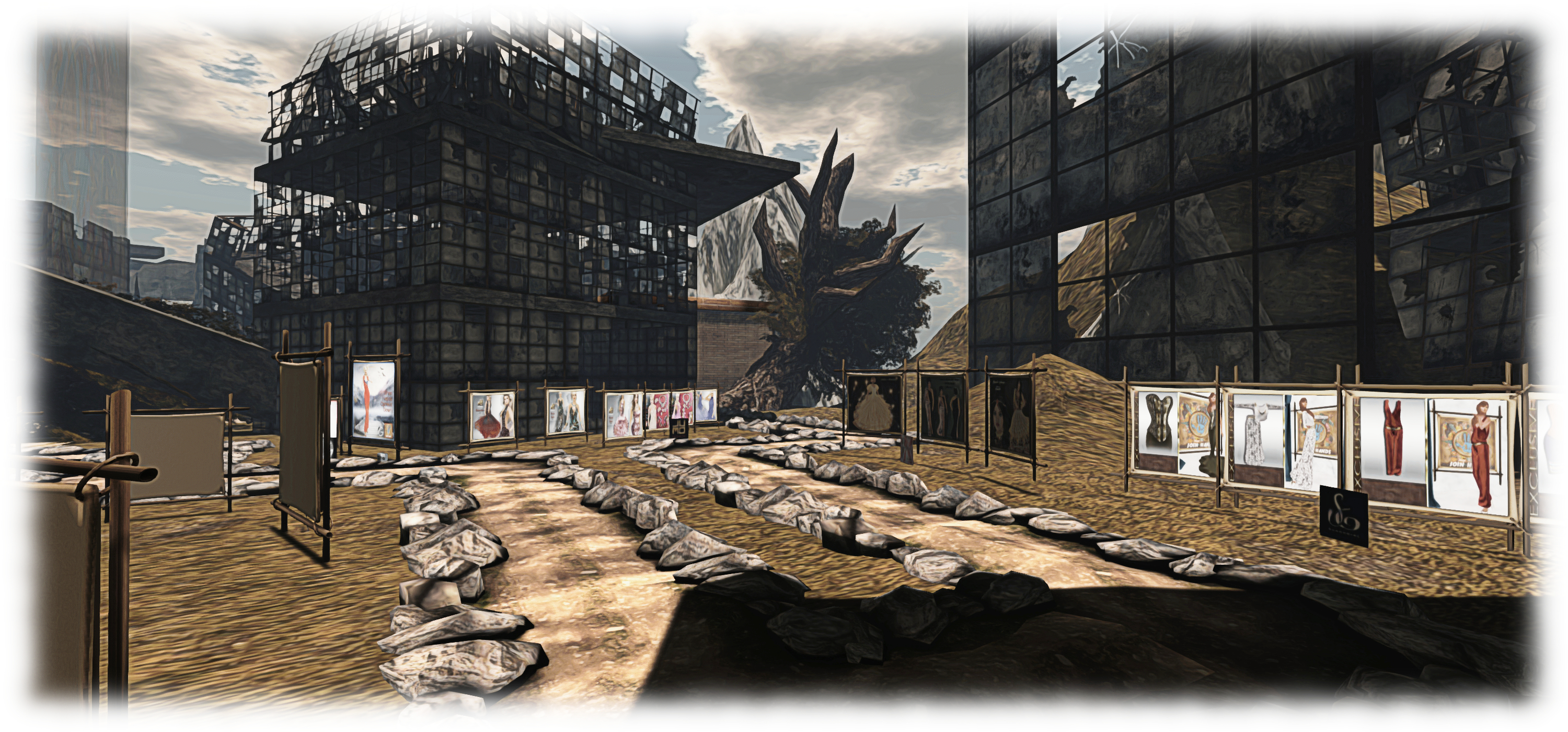
All proceeds of the sales through the vendor boards will be going to support the WFP's programme to deliver food to the people of Nepal
All proceeds of the sales through the vendor boards will be going to support the WFP’s programme to deliver food to the people of Nepal

The region hosting the event – Indian Paradise – has been designed to recreate an environment which has been shattered and an earthquake, offering something of a glimpse of the devastation wrought in Nepal. The fashion show and events area is located towards the centre of the region, while paths winding around the region take visitors past the vendor boards which will be available throughout the fours days of the event.

At the time of writing the schedule of events for Fashion for Food is as follows:

  • Wednesday, May 13th, 2015, 14:00 SLT: Fashion Showcase by SCALA™Models
  • Wednesday, May 13th through Saturday May 16th 2015:  outfits and jewellery from the participating designers on sale throughout the region, will all proceeds going to the WFP
  • Thursday, May 14th, 2015, 12:00 noon SLT: DJ Bonie Facio
  • Saturday, May 16th, 2015, 14:00 SLT: closing party with SCALA™ DJ – Seashell Dench

Fashion for Food is being largely organised by the Indian community in Second Life to support their neighbouring Nepal, with the event region being sponsored by Indian Paradise. Note that if you would prefer to donate to the WFP’s work directly, you can do so via their Nepal relief work page.

Related Links

Lab confirms open source support sought for Linux viewer development

Linux-SLIn April I blogged about the Lab seeking assistance from the Linux community to assist with the continuing development of the Linux flavour of the viewer.

The call came during a Third-Party Developer meeting on April 24th, with Oz linden indicating that while the Lab will continue to integrate and provide build services for Linux, and publish the results, but is unable to pro-actively continue developing the Linux flavour of the viewer, which has generally accounted for around 1% of the total user base, although the Lab currently puts the figure at around half that.


On Tuesday, May 11th, the Lab expanded on this in a technology blog post, which reads in full:

Since its introduction, the Linux version of the Second Life Viewer has been considered a Beta status project, meaning that it might have problems that would not have been considered acceptable on the much more widely used Windows or Mac versions. Because “Linux” isn’t really one platform – it’s a large (and fluid) number of similar but distinct distributions – doing development, builds, and testing for the Linux version has always been a difficult thing to do and a difficult expense to justify. Today, Linux represents under half of one percent of official Viewer users, and just a little over one percent of users on all viewers. We at Linden Lab need to focus our development efforts on the platforms that will improve the experience of more users.
While we hope to be able to continue to distribute a Linux version, from now on we will rely on the open source community for Linux platform support. Linden Lab will integrate open source community contributions to update the Linux platform support, and will build and distribute the resulting viewers, but our development engineering, including bug fixing, will be focused on the platforms more popular among our users. We hope that the community will take up this challenge; anyone interested in ensuring that their fellow Linux users can continue on their preferred platform is encouraged to reach out to us to find out where help is most needed.

So, if you’re a Linux user and in a position to help the viewer move forward, please do consider assisting the Lab and your fellow Linux users.