Linden Realms revamped

The flames of Linden Realms

Linden Realms, first introduced by the Lab in 2011, has proven surprisingly popular among residents. An early example of the Lab’s (then) nascent experience tools, the appeal of the game is – in part at least – its relative simplicity (coupled with the Linden Dollar rewards). In short, players are delivered to a 12-region location (there are several – all identical – on the grid) – where they can receive a game HUD and instructions. Then it is a case of running around the landscape collecting crystals which can be exchanged for Linden Dollars.

Crystals come in three colours, reflecting their rarity  / value, and they can be collected by running over them. However, this being a game means there are a range of hazards – from the rock monsters patrolled the regions and which will chase you if you get too close, through to toxic waters, fireball-spewing rock carvings, treacherous caverns and so on. However, no-one actually dies from these hazards – being “caught” by any of them will lead to players being teleported to one of several “resurrection circles” (generally the one closest to the point where they were “caught”), and then they can resume the game. Or those are the basics.
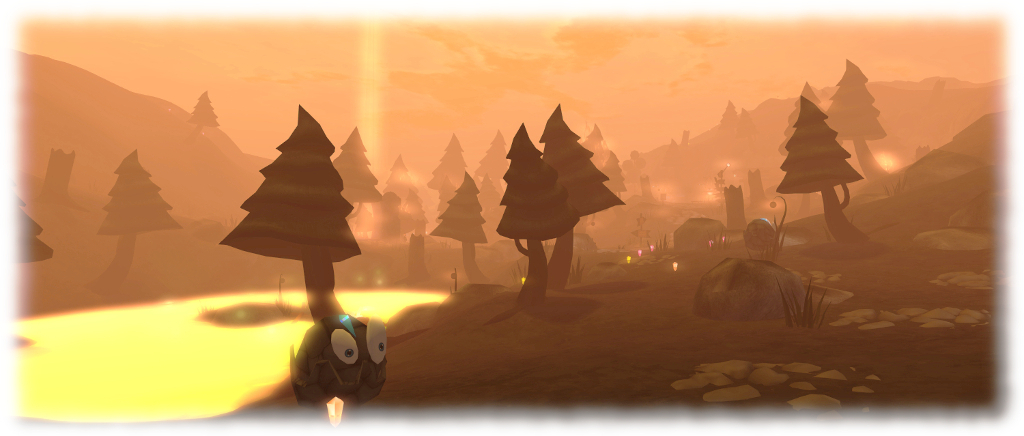
Linden Realms: the threats are still there, despite the flames

The game has been tweaked a few times along the way (such as being opened to all SL users a month after it opened, rather than remaining Premium-only), and on Thursday, March 15th, the Lab announced the latest of these tweaks: a new fiery look for the Realm regions. In a very brief back story, it seems the wicked Ruth (she of the villainy in Tyrah and the Curse of the Magical Glytches – see my review here) has used Magellan Linden’s coffin (launched into space as part of the prologue to the Tyrah story), to divert a comet so it has crashed on the Realms, leaving them in flames (technically, it should have flattened them, but I’ll push the space fan in me to one side 🙂 ).

From the  – admittedly brief – time I spent there, game play is still the same as previously, just now within a lurid,  smoky-orange environment where trees and building equally burn. How long it will remain so is hard to say, but right now, and allowing for the aforementioned point that Linden Realms has retained popularity through the last 6+ years, the new look and feel does appear to be attracting the curious and encouraging them to play.

Should you opt to renew your acquaintance with Linden Realms (or even hop over to play it for the first time), don’t forget that the regions are also available for the capture of Glytches from Tyrah and the Curse of the Magical Glytches mentioned above. Just be sure to wear your Tyrah HUD and Glytch capture weapon at the ready, as the note in local chat reminds you on first arriving within the Linden Realms regions:

If you would like to play Tyrah and the Curse of the Magical Glytches on this parcel (and many others) you need to be wearing a HUD and a weapon for collecting Glytches. If you do not have a HUD or weapons for collecting the Glytches, you can collect them from Hartyshire (144,126,23). You can read more about the game Tyrah and the Curse of the Magical Glytches at this URL: https://wiki.secondlife.com/wiki/Linden_Lab_Official:TCMG.
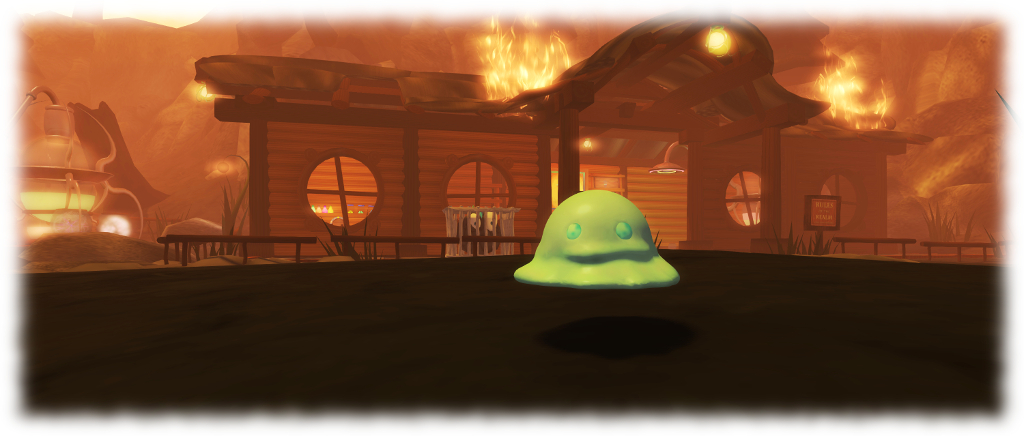
Glytches are also in Linden Realms, and can be hunted and caught is you’re wearing the Tyrah and the Curse of the Magical Glytches HUD (the Glytches will ignore you if you don’t)

And happy hunting, whether it is for crystals or Glytches – or both.

Linden Realms, Tyrah and other Linden-created destinations can be reached via the Portal Parks:

Second Life: Mainland price restructuring

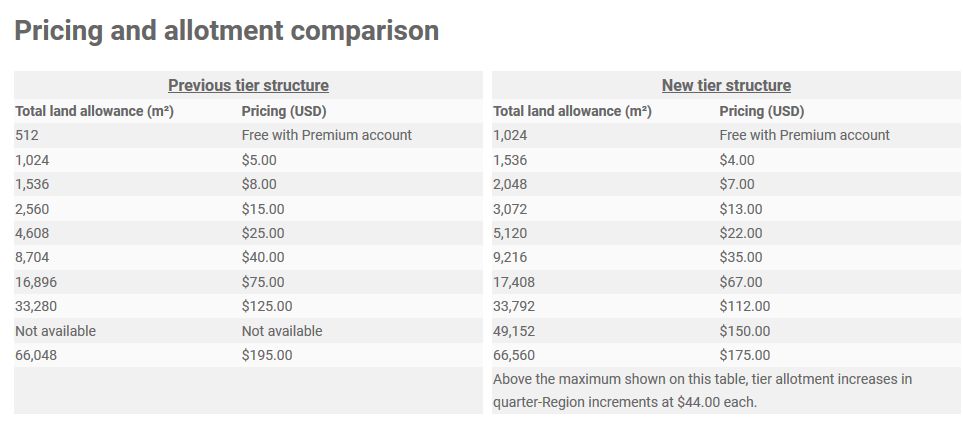
On Wednesday, March 14th, 2018 Linden Lab announced a restructuring of Mainland tier costs, with allotment of “free” land for Premium members doubled from 512 sq metres to 1024 sq metres.

The announcement was made via a blog post, which reads in full:

We’ve got some exciting news for both aspiring and existing Landowners who think the cost of land is too darn high in Second Life. Effective immediately, we’ve reduced Mainland costs by over 10 percent. 

But, wait…there’s more!

Premium members now also get DOUBLE the Mainland allotment! That’s twice as much space to build, create and design your own home, business or experience in Second Life at no extra charge! Premium subscribers now have 1,024m² included with their membership: you could keep your Linden Home and still have another 512m² left over, or use your entire 1024 allotment towards a parcel on the Mainland.  To learn more about specifics of this change, view our Pricing and Allotment Comparison chart.

We know that costs associated with land ownership can hinder some people from realizing their full creative vision in Second Life or even keep them from participating in Second Life as much as they’d like. In 2015, we decreased land setup fees by up to 40% and restored a 50% discount on set-up fees and ongoing maintenance fees for educators and nonprofits. In 2016, we offered a limited-time “buy-down” opportunity that rolled back maintenance fees on full islands and homesteads.

As Second Life begins to celebrate its fifteenth birthday, we hope that this latest price drop will be welcome news to those who aspire to explore their creativity in 2018 and beyond.

The new Mainland tier rates for Premium members (right), with the new “free” allowance of 1024 sq metres of land, compared to the pre-March 14th tier rates

Of course, when people talk about tier being “too damned high”, they are generally referring to the cost of private regions (particularly Homesteads), so this change in Mainland rates many not be looked upon favourably in some quarters. But the fact remains – as I pointed out in 2013 – lowering private region tier isn’t as easy a proposition for Linden Lab as some tend to think, the (roughly) 23% reduction in tier revenue the Lab has seen since November 2013, notwithstanding.

As such, this should be seen for what it is – an attempt by the Lab to encourage land take-up  – and leave us not forget there have also been calls to re-invigorate Mainland with all of its abandoned land – without unduly exposing their bottom-line. So, if nothing else, it will be interesting to see what this offer does both in terms of Premium subscriptions and in encouraging people to take-up their “free” 1024 square metres of Mainland (or go bigger and use the 1024 “free” + the reduced difference in remaining tier).

A slight spanner in the works here, of course is that obtaining Mainland parcels can be time-consuming, and comes with the initial overhead of the purchase price. Nevertheless, it will also be interesting to see if / how this affects Linden Home ownership. A complaint against the latter is that while they come with a 175 LI allowance and a house which does not count towards that total, the houses themselves are oft viewed as unattractive. So, will these changes encourage some of those with Linden Homes to abandon them in favour of a 1024 sq m parcel (the aforementioned pain in finding and purchasing a suitable parcel notwithstanding) with at least 350 LI and a house of their own choosing, even if it does count against that total?

Time will tell on this.

SL Linux viewer to help bridge the gap

As noted in my recent article on the promotion of the Lab’s Alex Ivy 64-bit viewer to release status, there is currently no official 64-bit support for Linux at this time.

It is hoped with will change: the Lab is establishing a viewer build environment to build a Debian version of the viewer with the various specialist libraries required by the various flavours of Linux. The hope being that this, with contributions from the open-source community, will provide a means for the Linux flavour of the viewer to continue, with viewer developers adding the specific libraries they may need as required.

It’s not clear how long it will take for all of this to mature, and for a Debian version of the viewer to appear. In the meantime, it means that as the Lab baseline their viewer build process on Alex Ivy, and existing project and release candidate viewers are updated to the Alex Ivy code, they will cease having Linux versions. This can already be seen with the 360 snapshot viewer, the project render viewer, and the Nalewka RC at the time of writing (versions 5.1.0.506743, 5.1.1.511873, and 5.1.1.511871 respectively), none of which have a Linux flavour of the viewer. As the remaining project and RC viewers currently in the pipeline are updated with the new code case, they will also be without a Linux version for the time being.

To help compensate for this, on Thursday, January 18th, 2018, the Lab release the Linux Spur release candidate viewer, version 5.0.9.329906.  Dated November 17th, 2017, this viewer is in fact the Martini RC viewer which was promoted to release status on  November 29th, 2017 – the latest viewer to be promoted to release status prior to Alex Ivy being promoted.

While it is not explicitly stated in the release notes, it is unlikely this version of the viewer will be updated with bug fixes, updates, etc., but will be offered until such time as a Linux viewer using the 64-bit libraries is made available.  As such, it may offer a means for SL viewer users on Linux wishing to continue using that viewer, rather than a TPV flavour of Linux.

Obviously, those TPVs providing their own Linux flavour of the viewer are free to continue to do so.

Second Life: official 64-bit viewer and plans

On Tuesday, January 16th, Linden Lab promoted the Alex Ivy 64-bit viewer (version 5.1.0.511732 at the time of writing). This is a significant release, not so much because of any specific new features (although it does include improvements to media handling), but because it marks a number of important changes to the viewer.

Following the release, which Oz Linden blogged about the viewer and the Lab’s plans around it, on Wednesday, January 17th, 2018, and I’ve highlighted a few points of note from that blog post below – but do please read it in full.

Most notably, this version of the official viewer is built using an updated set of libraries (some of which will be undergoing a further update in the future), and a revised build process. It is currently being made available for download for Mac OS X (64-bit) and Windows (32-bit and 64-bit) – there is no Linux version of this viewer at this time, as explained below.

For Windows users, the most significant update lies with a new viewer executable, the SL_Launcher, which – as Oz explains in his blog post:

Manages the viewer update process, and on Windows also ensures that you’ve got the best build for your system (in the future it may pick up some other responsibilities). For Windows systems, the best build is usually the one that matches your operating system. For example, if you’re running a 64-bit Windows, then you’ll get the 64-bit viewer. If not, then you’ll get the 32-bit viewer.  However, some older video cards are not supported by Windows 10, so the launcher may switch you to the 32-bit build which is compatible for those cards. You won’t have to do anything to make this work – it’s all automatic – if you get an update immediately the first time you run this new viewer, it’s probably switching you to the better build for your system.

Oz also notes that if you have a shortcut to the viewer set-up, you should update it to point to SL_Launcher rather than the viewer .EXE, to avoid issues with running / updating the viewer, and indicates there is a slight bug with both the SL_Launcher and Second Life Viewer processes both show as icons on the OS X Dock, and will be fixed in a future update so that only a single icon is shown.

One of the things the Lab has been tracking with the Alex Ivy viewer is overall performance / stability. It had long be noted that running the 32-bit version of the Windows viewer on 64-bit version of Windows with more than 4 Gb of memory could lead to fewer crashes related to running out of memory. However, with the 64-bit version of the viewer, the Lab have seen further benefits for Windows users, and so are encouraging those who can to switch to using a 64-bit version of their preferred viewer, if one is available (e.g. users still running a 32-bit version of a viewer on a 64-bit version of Windows, or those upgrading their hardware to a system running 64-bit Windows).

Linux will be supported – if there is sufficient input from the open-source / Linux communities

Linux is the notable exception to the Alex Ivy branch of the official viewer, as there is currently no support for the operating system.

Linden Lab halted Linux development work in 2015 for a number of reasons (see here for more), and sought the support of the Linux community (who represent around 1-1.5% for the SL user base) to help maintain the viewer on Linux. More recently, as I’ve reported in a number of my weekly SL project updates (see here for an example),  the Lab has set out new plans for Linux support going forward, With Oz explaining:

We’re reorganising the Linux build so that instead of a tarball, it produces a Debian package you can install with the standard tools, and rather than statically linking all the libraries it will just declare what it needs through the standard package requirements mechanism. We’ll post separately on the opensource-dev mailing list with information on where that project lives and how to contribute to it.

Again, a key aspect of this project will be continued support from the open-source / Linux community to help maintain the Linux viewer going forward, in providing bug fixes, etc., and the Lab providing essential QA and the core build environment, as noted above. This approach is seen as beneficial, as it will remove many of the idiosyncrasies / overheads involved in producing a Linux viewer, such as maintaining multiples libraries associated with the viewer, and instead provide a basic viewer package which can be used by TPVs / Linux users to meet their specific preferences.

Some TPVs have already released versions of their viewers based on the Alex Ivy code, and Firestom’s upcoming release should also, I believe, include a 64-bit version based on Alex Ivy.

And if you’re wondering about the viewer’s name – as Oz explains (and I noted back when the first 64-bit project viewer appeared), Alex Ivy is derived from 64 in Roman numerals: LXIV – aLeX IVy.


Peter Gray to depart Linden Lab

Courtesy of Linden Lab

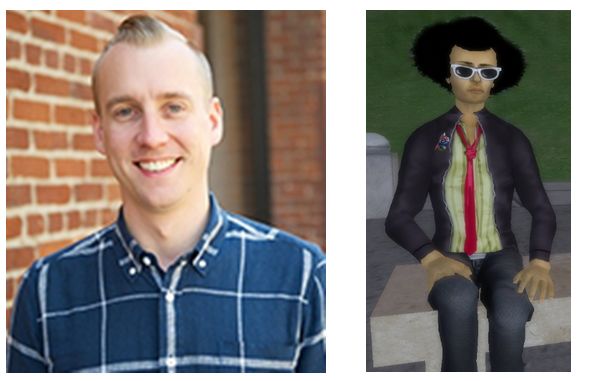
Peter Gray, Linden Lab’s Senior Director of Global Communications is departing the company after nine  years.

Peter broke the news to me via e-mail on Tuesday, January 2nd, 2018 prior to e-mailing a number of other people. He first joined Linden Lab in 2009 from Lewis PR, a technology-focused company, where he gained his first exposure to both Linden Lab and Second Life. This means his experience with the company extends back more than a decade.

It’s been a privilege to represent Linden Lab, our innovative products, and their incredible users as a Linden for the past nine years. I wish our user communities and my Linden colleagues all the best for the future, and I’ll be rooting for their continued success.

– Peter Gray, Senior Director of Communications, Linden Lab

Throughout his time at the Lab, Peter has been one of the public faces of the company, rising from PR Specialist to his current position of Senior Director of Global Communications, gathering a wealth of knowledge about the Lab’s products along the way. In-world, his Classic avatar has often been visible at events such as the SL Birthday celebrations, taking questions at Meet the Lindens events, VWBPE conferences and more. More recently, Peter’s role has extended beyond Second Life to encompass Blocksworld and Sansar, and he has never failed to deal with the myriad question I and a lot of other bloggers have forwarded to the Lab over the years, as and where he has been able to do so.

In departing Linden Lab, Peter is moving on to  a new role with the communications team at Facebook AI Research  – and I wish him well in the new role, although I can honestly say he will be sorely missed.

Peter Gray and his Linden alter-ego

On a personal level, I would like to take this opportunity to publicly thank Peter for all of his help over the years; I’ve deeply appreciated our working relationship, and can say with hand on heart that his support, assistance and insight is one of the major reasons I’ve kept on blogging about SL for so long; his support – and what of the Lab as a whole – has, I believe allowed me to present news and information through these pages objectively, and in the knowledge it is as accurate as I could possibly make it.

Throughout all our time in correspondence and conversation, Pete has never been anything less than open, supportive and friendly. I’d like to further thank him for the personal invite to pop into the Lab and pay him a visit if ever I managed to get back to California and make my way up to San Francisco; I’m genuinely sad I never got to take him up on the offer.

Many thanks again, Peter, and wishing you all the best for 2018 and the future!

Space Sunday: helicopters, telescopes and cars in space

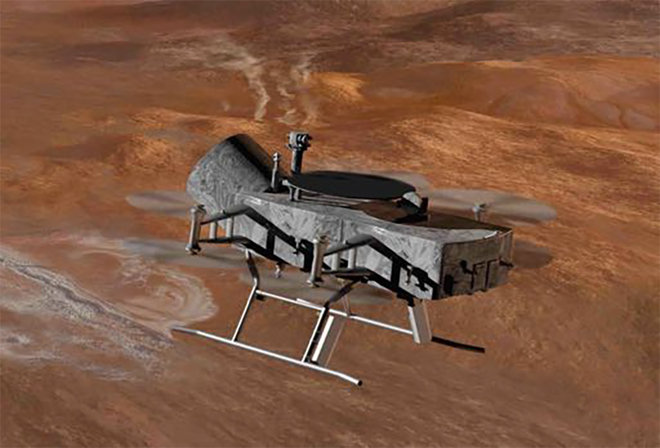
An artist’s impression of the Dragonfly dual-quadcopter, both on the surface of Titan and flying. The vehicle could make multiple flights to explore diverse locations as it characterises the habitability of Titan’s environment. Credit: JHU /APL / Mike Carroll

Back in August I wrote about a proposal from the Johns Hopkins Applied Physics Laboratory (APL) to fly a robotic helicopter to Saturn’s moon Titan.

Called “Dragonfly”, the mission would use a nuclear-powered dual-quadcopter, an evolution of drone technology, carrying a suite of science instruments to study the moon. Capable of vertical take-off and landing (VTOL) operations, the vehicle would be able to carry out a wide range of research encompassing Titan’s atmosphere, surface, sub-surface and methane lakes to see what kind of chemistry is taking place within them.

The proposal was one of several put forward for consideration by NASA as a part of the agency’s New Horizons programme for planetary exploration in the 2020s. In late December 2017, NASA announced it was one of two finalist proposals which will now receive funding through until the 2018 for proof-of-concept work.

Titan has diverse, carbon-rich chemistry on a surface dominated by water ice, as well as an interior ocean. It is one of a number of “ocean worlds” in our solar system that hold the ingredients for life, and the rich organic material that covers the moon is undergoing chemical processes that might be similar to those on early Earth. Dragonfly would take advantage of Titan’s dense, flight-enabling atmosphere to visit multiple sites by landing on safe terrain, and then carefully navigate to more challenging landscapes.

Dragonfly in flight. Credit: JHU /APL / Mike Carroll

At 450 kg, Dragonfly is no lightweight, and a fair amount of the mass would be taken up by its nuclear power unit. However, the vehicle will carry a science package comprising some, or all, of the following:

  • A mass spectrometer for analysing the composition of Titan’s atmosphere and surface material.
  • A gamma ray spectrometer of analysing the shallow sub-surface.
  • A seismometer for measuring deep subsurface activity.
  • A meteorology station for measuring atmospheric conditions such as wind, pressure and temperature.
  • An imaging system for characterising the geologic and physical nature of Titan’s surface and identifying landing sites.

Commenting on the NASA decision to provide further funding for the project, APL Director Ralph Semmel said:

This brings us one step closer to launching a bold and very exciting space exploration mission to Titan. We are grateful for the opportunity to further develop our New Frontiers proposals and excited about the impact these NASA missions will have for the world.

The second proposal to receive funding through until the end of 2018 is the Comet Astrobiology Exploration Sample Return (CAESAR) mission proposed by Cornell University, Ithaca, New York and NASA’s Goddard Space Flight Centre.

This mission seeks to return a sample from 67P/Churyumov-Gerasimenko, a comet that was successfully explored by the European Space Agency’s Rosetta spacecraft, to determine its origin and history. This project is being led by Steve Squyres of Cornell University, who was the principal investigator for NASA’s Mars Exploration Rover missions featuring Opportunity and Spirit.

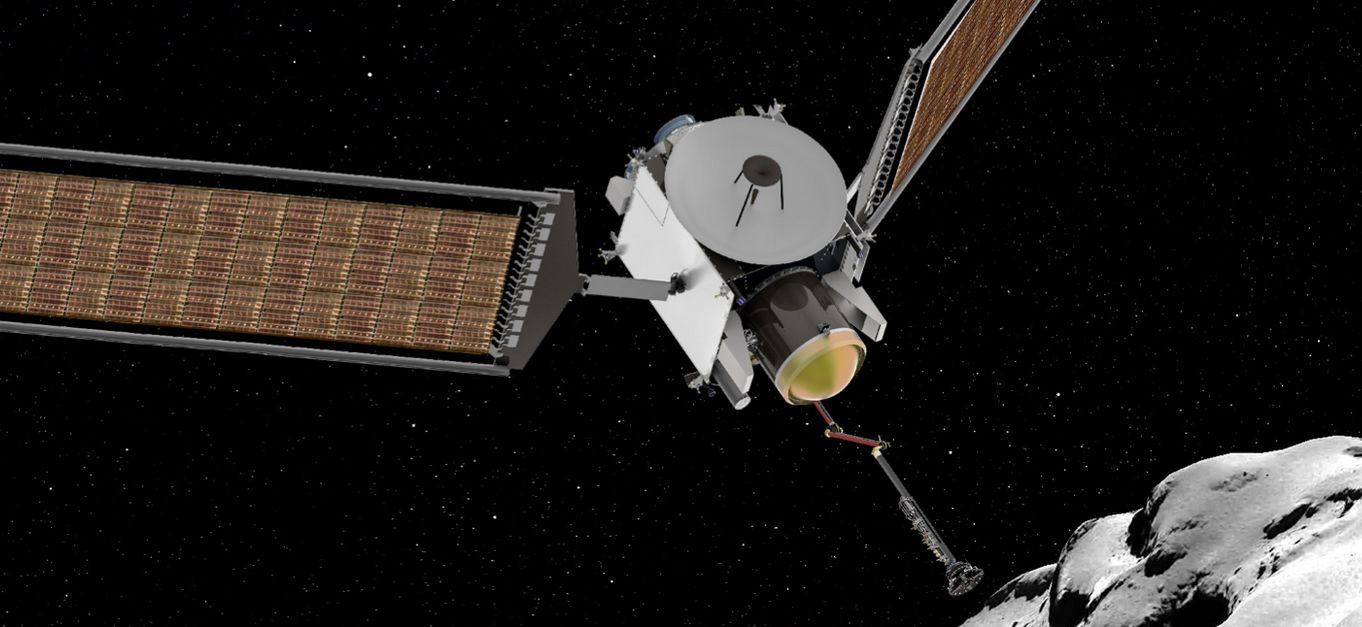
If approved by NASA, CAESAR would launch in 2024/25, collect at least 100 g (3.5 oz) of regolith from the comet, separating the volatiles from the solid substances. The spacecraft would then head back to Earth and drop off the sample in a capsule, which would re-enter Earth’s atmosphere and parachute down to the surface in 2038. 67P/C-G was selected because it has been extensively imaged and mapped by the Rosetta mission, thus enabling engineers to design a vehicle better able to meet the conditions around the comet as it swings around the Sun.

A conceptual rendering of CAESAR orbiting comet 67P/C-G

New Frontiers is a series of planetary science missions with a cap of approximately US $850 million apiece. They include the Juno mission to Jupiter, the Osiris-REx asteroid sample-return missions, and the New Horizons mission to Pluto, also built and operated by APL. Under the terms of NASA funding, both of the 2017 finalists will receive US $4 million each in 2018, and a final decision on which will be funded through to completion will be made in 2019.

WFIRST: Hubble’s New Cousin

While attention is on the next space telescope due for launch – the ambitious James Webb Space Telescope (JWST), which will be departing Earth in 2019 – NASA and the international community is already turning its attention to the telescope that will come after JWST, with a launch due in the mid-2020s.

Billed as a cousin to the Hubble Space Telescope, and something of a descendent of that observatory, the Wide Field Infra-Red Survey Telescope (WFIRST) will use a very similar telescope system as Hubble, with a 2.4m diameter primary mirror, but with a shorter focal length. This, coupled with no fewer than 18 sensors built into the telescope’s camera (Hubble only has a single sensor), means that WFIRST will be able to image the sky with the same sensitivity as Hubble with its 300-mexapixel camera – but over an area 100 times larger than Hubble can image. To put this in perspective: where Hubble can produce a poster for your living room wall, an image from WFIRST can decorate the entire side of your house.

NASA’s Wide Field Infrared Survey Telescope (WFIRST) will fly in the mid-2020s and provide astronomers with the most complete view of the cosmos to date. Credit: NASA Goddard Space Flight Centre / CI Lab

This wide field of view will allow WFIRST to generate never-before-seen big pictures of the universe, allowing astronomers explore some of the greatest mysteries of the cosmos, including why the expansion of the universe seems to be accelerating. One possible explanation for this speed-up is dark energy, an unexplained pressure that currently makes up 68% of the total content of the cosmos and may have been changing over the history of the universe. Another possibility is that this apparent cosmic acceleration points to the breakdown of Einstein’s general theory of relativity across large swaths of the universe. WFIRST will have the power to test both of these ideas.

Continue reading “Space Sunday: helicopters, telescopes and cars in space”