Marketplace: Commerce Team refuse in-world meetings (at least for now)

On the 7th November, the Commerce Team gave their latest update on activities. The post reads in full:

Merchants,

Thank you for your continued feedback. Following is an update regarding your latest questions and requests:

  • Direct Delivery email notifying merchants receipt of item by customer: We understand your request and are looking into this.
  • Marketplace category changes: We’re working on some proposed updates to these categories and will give you the opportunity to provide input. Stay tuned for more details – including a survey.
  • JIRA changes: We are working to adjust our communications practices to make sure all Merchants are kept up-to-date on bug fixes.
  • Marketplace weekly user group: We will not be adding a user group at this time.
    [My emphasis]
  • Publish Marketplace six-month backlog: There are no plans to provide this data.

In addition, we are evaluating ways to improve communications practices with Merchants that will allow us to address technical and support issues more effectively. This includes direct email correspondence, such as the direct email that was sent November 6, 2012 to let all Merchants know about the benefits of Direct Delivery.

We appreciate your patience while we continue to improve marketplace functionality and merchant communications.

The Commerce Team

Of particular interest here are two statements – that the Commerce Team are “evaluating ways to improve communications practices with Merchants”, while simultaneously refusing to agree to in-world user group meetings.

On the subject of the former, the Commerce Team point to their recent e-mail to merchants extolling the virtues of Direct Delivery; virtues which are, as I commented at the time, actually non-existent for many in receipt of the e-mail because Direct Delivery is for them proving to be at least as unreliable as Magic Boxes (and the Marketplace in general). As such, I’m actually unclear on exactly how such an e-mail is actually “improving” communications practices given the frustration it might generate, much less addressing technical and support issues “effectively” – but, c’est la vie.

User Group meetings: a source of positive LL / user interaction the Commerce Team remain unwilling to embrace

The refusal to hold in-world meetings, although hardly unexpected, is regrettable. While it is true that in this day and age, face-to-face meetings are not always required in order to resolve technical issues and problems, the fact remains tat face-to-face meetings – even in the digital domain – do serve a valuable purpose. They help promote a more positive attitude between people and they encourage greater mutual support and respect for one another (and I’m deliberately not mentioning the very practical results which can come out of such meetings by way of ideas and suggestions for dealing with issues and problems or providing LL with information on issues of which they may have no prior knowledge).

Anyone who has ever been to other SL user group meetings cannot fail to note the appreciation and understanding they generate towards LL. sure, there may be occasional bursts of frustration when things are going wonky somewhere on the grid – but by and large both sides of the equation – Lab and users – benefit from the interaction and exchange.

It’s therefore regretful that the Commerce Team continue to step back from in-world interactions with merchants. While the initial meeting may well be a little rough on them – I would venture to suggest that the vast majority of merchants would actually welcome the opportunity to have such face-to-face meetings and would be only to willing to engage with the Commerce Team fairly, rationally and respectfully.

Of course, there is the little caveat to the Commerce Team’s rejection on the idea of in-world meetings, the “At this time.” This suggests that at some point in the future they may well reconsider their position. I hope they do – and that they do so sooner rather than later – because doing so really would be to be to their credit and do far more to help to “improve communications practices with Merchants that will allow us to address technical and support issues more effectively” far more than any number of bland e-mails or forum posts is ever likely to achieve.

Using a virtual world can help improve your health

According to a study released by the University of Missouri (PDF), having a healthy-looking avatar can be good for our own health and self-esteem.

Elizabeth Behm-Morawitz, assistant professor of communication in the University of Missouri’s College of Arts and Science, who lead the study

Dr. Elizabeth Behm-Morawitz surveyed 279  Second Life users to study how their choice of avatars affected their real-world existence. She found that the amount of self presence, or identifying with a virtual representation, predicted the amount of influence an avatar had on a person’s life in the physical world. A strong sense of self-presence improved how they felt about themselves and promoted better health and well-being.

“The creation of an avatar allows an individual to try on a new appearance and persona, with little risk or effort,” Behm-Morawitz, communications professor at the University of Missouri, said in a press release accompanying the report. “That alter-ego can then have a positive influence on a person’s life. For example, people seeking to lose weight could create fitter avatars to help visualize themselves as slimmer and healthier.”

Those in the study who indicated they have a high degree of self-presence within SL indicated that they felt their relationship with their avatar improved how they felt about themselves in the real world. Self-presence also correlated to greater satisfaction with online relationships.

This isn’t the first published study to delve into the possible benefits of Second Life. In June of 2011 Indiana University reported that Second Life could be used to practical ends to achieve real weight-loss, with the results of a 12-week study involving both in-world and real-world meetings being widely reported in the media at the time.

In the Indiana University study, researchers found that, over a period of twelve weeks, people attending weight-loss / fitness programmes within Second Life tended to lose the same amount of weight as those attending equivalent real-world programmes. However, they further discovered that those engaged in the programme through Second Life reported significantly greater gains in behaviours that could help them live healthier and leaner lives – again underlining the strong psychological link people can develop with their online alter-ego.

The University of Missouri’s study – which actually pre-dates the University of Indiana’s study inasmuch as iot place in February / March 2011 – did not involve physical activities, but focused on participants completing an online questionnaire. The 279 respondents involved in the study represented 30 countries, with some 65% residing in the United States. Some 56% of respondents were female and 41% male, with the remaining 3% identifying themselves as transgender, male-to-female. The average age of respondents was 41 years, with an overall age range spread of 18 through 70.

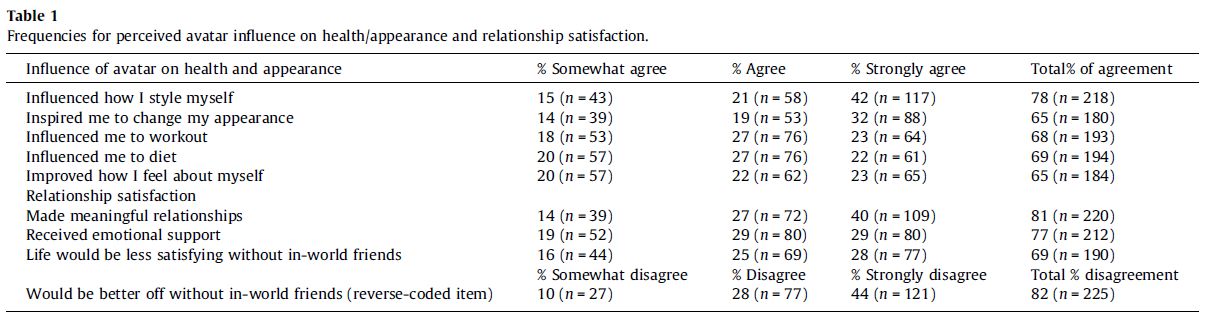
The questionnaire iteself was structured to measure feedback against a number of hypotheses established ahead of the study as a result of factor analysis with five questions being asked of the participants.

Perceived avatar influence on health / appearance and relationship satisfaction (click to enlarge)

The format of the study means that it is somewhat flawed – the data has gathered from what is effectively a single point in time. A more accurate measure of the relationship between our real and online selves requires that study should be carried out over a more extended period, with experiences and the effects of their avatar on their human condition being tracked over multiple points.

Nevertheless, both this study and that of the University of Indiana highlight the very strong physical and psychological link people can develop with their avatar. This caused Dr. Behm-Morawitz’s team to extend the concept of “mirrored worlds” (as proposed by Joe Sanchez in 2009 to describe how ‘worlds complete with social and financial dynamics such as Second Life and World of Warcraft can “seep out”  of cyberspace to both mirror and impact offline life) to encapsulate the idea of “mirrored selves”, in which the investment we make in out avatars can be both reflected back on, and have impact with, our real lives in meaningful ways.

Many involved in Second Life will view the outcome of the study as unsurprising simply because they have an understanding and awareness of the investment they have made in their avatar. Even so, for those interest in the nature of our relationship with out virtual selves and the degree with which one can positively impact the other, it does make interesting reading.

For Dr. Behm-Morawitz, it has revealed that Second Life and virtual worlds are a rich source of behavioural study, and she is already investigating ways in which avatars may be used to encourage tolerance of diversity. “I am also interested in studying how using an avatar with a different race or ethnicity may increase empathy and decrease prejudice,” she said in the press release announcing the study. “This may occur through the process of identification with an avatar that is different from oneself, or through a virtual simulation that allows individuals to experience discrimination as a member of a non-dominant group might experience it.”

Related Links

Oskar confirms his departure

Happier times: Oskar’s profile picture (Tangent Eponym)

On Friday November 2nd, comment was passed (not from LL) on the apparent departure of Oskar Linden from the Lab. I commented on the matter in my last SL Projects Update for week 44, but at the time it was unclear as to what had happened and why.

A thread on the SL Universe forum started, some of which doesn’t make the most comfortable of reading given some of the attitudes expressed (not towards Oskar or the Lab, I hasten to add, but rather in comments passed by some SL users regarding other SL users). Yesterday – Monday November 5th – (and missed by me at the time as I was completely distracted with other things), Oskar himself popped-up on the thread to pass word himself on the matter, commenting:

To solidify all rumors, yes my employment was terminated by Linden Lab last Friday [November 2nd]. It was a surprise Skype call with the manager of my department and HR. At the same moment all my accounts were locked and I was told a courier was on the way to my house to take my laptop. This is standard operating procedure at the Lab. The reasons given were quite vague, but at the root of it was complaints from a griefer who I had banned from a private testing sandbox that I managed after he was harassing people and threatening to crash them and the region.

Oskar Linden at SLCC 2009 (image: Teagan Linden / Linden Lab)

I was also told that there were issues with my communications. I don’t understand that because I have operated in the role of public communicator for the lab for three years and have always had stellar reviews. It’s not like the reasons really matter anyway. When the Lab wants you gone it’s over.

To be quite honest this has all come as a surprise and a shock. I have known for a while that this would happen eventually though. All Lindens fear ‘the Skype call’. The old Linden culture is long gone. Many Lindens are disappeared in that way when the Lab no longer has use for them. It has been difficult working through the changes at the Lab the past few years. I could have left, perhaps I should have left on my own. I would have been better off. I did not choose to do so because I was dedicated to the wonderful residents I have met during my 4 years working on SL. I was committed to all of you and committed to making Second Life and Linden Lab a better place. I felt I was fighting the good fight and didn’t want to just run away. I felt that I was making a difference. I hope that I did.

I have no idea what is next for me. I have varied passions that I will follow until I feel the need to pursue further employment.

He goes on to add:

I greatly appreciate all of you who friended me and were so passionate about helping me make Second Life a better place. Your enthusiasm to help find bugs greatly helped the quality of the server code. You are all amazing. You are Second Life, not Linden Lab. Never forget that. I love you all and will miss working with you greatly!

I won’t pretend to have known Oskar well; we’d only spoken a few times, and I’ve only recently been attending his meetings – but I will say that I’ve also found him (and despite my one growl I unfairly gave him in these pages as a result of LL’s own communications policy), to be one of the most open and informative Lindens who faced the user community. His departure is going to take some adjusting to for those who did know him well.

To Oskar himself, I’d just like to pass on my personal thanks for all the effort he has put in over the years. I very much hope that all goes well for him and his family wherever his passions and career may lead. Hopefully, we’ll also see you in-world as well.


Of copyright, IP and product licensing

I’ve been watching a semi-interesting forum discussion going on since the weekend

In essence, some are getting upset over the fact that CBS, who now own the rights to the Star Trek franchise world-wide, have apparently “clamped down” on Trek merchandise for sale in SL, with the result that at least one creator has had all wares removed from vendors and the Marketplace, and may have also been banned.

While one may initially feel sympathy for those involved, it has to be said – as several have in commenting on the forum thread itself – that at the end of the day, copyright is copyright, period. Just because the holder happens to be a major entertainment conglomerate doesn’t make the fact that in building and selling content derived from their products, and thus potentially impinging on their copyrights, any less “wrong” than finding the guy on the next parcel over to yours is hard at work copying your own original builds.

Some of those expressing upset at the move do so on the basis that CBS (and before them, Viacom / Paramount) may have flip-flopped over matters in the past, and that holders of other franchises are more lenient. Sadly, none of this matters a jot. Nor does the issue of “fan loyalty” or any other argument.

The major issue in this matter, and the one that gets little or no mention in the topic, is that of licensing.

The fact of the matter is that over the years those holding the Star Trek franchise have made a considerable amount of money through licensing deals with other companies, allowing the latter to make Trek-related products (both real and digital) wither exclusively or in cooperation with others. These deals generally involve a significant upfront payment from the licence holder, usually coupled with a royalties payment scheme based upon unit sales.

As such, while CBS / Viacom / Paramount may well have wibbled over some matters, that licences have been granted at the exchange of large amounts of money, they do actually have an obligation to ensure said licences are protected, period. It doesn’t matter if the person in violation is a fan or not.

There are many great Trek-related (and other franchise-based) models and other goods on sale in SL. While there is no doubting the skill and dedication of those making them, many nevertheless are open to accusations of copyright / IP infringement

Some posters in the thread are calling for LL to get involved in matters. Yet the fact is, LL do not need to involve themselves in matters. I’d actually suggest that, on balance, it is far better that they don’t get involved in this, or any other licensing situation in terms of negotiations over rights even if they were so minded, as it is very likely that things would not end well for anyone.

A far better solution, as some have suggested, is for the Trek fans themselves to address the matter with CBS – and the roadmap for them doing so has already been drawn. At the end of 2010, the Battlestar Galactica community faced an identical situation Universal Studios took issue with BSG-related goods being sold in SL. At the time the fans responded by engaging with Universal and discussing the situation with them.

The result was that in February 2011, Universal Studios agreed to allow BSG-related merchandise to remain available in SL, so long as it was not being sold for personal profit / gain. One might question how actually effective this arrangement has been (there are admittedly a fair proportion of BSG-derived items on active sale in the Marketplace), but the arrangement at least leaves people knowing where they stand, and that those persisting in selling franchise-related merchandise which may be subject to licence arrangements elsewhere and / or are liable to be looked upon as copyright/IP infringing would know precisely where they stand.

At this point in time, there seems little reason to suspect CBS would not be willing to enter into such an agreement if approached positively, and I would hope that if they are not already doing so, Trek fans in SL are making overtures along such lines already. In fact, I’ll be rather surprised if this isn’t already the case. In 2010/2011 the Universal deal was reached through the able assistance of Anthony Haslage, (Ntanel Swordthain in SL), himself of the International Federation of Trekkers (IFT), and Entertainment Consumers Association (ECA) Second Life Chapter President. So not only is the roadmap there, the chief architect for bringing it to pass is himself well-placed to represent SL Trek fans.

In the meantime, perhaps the biggest question this situation leaves open is what will happen with regards to Star Wars merchandise in SL now that Disney has acquired LucasFilm, and, presumably, the rights to the highly lucrative merchandising arrangements related to that franchise.

Slightly Mad Avians: Humble talks Creatorverse, Versu and Dio

Update, February 19th, 2014: Creatorverse, Versu and dio were discontinued by Linden Lab on February 19th, 2014. Links to their websites, etc, have therefore been removed from this article.

Looking through the pingbacks on my blog comments, I was curious to see one show up on the 23rd October 2012 linking to an article I wrote back at the start of the year. Curious at to why someone would be linking to an old article, I went to have a look.

Turns out the article linking to me is from Kotaku, a games-related blog run by Gawker News – and the article itself is an interview with Rod Humble. (which came to me via Kotaku’s Australian site) Needless to say, I was more than a tad surprised to have someone interviewing our own Rodvik linking to my blog (oh, be still, beating ego!), so I decided to have a read through.

The piece itself is obviously about the Lab’s new and upcoming products, and it gives some interesting insights into the thinking behind them.

“Just about everybody I know who isn’t in the games business or programming business comes to me with a game idea or a website, and the truth of the matter is, quite often, they can’t make it.”

the article quotes Humble as saying. He then goes on:

“There’s this big barrier. They look at something like C++ [programming] code and, frankly, it looks like a big equation. It just looks like gibberish.

“The more we can make tools that are just fun to use—all of a sudden you are making something you wanted—you can focus on the creativity than mastering this arcane set of symbols. We can hopefully bring more people into that fold of ‘hey, you made something!'”

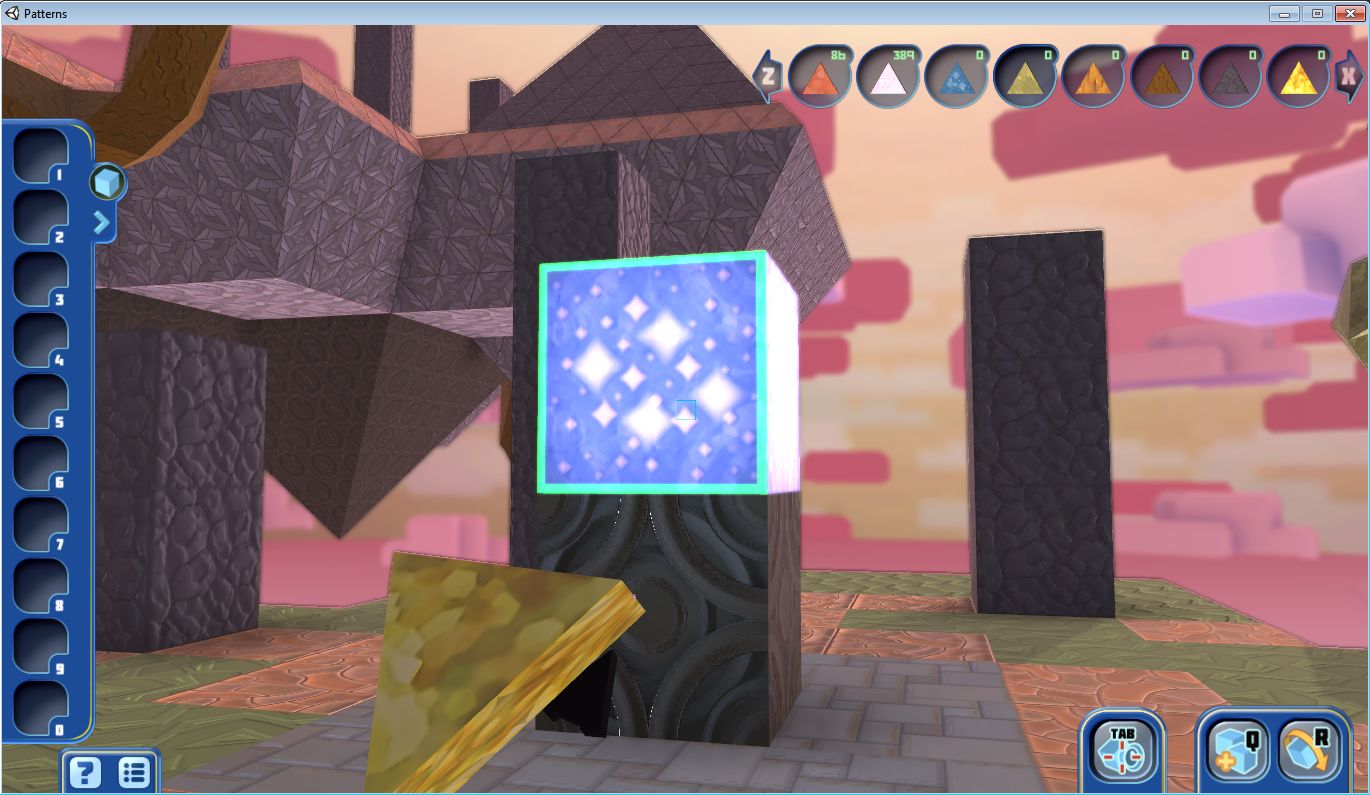
Thus is the broad thinking behind Patterns, Creatorverse and the still-to-be-seen Dio and Versu, which are apparently going to be appearing something in the next month – if not before the end of this one, depending on how you read quotes from elsewhere.

Creatorverse itself comes in for some attention in the piece – Humble describes it as being his five-year-old daughter’s favourite game at the moment, and it is referred to as coming out “later this year”. Whether that is a result of the interviewer misunderstanding Humble (the interview was via ‘phone), or whether it is because the release date may have shifted while the wheels at Apple (or elsewhere) turn slowly, isn’t clear.

What is clear, however, is the novel way Creatorverse is pitched in the interview:

In the near future, his company will put out a program for iPad called Creatorverse, which will let people use shapes and physics to create basic 3D systems and, yes, games, then share them for anyone else to download and play. Think of making a game that lets you fling shapes into other shapes—your own “Slightly Mad Avians”, he offers as an example, if you get what he means.

Creatorverse

While Slightly Mad Avians could stand as a title in its own right (along with Perturbed Pigeons, a name Darien Caldwell suggested to me the other evening in an entirely unrelated conversation…), it’s nevertheless a curious hook on which to hang a description of Creatorverse – but an interesting one in terms of mental images….!

What is of greater potential interest, however, is the comments about the upcoming Dio and Versu.

Dio is described as: “A website that lets people create rooms out of their personal images and videos, connects them to other people’s rooms and lets people share the space.”

While it has previously been described as “A room creator, in which players can do everything from construct a choose-your-own adventure to develop an interactive wedding album,” and Linden Lab managed to accidentally give people something of a quick peek at an early iteration of a website connected to Dio back at the start of the year, the comment in the Kotaku piece implies that the website appears to be the product, rather than in support of it. It’ll be interesting to see how people react to this.

Versu, meanwhile, gains a little more flesh on the bones given in an interview with Giant Bomb, with Humble describing it as, “A platform that lets you make real interactive drama” by giving you “the ability to create characters within a story and then, thanks to the AI, see that “those characters will have emergent properties as you play through the story.” He goes on to admit that this is pretty ambitious and admits to an element of “Tilting at windmills” in order to bring it to a wide audience.

The article goes on to talk in more detail about Patterns, which many of us – and many more in the gaming community – are enjoying even in its nascent (or as Humble puts it, “not even pre-baked”) form. It also talks about Humble himself and his arrival at Linden Lab, which leads to a good mention of Second Life:

It makes perfect sense that Humble would wind up at Linden Lab, the company best known for the virtual world Second Life. It’s as successful a canvas for the communal creation of a virtual world as there’s been. It’s been a viable digital canvas for about a decade now has been populated by users who make their own buildings and vehicles, who design contraptions, contort physics, stage elaborate events, form societies, and pioneer the art of inhabiting elaborate second skins that express inner or otherwise impossible creativity and desires.

It’s a positive read, and well worth taking a few minutes out to read through.

Related Links

Rod Humble talks-up new products, creativity and Second Life

Lelani Carver pointed me towards a further interview with Rod Humble on the subject of new products which appeared in the Gamesbeat pages of VentureBeat on October 12th. The interview is pretty much what has been said elsewhere insofar as the new products are concerned, but there are some very interesting nuggets of information sitting within it.

Pride of the father: Rod Humble shows-off Creatorverse (images coutesy of VentureBeat)

Patterns and Creatorverse are primarily mentioned in the piece, with Humble again commenting on the company’s new-found philosophy established out of Second Life:

“At Linden Lab, we believe that creativity is within all people and that it empowers them like nothing else,” said Humble. “We make digital spaces where people can have fun while exploring and sharing their creativity with others. Millions of people around the world have enjoyed that in Second Life, and we look forward to inspiring even more creativity.”

Some people have already taken issue with the use of the past tense (“have enjoyed”) when used in reference to Second Life on the Lab’s corporate website, and they are liable to feel the same way seeing Humble use the same phrasing here. While I don’t necessarily support such views, I would say that when commenting on Second Life to the wider community, media or otherwise, use of the present tense might underline the fact that SL is still out there and people are enjoying it and what it has to offer. Hope you’re reading this, Rod! ;-).

The feature is light on details for both Dio (which gets a throwaway mention) and Versu (which gets no mention at all); whether this is down to the interviewer missing them, or Humble not being in a position to speak about them at the time of the interview, is unclear. However, what he does say in reference to all three which do get a mention (Patterns, Creatorverse and Dio) is that people will be able to monetize them.

Patterns: users to be able to monetize it in the future?

This is something he lightly touched upon in his interview with Giant Bomb, specifically with reference to Creatorverse, and I mused in passing on his comment and whether it would be applicable to all of LL’s new products. Well, it would seem so.

For those curious about Linden Research itself, the article contains some interesting elements:

Today, Second Life survives with 1 million monthly active users. The world generated $75 million in revenues last year and it is operating profitably. That has allowed Humble to expand his team to 175 employees and go after the markets beyond the virtual world.

There is also mention of the 2010 lay-offs, although these are again referred to slightly out-of-context, failing to mention that during his tenure, Mark Kingdon actually recruited some 125 people into LL, expanding it by as much as 50% in order to fuel (for the most part) the company’s failed (some would say misguided) attempt to enter the enterprise market. As such, while the lay-offs did hurt, at the time they actually returned the company to more-or-less the “pre-Kingdon” expansion, a move in line with the company also dropping all aspiratiosn of entering the enterprise applications market.

However (and ignoring the perjorative “survives” in the Gamesbeat comment), the reference to “expanding” the team to 175 is an eye-opener; it suggests that the continuing run of those departing the company / being asked to leave has been cutting somewhat deeper than may have previously been appreciated given that 200-220 employees has tended to be the considered figure for the number of people employed by the Lab.

Nor does the article ignore Second Life. In referring to SL, Humble tells Gamesbeat that it is also getting a major upgrade this year, and that Linden Lab is “still investing in 3D virtual worlds.” This is liable to lead to some speculation as to what the “major upgrade” may be. For my part, and given that this week sees some shuffling of regions onto new hardware together with the recent network optimisation tests, I’m thinking Humble is talking more in terms of the company’s much-touted hardware and infrastructure investment, rather than a mega new in-world feature.

Also quoted in the article, LL board member Will Wright makes mention to SL in a maner which may draw frowns from some:

Rod has a great sense of player communities and the forces that drive them. At Linden Labs [sic] I know he’s focused on trying to evolve a very established community into something much broader and more inviting.

While this probably refers to opening-out Second Life to Steam and potentially generating a wider appeal for the platform than is currently the case, that Wright refers to Humble trying to make the existing SL community “more inviting” might easily be taken the wrong way. Many within SL are already feeling increasingly alienated as a result of some of LL’s actions under Humble’s tenure as CEO; so the idea that some at board level are still of the opinion that the existing SL user community is somehow less-than-inviting isn’t going to do much to dispel these feelings or that there is perhaps something of an adversarial attitude within the Lab towards its existing users.

Issue might also be taken with Humble’s own closing statement in the interview, in which he says, in part:

“We are still investing in 3D virtual worlds,” he said. “But shared creative spaces is what we do. There is an opportunity to embrace the new way of developing things. A lot of this could be done inside Second Life. But you get more creativity in the hands of more people by building on new platforms”

This could be seen as something of a dismissal of Second Life; however, I’d hesitate in seeing it that way. The sentiment behind the comment could just as easily be born out of an acknowledgement that from a business perspective, 3D immersive environments are still a niche market and are liable to remain so for some time to come. Thus, it is actually easier for the company to rapidly grow a new user base (and revenue streams) and leverage new platforms through the development of new products. As such, when looking at Humble’s words from the persepctive of SL, perhaps the the key phrase to focus upon is, “We are still investing in 3D virtual worlds.”

You can read the full article here.