Update, February 19th, 2014: Creatorvers and dio were discontinued by Linden Lab on February 19th, 2014. Links to their websites, etc., have therefore been removed from this article.
Details of a kind are starting to slip out about LL’s new product stream. We’re now already very familiar with Patterns and Creatorverse, the latter of which reached the Android platform at the start of the week, coming to it via the Kindle range of tablets.
Creatorverse: iPad, Kindle and Android so far
An article in Techcrunch provides some more insight into the remaining two products of which we’re already aware, Dio and Versu.
The article starts off with a positive comment on Second Life itself:
Linden Lab, the company that created Second Life and grew that online community into one of the most colorful, varied online social networks in the world, is doing some very different things for the first time in many, many years.
Admittedly, this quickly slides into the murkier waters regarding declining user numbers, observing rather interestingly that “passive viewing becoming the dominant interaction method”, before bringing up that beloved subject of many a journo reporting on SL, that of its “sordid past”.
I’m not entirely sure what is meant by “passive viewing”, but I suspect that relates to many of the more populous venues in SL being clubs (of every sort) whereby avatars are dancing but most of the conversation is going on in IM, giving the illusion that everyone is sitting in silence watching avatars gyrate twist and turn individually or in groups, or twirl gracefully around the dance floor like pairs of professional ballroom dancers. While the image is true, I’m not entirely sure how representative of SL it is as a whole.
But I digress.
In the article, Rod Humble confirms the upcoming order of the remaining two initial product releases from the Lab, with Dio coming up next, followed by Versu.
“The next project is a web experience called Dio that’s really hard to explain, which I like. It’s sort of like Second Life without the graphics, or Facebook but trying to be more of a creative space,” Humble is quoted as saying in the Techcrunch article. He goes on, “So it’s a web experience and you create your space, but within the spaces, everyone has their own avatar and avatars carry inventory. The way you navigate from space to space is via doors, and you can make things like a MUSH [multi-user shared hack] or hobby space very easily.”
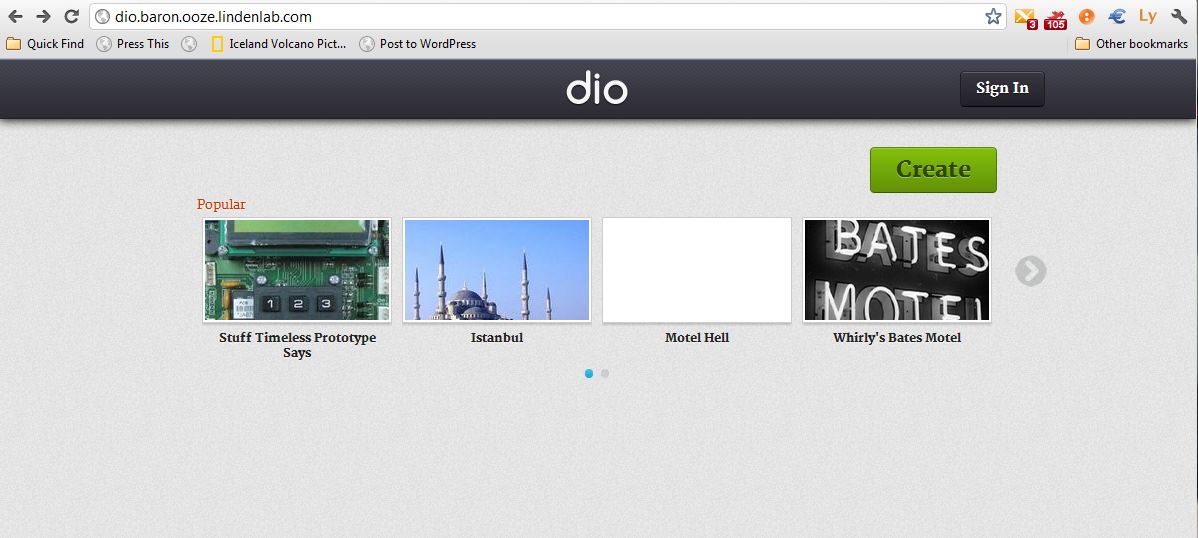
Dio: “webspace with avatars” (image from an early version of the Dio website, and not necessarily representative of how the finished product will appear)
Kill Screen carries an interesting article on Second Life and Linden Lab’s direction under the leadership of Rod Humble. Provocatively entitled, Can Rod Humble resurrect Second Life? the piece examines Humble’s role as LL’s CEO and in particular his strategy in driving the company towards diversification.
A relaxed Humble with a memory of the past…
The latter has tended to divide people engaged in or observing SL, with some seeing it as a sign that LL have somehow “given up” on Second Life or are using it simply as a financial lever with which to churn out new products, and others taking a more moderate view of things. I’ve argued myself on a couple of occasions that diversification could actually be both beneficial towards SL in the longer term, and really doesn’t measure up in any way to LL having “given up” on SL. However, Humble’s view adds an interesting dimension to the discussion, as it is clear his thoughts possibly reach far beyond matters of “direct” user retention. The article notes in particular that:
One initial challenge, however, is its own core product. Building an object in Second Life isn’t easy. There are tutorials and message boards, but for someone who wants to pop in and simply make something quickly, Second Life is intimidating. In fact, that was part of the barrier to the community’s growth. Despite all its fanfare and media coverage, actually getting started was a hindrance to casual users. “Second Life is a highly complex 3D space. It’s a high learning curve,” Humble notes. “A steep climb but rewarding and deep.”
As we’re aware, bridging that gap is hard. There have been numerous attempts to help new users across it, from in-depth solutions such as the old Orientation, Discovery and Help Islands, through to the infamous “first hour” experience of Mark Kingdon’s day (which grew to encompass the “first five hours” when it wasn’t working out as planned) to the highly minimalistic (and questionable) Destination Islands seen more recently. Efforts have also included privately run welcome areas through to experimental orientation areas to something of a return to the more traditional approach.
Part of the problem here is that everyone tends to have an opinion on how it should be done. Many focus on the technical aspects, some on the social aspects, and well may have common foundations, then often build out in various different directions. This makes drawing a consensus as to what works actually quite difficult – as the Lab has learned.
However, in launching the new apps – particularly Creatorverse and Patterns – Humble sees things differently; that by breaking down the creative process into easily understandable concepts and ideas that allow the user to develop a more intuitive understanding of the creative process – and perhaps then move on to more involved creative environments. As the Kill Screen article also comments:
The Linden apps strategy hopes to bridge the gap between the tactile joys of painting and the more guided pleasures of digital makers. More importantly, Humble’s ultimate goal is digital literacy. As he struggled as an amateur, he found that his appreciation of the masters was heightened. The jazzy rhythms of Kandinsky took on new life as he was able to speak the painter’s language. Humble hopes that games like Creatorverse will foster a greater appreciation of the creative process behind designing digital goods. “The hope is that the more people make things, the more they have a richer language to express criticism.”
Rod Humble: Creatorverse and Patterns – opening doors to greater user creativity
Whether this will lead people from the likes of Creatorverse to Second Life is questionable; but where Patterns is concerned, there is something of a path where this may happen; both it and Second Life are somewhat grounded in similar concepts, something a number of commentators – myself included – have noted. Obviously for it to be effective, there needs to be some pointing of the finger towards the doorway from either Patterns to Second Life, which is currently far from being evidenced; but then Patterns is also a long way from prime-time as well.
Perhaps more telling from an SL standpoint is a direct quote from Humble:
“I like rebelling against the tyranny of structured forms,” Humble says. Sims creator Will Wright’s approach to “software as toys” was an inspiration to Humble while the latter was at EA. The constraints that game designers typically place on their players are anathema to the more open-ended creative process that Humble sees as the future of play. “Instead of being told you need to do these tasks to proceed to the next air lock of fun, why not open those doors and give you the ability to fly around?”
This not only encapsulates the broader aims of the likes of Creatorverse and Patterns in reaching new audiences and (maybe) enticing them towards Second Life, it more particularly seems to point to why Linden Lab has, on the one hand, been pushing out new tools and capabilities on their users while on the other, seeming to step back from “direct” involvement within SL. That is, the company is simply trying to present users new and old with as wide a palette of tools and capabilities as possible (mesh, pathfinding, the still-to-be-completed advanced creation tools, the upcoming materials processing capabilities, etc.) they can use create and explore the 3D spaces offered by SL without feeling constrained by the constant presence of the company looking over their shoulder.
The Garden – a subtle use of Teleport Agent, an element of the advanced creation capabilities in SL, which is used ion the puzzle HUD
Doubtless there will be disagreements with this view and with Humble’s comments in general; however they do make interesting reading. For me, and despite all the problems which are looming on the horizon where SL is concerned, I can’t help but come away from it with a feeling that (again) neither Humble nor LL have given up on their core platform.
With thanks to Daniel Voyager for the Twitter pointer.
Update, February 19th, 2014: Creatorverse, Versu and dio were discontinued by Linden Lab on February 19th, 2014. Links to their websites, etc, have therefore been removed from this article.
Looking through the pingbacks on my blog comments, I was curious to see one show up on the 23rd October 2012 linking to an article I wrote back at the start of the year. Curious at to why someone would be linking to an old article, I went to have a look.
Turns out the article linking to me is from Kotaku, a games-related blog run by Gawker News – and the article itself is an interview with Rod Humble. (which came to me via Kotaku’s Australian site) Needless to say, I was more than a tad surprised to have someone interviewing our own Rodvik linking to my blog (oh, be still, beating ego!), so I decided to have a read through.
The piece itself is obviously about the Lab’s new and upcoming products, and it gives some interesting insights into the thinking behind them.
“Just about everybody I know who isn’t in the games business or programming business comes to me with a game idea or a website, and the truth of the matter is, quite often, they can’t make it.”
the article quotes Humble as saying. He then goes on:
“There’s this big barrier. They look at something like C++ [programming] code and, frankly, it looks like a big equation. It just looks like gibberish.
“The more we can make tools that are just fun to use—all of a sudden you are making something you wanted—you can focus on the creativity than mastering this arcane set of symbols. We can hopefully bring more people into that fold of ‘hey, you made something!'”
Thus is the broad thinking behind Patterns, Creatorverse and the still-to-be-seen Dio and Versu, which are apparently going to be appearing something in the next month – if not before the end of this one, depending on how you read quotes from elsewhere.
Creatorverse itself comes in for some attention in the piece – Humble describes it as being his five-year-old daughter’s favourite game at the moment, and it is referred to as coming out “later this year”. Whether that is a result of the interviewer misunderstanding Humble (the interview was via ‘phone), or whether it is because the release date may have shifted while the wheels at Apple (or elsewhere) turn slowly, isn’t clear.
What is clear, however, is the novel way Creatorverse is pitched in the interview:
In the near future, his company will put out a program for iPad called Creatorverse, which will let people use shapes and physics to create basic 3D systems and, yes, games, then share them for anyone else to download and play. Think of making a game that lets you fling shapes into other shapes—your own “Slightly Mad Avians”, he offers as an example, if you get what he means.
Creatorverse
While Slightly Mad Avians could stand as a title in its own right (along with Perturbed Pigeons, a name Darien Caldwell suggested to me the other evening in an entirely unrelated conversation…), it’s nevertheless a curious hook on which to hang a description of Creatorverse – but an interesting one in terms of mental images….!
What is of greater potential interest, however, is the comments about the upcoming Dio and Versu.
Dio is described as: “A website that lets people create rooms out of their personal images and videos, connects them to other people’s rooms and lets people share the space.”
While it has previously been described as “A room creator, in which players can do everything from construct a choose-your-own adventure to develop an interactive wedding album,” and Linden Lab managed to accidentally give people something of a quick peek at an early iteration of a website connected to Dio back at the start of the year, the comment in the Kotaku piece implies that the websiteappears to be the product, rather than in support of it. It’ll be interesting to see how people react to this.
Versu, meanwhile, gains a little more flesh on the bones given in an interview with Giant Bomb, with Humble describing it as, “A platform that lets you make real interactive drama” by giving you “the ability to create characters within a story and then, thanks to the AI, see that “those characters will have emergent properties as you play through the story.” He goes on to admit that this is pretty ambitious and admits to an element of “Tilting at windmills” in order to bring it to a wide audience.
The article goes on to talk in more detail about Patterns, which many of us – and many more in the gaming community – are enjoying even in its nascent (or as Humble puts it, “not even pre-baked”) form. It also talks about Humble himself and his arrival at Linden Lab, which leads to a good mention of Second Life:
It makes perfect sense that Humble would wind up at Linden Lab, the company best known for the virtual world Second Life. It’s as successful a canvas for the communal creation of a virtual world as there’s been. It’s been a viable digital canvas for about a decade now has been populated by users who make their own buildings and vehicles, who design contraptions, contort physics, stage elaborate events, form societies, and pioneer the art of inhabiting elaborate second skins that express inner or otherwise impossible creativity and desires.
It’s a positive read, and well worth taking a few minutes out to read through.
Lelani Carver pointed me towards a further interview with Rod Humble on the subject of new products which appeared in the Gamesbeat pages of VentureBeat on October 12th. The interview is pretty much what has been said elsewhere insofar as the new products are concerned, but there are some very interesting nuggets of information sitting within it.
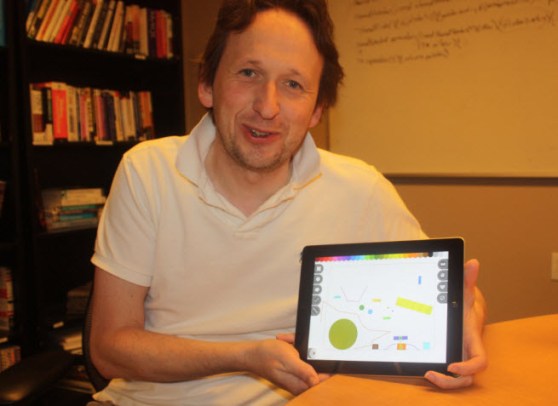
Pride of the father: Rod Humble shows-off Creatorverse (images coutesy of VentureBeat)
Patterns and Creatorverse are primarily mentioned in the piece, with Humble again commenting on the company’s new-found philosophy established out of Second Life:
“At Linden Lab, we believe that creativity is within all people and that it empowers them like nothing else,” said Humble. “We make digital spaces where people can have fun while exploring and sharing their creativity with others. Millions of people around the world have enjoyed that in Second Life, and we look forward to inspiring even more creativity.”
Some people have already taken issue with the use of the past tense (“have enjoyed”) when used in reference to Second Life on the Lab’s corporate website, and they are liable to feel the same way seeing Humble use the same phrasing here. While I don’t necessarily support such views, I would say that when commenting on Second Life to the wider community, media or otherwise, use of the present tense might underline the fact that SL is still out there and people are enjoying it and what it has to offer. Hope you’re reading this, Rod! ;-).
The feature is light on details for both Dio (which gets a throwaway mention) and Versu (which gets no mention at all); whether this is down to the interviewer missing them, or Humble not being in a position to speak about them at the time of the interview, is unclear. However, what he does say in reference to all three which do get a mention (Patterns, Creatorverse and Dio) is that people will be able to monetize them.
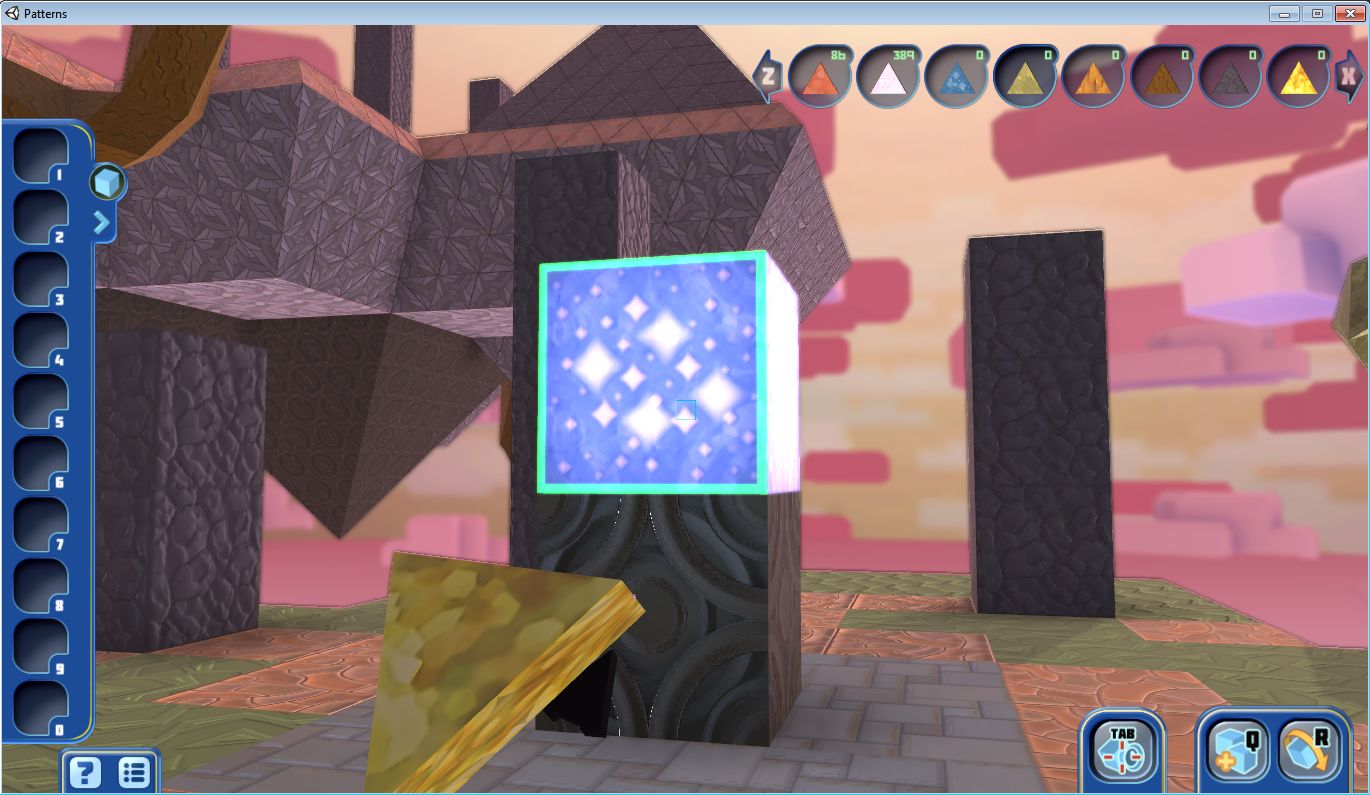
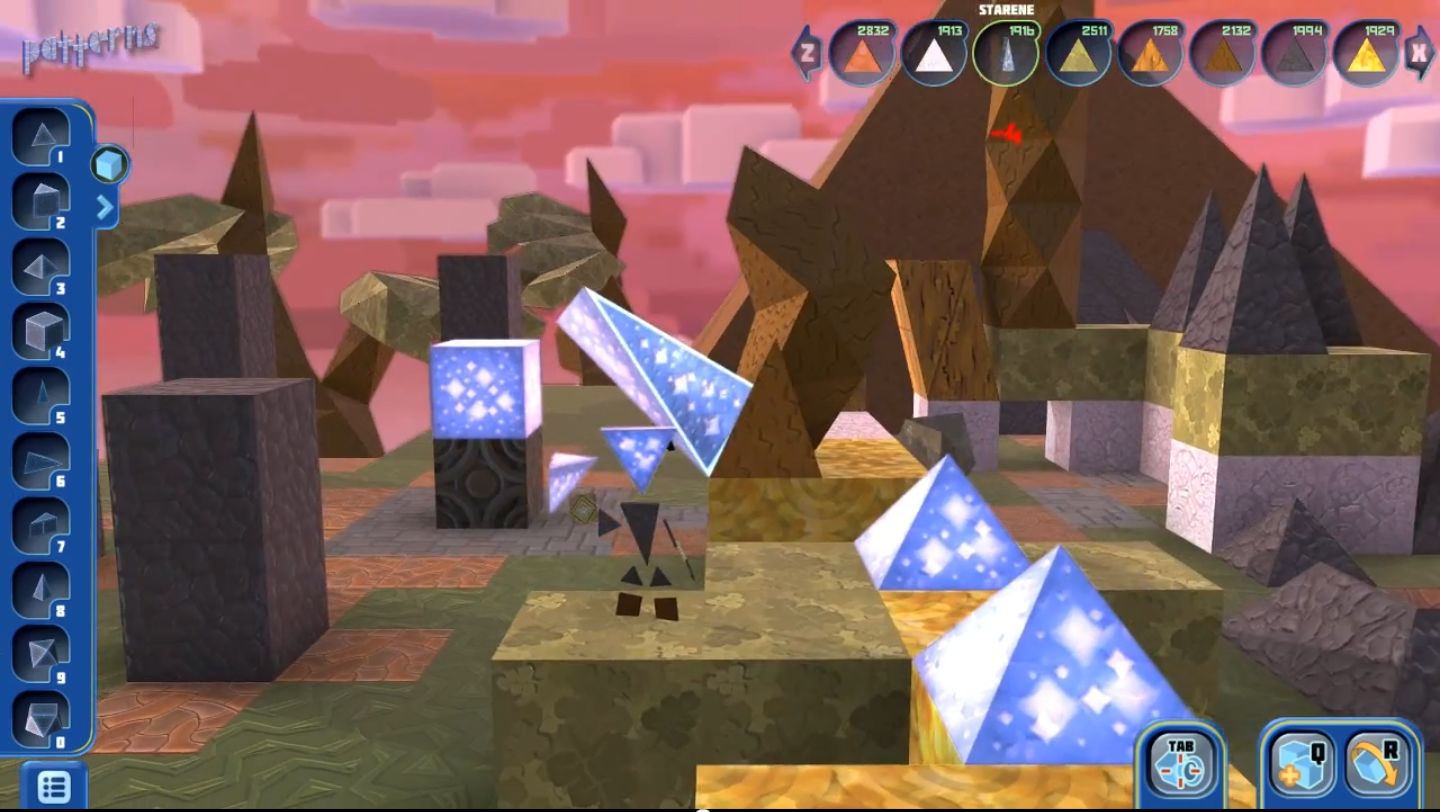
Patterns: users to be able to monetize it in the future?
This is something he lightly touched upon in his interview with Giant Bomb, specifically with reference to Creatorverse, and I mused in passing on his comment and whether it would be applicable to all of LL’s new products. Well, it would seem so.
For those curious about Linden Research itself, the article contains some interesting elements:
Today, Second Life survives with 1 million monthly active users. The world generated $75 million in revenues last year and it is operating profitably. That has allowed Humble to expand his team to 175 employees and go after the markets beyond the virtual world.
There is also mention of the 2010 lay-offs, although these are again referred to slightly out-of-context, failing to mention that during his tenure, Mark Kingdon actually recruited some 125 people into LL, expanding it by as much as 50% in order to fuel (for the most part) the company’s failed (some would say misguided) attempt to enter the enterprise market. As such, while the lay-offs did hurt, at the time they actually returned the company to more-or-less the “pre-Kingdon” expansion, a move in line with the company also dropping all aspiratiosn of entering the enterprise applications market.
However (and ignoring the perjorative “survives” in the Gamesbeat comment), the reference to “expanding” the team to 175 is an eye-opener; it suggests that the continuing run of those departing the company / being asked to leave has been cutting somewhat deeper than may have previously been appreciated given that 200-220 employees has tended to be the considered figure for the number of people employed by the Lab.
Nor does the article ignore Second Life. In referring to SL, Humble tells Gamesbeat that it is also getting a major upgrade this year, and that Linden Lab is “still investing in 3D virtual worlds.” This is liable to lead to some speculation as to what the “major upgrade” may be. For my part, and given that this week sees some shuffling of regions onto new hardware together with the recent network optimisation tests, I’m thinking Humble is talking more in terms of the company’s much-touted hardware and infrastructure investment, rather than a mega new in-world feature.
Also quoted in the article, LL board member Will Wright makes mention to SL in a maner which may draw frowns from some:
Rod has a great sense of player communities and the forces that drive them. At Linden Labs [sic] I know he’s focused on trying to evolve a very established community into something much broader and more inviting.
While this probably refers to opening-out Second Life to Steam and potentially generating a wider appeal for the platform than is currently the case, that Wright refers to Humble trying to make the existing SL community “more inviting” might easily be taken the wrong way. Many within SL are already feeling increasingly alienated as a result of some of LL’s actions under Humble’s tenure as CEO; so the idea that some at board level are still of the opinion that the existing SL user community is somehow less-than-inviting isn’t going to do much to dispel these feelings or that there is perhaps something of an adversarial attitude within the Lab towards its existing users.
Issue might also be taken with Humble’s own closing statement in the interview, in which he says, in part:
“We are still investing in 3D virtual worlds,” he said. “But shared creative spaces is what we do. There is an opportunity to embrace the new way of developing things. A lot of this could be done inside Second Life. But you get more creativity in the hands of more people by building on new platforms”
This could be seen as something of a dismissal of Second Life; however, I’d hesitate in seeing it that way. The sentiment behind the comment could just as easily be born out of an acknowledgement that from a business perspective, 3D immersive environments are still a niche market and are liable to remain so for some time to come. Thus, it is actually easier for the company to rapidly grow a new user base (and revenue streams) and leverage new platforms through the development of new products. As such, when looking at Humble’s words from the persepctive of SL, perhaps the the key phrase to focus upon is, “We are still investing in 3D virtual worlds.”
Talking to Giant Bomb, Rod Humble has revealed more about the Lab’s upcoming new products, all of which appear set for launch in October.
We already know about Patterns, which is already available in its Genesis Release, and which has had something of a positive response among those in the gaming community who have tried it.
Patterns: generally positive reception to initial Genesis Release
We also know that Creatorverse will also be appearing shortly, and will initially be aimed at the iPad (but is currently still awaiting Apple’s approval), although it appears it will eventually be available for the PC and Mac as well going by comments in the article. The description of a demonstration of Creatorverse given by Humble is somewhat amusing:
Humble loaded up the app, which starts with a white screen. First, he drew a box, colored it in and tried to convince me it was a car. He made a better argument when two circles were underneath it, but when he clicked “play,” everything fell apart. By tapping the left side of the screen and pulling up his toolbox, Humble added joints that merged the “wheels” with the “car,” and gave the wheels a movement ability. Finally, he added a squiggly green line beneath everything, and clicked play again. The car roared to life…and then quickly fell off, tumbling into oblivion.
Probably not the intended result, but it does raise a smile. However, the really interesting part of the news about Creatorverse is in the paragraph which follows:
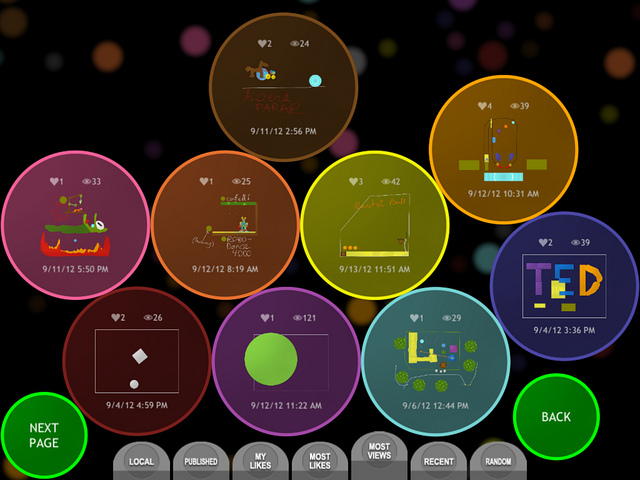
Each creation can be uploaded into the cloud, and both played and edited by anybody. The goal is to bring some Second Life sensibilities to Creatorverse eventually, too, such as giving users the ability to charge for them. (That can’t happen on iOS, though.) One of the more ambitious toys created by pre-release users was a pinball machine.
So not only would shared creative spaces appear to be a concept being carried forward from SL into their new endeavours by LL, but also the opportunity for users to monetize their creations…
Creatorverse: shared creative space and monetization? (copyright Linden Lab)
Of the remaining two products up for launch, one is Dio, which has been known about in essence, if not in content for a while. It is described as a “room creator, in which players can do everything from construct a choose-your-own adventure to develop an interactive wedding album.” This had been thought to be a product arising from the acquisition of Little Text People earlier this year. However, the fruits of that collaboration would appear to be in the fourth product in the lie-up.
Dio: to appear in October as well
This fourth product is to be called Versu, and is described as a storytelling toolset, in which players assign characters a set of motivations. The characters react to the actions of the player based on these motivations, and the story is procedurally generated. The first release is aimed at murder mystery and romance stories.
The timing of the launches so close to one another is intentional, with Humble hoping that the close proximity of the launches to one another will change people’s perception of Linden Lab, and encourage those who wrote it off as “just the Second Life company” to come back and have another look.
Hopefully, if successful, this may encourage people to take a look at Second Life as well…
Humble’s reasons for joining the company are enlightening – he’d actually forgotten about the platform and had been thinking of developing something along the same lines when the opportunity to join Linden Research popped-up. A nice example of serendipity in action.
Since joining Linden Research, Humble’s focus has been on the platform’s usability, which the article describes as being “far from perfect” – something many users would doubtless regard as an understatement. While there is still a good way to go in making things “better”, only the churlish would refuse to accept there haven’t been improvements in a number of areas, and that Linden Lab is working to get some deep-rooted issues – stability, performance, region crossings, even (dare I say it) the official Viewer – properly addressed.
There are also some comments that are liable to have users cringing in some quarters. Humble’s comments on gaming mechanics in particular may well offer little comfort to some as to the future of the platform. While SL may not itself be a game, it is a perfectly valid platform upon which users can develop games of their own if they so wish. Indeed, one might argue many have been doing precisely that almost since the platform entered open beta 10 years ago. That LL are now making the capabilities to do so easier to use is demonstration that the company is working meet user demands and provide more effective means by which the platform can be leveraged by users themselves.
As well as wanting to get issues around SL’s usability sorted out, Humble reveals that one of his overall goals would be to expand LL’s portfolio of products – to put the “Lab” back into “Linden Lab”. Reading this, one is tempted to wonder if this desire formed a part of his pitch for the CEO position, and was thus one of the reasons he was hired. Thirteen years with just a single product is a remarkable achievement for any company – but it is also a precarious position to hold.
In terms of the acquisition of LittleTextPeople, it appears to be something of a natural symbiosis more than a straight buy-out: Humble / LL were working in a particular direction and at the end of last year it became apparent that Short and Evans were working towards the same destination. Thus, the acquisition was to their mutual advantage. It’s also interesting to note that the Humble / Short / Evans relationship is a lot deeper than the EA Games link between Humble and Evans many of pointed to when news of the acquisition broke.
As to the product itself, little is said in detail, but what is mentioned helps frame the product more clearly. It will be primarily text-based with 2D graphics. It will be a story form, but deal with social interactions – how people treat each other and what say to one another. Most intriguingly of all however, is that it appears the product will be capable of supporting user-generated content. “Although it will launch with some very, very well crafted content, the overall plan – just like all Linden lab products – is to democratise the actual creation process. Other people will be able to make things on that platform. That’s really the business we’re in: building platforms that allow people to express themselves in different ways.” Humble informs Games Industry when mentioning the product.
Of the other two products currently being developed at the Lab, even less is said other than the intimation they will also support user-generated content – although Humble did hint this would be the case when the development of new products was first announced at SLCC-2011. However, this is the first time we’ve had it directly confirmed that three products are currently in the pipeline. Again, Humble has only previously hinted at this in a comment on New World Notes, wherein he made reference to the LTP project being “Product 3”, and there being a “Product 2” under way at the Lab as well – although at the time, some did speculate as to whether “Product 1” was perhaps Second Life.
The interview isn’t going to satisfy everyone within the SL community, but for my part, I found it a worth-while read, not so much the for the titbits of information that emerge about the upcoming new products, but because it again shines a light on Rod Humble’s thought processes and some of his strategic thinking where both the company and SL are concerned. Given the company has been pretty quiet when it comes to talking to the community as a whole on such things, it’s refreshing to gain this kind of near-candid insight, and actually does help restore one’s faith that, overall, SL is in a safe pair of hands right now – a perception that has been slipping a little of late.
Obviously, the new tools being rolled-out / developed for SL and the new products themselves aren’t going to lift LL out of the perceived mire, and it fair to stay the company is facing further clouds on the horizon – particularly around the stormy issue of tier. But taken as a whole, this is a positive piece and carries with it the promise that we may well be hearing a lot more from LL as whole in the coming months – and that in itself will be refreshing.
Don’t just take my word for it – go read the article, and don’t miss the side-bar piece as well.
 Update, February 19th, 2014: Creatorvers and dio were discontinued by Linden Lab on February 19th, 2014. Links to their websites, etc., have therefore been removed from this article.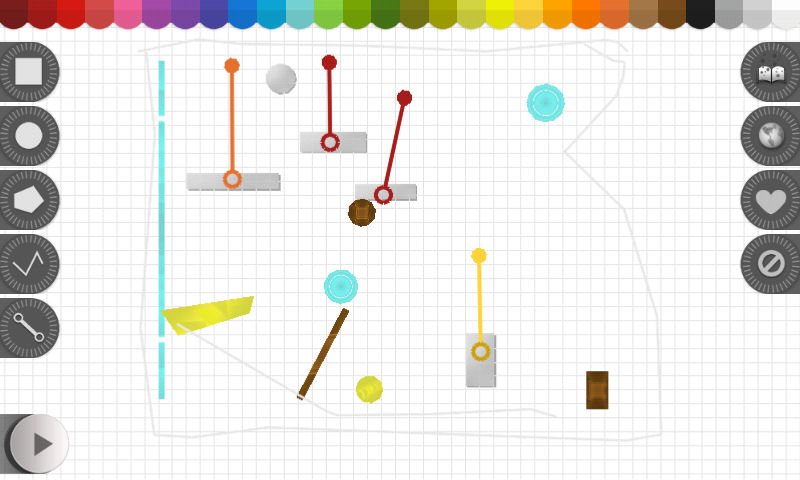




 Inara Pey: Living in a Modemworld