On Thursday, September 25th, 2025, Linden Lab hosted a further Zoom call with creators and bloggers to discuss a number of announcements and initiatives, one of which was a new Premium Plus subscription option. I’ll be summarising other aspects of the meeting in due course. This article focuses on the new subscription option – what it is, why it is being done, and when it can be expected.
What is It?
While Premium Plus has been been well-received, the cost of US $249 (annual billing plan) has been seen by many as being too expensive to justify.
To help overcome this, from October 2025, Linden Lab will be offering a “Premium Plus, No Stipend” option.
This subscription level will offer exactly what it suggests:
All of the “physical” benefits of Premium Plus (2048 sq metre Linden Home options etc.).
HOWEVER users signing-up to it will not receive either the one-off sign-up bonus (L$ 3,000) or the weekend stipend (L$650).
The new offering will retain the “Premium Plus” name for simplicity, and presented as an option within the Premium Plus subscription level.
By removing the sign-up bonus and stipend the new offering, when available, will cost US $11.99 per month / US $143.88 per annum (plus applicable local taxes) – a saving of US $105.12 on the annual cost of Premium Plus with stipend.
The upcoming new “Premium Plus, No Stipend” subscription option. Credit: Linden Lab
In addition, subscribers will be able to move between the subscription levels with immediate effect (e.g. Premium subscribers will be able to upgrade to “Premium Plus, No Stipend” without delay, and if they don’t like it, downgrade back to Premium or upgrade to “full” Premium Plus, and if a Premium Plus user opts to do without the stipend, they can switch over to “Premium Plus, No Stipend”).
Why is it Being Added?
As noted, it is primarily aimed at making Premium Plus more attractive to users who feel the current offering, even with the sign-up bonus and stipend, is still too expensive to justify.
The decision to remove the sign-up payment and stipend was made on two counts:
Those on both Premium and Premium Plus continue to purchase Linden Dollars regardless of their stipend.
Stipend payments further add to the supply of L$ in circulation, contributing to the on-going issues of a top-heavy supply of Linden Dollars impacting exchange rates, as has been previously discussed – see: Linden Dollar Exchange Rate and the Economy.
It is recognised the removal of the stipend will not appeal to everyone, hence why the current Premium Plus option will be remaining.
It is particularly hoped that the new option will encourage Premium subscribers who have previously expressed reluctance in upgrading to Premium Plus due to the cost to now consider doing so.
In a perfect world every premium subscriber would move to Premium Plus, No Stipend. Best for residents, best for creators. If that takes off, this is really good for residents and really good for creators, if people upgrade. If people downgrade, it is what it is; hopefully they don’t, but if they do, they do. But upgrading, that’s a win for the creators like no other, and its a win for the residents; we’re really giving a lot more for very little.
– Brad Oberwager, during the Zoom Call, September 25th, 2025
When Will it Launch?
If all goes according to plan, “Premium Plus, no Stipend” will launch in the first half of October 2025.
Formal announcements of its availability will be made when officially launched.
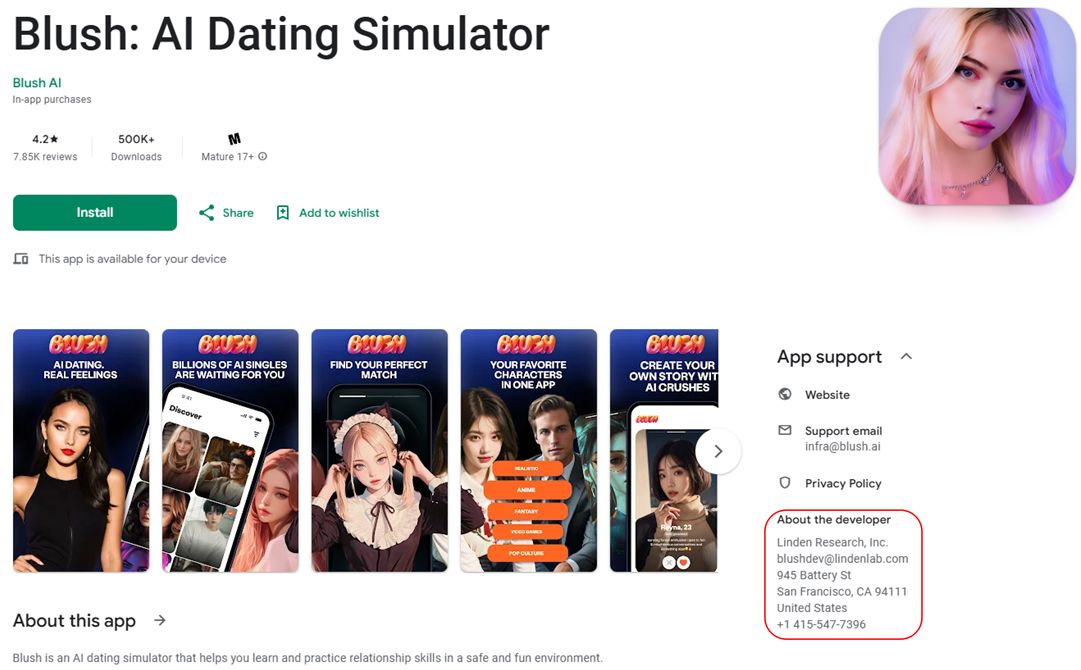
Towards the end of August 2025, I was contacted to ask if I knew anything about a recent acquisition by Linden Lab – that of Blush AI, a dating simulator available for both Android and iOS that (quote) “helps you learn and practice relationship skills in a safe and fun environment”.
Blush AI was originally developed by Luka Inc., the company behind Replika, an emotional artificial intelligence (AI) companion chatbot first released in 2017, and which has proven highly popular with a claim of over 30 million users – although it has not been without its share of concerns around user data protection.
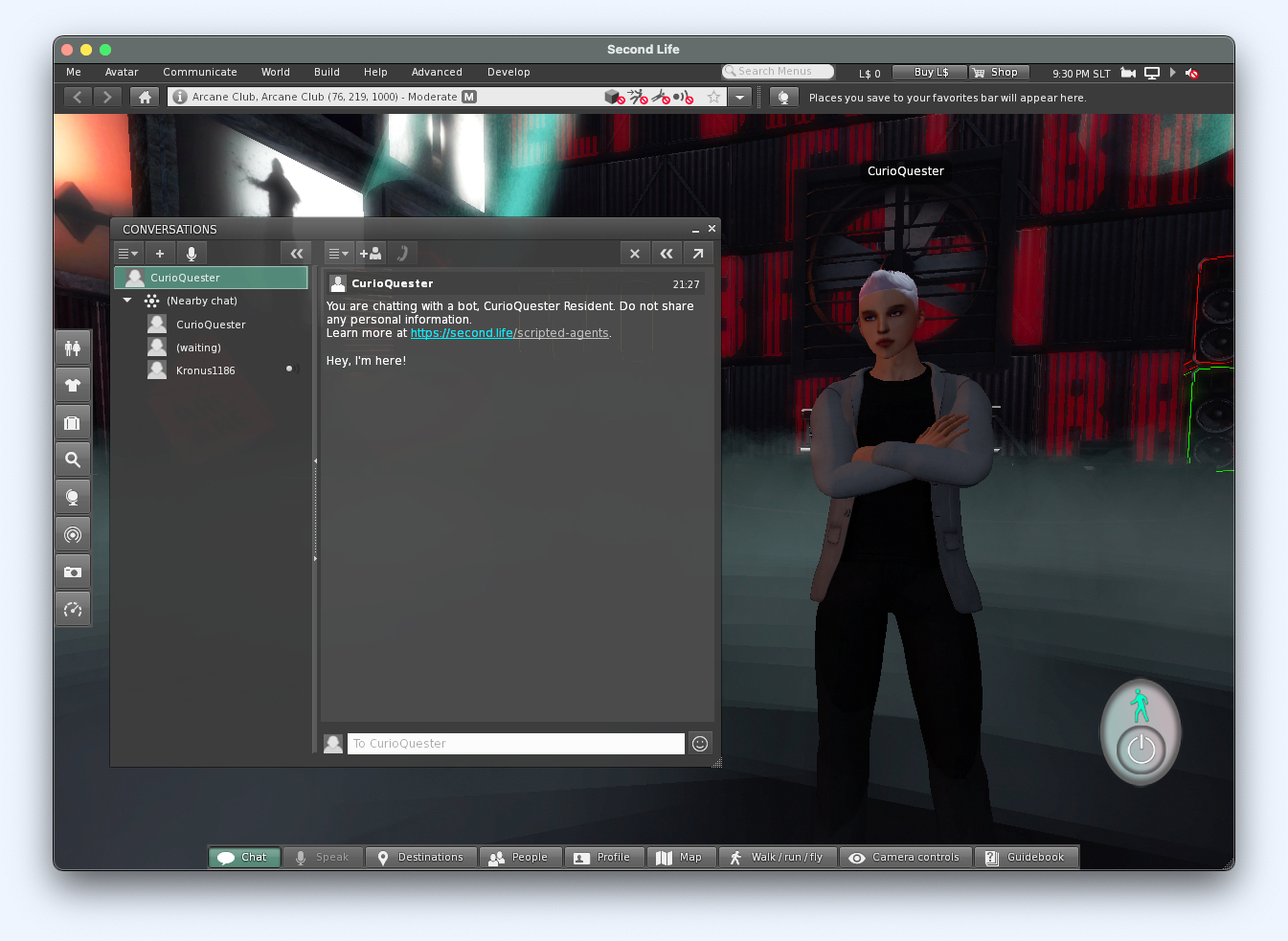
At the time I was contacted, the acquisition of Blush AI from Luka Inc., was causing some concern within the forums and on social media, with some of the concerns being around the possible use of SL chat logs being used to train the AI. As there had been no official announcement on the matter, I contacted Linden Lab to see if they would comment on the acquisition. Due to matters of vacations, etc., it took a while to obtain a response, but this week I did receive an official statement on the acquisition, which hopefully addresses some of the concerns raised in the forum thread:
Linden Lab has always been a place where new ideas are explored both in and outside of Second Life. Blush is one of those explorations—a small, independent product with its own team and no connection to Second Life user data. Blush is a separate effort focused on AI companionship, while our focus in Second Life is on growing and improving the world our creators have built.
We have no plans now or in the future to use Second Life conversations or content to train AI systems. Any such use would require explicit disclosure in our Privacy Policy. Second Life remains our flagship offering, built around empowering human creativity, and we are continuing to invest heavily in it with recent updates like glTF imports, WebRTC voice, our mobile app, and Project Zero.
– Linden Lab spokesperson
The Blush App page on Google Play, listing the Lab as the new developer
Given this, it would appear that the intent is to have Blush AI continue to operate independently from Second Life using its own revenue stream via in-app purchases. Most particularly, it makes clear that conversation logs, etc., from Second Life will not be used to help train the Blush AI, nor is likely that there be any other connections between Blush AI and Second Life user data.
Obviously, the question remains why make such an acquisition in the first place. Without any direct statement from the Lab, anything relating to this question is pure supposition. On a personal level, I have no strong opinion on; AI tools / entertainment of this nature simply do not interest me at all. So long as the acquisition doesn’t interfere with /detract from the on-going effort to enhance and grow Second Life, which remains the Lab’s bread and butter, then I can happily ignore Blush AI. That said, given that past acquisitions by the Lab haven’t always gone that well (Blocksworld being the only real exception), I will admit to my curiosity being piqued as to how this one progresses and how long it lasts.
On Thursday, July 31st, Linden Lab provided an update on the AI Character Generation project which indicates it it to be paused / closed at the start of September.
The project was initially launched in December 2024 and powered by Convai, a platform for developers and creators proving an intuitive approach to designing characters with multimodal perception abilities in both virtual and real world environments (see: Linden Lab leverage Convai for AI character generation in Second Life). However, it was shortly thereafter suspended as a result of community feedback, before being re-launched to a wider audience of potential users at the end of February 2025.
The Character Designer was launched as an experimental feature to explore the potential of AI-powered characters in Second Life. Built in collaboration with our AI technology partner Convai, this tool enabled residents to create interactive, virtual characters with conversational capabilities.
From elaborate roleplay scenarios to immersive visitor greeters, your projects and feedback have been invaluable. This pause gives us time to carefully evaluate everything we’ve learned and determine how best to evolve this technology in a way that aligns with the broader future of Second Life.
This is not the end of AI in Second Life; rather, it is a thoughtful pause as we refine our strategy and continue exploring new opportunities for innovation.
– Linden Lab blog post
The “pause” is set to come into effect from Monday, September 1st, 2025, with the Lab further noting that as of that date:
It will no longer be possible to create, deploy, or run AI Characters using the Character Designer interface.
Characters created through the Designer will no longer function or appear in-world.
Previously created characters and their memory will not be retained post-pause.
Any alt accounts created specifically for testing the Character Generator will remain valid Second Life accounts, and can be logged into just like any other alt account.
Community support for the project will continue through the following channels:
Second Life Discord for real-time responses from staff and developers.
Support Portal for any account-specific issues.
In addition, those who have used the Character Generator are encouraged to record their work during the wind-down period and share video through the forum thread or suitable platforms.
The sunsetting of this project does not mean the end of further possible projects and experiments in the use of AI technologies, with the blog post also stating:
This is not the end of AI features in Second Life—we’re using this moment to regroup and plan for future development … We are actively and cautiously experimenting with other AI technologies to enhance Second Life’s creative potential, performance, and immersion. The insights from this project are already helping to inform future efforts.
For further information, please refer to the official blog post, which includes a short-term FAQ.
I’ve been a user of the Firestorm third-party viewer (TPV) since its inception (and was a user of its precursor, Phoenix). It’s a viewer which offers a comprehensive set of capabilities – those also available in the Official Viewer; those otherwise tucked away in the debug settings and brought to light through the building of UI elements; and those developed by members of the Firestorm team and those contributing to it down the years.
True, it may not run well on all systems – indeed, it may not run as well as other viewers on the same computer; but it offers such a range of capabilities that it is practical for anything a person might want to turn their hand to in SL, from simply pootling around and having fun, to photography, building, scripting, and content creation. Hence why it has become the most widely used TPV in Second life (and, quite likely, Open Simulator worlds).
Given the large percentage of users engaged with SL through Firestorm can clearly present LL with some major headaches, particularly when it comes to matters of support and the deployment and adoption of new capabilities within Second Life. For example, in the six months or so prior to this article one of the main hold-ups in allowing LL to completely switch Second Life over to the WebRTC Voice service and finally turn-off the outdated, troublesome (and potentially costly?) Vivox service, has been the fact that many Firestorm users still use versions of the viewer without the necessary WebRTC support (although that number has been declining).
As it does have such a large percentage of the the total SL user base means it cannot simply be ignored by LL on any level. In this, I do applaud recent moves on the part of the Lab to allow staff to become more au fait with Firestorm and its capabilities, and in publicly recognising the sheer weight of user numbers Firestorm has. Not only does this potentially assist in terms of support issues, it allows Lab personnel more readily understand where people like content creators are coming from when discussing options and capabilities that may have been exposed within Firestorm but may not be so readily apparent in the Official Viewer.
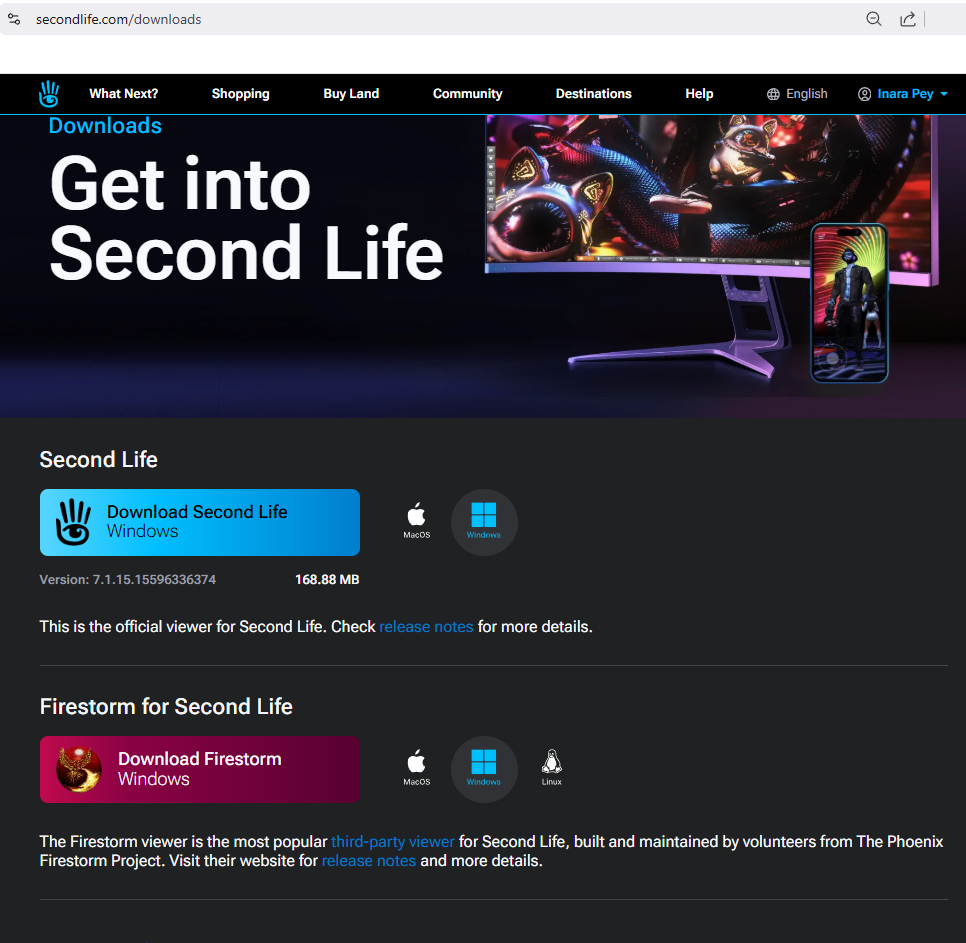
However, what I don’t think is particularly fair is the for Lab to promote Firestorm to the exclusion of all other TPVs. At the June Web User Group it was stated that Firestorm would be added to the Official Viewer download page, and this was due shortly thereafter.
The updated official viewer download page with Firestorm
What I find unfair in this move is not the inclusion of Firestorm on the Official Viewer download page per se. As noted, there are good reasons for LL to acknowledge it. Rather it is in the fact that in doing so, all other TPVs are completely ignored to the point where they might as well not exist. Even the one link referencing third-party viewers goes to the Firestorm Viewer download page, not the Third Party Viewer Directory. There’s not even a statement as to what a TPV actually is.
Worse, the appearance of Firestorm alone on the Official Viewer download page can so easily be interpreted as meaning Firestorm is now “officially endorsed” by Linden Lab as “the” alternate viewer for accessing Second Life; or for those relatively new to SL, that Firestorm is the only TPV on offer.
As such, I cannot help but find this move to be demeaning towards the developers of other third-party viewers. Yes, they may well have a smaller overall percentage of users when compared to Firestorm, but this doesn’t invalidate them. What’s more – and as I’m sure the Firestorm developers will agree – many of the people behind those other viewers have contributed to the success of Firestorm and the Official Viewer through code contributions (direct and indirect). Thus, to ignore them entirely is to do them a disservice, however unintended.
The point here is that all of the above could have been easily addressed from the outset by including a section on the Official Viewer download page below the one for Firestorm, outlining what third-party viewers are, and which provides links to the TPV Directory and the TPV Policy. Nor does such a statement have to be complicated. For example:
Third-party viewers are developed by users of Second Life. They are based on the core code from the official viewer but offer additional options and capabilities to users. Third-party viewers (including Firestorm) are not endorsed or supported by Linden Lab. However, those recorded on our Third Party Directory have been self-certified for their compliance with our Third Party Viewer Policy to provide a positive and predictable experience for all Second Life Residents.
Such an inclusion would only be fair an appropriate – as I hope that if anyone from the Lab who might read this piece would agree. All TPV developers put in considerable amounts of their own time and effort into developing viewers to offer users a broader choice in the software they might opt to use. As noted, numbers of active users employing them might pale in comparison to Firestorm, but this does not make them any less deserving of a similar degree of recognition by LL.
Comparing the large dwarf planets with Earth and the Moon. Credit: unknown
As I noted back in July 2024, classifying just what “is” and “is not” a “planet” is something of a minefield, with the entire debate going back to the 1800s. However, what really ignited the modern debate was – ironically – the search for the so-called “Planet 9” (or “Planet X” as it was then known), a body believed to be somewhere between 2 and 4 times the size of Earth and around 5 times its mass (see: Space Sunday: of “planet” and planets).
That hunt lead to the discovery of numerous bodies far out in the solar system’s Kuiper Belt which share similar characteristics to Pluto (size, mass, albedo, etc), such as Eris (which has at least one moon) Makemake, Haumea (which has two moons), Sedna, Gonggong and Quaoar (surrounded by its own ring of matter), all of which, like Pluto, appear to have reach a hydrostatic equilibrium (aka “nearly round shape”).
Is it a dwarf planet? A TNO? A Plutoid? This Euler diagram, used by the IAU Executive Committee, demonstrates the complexity in trying to classify objects within the solar system. Credit: Holf Weiher
The discovery of this tiny worlds led to an increasing risk that the more we looked into the solar system, so the number of planets would require updating, causing confusion. So, in 2006, the IAU sought to address the issue by drawing up a definition of the term “planet” which would enable all these little planet-like bodies to be acknowledged without upsetting things too much. In the process, Pluto was relegated to the status of “dwarf planet”, in keeping with the likes of Ceres in the inner solar system, Eris, Makemake et al. This make sense – but that’s not to say it didn’t cause considerable upset.
The definition was also flawed from the outset in a couple of ways. Firstly, if taken strictly, the criteria the IAU had chosen meant that Saturn Jupiter, Mars and Earth were actually not planets, because all of them have not “cleared the neighbourhood around [their] orbit[s]”: all of them have gatherings of asteroids skipping around the Sun in the same orbit (notably some 10,000 for Earth and 100,000 for Jupiter).
Secondly, that body has to be “in orbit around the Sun” pretty much rules out calling called planet-like bodies orbiting other stars “planets”; something which given all the exoplanet discoveries by Kepler and TESS et al has become something of a bite in the bum for the IAU. As a result, the “pro-Pluto is a planet” brigade have felt justified in continuing their calls for Pluto to regain its planetary status.
Several attempts have been made to try to rectify matters in a way that enables the IAU to keep dwarf planets as a recognised class of object (including Pluto) and which addresses the issues of things like exoplanets. The most recent attempt to refine the IAU’s definition took place in August 2024, at the 32nd IAU General Assembly, when a proposal offering a new set of criteria was put forward in order for a celestial body to be defined as a planet.
Unfortunately, the proposal rang headlong into yet more objections. The “Pluto is a planet” die-hards complained the new proposal was slanted against Pluto because it only considered mass, and not mass and hydrostatic equilibrium, while others got pedantic over the fact that while the proposal allowed for exoplanets, it excluded “rogue” planets – those no longer bound to their star of origin but wandering through the Galaxy on their own – from being called “planets”. Impasse ensued, and the proposal failed.
In the meantime, astronomers continue to discover distant bodies that might be classified as dwarf planets, naturally strengthening that term as a classification of star system bodies. This last week saw confirmation that another is wandering around the Sun – and a very lonely one at that.
Called 2017 OF201 (the 2017 indicating it was first spotted in that year), it sits well within the size domain specified for dwarf planets, being an estimated 500-850 metres across, and may have achieved hydrostatic equilibrium (although at this point in time that is not certain). Referred to as an Extreme Trans-Neptunian Object (ETNO, a term which can be applied to dwarf planets and asteroids ), it orbits the Sun once every 25,000 years, coming to 45 AU at perihelion before receding to 1,700 AU at aphelion (an AU – or astronomical unit – being the average distance between Earth and the Sun).
As well as strengthening the classification of dwarf planets (and keeping Pluto identified as such), 2017 OF201 potentially adds weight to the argument against “Planet 9”, the original cause for the last 20 years of arguing over Pluto’s status.
2017 OF201 imaged by the Canada–France–Hawaii Telescope on 31 August 2011
To explain. Many of ETNOs and Trans-Neptunian Objects (TNOs) occupy very similar orbits to one another, as if they’ve somehow been clustered together. For example, Sedna has a number of other TNOs in orbits which closely match its own, leading the group as a whole to be referenced informally as “sednoids”. Among “Planet 9” proponents, this is taken as evidence for its existence, the argument being that only the influence of a large planetary body far out beyond Neptune could shepherd these ETNOs and TNOs into clusters of similar orbits.
However, by extension, this also means that 2017 OF201 – together with 2013 SY99 and 2019-EU5 should have also fallen to the same influence – but none of them have, orbiting the Sun quite independently of any clusters. This potentially suggests that rather than any mysterious planet hiding way out in the solar system and causing the clustering of groups of TNO orbits, such grouping are the result of the passing influence of Neptune’s gravity well, together with the ever-present galactic tide.
Thus, the news concerning 2017 OF201 confirmation as a Sun-orbiting, dwarf planet-sized ETNO both ups the ante for Pluto remaining a dwarf planet and simultaneously potentially negating the existence of “Planet 9”.
Jupiter: Only Half the Size it Once Was?
Definitions and classifications aside, Jupiter is undoubtedly the planetary king of the solar system. It has a mass more than 2.5 times the total mass of all the other planetary bodies in the solar system (but is still only one-thousandth the mass of the Sun!) and has a volume 1,321 times that of Earth. It is also believed to have been the first planet to form in the solar system; possibly as little as one million years after the Sun itself was born, with Saturn following it shortly thereafter.
Jupiter is an important planet not just because of its dominance and age, but because of the role it and Saturn played in the overall formation of the solar system, although much of this is subject to contention. The primary concept of Jupiter’s and Saturn’s voyage through the solar is referenced as the “grand tack hypothesis“, on account of the two giants migrating through the solar system in the first few millions of years after they form.
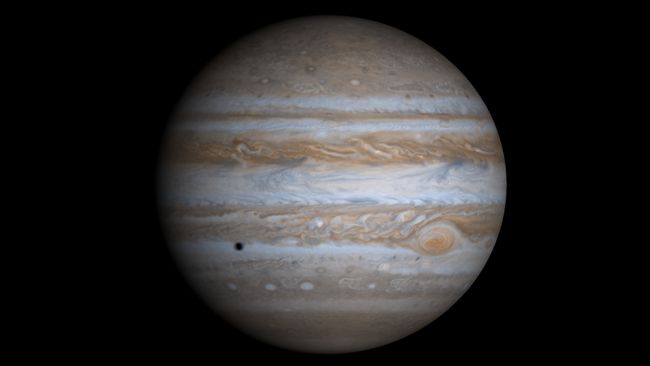
Jupiter as it is today, as seen by the Hubble Space Telescope. Not long after its formation, it might have been twice its current size. Note the black dot to the left of the image is the shadow Io, the innermost of Jupiter’s large moons. Io itself is outside of the frame. Credit: NASA/JPL / University of Arizona
Under this theory, Jupiter formed around 3.5 AU from the Sun, rapidly accreting a solid core and gaining mass to a point where it reach around 20 times Earth’s mass (although Earth would not form for another 45-50 million years). At this point, it’s mass and size (and those of Saturn) were such that they entered into a complex series of interactions with one another and the Sun, with both migrating towards the Sun, likely destroying a number of smaller proto-planets (all of them larger than Earth) along the way. At some point, these interactions reversed, and both infant planet started migrating away from the Sun again, clearing the way for the remnants of the smaller proto-planets they’d wrecked to gradually accrete to form what we now know to be the inner planets, as Jupiter and Saturn continued outwards to what are now their present orbits.
Believed to have occurred over between 4 to 6 million years, the “grand tack hypothesis” is contentious, as noted, and there are alternate theories concerning Jupiter’s formation and the early history of the solar system. Because of this, astronomers Konstantin Batygin (who, coincidentally, is one of the proponents of the “Planet 9” theory) and Fred C. Adams used complex computer modelling to try to better understand Jupiter’s formation and early history, in order to try to better determine how it may have behaved and affected the earliest years of the solar system’s formation.
In order to do this, and not be swayed by any existing assumptions concerning Jupiter’s formation, they decided to try to model Jupiter’s size during the first few million years after its accretion started. They did this using the orbital dynamics of Jupiter’s moons – notably Amalthea and Thebe, together with Io, Jupiter’s innermost large moon – and the conservation of the planet’s angular momentum, as these are all quantities that are directly measurable.
Taken as a whole, their modelling appears to show a clear snapshot of Jupiter at the moment the surrounding solar nebula evaporated, a pivotal transition point when the building materials for planet formation disappeared and the primordial architecture of the solar system was locked in. Specifically, it reveals Jupiter grew far more rapidly and to a much larger size than we see today, being around twice its current size and with a magnetic field more than 50 times greater than it now is and a volume 2,000 times greater than present-day Earth.
Having such a precise model now potentially allows astronomers to better determine exactly what went on during those first few million years of planetary formation, and what mechanisms were at work to give us the solar system we see today. This includes those mechanisms which caused Jupiter to shrink in size to its present size (simple heat loss? heat loss and other factors?) and calm its massive magnetic field, and the time span over which these events occurred.
Yeah. Finding Life is Hard
In March, I reported on a possible new means to discover evidence of biosigns on worlds orbiting other stars by looking for evidence of methyl halides in their atmospheres (see: Space Sunday: home again, a “good night”, and seeking biosigns). In that reported, I noted that astronomers had potentially found traces of another element associated with organics, dimethyl sulphide (DMS) , within the atmosphere of exoplanet K2-18b, a hycean (water) world.
This is the strongest evidence yet there is possibly life out there. I can realistically say that we can confirm this signal within one to two years. The amount we estimate of this gas in the atmosphere is thousands of times higher than what we have on Earth. So, if the association with life is real, then this planet will be teeming with life.
– Prof Nikku Madhusudhan, lead investigator into the study of the atmosphere of K2-18b and the apparent discovery of dimethyl sulphide.
Now in fairness, the team behind the discovery did note that it needed wider study and confirmation. Extraordinary claims requiring extraordinary proof and all that. And this is indeed what has happened since, and the findings tend to throw cold water (if you forgive the pun) on that potentially wet world 124 light-years away, having dimethyl sulphide or its close relative, dimethyl disulfide (DMDS) in anywhere near detectable levels.
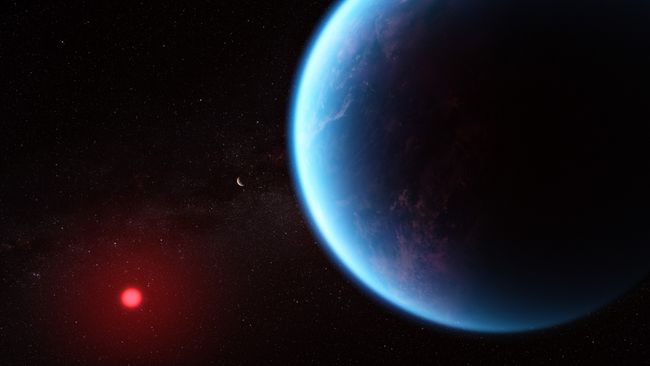
An illustration of what K2-18b may look like. Credit: NASA / ESA / CSA / Joseph Olmsted
The more recent findings come from a team at the University of Chicago led by Rafael Luque and Caroline Piaulet-Ghorayeb. Like Madhusudhan and his team at Cambridge University, the Chicago team used data on K2-18b gathered by the James Webb Space telescope (JWST). However, in a departure from the Cambridge team, Luque and his colleagues studied the data on the planet gathered by three separate instruments: the Fine Guidance Sensor and Near Infrared Imager and Slitless Spectrograph (FGS-NIRISS), the Near Infrared Spectrograph (NIRSpec) and the Mid-Infrared Instrument (MIRI) – the latter being the sole source of data used by the Cambridge team.
Combing the data from all three instruments helps ensure a consistent, planet-wide interpretation of K2-18b’s atmospheric spectrum, something that cannot be obtained simply by referencing the data from a single instrument. And in this case it appears that by only focusing on MIRI, the Cambridge team inferred a little too much in their study.
We reanalyzed the same JWST data used in the study published earlier this year, but in combination with other JWST observations of the same planet … We found that the stronger signal claimed in the 2025 observations is much weaker when all the data are combined. We never saw more than insignificant hints of either DMS or DMDS, and even these hints were not present in all data reductions.
Caroline Piaulet-Ghorayeb
Most particularly, the much broader set of spectrographic data gathered from the three instruments points to some of the results observed by Madhusudhan’s team could actually be produced entirely abiotically, without any DMS being present. The Chicago paper has yet to be peer-reviewed, but their methodology appears sufficient to roll back on any claims of organic activities taking place on K2-18b or within its atmosphere.
AAS Recognises Gene Kranz
The “original four” NASA Flight Directors. Back row, (l to r): Glynn Lunney and John Hodge. Bottom (l to r): Gene Kranz and Chris Kraft. Credit: NASA
He is particularly most well-known for his leadership of his White Team during the Apollo 11 Moon landing in 1969, and for leading the work to get the crew of Apollo 13 back to Earth safely when that mission faced disaster. As a result of the latter, Kranz and his entire White Team received the Presidential Medal of Freedom in 1970 as well as being immortalised in film and television (although the line “Failure is not an option” was not something Kranz ever said – he instead used it as the title for his 2000 autobiography; the quote was purely fiction and used in the 1995 Ron Howard film Apollo 13, which saw Ed Harris play Kranz).
His career at NASA ran from 1960 through 1994, during which he rose from Mission Control Procedures Officer to Director of Mission Operations. As a result, he has been the recipient of NASA’s own Distinguish Service Medal, Outstanding Leadership Medal and Exceptional Service Medal.
And he has now been similarly recognised by the American Astronautical Society, which on May 21st, 2025, named him the recipient of their 2024 Lifetime Achievement Award. Only presented every 10 years, the award recognises Kranz for his “exemplary leadership and a ‘must-never-fail’ style that ensured historic mission successes, empowered human space exploration, saved lives and inspired individuals around the world.”
The ceremony took place at the Johnson Space Centre, Houston, Texas, where Kranz was also able to revisit the place where he and his teams and colleagues made so much history: the Apollo Mission Operations Control Room (MOCR – pronounced Mo-kerr – NASA has to have an acronym for everything 🙂 ).
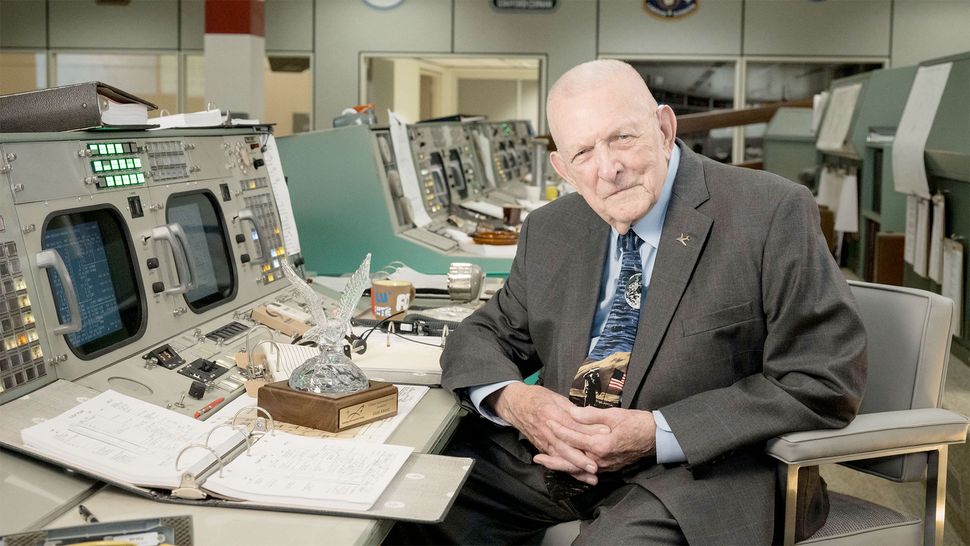
Gene Kranz, with his AAS Lifetime Achievement Award, seated at the restored console he occupied at the White Team Lead Flight Director, notably during the Apollo 11 and Apollo 13 missions. Credit: NASA
The latter had been recently restored as a direct result of a project initiated and driven by Kranz in 2017 in memory of Apollo and so many of his colleagues who have since passed away (the most recent, sadly, being Robert Edwin “Ed” Smylie whose team worked alongside Kranz’s White Team to make sure the Apollo 13 astronauts returned to Earth safely, and who passed away on April 21st, 2025). Fully deserving of the AAS award, Gene Kranz remains one of the stalwarts of NASA’s pioneering heydays.
A selection of the old-style Meadowbrook homes, soon to depart the gird, and one of their local community points, a swimming pool
As I’ve recently noted in writing about the release of the Aspen Linden Homes and new house styles for the Log Home theme (both themes being available to Premium and Premium Plus subscribers – read here and here for more), Linden Lab has started making renewed noises about retiring the “older” generation of Linden Homes, first introduced in 2010.
On Friday, May 2nd, 2025, the Lab further confirmed the upcoming closure of the older style of Linden Homes (all of which stand on 512 sq m parcels within their own theme mini-continent scattered across the grid), with a post entitled Honouring the Past, Embracing the Future: Your New Linden Home Awaits.
Clearly aimed at users who have not as yet made the move from these older themes and styles of home to the “modern” Homes on Bellisseria, the post reads in part:
As we continue evolving and improving the Linden Home experience, we want to ensure that our residents have access to the best and most modern living spaces available. A couple of years ago, during SLB, we announced our long-term plan to phase out all legacy Linden Homes. The time has come to make that transition, and while saying farewell to your current home may feel bittersweet, we are confident that the next chapter will bring even more possibilities, personalization, and comfort.
We also recognize the lasting impact these homes have had, and we are planning a special tribute to honour the legacy Linden Homes and the memories they have held. We will share more details soon.
Whilst no deadline is given in terms of how much longer the older Homes will remain on the grid, the post does tend to make it clear their days are now definitely numbered. I honestly have no idea as to how active people are / were when in terms of living-in and utilising these older Linden Homes, or exactly how much “community” they fostered. However, they do represent a point in time in SL’s history that is worth remembering in some way; many of us actually appreciated having them – as limited as they are by today’s standards!
However, what piqued my interest was the idea of “honouring” these older homes – and very much hope that whatever is planned goes beyond just the houses themselves. While I’ve no idea how popular the approach was, at least one of the little continents presenting these older Linden Homes carried with it something of a little “backstory” to Second Life; one likely utterly obscure in this day and age, but one my mind immediately sprang to on reading the Lab’s post.
Cape Ekim, May 2025
It’s called Cape Ekim, and the legend wrapped around it involves another mythical Linden explorer in the form of Professor Linden (totally overshadowed by the feats and ego of Magellan Linden – possibly because the Professor never survived long enough to be embodied in some manner!), and his hunt for a great and benevolent dragon said to have once roamed the grid.
It’s a fun little mystery (if one a little long in the tooth and genteel / pedestrian in this age of scripted Experiences, mesh, Animesh, and all the rest we can use in SL to create adventures and games), and one I wrote about more than a decade ago.
It may not tax the grey matter too much, but it does features riddles, books, secret passageways, and a cipher to solve to unlock a door (no pesky double-click TPing!), and is of an age and style that allow it to stand as a glimpse of SL’s past as much as the houses close to where it sits. As such, I really hope LL will give thought to the idea – and to any other similar spots which may exist within the old Linden Homes continents.
Cape Ekim, May 2025
Certainly, if the history of SL and nostalgia are your thing – and just in case it will soon vanish – why not try exploring / revisiting Cape Ekim for yourself?







 Inara Pey: Living in a Modemworld