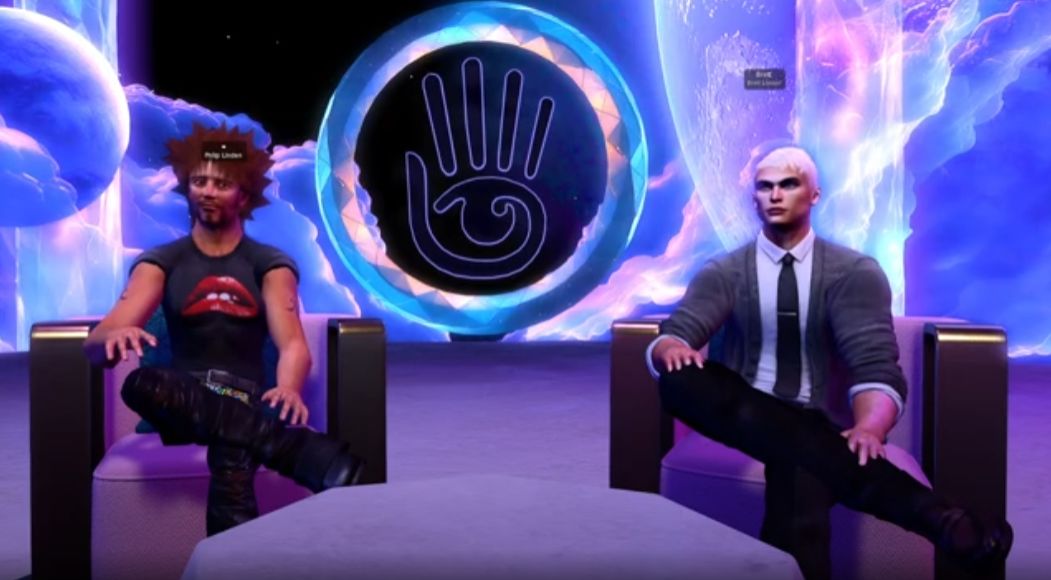
| On Wednesday, June 25th, 2025, Linden Lab held the second of the SL22B Meet the Lindens events, featuring Second Life and company founder, Philip Rosedale, in conversation with Brett Linden. The session was live and featured a mix of pre-submitted questions, and those asked during the session.
This is a summary of the majority of topics discussed at the session, and the official video of the session is embedded at the end of this article. Fore ease of reference:
|
Table of Contents
|
- In the hopes of better continuity, questions asked during the open Q&A session which related back to comments made earlier in the session have been incorporated within the topic section itself under the heading “From the Live Q&A Session”.
Note this is not intended to be a full transcript, but rather covers those items discussed which are liable to be of the most interest.
Personal Perspectives on SL and Working at LL
- Has been back working on Second Life full-time for some seven months. Prior to that, was sharing office space with LL, but was not working on SL day-to-day (that work was with In Reality Lab (IRL415).
- Obviously, for the first 10 years, was the CEO of Linden Lab.
- Recognises the company has 25 years of history and SL has changed a lot, but is delighted that overall, the technology LL has created / brought together is good, positive and humane for people, when as a whole within the industry, the overall impact of technology can be uncertain – or even negative (as with social media).
What is He Most Proud of with Second Life?
- Would say is he is not proud of anything he has created – but is proud of what people have created in SL.
- From the start, was always most interested to see what people would create in SL, and started out more from a physics perspective than a creator perspective: making various physics laws and then seeing what people created using those laws.
- Points specifically to:
- The volume of art produced within Second Life, and how it is exponentially larger than any single art museum.
- The number of teaching / learning spaces and all the various ways they are used.
- All the communities that have grown in SL – particularly their support for diversity.
- Is “super, super proud” of the positive feedback he receives from people about how SL has helped and changed them.
Is There a “Hidden Gem” in Second Life?
- Thinks Second Life has so many hidden gems. Second Life could be compared to Los Angeles, but has for more to discover within it than can be found in LA, so picking on a particular thing as a “hidden Gem” feels “goofy”.
- That said, would say that one thing he would like to see more of is the “sandbox experience”: people building and sharing together in sandboxes, becoming friends learning from one another, teaching one another.
- Does not believe LL has intentionally changed this, but the nature of the platform has simply drifted away from it. So while not a “hidden gem”, would like to see a move back towards it more.
From the Live Q&A Session
[Video: 52:41-54:54] In response to a comment that while he mention in-world building, Second Life has become more about building content outside of the platform and then “showcasing” it in-world, rather than fostering the arts of in-world creation, and asking if SL will “again” get tools to encourage the latter?
- Believes SL has always been a place for content creation, and believe it should remain so, but recognises a need to provide more tools for content creation.
- Notes that earliest content creation was prims, and most users learned to build using them. However, mesh is a more sophisticated means of content creation, which necessitated leaning on external building tools and then import the results.
- Were it possible, he would have some form on in-world mesh editing capability, but providing such would be difficult because of the complexities and capabilities of the toolsets involved (e.g. blender).
- Suggests that if SL is not supporting enough of the features of something like Blender in-world, then perhaps the Lab might need to figure out how to correct that.
[Video: 58:58-1:01:07] What is the one thing you would change in Second Life if you could?
- While there are lots of things he would like to change, the first thing that came to mind was better support for democracy and Groups.
- A lot of good work has been done with Groups, but when SL was started, Groups weren’t considered, nor were things like social media, as SL was supposed to be a place.
- Groups were one of the things that came out of SL that he didn’t really expect, and it has given him pause for thought on how self-governance tends to be done through Group membership.
- So sees making Groups stronger in terms of governance, democracy, identity and reputation, etc., as important, and as such, would liked to have considered Groups from the outset as a “kind of a fundamental all primitive in Second Life”.
On His Vision for Second Life (next few years)
- Second Life can do something really special – preserve diversity in an increasingly homogenous world.
- A lot of what is going on in the physical world – social media, AI, the geopolitical situation in many countries (notably, but not exclusively the United States) – is trying to make everyone in the world more similar and repressing differences between people.
- So in thinking about a “vision” for Second Lie, tends not to focus on a specific feature or reason for the platform, but the opportunities SL has to stand as a place that preserves diversity and differences, and the ways in which it can deliver on that.
On Expanding the User Base: Non-Verbal Communication Cues
- Find it amazing that SL has been around for 20+ years, and still represents probably the largest gathering of “grown-ups” in a virtual world.
- Recognises that SL is not for everybody and only a tiny fraction of a single percent of people are using it, whereas social media is used by a majority of people worldwide.
- Personally believes that to make SL more accessible to the majority is to get people comfortable with using SL through better transmission of nonverbal cues.
- Right now, an SL avatar is non-expressive in terms of what a person is expressing by way of hand-gestures, facial expression, etc.
- Such no-verbal cues are critical to communications, and in order to gain millions (or more) users, SL needs to be able to someday express them.
- Believes this is a particular reason why VR Chat has been so successful, because VR headsets allow more non-verbal cues on communication to be expressed.
- Obviously recognises there are other technical aspects of SL which need to be addressed: the complexity of the viewer UI, avatar dressing, etc., but to grow the user base, SL needs to get everyone more comfortable talking to people they don’t know by transmitting these non-verbal cues.
From the Live Q&A Session
[Video: 35:07-37:23] In response to a comment on the benefits of the asynchronicity of text chat, which many users prefer:
- Didn’t mean to dismiss other means of communication in Second Life such as text chat, avatar actions, etc., and totally values these means of communication.
- Rather, he meant that if two complete strangers are put together with Second Life, unable to physically see one another and their avatars their only means of communication / interaction, most will express discomfort at conversing with a stranger without the benefit of body language and non-verbal cues as to what the other person is thinking.
- So while the more “advanced” means of communications within Second Life are valuable, there are table stakes around getting people comfortable when they are conversing with strangers through non-verbal cues.
On Second Life and VR
- Bringing native VR headset support to SL is something the Lab is “always” thinking about. However, there are no current plans to do so.
- Has a deep respect for VR Chat in the way it has demonstrated how to build an experience like SL entirely for VR headsets – something he tried to do with High Fidelity, and recognises there are “amazing” experiences to be opened up by VR headsets.
- However, also recognises that VR headsets are not for everyone and they’re may not be particularly with people to whom something like Second Life appeals.
- As such feels the overlap between VR headsets and virtual worlds is not clear, but is by no means a 100% overlap.
- But again, does feel there are capabilities SL has which VR could “completely open up” (e.g. the already mentioned non-verbal communication cues).
- Also notes that some of this could possibly be achieved without the need for a VR headset, such as using a combination of AI tools and a webcam (or webcams) as a means of conveying non-verbal cues and controlling an avatar, without the need to put on a “face toaster”.
- So, does think VR support for SL is interesting, it’s just not something the Lab has any announcements about at this time.
On Second Life and AI “Taking Over”
- As a sophisticated technologist, and is very involved in AI, and is on the board of the California Institute for Machine Consciousness (AI), and so is doing a lot of work on AI outside of Second Life.
- Within Second Life, believes the Lab has been very cautious with regards to AI, and has tried to be respectful as to the risks and the debate about how to use AI.
- The Lab hasn’t “done anything broad” as yet with AI outside of a few experiments.
- Stated that any use of AI within Second Life “has got to end up by enhancing human contact not reducing it”, by helping people to connect to one another, and must do this “well”.
If AI can help with that, I’m all for it; if it hurts that, we shouldn’t do it. And as long as I’m here, I’m going to think I maintain precisely that position.
– Philip Rosedale on AI
- Outside of Second Life, thinks that AI offers “big possibilities, but also even more enormous risks”, and is going to cause some “necessary existential risk” which will cause “profound change” in the whole human population, and believes this will include:
- Forcing us as a planet-girdling species to change how we work together and do things.
- Potentially change our entire economic structures.
- As someone who programs a lot with AI, and as an engineer, is both shocked and excited about the potential impact of AI in the world whilst still trying to make sense of it.
- Returning to SL, believes the Lab is being “super cautious” and respectful of the risks that people have been raising.
From the Live Q&A Session
[Video: 41:31-47:10] On the use of AI Tools in Content Creation & managing the influx of copyrighted and potentially copyright-derived material produced using AI being upload to SL / the Marketplace.
- Notes that there are many different types of AI content, and that the general thinking among experts is that there is little hope of using AI tools to detect AI generated content.
- Given this, it would not be technically possible to add a “no AI” filter to the SL upload mechanisms; the technology is simply moving too fast, and would outstrip any such capability.
- That said, LL does respect the conversation going on around whether and to what extent and what should be the proper approach for AI should be.
- Believes that the wider global discussions on the use of AI are appropriate to be considered.
- Also feels that a lot of AI generated 3D content is so bad he doesn’t believe it would gain much of a foothold in SL compared to the content people are making, and that given the overall state of AI 3D content tools, doesn’t feel that at this point in time, it is not a major concern – although this could change.
- Points to his essay Ultravalletic Catastrophe and the potential for AI to completely overwhelm social media messaging due to its ability to impersonate people, which he sees as a major issue, and notes that this could result in fake AI “people” creating Second Life accounts, and we’re not even going to know it; so we’re all going to have to deal with the problem, and there’s not an easy way to just put a there’s not an easy way to put an AI filter on Second Life, even if everyone wanted one.
- Believes that with his background and LL’s geographic positioning, the company will probably figure out what to do “right” with AI.
On Inclusion and Accessibility
- Is particularly looking forward to the full deployment of the WebRTC (Real Time Communication) Voice service to replace Vivox.
- As well is improving Voice quality, this will allow:
- Speech-to-text and text-to-speech.
- Language translations.
- Thinks this can all be done later in 2025, with captioning (speech-to-text) and text-to-speech being the “number one” accessibility request of which he is aware.
On User Growth and Retention
- Notes that between Project Zero (the SL viewer in a browser) and SL Mobile, the Lab has been able to get 10 times as many people from the sign-up page and into SL compared to having to download and install the viewer.
- This looks to have doubled the number of people returning to SL after the first couple of times they initially log-in.
- Regards this as an important metric in allowing LL to further grow Second Life.
- Following-on from this, the focus is shifting towards
- The experience new users have after coming into Second Life.
- The whole dressing an avatar / changing an avatar’s appearance.
- Some of the latter has been initiated through the Avatar Welcome Packs, and will be expanded into the complexities of actually customising an avatar, with the aim of simplifying it – or at least making it “modestly difficult rather than almost impossibly difficult.”
- His own experiences in trying to create an avatar / look (see the videos here and here) have helped inform a design direction for the Lab to take, and so updates should be coming Soon to Welcome Areas.
From the Q&A Session: Project Zero
[Video: 37:24-38:51] Will Project Zero ever be free to those on lightweight hardware?
- The hope is to make it free at some point; currently, it is expansive to stream the viewer to a browser by the hour.
- So yes, longer term the hope is there, but right now, LL cannot offer it for free, and are focusing on offering it more to incoming new users rather than existing users – hence why some have not been unable to access it.
- Is optimistic about being able to offer it potentially for free because the rapid advances in AI are driving the price of GPUs down very fast, so there will be a crossover point which, once reached, will make more sense to offer Project Zero free to everybody, but things are not yet at that point.
On Creativity and Messaging / Policies and Supporting Creativity
- Agrees that maybe there are ways LL could do a better job to about what should be compelling to you as you’re coming to Second Life as a creator.
- Outside of for the “table stakes” of content creation: keeping fees low, the GDP stable, the ability to make money through content creation, etc., believes that adding creative features and capabilities is a mechanism for supporting creators.
- Specifically mentions:
- The server-side Second Life Lua (SLua) scripting language work, currently available on Aditi for testing, the Beta grid, and supported (at the time of writing) by a project viewer.
- Support for glTF mesh import, which is currently available (at the time of writing) within an initial release candidate viewer.
- Notes that support of glTF is important a) because it is a recognised standard and makes it easier to import from content creation tools into SL; b) support for the current mesh import format (COLLADA.DAE) is being increasingly deprecated within content creation tools.
- These are projected aimed for this year, and more broadly, notes the Lab needs to keep adding new (and modern) capabilities to support content creation.
On Prioritising Work
- There are often questions concerning how LL prioritises work, e.g. bug fixes vs. Stability vs. implementing new features. Part of this is because it’s a little harder to see what goes on behind the scenes.
- Feels that since his return full-time to SL, for any release and at any given time, around 75% of development time is toward infrastructure maintenance performance improvements and bug crashes and fixes, including (but not limited to): DDOS attacks; upgrading the platform on Amazon services. etc.
- So for the 50-ish strong development team, 75% at any time are working on “keeping the wheels on the car” and some 25% are working on “new shiny” features.
- [Video: 34:05-34:55] It is hard to keep Second Life running, but everyone at the Lab is doing good work, and there are not a lot of things the teams could just stop doing, which drives the 75%/25% split.
On Second Life Profitability
- SL has been fortunate as the mechanisms put in place (e.g. land fees) allowed the company to become profitable very early on – breaking even in around 2006.
- Since then, the company has been able to increase its profitability “a bit beyond that”. So yes, the company is “comfortably profitable”.
- This means the company will continue to be able to do what it has always done: set its own course. There is no critical market fit or monetisation problem requiring further funding from investors.
- As such, the company is able to sustain profitability and choose where it wants to take things next without having to worry about additional capital inflow.
Open Q&A Session
On Server Locations – Using Other Amazon Centres
- In theory should be relatively easy to move those servers which are most heavily used by a geographic region, but is not sure how much this has been looked into.
- Also notes the same is true for Project Zero – the servers running the viewer instances could be located in multiple Amazon centres. This is something that the Lab “should definitely do” as Project Zero starts to open up to more users.
On Users Helping Spread the Word about SL / Helping Improve the New User Experience
- With the company able to bring-in more people (via Project Zero / SL mobile, for example), the Lab needs help in figuring out how to make a newcomer’s experience in their first few minutes in SL “10 times better”.
- Is not sure exactly how users and communities can help LL to do this, but one way might be to experiment with different ideas and bring them to the Lab (e.g. develop an experience that would be comprehensible, compelling and interesting to a new user who has just arrived in SL).
- There are a couple of on-going programmes built around the new user experience, and those interested in helping are encouraged to join with those programmes.
- Has also ready noted the design challenge of helping people to more easily dress and customise their avatar, making it fun while also exposing them to SL content. To be effective, this work must involve changes to the software and to in-world content so a new user can more easily create an avatar that speaks to their needs.
On Spatial Audio in SL
- Spatial audio can be a pain in the posterior is that Bluetooth devices (including Apple) do not support stereo when the microphone is on. This means that spatial audio cannot be presented to the ears when the microphone is on.
- This has been one of the contributing factors as to why spatial audio hasn’t been more directly pursued within SL despite the environment being “amazing” for its use.
- Does believe that this issue will get fixed “in the next year or two”, and Bluetooth will support spatial audio correctly when microphones are on. When this happens, SL will definitely embrace everything that you can do with spatial audio; and you have to have spatial audio for group conversations to be comfortable.
On Bringing LindenWorld to Second Life
- Thinks it would be “wonderful” to have LindenWorld (the precursor to Second Life) in-world.
- Suggests that perhaps the “easiest” way to do this would be to have an intern who can focus on the project. However, the challenge would be to just get LindenWorld running again, as it did involve a different approach and a lot of user-generated content.
- Will explore whether or not it would be possible.
On SL Mobile and Future Plans
- Believes LL have created a strong asset with SL Mobile, which has Unity under the hood, giving LL access to the Unity renderer which could be used on the desktop and be a potential stepping-stone towards VR support and offers “solid base that we can use for a lot of stuff.”
- Understands that in the coming quarters there will be further improvements.
- Also,: please refer to:
- The Product and Engineering Meet the Lindens session.
- Mobile User Group summaries in this blog.
Closing Message to all of Second Life
Everybody here, all of us, should be proud to have been part of what is now more than 20 years of an experiment in demonstrating that online experiences, something you do online on your computer with other people can actually bring people together and make them happier and healthier. As opposed to making them lonelier and angrier, which sadly seems to be what we’ve done with most of our technological product time in the last decade or so…
And the hope that that gives to the world is something we all need right now … The whole world needs to see that you can use technology to bring us together; it is not just a force for evil. And so I think everybody here should be incredibly proud of having been part of that experiment and hopefully continuing to be a part of it indefinitely as we as we carry on so thank you.
Philip Rosedale