For those who have not already seen it, the next two weeks present an opportunity to witness a unique event – a very close conjunction between Jupiter and Saturn.
“Conjunction” is the term astronomers used to describe two astronomical objects or spacecraft having either the same right ascension or the same ecliptic longitude, and thus when seen from Earth, appear to be close together.
With the planets, such events are not especially rare – in fact as they and the Earth circle the Sun, conjunctions between Jupiter and Saturn tend to occur once every 20 years. However, most of these only see Jupiter and Saturn close to around one degree of one another, or about one-fifth the diameter of the Moon as seen from Earth. But sometimes they appear to get much closer, creating what is referred to as a “great conjunction”. This year, the two planets will appear to be just 6 arc minutes apart as seen from Earth on December 21st, 2020; so “close” (remembering that their respective orbits around the Sun will still be separated by 883 million km), they will almost, but not quite, appear as a single point of light when seen with the naked eye.
The great conjunction between Jupiter and Saturn,, tracked from October through to December 21st. Credit: Pete Lawrence
These “great conjunctions” occur, on average, once every 300-400 years, although such is the nature of orbital mechanics, they can actually occasionally occur more frequently, or have longer time gaps between them. As it is, the last time Jupiter and Saturn appeared as close as the will be between December 20th and 22nd was in 1623, not long after Galileo had observed both planets – although he was unable to witness the event, as the rising Sun would have rendered them invisible in its glare.
What is most rare is a close conjunction that occurs in our night time sky. I think it’s fair to say that such an event typically may occur just once in any one person’s lifetime, and I think ‘once in my lifetime’ is a pretty good test of whether something merits being labelled as rare or special.
Astronomer David Weintraub
However, the two planets can appear to be much closer. In 1226, and in the skies over the Mongol Empire, when the planets appear to be just 2 arc minutes apart.
Jupiter (again, the brighter object) and Saturn, seen in the sky over the Shenandoah National Park, Virginia, on December 13th, 2020. Credit: Bill Ingalls/NASA
Tracing these great conjunctions back in time reveals that Jupiter and Saturn may well have played a role in the legend of the Star of Bethlehem. In 7 B.C. not one, but three great conjunctions occurred, with the two planets again being within 2 arc minutes of one another as seen from Earth.
The first occurred in May of that year, when Jupiter and Saturn appeared as a morning star over the middle east. As the Magi were practitioners of (among other things) astronomy and astrology – both at that time pretty much joined at the hip – such an event may well have caused them to start out on their long journey towards Judea, the second conjunction, in September of the year, encouraging them to continue. The third conjunction occurred in December, 7 B.C., the time at which they were said to have met with Herod the Great.
Using Stellarium, open-source astronomy software, it is possible to reproduce how the great conjunctions of the 6th century B.C. might have looked to the Magi, as a wondrous new star, causing them to set out for Judea. Credit: Stellarium
This year’s conjunction will be not long after sunset, with the two planets located low over the south-west horizon. With a reasonable telescope or good pair of binoculars, you’ll have an ideal opportunity to see both planets and their major moons in the same field of view. Should you do so, you’ll be looking at over 90% of the planetary mass of the entire solar system.
Beyond the 21st, the two planets will gradually move “apart” as noted, until by the 25th December, they’ll be separated in the night sky by roughly the diameter of a full Moon, and will continue to draw apart relative to Earth as they pass below the horizon.
How to see the “great conjunction” of Jupiter an Saturn
And if you miss this close conjunction between the two, the next will be along in a relatively (and unusually) short period, occurring on March 15th 2080. The next time they’ll be as apparently close as they were in 7 B.C. will be on Christmas Day, 2874.
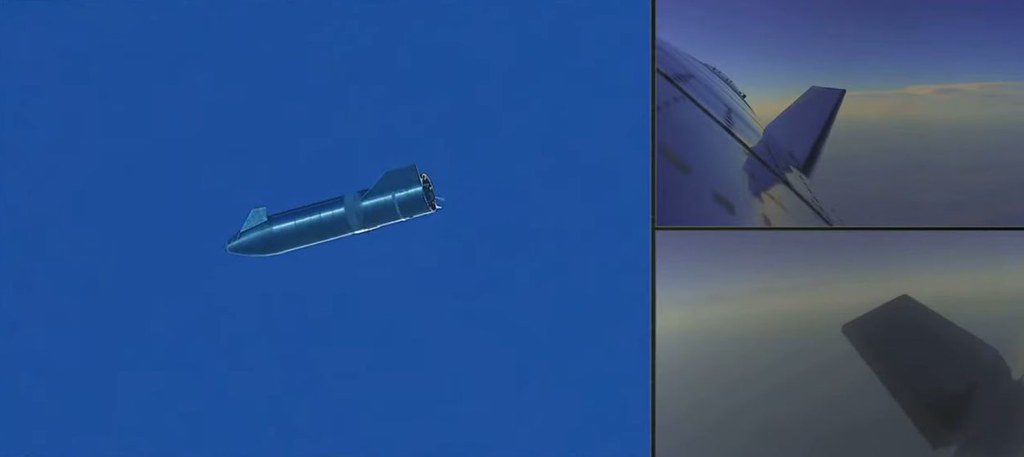
Starship prototype SN8 drops horizontally towards the ground after a flight to 12.5 km altitude, its stability maintained by the fore-and-aft wing flaps. Credit: SpaceX
On Wednesday, December 9th, SpaceX Starship prototype SN8 finally took to the skies in what was to be a very mixed ascent to around 12.5 km altitude and return to Earth.
The much anticipated flight of the prototype vehicle, weighing approximately 672 tonnes with its partial fuel load, was far more successful than SpaceX had anticipated, even if the vehicle was lost in what SpaceX euphemistically calls a “rapid unplanned disassembly” or RUD.
The first attempt at a launch of the 50m tall vehicle was made on Tuesday, December 8th; but this was scrubbed after a pre-flight engine issue caused an automatic shut-down on all three Raptor motors. The second launch attempt, in the morning of Wednesday, December 9th, was aborted just 2 minutes and 6 seconds before engine ignition when a light aircraft strayed into the no-fly zone around the SpaceX facilities in Boca Chica, Texas.
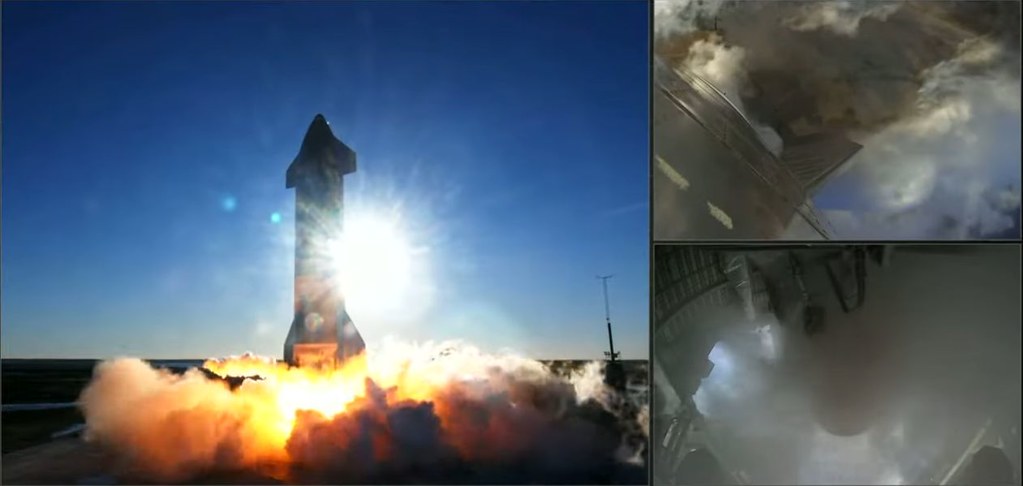
The moment of ignition caught by ground cameras (l) and camera on the hull of the vehicle (top r), and in the engine bay (bottom r). Credit: SpaceX
However, at 16:00 CST (22:00 GMT) that day, the countdown resumed, and at 16:45:26 p.m. CST (22:45:56 GMT), the three Raptor engines on the vehicle ignited and ran up to around 80% thrust, lifting prototype SN8 into the air.
The entire flight was live streamed by SpaceX, with the initial ascent proceeding as anticipated. At 1 minute and 40 seconds into the flight, one of the Raptor engines shut down and gimballed itself away from the remaining two operating motors. 94 second later, a second of the Raptors did the same. At the time, some pundits commenting on the flight speculated the shut-down indicated something was amiss.
The first of the Raptor engines shuts down – a planned part of the flight – as SN8 burns through its partial fuel load, so as to reduce its thrust-to-weight ratio. SpaceX
In actual fact, both engine shut-downs were planned. As the vehicle was flying with around 1/2 its normal fuel load, and getting lighter at the rate of 2.2 tonnes every second, the engines were shut down to reduce SN8’s thrust-to-weight ratio, naturally reducing its rate of ascent.
Even so, SN8 continued upwards under the thrust of the one remaining Raptor – Number 42, the latest and most modern Raptor engine evolution, with the vehicle’s reaction control system (RCS) firing thrusters around its hull in order to stay upright, until it reached a point where it was effectively hovering.
The moment of tip-over: SN8’s Raptor 42, assisted by the vehicle’s RCS thrusters, starts to tip the vehicle over into an horizontal orientation. Credit: SpaceX
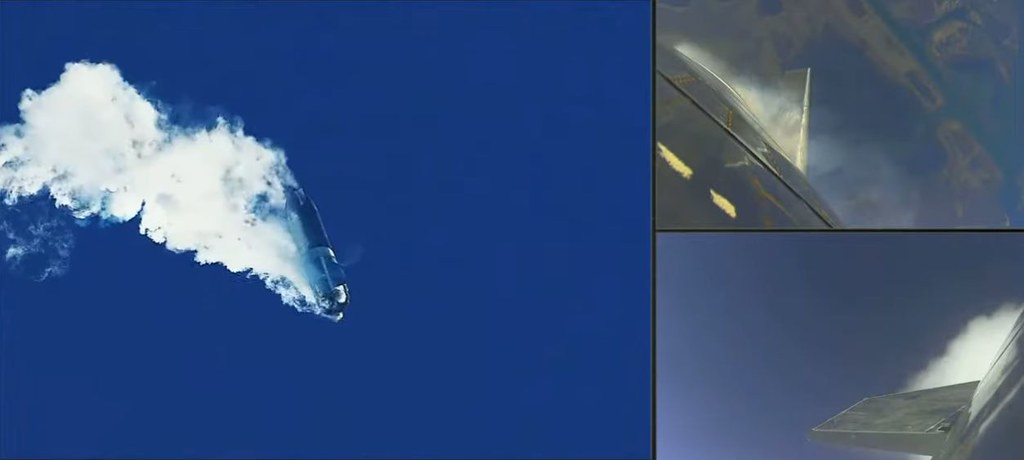
What happened next was one of the two most incredible sights witnessed in the testing of a space vehicle: as SN8 started to drop vertically backwards, Raptor 42 gimballed to direct its thrust at an angle, working with the RCS system to tip the entire vehicle over until it was falling more-or-less horizontally. At this point, the fore and aft flaps came into their own, working in tandem to hold the vehicle steady, much like a skydiver uses their arms and legs to maintain stability.
This skydive / bellyflop (as some unkindly refer to it) is how a Starship will make a return from orbit. Dropping into the atmosphere with the fore and aft flaps folded back against the hull to minimise their exposure to the fictional heat of atmospheric entry, an operational starship will be protected by heat shield tiles along its underside, after which the flaps fold out, acting as air brakes to slow the vehicle’s velocity as well as keeping it stable.
SN8 in its skydive mode (l) with exterior cameras (r) showing the forward (top) and aft (bottom) flaps in action. Credit: SpaceX
Dropping back through the atmosphere for almost two minutes, SN8 then completed the second most incredible sight seen in the testing of a spacecraft when, six minutes after launch, two of the Raptor motors re-ignited, using fuel from two small “header” tanks. These, coupled with the vehicle’s RCS tipped SN8 back to an upright position just 200 metres above ground.
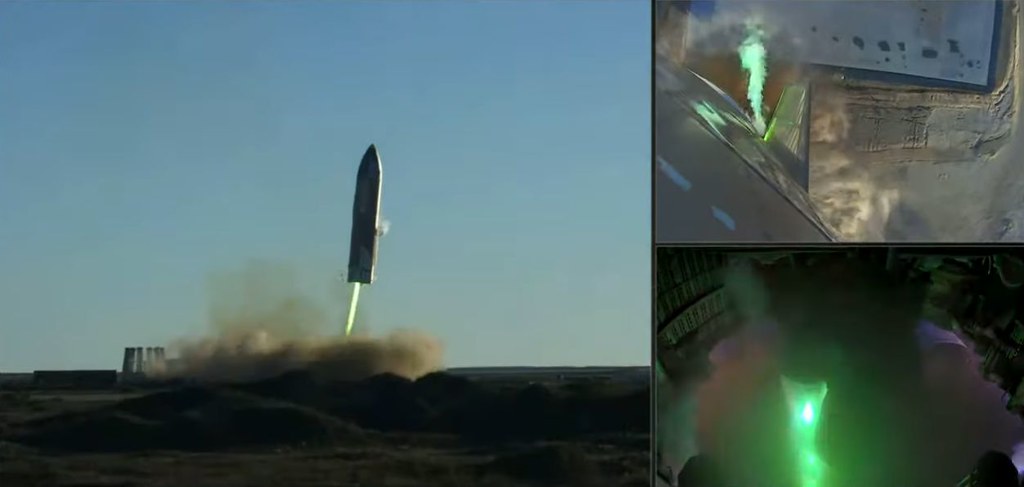
The idea had been for the vehicle to then descend tail-first over the landing pad, deploy its landing feet and touch-down. However, it was at this point things went wrong. With just tens of metres to go, one of the two operating engines shut down. For several seconds, the remaining engine fought to maintain vehicle stability, its exhaust plume turning bright green. Seconds later, its landing legs having failed to deploy, SN8 slammed into the landing pad and exploded in the RUD SpaceX thought might occur at some point in the flight.
The unusual green exhaust plume of the single remaining Raptor motor is clearly visible as SN8 almost overshoots the landing pad, and the failed deployment of the landing legs is visible in the image of vehicle. Three second later, the vehicle hit the landing pad and exploded. Credit: SpaceX
Initial analysis of data from the flight suggests that the header tanks suffered a pressurisation issue that prevented them pushing sufficient fuel into the two Raptor engines, causing one to shut down completely. The green plume from the second motor is thought to be one of two things: either that a) as the motor was so starved of fuel, it started consuming itself, material inside its turbopumps turning the exhaust green; or that b) as one engine shut-down unexpectedly, the second started gimballing wildly to try an maintain the vehicle’s orientation, and in doing so, smashed its engine bell into the other motor, exposing its copper cooling circuits, which caught fire and turned the exhaust plume green.
The Hyabusa2 sample return capsule, measuring just 40 cm across, lies amidst the scrub of Woomera, southern Australia, carrying samples from asteroid 162173 Ryugu. Credit: JAXA via AP
On Saturday, December 5th (Sunday December 6th local time in Australia), Japan’s Hyabusa2 successfully returned samples gathered from the asteroid 162173 Ryugu.
It marked the culmination of a six-year mission to reach the asteroid, gather samples and then make a return to Earth – although as I mentioned in my last Space Sunday update, the return of the samples does not mark the end of the road for Hyabusa2.
Travelling at 43,190 km/h – too fast to enter orbit – the spacecraft released the 40 cm sample return capsule on the night of Friday December 4th, 2020, whilst still some 220,000 km away. With its cargo duties discharged, Hyabusa2 performed an engine burn to start it on its way for a rendezvous with asteroid (98943) 2001 CC21 in 2026, before flying on to meet with 1998 KY26, in 2031.
With no means to slow down, the sample capsule slammed into the upper reaches of Earth’s atmosphere at 17:28 GMT on Saturday, December 5th (the earlier hours of Sunday December 6th in Japan and Australia). Following re-entry, that helped the capsule to slow to supersonic speeds, the capsule dropped to an altitude of 10 km before deploying its landing parachute, touching down in Australia at 17:47 GMT (04:17 a.m. local Australian time on December 6th), JAXA officials said.
Radio tracking systems deployed around the expected landing site were able to follow the capsule down allowing its landing point to be triangulated accurately so that recovery helicopters could quickly move in and retrieve the capsule and its cargo.
Following recovery, work started on capsule assessment and preparations to transfer it to the Japanese Space Agency’s (JAXA) Extraterrestrial Sample Curation Centre, a purpose-built facility designed to house and study cosmic material brought home by space missions. Here some of the samples – believed to measure just a few grams – will be studied by Japanese scientists, and some will be distributed to laboratories around the world, where scientists will study it for clues about the solar system’s early days and the rise of life on Earth.
The mission marks only the second time a dedicated sample return mission has brought samples of an extra-terrestrial body back to Earth, the first being the original Hyabusa mission, which returned samples from asteroid 25143 Itokawa in 2010. However, it will not be the last. China’s Chang’e 5 mission will shortly be on its way back to Earth with samples gathered from the Moon (see below for more), and NASA’s OSIRIS-REx will be returning samples from asteroid from 101955 Bennu in 2023.
Arecibo Collapses
When it came, it came suddenly and without warning – yet purely by chance, a drone was on hand to capture the event as it happened.
Cable break: a still from video footage recorded at the moment one of the two remaining primary cables supporting the 900-tonne receiving platform snapped, bringing about the destruction of the Arecibo radio astronomy telescope. Credit: UCF / NSF
I recently wrote about the fact that, having lost a primary and secondary support cable that were helping to keep its receiving platform aloft, the Arecibo observatory had been declared unsafe and was to be decommissioned, the replacement of the primary load-bearing cables – one of three in total – being determined to be both difficult and dangerous.
Due to the risk of the 900-tonne receiving platform collapsing onto the dish, built into a hilltop karst sinkhole, it had been hoped the telescope could be decommissioned and dismantled, possibly through the use of controlled demolition, sooner rather than later, lest further cables – including one of the two remaining primary cables – gave way.
But on December 1st, before decommissioning plans could be finalised, one of the remaining suffered a catastrophic failure, sending the receiving platform plummeting into the telescope’s 305-metre diameter dish.
The event took place shortly before 07:30 in the morning, local time – and by chance, engineers were monitoring the telescope’s cable system from the main control room and via an aerial drone positioned above the cable housings on the receiving platform when the cable failed. As a result, the entire collapse was caught on camera from two locations – although the drone had to be hastily moved away from the receiving platform as the collapse started.
Swinging towards the ground on the remaining support cables, the receiving platform disassembled as it fell, the bulk falling the 150m into the aluminium dish, the support frame swinging to smash into the the side of dish, the trailing cables also doing considerable damage. Such was the force of the failure, the mass of the platform tore away the top section of one of the support towers and brought about the complete collapse of another.
A rendering of Starship prototype SN8 in “belly flop” mode, returning to Earth after an ascent to 15 km and using the fore and aft flaps to steady itself like a skydiver uses their arms and legs. Credit: Bart Caldwell (aka Neopork)
It had been anticipated that mid-November would see the 15km flight of the SpaceX Starship prototype SN8. As I’d reported last month, that vehicle had completed its initial static fire tests before going on to be fully stacked with the intermediate ring and forward nose cone with aerodynamic canards.
Speculation had been that the test flight could come around the time of the SpaceX / NASA Crew-1 mission for Crew Dragon to the International Space Station which lifted-off from Kennedy Space Centre on Sunday November 15th (see: Space Sunday: a Dragon, a telescope and a heavenly princess). However, a final static fire test of the three Raptor engines during the week leading up to the possible launch window saw an issue occur, prompting SpaceX to place all launch plans on hold until the issue had been investigated and resolved.
The was done during the week following the 15th, and SpaceX has set the first part of the week commencing Monday, November 23rd as the target time frame for that static fire test, which eventually came on Tuesday, November 24th, when all of the vehicles fuel tanks – main and “header” tanks (the latter required to provide fuel to the engines during descent) – pressured prior to a 3-second and successful simultaneous firing of all three main engines.
The moment of ignition: with flaps folded back, Starship prototype SN8 fires its three Raptor engines in a pre-flight static fire test. Credit: Mary (aka BocaChicaGal)
Currently, documents filed with the Federal Aviation Authority (FAA) show that SpaceX have requested further road closures around their Boca Chica, Texa, test facility starting on Monday, November 30th – with Elon Musk indicating that this is likely to be the launch period for the vehicle.
The test flight itself is intended to test three core aspects of the vehicle’s flight envelope:
Powered ascent to altitude.
Controlled “belly flop” decent whilst horizontal, utilising the fore and aft flps to maintain stability and rate of descent.
Orientation to vertical during the final 100 metres or so, and descent to a tail-first landing under engine propulsion.
The flight comes with a high degree of risk – nothing quite like it has ever been attempted before – and SpaceX are anticipating only around a 33% chance of success, and that SN8 will in fact be lost in what they euphemistically refer to as an “unscheduled disassembly of the vehicle”.
However, Starship prototype SN9 is almost ready to start ground tests, and SN10 is following up behind it, meaning that if SN8 is lost, flight testing shouldn’t suffer too much of an interruption, and if the initial 15 km flight is successful, then SN9 and SN10 will be available to extend the testing programme such as flying to higher altitudes and / or flying with a full fuel load – SN8 will fly with its tanks carrying only the fuel to get to 15 km and then make a (hopefully) safe return and landing.
At the same time as work is continuing on the starship prototypes, SpaceX has also been engaged on the development of the test launch platform for the Super Heavy Booster and the assembly of components for what will be the first of these boosters, called simply BN1. Also appearing at the site is a mock-up of a section of the “lunar starship”, the vehicle SpaceX has put forward to help NASA in its plans to return humans to the Moon.
The SpaceX Boca Chica vehicle assembly area, complete with the new High Bay for stack the Super Heavy booster (right) and various vehicles and vehicle components. Credit RGV Aerial Photography
In terms of the Super Heavy booster, SpaceX appear to be reconsidering the idea of trying to bring such a massive beast back to Earth to land directly on the launch platform. While this would allow the company a shot at its so-called “fast turn-around” of the vehicle between launches, it also requires a high degree of pin-point accuracy on landing, and opens the launch mount to the risk of damage should any go awry with a returning booster. In a recent tweet on the subject, Musk indicated that the initial Super Heavy booster flights will aim to land the vehicles on the concrete apron alongside of the Boca Chica launch mount.
But it is not all good news for SpaceX, as the company has been informed it must undergo a new FAA environmental review and re-licensing specifically for the launch of the Super Heavy vehicles.
This is because at the time the original environment review took place in 2014, the license granted was for test flights of the Falcon 9 and Falcon Heavy, not the Starship or Super Heavy. The FAA allowed flight testing of the former to occur at the site, as it was deemed to pose no greater impact than flight testing either of the booster systems. However, with some 30 Raptor rocket motors powering it, the super Heavy is a significantly different proposition, particularly as SpaceX now intend to use Boca Chica not just as their test facility, but an operational launch facility – a move which has angered local environmental groups.
They went from proposing a few launches per year of an already field-tested rocket to ongoing experimentation of untested technology without doing the studies that would ensure environmental protection and public safety and without giving the local community a chance to have a say.
– Jim Chapman, president of Friends of the Wildlife Corridor
This has resulted in significant pressure on the FAA to carry out a new full review, called an Environmental Impact Statement (EIS), which could take up to two years to complete (from initial assessment through to drafting the report to debate and final report). Currently, it is not clear what impact this will have on the company’s plans for Super Heavy test flights.
Sunday, November 15th, 2020, 19:27 local the Crew-1 Falcon 9 booster lifts-off from Kennedy Space Centre’s Pad 39A.Credit: NASA
Sunday, November 15th saw the official start of a new era in low-Earth orbit space transportation with the launch of the NASA / SpaceX Crew-1 mission to the International Space.
Originally scheduled for launch on Saturday, November 14th, the Crew-1 mission was delayed due to weather causing concerns about the recovery of the Falcon 9 launch vehicle’s first stage. However, at 19:27 local time on Sunday (00:27 GMT on Monday, November 16th), the Falcon 9 topped by the Crew Dragon and its crew of four – NASA astronauts, Mike Hopkins, Victor Glover, Shannon Walker and Japanese astronaut Soichi Noguchi – lifted off from the SpaceX leased Pad 39A at Kennedy Space Centre, the first stage of the rocket making a successful return to Earth and landing aboard the autonomous drone ship Just Read The Instructions.
Resilience approaches the ISS on November 16th/17th 2020. Credit: NASA / SpaceX
Nine minutes after launch, the Crew Dragon capsule – named Resilience by the crew – achieved an initial orbit, and the crew followed a long tradition of space flight dating back to the first manned space mission, and revealed their “zero gee indicator”, a Baby Yoda plushy toy from the TV series, The Maldorian.
The use of toys and dolls as such indicators goes back to the flight of Yuri Gagarin and his flight aboard Vostok-1 in April 1961. Gagarin carried a small doll into orbit out of curiosity, as he wanted to see what floating in the micro-gravity of space looked like. However, his practice was copied by other Soviet cosmonauts, and in turn by NASA missions, with crews on the Crew Dragon continuing the tradition – Doug Hurley and Bob Behnken carried a plushy planet Earth on their trip to the ISS earlier in 2020 during the Crew Dragon certification flight.
While not confirmed, it is believed the selection of Baby Yoda was due to back-up crew member Kjell Lindgren. A long-time Star Wars fan, Lindgren had used a model of R2D2 as a zero-gee indicator during a 2015 Soyuz flight to the ISS and while aboard the station, persuaded the rest of the crew to dress up as Jedi Knights for a special NASA promotional poster.
It’s been a tough year. And the fact that … SpaceX and NASA were able to get our spacecraft ready to go, the rocket ready to go, throughout this year, throughout the pandemic, and all of that — we were inspired by everybody’s effort to do that. So that’s why we named Resilience, and we hope that it puts a smile on people’s faces, it brings hope to them. Baby Yoda does the same thing. I think everybody, when you see him, it’s hard not to smile, and so it just seemed appropriate.
– Mission commander Mike Hopkins explaining the choice of name for the Dragon
capsule and the selection of Baby Yoda as the zero-gee indicator.
A NASA graphic showing the craft docked at the ISS at the time the Resilience docked. Credit: NASA
It took some 27 hours for Resilience to catch up with the ISS, finally rendezvousing and docking with the station at 11:01 EST on Monday, November 16th (04:01 GMT, November 17th). Following a further 2 hours of post-flight checks and preparations both in the capsule and on the station, the forward hatch on Resilience was opened and the four crew were invited aboard the ISS. In doing so, they set a new record for the space station: the first time it has been occupied by full-time crew totalling seven people. This is actually one more person than the ISS is designed to accommodate, so Crew-1 commander Mike Hopkins is sleeping aboard the Resilience.
The Expedition 64 crew will remain on the ISS for a 6-month rotation period, Hopkins and his crew joining NASA astronaut Kate Rubins and Russian cosmonauts Sergey Ryzhikov and Sergey Kud-Sverchkov, who arrived at the ISS on October 14th, aboard the Soyuz MS-17 – a mission which was itself a record-setter, rendezvousing with the station just three hours after launch, utilising Russia’s “ultrafast” ISS launch and rendezvous flight plan for the first time.
Kate Robins, who arrived aboard ISS as a part of the Soyuz TM-17 crews, greets Victor Glover as he boards the ISS from Resilience, marking the first time an African-American astronauts has boarded the station as part of the full duration crew. Credit: NASAOnce aboard the station, the crew wasted little time in getting down to work. On November 18th, Ryzhikov – currently in overall command of the ISS – and Kud-Sverchkov made a 6-hour 48-minute spacewalk that inaugurated the operational use of the Poisk “mini research” module as an airlock.
As I noted in my previous Space Sunday update, Poisk has been delivered as an airlock / docking module in 2009. It is one of two such units attached to the Russian Zvezda module, the other being the Pirs airlock / dock, deployed to the ISS in 2001. Up until the Ryzhikov / Kud-Sverchkov EVA, Poisk had only been used as a docking module, spacewalks generally being conducted via the Pirs module.
Sergey Ryzhikov (centre top with the red stripe on his backpack) and Sergey Kud-Sverchkov work outside of the Poisk (the vertical unit) and Zvezdamodules of the ISS. Credit: Roscomos
However, Pirs is due to be removed from the ISS in 2021, so it can be de-orbited to burn up in the upper atmosphere using one of the Russian Progress resupply vehicles. It is due to be replaced by the Nauka Multipurpose Laboratory Module (MLM) – although there are some doubts about this module, as its launch has been delayed so much, several of its systems are at the end of their warranty period.
In particular, the Poisk spacewalk was to start the process of decommissioning Pirs, by moving vital communication equipment and cabling from that module and connecting them to Poisk, allowing it to become the primary Russian EVA airlock. As well as this work, Ryzhikov and Kud-Sverchkov retrieved hardware used to measure space debris impacts, and repositioned an instrument used to measure the residue from thruster firings. The EVA marked the 47th Russian space walk in support of ISS operations, and the 232nd ISS spacewalk overall.
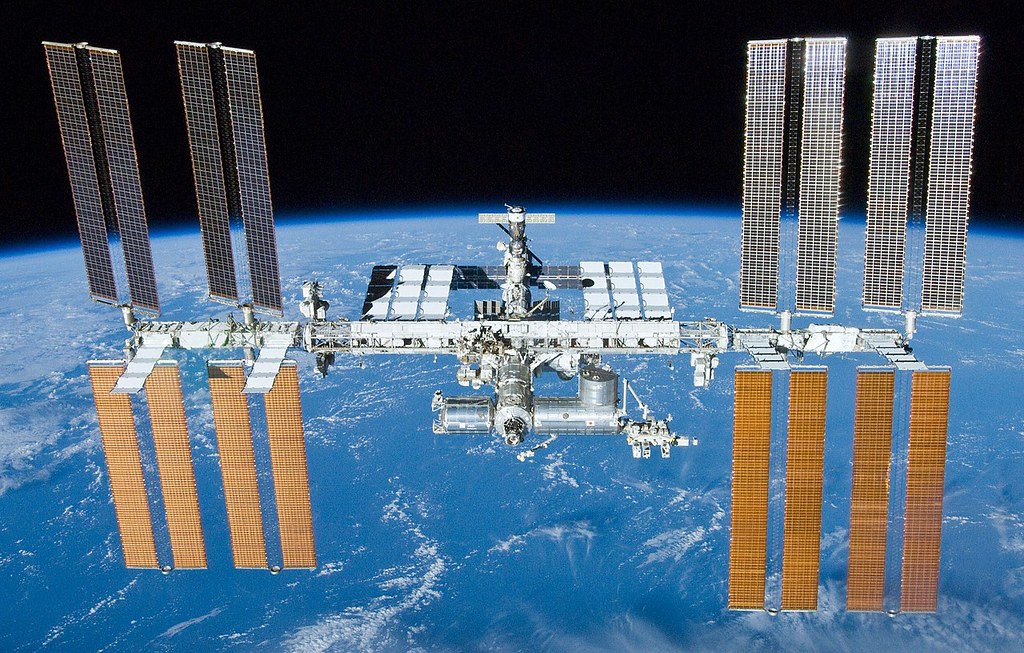
The International Space Station seen from the space shuttle Atlantis, May 23rd, 2010. The vertical gold / maroon panels are the solar panels for generating power; the white horizontal panels are the radiators for removing excess heat from the station. Credit: NASA
On October 21st, 2000, a Soyuz vehicle lifted-off from the Baikonur Cosmodrome in Kazakhstan en route for the fledgling International Space Station ISS, carrying two cosmonauts and an American astronaut. Sergei Krikalev, Yuri Gidzenko and William Shepherd were not the first people to visit the ISS, but when Soyuz TM-31docked with the station on November 2nd, they became the first official crew to live and work aboard it, and their arrival marked the start of 20 years of continuous occupation of the station.
At the time of the arrival of the Expedition 1 crew, the ISS was a small affair, the Russian-built Zarya propulsion, attitude control, communications and electrical power distribution module, launched in 1998; the American Unity module, intended to link future US and international modules on the station with the Russian units, delivered by the shuttle Endeavour in 1998; and the Russian Zvezda, which rendezvoused and docked with the station in July 2000.
The primary role of the Expedition 1 crew was to commission the ISS and its systems and to oversee the initial expansion of the station, with the assistance of two space shuttle flights. The first of these delivered the additional solar arrays to power the station, elements of the “keel” of the station (the Integrated Truss Structure), and the second the US Destiny research module. However, the work wasn’t all construction related: the three men also started the station’s long-running science programme that continues through to today. They also caused a slight controversy as they started work.
The ISS at the time of Expedition-1 crew. On the left is the Soyuz TM-31 vehicle the crew flew to the station aboard, docked against the Russian Zvezda module. In the middle is the Zarya module, the first module launched, and the US Destiny module to the right. This image was captured by the crew of STS-97 aboard the shuttle Endeavour, December 2000. Credit: NASA
The idea of a US space station has started to come together in the 1980s under the project title Space Station Freedom. This was later revised to Space Station Alpha before finally becoming the International Space Station following the signing of a US / Russian agreement to build a joint orbital facility. However, the “Alpha” name stuck with many at NASA, including Expedition 1 commander Shepherd, who insisted on using it – much to the consternation of Russian officials, who felt they had had the first space station in Salyut and Mir, so the new station was at best “Beta” (or better yet in their eyes, Mir -2).
Once aboard the station, and with the agreement of Krikalev and Gidzenko, Shepherd insisted on using “Alpha” as the station’s radio call sign, stating it was easier to say than “International Space Station” or “ISS”. Despite the annoyance on the part of Russia, “Alpha” continued to be used by the Expedition 1 crew, resulting in it being adopted as the station’s official radio call-sign.
As well as playing hosts to three space shuttle missions – the third of which delivered the Expedition-2 crew -, Shepherd Krikalev and Gidzenko also oversaw the start of re-supply missions using the Russian Progress vehicles (essentially fully automated Soyuz vehicles) capable of delivering around 2.4 tonnes of supplies and fuel to the ISS.
Following Expedition-1, the initial crews visiting the ISS were exclusively made up of Russian cosmonauts and American astronauts, with each crew spending, on average, 5-6 months on the station. It was not until June 2006 that the first international crew member boarded the ISS in the form of German astronaut Thomas Reiter. He was followed in 2008 by Frenchman Léopold Eyharts and Japan’s Koichi Wakata in 2009 (Wakata actually served a total of 5 Expedition crew rotations: 18, 19, 20 (all back-to-back and continuous) and 38 and 39 (again back-to-back). After this, crews routinely included one or more non-American / Russian astronaut.
The men who started it all: Sergei Krikalev, William Shepherd (centre) and Yuri Gidzenko: the Expedition-1 crew. Credit: Roscosmos
In the 20 years since Expedition-1, 240 individuals have made 395 flights to the ISS (including 7 “space tourists”) – a number that represents 43%of all human flights into space. In that time, the space station has grown from those initial three units to a total of 16 permanent pressurised modules, numerous unpressurised pallets and work stations, and one commercial unit, the Bigelow Expandable Activity Module (BEAM), an inflatable unit, currently configured as a storage space.
Outside of the Zarya, Zvezda, Unity and Destiny modules, the ISS comprises the following pressurised modules:
For science: the Columbus European module (added February 2008); the Japanese Kibō module (which, with its unpressurised work platform is the largest crewed elements of the ISS, added between 2008 and 2009); the Russian Rassvet module (now primarily used for storage, added May 2010).
Airlock / docking: the US Quest Joint Airlock, supporting EVAs using either US or Russian space suits (added July 2001); the Russian Pirs and Poisk airlock / docking modules (added September 2001 and November 2009, respectively, and connected to the Zvezda module); the US International Docking Adapters 2 and 3 (IDA-1 was lost in a Falcon 9 launch failure), delivered in 2016 and 2019 respectively.
Other modules: the US Harmony “hub node” connecting the European and Japanese science modules to the US Destiny module (added 2007); the European Tranquillity life-support and environmental module (added November 2009); the Leonardo European multi-purpose module (added February 2011) and the European Copula module, with its seven large windows (added in 2010).
Together, the pressurised modules of the ISS offer a volume of living / working space equitable to that of a 747 airliner. The overall mass of the ISS, including the Truss, and all unpressurised / external elements is approximately 425 tonnes.
Nor is this all: four more Russian modules are awaiting launch to the ISS: the Nauka Multipurpose Laboratory Module (MLM). Delayed since 2007, it is currently slated for a 2021 launch, but this may yet be cancelled as the warranties on several of the module’s system expire in later 2021; the Prichal “docking bell”, primarily intended to provide docking for two further power modules (SPM-1 and SPM-2) and for Soyuz / Progress docking. Prichal is slated for launch in late 2021, and the two SPM units in 2024.
Further commercial elements are also due to be added in the form of the Bishop Airlock Module, designed for the launch of cubesats from the station (and awaiting launch before the end of 2020), and the Axiom commercial node, due to be added in 2024.
The 2 decades of ISS operations has seen the amount of equipment deployed in the station increase. This is the console for operating one of the station’s 2 robot arms (located in the US Destiny module) which has become surrounded by a plethora of laptops and monitors that help monitor EVA operations. Credit: NASA
The living spaces on the ISS can support up to 6 crew at a time, although the standard crew complement outside of rotation periods, when two crews are operating side-by-side, has tended to be 3 (even when the shuttle was still operational). With the arrival of the SpaceX Crew Dragon and the Boeing Starliner, crews can now increase to 4-6, depending on requirements.
However, we’re not talking glitzy, hi-tech living. Despite its volume, the ISS is cramped; personal space is limited to a couple of cubic metres (mostly used to hang an astronaut’s sleeping bag), and “free” space has become increasingly overcrowded with the passing years as more and more equipment has been packed into the various modules.
The first Japanese astronaut to work aboard the ISS, Koichi Wakata, attempts to get some sleep during his fifth Expedition crew rotation (Expedition-39), which saw him take command of the ISS in 2014. Credit: NASA / JAXA
The lack of gravity means that almost any surface can be used as a floor, ceiling or wall, depending on a person’s orientation. However, to try to keep a general sense of orientation within the Russian modules, surfaces facing towards Earth are considered “down” and are coloured olive green; surfaces pointing away from Earth are considered “up”, and are painted beige. Perpendicular surfaces between them flow from the one colour to the other as you look “up” or “down”.
Doe to the lack of personal space, almost any “free” space on the structural walls / ceilings / floors of the various modules tend to become the home of personal and other mementos. One area of the Zvezda module, for example, has been turned into a corner for expressions of the Russian orthodox faith, and another a shrine to Russian heroes of space flight and discovery from Tsiolkovsky to Gagarin.
The two most popular areas of the station are the Harmony module, with its communal dining area, which is also used to celebrate birthdays, anniversaries, holidays, etc., and the European Copula, due to its unparalleled views out of its windows. Overall, however, life on the ISS is described as, “noisy, smelly [if your sinuses clear, as they are usually blocked due to the lack of gravity], dirty and awash with everything from human skin and floating globs of sweat [crew are expected to undertake around 2 hours of physical exercise a day] to the pencil you misplaced yesterday and which is now floating around in the air currents between modules,” with the noise being noted as the biggest issue.
The scientific range of the ISS has been, and remains, extensive. Human and life sciences space research includes the effects of long-term space exposure on the human body, testing medical systems and procedures specifically aimed towards supporting long-duration space missions (e.g. to Mars and back), zero-ego production of pharmaceuticals to help with ailments on Earth (the lack of gravity allows compounds to be mixed that would otherwise naturally separate). The broader aspects of life sciences have included the growth of unique protein crystals, and the evolution, development, growth and internal processes of plants and animals.
A second major area of research has been materials science. This has included the production of unique materials (again made possible due to the lack or gravity) or materials with a greater purity than can be achieved on Earth; energy production and clean energy alternatives. Astronomy and Earth sciences have formed a third leg of ISS science, with the former encompassing wide-ranging stellar and solar studies such as the impact of cosmic rays and the solar wind on out atmosphere, solar observations, research into dark matter, etc. Earth sciences have included climate change studies, monitoring ice melt, global pollution (including world-wide emissions of carbon gases and aerosols, etc.
The fourth aspect of ISS research is education and cultural outreach. This includes teaching and lecturing from orbit, working with Earth-based students by carrying out their experiments, etc. An amateur radio programme gives students from around the world the opportunity to contact the ISS and talk about science, technology, mathematics and engineering with the crew.
Research is split between the various science modules on the station, with some providing unique environments / facilities for specific research fields, others sharing larger research projects. The science programme can additionally be extended or supplemented through equipment and experiments carried up to the ISS via crewed and uncrewed vehicles.
The ISS in 2012: A – Zvezda; B – Zarya; C – Unity; D – Tranquillity; E – Quest; F – Destiny (under truss); G- Harmony; H – Kibō (with external experiments pallet); I – Columbus. Not visible: Rassvet and Leonardo. 1 – Soyuz vehicles; 2 – radiators; 3 – Integrated Truss; 4 – solar arrays. Credit: image – NASA / Roscosmos
Operating the ISS has not been easy. It is subject to numerous international agreements, has required the involvement of some 17 nations over the years (although Brazil has officially withdrawn from the programme), with 15 nations being original signatories to the ISS Intergovernmental Agreement. A total of 25 individual space agencies and centres around the world have a hand in managing ISS operations from the ground, with Russia and America providing the primary mission control centres and staff. These two countries are also responsible for carrying all crew to / from the station, and for the core missions to keep the station supplied with consumables, fuel, equipment, etc., although Japan also provides re-supply missions as well (as did the Europeans until their Automated Transfer Vehicle (ATV) programme came to an end).
Given the number of nations involved, there have inevitably been tensions from time-to-time, with perhaps the most famous being in 2009, when a disagreement between America and Russia resulted in Russian mission managers banning US personnel from using the toilets in the Russian modules and forbidding their cosmonauts from using toilets in the US modules!
Outside of odd bouts of tension on the ground, the main challenges in operating the ISS tend to be space-based. Several parts of the station are now ageing (the Zvezda module, whilst launched in 2000, was actually built in the 1980s, for example), so maintenance of the station, inside and out, accounts for a significant about of operational time. Stress on the structure as a whole means that there are often minor pressure / atmosphere leaks – which can be exacerbated by impacts with dust and tiny particles of debris, some of which can grow to be quite serious (but not life-threatening). There’s also the growing risk of collision with large pieces of orbital debris.
However, despite all this, the ISS today continues to be at the forefront of human space research, and can form an essential platform for research into crewed missions to Mars. It is estimated to cost US $7.5 million per crew member per day to operate the station – which, while expensive, is still less than half the anticipated cost set in 2000. Thanks to the US Senate and House finally giving approach, US funding for the station means it can now continue operating through to 2030.







 Inara Pey: Living in a Modemworld