Space Sunday: balloons, rockets, rovers, returns

A cabin at the edge of space. Credit: Space Perspective

Almost a year ago, I wrote about a company called Space Perspective and their plan to offer fare-paying passengers the chance to experience high-altitude balloon flights which, while failing to cross (or even come close to) the Kármán, will give the unique experience in rising to altitudes sufficient enough to witness the curvature of the Earth and see first-hand the tenuous nature of our protective atmosphere. And to do so in unique comfort.

As I reported in Space Sunday: balloons to space, Mars movies and alien water clouds, Space Perspective intend to offer passengers a six hour trip into the upper atmosphere aboard a luxury capsule slung beneath a gigantic helium balloon. And the price? US $125,000 per person – which sounds a lot, but is actually half that charged by Virgin Galactic for a flight lasting around 65 minutes, and who knows how much cheaper than a 12-minture trip aboard a Blue Origin New Shepherd vehicle.

A typical Space Perspective flight. Credit: Space Perspective

Obviously, both Virgin Galactic and Blue Origin have the added attractions of allowing passengers to experience microgravity for about three minutes and then collecting their (unofficial) astronaut wings on their return – neither of which are part of Space Perspective flights; which “only” rise to around 30-32 km. However, the watchword for Space Perspective trips is going to be a level of comfort well beyond anything Virgin Galactic or Blue Origin can achieve.

Just how much comfort has now been revealed by Space Perspective as they start to move ahead with the design of their full-scale Neptune capsule. In particular, the company has released a 3D interactive model of the capsule’s interior, demonstrating the 4 pairs of passenger seats located on other side of the capsule, the central bar / snack area alongside the access door.

The bar area and boarding door on Neptune. Credit: Space Perspective

In addition, the capsule has mood lighting and includes something necessary for a 6-hour flight: a lavatory (complete with its own window of its own so those needing it can continue to enjoy the view!). The passenger seats are designed to conform to the sitter’s body to offer maximum comfort and are fitted with fold-away tray tables. Potted plants add to the overall ambience while the floors and walls of the capsule covered in fabric to absorb sound and add to the sense of privacy.

Finally, the bar can be loaded with snacks and beverages in according with passenger’s preferences, whilst a central information display and wall-mounted tablets provide information on a flight. In addition the cabin will be equipped with wi-fi connectivity back to Earth, and heads-up displays may be included in the windows to help point out locations of interest visible beneath the clouds some 20 kilometres below the capsule as it cruises at altitude.

A view across Neptune, with the toilet on the left. Note to low-level lighting. Credit: Space Perspective

Flights will comprise a land-based launch From the Florida Space Coast with a 90-minute ascent to cruising altitude. The capsule will remain at its cruising altitude for around two hours before starting an equally gentle descent with a splashdown on water where the will be met by a support ship / yacht that will offer comfortable facilities to the passengers while the capsule is recovered, and then return them to land.

Should problems occur with the balloon during any phase of a trip, ground controllers can command the capsule to detach and drop aerodynamically to an altitude where parachutes can be deployed to slow the descent and cushion splashdown.

Space Perspective has recently secured a further US $40 million in funding to allow development of the full-scale Neptune capsule to proceed, and has secured the first of three hoped-for patents relating to the capsule’s unique structural design. In addition, the company states it already has 600 people who have paid for seats on flights, which are due to commence in 2024.

SLS: WDR Halted, Rocket to Return to VAB

In what is fast becoming something of a humiliating train of events in trying to get its first Space Launch System (SLS) rocket ready for launch, NASA has abandoned the critical wet dress rehearsal (WDR) and will be returning the rocket to the Vehicle Assembly Building (VAB) for a series of updates.

As I’ve reported over the last few week, the WDR is a last, critical step in ensuring the rocket and all its support systems – the mobile lunch platform, the propellant loading system, the launch control systems, etc., are ready to make a launch attempt. After been rolled out to launchpad 39B at Kennedy Space Centre, the WDR started on April 1st, and should have lasted three days.

However, that initial attempt had to be twice scrubbed as a result of issues within the supply of nitrogen gas (used to help purge and cool part of the launch system) to the vehicle. Correcting these issues took several days, prompting a further delay in resuming the test to make way for the launch of the Axiom Ax-1 private crew to the space station from the SpaceX facilities at neighbouring Pad 39A (see: AX-1 Artemis, ESA & a galaxy far, far away).

Launch Complex 39 at Kennedy Space Centre: in the foreground, the SpaceX / Axiom AX-1 stands on launch pad 39A. In the distance sits the NASA Artemis 1 SLS rocket on pad 39B. This picture was taken on April 6th, 2022. Credit: NASA

The intention had been to resume WDR processing on April 9th, but on April 7th, a fault was detected in pressure valve in the rocket’s upper Interim Cryogenic Propulsion Stage (ICPS). Rather than delay the test for at least a couple of months by returning the rocket back to the VAB to fix the faulty valve, NASA determined a process by which the test could continue with only “minimal loading” of the tanks on the ICPS, and pushed the resumption of the test back until at least April 12th to allow the necessary procedures to be properly revised.

Operations in fact resumed on April 14th – and almost immediately came to a halt due to propellent loading issues with the liquid oxygen. No sooner was this triaged and fixed than an over-pressure situation was detected within the liquid hydrogen tank, again bringing operations to a halt. After reviewing the situation again, NASA tried once more to resume propellant loading in a “modified” state, only for a hydrogen to be detected leaking from an umbilical line connecting the core stage to the mobile launch tower, again bringing operations to a halt.

The cause of the leak was found to be with the same nitrogen feed / purge system that caused the original problems at the start of the WDR process on April 1st. As a result, NASA announced late on April 16th that all WDR activities are now curtailed, and the rocket will be rolled back to the VAB to allow the problems with the nitrogen umbilical system to be addressed, and the valve in the ICPS to be fixed or replaced. The roll back will also be used to further investigate the liquid hydrogen over pressure issue on the core stage tank.

No date has been given on when the roll-back will occur  – there will be a further meeting to discuss this on April 18th. However, the move does mean that any Artemis 1 launch is unlikely to come before July at the earliest. However, to present further delays once the vehicle has been returned to the pad, mission managers are said to be considering – assuming the WDR runs flawlessly – moving directly from the test to launch readiness preparations without again returning the vehicle to the VAB for post-WDR inspections.

Continue reading “Space Sunday: balloons, rockets, rovers, returns”

Space Sunday: Ax-1 Artemis, ESA & a galaxy far, far, away

Crew Dragon Endeavour docked with the forward port on the US Harmony module at the ISS, and bearing the Axiom logo. Credit: NASA

The first entirely private sector mission to the International Space Station (ISS) lifted-off from the SpaceX Falcon launch facilities at Pad 39A, Kennedy Space Centre (KSC) on Friday April 8th, 2022, carrying a crew of four to the station aboard the Crew Dragon vehicle Endeavour.

The launch took place at 16:17 UTC, with the Falcon 9’s first stage making a flawless ascent prior to upper stage separation, then completing a boost-back manoeuvre and a successful return to Earth to land on one of the SpaceX autonomous drone ships. It marked the 5th successful flight for the core stage, which coincidentally was the same stage that launched the first all-private mission to Earth orbit – Inspiration4 (see: Space Sunday: Inspiration4 and Chinese flights) in September 2021.

Ax-1 has been seen by some as just another jolly jaunt into space by those who can afford it; however and in fairness, it is slightly more than that. Axiom Space was founded to create the world’s first commercial space station. While others have since entered this arena, Axiom has been granted access to the forward port of the ISS’ Harmony module, to which Axiom plans to dock the Axiom Orbital Segment; a complex that could grow to five pressurised modules after 2024.

Axiom’s plans for their space station (click for full size). Credit; Axiom Space

In order to help finance their plans, Axiom plan to offer a series of fare-paying flights to the ISS, with the 8-10 day Ax-1 being the first. However as a part of these flights, those paying for seats will also help Axiom pave the way towards their goal in bringing their first module to the ISS in 2024 and carry out a suite of selected on-orbit studies and experiments.

Commanding the mission is Michael López-Alegría, who was one of NASA’s most experienced astronauts prior to retiring in 2012. He holds the US record for the most EVAs undertaken by a NASA astronaut (10 totalling 67 hours and 40 minutes) and is also (and quite separately) licensed to officiate at wedding ceremonies. In 2017, he joined Axiom Space as their director of Business Development, and allowing him to regain his space flight status. Joining him on the mission are US entrepreneur  Larry Connor, Israeli businessman and former fighter pilot Eytan Stibbe and Canadian philanthropist and businessman Mark Pathy, each of whom paid an estimated US $55 million to join the mission.

The Ax-1 crew: from left – Larry Connor Mark Pathy Michael López-Alegría and Mark Pathy. Credit: Axiom Space / SpaceX
Endeavour took a gentle path up to the space station over a 20 hour flight; however, docking was delayed by some 45 minutes due to an issue with the video system used by the ISS crew to monitor docking operations.

Following post-docking checks, the hatches between Endeavour and the ISS were opened, and the Ax-1 team were welcomed aboard the station by the 7-person crew. During a brief ceremony-come-video press briefing, López-Alegría – who had become the first former astronaut to return to the ISS – presented his three fellow crew members with astronaut pins. Whilst not official US astronaut pins, those presented to Stibbe, Connors and Pathy have been designed by the Association of Space Explorers, which encompasses a lot of members from 38 different countries that have flown astronauts.

Alongside of their work in support of Axiom Space, the Ax-1 crew will take part in a multi-discipline science programme of some 25 different research experiments sponsored by the ISS U.S. National Laboratory in collaboration with the Mayo Clinic, the Cleveland Clinic, Canadian Space Agency, Montreal Children’s Hospital, Ramon Foundation (named for Ilan Ramon, the Israeli astronaut killed in the Space Shuttle Columbia disaster of 2003) and Israel Space Agency.

The Axiom Ax-1 crew (to the rear) with their ISS colleagues, around them in the foreground – counter-clockwise from right: NASA astronaut Tom Marshburn (holding the microphone) ; Roscosmos cosmonaut Oleg Artemyev (in the blue, centre); NASA astronaut Kayla Barron; cosmonauts Sergey Korsakov and Denis Matveev (floating); and upside down NASA astronauts Raja Chari and ESA astronaut Matthias Maurer. Credit: NASA

As a fully private mission to the ISS, Ax-1 not only features a non-government crew launched aboard a private sector space vehicle and rocket, it is also being managed through the SpaceX flight control centre, Hawthorne, California and Axiom’s own mission control centre in Houston, Texas.

Artemis WDR: Further Issues and Delay

The Wet Dress Rehearsal for the Artemis 1 Space Launch System (SLS) vehicle at KSC’s Pad 39B continues to hit niggling problems, with a resumption of testing now pushed back until April 12th.

As I noted in my previous Space Sunday report, while it had been hoped this full test of a launch countdown procedure, including fuelling the massive rocket’s liquid propellant tanks, could be completed in a 3-day period between April 1st and April 3rd, the test ran into a series of issues that caused efforts to be scrubbed on two occasions.

The issues were now with the rocket itself, which performed flawless during the tests up until the scrubs were each called, but with support systems within the vehicle’s mobile launch tower. However, after the second set of issues on April 3rd caused a scrub, the plan had been to investigate and correct the issue in time to resume the countdown on April 4th and complete the tests ahead of the launch of the SpaceX / Axiom Ax-1 mission reported above – a launch that had already been postponed from April 3rd.

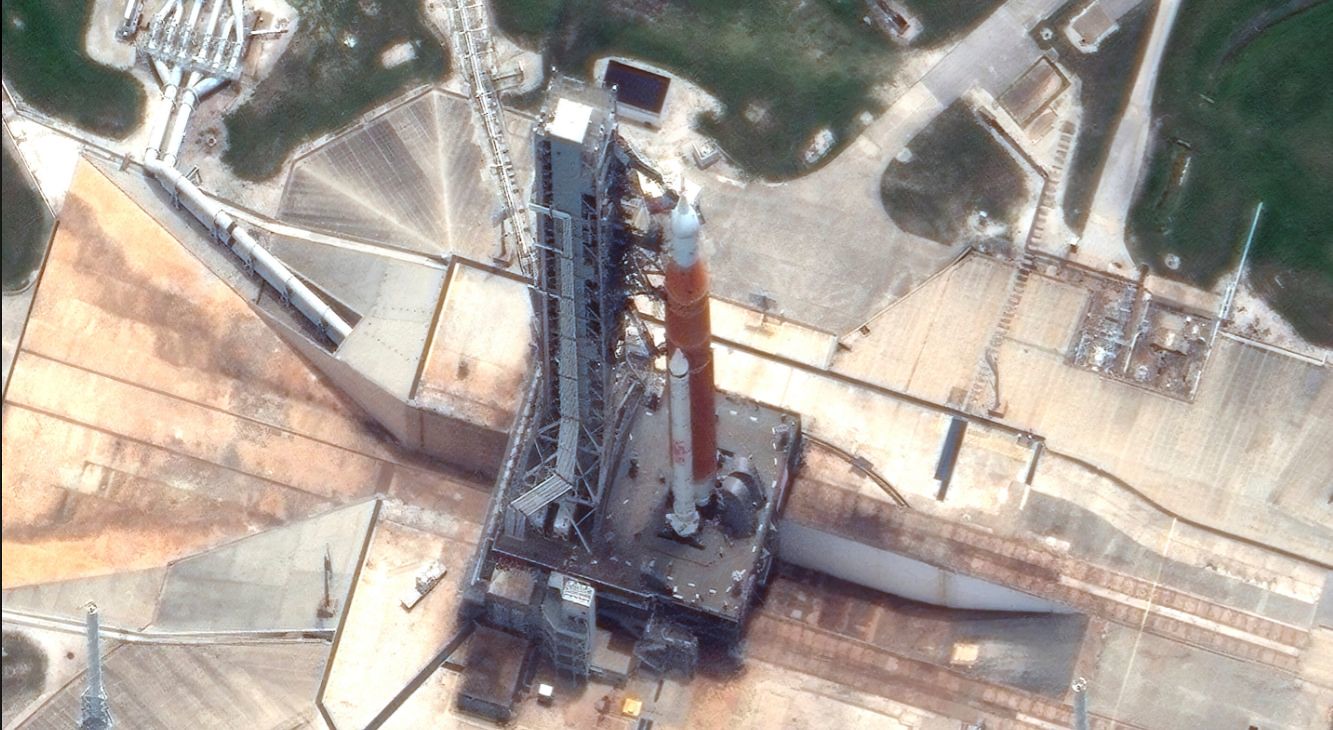
Artemis 1 and its mobile launch platform on Pad 39B at Kennedy Space Centre. Credit: NASA

As the investigations took longer than planned, on April 4th, the decision was taken to stand down WDR operations to allow the Ax-1 to go ahead, and to resume the tests on April 9th. But on April 7th, during a check on the rocket’s systems, engineers found a problem when trying to maintain helium purge pressure in the Interim Cryogenic Propulsion Stage (ICPS), the upper stage of the rocket itself.

The ICPS is based on the second stage of the Delta 4 launch vehicle. It uses a single RL10 engine to propelled the payload carrying section of the rocket – although it will be replaced by the more powerful and purpose-built Exploration Upper Stage from the third SLS flight (Artemis 4) onwards. This particular ICPS was one of the first to be completed, and had been in storage for several years awaiting the completion of the Artemis 1 core stage and boosters.

The Artemis 1 ICPS at Kennedy Space Centre, prior to its integration with the rest of the SLS rocket. Credit: NASA

The issue was traced to a check valve intended to prevent helium – used to purge propellant lines and drain propellant – from escaping the rocket., the valve failing to function as intended. To allow time for a possible fix for the problem to be developed and attempted, the decision was taken to push test resumption by to April 12th. Unfortunately, by April 9th, it became clear that the valve would need to be replaced; but rather than cancel the WDR completely, NASA has decided to complete the test as planned on the 12th – but to only perform a “minimum fill” of the ICPS tanks;  enough to prove the propellant loading system works. This, with a full load of the core stage tanks is seen as sufficient for the WDR to be completed.

Replacing the check valve will be carried out once the rocket has been returned to KSC’s Vehicle Assembly Building as a part of the post-WDR checks. However, this means that any chance of Artemis 1 making the hoped-for May launch window is now out of the question, whilst NASA is confident replacing the valve will correct the issue, it is also unlikely the turn-around can be completed in time for the rocket to make the June 6th through 16th launch window, potentially making July the earliest Artemis 1 launch opportunity.

Continue reading “Space Sunday: Ax-1 Artemis, ESA & a galaxy far, far, away”

Space Sunday: distant stars, sounds on Mars, a return and a rocket

The Artemis 1 Space Launch System (SLS) rocket stands on its mobile launch platform at Kennedy Space Centre’s Pad 39B, where it is undergoing a full wet dress rehearsal ahead of its launch later this year – see later in this article for more. Credit: NASA

The Furthest Star

My previous Space Sunday update ended with a note that NASA would be making an announcement at the end of March 2022 concerning a new discovery by the Hubble Space Telescope (HST) that could have repercussions for the James Webb Space Telescope (JWST), once it commences its scientific mission. Announced on March 30th, that discovery was revealed to be the imaging of the most distant individual star from Earth yet discovered. So distant, in fact, that it has taken the light from it 12.9 billion years to reach us. By contrast, the next oldest individual star we have detected using Hubble was born when the universe was already some 4 billion years old, taking 9 billion years to reach us.

Christened  Eärendel, the Old English term for “morning star” (and, as Tolkien fans like me will know, was the name initially given to the half-human, half-elven navigator, prior to Tolkien changing the name of that character to Earendil), the star was discovered as a part of a HST programme called RELICS -the REionisation LensIng Cluster Survey, intended to capture to light from really far distant objects born not long after the Big Bang.

To do this, RELICS employs the phenomenon of gravitational lensing, whereby the mass of a huge object such as a galaxy or cluster of galaxies bend and focuses the light coming from objects far beyond them, allowing us to see them as magnified, arc-like objects. In this case, a cluster of galaxies called WHL0137-08 was found to be lensing the light of a galaxy far beyond them, drawing the collected light of that galaxy out into a slender crescent Hubble could see and which astronomers nicknamed the Sunrise Arc.

The red arc of the Sunrise Arc galaxy, and within it, the single point of light of Eärendel. Credit: NASA, ESA, Brian Welch (JHU), Dan Coe (STScI)

For the most part, the Sunrise Arc is blurred and instinct, like sunlight diffracted by the ripples on the surface of a swimming pool cast blurred clouds of light on the bottom of the pool. However, by coincidence, at the time the images of the Arc were recorded, Eärendel appeared directly on, or extremely close to, a curve in space-time that provided maximum brightening, allowing its light to stand out as an individual point within the blurriness of the Sunrise Arc – just like some rays of light can strike the surface of a swimming pool at precisely the right moment to avoid diffraction by the surface ripples and form pinpoints of light on the bottom of the pool rather than being blurred.

Initially it was thought that the star might in fact be a cluster, rather than a lone star, but careful analysis of Eärendel ‘s red shift has swayed astronomers towards believing it is most likely just the one star (although the potential for it to be a binary system hasn’t been entirely ruled out) of enormous size at least 50 times the mass of the Sun and correspondingly enormous luminosity.

Such is Eärendel age, that it at the time its light departed it, the star was likely only made up of primordial hydrogen and helium following the Big Bang. This makes it a prime target for study by JWST – which thanks to is infra-red capability can pick out more information about a target object than HST -, as doing so could reveal more about the state of the early universe and early stellar development.

However, such is the nature of things that – whilst referring to the star in the present tense, it’s important to note that it is very likely that while the most distant individual star observed by HST, Eärendel is not the oldest star yet found; in fact, it probably no longer exists. This is because such supermassive stars tend to burn through their available fuel stocks in mere millions of years, rather than billions. It’s therefore very likely that at some point when the light captured by Hubble was still making its way towards us, Eärendel either violently exploded into a supernova, or collapsed into a black hole – something we’ll only know for sure a few million years into our future.

The Nature of Sound on Mars

We’re all familiar with the concept of the speed of sound. Here on Earth and at sea level, with the temperature at 20ºC, sound travels at 343 metres per second (m/s). However, that is not an absolute; it varies according to the relative atmospheric temperature and density. At altitudes up to 20 km, the speed of sound slowly declines due to the thinning of the atmosphere; however, above 20 km, whilst the atmosphere continues to thin, its temperature actually increases, making it more excitable, and so the speed of sound increases once more.

Much the same was thought to be true on Mars, where the relatively thin atmospheric density close to the surface of the planet was thought to limit sound waves to around an average of 240 m/s (again, allowing for variations in temperature).  However, what no-one expected was that the speed of sound would vary according to frequency – but that is what the Mars 2020 mission has revealed.

An international team of scientists reached this conclusion after analysing recordings made by one of two microphones mounted on the Perseverance rover. The SuperCam microphone mounted at the top of the rover’s mast is somewhat directional in nature in that turning / tilting the SuperCam unit allows the microphone to be pointed directly at sound sources, allowing it to record them with a good level of fidelity.

The Mars 2020 rover’s SuperCam system with the “directional” microphone highlighted. Credit: NASA/JPL

This is been done a number of time during the rover’s mission. For example, the camera has been pointed towards the Ingenuity Mars helicopter, allowing it to directly record the low-frequency beating of the helicopter’s rotors. It is also naturally pointing at rockets targeted for “zapping” by SuperCam’s laser. It has also been able to listen to tools and equipment operating at the end of the rover’s robot arm. All of these sounds have now been collectively analysed, and scientist have been surprised to find that while lower frequency sounds – such as the beating of Ingenuity’s rotors – travel at the expected Martian average of 240 m/s, sounds at frequencies greater then 240 Hertz, such as the higher-pitched click-click-clicking of the SuperCam laser actually travel around 10 m/s faster – the first time this has ever been observed.

The cause for this unusual difference is thought to be the result of the Martian atmosphere being largely carbon-dioxide. In studying the tenuous Martian atmosphere, scientists have discovered during the day, the heat of the Sun, deflected as it is by the surface of the planet, generates an unusual turbulence in the first 10 km of atmosphere above the planet. This turbulence has an unusual impact on the carbon dioxide that isn’t seen in Earth’s denser atmosphere: it allows higher frequency sounds to excite the carbon dioxide molecules a lot more than low-frequency sounds, allowing such higher frequencies to be more rapidly transmitted through the atmospheric medium.

Because this effect happens almost smack in the middle of the bandwidth of sounds audible to the human ear, it means that if we were able to stand out in the open on Mars and listen to something like a symphony being played a few 10 of metres away, rather than hearing all the notes collectively as we would on Earth, we’d hear the higher notes a second or so ahead of the lower notes, resulting in a discordant mess. However, a more practical outcome of this discovery is that engineers believe that by listening to the different frequencies within the sounds made by various pieces of audible equipment on the rover, they could potentially identify if that part of the rover is experiencing issues, and thus be forewarned that action might be required well before a potential failure occurs.

Continue reading “Space Sunday: distant stars, sounds on Mars, a return and a rocket”

Space Sunday: Starship, ExoMars and sundry news

What it might look like: an animation of the first Starship orbital flight. Credit: C-Bass Production / Neopork

Such is the pace of development, the first orbital flight of the SpaceX Starship / Super Heavy combination will now not take place as originally planned.

It had been thought that the flight, which has been repeatedly delayed for a number of factors, including slippages in the Federal Aviation Administration being able to publish the final version of its study into the impact of SpaceX’s operations in Boca Chica on the surrounding environment, would be made by Starship No. 20 (“Ship 20”), and Super Heavy booster No 4 (Booster 4), both of which have been going through a wide range of cryogenic and static fire tests since mid-2021, the most recent of the cryogenic tests occurring just over a week and a half ago, with both vehicles stacked together on the launch platform.

However, on Saturday, March 22nd, Starship 20 was “destacked” from Booster 4 and removed from the orbital launch facilities, and 24 hours later, Booster 4 was also removed, with Elon Musk Tweeting that neither would now play a role in the first orbital flight attempt. The reason for this is simple: work on developing and enhancing the design of both the Starship vehicle and the Super Heavy booster now means that Booster 4 and Ship 20 are essentially obsolete.

March 22nd, 2022: Mechazilla on the orbital support tower lowers Starship 20 following its disconnect from Booster 4. Credit: NASA Spaceflight

The major cause for this is that – despite a scary e-mail from Musk at the end of 2021 stating SpaceX could go bankrupt if issues with the powerful Raptor 2 engine were not quickly sorted out and production ramped – the company is now solely focused on boosters and ships built to mount the much more compact Raptor 2 motors, the sea level versions of which (primarily used to power Super Heavy, but three are also used in each Starship) are considerably smaller and less complicated than their Raptor 1 cousins, and generate far more thrust (from 230 to 250 tonnes per Raptor 2 compared to a maximum 185 tonnes for a Raptor 1).

Left: a sea-level Raptor 2 engine compared to its much larger Raptor 1 equivalent. Credit: Nic Ansuni / NASA Spaceflight

The more compact size of the Raptor 2 makes it possible for SpaceX to increase the total compliment of engines on a Super Heavy from 29 to the planned 33. The reduction in their complexity also makes all of the plumbing required  to feed them propellants and the electronics needed to control them  a lot easier to manage. For starship vehicles, the smaller Raptor 2 motors should make it easier to increase the number of engines from 6 to the planned 9 (3 sea-level and 6 vacuum engines with their much large exhaust bells).

Booster 7 and Ship 24 are also the first of each design to incorporate other critical design changes. Some of these are to easy the fabrication and assembly process, others are to help improve performance or meet the demands of having more engines, and still other to improve aerodynamics.

In the case of the Super Heavy booster, one of the cleverest – and most visible – changes is in the number and positioning of the Composite Overwrapped Pressure Vessels (COPVs).

COPV are tanks of hydrogen used in the ignition process for the outer ring of Raptor motors on a Super Heavy. With Booster 4, four pairs of COPVs were placed equidistantly around the base of the booster, covered by steel aeroshells.

However, with the increased number of Raptor engines, Booster 7 and those that follow it require 10 COPVs each. Were the extra two COPV to be paired at the base of the rocket, they would work with the other four pairs to disrupt airflow over the tail of the booster during ascent, generating both drag and potential buffeting / vibration.

To prevent this, Booster 7 is the first Super Heavy to have the COPV stacked vertically along its sides in two sets of five. Not only does this remove the risk of additional drag / buffeting during ascent, it also simplifies the overall plumbing to supply hydrogen to the Raptors, as each set of 5 can use common feedlines down the the engines. However, what is particularly clever is that offsetting each stack of COPVs slightly from the rocket’s centreline, their aerodynamic covers can actually help generate a degree of lift around the base of the rocket during its descent back through the atmosphere, helping to both slow it and provide a greater degree of control during the descent.

The COPV changes: left, as they were on Booster 4, and as they are on Booster 7. Credit: Brendan Lewis / ChameleonCir

As it is the closest to completion, Starship 24 would appear to be the primary candidate for joining booster 7 on the orbital flight attempt (work on ships 21 through 23 having been abandoned / bypassed) – but this far from certain. Recent work on the vehicle has seen it installed with a small prototype payload bay door, suggesting it has been earmarked for a payload bay test flight, something yet to be scheduled. As such, it is possible that Ship 25, also being assembled at Boca Chica, might be selected for the first orbital attempt.

Although the switch to using more recent versions of Super Heavy and Starship means that the first orbital flight attempt is now unlikely to occur before late May 2022, when it does happen, it will allow SpaceX to gather more relevant data on vehicle performance, which should help benefit the programme overall. It also means that by the time the booster / ship combination is ready to go, the FAA’s report on its environmental review of the Boca Chica site should have been published (the release date was recently pushed back again from the end of March to the end of April), and SpaceX should be in a position to know whether or not they are to be granted a licence for their orbital launches from the site.

Continue reading “Space Sunday: Starship, ExoMars and sundry news”

Space Sunday: a big rocket, a telescope & yellow and blue

Artemis 1: the SLS rolls slowly out of the Vehicle Assembly Building (VAB) and out to pad 39B at Kennedy Space Centre. Credit: NASA / Artemis- 

NASA has rolled out the first of what is intended to be both the first of its new “super rocket”, the Space Launch System, and the vehicle to start the United States and its international partners on the road back to the Moon.

At 21:47 UTC on March 17th, the huge rocket, mounted on its mobile launch platform, slowly crept out of one of the high bays of the Vehicle Assembly Building (VAB), the iconic cube sitting within NASA’s Kennedy Space Centre which was used as an integral part of Project Apollo and which is now fulfilling a similar role for Project Artemis, on the back of a massive crawler-transporter at the start of a 6.72 km journey to Kennedy Space Centre’s Lunch Complex pad 39B.

It was not a swift journey, taking some 11 hours to complete  – albeit with stops along the way for checks to be carried out – the crawler-transporter finally reaching the top of the incline of the launch pad 04:15 UTC on Friday, March 18th.

The move of the rocket from VAB to pad was not in readiness for the launch of Artemis 1 – the mission this SLS vehicle will carry to orbit – but rather for the final series of tests to be carried out on the fully integrated rocket and its Orion Multi-Purpose Crew Vehicle (MPCV) payload to ensure both are ready for that launch, which is currently set for a provisional window in mid-May 2022.

Another view of Artemis 1 SLS emerging on its mobile launch platform from the VAB at Kennedy Space Centre. Credit: NASA / Artemis 1

As I noted in my last Space Sunday update, the focus of these tests will be a full wet dress rehearsal, due to take place in April. This will see the rocket fully fuelled and go through a full launch countdown that will stop just nine seconds prior to an actual launch. The intention is to make sure everything with the rocket, the payload and the launch systems are all ready for a launch attempt, and will be followed by a further 8-9 days of additional pad tests. After this, the rocket will be returned to the VAB and assessed ready for final flight clearance.

When it does take flight, SLS will become the most powerful launch system built by NASA. The Block 1 vehicle being capable of delivering up to 95 tonnes to low Earth orbit, and the upcoming Block 1B up to 105 tonnes, and the future Block 2 vehicle up to 130 tonnes – putting it in the same lifting class as SpaceX’s Starship / Super Heavy launch system, but potentially far more flexible in turns of specialised launches, SLS being capable of launching smaller payloads (e.g. 23-45 tonnes, depending on the launcher variant) directly to the Moon, or other payloads out into the solar system without any need for on-orbit refuelling.

However, as I’ve noted before, there are some significant cost issues for SLS that may impact its use, the most notable being that of ongoing costs. Development work on the SLS system has thus far eaten US $23.01 billion, and while NASA would claim a lot of that (US $14 billion) has gone directly into work creation, it nevertheless means that as a non-reusable system, SLS is terribly expensive: NASA’s own Office of Inspector General (OIG) estimates each launch will cost some US $4 billion, twice NASA’s launch cost estimate, and will never fall below US $1 billion as the agency has suggested.

This cost factor has already seen NASA turn to other launch systems for missions originally earmarked for SLS. The Europa Clipper mission, for example, has been move to a SpaceX Falcon Heavy launcher on the ground of launch costs (and the fact that SLS generates so much vibration at launch, it is unsuitable to fly certain sensitive instruments into space).

As it is, five SLS missions in support for Artemis have thus far been confirm, with vehicles for three more after Artemis 1 already under construction:

  • Artemis 1: uncrewed mission to cislunar space to test the Orion MPCV; duration: some 25.5 days – mid 2022.
  • Artemis 2: crewed mission to lunar orbit; duration: 10 days – 2024.
  • Artemis 3: crewed lunar obit / lunar landing mission; duration:30 days – 2025/26:
  • Artemis 4: crewed mission to a lunar near-rectilinear halo orbit (NRHO) in support of the Lunar Gateway station and the core I-HAB deployment – 2026/27
  • Artemis 5: crewed mission to a lunar near-rectilinear halo orbit(NRHO) in support of the Lunar Gateway station and the European System Providing Refuelling, Infrastructure and Telecommunications (ESPRIT) module, together with a lunar surface mission – 2027-28.

Starship HLS: NASA Updates

A further key component for Project Artemis is the Human Landing System (HLS), the vehicle that will be used to transfer crews between lunar orbit and the surface of the Moon and (initially) provide them with living space whilst on the Moon. Currently, only one contract has been issued for HLS, and as I’ve noted before, it is to SpaceX for the use of a lunar variant of their Starship vehicle, although the agency has more recently been order to acquire HLS vehicles from other sources.

As a part of their Artemis HLS update, NASA provides images of astronauts working with prototype elements that will be used within the vehicle, which SpaceX are due to build. Credit: NASA

Coinciding with the SLS roll-out at Kennedy Space Centre, NASA issued an update on the SpaceX HLS programme, including the work going into some key elements, such as the elevator that will carry the 2-person crew of Artemis 3 the 30-40 metres down the side of the vehicle to the Moon’s surface and back after landing, together with the airlock through which they’ll leave / enter HLS during surface operations and some of the living / working facilities inside the vehicle.

The update also confirms that HLS will require some six starship / super heavy launches:

  • The launch of a special “tanker” Starship that will be parked in Earth orbit and used for a wide range of Starship propellant transfer operations.
  • Four further launches of re-usable Starship vehicles equipped with additional fuel tanks that will carry propellants to be transferred to the orbital “tanker”.
  • The HLS starship itself and the cargo needed for Artemis 3. This will dock with the “tanker” and take fuel from it that can be used to boost the HLS vehicle to lunar orbit and to both land it on the Moon and then get it back to lunar orbit.
Artemis 3 / HLS operations concept graphic. Credit: NASA

Once the HLS is in lunar orbit, the 4-person Artemis 3 crew will then launch to the Moon aboard an Orion MPCV lifted by SLS, and rendezvous with HLS so two can transfer to it and then travel to / from the lunar south pole. After transferring back to Orion, the crew will return to Earth, leaving the HLS starship in lunar orbit, potentially with either fuel to be used by the crew of Artemis 5, the second lunar landing mission.

However, whilst SpaceX HLS is earmarked for this mission (and will likely be the only HLS craft capable of supporting Artemis 5 in 2027/28), some in Congress are pushing NASA to use an alternative HLS design for the second lunar landing (which is which Artemis 4 was switched from a join lunar gateway / lunar landing mission to being solely a lunar gateway mission.

Continue reading “Space Sunday: a big rocket, a telescope & yellow and blue”

Space Sunday: space stations, politics and Artemis 1

The International Space Station. Credit: NASA

The war in Ukraine continues to have repercussions in international space activities. some of them somewhat bizarre in nature.

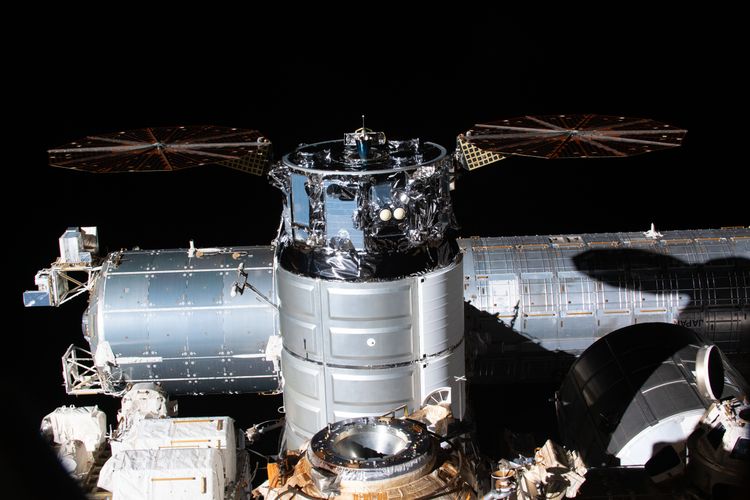
In particular, the head of Roscosmos and noted Putin hardliner, Dmitry Rogozin has been putting out a series of tweets that have been increasingly threatening – in my previous Space Sunday update, I noted that Rogozin had threatened to allow the International Space Station ISS to slip into an uncontrolled de-orbit and potentially crash into a Western city (since the shuttle’s retirement, Russian Progress re-supply vehicles have been used to routinely boost the station’s orbit as drag with the upper reaches of Earth’s atmosphere), despite the fact the multiple means by which the United States can boost the station’s orbit. In fact, NASA is planning a test using the current Cygnus NG-17.resupply vessel that docked with the ISS on February 21st to do just this, the test being scheduled for early April 2022.

Since then, there have been threats to “abandon” US astronaut Mark Vande Hei on the station at the end of his tour. Vande Hei flew to the ISS in 2021 aboard Soyuz MS-18 in April 2021. He is due to return to Earth at the end of March aboard Soyuz MS-19, but Rogozin has publicly tweeted that Russia will deny him his seat on the flight unless US and International attitudes towards Russia are reversed.

Whilst denying Vande Hei a seat on a Soyuz would mean his return to earth would be delayed, it is hardly “abandoning” him. NASA has at least two options for returning him directly to the United States using the SpaceX Crew Dragon, which can carry up to seven people – although flights thus far have not exceeded four -, whilst Boeing’s CST-100 Starliner, once operational and as a longer-term option, might also be used.

Most bizarrely, and in connection with Vande Hei, on March 5th Russian state media company RIA Novosti posted a video apparently put together by Roscosmos that showed Russian cosmonauts packing up and detaching the Russian segment from the ISS utilising edited footage of actual activities on the ISS, together with studio-developed CGI images,  it is unclear if the video is intended to be a threat or not, although it does end with the words “This is based on unreal events”, but it appeared to be a further part of the Roscosmos / Rogozin belligerency, the latter issuing a statement at more-or-less the same time, also through Russian media:

The blame for the collapse of cooperation in space lies on the shoulders of the United States, Britain, France and Germany. These countries destroyed what was created by mankind with such difficulty, what was created by the blood and sweat of those people who mastered space.

– Dmitry Rogozin, Roscosmos director

But could / would Russia take such an act? The Russian elements of the station sit as an individual group of modules connected to the rest of the station at a single point. So technically, they could be detached. However, doing so would require more than a simple packing up of bags, closing a couple of hatches and pushing off; there are a lot of interdependencies to be considered – and the flow of power, etc., is not one-way as Rogozin has attempted to paint. As such, numerous activities would have to be completed ahead of time so as to avoid risk to the Russian crew. As such, seeing the video as an outright threat, per the NASAWatch tweet above, this seems unlikely.

More to the point, Roscomos has already announced plans for a new dedicated space station – the Russian Orbital Service Station (ROSS) – they intend to start assembling in 2025. This will use at least one module (SPS-1/NEM-1) originally intended to join the ISS in 2024, but which Roscosmos has stated will be repurposed for the new station. This will be added to using a second “former ISS” module and the Nauka module that arrived at the ISS in July 2021, both in around 2028. As such, detaching modules such as Zarya and Zvezda, already practically at the end of their operational life, from the ISS and which would serve no real purpose would seem unlikely. But then, international space cooperation is one of the more significant areas in which Russia could express itself without necessarily escalating tension on Earth in an irreversible manner.

Given their plans to fly ROSS – the Russian Orbital Service Station, it would seem unlikely Roscosmos would unduly threaten ISS operations. Credit: Roscosmos

Currently, NASA is stressing that from their perspective, and despite Rogozin’s rhetoric, it is cooperation as usual with the ISS, although some voices are urgent the agency to put together a tiger team to explore options should Russia opt to do something unexpected with the ISS. However, ISS missions aren’t the only target.

As I noted last time around the worsening situation in Western-Russian relations means that a number of ESA launches have potentially been impacted, and the fate of the joint ExoMars lander / rover mission, due for launch from the Baikonur Cosmodrome in September – a date a lot closer than the other threatened missions.

More directly impacted has been British satellite internet company OneWeb. They had contracted Roscosmos to launch 36 of their internet communications satellite network – part of an initial network of 220 such satellites (eventually rising to 600), However, OneWeb was rescued from bankruptcy by the UK, which now holds a 51% stake, and Roscosmos initially refused to go through with the launch until the UK government sold its stake in OneWeb – a demand that was refused. As a result of the action by Roscosmos, OneWeb has cancelled all further launches using Russian vehicle, and has joined a growing number of businesses no longer utilising the Russian launch vehicle fleet, and taking their business elsewhere.

Spektr-RG telescope. Credit: DLR

But it is not all one-way. The German Aerospace Centre (Deutsches Zentrum für Luft- und Raumfahrt or DLR), one of the largest space agencies in Europe announced it has cancelled its partnership with Roscosmos across all space research and development, with no intention of resuming cooperative ventures with Russia in the future.

In response, Dmitry Rogozin immediately ordered the shut down of the  German-built eROSITA x-ray instrument on the on the Spektr-RG  high-energy astrophysics space observatory, launched in 2019. Occupying the Earth-Sun L2 position 1.5 million km from Earth, Spektr-RG was a flagship mission for both DLR and Roscosmos. However, shutting eROSITA down is something of a pyrrhic response on Rogozin’s part, as it is the primary instrument aboard the satellite, and its loss impacts Russian space science as much as German.

China Offers Station for Commercial and International  Cooperation

China is planning to open its space station to commercial research and activities, according to a senior human spaceflight program official. It is first indication that the national space agency will allow Chinese commercial enterprises to participate in the programme, and is being seen as a similar step to NASA’s “public/private” partnerships for crew and cargo vehicles for the ISS.

When our space station is completed and running, we will actively encourage the private sector to engage in space through various ways. There are many possibilities. We hope there will be competitive, cost-efficient commercial space players to participate in areas including space applications and space resource development. The prospects are good.

– Zhou Jianping, director of China’s human spaceflight programme

Construction of the Tiangong station is due to be completed this year with the addition of the Wentian and Mengtian modules (May / June 2022 and August / September 2022 respectively), two cargo spacecraft and two crewed missions – Shenzhou 14 and 15 – are also due to visit the station, marking the start of a 10-year operational lifecycle for Tiangong.

An artist’s impression of the Tiangong space station. Credit: CNSA

As well as national interests, China is also seeking international involvement with the station, calling directly to scientists and universities around the world to provide experiments and engage with China to research and station activities. China has also extended an invitation to United Nations Office for Outer Space Affairs (UNOOSA), following in the footsteps of America’s Sierra Space in offering the opportunity to those countries that do not have easy access to space with the ability to fly experiments to Tiangong (Sierra Space is due to fly the first UNOOSA mission aboard its Dream Chaser Cargo space plane in 2024).

Nor is this passing unnoticed. Nanoracks, a company that specialising in flying experiments to the International Space Station in behalf of clients, has admitted China has already lured one of the significant customers to start flying to Tiangong in preference to the ISS.

Continue reading “Space Sunday: space stations, politics and Artemis 1”