Space Sunday: NASA and Mars and some updates

NASA Moon-Mars concept. Credit: NASA

As NASA moves forward with plans to return to the Moon under the umbrella of Project Artemis, it is now stirring the pot on ideas for sending humans to Mars once more.

There have been many proposals for crewed missions to Mars since the 1950s, and in the last thirty years we’ve had a fair plethora, from the utterly unworkable ideas put forward in the Space Exploration Initiative SEI) of the early 1990s through Mars Direct, NASA’s Sprint and Mars Semi-Direct outlines through to what amount to pipe dreams expressed by Elon Musk / SpaceX.

On May 17th, NASA published a video and documentation outlining a set of high-level objectives identifying four overarching categories for developing a Moon-to-Mars exploration strategy, including transportation and habitation, together with ideas for initial missions which, for those who have followed all the various plans for exploring Mars, come across as a fresh pulling together of some very old concepts.

NAS’s latest conceptual strategy for using technologies for Moon and Mars exploration. Credit: NASA

Managed by the Exploration Systems Development Mission Directorate at NASA Headquarters in Washington DC, the purpose of the publications is to generate feedback from both interested parties within the space industry and from the general public (closing date, June 3rd, 2022). However, the process will not result in NASA issuing any RFIs or undertaking any procurement activity as a result of industry feedback received.

These objectives will move us toward our first analogue Mars mission with crew in space and prepare us for the first human mission to the surface of the Red Planet. After reviewing feedback on the objectives, we will work with our partners to discuss input and finalise our framework this fall.

– Jim Free, associate administrator, Exploration Systems Development Mission Directorate.

In particular, the outline seeks to leverage capabilities that can be utilised / tested on the Moon and then extended to Mars, such as in-situ resource utilisation (ISRU) – although arguably, scaled ISRU for water, oxygen and propellant production is somewhat simplified on Mars, thanks to its atmosphere); and combining robotic and human systems.

The outline also provides insight into how NASA’s initial thinking on how to undertake initial missions and this is where echoes of past proposals comes in. In brief, these ideas include:

  • A “Transit Hab” capable of carrying crews of 4 between lunar orbit and Mars, using a mix of chemical and electric propulsion. Delivered to the Lunar Gateway station in the early 2030s, this vehicle would be capable of both conjunction and opposition trips to Mars.
  • The use of precursor cargo flights to deliver equipment and supplies to Mars ahead of any crewed landing.
  • Precursor crew ascent vehicle missions to provide the means for crews to return to Mars orbit at the end of their time on the surface and return to the transit vehicle.
  • An initial conjunction mission (previously referred to as a “Sprint” mission) with two astronauts spending just 30 days on the surface of Mars utilising a pressurised rover.
  • The first opposition mission with a 4-person crew spending 540 days on Mars utilising large lander-habitats.
NASA 2022 first crewed mission concept. Credit: NASA

To explain the difference between “conjunction” (/”Sprint”) and “opposition” missions to Mars:

  • Opposition missions refer to Earth and Mars being on the “same side” of the Sun in their orbits around the Sun (so the Sun and Mars are on “opposite sides” of Earth), allowing for the fastest transit time between the two planets – 180 to 270 days -, but which require crews to spend up to 540 days on Mars, for a mission duration of 900 days.
  • Conjunction mission refer to Earth and Mars being (more-or-less) on opposite sides of the Sun relative to one another, requiring a mission to “sprint” to catch Mars (usually by making a gravity-assist around Venus). These missions are of a shorter duration (600-650 days total), but restrict crews to just 30 days on Mars but with highly-variable transit times (200-400 days).

There are arguments on both sides of the coin for opposition / conjunction missions, but overall, the choice of a conjunction approach to the first mission is a little odd: it maximises transits times (620 days in space), minimises Mars surface time and requires a Venus sling-shot.

Mars transit options: conjunction (left) and Opposition (right). Credit: NASA

However, the most interesting aspect of the NASA outline is that for this initial landing, the two crew making the descent to the surface of Mars will do so within a pressurised rover. The reasoning behind this is to deal with the crew potentially being “deconditioned” as a result of the transit to Mars, and so will use the rover to reduce the amount of time they will need to take adjusting to conditions on Mars, limiting the amount of actual science they can perform in 30 days.

In actual fact, the idea of making a rover the lander for a crew isn’t new. The first complete Design Reference Mission proposal that suggested this approach was put forward in 2004 – by none other than film director James Cameron!

The lander-rover from the 2004 Cameron DRM, note the landing motors and fuel tanks and fore-and-aft cabins. Unlike the proposed NASA rover, this vehicle required a separate habitat module.

Cameron’s rover was admittedly far more massive that the vehicle NASA is suggesting in their outline, but it was part of an overall strategy involving transfer vehicles, deployable habitation modules, and the use of biconic vehicles to descend through the Martian atmosphere (SpaceX have copied the biconic approach with the shape of starship, although the overall landing is very different).

Similarly, the ideas of sending equipment / supplies and the vehicle that will get the crew off the surface of Mars and back to orbit are not particularly new. Zubrin, Baker, Wagner et al, developed the first modern plan for doing these in the Mars Direct mission plan – although in that, the crew would make the entire trip back to Earth within the very cramped confines of their ascent / return vehicle.

This proposal also laid out who the propellants for the craft could be manufactured on Mars, with the general idea being modified by NASA as a part of their Design Reference Mission proposals, such that the ascent vehicle would only carry the crew up to orbit and a waiting transit vehicle – albeit one much larger than its outline suggests.

As noted, the ideas presented in the NASA document and video are for discussion and feedback, rather than for presenting actual plans. As such, they will be something I’ll return to in the future; once more definition has been given to actual mission outlines, the use of ISRU, etc.

Continue reading “Space Sunday: NASA and Mars and some updates”

Space Sunday: Starliner, “dog doors” + more SpinLaunch & China

The CST-100 Starliner sits just 10 metres off the ISS, its nose open to expose its docking mechanism and forted port May 20th, 2022. Credit: NASA

Boeing’s CST-100 Starliner finally lifted-off from Space Launch Complex 41 at the Cape Canaveral Sport Force station on Thursday, May 19th, sitting atop a United Launch Alliance (ULA) Atlas 5 booster, in what is a critical test flight for the system, one that involves a rendezvous and docking with the International Space Station (ISS).

Called Orbital Flight Test 2 (OFT-2), the uncrewed mission is the second attempt to fly a Starliner vehicle to a successful docking with ISS – seen as a critical precursor to Starliner vehicles carrying crews to / from the ISS. The first attempt, carried out in December 2019 failed to rendezvous with the ISS after a software issue caused the vehicle’s orbital manoeuvring and attitude control (OMAC) thrusters to misfire repeatedly, leaving the vehicle with insufficient propellant reserve to make the rendezvous once the issue had been controlled. However, the Starliner – christened Calypso, and now earmarked for the first CST-100 crewed flight – still completed the orbital tests for the mission successfully, and made a safe return to Earth.

CST-100 OFT-2 lifts-off from SLC-41 at Cape Canaveral Space Force station, May 19th, 2021. Credit: NASA

Following lift-off at 22:54 UTC, on May 19th, the Starliner vehicle (currently unnamed) reached an initial orbit successfully. However, at 31 minutes after launch, things went slightly awry. At this point one of the vehicles 12 main OMAC thrusters was due to fire for 45 seconds to place the Starliner on the correct trajectory to commence its “chase” to the space station.

However, one second after firing, the thruster shut down. This triggered an automatic firing of a second thruster, which ran for 25 seconds before shutting down, leaving a third thruster completing the burn. Whilst of concern, the initial two thruster failures were not sufficient to prevent the mission continuing, and both NASA and Boeing are reviewing data to determine what the problem is – and whether the two faulty thrusters are still capable of firing correctly – the main OMAC thrusters being needed to de-orbit the vehicle at the end of its flight.

Sunlight flashes off of the hull of the CST-100 Starliner as it chases the ISS. Credit: NASA

Despite these teething problems, the Starliner “caught up” with the ISS on Friday, May 20th, having successful completed a series of tests whilst closing on the ISS. At 20:36 on the 20th, the crew on the ISS caught their first sight of the Starliner. The capsule steadily closed on the station before completing two “flyarounds”, allowing the ISS crew to observe the vehicle’s overall condition ahead of docking.

Utilising self guidance, the capsule then closed to within 180 metres of the space station before coming to a stop and then moving away once more in an “approach and retreat manoeuvre” intended to test the vehicle’s ability to carry out precise manoeuvres in close proximity to the station. After this, it resumed its approach towards the Harmony module and its docking port, coming to within 10 metres of the station when it was ordered to stop when mission control confirmed it was a little off-centre relative to the docking port.

Another view of the Starliner approaching the Harmony module of the ISS, May 20th, 2022. Credit: NASA

This eventually required the vehicle to back away from the station, correct its alignment and make a second approach – which was again halted at 10 metres from the station. This proved to be the start of an irritating period of minor issues with the docking mechanism at the front of the vehicle which ultimately delayed docking by 90 minutes, Starliner finally connecting with the ISS at  00:28 GMT on Saturday, May 21st.

Following docking, a further series of testes on the vehicle were conducted, and the hatches between station and capsule were finally opened at 16:04 GMT, allowing astronauts Robert Hines and Kjell Lindgren connect ventilation systems and move camera systems into the capsule. They also greeted the capsule’s main occupant: Rosie the Rocketeer, a mannequin occupying the commander’s seat in the capsule and equipped with various instruments to test how orbital ascent (and return to Earth) affect those riding in the vehicle.

The Starliner docked against the extended docking arm of the Harmony module – the latter retracts to pull the capsule against the docking port. Credit: NASA
Also on the flight is a plush toy of Jebediah Kerman, one of the four original characters from the space game Kerbal Space. The first Kerbal to officially make it to space, “Jeb” is the mission’s “zero-g indicator” for the flight. His presence was kept secret by the ground control team, so that he might be discovered by the ISS crew on entering the vehicle – Kerbal Space is apparently very popular among Boeing and NASA staff.

The Starliner is set to remain docked with ISS for 4-5 days before departing for a return to Earth.  If declared a success post-analysis, OFT-2 should pave the way for the first crewed flight before the end of 2022. Called Crewed Flight Test, it will carry a crew of 3 (personnel still to be confirmed) to the ISS on a 10-day (ish) mission to the space station. That in turn should clear the way for operational flights with Starliner to start in early 2023.

Curiosity’s “Dog Door” and InSight’s Demise

Parts of the Internet have been all agog over the last few days, after NASA Tweeted images on May 18th captured by the Mars Science Laboratory rover Curiosity, labelled (perhaps a little unfortunately) as a “door shaped fracture” that offers (again, unfortunate wording) “a doorway into the ancient past” – terms that were taken just a little too literally by some.

A mosaic of 113 images captured by the MastCam system on NASA’s Curiosity rover captures the face of “East Cliff” on May 7th, 2022, (mission sol 3,466). The fissure of “Dog Door can be seen over to the upper left. This mosaic has been colour and light adjusted to give the same conditions as if the feature was being viewed on Earth. Credit: NASA/JPL

The images were part of a series captured by the rover on May 7th, during a survey of a sedimentary mound of rock layers dubbed “East Cliff”, and sitting on the flank of “Mount Sharp”, the 5-km high mound of material at the centre of Gale Crater. During the processing of 133 images taken of “East Cliff” using the rover’s MastCam, the science team noted an interesting fissure within the upper, most weathered layers of the mound.

Looking to be rectangular in shape, the fissure does appear to be door-like – although not one any human is going to be walking through, given it is just 29.1 cm tall and the maximum width of the feature in just 38.9cm (sizes which prompted NASA to call the feature a “dog door” as it is closer in dimensions to the front opening on a kennel).

A further mosaic from Curiosity taken on May 7th, 2022, showing the “Dog Door” fissure more centred (and circled) in the image. Again, the image has been colour / light adjusted for Earth lighting. Credit: NASA/JPL

However, while the fissure is real, it’s door-like appearance is the result of two key factors: the angle at which sunlight is striking the mound, which casts the back of the fissure into shadow, giving the impression it is some form of entrance; and the also pareidolia – the tendency for the human brain to try and interpret strange sights and objects by trying to perceive them as something familiar – in this case a door.

Such fissures are not actually uncommon within geological features like East Cliff, both here on Earth and on Mars. They are caused by the intersection of multiple vertical (from weathering under the influence of water / wind) with horizontal layering of rock such that the most exposed part of the result lattice break away, forming a shallow fissure with regular-looking sides.

An anaglyph close-up of the “Dog Door” with annotations indicating the approximate width, height, and depth of the open fissure. Credit: NASA/JPL

And the comment about being a “doorway into the past”? That’s simply a reference to the fact that the collapse that formed the fissure offers the opportunity to perhaps examine rocks that haven’t been so exposed to the ambient surface conditions of Mars and may have had a degree of protection from harsher solar radiation, and so might reveal further chemical / mineral clues to the ancient past of “Mount Sharp”.

It has also been announced that NASA’s InSight Lander mission, which has been operating on Mars since November 2018, but which tends to get overlooked in favour of the “sexier” rover missions, may be coming to an end as soon as mid-July 2022.

InSight, which I covered in-depth at its May 2018 launch (see: Space Sunday: insight on InSight, May 2018) has been carrying out studies into the interior of Mars, including the study of “Marquakes” that appear to take place deep within the planet. However, it has been suffering from a significant decrease in available power as a result of dust accumulation on the pair of 2.2 metre diameter solar arrays.

Comparative images showing how dust accumulated on InSight’s sollar arrays. On the left, one of the arrays 10 days after landing, looking fairly clean. On the right, the same array after just under 4 months on Mars. Credit: NASA/JPL

As I reported in 2021, such was the dust build up on the arrays, the electrical power generation on the lander has been reduced to just one-tenth of the 4.6 kilowatt-hours the arrays generated during the initial days of Mars operations, and is now insufficient to continue to meet the needs of all systems on the lander.

Because of this, the decision has been taken to start powering-down non-essential systems and instruments, the intention to leave only the seismometer positions on the surface of Mars working, together with the camera system mounted on the lander’s robot arm (which will be oriented to focus on the seismometer before the arm is shut down), and the lander’s communication system.

However, even with the reduction in power usage this will achieve, the mission team believe that power production levels will drop below the minimum required to keep the seismometer functioning by mid-to-late July; although sufficient power will still be generated to power the communications system through until possibly the end of 2022.

Despite being overlooked at times, InSight has far surpassed its planned 2-year primary mission, and has yielded a lot of information about the processes at work deep within Mars.

SpinLaunch Update

In November 2021, I wrote about Spinlaunch, a company that plans to use a 100-metre diameter vacuum accelerator to propel payloads of up to 200 kg on the first leg of their journey to orbit.

This would be achieved by placing the payloads and their rocket inside a ballistic projectile (total mass: 11.2 tonnes) which would then be spun-up to a speed of 8,000 km/h with the drum-like accelerator before releasing it along a guidance tube (think gun barrel) and out into the atmosphere to be hurtled to a altitude of 61 km, where the projectile splits open to release the rocket, which can ignite its motors and power its way to orbit.

The Spinlaunch prototype accelerator shown in scale to the statue of liberty. Credit: SpinLaunch
This may sound crazy – and there are a lot of issues / questions around the full-size implementation of the system – however, since October 2021, SpinLaunch has been carrying out increasingly ambitious sub-orbital tests using a 1/3rd scale accelerator operating at 20% of the full-scale system to launch projectiles (“simulators”) on ballistic flights to offer both a proof of concept for the idea and to gather essential data on its overall feasibility.

As a part of these tests, on April 22nd, 2022, Spinlaunch for the first time carried out a test launch of a simulator equipped with a camera system. The resultant video is impressive, showing the launch accelerator dwindling in size below the projectile as it climbs into the atmosphere at 1,600 km/h before starting its tumble back to Earth, where the video cuts out.

However, before watching the video be warned: a longitudinal spin is imparted to the simulator to help with stabilising it in flight (again akin to a bullet being stabilised by the rifling in a gun barrel), and this spinning might induce a sense of motion sickness in the sensitive.

The exact height reached by the projectile simulator has not been confirmed by SpinLaunch, but given the curve of the Earth can be seen, it would seem likely that the simulator reached several kilometres in attitude.

There is still a long way to go before SpinLaunch is close to being ready to start full-scale operations (and much to be proved before they do), but such has been their progress to date, NASA has signed-on to the project with the intent to fly at least one payload of their own on a sub-orbital launch so that they might gather data on system and payload performance.

More from China

May has been a busy month for announcements by China concerning its space ambitions. In the previous Space Sunday update, I covered the most recent news on China’s upcoming space telescope. It is just one of three initiatives to gain update / confirmation.

The first part of May saw a series of television interviews with CCTV, the state television network, Huang Zhen the chief designer at the China National Space Administration (CNSA) gave the first official confirmation of the multi-facetted work being put into developing a permanent human presence on the Moon.

In particular, the interviews gave the first official confirmation of China’s Manned Lunar Deep Space Exploration Project Office (MLDSEP), tasked with developing the technologies required to establish a permanent presence on the Moon – and to enhance those technologies, where relevant, for future crewed mission to Mars.

The interviews also touched upon – if only superficially – various aspects of the work MLDSEP is engaged upon. These include: the development of Earth-based training facilities for lunar hardware and operations; design and development on lunar hardware including: crewed lander vehicles, pressurised rover vehicles, payload landers, and what appears to be a lunar orbital space station similar in nature to NASA’s Gateway station, together with research into and research into in-situ resource utilisation capabilities to provide air, water, and building materials to support an expanding lunar presence.

A general graphic displayed by China state television during interviews with CNSA chief designer Huang Zhen, showing some of the lunar hardware CNSA are developing for human operations on the Moon. Credit: CNSA / CCTV

Then, on May 13th, another of China’s chief designers – Zhang Rongqiao, responsible for China’s highly successful Mars orbiter / lander / rover mission, Tianwen 1 – confirmed his team are deep into developing Tianwen-2, a decade-long two-phase, mission of enormous ambition.

The first phase of the mission, lasting 2 years, will see the vehicle launches and rendezvous  with asteroid 469219 Kamo’oalewa, a quasi-satellite of Earth occupying a solar orbit close to our own..On arrival, Tianwen-2 will first perform a “touch and go” flyby similar to those used by Japan’s Hayabusa 2 and NASA’s OSIRIS-Rex, to gather samples from the surface of the asteroid.

Assuming a suitable location can be found; the vehicle will then attempt to anchor itself to the asteroid using a set of robot arms, and then drill into the asteroid to obtain a core sample. Tianwen-2 will then return to Earth and use the planet’s gravity to slingshot it on its way to its next target, but not before it has dropped off the samples from 469219 Kamo’oalewa for recovery and study.

The slingshot manoeuvre will set the vehicle on a 7-year journey to 311P/PanSTARRS, a so-called “active asteroid”, because it has properties seen within both asteroids and comets. Once there, it will orbit and analyse the asteroid for at least a year (possibly longer, depending on propellant reserves) using a range of cameras and spectrometers to glean insights into questions such as the mystery of the source of Earth’s water. Data gathered will be communicated back to Earth, although Tianwen-2 will not itself be returning. No images have been released as yet to show the proposed design of Tianwen-2.

Space Sunday: black holes, UK launches & a Chinese sentinel

An image of the super-massive black hole (SMBH) at the centre of our galaxy, as released by the Event Horizon Telescope (EHT) team, May 12th, 2022. Credit: European Southern Observatory (ESO) / EHT

On Thursday May 12th, 2022, the consortium of global observatories that calls itself the Event Horizon Telescope (EHT) announced it had successfully imaged the super massive black hole (SMBH) residing at the centre of our galaxy. It’s not the first time such a SMBH has been imaged – EHT captured the first direct look at one back in 2019, when it observed the black hole at the centre of the supergiant elliptical galaxy Messier 87 (M87*, pronounced “M87-Star”) 55 million light years away, but is still a remarkable feat.

Sitting at the centre of our galaxy and a “mere” 27,000 light years from Earth, Sagittarius A* (pronounced “Sagittarius A Star” or Sgr A*, and so-called because it lies within the constellation of Sagittarius close to the boundary with neighbouring of Scorpius when viewed from Earth) is some 51.8 million km in diameter and has an estimated mass equivalent to 4.154 million Suns.

A composite image showing three of the radio telescopes in the European Southern Observatory’s Atacama Large Millimeter/submillimeter Array (ALMA), Chile, aimed towards the heart of our galaxy and the location of Sgr A*  (image inset). Note the fourth telescope in the background of the image is not aimed at the same point. Credit: ESO/José Francisco Salgado (josefrancisco.org) / EHT

Because of its distance and size (in terms of SMBHs, it is actually fairly middling (M87*, by comparison has a mass somewhere between 3.5 and 6.6 billion Suns) and factors such as the volume of natural light and interstellar dust between Earth and Sqr A*, we cannot see it in the visible light spectrum.

However, we can detect the infra-red radiation from the space around it. This is important because black holes are surrounded by an accretion disk – material attracted by the gravity well of the black hole and which fall into an orbit around it just beyond the event horizon. This material is travelling as such massive speed, it creates high-energy radiation that can be detected.

Even so, gathering the necessary data to image an SMBH, even one as relatively close to Earth as Sgr A* or as incredibly huge as M87* (which is thousands of times bigger than Sgr A*) requires an extraordinary observation system. Enter the Event Horizon Telescope (EHT).

This is actually a network of (currently) eleven independent radio telescopes around the world. It extends from the Max Planck Institute for Radio Astronomy (MPIfR) in Bonn, Germany, and the Very Long Baseline Array (VLBA) in New Mexico, USA, down to the South Pole Telescope (SPT) located at the Amundsen–Scott South Pole Station, Antarctica; and from the James Clerk Maxwell Telescope and the Submillimeter Array, Hawaii to the Northern Extended Millimeter Array on the Plateau de Bure in the French Alps.

The EHT network of observatories. Credit: ESO / EHT via Wikipedia

Together, the telescopes work like this: as the Earth spins, the target object rises over the horizon for some of the telescopes, they all lock onto it with millimetre precision, and track it across the sky. As more telescopes in the network are able to join in, they do, while those passing beyond the point where they can see the target cease observations until the Earth’s rotation brings the object back into view.

This effectively turns Earth itself into a massive radio telescope using Very Long Baseline Interferometry (VLBI), with all of the telescopes gathering an immense amount of data at resolutions far in excess of anything the individual telescopes could achieve. So much data, in fact, that the images of Sgr A* released by the EHT actually don’t do genuine justice.

This is because the total amount of image data gathered by EHT amounts to 3.5 petabytes (that’s equivalent to 100 million Tik Tok videos for the young ‘uns out there!). In order to produce images that could be easily transmitted over the Internet, this data had to be compressed and altered. In fact, the data volume was so huge, it was easier to remove the hard drives containing it and shipping them to the various centres around the world wanting to analyse the data, rather than trying to transmit the data between different locations!

The data were gathered over the course of multiple nights of observations performed by the telescopes in the network in 2017, and it has taken 5 years of analysis using a batch of super computers for the researchers to reach a consensus. This was in part due to the nature of Sgr A* itself. The EHT team had cut their teeth observing M87*, but in terms of imaging, Sqr A* is completely different, as EHT team member Chi-kwan Chan explains:

The gas in the vicinity of the black holes moves at the same speed – nearly as fast as light – around both Sgr A* and M87*. But where gas takes days to weeks to orbit the larger M87*, allowing us to gather consistent images over days. The material around the much smaller Sgr A* it completes an orbit in mere minutes. This means the brightness and pattern of the gas around Sgr A* were changing rapidly as we were trying to image it, so it was a bit like trying to take a clear picture of a puppy quickly chasing its tail.

– Chi-kwan Chan, Steward Observatory, University of Arizona

However, one thing did emerge as processing continued: despite being very different in almost every respect, both M87* and Sgr A* have produced images that are remarkably similar. That they do is seen as a further proof of Einstein’s theory of general relatively, with both accretion disks conforming to his predictions of what should be seen, despite the – no pun intended – massive differences in their nature.

And that’s the key factor in studies like this: they do much to help increase / confirm our understandings of the cosmos around us (or at least, reveal what we theorise to be the case is actually the case). With M87* and Sgr A*, the data gathered are allowing scientists to formulate and model a “library” of different simulated black holes. This library in turn enables researchers test the laws of physics under different domains and offer opportunities to better understand the formation, life and death of galaxies and the very nature of SMBHs themselves, which are believed to be the “powerhouses” of massive galaxies.

Despite being – quite literally – massively different and exhibiting very different natures, when imaged in the infra-red, M87* (55 million light years away at the heart of the M87 galaxy) and Sgr A* (27,000 light years away at the heart of our galaxy) produce remarkably similar images, both of which conform to Einstein’s theory of general relativity. Credit: ESO / EHT

One of the things the EHT observations of Sgr A* have confirmed is that it is actually quite “tame”. In contrast to the idea of the black hole “sucking in” any and all material straying too close to it, it does nothing of the sort – and this appears to be typical for black holes of all sizes.

If Sagittarius A* were a person, it would consume a single grain of rice every million years. Only a trickle of material is actually making it all the way to the black hole. Sagittarius A* is giving us a view into the much more standard state of black holes: quiet and quiescent. M87 was exciting because it was extraordinary in size and power. Sagittarius A* is exciting because it’s common.

– Michael Johnson, Harvard/Smithsonian Centre for Astrophysics

Continue reading “Space Sunday: black holes, UK launches & a Chinese sentinel”

Space Sunday: Samples from Mars & catching a rocket in mid-air

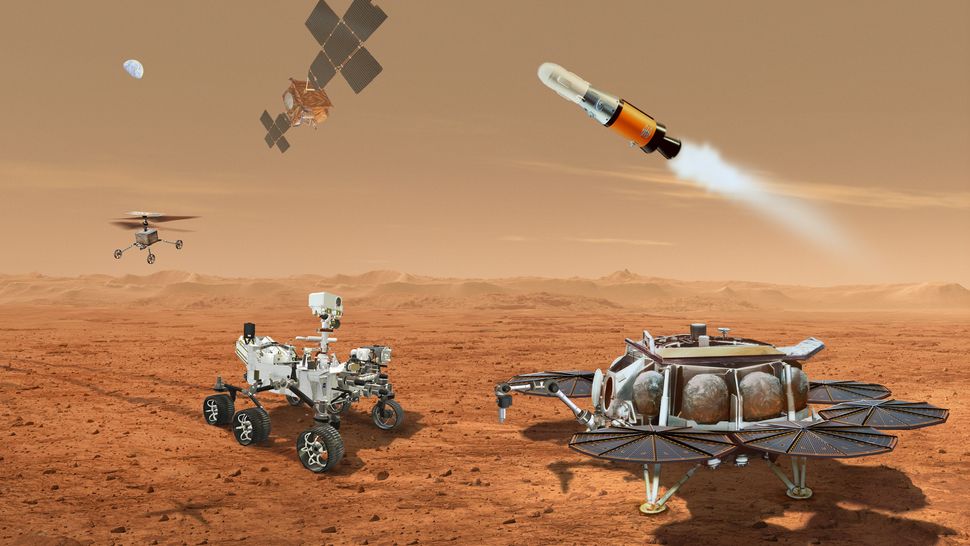
NASA-ESA Mars Sample Return mission elements: the Mars 2020 rover (l) responsible for collecting / caches samples; the Sample Fetch Rover (2028) responsible for collecting the sample tubes and delivering them to (r) the SRL-1 lander (2028), part of the system for delivering the samples to orbit and the Earth Return Orbiter (MRO – 2027), seen overhead (Earth shown in a piece of artistic licence to illustrate the idea of a sample-return mission). Credit: NASA / ESA

NASA’s Mars 2020 rover Perseverance is busy on Mars carrying out a range of science duties, including gathering samples of sub-surface materials that can be sealed in tubes and returned to Earth by a future Mars Sample Return (MSR) mission.

In all, the rover has 43 such sample tubes, and the plan is for it to “geocache” them at one or two locations on Mars at some point, with one of the caches being used as the target for the MSR mission, which NASA had, until recently, vaguely pointed towards being some time in the 2030s.

However, MSR has been prioritised both by the Decadal Study (see: Space Sunday: Future Mission, SpaceX Update) and US politicians – and as a result NASA and ESA have dusted down plans first put forward in 2018/2019 and revised them for a proposed joint, three-part (and frankly overly-complicated), six vehicle mission. This comprises:

  • The Sample Retrieval Lander 1 (SRL1) – carrying the Mars Ascent Vehicle (MAV) – NASA.
  • The Sample Retrieval Lander 2 (SRL 2) – NASA – carrying the Sample Fetch Rover (SFR) – ESA.
  • The Earth Return Orbiter (ERO) – ESA – – carrying the Earth Entry Vehicle (EEV) NASA/ESA.
An early concept of the MSR mission. Credit: NASA/ESA

The mission plan is complicated, but will currently run like this:

2027: The ESA-built ERO vehicle is launched to Mars via an Ariane 6 rocket. It uses ion drive propulsion to cruise to Mars, arriving in 2028, where it will use a separate propulsion system to ease itself into the correct orbit.

2028: SRL-1 and SRL-2 launch to Mars on faster transfer orbits.

  • These both make a soft-landing relatively close to the sample cache.
  • SRL-2 deploys the SFR, which drives to the sample cache and retrieves sample tubes. It then drives the tube to SRL-1.
  • SRL-1 uses a robot arm to transfer the tubes to a capsule at the forward end of the MAV (stowed horizontally on the top of SRL-1 in a protective tube).
  • When ready, the MAV and its protective tube are raised to a vertical position. A spring-loaded “catapult” will then eject the rocket from the tube at a rate of 5 metres per second, allowing the rocket’s motor to safely ignite and power it up to orbit to rendezvous with MRO.
A drawing indicating the major components of the Sample Fetch Rover (SFR). Credit: ESA

The sample return capsule is then transferred from the MAV to a NASA-built containment system contained in the EEV attached to MRO. The latter then engages its ion drive to start it on a gentle transfer flight back to Earth, which it will pass in 2032/33. As it approaches Earth, the EEV is ejected and enters the atmosphere to make a passive descent and landing (no parachutes), using shock absorbing materials to cushion its touch-down in Utah.

Work has already commenced on elements of the mission – such as the Sample Fetch Rover, which ESA is building, and uses design elements  – such as the flexible wheels, the camera systems, etc., – used in the ExoMars Rosalind Franklin rover, and I’ll have more on this joint mission as it develops.

Rocket Lab Grab Their Rocket Out of the Air

Rocket Lab, the New Zealand / US commercial launch company, has recovered one of its launch vehicles after it had successfully sent its payload on its way to orbit. But unlike other companies developing / using re-useable rocket stages, Rocket Lab didn’t land their rocket or let it splashdown – they snatched it out of mid-air with a helicopter!

Rocket Lab’s Sikorsky S-92, trailing the capture line, circles on May 2nd (UTC), awaiting the descent of an Electron rocket first stage under a parachute. Credit: Rocket Lab

The two-stage Electron rocket lifted-off from Rocket Lab’s launch pad on New Zealand’s Mahia Peninsula at 22:49 UTC on May 2nd. The mission, called There and Back Again, was Rocket Lab’s 26th Electron flight, and after sending the upper stage and its payload of 34 smallsats on their way to a successful deployment on orbit, the rocket’s first stage started back to Earth, deploying a parachute to slow its descent.

At just under 2 km above the Pacific Ocean of New Zealand’s coast, Rocket’ Lab’s recovery Sikorsky S-92 made a successful rendezvous the the rocket’s first stage and made an initial capture using a line slung below the helo. Unfortunately, the helo’s crew were forced to release the line within seconds due to the way the booster started to behave after being caught. The rocket then continued one to a splashdown, and was recovered by the Rocket Lab recovery vessel, which was also on station for this eventuality.

Left: the cockpit view as the helicopter approaches the descending Electron first stage. Right: Moments before the capture line initially snags the lines of the rocket’s parachute lines. Credit: Rocket Lab

Whilst not 100% successful, the attempt demonstrated Rocket Lab are on the right track, and likely will be able to capture future Electron stages in mid-air (thus avoiding exposing them to saltwater on splashdown), and fly them back to base for re-use.

In Brief

Virgin Galactic Delays Passenger Sub-Orbital Flights Until 2023

On May 5th, 2022, Virgin Galactic announced it is postponing the start of commercial services with its SpaceShipTwo suborbital spaceplane from late 2022 to early 2023, citing supply chain and labour issues.

Both VSS Unity, the first of the operational Virgin Galactic spaceplanes and the MSS Eve carrier / launch aircraft have been hit by extended delivery times of “high performance metallics” used in some of their components, resulting in a shortage of spares and replacement units.

The first flight of Unity with fare-paying passengers had been expected to take place in the 4th quarter of 2022, but has now been pushed back until the start of 2023, with the end of 2022 now earmarked for final flight tests of both Unity and Eve once the supply chain issues have been resolved, ahead of final certification for commercial flight operations.

Virgin Galactic has pushed back the start of its sub-orbital, fare-paying passenger flights to early 2023

The second sub-orbital vehicle, VSS Imagine, the first f the company’s SpaceShip III class, has yet to complete its own test regime, but is also expected to start passenger flight operations later in 2023. It’s not clear how many vehicle of the class will be built, as the company recently announced it plans to introduce a new “delta class” spaceplane in the mid-2020s.

The company also stated it has now sold 800 tickets for sub-orbital flights that will enable customers to experience around 3 minutes of microgravity. The majority of these were at the “introductory” prices of $250,000, but at least 100 have been at the “full” price of $450,000 – although it is believed most customers have thus far only made the basic down payment of $150,000 a ticket.

ESA Indicate Rosalind Franklin Unlikely to Launch Before 2028

The European Space Agency (ESA) has stated that Rosalind Franklin, the agency’s Mars rover and surface contingent of the ExoMars programme is unlikely not launch until 2028.

As I’ve noted in that past, this rover programme is already around 20 years old, and has had more than its fair share of setbacks. It had been expected to head to Mars later in 2022 using a Russian launch vehicle and lander craft. However, Russia’s invasion of Ukraine put paid to that as all cooperative space activities and projects between Europe and Russia were initially suspended and then scrapped – with ESA noting it has no intention of working in partnership with Russia in the future.

While alternate launch vehicles are available that could get the rover to Mars, the ending of ESA-Roscosmos cooperation means Rosalind Franklin is currently without a lander vehicle and, realistically, one cannot be designed, built and tested in time for launch sooner than the 2028 opportunity (the optimal times to launch missions on a cost-effective basis to Mars using chemical rockets occur once every 26 months).

However, even a 2028 launch is questionable. Firstly, the new lander will require a specific type of rocket motor to slow it during the final stage of landing – and these would have to be supplied by the United States, which will require negotiation and agreement. Secondly, the rover now needs new RHUs (radioisotope heating units) that keep it warm both during the trip to Mars and when on the surface. These were originally supplied by Russia, but have now been withdrawn, so ESA must again turn to the United States for new units. The RHU situation means that ExoMars can only launch from US soil, and this, with the need for the US-built motors likely means the land should be built in the US, all of which needs to be negotiated, so ESA can’t simply go out and build a lander for itself.

Europe’s ExoMars rover Rosalind Franklin – more delays. Credit: ESA

Also, a 2028 launch would mean that the rover would arrive in its designated landing / science location just one month ahead of the annual dust storms that sweep through the region, something to could adversely impact getting the rover checked-out and commissioned after it arrives. A longer flight time could be employed, but orbital mechanics dictate that the rover would be stuck in interplanetary space for two years before arriving at Mars – which is also far from ideal.

Nor is that all. The 2028 launch opportunity has been prioritised for the revised ESA/NASA Mars Sample Return (MSR) mission (see above). As such, there have been suggestions that the entire ExoMars rover could be re-purposed to fulfil the role of the ESA rover in that mission – although it is not clear how this would impact the rover’s current design and its own science goals.

Continue reading “Space Sunday: Samples from Mars & catching a rocket in mid-air”

Space Sunday: aerial views, infra-red images & a few notes

Debris Field From the Mars 2020 mission entry, descent and landing (EDL) systems as seen by the Ingenuity helicopter drone during its 26th flight on April 19th, 2022: to the left, the shattered backshell that helped protect rover and helicopter during entry in the Martian atmosphere. and to the right, the collapsed supersonic parachute that slowed the descent to subsonic speeds. Credit: NASA/JPL

Ingenuity, the Mars 2020 mission’s helicopter drone completed its 26th flight on April 19th, and it was something very special, as NASA revealed in a mission update published on April 27th.

As I reported in a recent Space Sunday article, the Mars 2020 rover Perseverance passed close to where its aeroshell – called the backshell – and the parachute used during the descent through the Martian atmosphere had landed after the rover and its rocket-powered skycrane had departed, and was able to image both from a distance at ground level. For its 26th flight, Ingenuity was tasked with flying over and around both backshell and parachute and taking a series of images.

Graphic showing the Mars 2000 EDL – entry decent and landing – and the use of the backshell and parachute. Credit: NASA/JPL

During the mission’s arrival on Mars in February 2021, both the aeroshell and the parachute performed vital roles. The former protected the rover and skycrane from the heat generated through the entry into Mars’ atmosphere and its supersonic descent, whilst the latter slowed that supersonic descent to subsonic speeds, allowing the rover and its rocket-propelled skycrane to drop free and fly clear.

Once separated, the backshell and parachute continued their descent and, in a very practical demonstration on why parachutes can only do so much in the tenuous atmosphere, reached the ground still travelling at an estimated 126 km/h. Hence while the conical backshell appears to have burst apart on impact.

The Mars 2020 mission backshell and supersonic parachute seen from Ingenuity as it traverses over the debris zone, April 19th, 2022. The black object, slight above centre on the left edge of the image is actually part of one of Ingenuity’s landing feet, not part of the backshell debris. This image has also been post-processed to give near-Earth normal lighting and colour definition. Credit: NASA/JPL

Imagining the backshell and parachute not only provides some stunning photographs, it also helps inform engineers on how well the hardware actually worked, and offer insights to help with upcoming missions – such as the Mars Sample Return mission, for which initial testing of elements of the EDL systems recently started.

Getting the images proved a fitting celebration for the first anniversary of Ingenuity’s maiden flight. Stating at 11:37 local time, with the Sun ideally placed to offer the best lighting, the 159-second flight saw the helicopter climb to a height of 8 metres before flying 192 metres to take its first image. It then moved diagonally across the debris zone, hovering to take a further nine images at pre-determined points. It then moved 75 metres clear of the debris field and landed, for a total flight distance of 360 metres, With the flight completed, Ingenuity had clocked up a total of 49 minutes flying time on Mars, with a total distance covered of 6.2 km.

A further view of the Mars 2020 mission backshell and supersonic parachute seen from Ingenuity on April 19th, 2022., seen under Mars daylight lighting. Credit: NASA/JPL

The images reveal the backshell survived its impact surprisingly well, and that its protective white covering also came through entry into the Martian atmosphere with very little heat scarring, while many of the 80 high-strength suspension lines connecting it to the supersonic parachute are visible and appear intact.

Only around one-third of the 21.5 metre diameter parachute is visible, however. Whilst smothered in surface dust, the ‘chute appears completely undamaged by the supersonic airflow during inflation, and it is thought that only a third can be seen because of the way in which it collapsed onto itself after the backshell impacted.

Perseverance had the best-documented Mars landing in history, with cameras showing everything from parachute inflation to touchdown. But Ingenuity’s images offer a different vantage point. If they either reinforce that our systems worked as we think they worked or provide even one dataset of engineering information we can use for Mars Sample Return planning, it will be amazing. And if not, the pictures are still phenomenal and inspiring.

– Ian Clark, Mars Sample Return Ascent Phase Lead

JWST Update

The James Webb Space Telescope has now completed all aspects of aligning the 18 segments of its massive primary mirror and is moving into the final phase of science instrument commissioning.

As I’ve previously reported in these pages, JWST, the most ambitious space telescope yet built, is located at the Earth-Sun L2 position, 1.5 million kilometres beyond the orbit of Earth relative to the Sun. In March the core work of aligning the 18 segments of the primary mirror was completed such that the telescope could capture crystal clear images in the infra-red directly through its optical systems.

However, and  as I noted at the time, the process of commissioning the science instruments on the telescope would likely require further adjustments to ensure the everything is correctly aligned for science image processing. This work was the first formal step taken in the commissioning process for the science instrument suite once it had been powered up and had reached its required operating temperature range, and on April 28th, NASA confirm the month-long process of very fine final adjustments had been successfully completed, and the science team is now ready to move forward into the final phase of JWST’s commissioning: calibrating the instruments.

The optical performance of the telescope continues to be better than the engineering team’s most optimistic predictions. Webb’s mirrors are now directing fully focused light collected from space down into each instrument, and each instrument is successfully capturing images with the light being delivered to them. The image quality delivered to all instruments is “diffraction-limited,” meaning that the fineness of detail that can be seen is as good as physically possible given the size of the telescope. From this point forward the only changes to the mirrors will be very small, periodic adjustments to the primary mirror segment.

– NASA JWST press release, April 28th, 2022

This NASA image contains images from each of the major instruments on the James Web Space Telescope (JWST) to ensure the telescope’s mirrors are correctly aligned to allow all instruments to product perfect images. Credit: NASA/STScI
The completion of the alignment work came with the release of a set of images from each of the telescope’s science instruments, as shown above. These instruments are:

  • The Near Infrared Camera (NIRCam): the primary imager covering the infra-red wavelength range 0.6 to 5 microns. It is capable of detecting light from the earliest stars and galaxies in the process of formation, star populations in nearby galaxies, the light from young stars in our own galaxy, and objects within the Kuiper Belt.
  • The Near InfraRed Spectrograph (NIRSpec): primarily designed by the European Space Agency (ESA) NIRSpec will operate in tandem with NIRCam over the 0.6 to 5 micron wavelengths to reveal the physical properties of objects emitting light at those wavelengths.
  • The Mid-Infrared Instrument (MIRI): also primarily the work ESA, MIRI has both a camera and a spectrograph operating in the 5 to 28 micron wavelengths – longer than our eyes see. As such, it will be able to “see” and reveal the properties of near and distant objects “invisible” to NIRCam and NIRSpec.
  • FGS/NIRISS: technically two instruments supplied by the Canadian Space Agency operating in the 0.8 to 5.0 micron wavelengths:
    • The Fine Guidance Sensor (FGS): allows Webb to point precisely, so that it can obtain high-quality images.
    • The Near Infrared Imager and Slitless Spectrograph (NIRISS) instrument: designed for first light detection, exoplanet detection and characterisation, and exoplanet transit spectroscopy

The final work in calibrating these instruments is expected to take around a month to complete, and will also involve ordering the telescope to point to different deep space targets so that the amount of solar radiation striking its heat shield will vary, allowing the science team to confirm that the thermal stability for the instruments and mirrors is being maintained within the optimal operating temperatures.

A comparison in resolution power between the Spitzer infra-red telescope (2003-2020) and JWST (2022), using the same region of deep space. NASA/STScI / 

As a part of the alignment exercises, JWST was directed to image an area of space that had been used for aligning / calibrating the mirrors and instruments used on the Spitzer Space Telescope (2003-2020). While a direct comparison between Spitzer (with a primary mission diameter of just 85 cm), and JWST (with a primary mirror diameter of 6.5 metres) is little on the “apples and pears” scale, putting the two commissioning images side-by-side does reveal just how much more of the universe JWST will be able to reveal to us.

Continue reading “Space Sunday: aerial views, infra-red images & a few notes”

Space Sunday: future missions, SpaceX update

Decadal Survey 2023-2032. Credit: NASEM

A study outlining priorities in US planetary science for the next decade was published by the United States National Research Council (NRC) on April 19th. Entitled Origins, Worlds, and Life: A Decadal Strategy for Planetary Science and Astrobiology 2023-2032, the report is part of a 20-year history of the NRC offering periodic roadmaps for America’s space exploration strategies, during which time many of the recommendations made have gone on to shape NASA’s activities and goals.

The next decade of planetary science and astrobiology holds tremendous promise. New research will expand our understanding of our solar system’s origins, how planets form and evolve, under what conditions life can survive, and where to find potentially habitable environments in our solar system and beyond.

– from the introduction of the 2023-2032 Decadal Survey

The report – running to 522 pages – includes input from science organisations, universities and research institutions from around the world. Within it, the committee has identified twelve priority science questions that should be the focus of NASA and America’s work in space. These are divided into three categories: Origins, Worlds and Processes, and Life & Habitability, with each category including a total of 12 major areas of investigation, with the committee outlining the robotic and crewed mission proposals that NASA should consider undertaking in support of these investigations.

This report sets out an ambitious but practicable vision for advancing the frontiers of planetary science, astrobiology, and planetary defence in the next decade. This recommended portfolio of missions, high-priority research activities, and technology development will produce transformative advances in human knowledge and understanding about the origin and evolution of the solar system, and of life and the habitability of other bodies beyond Earth

– from the 2023-2032 the Decadal Survey

Highlights of the survey’s recommendations include:

Flagship Missions

Flagship missions are the “big ticket” missions for NASA. At the time of the last Decadal Survey (2011), the flagship missions were identified at the Mars 2020 mission, Europa Clipper, and the Uranus Orbiter and Probe (UOP) – the latter ultimately losing out to the other two.

This being the case, UOP has been awarded the highest priority within the 2023-32 survey. It would deliver an in-situ atmospheric probe into Uranus’ atmosphere and conduct a multi-year orbital tour to study the ice giant and its system of moons, with the objectives including the study of Uranus’ interior, atmosphere, magnetosphere, satellites, and rings.

A drawing of the proposed Uranus Orbiter and Probe.

Due to the need to utilise planetary fly-bys (gravity assists) to reach its destination, UOP would not launch until the early 2030s, when planetary alignments would facilitate the needed assists, with the primary science mission around Uranus commencing in the mid-2040s.

A second Flagship mission identified by the survey as worthy of consideration by NASA is the Enceladus Orbilander. If funded, this mission would launch in the late 2030’s sending a compact robot vehicle to orbit Saturn’s icy moon of Enceladus, passing through the plumes of water we know to be escaping the moon’s subsurface ocean as a result of gravitational interactions with Saturn. The aim of the mission is to to sample and study the plumes before making a landing on Enceladus in the early 2050s to search for biosignatures either in the surface ice.

New Frontier Missions

Regarded as “medium priority” missions, the New Frontier missions identified in the survey for further / continued development are designed to increase our understanding of the major and minor bodies in the solar system. The cost of such missions is capped at US $1.65 billion, with NASA likely to select two new missions from the crop of recommendations. They comprise:

  • Europa Clipper: a former Flagship mission, now downgraded to reflect its advanced status, this is due for launch in October 2024. It will arrive in orbit around Jupiter where it will fly by Europa multiple times, investigating the moon’s habitability and help identify a potential landing site for a future Europa Lander mission.
  • A Ceres sample / return mission to follow-up on the Dawn mission’s orbital survey of the asteroid Ceres.
  • A comet sample return mission.
  • A network of lunar landers to collect geophysical data.
  • A Saturn orbiter mission to follow-up on the Cassini mission.
  • The Oceanus Titan orbiter, proposed but not selected as a 2017 Frontiers Mission.
  • A Venus “in situ atmospheric” mission – possibly a vehicle to deliver a balloon that would drift through the upper reaches of Venus’ atmosphere.
  • A Triton (Saturn’s largest moon) orbital mission.

Mars Exploration

For the first time, a Decadal Survey identifies Mars as a dedicated target for exploration, specifically  underling two missions:

  • The long-planned Mars Sample Return mission, which has had its share of ups and downs, and has yet to be properly settled upon by NASA.
  • The yet-to-be-defined Mars Life Explorer (MLE) mission designed to look specifically for signs of current microbial life on Mars and to pave the way for future human missions to Mars.
[A] sample return will provide geologic materials that are not represented among Martian meteorites and whose volatile, organic, and secondary mineral composition have not been altered by impact… In addition, sample return will allow for future analyses by instruments and techniques not yet developed. As has been the case with the Apollo samples from the Moon, future analyses are expected to yield profound results for many decades after sample return.

– from the 2023-2032 the Decadal Survey

The survey calls for cohesion between robotic and human missions is a priority for future missions to the Moon and Mars. Credit: NASEM

Lunar and Human Exploration

Unsurprisingly, the survey supports NASA’s lunar ambitions, identifying the need for robotic missions in support of a human presence on the Moon, the establishment of an “Artemis Basecamp” in the south polar region of the Moon. This also recommends much more coordination for human activities on the Moon to be linked with human missions to Mars.

Planetary Defence

A call for the development and improvement of our abilities to detect and track near-Earth Objects (NEOs) that may come to pose an impact threat for Earth, and the means to mitigate such genuine threats when identified and confirmed.

The highest priority planetary defence demonstration mission to follow DART and NEO Surveyor should be a rapid-response, flyby reconnaissance mission targeted to a challenging NEO, representative of the population of objects posing the highest probability of a destructive Earth impact (~50-to-100 m in diameter). Such a mission should assess the capabilities and limitations of flyby characterization methods to better prepare for a short-warning-time NEO threat.

– from the 2023-2032 the Decadal Survey

Which of the missions outlined by the survey are actually adopted will be down to a combination of NASA planning and congressional funding / willingness to support the goals and aspirations set out throughout the report.

Picture of the Week

Paris, April 17th 2022: the full Moon rises in line with the Arc de Triomphe and the Avenue des Champs-Elysées – a single exposure image captured by astro-photographer Thierry Legault. No compositing or other post-process used. Credit: Thierry Legault

SpaceX Starship Update

SpaceX has been moving ahead rapidly with the development of both prototypes of their Starship / Super Heavy vehicles and the facilities required to manufacture and launch them.  Here’s a quick summary of key activities since my last update:

  • Booster 7 (sans any Raptor 2 engines) has undergone initial cryogenic and pressure testing whilst on both the orbital launch platform and the “Can Crusher”.
  • The test on the launch stand marked the first time any Super Heavy booster has had both tanks filled with cryogenic liquid (in this case, liquid nitrogen).
  • The tests on the “Can Crusher” have comprised both an ambient nitrogen pressure test of the tanks under high gaseous pressures and liquid nitrogen load tests.
  • The load tests have apparently included the use of the thrust rams of the “Can Crusher”, designed to simulate the pressure exerted against the rocket as a result of the thrust from its Raptor 2 motors.
Booster 7 undergoing cryogenic testing using liquid nitrogen to fill both tanks to capacity, forming frost on the outside of the stainless steel hull. Credit: NASA Spaceflight.com

At the same time as this work has been carried out, work on the next Super Heavy rocket – Booster 8 – appears to have been accelerated.

  • This has led to a degree of speculation that Booster 8 will actually make the first orbital launch attempt, not booster 7, which may be consigned to the role of a structural test article (much like Booster 1 and Booster 4).
  • The reason for this thinking is that Elon Musk has stated that with Raptor 2 production still ramping up, there will only be sufficient engines for a single booster by May, when SpaceX hope to complete the first orbital launch test. So if these engines are to be used on Booster 7, there seems little need to accelerate the assembly of Booster 8.

It also now seems likely that Starship 24 will be the vehicle to participate in the orbital launch attempt with either Booster 7 or 8. Originally, the inclusion of a payload bay door to facilitate the deployment of Starlink satellites, had been thought of as indicative that Ship 24 would be held over until SpaceX is ready to commence testing Starlink deployments with Starship.

Animated showing how the payload slot on Ship 24 and Ship 25 could release multiple Starlink satellites. Credit: OweBL

However, Ship 25 has also now been fitted with a similar mechanism, suggesting that it will be a feature of Starship vehicle during at least the next phase of development. If so, it would fit with the idea that SpaceX would like to demonstrate Starship’s ability to deliver payloads to orbit as soon as possible, even if other aspects of the system are still in development.

Nor is this the end of progress over recent weeks:

  • The SpaceX launch faculties at Kennedy Space Centre’s Pad 39A have seen the foundations for the new Starship / Super Heavy launch facilities start to come together.
  • At Roberts Road just a few kilometres away, the sections of the massive orbital launch tower are being assembled in parallel, with each section additionally being outfitted with all the required plumbing, ducting, etc., it requires.
  • This means that when ready, it should be possible for SpaceX to rollout, secure, stack and connect the sections into a finished tower in relatively short order compared to the construction of the tower at Boca Chica, which was erected in stages and the plumbing added after initial construction was completed.
From early April: four sections of the Starship / Super Heavy launch support tower under construction at Robert Road, Kennedy Space Centre (KSC). When complete, this section will be moved to the launch facilitates under construction within Pad 39A at KSC. Credit: Julia Bergeron / NASA Spaceflight.com
  • Also at Robert’s Road, work on the new fabrication and assembly facilities for Super Heavy boosters and Starship vehicles is moving forward.
  • All of this progress has perhaps been why SpaceX appear to have abandoned – or at least delayed – the development of a second orbital launch facility at Boca Chica (although this might also be in order to head-off any negative findings by the FAA on those plans when the latter’s environmental study and recommendation is finally published).
  • one of the two oil rigs SpaceX purchased for offshore launches has also completed the first stage of refurbishment – the removal of all equipment and elements not required for its use as a floating launch platform – and has been relocated in preparation for more extensive fitting-out to commence.

There is a long way to go before the Starship / Super Heavy system proves itself – from being able to launch successfully through to the routine and safe recovery of both boosters and starship vehicles to demonstrating the system is safe for human flight, let alone routinely flying with crews / passengers or being ready to meet the company’s long-term goal of reach Mars (a very different proposition to launch / landing here on Earth). However, there can be no denying the determination of SpaceX to develop, iterate and expand along their development path.