Space Sunday: Voyager at 45

Voyager: 45 years on. Credit: NASA

August and September 2022 mark the 45th anniversaries of the launches of Voyager 1 and Voyager 2, NASA’s twin interplanetary – and now interstellar – explorers.

Designed to take advantages of a planetary alignment which occurs once every 176 years, allowing the use the gravities of one of the outer planets to “slingshot” a vehicle on to the next, the two Voyager mission vehicles remain in operation today, and continue to stand at the forefront of our understanding of the local space surrounding our solar system.

Voyager 1 continues to set records as the furthest man-made object from Earth – it is now over 23.3 billion kilometres away – whilst Voyager 2 remains famous for giving us our first detailed views of Uranus and Neptune during its 20-year voyage through the outer solar system.

Products of the 1970s, the Voyager craft stand as museum pieces by today’s standards. Each has around 23 million times less memory than a modern cellphone, their communications systems can only transmit and receive data some 38,000 times slower than a modern cellular network, and they record the data they gather on an 8-track tape recorder prior to transmitting it back to Earth. Nevertheless, the amount of knowledge they have gathered and returned to us about the outer reaches of the solar system, the heliosphere (the bubble of space around the Sun in which the solar system resides), the heliopause (the boundary between that Sun-dominated “bubble” and the galaxy at large) and the realm of interstellar space beyond that bubble.

Operated by NASA’s Jet Propulsion Laboratory (JPL), the Voyager craft were launched in reverse order, with Voyager 2 lifting-off on August 20th, 1977 and Voyager 1 following on September 5th, 1977. The reason for this ordering was simple: during the development of the mission, Saturn’s moon Titan, known to have an atmosphere, was identified as a primary target for fly-by investigation, and so was assigned to Voyager 1.

Animation of Voyager 1’s trajectory around Jupiter: Pink – Voyager 1; Light Blue · Jupiter; Red · Io; Dark Blue -Europa; Yellow – Ganymede; Green · Callisto. Credit: Phoenix777

However, in order to reach the moon, the vehicle would have to follow a course that would carry it over Saturn’s northern reaches, and throw it “down” and out of the plane of the ecliptic and away from any chance of reaching the outer planets. Instead, Voyager 2 was tasked with completing the “grand tour” of the major planets – Jupiter, Saturn, Uranus and Neptune, and in order to achieve this, it would have to be launched first.

Even so, thanks to the nature of orbital mechanics requiring Voyager 2 to be thrown out on a more circular, “indirect” path towards Jupiter whilst Voyager 1 could be launched more directly towards Jupiter meant it could reach the gas giant first, arriving in January 1979, having “overtaken” Voyager 2 in December 1977. . Its passage through the Jovian system revolutionised our appreciation of the Galilean moons of the system, after which it travelled on to its November 1980 encounter with Saturn and then Titan.

Voyager 2’s more circular trajectory meant it did not reach Jupiter until July 1979, six months behind Voyager 1, but its route allowed it to make a much closer fly-by of Europa, the ice-covered Galilean moon, giving scientists the first hint of the nature of the mechanisms at work deep within the moon.

A transit of Io across Jupiter as imaged by Voyager 2 in July 2022. Credit: NASA/JPL

From here the vehicle journeyed on to an August 1981 encounter with Saturn and then Uranus in 1986 and then Neptune in August 1989, whilst Voyager 1 continued onwards toward the heliopause, all of which I covered in  Space Sunday: Voyager at 40.

In 2010, Voyager 1 commenced a two-year transition from the space dominated by the Sun and its outward flow of radiation, and the realm of interstellar space. The first indications that it was beyond the influence of the Sun’s radiation came in later 2012 – although it was not until March 2013 that this was empirically confirmed through analysis of multiple data returned by the vehicle.

Voyager 2 commenced its voyage through the heliopause in 2013; however, as it was still travelling within the plane of the ecliptic, it was effectively travelling through a “thicker” part of the “bubble wall” of the heliosphere, so it did not enter interstellar space until November 2018.

Even so, and possibly confusingly, neither craft have actually departed the solar system per se. This is because the “size” of the solar system is measured in two ways: the influence of the Sun’s outward flow of radiation and by the influence of its. Despite having passed through the former, both craft are sill within space affected by the latter, and neither will reach the Oort Cloud – the source region of long-period comets and seen as marking the outer limits of the Sun’s gravitational influence – for another 300 years.

As such, both of the nuclear-powered vehicles are now engaged in a multi-vehicle mission (having been joined in it by the likes of the New Horizons spacecraft, the Parker Solar Probe and others) referred to as the Heliophysics Mission.

The Heliophysics Mission fleet provides invaluable insights into our Sun, from understanding the corona or the outermost part of the sun’s atmosphere, to examining the sun’s impacts throughout the solar system, including here on Earth, in our atmosphere, and on into interstellar space. Over the last 45 years, the Voyager missions have been integral in providing this knowledge and have helped change our understanding of the sun and its influence in ways no other spacecraft can.

– Nicola Fox, director of the NASA’s Heliophysics Division

Voyager 2 left the heliosphere on November 5, 2018. Credit NASA/JPL
Today, as both Voyagers explore interstellar space, they are providing humanity with observations of uncharted territory. This is the first time we’ve been able to directly study how a star, our sun, interacts with the particles and magnetic fields outside our heliosphere, helping scientists understand the local neighbourhood between the stars, upending some of the theories about this region, and providing key information for future missions.

– Linda Spilker, Voyager’s deputy project scientist at JPL

Continue reading “Space Sunday: Voyager at 45”

Space Sunday: Curiosity’s 10th, and motors for rockets

Ten years ago, on August 6th, 2012, the world held its breath as a capsule the size of a small truck slammed into the Martian atmosphere at the start of 7-minute descent referred to as the “seven minutes from hell”.

It would either end with the extraordinary sight (had we been able to see it) with a rocket-propelled platform hovering just metres above the surface of the planet as it gently winched a rover the size of an SUV to the floor of Gale Crater – or in a fresh new crater within the crater.

Fortunately, the former was the case, marking the true start of the Mars Science Laboratory (MSL) mission on Mars, an attempt to seek evidence that, billions of years ago, Mars had the conditions needed to support microscopic life. Coincidentally, it marked the start of the column that would morph into Space Sunday.

Since that heady day, the rover – called Curiosity – has clocked up some impressive statistics, including:

  • Achieving its primary mission objective – to discover whether Mars had the conditions under which life may have arisen – within its initial 90-day mission period.
  • Driving almost 29 kilometres around Gale Crater.
  • Ascending 625 metres above the floor of the crater.
  • Analysing 41 rock and soil samples using its onboard suite of science instruments, furthering our understanding about Mars.
  • Providing huge insights into the Martian climate and weather.
  • Being so successful, it has seen its mission initially extended to its full 2-year “post landing” period, and then in multi-year increments, including a recent 3-year further extension.

While Curiosity’s work has been more recently overshadowed by its sibling, Perseverance, it is still ongoing. In the last ten years, the rover has studied the Red Planet’s skies, capturing images of shining clouds and witnessing the transit of the Martian moons Phobos and Deimos across the face of the Sun, causing very localised eclipse phenomena.

This series of images shows the Martian moon Phobos as it crossed in front of the Sun, as seen by NASA’s Curiosity Mars rover on Tuesday, March 26th, 2019 (mission Sol 2359). Credit: NASA/JPL / MSS

In addition, the rover’s radiation sensors have helped scientists measure the amount of high-energy radiation future astronauts would be exposed to on the Martian surface, increasing our understanding of what will be needed to keep them as safe as possible – both in terms of practical protections and the types of procedures required to minimise their overall exposure whilst working on the surface of Mars.

However, Curiosity’s most important work is that of determining that liquid water as well as the chemical building blocks and nutrients needed for supporting life were present for at least tens of millions of years in Gale Crater – and that similar conditions could exist elsewhere on Mars. These discoveries directly confirmed the need for the Mars 2020 mission with Perseverance – which is designed to look for the direct evidence that microbial life did take hold in the conditions Curiosity found to be true.

A view across the slopes of “Mount Sharp” captured on September 9th, 2015 using Curiosity’s MastCam. The circle denotes a boulder roughly the size of the rover, to the left of which is “Paraitepuy Pass,” which Curiosity started traversing in 2022. Credits: NASA/JPL

After exploring the bedrock floor of the crater, Curiosity started on a major phase of its mission – scaling the flank of “Mount Sharp”, a 5-km high mound of materials deposited against and around the crater’s central impact peak during the many warm, wet periods that marked the very early history of Mars, and which meant Gale Crater was once the site of a huge lake of liquid water.

The climb has taken up the majority of the rover’s time on Mars, and is still continuing, with Curiosity recently move into an entirely new phase of operations. For the last few months the rover has been making its way along a canyon marking the transition between the more submerged parts of “Mount Sharp” – officially called Aeolis Mons – a region believed to have formed as water was drying out, leaving behind salty minerals called sulphates.

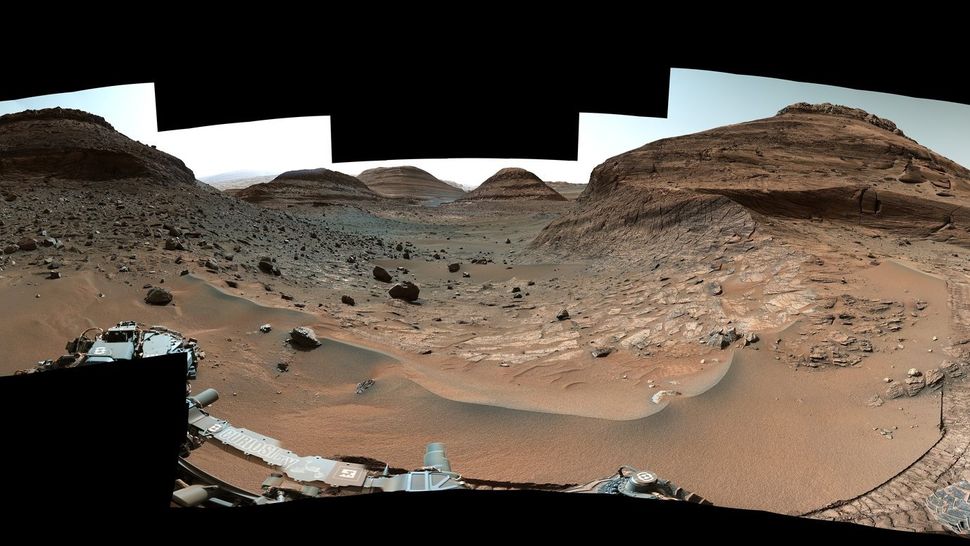
Centred in this 360-degree collage of 27 images is the boulder circled in the above image, and which Curiosity drove by on July 15th, 2022 (mission day Sol 3533). Credit: NASA/JPL
We’re seeing evidence of dramatic changes in the ancient Martian climate. The question now is whether the habitable conditions that Curiosity has found up to now persisted through these changes. Did they disappear, never to return, or did they come and go over millions of years?

– Ashwin Vasavada, Curiosity’s project scientist

The team plans to spend the next few years exploring the sulphate-rich area. Within it, they have targets in mind like the Gediz Vallis channel, which may have formed during a flood late in Mount Sharp’s history, and large cemented fractures that show the effects of groundwater higher up the mountain.

All this progress has come at a cost, however. Along the way, Curiosity had suffered several issues – all of which have been overcome as a result of a team of literally hundreds of engineers and scientists based at the Jet Propulsion laboratory (JPL) and other NASA centres as well as research centres and universities across the United States.

This has allowed major issues that might otherwise have crippled the rover’s abilities. How Curiosity drills for samples has been reinvented a number of times to overcome problems that as the very least might have ended the rover’s ability to drill at all and at worse, crippled its ability to use its robot arm.

Another area of concern has been the rover’s aluminium wheels. These bear the brunt of the sheer force of Curiosity’s progress as it makes its way over the unforgiving Martian landscape; and even while the rover’s daily progress can only be measured in metres-per-day, the fact is that it is constantly traversing terrain which could rip any one of the large aluminium wheels apart given sufficient time. As such, damage was to be expected – but the speed with which it occurred early in the mission still came as a shock, with engineers going so far as to have the rover reverse course and find a new way around some particularly rough terrain at the foot of “Mount Sharp”.

Captured earlier in 2022, this image shows the damage suffered by Curiosity’s left centre wheel after almost 10 years of operations on Mars. Credit: NASA/JPL

To counter the risk of wheel breakage, Curiosity’s driving has been extensively revised, and new algorithms written to help the rover better maintain traction whilst manoeuvring over rocks and to better analyse feedback from wheel motors to prevent them overworking or forcing the rover into an manoeuvre that might result in the loss of a wheel. In addition, the rover routinely examines the state of its wheels using both the MastCam system and the MAHLI imager on the robot arm.

Another threat to the rover’s future is that of electrical output. Curiosity utilises the radioactive decay of plutonium pellets within its radioisotope thermoelectric generator (RTG) to create heat which can be converted into electrical power. On the plus side, this means the rover is not dependent on the vagaries of solar power and can (initially) produce much higher levels of electrical power – some 2,000 2atts on its arrival on Mars.

The downside, however, is that the 4.8 Kg of plutonium within Curiosity’s RTG have a half-live of 14 years – and the rover is now 10 years into that period. As such, it is generating a lot less heat that can be turned into electrical power,, and as a result engineers and scientists are now looking at ways to operate the rover more efficiently and reduce the daily power requirements. This includes switching some operations to run in parallel, effectively sharing power.

Despite this latter points, Curiosity is still performing at near-optimal levels for this period in its life, and with caution and forethought, in is not inconceivable to believe the rover will not still be investigating “Mount Sharp” – even on a reduced basis – in another 10 years.

Continue reading “Space Sunday: Curiosity’s 10th, and motors for rockets”

Space Sunday special: Nichelle Nichols, First Lady of Space

via NASA / Paramount +

While I have written about the passing of noted individuals involved in astronomy and space exploration in previous Space Sunday articles, this obituary – coming a little later than intended – focuses on the life of a woman who never actually flew in space or worked directly on any space programme, but who nevertheless has a profound impact on the shape of the US space programme from the late 1970s through mid-1980s. who who served as an inspiration for woman and those from diverse ethnic backgrounds to seek careers with NASA, and who sadly passed away on July 30th, 2022

Her name is Nichelle Nichols, known the world over as Lt. Uhura from the original Star Trek TV series and the first six of the franchise’s big screen outings, and this is her story.

Born Grace Dell Nichols on December 28th, 1932 to Samuel Earl Nichols, a factory worker who Lishia (Parks) Nichols, in Robbins, Illinois (a suburb of Chicago), where Samuel Nichols served as both the local mayor (1929) and its chief magistrate. From the start, she was determined in her aims: as a youngster, she informed her parents she did not like her given first name and asked them to change it, any they suggested “Nichelle”, which she adopted.

By the age of 16, Nichelle Nichols was singing professionally for Duke Ellington. Credit: Unknown

Studying ballet, dance, music and singing at High School and the Chicago School of Ballet, Nichols landed her first professional gig when just 16, singing in a revue at The College Inn, a well-known Chicago night spot.

It was there that jazz legend Duke Ellington witnessed her performance and he invited her to join his big band as a singer / dancer. This was followed by time with Lionel Hampton’s band, which she joined as a lead singer and dancer.

Nichols’ acting break came in 1959, when she appeared in Porgy and Bess, Starring Sammy Davis Jr., Sidney Poitier, Dorothy Danridge and Pearl Bailey. While she was uncredited in the film, her appearance led to a series of small stage roles, then in 1961 she was cast opposite Burgess Meredith in Oscar Brown’s Kicks and Co, a musical satire poking fun at Hugh Hefner’s Playboy.

The show wasn’t a success, closing not long after it opened, but it ran for long enough for a curious Hefner to attend a performance. He was so impressed by Nichol’s stage presence and singing voice, he immediately offered her the chance to sing at his original Playboy Club, which has opened to great success as a nightspot in 1960.

Three years later, Nichols gained her first TV part, a small role in The Lieutenant starring Gary Lockwood (2001 a Space Odyssey) and created by a certain Eugene “Gene” Roddenberry. The episode, entitled To Set It Right, guest-starred Don Marshall (Land of the Giants) and the legendary Dennis Hopper, and dealt with the controversial subject of racism – so controversial in fact that NBC initially refused to air it, a decision that Roddenberry later said helped spur him in his desire to create Star Trek and use the science-fiction format by which to tell morality tales and socially-aware stories without upsetting the network censors.

Nichol’s role in The Lieutenant was small but memorable (and actually led to a short-lived affair with Roddenberry). More particularly, in appearing in the show, she joined a distinguished list of actors who would go on to have an impact on Star Trek, including cast members Majel Barrett (with whom Roddenberry also had an affair before eventually marrying her) Leonard Nimoy, William Shatner and Walter Koeing, and guest stars Ricardo Montalban (Khan Noonian Singh from Space Seed and later, Star Trek II: The Wrath of Khan) Paul Comi (Lt. Styles, Balance of Terror), and Lockwood himself (Lt. Commander Gary Mitchell from Where No Man Has Gone Before).

As Lieutenant Uhura in Star Trek, Nichols became an icon for women and people of colour the world over, and particularly in the Untied States. Her position as a female officer serving on the bridge of a quasi-military vessel (part of an organisation clearly modelled on the US Navy), was unprecedented, while the role itself was one of the first times an African American actress was portrayed a non-stereotypical role on television.

However, thanks to the core focus on the series leads – Shatner and Nimoy – by the end of the first season, Nichols was dissatisfied in having little to do, and on the final day of shooting, Wednesday, February 22nd, 1967, she handed her resignation to creator-producer Roddenberry, stating her intention to take an offer to appear on Broadway. Rather than accept, Roddenberry requested she take time to think about leaving the show some more before making her decision final.

Nichelle Nichols in her iconic and inspirational role of Lt. Uhura in Star Trek. Credit: Paramount – CBS

The following Saturday, February 25th, 1967, Nichols attended an event at the Beverley Hills Hilton in connection with the Nation Institute (although later attributed as an NAACP banquet) at which Dr. Martin Luther King Jr, was to speak. It was an event to go down in history as the first time Dr. King publicly condemned the war in Vietnam. However, for Nichelle Nichols it was memorable for another reason entirely. Ahead of King’s address, she was informed her “greatest fan” wanted to meet her.

I said, ‘Sure.’ I looked across the room and thought whoever the fan was had to wait because there was Dr. Martin Luther King walking towards me with this big grin on his face. He reached out to me and said, ‘Yes, Ms. Nichols, I am your greatest fan.’ He said that Star Trek was the only show that he, and his wife Coretta, would allow their three children to stay up and watch. When I told he I was leaving the series, he said, ‘you cannot, you cannot! For the first time on television, we will be seen as we should be seen every day, as intelligent, quality, beautiful, people who can sing dance, and can go to space, who are professors, lawyers … If you leave, that door can be closed because your role is not a black role, and is not a female role; he can fill it with anybody even an alien.

– Nichelle Nichols, recalling her 1967 meeting with Dr. Martin Luther King Jr.

So deeply affected by King’s words, Nichols didn’t only return to Start Trek and stay with it through the Star Trek VI: The Undiscovered Country, the last outing for the entire original series cast, she sought to do more for the people of whom King spoke.

Most notably, she helped found and run Women in Motion, a company that initially produced educational materials using music as a teaching tool and which focused on young women and girls. However, during a visit to a NASA facility, she commented about the lack of apparent diversity among the staff. NASA responded by asking her to help them broaden their recruiting activities, providing a grant to Women in Motion to help with the work.

Nichelle Nichols one one of the two Apollo Mission Operations Control Rooms (MOCR, popularly referred to as “Mission Control”) in 1977. Credit: NASA

Continue reading “Space Sunday special: Nichelle Nichols, First Lady of Space”

Space Sunday: space stations, sample returns and falling rockets

The ISS: US Congress signals NASA funding through to 2030 now possible. Crew: NASA
The US Congress has approved NASA’s request or funding to extend International Space Station operations through until the end of 2030. However, this does not mean the station’s future is necessarily set in tablets of stone.

The approval came not through NASA’s core budgetary process, but as a result of an additional NASA authorisation bill being appended to the newly passed Creating Helpful Incentives to Produce Semiconductors (CHIPS) Act of 2022, intended to increase semiconductor manufacturing in the United States in the wake of pandemic-induced supply chain shortages.

The authorisation bill included in the act specifically targets NASA to receive funding to support ISS operations, and to further the agency’s lunar ambitions and robot exploration of Mars. In addition, the 2023 Commerce, Justice and Science (CJS) spending bill. currently being drafted in Congress, looks as though it will seek to provide NASA with the US $25.9738 billion it has requested for its 2023 operational budget – albeit it with one or two small strings attached. These include ensuring the asteroid-hunting NEO Surveyor mission launches in 2026 as planned, rather than slipping to 2028; cutting a part of the space technology spending that includes nuclear thermal propulsion work; and adding $50 million to support a new commercial crew provider beyond Space and Boeing to increase program options.

However, while paying the lion’s share towards ISS operations, the US relies heavily on the assistance of its International partners: a further 15 nations (Brazil having withdrawn in 2007), with both the European Space Agency (ESA) and the Japan Aerospace Exploration Agency (JAXA) providing core modules for the station, and the Canadian Space Agency (CSA) crucial support systems. While 14 out of the 15 (the majority operating under the auspices of ESA), the same cannot be said for the 15th – Russia, which is also the second largest financial contributor to the station, as well as the largest contributor of pressurised modules.

Russia has long bulked at any attempts to extend ISS operations beyond 2024, and while it appeared that a shorter extension to the station’s life to take it through to 2028, that was thrown into doubt in early 2021, when the Russian space agency, Roscosmos, announced that a module – the Solar Power Module-1 (SPM-1, also referred to as NEM-1) – due for launch in 2024, would be repurposed to serve as the core power module for a new, smaller, all-Russian space station, provisionally called the Russian Orbital Service Station (ROSS).

The Russian Orbital Service Station, as rendered during a recent presentation by Vladimir Solovyov, chief designer at RSC Energia, and the director of Russian involvement in the ISS. To the left and right, with the large four-panel solar arrays are the two core modules for the station. To the left foreground and right background as the additional science modules. Credit: Roscosmos

At the time, it was indicated that work on ROSS would commence in 2024 and conclude around 2029. However, that time line was then pushed back to 2030-2035, possibly signalling Russia would remain fully engaged in ISS operations through until 2030. Then came the Russian invasion of Ukraine, international outrage, condemnation and the rest. This included assorted (and somewhat silly) threats on the part of the then head of Roscosmos, Dmitry Rogozin, which included statements that Russia would depart the ISS in 2024 – and might take parts of it with them…

While Rogozin has now departed Roscosmos for pastures new, his replacement at the agency, his replacement – equal hardliner Yuri Borisov – Has sounded something of a warning that attitudes towards ISS operations have not shifted, telling the TASS news agency that Russia’s engagement in ISS will come to an end “after 2024” – the date to which the committed to support the station.

Exactly what “after 2024” means in practice remains unclear. ISS partners are obligated to give at least 12 months warning of an intention to depart the project – and Russia has never taken that step through to now, and it could be argued that 2030 is as much “after 2024” as 2025.

That said, coming on the heels of Borisov’s comments to TASS, Vladimir Solovyov – who is both the chief designer at RSC Energia, the company responsible for developing space station modules and the director of the Roscosmos department directly responsible for ISS operations – presented the first detailed overview of the proposed ROSS platform, including the fact that the first modules are to be operational by the end of 2028.

ROSS: the SPM-! (NEM-1) core module, originally intended for the ISS is currently being repurposed to provide the new space platform with all its required power management capabilities. Credit: Roscosmos

While not explicitly named by Solovyov, the first of these modules appears to remain the re-purposed SPM-1 / NEM-1, Solovyov indicated would launch in 2026. This will then be followed in 2028 by a Core Crew Module (CCM – this nomenclature will likely change), providing crew living facilities and additional power systems, with the two units operating as a baseline station until two additional science modules can join them in 2030.

This tends to indicate that from 2025, Roscosmos will start pivoting priorities away from ISS and to ROSS; but it does not signal they will be ending all involvement in ISS. Further, and while again not indicated by Solovyov, the fact that the science modules will not be flown until 2030 might be indicative that consideration is being given to perhaps utilising the Nauka module, which only joined the ISS in 2021 and which is capable of its own propulsion, within ROSS.

This might come down to the orbit ROSS eventually placed within. During his presentation Solovyov stated the some of Russia’s frustrations with ISS is that the station operates at an orbital inclination that precludes much of the Earth and space science Russia would like to carry out. As such, a wide range of potential orbits are being considered for ROSS, some of which would exclude any transfer of Nauka from ISS to ROSS.

ROSS: a further view of the Core Crew Module (CCM – left) and the core power module (SPM-1/NEM-1 – right) linked by the multi-port docking hub, which also has an unidentified vehicle docked to it. These elements of the platform are being targeted for operational use starting in 2028. Credit: Roscosmos

As well as the four core modules, Solovyov indicated that the station’s facilities could be expended through the use of a (yet-to-be built) large-scale automated re-supply vehicle that could perform a number of roles from straightforward delivery of supplies and consumables through performing required orbital boosts to offering temporary additional working space when needed. It is additionally possible this re-supply vehicle might be combined with a capsule-like crew vehicle, allowing it to deliver both personnel and supplies to the station, with dedicated crew-only flights to and from ROSS carried out aboard a smaller vehicle intended to replace the veritable Soyuz

Most interestingly, Solovyov  stated ROSS would not necessarily be permanently crewed, but will utilise a high degree of automation for science operations, with crews visiting it to carry out very specific science research and / or to collect data and carrying out maintenance and other work. However, as he also indicated that the station could well form a part of Russia’s ambitions for the Moon and Mars (some of least at which will likely include working with China), the station could become more fully crewed from 2030 onwards.

ESA / NASA Simplify Mars Sample Return Mission

In May I wrote about the proposed ESA / NASA Mars Sample return mission to bring core samples gathered by NASA’s Perseverance rover back to Earth for analysis. At the time of that report, NASA and ESA were responding to calls for the mission to be prioritised and take place earlier than the early-to-mid 2030s. However, the plan being forward back then stuck me as being overly complicated, involved six vehicles and three individual launches; and bless them, NASA and ESA now seem to share that view:  on July 27th, 2022, the two agencies issued an update that reduced the mission to just two launches and changes the overall line-up of vehicles involved, although the fine details have yet to be worked out.

As it was: the Mars Sample Return (MSR) mission in March-May 2022: top right is the ESA-built Earth Return Vehicle (ERV); lower right the Mars Ascent Vehicle (MAV) mounted on its lander; in the centre is the ESA-built “fetch” rover (minus its lander) which would transfer samples from where they had been deposited by Perseverance (left) to the MAV. Credit; NASA / ESA

In the March-May plan, Perseverance would have deposited a cache of core sample tubes somewhere in Jezero crater. This cache would then be targeted by two landers – one carrying the Mars Ascent Vehicle (MAV), and the other a small, European-built “fetch” rover. This would collect the sample tubes from the cache and deliver them to the MAV, which it turn would launch from its lander to carry them up to a waiting Earth Return Vehicle (ERV) built by ESA, with the sample tubes transferred to that vehicle for the return to Earth.

Under the new plan, the ERV remains, as does the MAV and its lander. However, the “fetch” rover and its lander have been scrapped. Instead, the MAV will launch to Mars in 2028 and its lander will use telemetry from Perseverance to land in the vicinity of the rover, which will then drive to the MAV and perform the transfer of samples directly.

Exactly how this transfer will be managed is unclear – Perseverance isn’t exactly designed for such a task. So, as a contingency, the lander carrying the MAV will carry will also be equipped with two “Ingenuity class” helicopters. Fitted with wheels and a small grappling arm, as well as flying, these will be capable of scooting around on wheels, collecting sample tubes from the cache rack Perseverance will deposit on the surface of Mars and delivering them to the MAV. Once loaded, the MAV will launch to orbit, rendezvous with the ERV, and the sample pack transferred for its return to Earth.

As it now is: the current Mars Sample Return mission hardware: the ESA-built Earth Return Vehicle (top), with the Mars Ascent Vehicle (MAV) flying up to it from its lander (right), and one of the two “ingenuity-class” helicopters hovering close to the Mars 2020 rover. Credit: NASA / ESA

Overall, the approach is still somewhat complicated, but assuming a methodology can be employed to allow Perseverance to complete the sample transfer to the MAV unaided, it means NASA will have two fresh helicopters available to support the rover in its further explorations in and around Jezero Crater. And even if the helicopters do have to be used for sample retrieval, by combining them with the MAV and its lander, an entire additional launch – and the development of a complex small-scale “fetch” rover – can be avoided, both reducing the overall cost of the mission and reducing the potential for long-term delay which might occur with the development of an entirely new class of rover.

Which is not to say the target 2027 launch date for the ERV isn’t itself challenging; three years to develop and test a space vehicle is an extremely short time-frame; as such it would seem likely this mission will slip back into the early 2030s.

Continue reading “Space Sunday: space stations, sample returns and falling rockets”

Space Sunday: galaxies, launches and health in space

Gz-13, as seen by the James Web Space Telescope, one of the earliest known galaxies in the universe and seen as it would have appeared just a few million years after the Bi Bang. Credit: NASA / ESA / CSA / STScI

The above image may not look to be much, but it in fact a glimpse at one of the most distance galaxies from our own, a place called Gz-13. It is so far away, the light captured by the image departed it about 300 million years after the universe itself was born.

Gz-13 is a part of a cluster of galaxies seen within one of the first set of images released by NASA from the James Webb Space Telescope (JWST), and which I covered in my previous Space Sunday update. So far away are these objects, that they can only be seen via the effect of gravitational lensing – using the gravity of an object much, much closer to our own solar system to “bend” the light from them and focus it so that JWST can capture images.

Gz-13 lies tucked away in the SMAC-0723 grouping of very distant objects. Originally imaged by the Hubble Space Telescope (HST), the grouping has been given sharp, new high-definition exposure by JWST. Some much definition, in fact, that GZ-13 hadn’t been seen by Hubble.

While it may seem like a blob of red-shifted light, massively distant objects like Gz-13 (and Gz-11, another far-distant galaxy that was seen when Hubble viewed SMACS-0723) are important targets for study, as they represent a period of time literally just a blink (in cosmic terms) after the universe went off with its Big Bang; thus thus represent an opportunity for us to understand what was going on very close to the origin of literally everything there has ever been.

SMACS 0723 as it appeared 4.6 billion years ago. Tucked away inside this cluster sits Gz-13. Credit: NASA/Goddard Space Centre / STScI

What is particularly interesting about the likes of Gz-11 and Gz-13 is that despite being formed just 150-200 million years after the first stars are believed to have started forming, they still have masses that suggest they are home to several billions stars with a mass equivalent to our own Sun. Thanks to them being so bright in the infra-red, they offer an unparalleled opportunity for astronomers to carry out extensive spectrographic analysis  to help us to discover more about them and the nature of the stars they contain – including, potentially, whether any of their stars might be surrounded by disks of dust and gas that might have gone on to form planets.

Given the nature of the expanding universe, Gz-11 and Gz-13 are liable to be just the tip of a massive iceberg of galaxies far, far, away that are waiting for JWST to find. This is turn will massively increase our total understanding of the nature of the universe, and the formation and growth of the galaxies within it. In fact, it is very possible that JWST will look so far out that we are looking almost back to the very edge of the Big Bang itself.

China Launches First Space Station Science Module

China has launched the first of two science modules to its nascent Tiangong Station (TSS).

The Wentian module was lifted into the sky atop a Long March 5B heavy-lift rocket at 06:25 UTC on Sunday, July 24th, the launch taking place from the Wenchang spaceport on the southern island of Hainan.

Measuring 17.9 metres in length and with a diameter of 4.2 metres, the module has an operational mass of around 23 tonnes, putting it on a par with US and international modules on the ISS. At the time of writing, the module was due to make an automated docking manoeuvres with Tianhe-1, the core module of the Chinese space station.

Chinese Space Station supplemental module Wentian. Credit: Leebrandoncremer via Wikipedia

Wentian, which literally means “quest for the heavens,” is the first of two science modules intended to join with Tinahe-1 to complete the currently-planned elements of TSS and bring its all-up mass to around 66 tonnes (the ISS, by comparison, masses 460 tonnes). In addition, operations aboard the station can be added-to through the use of Tianzhou automated re-supply vehicles.

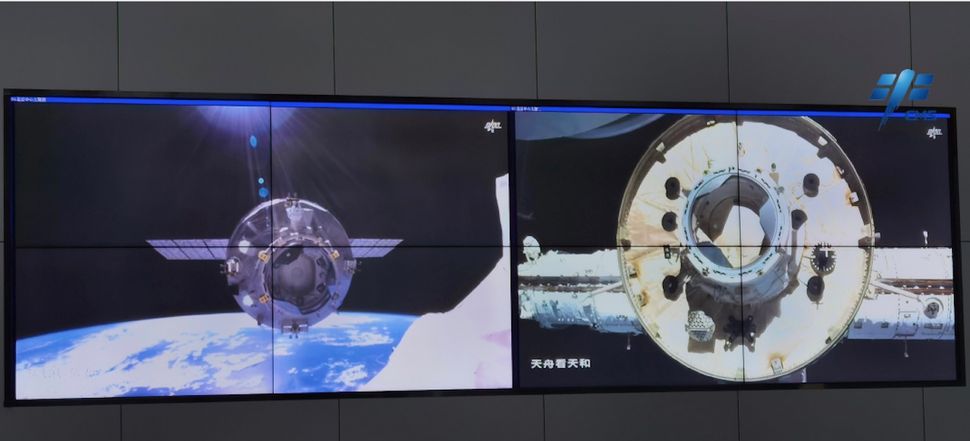
The module’s docking will be overseen by the three crew of the Shenzhou 14 mission. It will initially dock with Tianhe’s forward docking port, where it will remain during initial tests and check-out by the crew to confirm its overall condition. The crew will then commence initial science activities, which will include a live broadcast via Chinese state media.

At some point in the future, Wentian will be relocated to a side port on Tianhe’s forward docking hub to form one arm of an eventual “T” that will be made by the core module and the two science modules, leaving the forward port free for visiting crews, and the after port at the far end of Tianhe available for visiting Tianzhou vehicles.

Whilst classified a science module, Wentian is actually a multi-purpose facility. It includes an airlock of its own to enable crew members to complete space walks, it has an external robot arm of its own to assist with such spacewalks, and additional living space for 3 tiakonauts, allowing up to six to live in comfort on the station during hand-over periods. The first such hand-over (similar in nature to ISS handovers) is due to take place in December 2022, when the crew of Shenzhou 14 pass the station over to the 3-person Shenzhou 15 crew. However, prior to that event, the second science module, called Mengtian (“Dreaming of Heavens”), is due to be launched to the station in October.

NASA Sets Artemis-1 Launch Dates

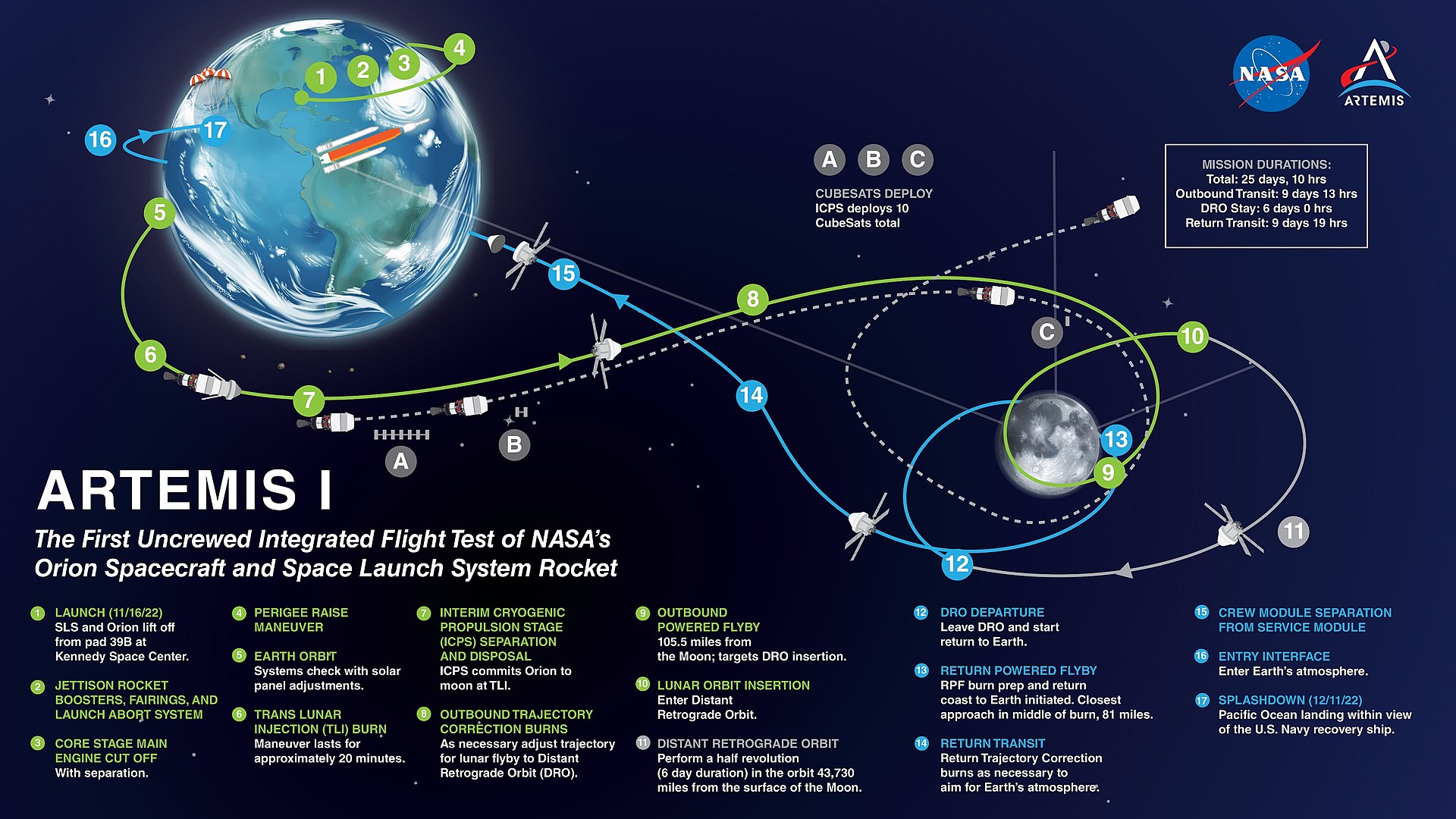
On July 20th, 2022, NASA announced they are targeting three dates at the end of August / beginning of September for the first flight of their Space Launch System (SLS) super rocket which sits at the heart of their plans for a return to the Moon.

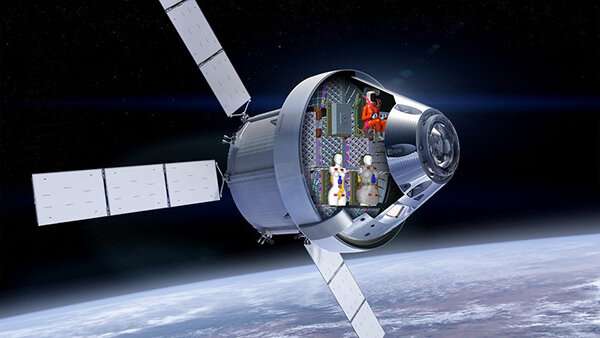
The Artmis-1 mission will launch an uncrewed Orion Multi-Purpose Crew Vehicle (MPCV) on an extended mission to cislunar space. Each of the three launch dates has different launch windows and mission durations:

  • August 29th: the launch window runs from 12:33 to 14:33 UTC, and would result in a 42-day mission ending with a splashdown on October 10th.
  • September 2nd: the launch window runs from 16:48 to 18:48 UTC, and would result in a 39-day mission splashing down on October 11th.
  • September 5th: the launch window opens at 21:12 UTC for 90 minutes, and would result in a 42-day mission splashing down on October 17th.
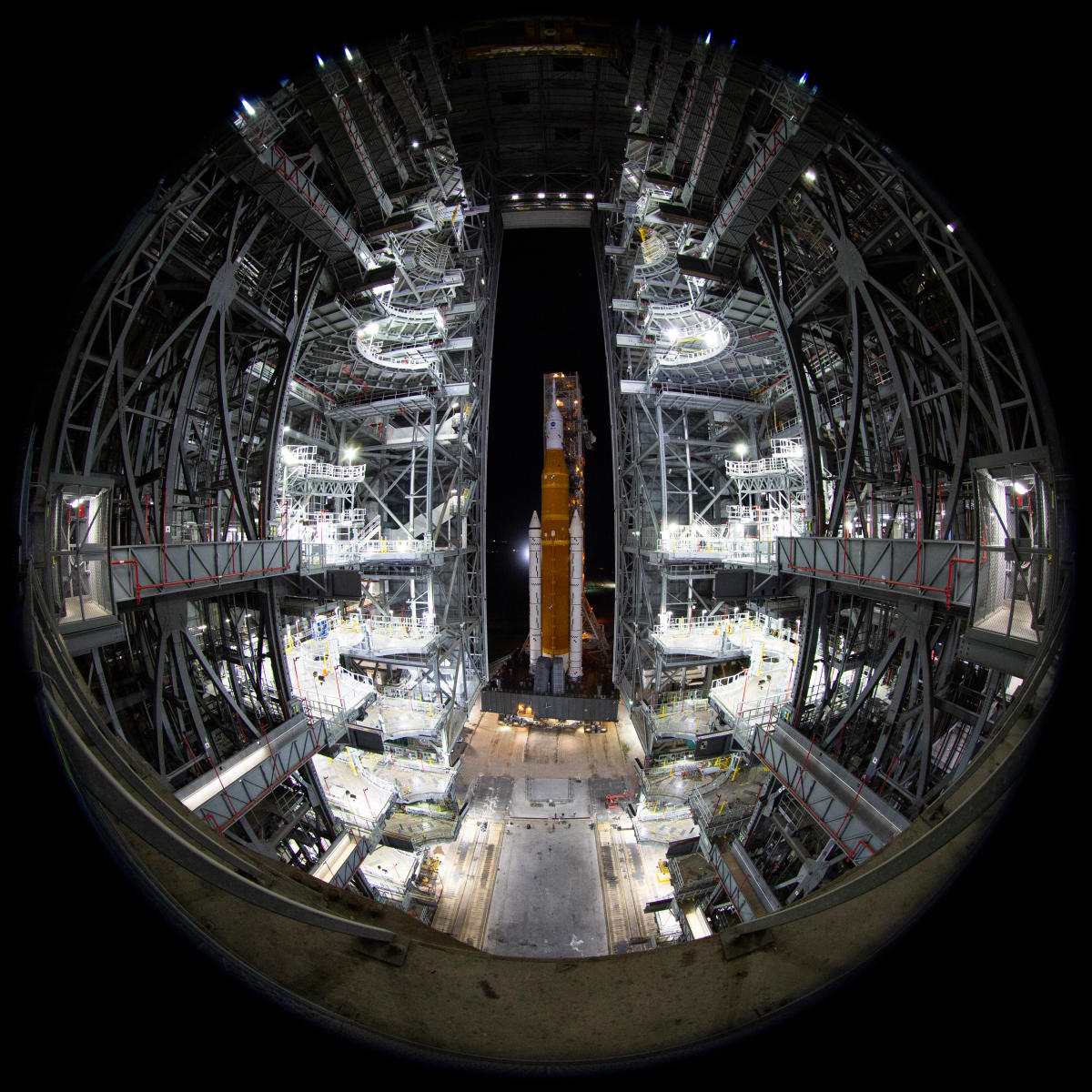
The Artemis-1 Space Launch System rocket, seen during the initial Wet Dress Rehearsal test in April 2022. Credit: NASA

Splashdown for all three launch opportunities will occur off the coast of San Diego, California.

The dates themselves have been defined based on the need to complete post-Wet Dress Rehearsal  test work on the vehicle. They all represent “long-class” flights for the Orion, with Artmis-1 originally being planned around shorter 4-week flights in order to test out all of its handling characteristics in cislunar space. However, given all of the delays thus far experienced with Artemis-1, NASA opted to push for these launch dates rather wait until the end of October when windows for shorter-during flights would open, together with a further rick of slippage of the launch back into 2023.

Continue reading “Space Sunday: galaxies, launches and health in space”

Space Sunday: Webb’s views, booster bang + Rogozin’s roulette

Where they are: the five subjects of the first five science images release by NASA for the James Webb Space Telescope (JWST). 1: the Carina Nebula; 2. the Southern Ring Nebula; 3. Stephan’s Quintet; 4. WASP-96b; 5. SMACS 0723. Credit: NASA/Goddard Space Centre / STScI
The first series of science images from the James Webb Space Telescope (JWST) were released on July 12th, 2022 rightly grabbing the headlines around the world, revealing as they did elements of our universe and our own galaxy in stunning detail and offering a superb launch for the observatory’s science mission.

At the time of their release, NASA also confirmed that, thanks to the extreme accuracy achieved by the European Ariane 5 rocket in delivering the observatory into is transfer orbit which allowed JWST to establish itself in its L2 position halo orbit, 1.6 million km from Earth, sufficient propellants remained aboard the observatory for it to operate for around 20 years – double its original extended mission time.

The mission itself is broken into periods of 12 months apiece, with science institutions, universities, etc., from around the world able to submit papers outlying studies they like to carry out using JWST to the Space Telescope Science Institute (STScI) in Baltimore, USA which form the management and operational centre for both JWST and the Hubble Space Telescope (HST). As such, the initial images selected for release on July 12th represent study targets for JWST accepted for its first year of observational science – but they are not the only targets. Since formally commencing its science programme in June, JWST has already gathered around 40 terabytes of images and data, and following the high-profile release of the initial images, on July 14th, 2022, STScI started issuing raw images of other targets so far examined by the observatory, including images of objects without our own solar system.

Webb is designed to collect light across the entire red to mid-infrared spectrum wavelengths of light that are blocked by Earth’s atmosphere, and while Hubble crosses from visible light into the near-infrared, JWST has a light collection area 5 times greater than that of HST. Taken together, these facts mean that JWST can reveal objects near and far with a lot more detail than we’ve ever been able to see them, and can also see much further out in the cosmos, allowing us to see the light of objects as they appeared close to the birth of the universe. Add this to the fact that the four science instruments on JWST can be combined to operate in a total of 17 different modes, and JWST is genuinely unparalleled in its capabilities.

The following is a brief summary of the images released on July 12th.

Carina Nebula

Lying some 7,600 light-years away and visible in southern hemisphere skies within the constellation Carina, this nebula (NGC 3372) is a familiar sight among astronomical photographs and studies. It is a massive birth-place of stars, with multiple young stellar groupings like Trumpler 14, and Trumpler 16.

The former, measuring just 6 light-years across (or roughly 1.5 times the distance between our Sun and the Alpha Centauri system) is just half a million years old – but it is home to around 2,000 young stars! Slightly older, Trumpler 16 is home to two of the most luminous stars in our galaxy: Eta Carinae and WR 25. These are two of the most luminous objects in our galaxy – while both are invisible to the naked eye on Earth, they are nevertheless several million times brighter than the Sun.

The “cosmic Cliffs” of NGC within the Carina Nebula, showing the blue “bowl” of hot stars that have pushed interstellar dust and gases into to a ring that resembles towering cliffs and mountains, and within which younger, new stars can be seen. Credit: NASA/Goddard Space Centre / STScI

Neither of these stellar groups was the focus in the Carina Nebula image release on July 12th. This honour went to the “Cosmic Cliffs”, part of a nebula-within-a-nebula (NGC 3324). A ring of dust and debris, it has been formed by the young, super-hot, super-active blue-white stars at the centre of NGC3324 (seen at the top of the image above) generating a collective powerful radiative force that has pushed the remaining gases and dust left over from their formation outwards to a point where the pressure of their own radiation is matched by that of the surrounding larger nebula.

Normally invisible to the naked eye, the portion of the “Cosmic Cliffs” have been beautifully rendered using images from both the Near-Infrared Camera (NIRCam) and the Mid-InfraRed Instrument (MIRI) on JWST, which have been processed to produce a remarkable composite image that reveals never-before-seen details. Within this ring of material, compression and gravity are combining to create even younger stars, many revealed in this image for the first time – with some even showing protostellar jets of material shooting outwards from them. Images like this shed enormous light (so to speak!) on the process of star formation.

Southern Ring Nebula

Catalogued as NGC 3132, the Southern Ring Nebula stands in contrast to the Carina Nebula, being the home of a binary star system where one of the stars is in its death-throes.

The pairing sits in a tight mutual orbit, and the elder of the two stars has gone through a series of events where it has thrown off shells of gas and mass, which are being mutually “stirred” by the two stars as they continue to orbit one another, leading to a complex pattern of gases around both.

The Southern Ring Nebula as seen by JWST’s NIRCam (l) and MIRI (r). Credit: NASA/Goddard Space Centre / STScI

JWST imaged the nebula with both NIRCam (seen on the left, above) and MIRI (seen on the right), with the latter showing for the first time that the second star is surrounded by dust, suggesting a more “recent” ejection of mass. The brighter star (visible in both images) is in an earlier stage of its stellar evolution and will probably eject its own planetary nebula in the future.

Studies of phenomena like the Southern Cross Nebula is like watching a slow motion film of a star’s evolution towards the end of its life, each of the shells of gas and dust from outer to inner representing increasingly more recent events in its life, allowing astronomers gain insight in the life and death of stars, whilst studies of the gases released provide insight into how these delicate layers of gas and dust will dissipate into surrounding space.

Stephan’s Quintet

This is a visual grouping of five galaxies, four of which (called the Hickson Compact Group 92) are a genuine grouping of galaxies that are gradually being drawn together by gravity, and will all eventually merge. The fifth member of the quintet is the result of line-of-sight alignment, rather than an actual part of the group. It is possibly best known for its appearance in the classic film It’s a Wonderful Life.

Imaged numerous times in the past, JWST nevertheless reveals the quintet in a new light via a mosaic image that represents Webb’s largest image to date, containing over 150 million pixels and comprising 1,000 individual pictures of the galactic group.

Stephan’s Quintet, comprising a close-knit group of four galaxies, two of which have already merged (centre right) to form NGC 7318. Also visible in the image are clouds of sat-forming dust and material, and the shockwave of the NGC 7318 merging rippling through NGC 7319. Credit: NASA/Goddard Space Centre / STScI

The quartet of galaxies are some 280 million light-years from our own, and of particular note in this composite image is the details of gaseous clouds where star formation is going on; the clear view of the two galaxies in the group which have already collided (UGC 12099 and UGC 12100, now collectively classified as NGC 7318) – the lower right of the “three” close-packed galaxies in the central group – and the white shockwaves of that collision as they sweep towards the top right galaxy, NGC 7319.

Continue reading “Space Sunday: Webb’s views, booster bang + Rogozin’s roulette”