Space Sunday: cameras and Starliners and starships

The Vera C. Rubin Observatory, Chile, as it nears completion. It is now the house of the world’s most powerful digital camera, with a 3200 megapixel resolution. Credit: NSF / NOIRLab screen capture

So, what is the megapixel resolution of your favourite camera / phone / tablet camera? Leaving aside the questions of sensor size, pixel light bleed and so on, all of which influence the quality of images over and above mere megapixel count, people seem to take great pride in the camera’s megapixel resolution; so is it 16, 20, 24, 30? Well, how about 3200 megapixels?

That’s the resolution of the world’s most powerful digital camera. Not only that, but its sensor system is so large (64 cm (2 ft) across) it can ensure every single pixel produces the absolute minimum in light-bleed for those around it, ensuring the crispest, deepest capture possible per pixel. This camera is called The Legacy Survey of Space and Time (LSST) camera – which is a rather poetic and accurate name for it, given that in looking out into deep space it will be looking back in time – and it has been 20 years in the making. It is the final element of a major new stellar observatory which will soon be entering full-time service: the Vera C. Rubin Observatory, and it will lie at the heart of the observatory’s primary telescope, the Simonyi Survey Telescope.

The observatory is located 2.682 kilometres above sea level on the El Peñón peak of Cerro Pachón in northern Chile, a location that is already the home of two major observatories: Gemini South and Southern Astrophysical Research Telescopes. Originally itself called the LSST – standing for The Large Synoptic Survey Telescope – the observatory was first proposed in 2001, and work initially commenced through the provisioning of private funding – notably from Lisa and Charles Simonyi, who put up US $20 million of their own money for the project (and hence had the telescope named for them), and a further US $10 million from Bill Gates.

By 2010, the potential of the observatory was such that it was identified as the most important ground-based stellar observatory project by the 2010 Astrophysics Decadal Survey – a forum for determining major projects in the fields of astronomy and astrophysics which should receive US funding in the decade ahead. This led the National Science Foundation (NSF) to provide an initial US $27.5 million in 2014, as the first tranche of funding via the US government, while the US Department of Energy was charged with overseeing the construction of the observatory, telescope and the primary camera system, with the work split between various government-supported / operated institutions and organisations.

A dramatic shot of the Vera C. Rubin Observatory following the completion of all major construction work on the building in 2022. Set against the backdrop of the Milky Way galaxy as we look towards its bright centre, the image brilliant captures the Great Rift, a huge shroud of interstellar dust which hides a strip of the Milky Way from our view. The Simonyi Telescope and LSST camera will be able to look right into the Rift and hopefully discover what might be lurking there. Credit: NSF / AURA

Whilst originally called the LSST, the observatory was renamed in 2019 in recognition of both its core mission – studying (the still hypothetical) dark energy and dark matter by a number of means – and in memory of astronomer Vera Rubin (July 1928 – December 2016); one of the pioneers of dark matter research. It was her work on galaxy rotation rates which provided key evidence for the potential existence of dark matter, and laid the foundation upon which later studies into the phenomena could build.

As well as this work, the observatory and its powerful camera will be used for three additional major science tasks:

  • Detecting transient astronomical events such as novaesupernovaegamma-ray burstsquasar variability, and gravitational lensing, and providing the data to other observatories and institutions for detailed follow-up, again to increase our understanding of the universe around us.
  • Mapping small objects in the Solar System, including near-Earth asteroids which might or might not come to pose a threat to us if their orbits around the Sun are shown to intersect with ours, and also Kuiper belt objects. In this, LSST is expected to increase the number of catalogued objects by a factor of 10–100. In addition, the telescope may also help with the search for the hypothesized Planet Nine.
  • Mapping the Milky Way. To increase our understanding of all that is happening within our own galaxy.

To achieve this, the telescope is a remarkable piece of equipment. Comprising an 8.4 metre primary mirror – putting it among the “large” – but not “huge” earth-based telescope systems – it has a mechanism capable of aligning it with a target area of the sky and allowing the LSST camera capture an image before slewing the entire multi-tonne structure through 3.5 degrees, and accurately pointing it for the next image to be captured in just 4.5 seconds (including time needed to steady the entire mount post-slew). This means the telescope will be able to survey the entire visible sky above it every 3-4 days, and will image each area of sky surveyed 825 times apiece, allowing for a comprehensive library of images and comparative data to be built over time.

A cutaway view of the LSST camera, showing the lens system, filters, CCD and major electronics. Credit: Todd Mason

In turn, to make this possible, the LSST camera is equally remarkable. Operating a low temperatures, it has a primary lens of 1.65 metres in diameter to capture the light focused by the telescope’s unique set of three main mirrors (two of which – the 8.4 metre primary and the 5.0 metre tertiary – are effectively the “same” glass, being mounted back-to-back). This light is then direct through a second focusing lens and a set of filters to screen out any unwanted light wavelengths, to no fewer that 189 charge couple devices (CCDs).

These are arranged in a flat focal plain 64 cm (2 ft) across, and mounted on 25 “rafts” which can be individually fine tuned to further enhance the quality of the images gathered. In use, the focal plain will be able to capture one complete, in-depth, time-exposed image every 15 seconds, allowing it to capture the light of even the faintest objects in its field of view. Combined with the speed with which the telescope can move between any two adjacent target areas of the sky – each the equivalent of a gird of 40 full Moons seen from Earth – this means that the camera will produce around 20-30 terabytes of images every night, for a proposed total of 500 petabytes of images and data across its initial 10-year operational period.

The 64-cm wide focal plane of the LSST camera showing the grid of 189 CCD devices that will capture light and create images. Credit: Jacqueline Orrell / SLAC National Accelerator Laboratory

As noted, the LSST camera is the last major component for the telescope to arrive at the observatory. It was delivered from the United States on May 16th, 2024, and will be installed later in 2024. As it is, all of the core construction work at the observatory – base structure, telescope mount, telescope frame and dome – has been completed, with the telescope delivered and mounted between 2019 and 2023. In 2022, a less complex version of the LSST camera, called the Commissioning Camera (ComCam) was also installed in preparation for commissioning operations to commence.

Most recently – in April 2024 – work was completed on coating the primary and tertiary mirror assembly with protective silver, so it is now ready for installation into the telescope (the 8 metre secondary mirror is already in place). This coating work could only be done at the observatory and once all major construction work have been completed, meaning the three mirrors have been carefully stored at the site since their respective arrivals in 2018 and 2019.

Commissioning will see the ComCam used to assist in ensuring the mirrors correctly moments and aligned, and to allow engineers make physical adjustments to the telescope without putting the LSST camera at risk. Commissioning in this way also means that issues that may reside within the LSST camera are not conflated with problems within the mirror assembly. Once science teams and engineers are confident the telescope and its mirrors are operating exactly as expected, the ComCam will be replaced by the LSST camera, which will then have its own commissioning  / calibration process.

If all goes according to plan, all of this work should be completed by 2025, when the observatory will commence the first phase of its science mission. However, there is one slight wrinkle still to be ironed out.

The ComCam – Commissioning Camera – a simpler version of the LSST camera, but sharing its dimensions, being installed into the Simonyi Telescope at the Vera C. Rubin Observatory, August 2022. Credit: NSF / AURA

As a result of growing concern among astronomers about the growing light pollution caused (particularly) by the 4,000+ SpaceX Starlink satellites, the European Southern Observatory (ESO) carried out a survey on behalf of AURA – the Association of Universities for Research in Astronomy, which is now responsible for managing the observatory’s operations – to measure the potential impact of Starlink overflights on the Vera Rubin’s work.

Using the La Silla Observatory, located in the same region as the Vera C. Rubin and at near enough the same altitude, ESO replicated the kind of 15-second image exposure the latter will use when operational, and found that during certain periods of the Vera C. Rubin’s daily observation times, between 30% and 50% of exposures could be impacted by light trails formed by the passage of multiple Starlink satellites overhead.

SpaceX has promised to do more to “darken” their satellites in the future (the first attempts having had mixed results), but AURA is also considering whether or not to make updates to the LSST camera’s CCDs and control system to allow the camera to overcome image pollution from these satellites. Such work, if proven viable, will need to be carried out ahead of the LSST’s installation into the telescope, and thus might result in the start of operations being pushed back.

Continue reading “Space Sunday: cameras and Starliners and starships”

Space Sunday(ish!): Mars methane mysteries

Curiosity, NASA’s Mars Science Laboratory (MSL) rover, arrived on Mars in 2012 – and helped kick-off Space Sunday in this blog. Since then, the mission has been a resounding success; even now the rover continues climbing the flank of “Mount Sharp” (officially designated Aeolis Mons), the 5km high mound of sedimentary and other material towards the centre of Gale Crater where it landed, revealing more and more of the planet’s secrets.

However, there has been one long-running mystery about Curiosity’s findings as it has traversed Gale Crater and climbed “Mount Sharp”. As it has been exploring, the rover has at times been sensing methane in the immediate atmosphere around it. Methane can be produced by both organic (life-related) and inorganic means – so understanding its origins is an important area of study. Unfortunately, Curiosity is ill-equipped to easily detect and investigate potential sources of the gas; that’s more a job for its sibling, Perseverance. As such, the overall cause of the methane Curiosity has detected remains a mystery.

And it is a mystery compounded in several ways. For example: the methane often only seems to “come out” at night; the amount being detected seems to fluctuate with the seasons, suggesting it might be linked to the local environmental changes; but then, and for no apparent reason, Curiosity can sometimes sniff it in concentrations up to 40 times greater than it had a short time before – or after. A further mystery is that whilst Curiosity detects methane in the atmosphere around it, it is the only vehicle on Mars to thus far do so to any significant extent.

Further, the European Space Agency’s (ESA) ExoMars Trace Gas Orbiter (TGO), a vehicle specifically designed to sniff out trace gases like methane throughout the Martian atmosphere has, since 2018 when it started operations, almost totally failed to do so. All of which suggests that whatever Curiosity is encountering is unique to the environment of Gale Crater – and possibly to “Mount Sharp” itself.

Given this, scientists have been trying to determine the source of methane, but so far, they haven’t come up with a specific answer. However, current thinking is that it has something to do with subsurface geological processes involving water – with one avenue of research suggesting that it is curiosity itself that is in part responsible for its release, particularly when it comes to the sudden bursts of methane it detects.

The possible ways methane might get into and be lost from the Martian atmosphere, including via microbes under the surface (l) or via inorganic means (r), which get stored as methane ice (clathrate), which sublimates and outgases in the warm seasons. In addition, it is possible that organics or chemical reactions within the Martian regolith create methane which is then outgassed, whilst even ultraviolet light from the Sun can create it by affecting surface materials – although it more generally causes methane to break down, producing carbon dioxide. Credit: NASA/JPL

A recent study by planetary scientist at NASA’s Goddard Space Flight Centre has demonstrated that any methane within Gale Crater, whether produced by organic or inorganic means, might actually be following the path outlined in the diagram above – but is getting trapped within the regolith by salt deposits before it can ever be outgassed. However, this was not the original intent of the study, which first started in 2017.

At that time, a team of researchers at NASA’s Goddard Research Centre led by Alexander Pavlov, were investigating whether or not bacteria could survive in an analogue of the kind of regolith Curiosity has encountered across Gale Crater and within environmental conditions the rover has recorded. Their results were inclusive in terms of organic survivability, but they did find that the processes thought to be at work within Gale Crater could lead to the formation of solidified salty lumps within their analogue of Martian regolith.

And there the matter might have rested, but for a report Pavlov read in 2019, as he noted in discussing the results of his team’s more recent work.

We didn’t think much of it at the moment. But then MSL Curiosity detected unexplained bursts of methane on Mars in 2019. That’s when it clicked in my mind. We began testing conditions that could form the hardened salt seals and then break them open to see what might happen.

– Alexander Pavlov, Planetary Scientist, NASA Goddard Research Centre

A view across Gale Crater as captured by NASA’s Curiosity rover in September 2015, three years into its surface mission. Credit: NASA/JPL

As a result, Pavlov and his team went back to their work, looking at the nature of the sedimentary layers of “Mount Sharp”, the amount of water ice they might contain, etc., and started testing more regolith analogues to see what might happen with different concentrations of perchlorates within the water ice. Starting with around a 10% suspension (much hight than has ever been found on Mars), the team gradually worked down to under 5% (closer to Curiosity’s findings, but still admittedly high). In all cases, they found that not only did the perchlorates leach out of the escaping water vapour as it passed through the reoglith analogue to form frozen lumps, it tended to do so at a fairly uniform depth the lumps combining over time  – an average of 10 days – to form what is called a “duricrust” layer.

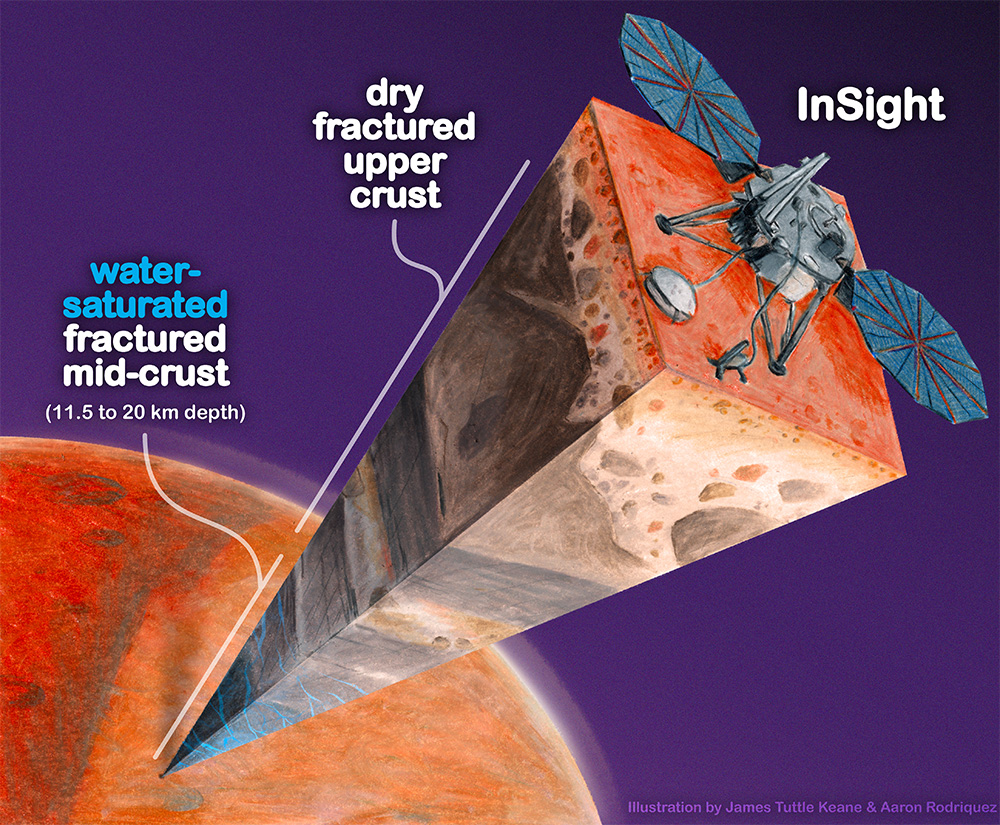
Duricrusts are extensive (in terms of the area they might cover) layers of frozen minerals trapped within the Martian regolith. They were first noted in detail during the NASA InSight lander mission (operational on the surface of Mars between November 2018 and December 2022), significantly impacting the effectiveness of the lander’s HP3 science instrument, which included a tethered “mole” designed to burrow down into the Martian regolith. However, the “mole” kept encountering duricrust layers which, as it broke through, would surround its pencil-like body with a cushion of very loose, fine material which completely absorbed the spring-loaded action of its burrowing mechanism, preventing it from driving itself forward.

This figure demonstrates how salts deposited in the Martian regolith as the water (originally ice) is lost through diffusion and sublimation, can for a sub-surface seal to trap methane within the regolith. Evidence for this kind of “cementing” of material to form a solid crust within the regolith was found by the NASA InSight lander during its surface mission (November 2018 to December 2022). Credit: Pavlov et al. 2024.

In their tests, Pavlov and his team found that the perchlorate duricrust formed in their tests would not only spread across a sample container, it was very effective in trapping neon gas (their methane analogue). Further, when the samples were exposed to the kind of natural expansion and contraction regolith on Mars would experience during a day / night cycle, they found the gas could indeed escape through cracks in the duricrust into the chamber’s atmosphere and be detected – just as with the methane around Curiosity. They also found that if a sample were subject to a pressure analogous to that of the wheel of a 1-tonne rover passing over it, it could be crushed and allow a sudden concentrated venting of any gas under it – again in the manner Curiosity has sometimes encountered.

Whether or not this is what is happening in Gale Crater, however, is open to question – as Pavlov notes. Firm conclusions cannot be drawn from his team’s work simply because scientist have no idea how much methane might actually be trapped within Gale Crater’s regolith, or whether it is being renewed by some source. As already noted, Curiosity is ill-quipped to study methane concentrations in the regolith and rock samples it gathers, because when the one instrument which could do so – the Sample Analysis at Mars (SAM) instrument – was designed, it was believed any methane trapped within Mars would be so deep as to be beyond the rover’s reach, and it thus wasn’t considered as something that would require analysis. While SAM can be configured for the work, it takes considerable time and effort to do so – and that is time and effort taken away from its primary science work, which is more-or-less constant as it handles both rock and atmospheric samples gathered by the rover.

Although Curiosity is fully capable of recovering rock and regolith samples from Gail Crater – such as the material gathered after drilling into a rock called “Aberlady” in April 2019 – around the time the rover was detecting concentrated bursts of methane in the atmosphere around it -, the rover is unable to easily carry out the kind of analysis required to detect any methane deposits which might reside within the samples. Credit: NASA/JPL

Even so, the Goddard work is compelling for a number of reasons; it points to the fact that howsoever any methane within Gale Crater might be produced (organically or minerally), there is a good chance it is becoming mostly trapped within the regolith, and possibly in concentrated pockets. If this can be shown to be the case, and if these pockets could be localised and reached by a future mission, they might some day give up the secret to their formation – including the potential they are the result of colonies of tiny Martian microbes munching and farting (so so speak!).

Continue reading “Space Sunday(ish!): Mars methane mysteries”

Space Sunday: solar events; black holes;+ updates

NASA’s Solar Dynamics Observatory captured these two views of massive solar flares, registering X5.8 and X1.5, respectively, on May 11th, 2024. Credit: NASA

We are currently approaching the mid-point in Cycle 25 of the Sun’s 11-year cyclical solar magnetic activity. These are the periods in which observable changes in the solar radiation levels, sunspot activity, solar flare and the ejection of material from the surface of the Sun, etc., go from a fairly quiescent phase (“solar minimum”) to a very active phase (“solar maximum”) before declining back to a quiescent period once more to repeat the cycle again. The “11-year” element is the average length of such cycles, as they can be both a little shorter or a little longer, depending on the Sun’s mood. They’ve likely been occurring over much of the Sun’s life, although we only really started formally observing and recording them from 1755 onwards, which is why this cycle is Cycle 25.

This cycle started in December 2019, and is expected to reach its mid-point in July 2025, before declining away in terms of activity until the next cycle commences in around 2030. Predictions as to how active it might be varied widely during the first year or so, (2019-2021), with some anticipating a fair quite cycle similar to Cycle 24; others predicted it would be more active – and they’ve been largely shown to be correct. And in this past week, the Sun has been demonstrating that while it might be middle-aged, it can still get really active, giving rise to spectacular auroras visible from around the globe.

The Aurora Australis (Southern Lights) seen over waters of Lake Ellesmere on the outskirts of Christchurch, New Zealand on May 11th, 2024. Credit: Sanka Vidanagama via Getty Images.

The cause of this activity carries the innocent name of AR3664 (“Active Region 3664”), a peppering of sunspots – dark patches on the solar surface where the magnetic field is abnormally strong (roughly 2,500 times stronger than Earth’s) – on the Sun, and one of several such groups active at this time. However, AR 3664 is no ordinary collection of sunspots. In a 3-day period between May 6th and May 9th, it underwent massive expansion, growing to over 15 Earth diameters in length (200,000 km), and at the time of writing is around 17 Earth diameters across.

This rapid expansion gave rise to a series of huge dynamic solar flares on the 10th/11th May, with the first a massive X5.8 class flare – one of the most powerful types of solar flare the Sun can produce. Accompanying the flares have been interplanetary coronal mass ejections, which since Friday have been colliding with Earth’s magnetosphere, causing geomagnetic storms and auroras, giving people spectacular night skies.

The first of these geomagnetic storms was classified G5 – the highest rating, and the first extreme storm of this type to strike our magnetosphere since October 2023, when damaged was caused to power infrastructure and services in several countries, including Sweden and South Africa. This event caused high-frequency radio blackouts throughout Asia, Eastern Europe and Eastern Africa, and disrupted GPS and other commercial satellite-directed services, although overall, the impact was fairly well managed.

Aurora Borealis (Northern Lights) seen over Vienna during the May 11th geomagnetic storm. Credit: Max Slovenchik via Getty Images

Further storms were experienced through Friday, Saturday and Sunday (10-12th May), varying between G3 and G4 as a result of further CMEs from AR 3664, together with further solar flares in the X4 range. Storms and auroras are expected to continue through until Monday, May 13th, after which AR 3664 will slip around the limb of the Sun relative to Earth.

Thus far, cycle 25 has seen daily sunspot activity around 70% higher during the peak period when compared to Cycle 24, although most of the resultant flares and CMEs have tended to be well below the extreme levels of the last few days. Whether AR 664 marks the peak of events for this cycle, or whether we’ll have more is obviously a matter for the future – but if you’ve not had the opportunity to witness the aurora, the nights of the 12th/13th May might be a good opportunity to do so!

High frequency radio blackouts occurred throughout Asia, eastern Europe and eastern Africa shortly after the X5.8 solar flare of May 11th, 2024. Credit: NOAA/SWPC

AR 3664 is, coincidentally, believed to be around the same size as the sunspot cluster thought to have been responsible for the 1859 Carrington Event, the most intense geomagnetic storm in recorded history (Cycle 10), resulting in global displays of aurora and geomagnetic storms, the latter of which massively disrupted telegraphic communications across Europe and North America (and lead to reports of telegraph operators getting electric shocks from their morse keys and still being able to send and receive messages even with their equipment disconnected from the local power supply!).

Take a Plunge into a Black Hole – Or Fly Around it

Black holes are mysterious (and oft misunderstood) objects. We all know the basics – they are regions on spacetime where gravity is so great that not even light can escape past a certain point (the event horizon) – but what would it be like to fall into one or pass into orbit around one?

In the case of the former, we may think we know the answer (stretching / spaghettification, death + a different perspective of time compare to those observing us from a safe distance), but this is not actually the case for all black holes; it comes down to the type you fall into.

In the case of stellar black holes, formed when massive stars collapse at the end of their life cycle, it’s unlikely you’ll ever actually reach the event horizon, much less fall into it; the tidal forces well beyond the event horizon will rip you apart well in advance. But in the case of supermassive black holes (SMBHs), such as the one lying at the centre of our own galaxy (and called Sagittarius A*) things are a little different.

The first direct image of a supermassive black hole, found in the galactic core of Messier 87, released in 2019 by the Event Horizon Telescope Collaboration. The orange colour is the accretion disk of matter surrounding the black hole some distance from its event horizon. Messier 87 is a giant galaxy 53 million year-years from Earth. Credit: EHO

These black holes are so mind-bogglingly big that the gravity curve is somewhat “smoother” than that of a stellar black hole, with the tidal forces more predictable, possibly allowing the event horizon to be reached and crossed (giving rise to spaghettification). Even so, trying to define what goes on in and around them is still somewhat theoretical and based on abstracted concepts drawn from indirect observation and complex maths.

So, to try to get a better handle on what the maths and theories predict should happen around something like a SMBH – such as falling into the event horizon or being able to orbit and escape such a monster, NASA astrophysicist Jeremy Schnittman – who is one of the foremost US authorities on black holes – harnessed the power of NASA’s Discover supercomputer (with over 127,000 CPU cores capable of 8,100 trillion floating point operations per second), and used available data on Sagittarius A* to generate two visual models which make for a fascinating study.

In the first, the camera takes us on a ride from a distance of some 640 million km from the SMBH (a point at which its gravity is already warping our view of the galaxy), through the accretion disk and into a double orbit around the black hole before gravity is allowed to pull the camera in and across the event horizon. It provides a unique insight into how the galaxy around us would appear, how time and space are bent (and eventually broken), whilst also offering an enticing view of another black hole phenomenon: photon rings – particles of light which are travelling fast enough to fall into orbit around the black hole and loop around it more than once before escaping again.

I’ll say no more here, the video explains itself.

In the second video (below), the camera passes around the black hole for two orbits before breaking away, just like the light particles responsible for the photon rings. As well as the visualisation of the warping effect gravity that a black hole has on light, both videos also demonstrate the time dilation effect created by the SMBH’s gravity.

In the “orbital” video, eat loop around the black hole takes – from the camera’s perspective – 30 minutes to complete. However, from the perspective of someone watching from the video’s starting point, 640 million kilometres away, each orbit appears to take 3 hours and 18 minutes. Meanwhile, in the “fall” video, from the camera’s perspective, the drop from orbit to event horizon lasts 10 minutes. However, from anywhere beyond the black hole, it never ends; the object appears to “freeze” in place the moment it touched the event horizon (even though it is ripped apart nanoseconds after crossing the event horizon).

And these dilation effects assume the black hole is static; if it happened to be rotating – then in the case of camera orbiting the black hole and then braking free, mere hours may seem to have passed – but to the observers so far away, years will have seemed to pass.

Updates

Starliner CFT-1 Delayed

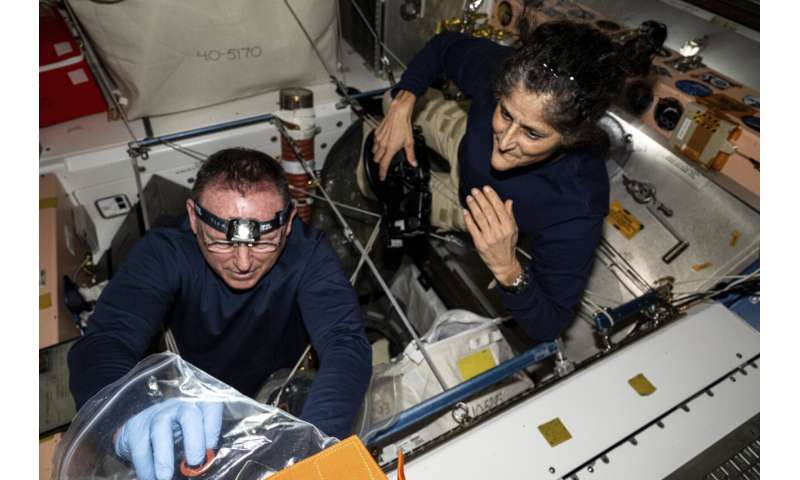
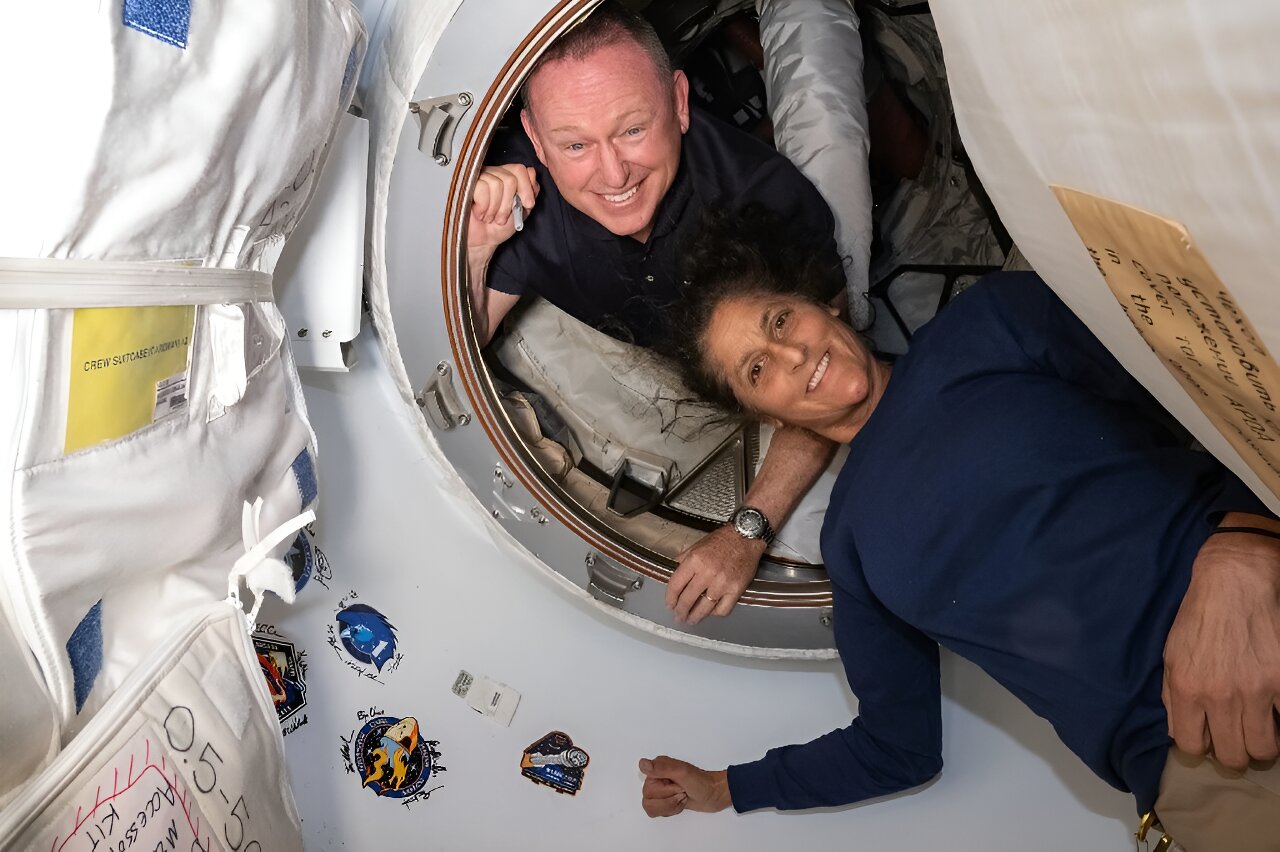
Boeing’s CST-100 Starliner continues on the rocky road to flight status. As I reported in my last Space Sunday, CST-100 Calypso was due to head off to the International Space Station (ISS) on Monday, May 6th, carrying NASA astronauts Barry “Butch” Wilmore and Sunita “Suni” Williams on a Crewed Flight Test (CFT) designed to pave the way for the spacecraft to be certified for operations carrying up to 4 people at a time to / from the ISS.

Whitmore and Williams departing the Neil A. Armstrong Building at Kennedy Space Centre in preparation to board the crew bus from the drive to neighbouring Canaveral Space Force Station for the (subsequently scrubbed) CST-100 launch attempt, May 6th, 2024. Credit: NASA

Only it didn’t; the launch was scrubbed some 2 hours ahead of lift-off due to issues in the flight hardware – although this time, thankfully, not with the vehicle itself. The fault lay within an oxygen relief valve in the Atlas V’s Centaur upper stage, of the Atlas V launch vehicle. The valve was cycling open and closed repeatedly and so rapidly that crew on the pad could hear it – describing is as a “buzzing” sound.

Initially, it had been hoped that the issue could be rectified without moving the vehicle back from the pad at Cape Canaveral Space Force Station, and that a launch date of May 10th could be met. However, by May 8th, attempts to reset the valve via software and control intervention had failed, and ULA – the company responsible for the Atlas V and its upper stage (ironically, the Centaur is produced by Boeing, one of the two partners in ULA) – decided the stack of rocket and Starliner would have to be rolled back to the Vertical Integration Facility (VIF) close to the pad, so the entire valve mechanism can be replaced.

Boeing’s Starliner spacecraft and its Atlas V rocket returning to the Vertical Integration Facility at Cape Canaveral Space Force Station, May 8th, 2024, so a faulty oxygen relief valve on the launch vehicle can be replaced. Credit: NASA

As a result, and at the time of writing, the launch is now scheduled to take place on Friday, May 17th, with a lift-off time targeting 23:16 UTC.

Hubble Back, TESS Down, Up, Down, Up

On April 28th, I reported that the Hubble Space Telescope (HST) had entered a “safe” mode following issues with one of its three remaining pointing gyroscopes. As noted in that piece, the gyroscopes are a vital part of HST’s pointing and steadying system, and while it generally requires three such units for Hubble to operate efficiently, it can get by at a reduced science capacity with only two – or even one, if absolutely necessary – functional gyro.

These gyros do naturally wear out – six brand new units were installed in 2009 (pairs of primary and back-up), but since then, three have permanently failed, and one of the remaining three has been having issues on-and-off since November 2023. Fortunately, in the case of that issue, and now with the April 23rd problem, engineers on Earth were able to coax the gyro back into working as expected. Thus, in the case of the latter, Hubble was back on science gathering duties with all instruments were operational on April 30th.

Hubble (l) and TESS: troubled times. Credit: Robert Lea

Quite coincidentally, another of NASA’s orbiting observatories – the Transiting Exoplanet Survey Satellite (TESS) – also entered a “safe” mode on April 23rd, 2024 – the second time in April its did so. On April 8th, 2024 TESS suddenly safed itself without any warning, and remained off-line for science operations through until April 17th, when the mission team managed to restore full service. However, what triggered the safe mode in the first place has yet to be identified; so when TESS slipped back into a safe mode on April 23rd, engineers looked to see if there was a connection. There, was – but not in the way they’d hoped.

In order to restore TESS to an operational status on April 17th, the mission team had to perform an “unloading” operation on the the flywheels used to orient and stabilise the observatory. This is a routine activity, but it requires the use of the propulsion system to correct for any excess momentum held by the flywheels that might get transferred directly to the spacecraft and cause it to lose alignment. This in turn requires the propulsion system to be properly pressurised. Unfortunately, this was not completed correctly, and the thrusters were left under-pressurised. As a result, a small amount of momentum was transferred to TESS’s orientation, gradually swinging it out of expected alignment until it reached a point where the main computer realised something was wrong, triggered the safe mode and ‘phoned home for help.

Given this, the fix was relatively simple: correctly pressurisation the propulsion system and gently nudge it to stabilise TESS once more so it is aligned in accordance with its science operations.

Space Sunday: Starliners and samples

An artist’s rendering of a CST-100 Starliner capsule and service module in low Earth orbit. Credit: NASA / Boeing

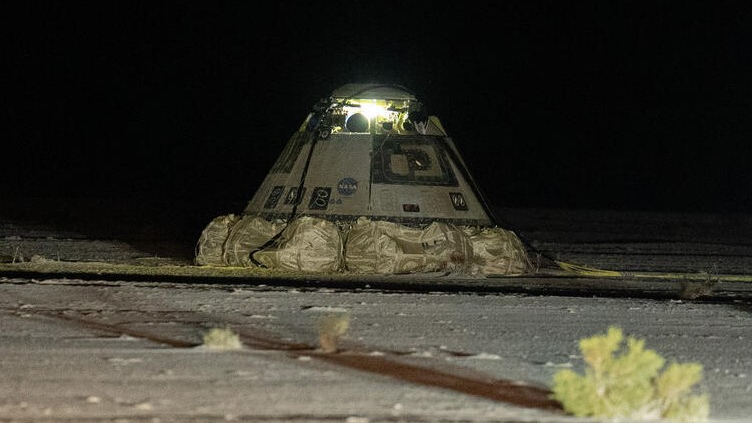
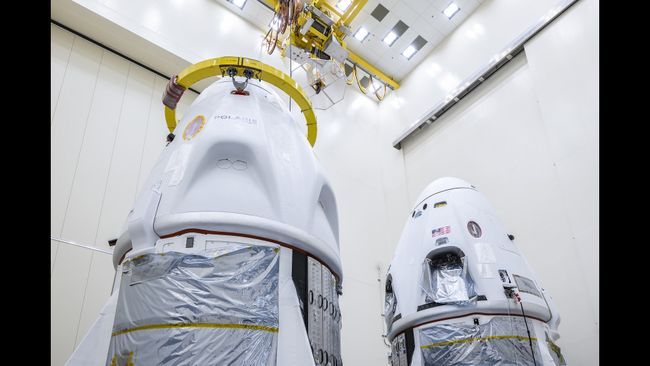
Monday, May 6th 2024 should hopefully mark the start of a new phase of crewed space launches from US soil when the long-overdue NASA Crewed Flight Test (CFT) of Boeing’s CST-100 Starliner lifts-off from Canaveral Space Force Station and heads for the International Space Station (ISS).

As I’ve noted in these updates, the Starliner is one of two commercial vehicles specifically contracted by NASA to handle crew transfers to / from the ISS (the other being the SpaceX Crew Dragon), under the the Commercial Crew Program (CCP). Like Crew Dragon, it comprises a reusable capsule powered and supported by an expendable service module. Like both NASA’s Orion capsule (which is somewhat larger) and the Crew Dragon (which is somewhat smaller), the Starliner is also capable of other missions to low-Earth orbit outside of its primary NASA function.

A comparison between NASA’s Apollo and Orion capsules, together with the commercial vehicles from Boeing (CST-100) and Dragon (SpaceX) – all seen without their service modules. Credit: G. De Chiara

Capable of carrying up to seven people (the general crew complement for an ISS Expedition crew rotation) – although normal operations will see it carry four at a time -, Starliner is designed to be used for 10 flights with a 6-month turn-around time. The system was first unveiled in 2010, and was intended to build on Boeing’s experience with NASA and the Department of Defence; with the company confident the vehicle could be flying by 2015 were NASA to fund it forthwith. However, as NASA did not grant a contract (US $4.2 billion) until 2014, the first flight (+ vehicle certification) was pushed back to 2017 – although development work on the vehicle continued between 2010-2014 due to funding via NASA’s Commercial Crew Development (CCDev) contract.

However, as as I’ve again charted in these pages, the programme has been beset with issues – many of them to Boeing’s complete embarrassment. Over confidence on Boeing’s part saw the initial uncrewed test flight(OFT-1) delayed and delayed, finally taking place in December 2019. Post-launch a number of software errors were found, including an 11-hour offset in the vehicle’s mission clock, which resulted in an over-use of propellants and leaving the vehicle unable to rendezvous with the ISS. To further software errors were detected during the flight, either of which might otherwise have resulted in the complete loss of the vehicle.

As a result, a second Orbital Flight Test was required, to be undertaken at Boeing’s expense. Again the company was bullish about things, stating they could complete it in 2020, despite NASA requesting some significant updates to the docking system (which were further exacerbated by COVID, admittedly hardly Boeing’s fault). As a result, the launch pushed back to August 2021, and things went sideways.

somehow, Boeing managed to assemble the vehicle, ship it to Canaveral Space Force Station, have ULA integrate it into its Atlas V launcher, roll it out to the pad and then realise 13 propulsion system valves were stuck in the wrong position. Rather than scrub the mission and roll the vehicle back for a complete check-out and repair, Boeing then tried to carry out a fix on the launch pad, and when that failed, at the ULA Vertical Integration Facility (VIF). Only after this (somewhat risky) options failed, did the company return the spacecraft to the factory for proper remedial action – only to then enter into an embarrassing attempt to blame-shift with propulsion system supplier Aerojet Rocketdyne.

August 22nd, 2022: harnessed against the risk of a fall down the side of the booster, Boeing technicians attempt to repair 13 propulsion valves in the OFT-2 Starliner vehicle from the High Bay of the ULA Vertical Integration Facility at Canaveral Space Force Station. Eventually, the vehicle had to be unstacked and returned to the factory for repairs. Credit: NASA

As a result, OFT-2 did not take place until May 2022, and whilst largely successful, the flight saw issues with both the Orbital Manoeuvring and Attitude Control System (OMACS) and Reaction Control System (RCS). Even so, the flight was seen as meeting all of NASA’s requirements and Starliner was cleared for a crewed test flight (CFT), initially scheduled for early 2023,  only for more issues to cause it to be pushed back. Chief among these were problems with the parachute harness linking the capsule to its descent parachute and also – most worryingly – the discovery that flammable tape had been used with electrical wiring in the vehicle (a contributing factor to the tragedy of the Apollo 1 fire in 1967). The need to subject the parachute harness to upgrades and testing, and to go through the capsule inch by inch and replace the flammable tape knocked any hope of a 2023 CFT launch on the head, and it was pushed by to April / May 2024, with May 6th eventually being selected for the launch day.

For the last couple of weeks, final preparations for the launch have been taking place at both Kennedy Space Centre, where the 2-person crew have been in pre-flight quarantine (with the exception of the pre-flight team assigned to them) so as to avoid either contracting any communicable illness which might be passed to the crew on the ISS; and at Cape Canaveral Space Force Station, most recently with the roll-out of the Starliner vehicle Calypso atop its Atlas V launch vehicle.

The Boeing Starliner Calypso departs United Launch Alliance’s Vertical Integration Facility atop a ULA Atlas V rocket on May 4th, 2024, heading for Space Launch Complex 41 (SLC-41), Canaveral Space Force Station, in anticipation of its crewed launch on May 6th, 2024. Credit: Miguel J. Rodriguez Carrillo / AFP via Getty Images

The launch will mark the first used of the human-rated N22 variant of the Atlas V, and the first time any variant of the Atlas family of launch vehicles has lifted humans to space since the days of Project Mercury in the 1960s. The launch will also mark the first crewed launch from Cape Canaveral since Apollo 7 (October 1968). The mission is scheduled to last 6 days, with the crew flying the vehicle to a rendezvous and manual docking with the ISS, where they will remain for several days prior to undocking and making a return to Earth and touch down on land (Starliner does not make the more usual – for US crewed capsules – ocean splashdowns, instead using propulsive braking and an airbag, both of which operate in the last second prior to the vehicle landing, to cushion the crew).

Whilst a manual rendezvous and docking with the space station is a major goal for the mission, CFT-1 is also about getting a hands-on view of the vehicle’s capabilities and flight systems, together with an overall assessment of its human factors and handling during dynamic events (e.g. launch, docking, atmospheric re-entry and landing). For this, the crew selected for the mission are highly qualified test pilots turned astronauts in the form of mission Commander Barry “Butch” Wilmore, a Captain in the US Navy NASA, and Pilot Sunita “Suni” Williams, also a Captain in the US Navy.

Whilst Starliner is designed to be lifted to orbit from a variety of launch vehicles – ULA’s Atlas V and Delta IV and SpaceX’s Falcon 9 – all of its completed and planned NASA crew flights will be atop the N22 crew-rated version of the Atlas V. Credit: ULA

Wilmore has spent a total of 178 days in space, flying both the space shuttle (STS-129) in the Pilot’s seat, and on the Russian Soyuz vehicle, which he used in 2014 to reach the ISS as a part of the Expedition 41/42 long duration station crew. As a fleet pilot, he gained over 6,200 hours flying a range of jet fighter and interceptor aircraft and making 663 at-sea landings aboard multiple US aircraft carriers. He also flew 21 combat missions during Operation Desert Storm. As a test pilot, he was heavily involved in the certification of the T-45 Goshawk trainer (a US version of the venerable British Hawk trainer) for carrier flight training, and served as an instructor for both US Navy fixed wing aviators and pilots training at the US Air Force Test Pilot School.

Williams served in the US Navy flying rotary aircraft, flying with Helicopter Combat Support squadrons. She flew missions during Operation Desert Shield, and was a senior pilot-in-charge of a detachment of Navy helicopters flying relief and rescue missions following Hurricane Andrew in 1993. She is qualified as a pilot, a test pilot and an instructor pilot on over 30 types of rotary wing aircraft, including helicopters and the likes of the V-22 Osprey.

NASA’s Crew Flight Test (CFT) astronauts Sunita “Suni” Williams and Barry “Butch” Wilmore (right) exit the Neil A. Armstrong Operations and Checkout Building at Kennedy Space Centre wearing the Boeing Starliner pressure suits on Friday, April 26th, during a mission dress rehearsal. Credit: NASA / Frank Micheaux

As a NASA astronaut, she has flown in space no fewer than six times, for a total of 321 days 17 hours in space, 50 hours of which were spent carrying out 7 EVAs outside of the space station, marking her as one of NASA’s top five most experienced EVA astronauts. She was also the first person to run a marathon in space, officially participating in the 2007 Boston Marathon. She did this using a treadmill and bungee cords to hold her in place, completing the run distance in 4 hours 24 minutes – during which time she actually circled the Earth 3 times! She took part in the same marathon again in 2008.

Providing CFT-1 is a success and meets all of its goals, it will clear the way for crewed flight operations using Starliner to commence in 2025. No date has been set for the first operational flight, Starliner-1, but it is due to launch a 4-man crew of NASA astronauts Scott Tingle and Michael Fincke, Canadian astronaut Joshua Kutryk and Japanese astronaut Kimiya Yui on a planned 6-month stay at the space station. Once operational Starliner will fly annually on ISS missions from 2025 through 2030, splitting operations with Crew Dragon.

Whilst Starliner can – like Crew Dragon – be used for other orbital mission types, Boeing stated recently that it currently has no plans to start operating the craft commercially. However, the company is a partner in the Blue Origin-led Orbital Reef commercial space station project. This is due to commence orbital operations in the late 2020s, and Starliner is the designated crew vehicle for operations and crew flights relating to that station.

Continue reading “Space Sunday: Starliners and samples”

Space Sunday: Rocket Lab, Voyager, Hubble and SLIM

June 29th, 2019: Rocket Lab’s Electron Rocket rises from Launch Complex 1 on the Mahia Peninsula of New Zealand North Island at the start of the mission Make It Rain. Credit: Rocket Lab

Rocket Lab, the New Zealand / US commercial launch provider, is gradually increasing the annual launch cadence of its Electron rocket, as the company continues to garner a solid reputation as a provider of a reliable launch platform whilst also building-out other aspects of its business.

Founded in 2006 in New Zealand by entrepreneur Peter Beck, Rocket Lab initially developed the  Ātea (Māori for “space”) sub-orbital sounding rocket, which made its first (and only) flight in 2009 with the Manu Karere or “Bird Messenger” mission. Although a sub-orbital class of rocket, the  Ātea -1 nevertheless pushed its upper stage and payload beyond the von Kármán line, the arbitrary “boundary” between the Earth’s atmosphere and space sitting at 100 km altitude (although the Earth’s atmosphere actually extends – albeit tenuously – far further than this), technically making Rocket Lab the first private company in the Southern Hemisphere to reach space.

The company started developing Electron Rocket after being awarded a 2010 US Government contract to study the use of a small-scale launch vehicle specifically geared towards servicing the developing cubesat market – a contract which in part lead to the company relocating to the United States in 2012-13 and taking up residence in California, with its New Zealand operations becoming a wholly owned subsidiary of the US business.

Electron Rocket on the production line in 2020. The one with the Electron logo on a white background was an Electron core stage outfitted to test systems to aid in the recovery of boosters following splashdown. Credit: Peter Beck

A two-stage rocket standing 18 metres tall, Electron made its first flight in May 2017. This did not go as planned and no payload was carried, justifying the mission’s name:  It’s A Test. However, the next flight (the first of three in 2018), called Still Testing, successfully delivered a payload of cubesats to orbit, whilst the next flight, called It’s Business Time saw the commencement of commercial launch operations. At the time of writing, Electron has clocked up an impressive 42 successful flights and payload deployments out of 46 launches, with customers paying between US $5 and $10 million per launch.

While this launch rate perhaps doesn’t sound like a lot when compared to SpaceX and its Falcon family, it needs to be remembered that while much is made of the annual volume of Falcon launches, less than 25% of them are actually directly revenue generating commercial sector launches; the vast majority (an average of 60% per year for four years) have been Starlink launches, for which SpaceX absorbs the cost (approx. US $40 million a launch) for no revenue, with a further 15%+ being far more lucrative US-government related launches. By contrast – although the margin of revenue over cost is much smaller, Electron should almost double Falcon’s 4-year average of commercial launches (13.25 per annum)  in 2024, if all 21 of its commercial launches are successful (the company also has 4 government contracted launches to complete in 2024 as well).

For a time Rocket Lab toyed with (and tested) the idea of plucking Electron core stages out of the air using a helicopter and a drag line designed to snag the line between the booster’s drogue and main parafoil as it descended towards a splashdown. This idea, whilst promising, was abandoned. in 2021. Credit: Rocket Lab

Currently, Electron is not reusable, making its launch costs higher than they might be. However, the company is looking to change this by recovering spent Electron first stages after splashdown and then refurbishing and reusing their nine Rutherford motors – the rocket motors being the most expensive element of the launch vehicle. The first re-use of a refurbished Rutherford motor took place in 2023, with Electron’s 40th flight, the the company is now building on this.

As well as commercial launch customers, Rocket Lab has garnered US government contracts from NASA, the National Reconnaissance Office and the United States Space Force, with the latter in recent months awarding the company contracts worth some US $547 million to develop and launch satellites as a part of the US military’s Proliferated Warfighter Space Architecture (PWSA), a constellation of satellites from a number of suppliers which provides  communications, information gathering, target tracking, etc., to the US military in battlefield and tactical / logistical operations. In addition, Rocket Lab has provided both its US and New Zealand launch services to other governments as well, including France, South Korea and the Australian government.

Nor is the company resting on its laurels with Electron. Despite once saying he would eat his hat if Rocket Lab ever moved towards making a reusable launch system  – his belief being that if the engines could be recovered and reused, that was enough – in March 2021 Rocket Lab announced they were to commence work on a medium-lift (8 – 13 tonnes payload range) launch vehicle.

Called Neutron, the reusable vehicle was introduced to the world on March 1st, 2021 in a video which saw Peter Beck keep his promise: he ate his hat (or some of it, at least).

Neutron – unlike SpaceX’s Starship / Super Heavy – has been designed from the ground-up to meet the needs of a number of existing government and commercial markets: the growing smallsat constellation market (which in and of itself is perhaps increasing more issues they it is potentially solving); medium payloads to LEO, SSO and also to geostationary transfer orbit (GTO – e.g. to other planets); and human space flight. It will achieve all of this in a novel approach.

Classified a 2-stage launch vehicle, Neutron will not have a conventional upper stage. Instead, the payload booster and payload will be contained inside the first stage. After passing through the majority of the atmosphere and entering a post-engine shutdown ballistic flight, the upper portion of the Neutron will open to eject the payload. Once the latter is clear, Neutron will use its thrusters to flip itself away from the “upper” stage, allowing the latter to fire its motor and push the payload on to its assigned orbit. Other factors then come into play – such as the shape of the Neutron, the re-use of at least one of its motors, etc – that will allow the rocket to make a propulsive return to launch sight descent and landing.

The advantages of this approach are multiple. Incorporating the upper stage into the rocket means that it can be smaller and lighter, as it does not require the additional structural reinforcement needed for it to be the fist of the rocket as it punches its way up through the atmosphere. Similarly, the integration of the protective payload fairings into the main rocket both increases the overall structural integrity of the vehicle and means they are not simply thrown away during a launch, removing the cost of a brand new set of fairings with each launch.

A rendering of Rocket Lab’s Neutron Rocket. Credit: Rocket Lab

However, there are also potential issues with the approach which Rocket Lab will have to demonstrate they can address. For example, human-rated vehicles generally require  means by which a crew can be hauled clear should the rocket malfunction. Clearly, if you are carrying your crew inside the rocket to start with, then getting them out of it will take longer that simply blasting them clear with powerful motors, as can easily be done when they are sitting at the pointy end of the rocket.

Currently, the first Neutron flight is targeting a late 2024 launch – which is an ambitious target for a project only announced in 2021, and which requires not only the development of the launch vehicle, but its propulsion system and fabrication facilities. As such, whether Rocket Lab achieve it or not is still open to debate.

The engine for Neutron is called Archimedes engine, and it is being built by Rocket Lab at their facilities in California. Primarily constructed using 3D printing, nine Archimedes motors will power the Neutron core stage with a further motor powering the “upper” stage.

Meanwhile, ground was broken for the rocket’s production facility in April 2022 at the  Mid-Atlantic Regional Spaceport (MARS) within NASA’s Wallops Flight Facility on the eastern coast of Virginia, USA – the MARS spaceport being the base of operations for Neutron, with no plans (at present) to launch the vehicle from New Zealand or elsewhere.

In addition to launch vehicles and satellites, Rocket Lab also produces the Photon satellite bus, designed for a variety of uses, including lifting satellites to their assigned orbits and providing power and propulsion for interplanetary payloads.  Photon is an attractive vehicle for government space agencies and the private sector, as it can be flown on a variety of launch vehicles and can utilise a wide range of rocket motors, such as Rocket Lab’s other engines, the Curie and HyperCurie and those from third-party suppliers, engine selection being based on mission requirements.

As such, while Rocket Lab might be small (literally and figuratively) when compared to SpaceX’s Goliath, it is (a bit like David was in that particular fight) the one to keep an eye on.

NASA: Voyager 1  and Hubble – Good News / Bad News

After a five month period of anxiety in which the spacecraft has been sending gibberish back to Earth, NASA’s Voyager 1 spacecraft, the most distant human-made object from Earth so far made, has resumed sending understandable engineering data.

As I’ve been covering in these pages, Voyager 1 started sending this gibberish since mid-November 2023, although it has remained fully capable of receiving and acting upon instructions from Earth. This resulted both in a suspension of the spacecraft’s science activities and an inability for engineers to determine the vehicle’s overall operational state.

An artist’s rendering of Voyager 1 in interstellar space. Credit: NASA / JPL

Since then, investigations initially narrowed the potential issue as lying with one of two systems: the spacecraft’s telemetry modulation unit (TMU), responsible for sending data to Earth; or the flight data subsystem (FDS), responsible for the actual packaging of that data ready for transmission to Earth. Further work determined the issue as lying within the FDS, although exactly what has gone wrong remained a puzzle.

Then, and as I reported in March (see:  Space Sunday: starships, volcanoes and Voyagers), an engineer from NASA’s Deep Space Tracking Network (DSN), which handles all communications with NASA’s multiple deep-space missions, noticed something odd about some outlier data the communications received from Voyager 1 – it did not appear to be gibberish. Digging deeper, he realised it was actually a complete dump of the FDS’s memory.

This allows engineers to determine a single memory chip within the FDS has failed, corrupting about 3% of the system’s memory; just enough for the data packaging operation to be thrown into disarray and result in gibberish. The cause identified, the problem became how to fix it.

The most obvious means to doe so would be to tell the spacecraft not to use the corrupted memory for data processing. However, that required instructing the FDS to use other memory space – and there wasn’t a single address space in the system large enough to match the corrupted memory and manage its own data processing. As a result, the engineers broke the problem down into a series of steps.

The first step was to updated the FDS software so that the system could take the data normally handled by the corrupted data so that it could be handled through several other parts of the FDS memory, and without messing up any of the other data they had to manage. This recoding was carried out during March and April, and on April 18th, 2024, the updated software was sent to Voyager 1. Then came a nigh-on 48 hours wait for a response: it takes 22.5 hours for a signal from Earth to reach Voyager 1, which then has to execute the code, carry out the instructions related to it, and send a reply – requiring another 22.5 hours to reach Earth.

If the engineers were correct and the update correct, then the response from Voyager 1 should be an engineering update on its overall status. On April 20th, that’s exactly what the mission team at NASA’s Jet Propulsion Laboratory received, and for the first time and for the first time in five months, Voyager 1 weas once again communicating with meaningful data.

Engineers and flight team members responsible for Voyager 1’s operation respond to the confirmation that data received from the spacecraft on April 20th, 2024 confirms their initial attempt to correct a data communications issue has worked. Credit: NASA/JPL

The next steps in the process are to ensure that all science data can be similarly re-routed through the FDS to avoid the corrupted memory sent to Earth without anything becoming confused, and then finally to ensure the faulty memory is completely ignored by all FDS processing and by any of Voyager 1’s systems that interact with the FDS. These steps are expected to take several more weeks. Nevertheless, the fact that Voyager 1 is once again “transmitting in the clear”, so to speak, is welcome news.

Unfortunately, things are not so good with the Hubble Space Telescope (HST), with NASA reporting it is again experience issues with its gyroscopes for the second time in the last six months – and the problem appears to lie with the space gyro that had problems in November 2023.

The gyroscopes are used to precisely point the telescope at targets and hold it steady during imaging. Originally, HST used 3 pairs of gyros, which were periodically swapped-out during servicing missions. However, the last time all six gyros were replaced was during the last servicing mission of 2009 – since the retirement of the space shuttle, NASA has not had the means to safely carry out such a mission, and in the intervening time, three of the gyros have failed completely.

The Hubble Space Telescope (HST) as seen from the departing space shuttle Atlantis, flying STS-125, the final HST Servicing Mission, in 2009. Credit: NASA

Such failures are the result of wear and tear affecting wires less than the width of a human hair and called flex leads which pass through the gyros carrying power and data. As the gyros operate, these flex leads well, flex; but they also slowly corrode as a result of this flexing and can eventually break. One sign of this possibly occurring can be seen when a gyro starts to show power fluctuations. This happened during the past week, causing the gyro to enter a “safe” mode.

As a result, and after allowing the telescope to enter a contingency mode were it can – at reduced capability – function on just two gyros for a few days, on Sunday, April 28th, 2024, NASA completely paused the telescope’s science operations in order to more fully investigate the gyro’s problems in order to try to determine if it is about to suffer a flex lead failure, or whether there is another cause of the gyro’s woes, as was the case in November 2023.

If it turns out the gyro cannot be safely restored to an operational state, NASA has indicated it will switch Hubble over to operating on just a single gyro – permanently degrading its capabilities – in order to hold the second functional gyro as a reserve against any further gyro failure.

Japan’s Moon Sniper Wakes Up – Again

As I’ve previously reported in these pages, Japan became the fifth nation to successful land a spacecraft on the Moon when its Smart Lander for Investigating Moon (SLIM – also called “Moon Sniper”) arrived on the lunar surface on January 19th, 2024. Unfortunately, the craft arrived upside down, as confirmed by images returned by one of the two micro-rovers deposited on the lunar surface as a part of the mission (see: Space Sunday: a helicopter that could; a lander on its head and  Space Sunday: More Moon (with people!) and a bit of Mars) – although precisely why it did has not been 100% confirmed.

Despite this, the vehicle was able to complete the majority of its science mission before being put in a dormant state with the onset of the long lunar night. At the time – the start of February – it was not anticipated that the craft would survive the 14 terrestrial day period without sunlight to warm it and provide energy to power its batteries. But it did; as it started to receive sunlight once more in late February, it called home.

Japan Aerospace Exploration Agency (JAXA) released this image, captured by the LEV-2 mini-rover, of their SLIM lander upside down on the Moon. Credit: JAXA

Whilst the team responsible for the spacecraft had hoped this might be the case, they were unable to get the vehicle to resume science operations and, after a further 14 terrestrial days of sunlight, SLIM went back to sleep for a second night. This time, it was not expected to wake up and the mission team disbanded – only to come back together in March 2024, when SLIM did indeed wake up as it received daylight, and started ‘phoning home and sending images, which it continued to do until night came yet again.

This time, the mission team were sure the vehicle would not call home once sunlight had returned to its landing spot and once again, they’ve been proven wrong. SLIM again ‘phoned home on April 24th, 2024, although it is unclear whether or not the mission team have been able to re-establish any of the vehicle’s science gathering activities. Even so, that the craft has thus far survived three long lunar nights again proves Japan’s prowess with their space technology.

Space Sunday: flying on Titan; bringing home samples from Mars

A 2021 rendering of NASA’s Dragonfly octocopter vehicle, now set to head to Titan in 2028. Credit: NASA / JHU/APL

NASA’s ambitious plan to fly a robotic vehicle on a moon of another world is to go ahead after receiving official confirmation in April 2024. With its cost now set at some US $3.35 billion, double its initial price estimates – largely the result of the COVID pandemic derailing the vehicle development process in 2020/21 -, the vehicle – called Dragonfly (as is the overall mission) is intended to have a 10-year primary lifespan, with 3.3 years of that time spent flying around and studying Saturn’s largest moon, Titan.

Dragonfly is a spectacular science mission with broad community interest, and we are excited to take the next steps on this mission. Exploring Titan will push the boundaries of what we can do with rotorcraft outside of Earth.

– Nicky Fox, NASA associate administrator, Science Mission Directorate, Washington D.C.

Titan is a unique target for extended study for a number of reasons. Most notably, and as confirmed by ESA’s Huygens lander and NASA’s Cassini mission, it has an abundant, complex, and diverse carbon-rich chemistry, while its surface includes liquid hydrocarbon lakes and “seas”, together with (admittedly transient) liquid water and water ice, and likely has an interior liquid water ocean. All of this means it is an ideal focus for astrobiology and origin of life studies – the lakes of water / hydrocarbons potentially forming a prebiotic primordial soup similar to that which may have helped kick-start life here on Earth.

Using a vehicle that is in situ on the surface of Titan is vital, because the moon’s dense atmosphere obscures its surface across many wavelengths, making it exceptionally hard to definitively identify the specific combinations of hydrocarbon materials present across the moon’s surface without getting very up close and personal. To do this, Dragonfly will be a unique rotary vehicle, one a good deal heavier and more complex / capable than the Ingenuity drone flown on Mars (which was an extraordinary flying vehicle – and now static weather station – on Mars).

The brainchild of Jason W. Barnes (University of Idaho) and  Ralph Lorenz (Johns Hopkins University Applied Physics Laboratory – or JHU/APL), Dragonfly is being developed for NASA by JHU/APL, with Elizabeth “Zibi” Turtle, a planetary scientist at JHU /APL serving as the mission’s principal investigator.

The craft is designed as an octocopter – an aerial vehicle with four pairs of contra-rotating rotor blades. Each pair of rotors will be powered by its own electric motor, and the craft has been design to withstand either the loss of a single rotor blade or the completely failure of and one motor powering a pair of blades. It will have an on-the-ground mass of around 450 kg (compared to Ingenuity’s 1.8 kg), and will use a mix of nuclear and battery power.

A large lithium-ion battery will provide direct power to the vehicles flight and navigation systems and to this science suite. It will provide sufficient power for the craft to travel up to 16 km on a single charge at speeds of up to 36 km/h, with a maximum airborne time of around 30 minutes per flight, and an estimated maximum altitude of 4 km – although generally the craft will fly much lower than this. The battery will be supported / recharged by a Multi-Mission Radioisotope Thermoelectric Generator (MMRTG), which will also be used to provide heat to the vehicle, particularly during Titan’s night periods when it is behind Saturn relative to the Sun, and which lasts for 8 terrestrial days. The MMRTG will additionally provide power to the vehicle’s science instruments during the night periods, allowing them to work whilst the vehicle waits out the night in order to resume flying in daylight..

Dragonfly’s remarkable flight capabilities – speed, altitude, single flight distance – are made possible by Titan’s environment: the moon’s low gravity (around 13.8% that of Earth and dense atmosphere (around 1.45 times that of Earth’s) mean that the flight power for a given mass operating on Titan is around 40 times lower than on Earth, so the vehicle can have a fairly significant mass which can be lifted by relatively low-mass, low-power motors.

A Dragonfly testbed article undergoing flight trials

The vehicle will fly a primary science suite of four packages, comprising:

  • DraGNS (Dragonfly Gamma-Ray and NeutronSpectrometer): comprising  a deuterium-tritium Pulsed Neutron Generator and a pairing of a gamma-ray spectrometer and neutron spectrometer to identify the surface composition under the vehicle.
  • DraGMet (Dragonfly Geophysicsand Meteorology Package): a suite of meteorological sensors including a seismometer.
  • DraMS (Dragonfly Mass Spectrometer): a mass spectrometer to identify chemical components, especially those relevant to biological processes, in surface and atmospheric samples.
  • DragonCam (Dragonfly Camera Suite) is a set of microscopic and panoramic cameras to image Titan’s terrain and scout for scientifically interesting landing sites.

Samples of surface material for examination by the science packages will be obtained using two coring drills and hoses mounted within Dragonfly’s skid, per the video below.

Further, the vehicle will be equipped with a fully autonomous flight and navigation system capable of flying it along a selected flight path, making its own adjustments to account for local conditions whilst in flight, and with sensors capable of record potential points of scientific interest along or to either side of its flight path, so the information can be relayed to Earth and factored into planning for future excursions. Flights over new terrain will likely be of an “out and back” scouting nature, the craft returning to its point of origin, allowing controllers on Earth to plan follow-up flights to locations along the flight track, taking into account any points of interest noted by the vehicle.

Currently, Dragonfly is targeting a July 2028 launch, although the launch vehicle itself has yet to be announced. It will take seven years to reach Titan, mostly likely using several gravity-assist manoeuvres around Earth to slingshot itself on its way. In this, it will be the first dedicated mission to the outer solar system not to flyby / utilise Jupiter whilst en route, as the planet will not be within the mission flight path.

On arrival at Titan, and following separation from the cruise stage that would keep it both powered and warm during the trip from Earth, Dragonfly will enter the moon’s atmosphere atop a 3.7 metre diameter heat shield, and under a protective back shell. Once in the atmosphere, a single drogue and single large main parachute will be deployed to slow the vehicle’s descent until it reaches an altitude at which the parachute is released and Dragonfly can drop clear of the back shell, enabling it to start its motors and make a first landing on Titan.

A 2017 rendering of Dragonfly’s arrival on Titan. Credit: NASA / JHU/APL

In this, the landing site for the mission has already been selected: the edge of a prominent and dark region of Titan called Shangri-La, thought to be an immense sand sea of dark, carbon-rich material.

Specifically, Dragonfly will touch down in a dune field close to the relatively young Selk impact crater, which will be the vehicles first science study location, as it contains strong indications that it was once home to deposits of liquid water (and is now surrounded by ejecta that includes water ice) and contains tholin organic compounds. After this, Dragonfly will move on into the Shangri-La, carrying out exploratory flights of up to 8 km at a time and gathering samples for analysis from diverse locations.

NASA Re-Re-Rethinks Mars Sample Return Mission

NASA is now officially seeking both internal outside support for its much-troubled Mars Sample Return (MSR) mission.

The goal of returning samples of surface and sub-surface material from Mars to Earth, where it can be subjected to much more intensive and multi-disciplinary study than can be achieved via in-situ robotic explorations, has long be sought. For NASA, the last 20 years have seen numerous ideas put forward for gathering and returning such samples from Mars, all of which have ended up being cut down in their prime due to matters of cost and stringent curbs on the US space agency’s budget – sending a vehicle to Mars with the express intent of obtaining, storing and then returning samples to Earth not being the easiest of mission profiles to plan, let alone achieve.

However, in the lead-up to the Mars 2020 mission, featuring the rover Perseverance, NASA and the European Space Agency (ESA) signed a letter of intent to jointly develop a sample return mission based around the concept of the actual sample gathering being carried out by Perseverance and deposited on the surface of Mars for collection “at a future date”. The operation to start depositing groups of these samples actually started on December 21st, 2022, with a total of 10 sample tubes being deposited relatively close together on Mars by Perseverance.

Resembling a Star Wars light sabre in an image obtained by the WATSON imager on Perseverance’s robot arm, this was the first of the sample tubes to be “dropped off” by the Mars 2020 rover (December 21st, 2022), marking the start of an initial operation to place 10 such sample tubes in a cache for collection by some future Mars Sample Return mission. Credit: NASA

Whilst this approach negated the need for the MSR to actually collect and store samples itself – in theory simplifying the mission parameters – actually settling on a final design for the mission proved difficult. By 2021, the “optimal” approach was seen as being a mission involving four unique vehicles in addition to the Mars 2020 rover. These were:

  • A NASA- built Mars lander / launch platform.
  • A NASA-built Mars Ascent Vehicle (MAV) with a specialised sample containment unit, and carried within the lander.
  • A European-built “fetch” rover with its own dedicated lander, designed to land ahead of the NASA lander and go find the sample tubes deposited by Perseverance, bring them to the NASA lander and transfer them into the sample containment unit in the MAV.
  • A European-built Earth Return Vehicle (ERV) designed to arrive in Mars orbit and await the arrival of the NASA-built MAV from the surface of Mars. This would then capture the sample unit (about the size of the basketball) after the latter had been released by the MAV, secure it and the samples inside itself and then make the return trip to Earth.

So, yeah; “simples” – not. The mission included, as identified by independent review board (IRB) charged with reviewing the mission for its overall cost-effectiveness and feasibility, no fewer than eight “break the chain” (and cause the mission to fail) first-time challenges, including the fully robotic collection and transfer of samples, the first automated launch of a vehicle from the surface of another planetary body, the first fully autonomous orbital rendezvous between two vehicles (the MAV and the ERV), and the first “pitch and catch” transfer of a sample package. However, despite this and concerns over the estimated mission cost rising to around US $4 billion, the IRB green lit the mission.

The MSR mission concept as envisioned in 2021 / early 2022 and featuring the ESA-built “fetch” rover (minus its lander).  Credit: NASA / ESA

 By July 2022, the complexities of the mission had been more fully realised, so efforts were made to “simplify” it. Specifically, the ESA “fetch” rover was eliminated from the mission – but was supplanted by the use of two Ingenuity class Mars helicopters. Fitted with wheels, these would also be delivered to Mars by the NASA lander carrying the MAV, and once there, they would fly and land in close proximity to sample tubes deposited by Perseverance, then drive up to them, pick them up and fly them back to the lander for transfer to the MAV, with the rest of the mission remaining the same.

The 2022 MSR update, with the ESA “fetch” rover removed from the mission, and replaced by two Ingenuity-class  helicopters (only one shown), which would be delivered to Mars by the NASA MSR lander and tasked with recovering sample tubes deposited by the Mars 2020 Perseverance rover. Credit: NASA / ESA

However, while this removed the need for an entire rover and lander, and meant that effectively, NASA would have two further helicopters on Mars with which they could carrying out other missions once the sample tubes had been delivered to the MAV, it didn’t actually do much to reduce complexity or mission cost – which threatened to rise to around US $8 billion.

To offset this, the planned mission time frame was revised from around 2030-31 to the mid-to-late 2030s, allowing the mission cost to be spread across a greater number of NASA fiscal years. However, by mid-2023, it was widely recognised that the mission would probably exceed the US $8 billion estimate and peak at perhaps as much as US $11 billion – gaining the mission a lot of opposition on Capitol Hill. Suggestions were made to push the mission time-fame out further, with the lander / MAV / helicopter element not launching until the early 2040s.

By mid-2023, the mission had been further revised in order to try to reduce complexity and costs. Under the new proposal, none of the sample tubes thus far used and deposited on Mars for collection by Perseverance would actually be recovered (about 24 of the 43 total). Instead, all of the remaining tubes (16 of which have yet to be used, as of the time of writing) would be retained on the rover. Then, on the arrival of the MSR lander / MAV combination, Perseverance would rendezvous with them and load its supply of sample tubes directly into the MAV’s sample capsule for onward transfer to the ERV and a return to Earth. Whilst this would limit the selection of samples compared to gathering them from the various caches the rover had made on the surface of Mars, it did both simplify the mission – NASA only having to fly the MAV-carrying lander – whilst ensuring ESA’s involvement was not wasted, as they would still supply the Earth Return Vehicle.

The 2023 MSR update, with Ingenuity class helicopters removed and showing the Perseverance rover directly transferring sample tube to the sample capsule of the MAV, eliminating the need for intermediary vehicles. Credit: NASA / ESA

Despite this, over mission complexities and the need for the development of two entirely new classes of robotic spacecraft (the MSR lander-come-launcher for the MAV, and the MAV itself, complete with its sample storage / containment system) meant NASA would still be looking at around a minimum US $8 billion cost – and if the timeframe for the mission were to be extended into the early 2040s, inflation would likely push the final price back up towards the US $11 billion figure.

As a result, and with NASA’s budget already being severely stressed for the 2024/25 period, the agency finally admitted defeat with its more grandiose MSR plans, and on April 15th, 2024, the US space agency issued a statement indicating it is now looking “outside the box” for the means to carry out a Mars sample return mission in a cost-effective manner and within a reasonable time-frame (i.e. before the end of the 2030s). To this end, the statement calls on all NASA centres involved in Mars exploration to work together in order to develop such a mission, whilst also indicating the agency will seek proposals for potential mission architecture from the private sector.

Currently, NASA itself has admitted it does not have firm ideas on how mission costs can be reduced, but is determined to see the sample return mission take place, viewing it as a vital precursor to any attempt at a human mission to Mars. Thus, the process for redeveloping plans and ideas is expected to run through until the latter part of autumn 2024.