Oh! I have slipped the surly bonds of Earth And danced the skies on laughter-silvered wings; Sunward I’ve climbed, and joined the tumbling mirth of sun-split clouds, — and done a hundred things You have not dreamed of — wheeled and soared and swung High in the sunlit silence. Hov’ring there, I’ve chased the shouting wind along, and flung My eager craft through footless halls of air….
Up, up the long, delirious, burning blue I have topped the wind-swept heights with easy grace. Where never lark, or even eagle flew — And, while with silent lifting mind I have trod The high untrespassed sanctity of space, – Put out my hand, and touched the face of God.
(Pilot Officer John Gillespie Magee, Jr., RCAF)
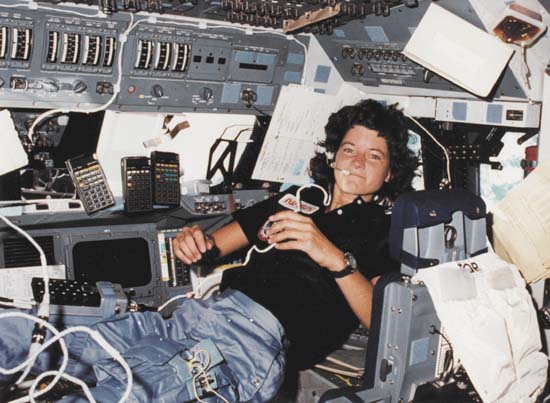
Sally Ride, 1951-2012
First American female astronaut.
Missions flown: STS-7, 1983; STS-41G, 1984.
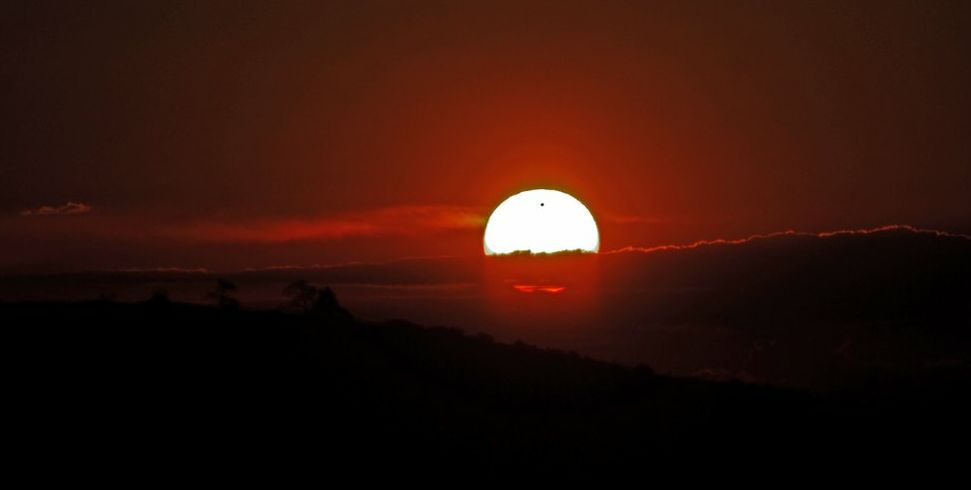
Update June 7th: Two additional images added to this article showing the Black Drop and a wonderful sunset view from Greece.
Well, we didn’t get an in-world venue sorted, but on the night of 5th / 6th of June 2012, a bunch of us gathered (with thousands of others) on Twitter to share in the Transit of Venus. Feeds were widely available from NASA and elsewhere, although many of us stayed with http://www.slooh.com, which provided feeds from telescopes right across the world – Norway, Sweden, mainland USA, Japan, Hawaii, the Pacific, New Zealand, Australia – ten locations in all, hoping to ensure the widest possible coverage should inclement weather interfere with things.
The transit itself has been written about rather a lot – so if you want an overview of the historical context, Wikipedia offers a very informative piece, including the sad tale of Guillaume Le Gentil, which was referred to several times in the SLOOH webcast, and which has itself been immortalised in a the play Transit of Venus. The article also touches on James Cook’s role in observing the transit of 1769.
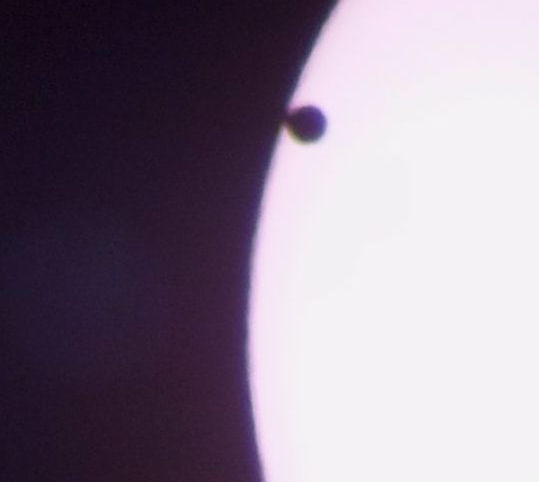
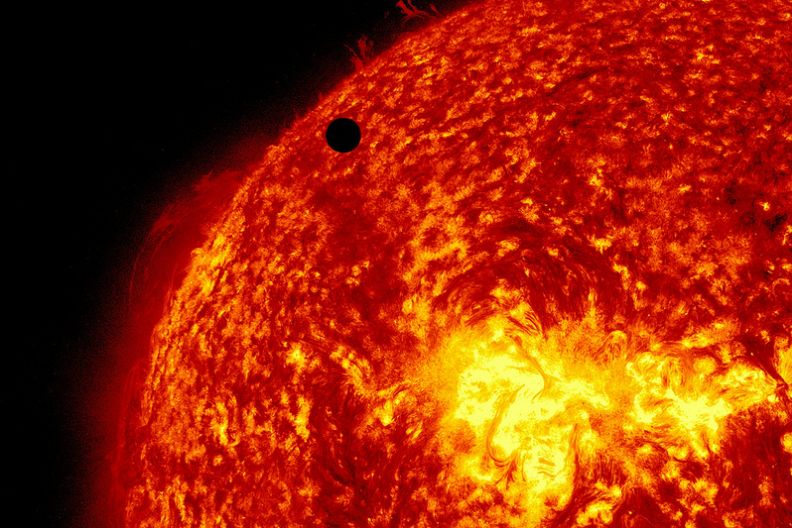
Balu Pulipaka of Indiana captured this image of the “Black Drop” effect as Venus passes through 2nd ContactVenus imaged by NASA’s Solar Dynamics Observatory
Today, the Transit is no longer used to help us understand the broader sweep of the solar system per se, but has, in both 2004 and 2012, been used to assist scientists in the study of exoplanets. In this, the 2012 transit is liable to have been more valuable than 2004, due to increased solar activity as we approach a period of Solar Maximum in the Sun’s (roughly) 11-year cycle.
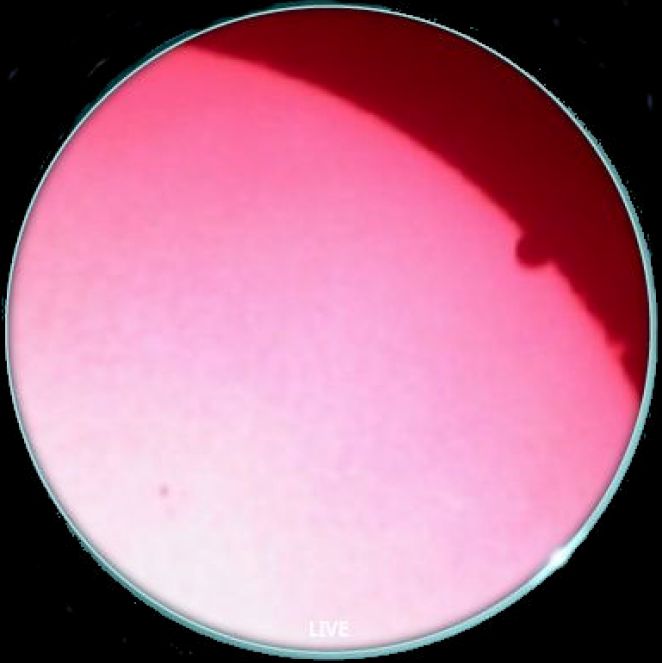
The view from Greece: Spyros Skikos captures a unique sunset with his camera, Venus prominent against the SunA pink-filtered image from the University of Oslo, showing the end of the transit, with Venus between 3rd and 4th contacts. Note the solar prominence on the limb of the sun just below it (image: http://www.slooh.com)
The 2012 event also helped with the calibration of instruments aboard NASA’s Solar Dynamics Observatory, while observations of the event taken from the Svalbard archipelago coupled with those from the European Venus Express mission in orbit around the planet will also hopefully increase our understanding of the planet’s atmosphere and climatology.
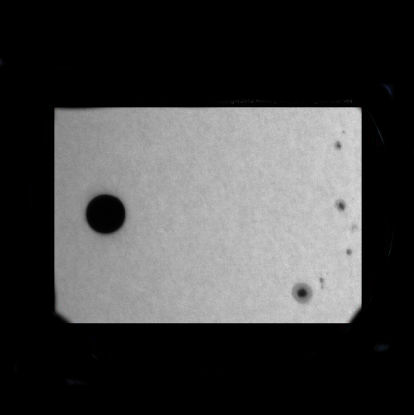
Black & white images from Broome, Australia, showing Venus (left) and sunspots on the face of the sun (image: http://www.slooh.com)
For casual observers, the four periods of contact were perhaps the most enthralling – the points where Venus first “touches” the limb of the sun, then slowly moves inside the sun’s disk until it is entirely “inside) (1st and 2nd Contact) and the point at which it touches the limb of the sun on the other side on its way “out” (3rd Contact), before vanishing entirely (4th Contact).
Of these in turn, the 2nd and 3rd contacts are of interest as they give rise to the so-called “black drop”. This is when light distortion possibly due to sunlight refracting through Venus’ atmosphere appears to “pull” the edge of Venus to the edge of the sun, elongating it into a tear-like shape, with the limb of the sun appearing to “bend in” towards it.
I’ve compiled a modest slideshow of the event from a number of the SLOOH feeds. The first 10 are from the University of New Mexico feed, while the last ten are from Oahu and the Haleakala volcano observatory, Hawaii. You get the opportunity to see the next transit of Venus live until 2117…
As I’ve previously posted here on occasion, and as friends on Twitter will know, I has a soft spot for space exploration. Last year I wrote some pieces about the space shuttle Endeavour, and included some favourite images of her prior to her final return to Earth.
Endeavour and the shuttle fleet have now gone; retired to museums and their missions confined to history. However, the last week or so saw the opening of a new chapter in low-Earth orbit space operations as the Dragon space vehicle, developed by Internet entrepreneur Elon Musk’s SpaceX Corporation, became the first privately funded vehicle to dock with the ISS under NASA’s Commercial Orbital Transportation Services programme.
May 22nd 2012: Dragon lifts-off atop SpaceX’s own Falcon 9 launch vehicle (image: SpaceX)
First flown in 2010, the Dragon space vehicle was put through its paces during May 2012 in an aggressive mission to demonstrate its core capabilities of launching a payload to orbit, rendezvousing with the ISS, where it would be captured by a robotic arm on the station and manoeuvred into a hard dock for cargo transfer, before returning to Earth with a payload from the station (in this case, 590 kilos of items, including “quick return” packages intended to demonstrate that SpaceX could return time-critical experiments from the ISS and deliver them to NASA within 48 hours of the Dragon vehicle detaching from the station).
Dragon is designed to be a highly versatile workhorse vehicle, capable of delivering some 3,310kg of cargo to the ISS and returning up to 2,500kg safely to Earth. What’s more the vehicle’s heat shield is designed to withstand re-entry velocities from possible lunar and Mars missions.
Russia’s Progress (l), Europe’s ATV (c) and Japan’s HTV (r)
The ability to make a return to Earth places Dragon is a league of its own compared to the other cargo vehicles currently operating to resupply the ISS. The Russian Progress vehicle, European ATV and Japan’s HTV all burn-up in the upper reaches of the Earth’s atmosphere after departing the space station.
Nor will Dragon be limited to cargo flights: development is under way of the DragonRider variant – a vehicle capable of lifting up to seven people to / from the ISS. Two further variants of the vehicle are under development: DragonLab, which will see the vehicle operate commercially on its own as an unmanned orbital research platform, with full return-to-Earth capabilities; and RedDragon, which has been proposed as a NASA Discovery mission slated for 2018, which would see a modified version of the unmanned Dragon fly to Mars and deliver a 1-tonne payload to the surface in order to try to sample subsurface water reservoirs.
Dragon approaching the ISS, May 25th 2012 (NASA)
Dragon was launched on its initial COTS mission on May 22nd, 2012. Once successfully in orbit, it commenced a 2-day “chase and rendezvous” flight with the ISS, gradually easing its way up to the space station, where it performed a series of check-out manoeuvres, prior to making its final approach to the station ready for capture and docking on May 25th.
The ISS captured by Dragon’s thermal camera prior to final rendezvous and capture (SpaceX)
Rather than docking directly with the station, as with the likes of the Shuttle, Progress and Europe’s ATV, Dragon gently manoeuvres up close to the station prior to a robotic arm on the ISS itself being used to “grab” the vehicle and then gently ease it into a berthed positioned against the station’s Harmony module.
May 25th capture: “Houston, we have a Dragon by its tail!” Astronaut Don Petit reported upon successfully grappling the vehicle with a robot arm (NASA)
Once successfully docked, Dragon spent several days mated to the ISS while the station crew off-loaded some 460kg of food, water and other items, then packed the vehicle with 560kg of equipment and items for the return to Earth.
Docked! (NASA)
Return operations commenced on May 31st, when the robot arm was used to detach Dragon from the ISS and move it to a distance of some 10 metres before releasing it. Manoeuvring thrusters then gently backed the vehicle away from the ISS prior to it commencing a series of manoeuvres that moved it ahead of the station by a few hundred kilometres, and started the de-orbit process.
Departure (NASA)
After successfully re-entering the Earth’s atmosphere, the main capsule having been detached from the orbital “trunk” of the craft, Dragon safely deployed its parachutes and splashed-down on-target a little under 900 kilometres off the coast of California, where it was recovered by waiting support ships, bringing the flight test phase of the mission to a successful conclusion.
A Dragon in the water (SpaceX)
Dragon is due to fly to the ISS once more in September 2012 in the first official Cargo Resupply Mission, which will see it carry a full load into space. This will be followed in October by Orbital Science’s Cygnus vehicle (which, like Progress et al, is designed to burn-up on re-entry), to mark the further expansion of the COTS programme.
Orbital Sciences’ Cygnus vehicle
For now, however, all eyes remain on SpaceX and their remarkable – and potentially highly versatile – Dragon vehicle; here’s to a successful mission in September! In the meantime, I’ve put together a little slideshow of images from NASA and SpaceX images highlighting the mission.
May 20/21 2012 saw an annular eclipse of the Sun. This is when the disk of the Moon comes between the Earth and the Sun, but the Moon is moving towards apogee in its orbit (the point at which it is furthest from the centre of the Earth), so that while the Sun, the Moon and the Earth are all aligned in syzygy, the disc of the moon is not large enough to cover that of the Sun to leave only the solar atmosphere visible (as with a total eclipse), but instead sits “inside” the disk of the Sun, creating what is called a “ring of fire”.
The eclipse was observable from China through Japan, Canada and much of the US from the west coast through to Texas. Images of the event were carried via a number of streams across the Internet, allowing thousands more to share in it.
I watched the event on-line (the sun having set in the UK a long time before the eclipse took place), along with a number of other SL friends who are also interested in astronomy, leading to a lively discussion about the eclipse itself and the possibility of hosting similar events in-world in the future. Our main stream for watching the event was provided by SLOOH Space Camera, which had cameras active in both California and New Mexico, although I was also keeping an eye on another feed from Reno, Nevada, which was transmitting via Ustream.
Annularity captured by the SLOOH camera in New Mexico, May 20/21 2012
SLOOH is a superb resource for people interested in astronomy and space exploration, regularly hosting events like observing the eclipse and their images are really excellent. I took the liberty of capturing screen shots of the event, as seen through both of the SLOOH cameras and have put them together in a Flickr slideshow (together with some initial images from the Reno feed and a brilliant photo obtained via the BBC) to try to capture the event.
A closer view through the SLOOH New Mexico camera. Note the sunspot close to the black disk of the Moon
The next major astronomical event SLOOH will be covering is the Transit of Venus next month, and if technology allows, there may be a chance people will be meeting-up in Second Life to witness the event, which will not occur again for another 105 years. If this can be arranged, I’ll be carrying information on the gathering on this blog nearer the dates of the transit (June 5/6).
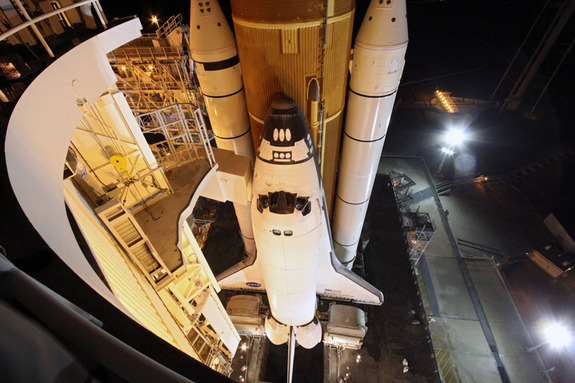
Endeavour on the launch pad prior to STS-134 (image NASA / Space.com)
The space shuttle Endeavour returned home safe and sound today, after her last 16-day flight into space – congratulations to Commander Mark Kelly and his crew on a remarkable mission which saw the last ever space walks to be conducted from a space shuttle, and the effective completion of the International Space Station – a task Endeavour herself started. Best wishes as well to Commander Kelly’s wife, Gabrielle Giffords, on her continued recovery following the terrible events in Arizona.
I’ve already written as to why the Endeavour is special to me, and I included a few facts about her, as well as posting some of my favourite images of her. To round-out her career, I thought I’d look at her “by the numbers”.
1: The number of times Endeavour has visited the Hubble Telescope in orbit. She undertook the first servicing mission (STS-61) in December 1993. The mission famously corrected the telescope’s faulty optics, effectively giving it a contact lens to wear.
3.5: The number of years it took construct Endeavour. Work commenced in September 1987, and was completed in April 1991.
The First: The crew of STS-49, Endeavour’s first mission into space
7: The number of times Endeavour landed at Edwards Air Force base, California.
10: The original anticipated lifespan (in years) for each shuttle vehicle in the fleet.
12: The number of times Endeavour visited the International Space Station. She started with the very first US mission to the station (STS-88, December 1998, carrying the Unity module), and finished with the final construction flight for the station, STS-134 in May 2011.
15 days, 17 hours, 38 minutes, 51 seconds: duration of Endeavour’s final mission.
19: The number of years Endeavour saw service. She first flew on May 7th, 1992, on mission STS-49, and was last launched on May 16th, 2011, returning home on June 1st on STS-134.
25: The number of missions Endeavour flew in her career.
100: total number of missions each shuttle was originally expected to undertake.
173: The number of crew Endeavour has flown into orbit. to orbit.
280: The total number of days Endeavour has spent in space.
4,429: The number of orbits Endeavour has made of the Earth.
The Last: the crew of STS-134, Endeavours final mission
6,154: The number of entries students gave to call the new space shuttle Endeavour after HMB Endeavour, the vessel captained by James Cook on his voyage to the South Pacific.
17,400: The speed (mph) at which Endeavour travels to remain in orbit (roughly Mach 25, five times the speed of a bullet).
122 million: total distance (rounded in miles) Endeavour has travelled during 25 missions.
$450 million: Average cost to launch a space shuttle.
$1,500 billion: Average cost of a complete shuttle mission.
$1,800 billion: How much it cost to build the Endeavour (in 1987 terms), or around 1/2 the cost of the original shuttle vehicles in the fleet, thanks to the use of “spare parts” that were available.
The last touchdown: Endeavour returns to Kennedy Space Centre, June 1st, 2011




 Inara Pey: Living in a Modemworld