Space Sunday: Polaris Dawn

A zoomed-in shot from the Earth-controlled camera within the nose cone hatch, showing Sarah Gillis as she climbs up onto the “skaywalker” platform inside the nose area of Crew Dragon Resilience to start her EVA. Credit: SpaceX via NBC News

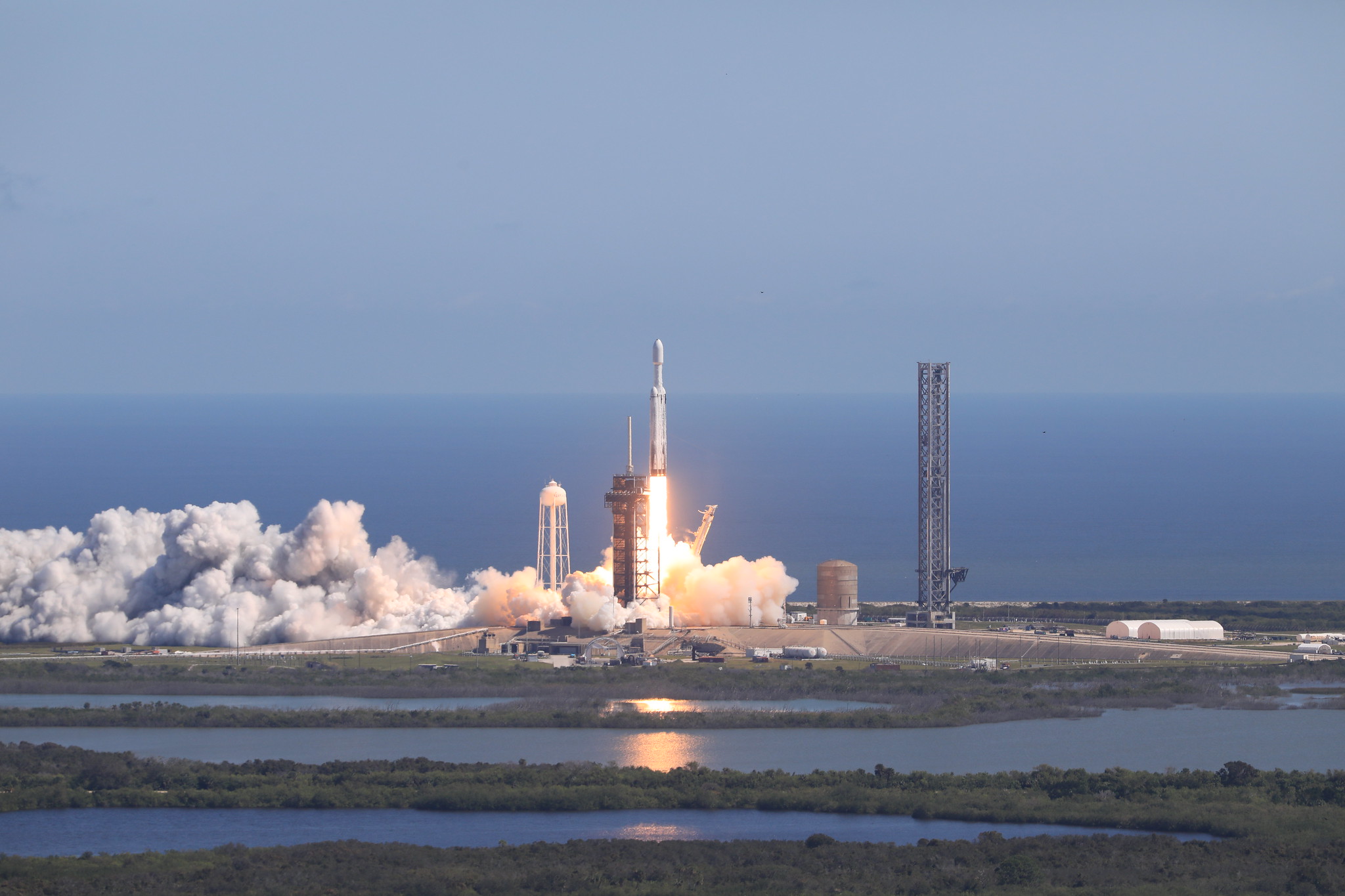
After delays related to a ground-side helium leak at the launch pad followed by a prediction of several days of poor weather in the region where the mission would splashdown at its conclusion, thus potentially hampering recovery operations if not put the crew and vehicle at outright risk, the Polaris Dawn private venture mission lifted-off from Kennedy Space Centre, Florida on September 10th, 2024.

The Falcon 9 rocket carrying Crew Dragon Resilience and its crew of four private citizens lead by billionaire Jared Isaacman,  departed Launch Complex 39-A at 09:23 UTC at the start of an extreme 5-day mission in an extended elliptical orbit around the Earth with a number of potentially high-stakes goals, including the very first spacewalk by non-career astronauts.

The first part of the mission called for the capsule to be placed in an orbit of around 200km perigee and an apogee of 1,200 km. This required the first stage of the Falcon 9 booster to operate in expendable mode, running for some 12 minutes prior to separation, after which it fell back into the Atlantic Ocean. On arrival in their initial orbit, the crew commenced an extended period of pre-breathing an oxygen-rich atmospheric mix designed to remove nitrogen from their blood, organs and muscles.

The Polaris Dawn crew (l to r): Anna Menon, Scott Poteet (vehicle pilot), Jared Isaacman (Commander) and Sarah Gillis (EVA-2), pictured in 2021. Credit: SpaceX

Such pre-breathing (very similar in nature to that undertaken by divers going down to significant depths in the oceans) is a requirement of all EVA work, as space suits operate at very low pressures (e.g. roughly 5 psi compared to the average sea-level atmospheric pressure of 14.8 psi). If the nitrogen is not flushed from the body, it can bubble and cause decompression sickness, causing serious injury –and potentially death – to the sufferer as the pressure is raised back to normal levels.

Normally, such pre-breathing would be carried out only be the astronauts making the EVA, and they would use an airlock in which to do so, spending several hours undergoing the process. However, Crew Dragon does not have any form of airlock, so the entire vehicle must be depressurised, hence the entire crew going on the oxygen rich mix. As this happened, work also started on very slowly reducing the overall cabin pressure from 14.5 psi to 8.6 psi, a process that continued over the first three days of the mission leading up to the actual EVA.

A SpaceX Falcon 9 rocket carrying the Polaris Dawn mission lifts off from Kennedy Space Centre in Florida at 09:23 UTC (05:23 EDT) on September 10, 2024. Credit: Polaris Programme / John Kraus

After some eight orbits around the Earth, the Dragon’s motors fired, elevating its apogee to around 1,400 km above sea level. This marked the furthest anyone has been from Earth since Apollo 17 in 1972, whilst also breaking the highest altitude record for a crewed mission orbiting Earth, originally set by Gemini 11 in 1966.

Both the 1200 and 1400km limits of the orbit meant the vehicle would skirt the Van Allen radiation belts, periodically passing through the South Atlantic Anomaly. This meant that during their five days in space, all four crew would be exposed to the same amount of radiation an astronaut on the International Space Station (ISS – orbiting at an average of some 400 km) would require some three or more months to experience. Whilst such a concentrated exposure marked a great long-term risk to the health of the four, it formed part of the science programme for the mission.

In brief, radiation exposures as a fact of space travel, but despite all the work aboard the ISS and other orbital vehicles like the space shuttle on extended missions, there are numerous active factors of radiation exposure in space that are not clearly understood. To this end, Polaris Dawn flew a series of experiments put together by Translational Research Institute for Health (TRISH), a NASA-funded consortium of academic institutions specifically aimed at investigating some of the more usual aspects of space-based radiation exposure, in order to better understand them.

Polaris Dawn crewmembers participating in these TRISH studies will provide data about how spaceflight affects mental and physical health through a rigorous set of medical tests and scans completed before, after, and during the mission. The work will include assessments of behaviour, sleep, bone density, eye health, cognitive function and other factors, as well as analysis of blood, urine and respiration.

– NASA statement on the Polaris Dawn NASA-sponsored science

Much of this work will continue well after the mission’s conclusion, with studies and checks on their health and welfare continuing over the next few years.

Scott Poteet rehearses with one of the TRISH instruments designed to test the effects of space-based radiation exposure on the human eye (notably bright flashes seen when they eyelids are closed). Credit: Polaris Programme

In addition, the mission flew Tempus Pro, a commercial package NASA has been adapting for use on space missions. It is designed to collect collect multiple health measurements from astronauts and compare them with a database of medical data on Earth, allowing flight surgeons to more fully diagnose an astronaut’s overall physical and mental health and well-being. The system can also be used to provide real-time telemedicine support (including any consultations from specialist almost anywhere on Earth) to assist medical personnel on space missions in provide physical and mental treatment to their fellow crewmembers.

In all the mission carried a total of 36 experiments from 31 partner institutions around the world. However, it was the EVA – to be undertaken in turn by Isaacman as crew commander (and major financier, who originally flew the Inspiration4 private venture orbital flight in 2021, and which also utilised Crew Dragon capsule Resilience), and Sarah Gillis, the senior space operations engineer at SpaceX – which had captured the attention of the world ahead of the mission.

The EVA took place on Flight Day 3, after the vehicle’s orbit haf been lowered and circularised at some 730 km above sea level. It commenced some time in advance of the actual hatch opening, with a further round of pre-breathing a 100% oxygen atmosphere to purge remaining nitrogen from the astronauts’ bodies, and a slow final lowering of the cabin pressure prior to full  venting.  All four then donned their IVA / EVA suits and tested their umbilical life support and power feeds (the SpaceX suits do not operate with the kind of back-pack common to NASA / Roscosmos EVA suits, but are reliant on a physical connection to the space vehicle).

A helmet cam view as Jared Isaacman looks up at the “skywalker” platform in the nose area of Resilience, as he’s about to climb up onto it for his part of the EVA. Credit: SpaceX via NBC News

At 15:12 UTC on Thursday September 12th, 2024, all four crew reported their suits were sealed and operational, and they were operating entirely off of the life support reserves supplied to their suits. The final de-pressurisation of the capsule cabin could then commence, causing their suits to expand to their pressurised size. Some 37 minutes after final depressurisation had  started, the vehicle was ready for the inner hatch to be unlatched by Isaacman, as EVA-1, and the pressure seal broken. This then allowed the hatch opening mechanism to be triggered, with the hatch sliding fully open at 15:56 UTC.

Isaacman then egressed through the nose chamber onto the “skywalker”, a special ladder-come-work platform with hand holds and foot restraints, design to allow a crew member to both raise themselves out of the nose of the craft and anchor their feet on the platform so that they can perform hands-free work.

A zoomed-out shot from the Earth-controlled camera within the nose cone hatch of Resilience, showing Isaacman as he paused on the “skywalker” platform to carry out the first set of arm mobility tests. Credit: SpaceX via NBC News

A camera mounted on Resilience’s nose cone cap (which had been opened as per standard practice since the craft’s arrival in orbit to help with general heat regulation) filmed Isaacman as he emerged from the nose of the vehicle, initially rising to waist level before carrying out a range of mobility tests as the spacecraft raced over Australia and towards New Zealand and the terminator between the day and night sides of Earth.

The mobility tests were designed to test both ease and range of movement within a pressurised IVA / EVA suit, both with arms and legs, moving up and down the steps on the “skywalker”, testing the ease of use of the foot restraints, and the overall freedom of movement and reach allowed by the suits when in the near-vacuum of space. In all, Isaacman spent roughly 8 minutes on the platform before climbing back down into the capsule.

Sarah Gillis then replaced him, moving into the nose of the capsule and onto the “skywalker”. Unfortunately, shortly after she anchored herself on the “skywalker” to commence her own series of tests, Resilience passed out of video relay range of NASA Tracking and Data Relay Satellite System (TDRSS), so the live video feed was lost, leaving only verbal communications. However, she spent almost the same amount of time as Isaacman in her EVA, allowing her to give an engineer’s perspective on the usability of the suits.

By 16:21 UTC, Gillis was back inside Resilience and the inner hatch was closed, leaving Isaacman with the task of latching and locking it securely. Over the next 50 minutes, the pressure inside the vehicle was restored to a point where the crew could use the cabin’s atmosphere and start removing their IVA / EVA suits.

The EVA by the numbers (from space commentator Jonathan McDowell:

  • Total elapsed time (starting when the capsule was fully depressurised through to being re-pressurised to approx 5 psi): 1 hour 46 minutes.
  • Total “spacewalk time” (time from unlatching the inner hatch to re-latching it): 33 min 25 seconds.
  • Total time Isaacman spent on the “skywalker” and outside the cabin: 7 minutes 56 minutes.
  • Total time Gillis spent on the “skywalker” and outside the cabin: 7 minutes 15 seconds.
The crew seen after the EVA period and following the removal of their IVA / EVA suits (l to r): Sarah Gillis, Jared Isaacman, Scott Poteet, and Anna Menon. Credit: Polaris Programme

These may not be record-breaking numbers, but they are nevertheless extraordinary and of potential significance as a starting-point for such operations by non-career astronauts. Private venture EVA operations are bound to become more and more commonplace and of longer and more complex duration as the next generation of private / commercial orbital facilities by the likes of Axiom and the Blue Origin / Sierra Space led Orbital Reef consortium come on-stream.

The remaining two days of the mission saw the four astronauts resume their science work as cabin pressure within the vehicle was gradually brought back up to more reasonable pressures in advance of a return to Earth. As well as the science work, the crew also conducted tests in using the SpaceX Starlink satellite network for audio and video communications with mission control.

Sarah Gillis filmed aboard Resilience as she plays Rey’s Theme from the music for Star Wars: The Force Awakens, composed by John Williams. Credit: Polaris Programme

Part of the latter once again involved Sarah Gillis, who is also a classically-trained violinist. On September 13th, she performed of Rey’s Theme by legendary composer John Williams. Whilst the performance was misreported in some media as the “first” performance of a musical instrument in space (instruments have been played in space for decades; for example, Catherine Coleman played the flute on the ISS in 2011 and Chris Hadfield, commander of ISS Expedition 35  famously recorded a music video of David Bowie’s Space Oddity, marking it as the first music video ever shot in space), it was nevertheless still and important factor for the mission’s overall objectives.

One of the things Isaacman has done with her personal fortune and through his private space ventures is to raise money St. Jude Children’s Research Hospital in Memphis, Tennessee. In 2021, for example he both donated several million to the hospital and auctioned off seats on the Inspiration4 mission with the money raised going to the hospital.  Gillis’ rendition of Rey’s Theme was combined with six orchestras from around the world to produce a recording and video entitled Harmony of Resilience to help raise further funds for the hospital from this mission.

As we travel around our beautiful planet Earth on this five-day mission, we wanted to share this special musical moment with you. Bringing together global talent, this performance symbolizes unity and hope, highlighting the resilience and potential of children everywhere.

– Sarah Gillis, September 13th, 2024, from orbit aboard SpaceX Crew Dragon Resilience

Polaris Dawn ended on Sunday, September 15th, 2024, with de-orbit operations starting at 06:34 UTC. These saw Resilience orient itself ready for atmospheric interface and jettison its service module – the Trunk, in SpaceX parlance to expose its heat shield. A series of thruster firings of the capsule’s Draco motors followed, slowing it velocity. These were completed by 06:50 UTC and the forward nose cone was swung back into its closed positions and latched.

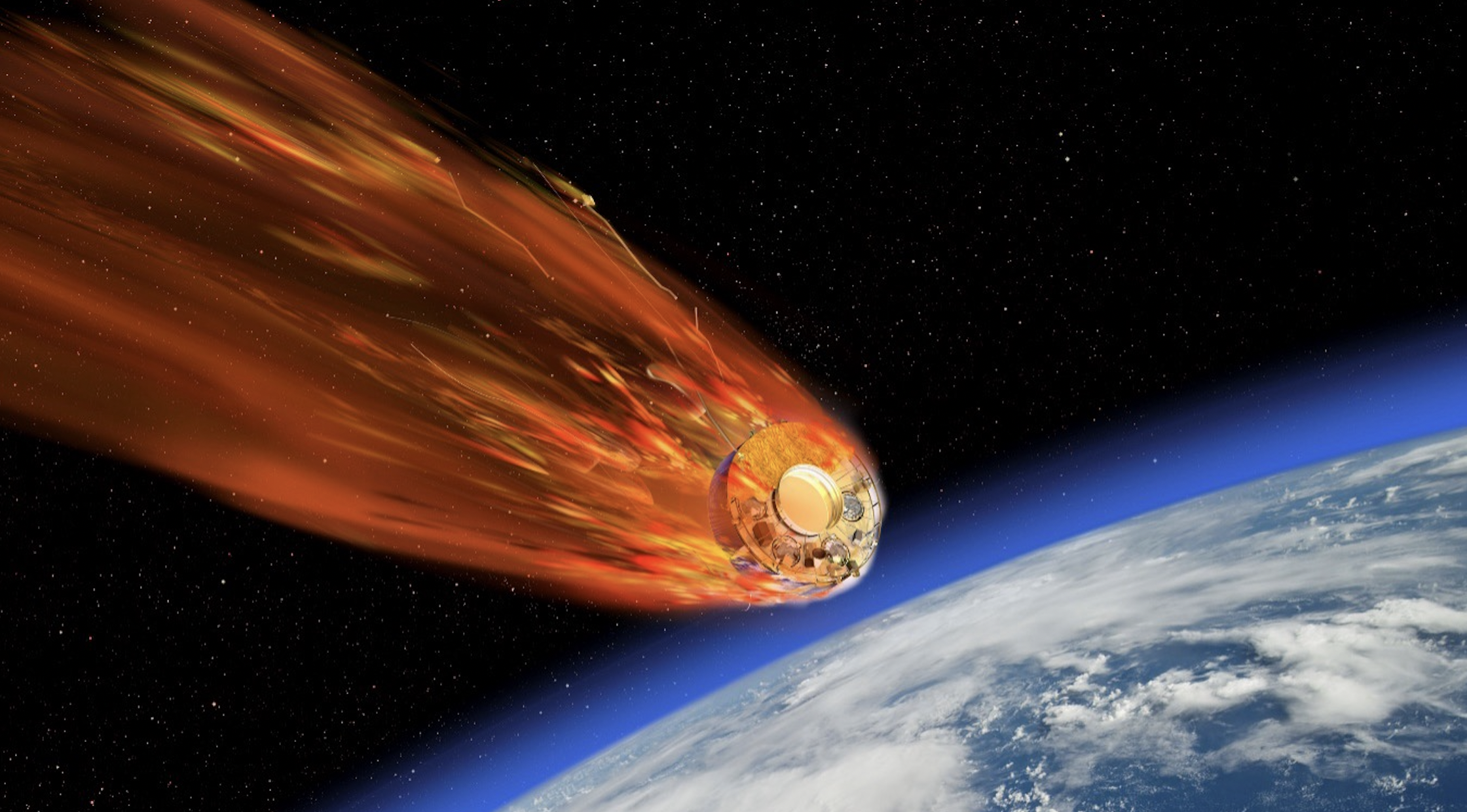
At 07:15 UTC, the vehicle reached interface and entered a roughly 7-minute period of descent through the upper atmosphere during which the vehicle experience peak frictional heating around it, together with a loss of communications. The track of Resilience meant it was not only caught on camera by recovery vessels in the Gulf of Mexico, but also seen by the crew of the ISS.

A dramatic shot captured by tracking systems on the recovery ship Bob, showing Resilience living up to its name as super-heated plasma surrounds it and streams behind it as it passes through the upper reaches of Earth’s atmosphere at over 20,000 km/h. Credit; SpaceX

Things then proceeded rapidly. After re-entry, the vehicle’s drogue parachutes deployed so start slowing it, and not long afterwards, the four large main parachutes deployed, with Resilience splashing down at 07:37 UTC.

An initial safety and recovery team approached the capsule in a RHIB deployed by the SpaceX recovery vessel Bob (named for astronaut Bob Behnken, one of the first two people to fly a Crew Dragon to space (the other being Doug Hurley, who has the larger recovery ship Doug named for him) to confirm the capsule was safe and not venting harmful gasses. At the same time, additional RHIBs sought to recover the spacecraft’s parachutes.

With the confirmation all was safe, the recovery operation began, the RHIB team preparing Resilience for hoisting onto Bob’s stern deck as the recovery vessel slowly closed with the capsule to arrive alongside at 08:00 UTC. Eight minutes later, with the lifting lines secured, the loading arm at the stern of Bob raised the capsule up onto the ship’s deck, where it was moved forward to the egress platform under the cover of the ship’s helipad and at a height that allows for easier opening of the capsule’s hatch.

Resilience comes aboard Bob at the conclusion of the Polaris Dawn flight, 08:08 UTC, September 13th, 2024. Credit: SpaceX

The latter was opened at 08:20 UTC, after a final round of checks, and the recovery ship’s surgeon entered the capsule to check on the overall condition of all four crew to ensure they were showing no signs of decompression sickness or other issues. After this, the crew were allowed to exit the vehicle, with SpaceX lead space operations and mission director Anna Menon the first to leave the capsule, followed by Sarah Gillis then pilot Scott Poteet and finally Isaacman. All were in a jubilant frame of mind – and rightly so.

Polaris Dawn was in many respects a high-stakes mission; Resilience had to be extensively modified for the flight – not just her forward nose area, but throughout, with electronics and other systems inside the vehicle being “hardened” for us in the near-vacuum of Earth orbit; the IVA / EVA suit, despite extensive testing on Earth was still unknown in terms of how it would work in space, and the crew themselves took on a lot in respect of future health and welfare through such an intense exposure to Earth’s radiation fields over so limited a time. In this latter aspect, the mission’s work will continue through post-flight research, as noted above.

First glimpse on hatch opening following recovery (l to r): Anna Menon, Scott Poteet, Jared Isaacman and Sarah Gillis, all in a jubilant frame of mind, September 13th, 2024. Credit: SpaceX

Two more Polaris missions are in development, although their time frames and goals have yet to be confirmed. One will most likely involve another Crew Dragon flight, and Isaacman has stated he plans the third to be the first crewed flight of SpaceX’s Starship vehicle; so that one at least is unlikely to be in the immediate (and potentially foreseeable) future.

Space Sunday: Starliner home; New Glenn update

A high-resolution image of the vestibule area within the nose of CST-100 Calypso showing some of the docking mechanism as the vehicle clear the International Space Station (ISS) on September 6th, 2024. Credit: NASA

Boeing’s Starliner capsule Calypso is back on Earth after what appears to have been an almost pitch-perfect automated return flight form the International Space Station (ISS).

The vehicle departed the ISS at 22:04 UTC on September 6th, after almost a day of preparations during which Starliner’s inner hatches were sealed as was the hatch on the ISS’s Harmony docking adaptor, prior to the “vestibule” at the forward end of Calypso, containing the vehicle’s half of the docking mechanism, being slowly depressurised. Some time prior to the undocking, and while awaiting the formal ATP – authority to proceed – the two control rooms at Johnson space Centre, Texas, one for the ISS the other for Starliner, did a final go / no-go poll, after which ISS Flight Director Chloe Mehring called the station.

Station Houston space-to-ground 2 for Starliner undock.
Go ahead, we’re with ya.
Hey, Suni both the Starliner and the ISS flight control teams have polled GO for undock at this time. Expected undock time is 22:04 [UTC].
Okay, copy. 22:04. Hey, y’know, just looking at the flight control roster, and like wow! It is the all-star team! You guys, it IS time to bring Calypso home. You have GOT this! We have your backs, and you’ve got this. Bring her back to Earth.

– Exchange between Flight Director  Chloe Mehring and astronaut Suni Williams on the ISS prior to Starliner’s departure.

The Starliner Mission Operations Control Centre during the Starliner return to Earth operation, Friday, September 6th, 2024. Credit: NASA

ATP came at 22:02 UTC, and the 12 docking “hooks” on the ISS docking adaptor rotated to their “open” position, allowing springs on the Starliner’s docking mechanism to very gently push it away from the space station two minutes later. The use of such springs avoids the need for the vehicle to use its forward thrusters, potentially spraying ISS docking adaptor and hatch with toxic hydrazine exhaust gas.

Once the separation between station and vehicle had exceeded 5 metres, Starliner commenced a series of 12 short firings of the forward facing reaction control thrusters on the service module, pushing itself outside the 200-metre Keep Out Sphere (KOS), an imaginary zone around the ISS within which a spacecraft must be on what is called a “4-orbit safe free drift trajectory”, meaning that it can float freely in close proximity with the station for a period of 4 orbits (roughly 6 hours)  without any risk of collision should its manoeuvring system fail.

These burns were more or less a “reversing manoeuvre” in a straight line. Once outside the KOS, Starliner was within the larger Approach Ellipsoid (AE), another imaginary area of space around the station within which spacecraft must be able to float freely for up to 24 hours without risk of impacting the space station. Once in the AE, Starliner continued to move away from the station whilst starting to raise its orbit until some 19 minutes after undocking, it was clear of the AE as well and moving on to an orbit that would carry it around the Earth several times and bring it to the required position for its de-orbit burn.

Starliner is pushed clear of the ISS by springs within the nose of Calypso, the vehicle’s capsule. Credit: NASA TV

Once clear of the AE, the ISS involvement in the flight concluded, leaving the NASA Starliner flight team to oversee the rest of the return, an operation of multiple parts.

In particular, the Calypso’s own Reaction Control System (RCS) thrusters were tested. Entirely separate from the problematic thruster systems on the service module, Calypso’s RCS allow the capsule to manoeuvre and maintain orientation once it has separated from the service module after the de-orbit burn, in order for it to successfully re-enter the denser atmosphere.  These 12 thrusters are divided to two “strings” of 6, with only one “string” being used in flight operations, the other being there for redundancy purposes. One of the thrusters did fail to fire during the tests, but posed no threat to the flight.

A view from the ISS television camera as the departing Starliner fires its forward-facing thrusters as it moves away from the station. Credit: NASA TV

Similar redundancy exists within the service module RCS (hence why it has 28 thrusters in 4 banks of 7 apiece), and a test of 10 of the unused RCS thrusters on the service module during the same period saw them all operate without a hitch.

Then, immediately prior to the de-orbit burn was due to commence, a final weather check was carried out over the landing zone to confirm everything was above the required minimums for a Starliner landing. These checks include ensuring that winds be no greater than 12 knots, temperatures at ground level will be no lower the -9.4ºC, and the cloud base must not be lower that approx. 300 metres and allow for an all-round visibility of no less than 1.85 km (1 nautical mile). It must also be confirmed that there are no thunder or electrical storms within a 35.4 km radius centred on the landing zone which might interfere with data transmissions / reception. Should any of these criteria not be met, the de-orbit burn would be postponed until such time as all could be met.

Mission control graphics of the de-orbit OMACS de-orbit burn of the CST-100 Starliner, September 6th/7th. 2024. The four OMACS motors (white) can be seen firing along the vehicle’s line of flight, with reaction control thrusters (coloured) also firing to maintain the vehicle’s orientation and rotation. Credit: NASA TV

As it was, everything was well within tolerances at the landing zone, and at approximate 03:15 UTC, four OMACS – orbital manoeuvring and Attitude Control System– motors on the service module fired in a 59-second burn, with several RCS thrusters also firing to maintain the vehicles overall orientation and attitude, slowing the vehicle sufficiently for natural drag to start pulling it into the denser atmosphere.

Immediately following the de-orbit burn, Calypso separated from the service module and oriented itself so the primary heat shield was at the correct entry for atmospheric interface, whilst the service module dropped into an uncontrolled re-entry so it would burn-up in the atmosphere and any surviving debris full into the southern Pacific Ocean. Calypso reached its re-entry interface – the period when it passed into the upper reaches of the denser atmosphere and experienced maximum re-entry temperatures – some 15 minutes after jettisoning  the service module, and as it approach California’s Baja Peninsula. After this, things happened rapidly.

An infra-red, low-light image of Calypso deploying her drogue parachutes during her atmospheric descent. The bight disk of light below the vehicle is the forward heat shield falling away. Credit: NASA

At 22km altitude, the forward heat shield at the top of the capsule was jettisoned, clearing the way for parachute deployment. This commenced almost immediately with the deployment of the vehicle’s two drogue parachutes, designed to help reduce its speed. These opened slowly over a 28-second period in order to reduce the stress on their canopies and the degree of sudden deceleration on the vehicle.

The drogues were in turn released at 10km altitude, allowing the three main parachutes to deploy and open over a 16-second period, again to reduce the strain on them and the vehicle. They then carried Calypso down towards landing. With a couple of hundred metres left in the descent, the primary heat shield was released, exposing the six airbags sitting between it and the base of the capsule, allowing them to rapidly inflate to cushion the actual landing.

At an altitude of around 10km, with the main parachute deployed and the capsule held upright, the main heat shield is dropped, freeing-up the six airbags under Calypso to inflate. Credit: NASA

Touchdown came at 04:01 UTC on September 7th, and the recovery teams started their operations shortly after, moving in to the landing site from upwind of the vehicle to avoid risk of any harmful gases from the propulsion systems, etc. Safing of the vehicle and preparing it for transit away from the landing zone proceeded over the course of the next several hours.

With Calypso now on Earth, the focus will shift to trying to rectify the causes of the issues with the service module propulsion systems. As I’ve previously noted, this is made harder as engineers have no physical parts to eyeball; they will have to continue to work on data gathered through ground testing of identical units and data gathered during all the test-firings performed during the flight (including those carried out during the vehicle’s return to Earth).

Seconds before touchdown: with the airbag inflated, Calypso is a seconds from landing within the White Sands Space Harbour, New Mexico, Credit; NASA

Calypso, meanwhile, with two flights under her belt, will now return to Boeing for a thorough check-out, overhaul and refurbishment. Although when she or the unnamed Capsule S2 (which performed the seconded uncrewed flight test to the ISS in 2022) will fly again is unclear. Currently, S2 is scheduled to fly the first Starliner operational mission (Starliner-1) in August 2025; however, NASA is now hedging its bets: it has recently double-booked the SpaceX Crew Dragon Crew-11 mission (crew yet to be assigned) to fly in the same period if it becomes apparent Starliner-1 will not be ready to fly.

As previously noted, this means that astronauts Barry “Butch” Wilmore and Sunita “Suni” Williams will be remaining aboard the ISS until February / March 2025, when they will return to Earth on the SpaceX Crew Dragon Freedom. This is due to lift-off from Kennedy Space Centre on or around September 24th, carrying astronaut Nicklaus “Nick” Hague, and cosmonaut Aleksandr Gorbunov to the ISS, where they will complete a 5-day hand-over with the Crew 8 team. The latter are set to depart the ISS around October 1st.

A high-speed tracking image of Calypso passing through re-entry, the plasma around it glowing bright and leaving a heated trail behind the capsule. Credit: NASA

However, Crew 9 will not be the first the reach the station following Starliner’s departure. Soyuz TM-26 is to due to depart the Baikonur Cosmodrome on September 11th, carrying cosmonauts Aleksey Ovchinin and Ivan Vagner, and NASA astronaut Don Pettit.

They will dock with the ISS a few hours later, after a “fast” ascent and rendezvous, and raise the total crew on the ISS to 12. Then on September 24th (the day NASA is targeting for the launch of Crew 9 / Expedition 72), Soyuz TM-25 is set to depart the station and bring Oleg Kononenko, Nikolai Chub, and NASA astronaut Tracy Caldwell-Dyson back to Earth .

Calypso on the ground on September 6th / 7th, 2024. following her return to Earth at the end of her second flight into space (and first to the ISS). Credit: Boeing

Blue Origin Advances New Glenn Maiden Flight, But Without NASA’s EscaPADE

Blue Origin is progressing toward the maiden flight of its New Glenn semi-reusable medium-to-heavy lift launch vehicle – although there are doubts about whether the company will meet the mid-October launch window NASA originally set it.

On September 3rd, the company deployed the new rocket’s 23m tall second stage to its launch facilities at Cape Canaveral Space force Station, Florida, where it will undergo a static fire test of its two Blue Origin BE-3U motors. However, this is just one of a number of milestones the company must meet in very short order if it is to make the mid-October launch window they state they still intend to meet.

The second stage of the first New Glenn rocket built for flight by Blue Origin, is moved to Launch Complex 36 at Cape Canaveral Space Force Station, Florida where it is due to undergo static fire tests. Credit: Blue Origin

This date was set by NASA when Blue Origin offered the flight as the launch vehicle for NASA’s EscaPADE Mars orbiter mission. A part of NASA’s  Small Innovative Missions for Planetary Exploration (SIMPLEx) programme, whereby missions costs are to be reduced by launching them as secondary payloads alongside primary missions, thus reducing their launch costs.

In this, EscaPADE – standing for Escape and Plasma Acceleration and Dynamics Explorers – a pair of identical satellites designed to study Mars’ atmosphere, were supposed to be launched with NASA’s Psyche mission, which originally was going to make a fly-by of Mars whilst heading for asteroid 16 Psyche, eliminating virtually all launch costs. However, Pysche’s launch was revised to a point where the Mars fly-by was no longer possible, and EscaPADE needed a new ride.

The New Glenn second stage raised to its vertical position on on the static fire test stand, Cape Canaveral Space Force Station, Florida. Credit: Blue OriginWhile Blue Origin offered the maiden flight of New Glenn at the bargain basement price of $20 million, it was still more that the original budget for the mission. With the launch facing a host of deadlines, including the second stage static fire test, and things like the integration and testing of the vehicle’s seven first stage BE-4 engines; stacking and integration of the vehicle’s two stages together with the payload and payload fairing; pad roll-out and countdown demonstration tests, NASA has been understandably concerned about Blue Origin’s ability to make the launch window for the last couple of months.

These concerns gained momentum because in order for EscaPADE to be ready for the launch, both satellites must be loaded within toxic hypergolic propellants. This is a costly, time-consuming exercise, and if New Glenn cannot make the October launch window, then NASA will have to go through an equally costly and delicate “de-tanking” exercise and purging of the propellant tanks of the satellites – and then go through the process again when the mission is ready for launch. So the decision was taken to avoid the additional costs and pull EscaPADE from the New Glenn launch. Instead, the agency is looking to launch the mission in spring 2025 – but still using a New Glenn vehicle.
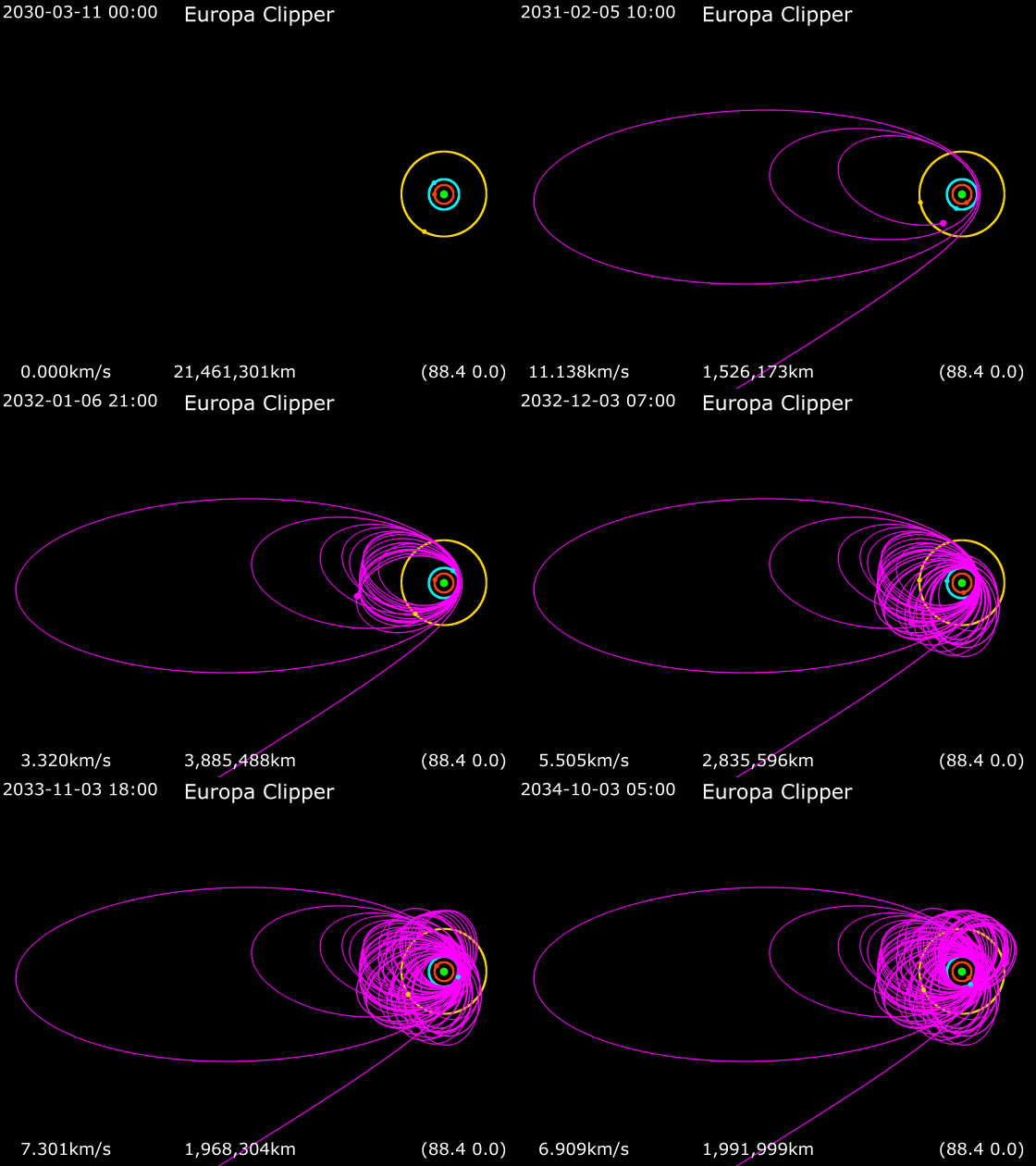
Blue and Gold, the two identical EscaPADE satellites, built by Rocket Lab for NASA, seen in their “folded” configuration within an NASA clean room. Credit: NASA / Rocket Lab

This  in itself has raised eyebrows; optimal launch windows to Mars occur around every 26 months, which spring 2025 does not meet. As such, it currently looks as if EscaPADE, a 990 kg all-up weight – will be the sole payload for the launcher, which will have to throw it into a heliocentric orbit around the Sun and out to Mars on an extended transfer flight.

In the meantime, and as noted, Blue Origin have stated they are still aiming to launch New Glenn on its maiden flight in October. With the removal of EscaPADE, they now intend to use the launch to place its Blue Ring “space tug” into orbit. This is a vehicle at the centre of a new operation for Blue Origin – providing on-orbit maintenance and movement of satellites. The company is also talking to the US government about using the flight to certify New Glenn as  National Security Space Launch system.

As a semi-reusable vehicle, the first stage of New Glenn is designed to be able to land after each use. To achieve this, it will use a sea-going landing barge akin to, but larger than, the SpaceX autonomous drone ship landing platforms. Officially called a landing platform vessel (LPV), the first of these barges arrived at Port Canaveral at the start of September 2024 in readiness for the maiden flight of New Glenn.

Built in Romania and outfitted and commissioned in France, LPV-1 Jacklyn, named for the mother of Blue Origin founder Jeff Bezos (who has also personally financed the company), the 115-metre long platform has already caused raised eyebrows as it has four large structures fore and aft of the 45m wide landing area. It’s not clear if these are integral to the barge (although the do seem to be) and what they might be for.

Blue Origin LPV-1 Jacklyn alongside at Port Canaveral, September 3rd, 2024

Certainly, putting such large structures on the barge is an interesting choice. Trying to successfully land a tall, thin tube containing the remnants of liquids that like to go kaboom when mixed and given the excuse, is not exactly a sinecure (just ask SpaceX). As such, hemming-in the landing zone with tall structures that could cause an even greater conflagration were a booster stage to topple into them whilst going the way of said kaboom seems to be somewhat tempting fate; I guess time will tell on that.

Space Sunday: stellar companions and updates

Side-by-side comparison of Betelgeuse’s dimming, as seen by the SPHERE instrument on ESO’s Very Large Telescope prior to (left) and during (right) the “great dimming” of 2019/2020. Credit: ESO/M. Montargès et al.

Back in 2019 / 2020 the red giant star Betelgeuse caused considerable excitement among astronomers on account of it undergoing a period of exceptional dimming – far more than is customary, given it is a pulsating variable star – which fuelled speculation that what was being seen might be the precursor to the star having gone supernova some 643 years ago (that being the time it takes for light from it to reach us), and the dimming was actually the star going through the kind of collapse the comes before such a supernova explosion.

However, despite the rapid and unusual dimming witnessed over December 2019January 2020 and February 2020, by April 2020, the star  had returned to its normal levels of brightness, and by August of that year, astronomers thought that had an explanation for the unwarranted dimming: the star’s pulsating nature gives rise to clouds of energetic particles to be ejected, some of which form a illuminate cloud around the star whilst more cool and form a blotchy cloud too dim an cold to be detected by optical or infrared means, and which can result in the star dimming significantly in addition to any normal variations in its brightness as see from Earth.

“Betelgeuse is big. Really big. You just won’t believe how vastly hugely mind-bogglingly big it is. You might think it’s a long way to the Moon, but that’s just peanuts to Betelgeuse!” (with apologies to the estate of Douglas Adams). A diagram showing the approximate size of Betelgeuse compared to our solar system. Credit: unknown

Because of the “great dimming”, astronomers have continued to observe Betelgeuse and gather a lot more data about it, particularly with regards to trying to understand the drivers of the star’s Long Secondary Period (LSP) of variability. Stars like Betelgeuse tend to have overlapping periods of variability: the first tends to be a fairly short cycle of dimming and brightening. In the case of Betelgeuse, this cycle of dimming and brightening again lasts some 425 days.

This overlaps a much longer period of variability – the LSP – which in the case of Betelgeuse lasts somewhere in the region of 2,100 terrestrial days, or roughly 6 years. These periods, short and long, can occasionally synchronise so that both reach a period of maximum dimness or brightness. Originally, it had be thought that such a period of synchronicity had caused with the 2019/2020 “great dimming”, until data and observations showed otherwise. However, and more to the point, the actual mechanisms which cause LSPs for variable red giant stars is not well understood, and have been ascribed to several potential causes.

One of these is the potential for the red giant to have a smaller companion star, one very hard to observe due to the behaviour and brightness  of the red giant. Such is the conclusion reached in a new paper: A Buddy for Betelgeuse: Binarity as the Origin of the Long Secondary Period in α Orionis published via arxiv.org (and thus still subject to peer review). In it, researchers  Jared A. Goldberg, Meridith Joyce and László Molnár walk through all of the accepted explanations for LSPs among red giant stars as they might be applied to Betelgeuse, concluding that perhaps the most likely is that the red giant has a very low-mass (comparatively speaking) companion orbiting it at roughly 2.43 times the radius of Betelgeuse.

This puts the companion within the observable and illuminated dust cloud around Betelgeuse, potentially making the companion – referred to as α Ori B – exceptionally hard to observe, as it would be subsumed in the brightness of the surrounding dust and Betelgeuse’s own corona. further, it would be unlikely to form its own accretion disk, something which might otherwise aid its observation.

This December 2019 VLT VISIR image reveals the infrared light being emitted by the dust surrounding Betelgeuse. These clouds are formed when the star sheds its material back into space, while the black disk at the centre of the image obscures the star and its corona and inner dust cloud in order for VISIR to see the infra-red light of the dust clouds. An image of Betelgeuse is overlaid to scale at the centre of the disk. The disk also covers the area within which the proposed companion object might reside. Credit: ESO / P. Kervella / M. Montargès / Eric Pantin

In particular, the paper notes that such a low-mass companion orbiting at the calculated distance from the red giant would actually give rise to an LSP of some 2,000-2,100 days as seen from Earth.

The one wrinkle in the idea – as noted by the authors – is that the calculated mass for α Ori B is well in excess of the calculated potential mass for such theoretical binary companions as provided by established (and peer-reviewed) papers investigating possible causes for LSPs among variable red giants. As such, and given the unlikely ability to optically identify any companion to Betelgeuse, the paper’s authors outline upcoming periods when α Ori B might be particularly susceptible to detection via repeated targeted radio-interferometric observations, in the hope their theory might be proven or disproven.

But why is all this important? Well, notably because Betelgeuse, at around 10-12 million years of age, could have entered the period in which it might go supernova (such massive stars evolve and age much more quickly than main sequence stars like our on Sun). When it does so, even though it is over 640 light years away, it will shine in the night sky with a brightness equivalent to that of the half Moon for a period in excess of three months before it fades away; hence why the “great dimming” caused so much excitement.

An artist’s impression of how Betelgeuse might look in our night sky when it goes supernova. Via wikimedia

However, we could equally be as much as 100,000 years from such an event occurring. By understanding precisely what is going on around Betelgeuse, such as the presence of a cooler, darker dust cloud orbiting it affecting its brightness and as potentially found by the Hubble Space Telescope, or confirmation that the star has a smaller companion which plays a role in its cyclical brightening and dimming, astronomers are better available to judge whether or not any prolonged or unusual dimming of the star might indicate it has started collapsing in on itself and is heading for a supernova explosion – or are simply the result of expected and identified events unrelated to any such collapse.

New Shepard Aces Return to Flight Mission

Blue Origin took six people, including a NASA-funded researcher, on a New Shepard suborbital spaceflight on August 29th, the first such flight after issues have kept the system grounded almost continuously for two years.

The NS-26 flight carried its occupants to an altitude of 105.2 km, thus passing through the Kármán line, which is seen by some as the “boundary” between Earth and space at 100km above mean sea level. Interestingly, whilst named for Theodore von Kármán, the limit was not actually defined by him; instead, he calculated a theoretical altitude for aeroplane flight at 83.8 km (52.1miles) above mean sea level, which has led to 80 km (50 miles) also being regarded as the “boundary” between the denser atmosphere and space – however, some nations and organisations raised this to 100km based on calculations which showed that any satellite dropping to or below that altitude without any attempt to boost its orbit will see its trajectory decay before it can complete one more orbit.

The flight, which took off from Blue Origin’s Launch Site One in West Texas at 13:07 UTC, lasted 10 minutes and 8 seconds, the New Shepard booster safely landing some 7 minutes 18 seconds after launch, having separated from the capsule First Step, which continued upwards under ballistic flight. Aboard the flight were six people, including Robert Ferl, a University of Florida professor who conducted experiments on how gene expression in one type of plant changes when exposed to different phases of the the flight, including microgravity.

Also aboard was Karsen Kitchen, a 21-year-old University of North Carolina student, who became the youngest woman to cross the Kármán Line – but not necessarily the youngest woman to reach the edge of space; in August 2023, Eighteen-year-old Anastatia Mayers flew aboard Virgin Galactic 02 and passed through the 80-km “boundary” (also becoming one half of the first mother-daughter duo to reach the edge of space with her mother, Keisha Schahaff).

21-year-old student Karsen Kitchen exits the New Shephard capsule RSS First Step at the end of NS-26, and becoming the youngest woman thus far to cross the Kármán Line. Credit: Blue Origin

The remaining passengers on NS-26 comprised Nicolina Elrick, a philanthropist and entrepreneur; Ephraim Rabin, an American-Israeli businessman and philanthropist; Eugene Grin, who works in real estate and finance; and Eiman Jahangir, a cardiologist and Vanderbilt University associate professor (making a sponsored flight, rather than for research, his seat paid for via cryptocurrency group MoonDAO).

As noted, the flight came after almost two years New Shepard during which the vehicles barely flew. In September 2022 Blue Origin launched the first of 2 planned uncrewed flights – NS-23 – utilising the capsule RSS H.G. Wells carrying a science payload. During ascent, the booster’s main engine failed, triggering the capsule launch escape system. Whilst the capsule successfully escaped and made a safe landing under parachute, the booster was lost, resulting in the system being ground for investigation.

It was not until December 2023 that flights initially resume, again with a payload-carrying science mission. However, whilst successful, that flight was followed by crew-carrying NS-25 in May 2024. While no-one was injured, this flight suffered a partial deployment failure with one of the capsule’s three main parachutes, prompting a further grounding whilst the matter was investigated and remedial actions taken. NS-26 is thus the first flight since that investigation and subsequent work on the parachute systems had been completed.

New Shepard’s propulsion module makes a powered landing during the NS-26 mission on August 29th. Credit: Blue Origin webcast

For Ferl, the flight was a vindication of the value of sub-orbital flight to carry out research, despite their brevity. A long-time advocate of the use of sub-orbital crewed flights for carrying out packets of research , his work was funded by NASA’s Flight Opportunities programme and supported by the agency’s Biological and Physical Sciences Division, and marked him as the first NASA-funded researcher to go on such a flight.

Brief Updates

Polaris Dawn

The first all-private citizen spaceflight scheduled to include a spacewalk by two of the crew is currently “indefinitely” postponed – although that could now once again change fairly soon.

As I noted in my previous Space Sunday article, the mission, financed by billionaire Jared Issacman and to be carried out using a SpaceX Falcon 9 launcher and the Crew Dragon Resilience, had been scheduled for lift-off from Kennedy Space Centre at 07:38 UTC on the morning of August 27th. However, the launch was  scrubbed as a result of a helium leak being detected  in the quick disconnect umbilical (QDU) that connects the propellant feed lines to the launch vehicle. Helium is used to safely purge such systems of dangerous gases that might otherwise ignite. Ironically, helium leaks are a part of the issues which have plagued the Boeing Starliner at the ISS.

The Polaris Dawn crew are currently awaiting news on when their mission is likely to fly. Credit: Polaris Dawn

The launch was initially re-scheduled for August 28th, but this was then called off as a result of weather forecasts indicating conditions in the splashdown area for the capsule at the end of the mission would likely be unfavourable for a safe recovery and would probably remain so for several days. As the Crew Dragon will be carrying limited consumables for the crew and so cannot remain in orbit for an extended period, it is essential it is able to make a return to Earth and safe splashdown within n a limited time frame.

It was then postponed altogether later on August 28th after the longest-serving core stage of a Falcon 9, B1062 with 22 previous launches and landings to its credit, toppled over and exploded whilst attempting its 23rd landing – this one aboard the autonomous drone ship A Shortfall of Gravitas. The accident prompted the US Federation Aviation Administration to suspend the Falcon 9 launch license pending a mishap investigation. However, following a request from SpaceX, the license was reinstated on August 30th, allowing launches to resume whilst the FAA continues its investigation into B1062’s loss.

SpaceX has yet to indicate when the Polaris Dawn mission might launch, with much depending on other operational requirements both for SpaceX and at Kennedy Space Centre.

Starliner Update: One Down, Two Up

Again in my previous Space Sunday article, I updated on the Boeing Starliner situation and NASA’s decision not to have astronauts Barry “Butch” Wilmore and Sunita “Suni” Williams fly the beleaguered craft back to Earth. At that time, it had been decided to fly the next crewed flight – Crew 9 / Expedition 72 – to the International Space Station (ISS) with just two crew, leaving two seats on the Crew Dragon vehicle available to bring Williams and Witmore back to Earth at the end of that mission in February / March 2025.

Since then, NASA has confirmed that the two members of Expedition 72 who will launch on the Crew 9 flight will be NASA astronaut Tyler Nicklaus “Nick” Hague, and Roscosmos cosmonaut Aleksandr Vladimirovich Gorbunov. I’d previous pointed to Hague making the flight, but had pegged mission commander Zena Cardman as flying with him. However, in order to keep the seating agreement with Roscosmos (who provide seats to NASA on their Soyuz craft flying to the ISS in return for NASA reciprocating with their flights), rookie Gorbunov was first announced as flying the mission, with Hague taking over the Commander’s seat on the basis of experience – he has flown into space previously aboard Soyuz TM-12, whereas Crew 9 would be Cardman’s first flight, and NASA does not fly all-rookie crews.

A composite image of NASA’s Nick Hague (left) and Roscosmos’s Aleksandr Gorbunov in their SpaceX crew suits and helmets. The two will now form the Crew  9 Expedition 72 team flying to the International Space Station on or after September 24th.

In fact, Hague has had something of an exciting time in his NASA career: his very first launch was on Soyuz TM-10 (Expedition 57) in October 2018 – only for that mission to suffer a booster failure mid-ascent to orbit. This triggered the crew escape system, which pushed the capsule containing Hague and mission commander Aleksey Ovchinin clear of the booster prior to the later breaking up, and then make a safe return to Earth under the capsule’s parachutes.

Currently, Crew 9 is slated for launch no earlier that September 24th.

Prior to that, and somewhat sooner than may have been expected, Boeing will attempt to bring their Starliner capsule Calypso back to Earth safely on September 6th. The announcement was made on August 29th, Boeing having indicated earlier in the month that it would take “several weeks” to prepare and upload the required software to the vehicle. Under the plan, the craft to undock from the ISS at 22:04 UTC on Friday, September 6th, and then complete a 6-hour return to Earth, the capsule landing at White Sands Space Harbour in New Mexico at 04:03 UTC. If this schedule holds, the vehicle will have spent exactly 3 months at the ISS on what should have been a week-long flight.

Of particular concern during the return attempt will be the performance of the vehicle’s primary propulsion thrusters, mounted on the Starliner’s service module. These are required for the vehicle to manoeuvre accurately and complete critical de-orbit burns prior to the service module being jettisoned to leave the Calypso capsule free to re-enter the atmosphere and make its descent.

The Boeing CST-100 Starliner, comprising the capsule Calypso and it service module, is now set to depart the ISS on Friday, September 6th, under automated flight. Credit: NASA

Should the return be successful, it will enable engineers to carry out a complete assessment of the capsule and its systems to assess how it stood up to its unexpectedly extended stay at the ISS. However, determining what needs to be done to overcome the propulsion systems issues might take longer to resolve, as Boeing and Aerojet Rocketdyne (who built the thrusters systems on the service module) will only have data to work from – as the service module will be jettisoned to burn-up in the atmosphere, they will not be able to eyeball the faulty elements to determine more directly where root causes lay. Only after this work has been completed is it likely that Starliner will again carry a crew – although whether this is as part of an operational flight or as a second crew flight test (possibly completed at Boeing’s expense), remains to be seen.

Commercial activities and a fly-by

Credit: Polaris Dawn

August 27th is due to see the launch of a ground-breaking flight into space which is both daring and possibly questionable. Entitled Polaris Dawn, it is slated to be the first private-venture / commercial spaceflight to feature an EVA – “spacewalk” – and a flight that will carry humans the farthest from Earth since Apollo.

The mission is due to lift-off from Kennedy Space Centre at 07:38 UTC on the morning of August 27th, carrying four “citizen astronauts” into a highly elliptical orbit around the Earth. This will reach a maximum apogee of 1,400 km, putting the crew inside the Van Allen radiation belts, thus providing one of the medical goals for the mission.

Polaris Dawn is one of three such missions that are being led and paid for by billionaire Jared Isaacman. It will mark his second flight into orbit; the first being in 2021, when he paid for and led the Inspiration4 private mission also using SpaceX. This mission flew a crew of paying private citizens around the Earth as part of a multi-million dollar fund-raiser for St. Jude Children’s Research Hospital in Memphis, Tennessee (and for whom Polaris Dawn is continuing to raise money). However, Polaris Dawn is far more ambitious.

The Polaris Dawn crew. Credit: Polaris Dawn

Following launch, the Crew Dragon vehicle, comprising the capsule Resilience – also the craft used for the Inspiration4 mission – and a power and propulsion service module (“trunk” in SpaceX parlance) will be placed into an orbit with an apogee of 1,200km, which all then be raised to 1,400 over a number of orbits. These initial orbits will repeatedly pass through South Atlantic Anomaly, exposing the crew to the same amount of radiation in just a few orbits as a crew on the ISS would experience in some 3 months in space. The purpose of this is for researchers to gain, “Valuable research into the health effects of space radiation and spaceflight on the human body.”

On the second day of the flight, the orbit will be lowered and circularised at 750 km as on-board experiments are carried out, including testing the viability of the SpaceX Starlink system for use in crewed missions “to the Moon, Mars and beyond”. Then, on flight day 3, the EVA will be carried out with two of the crew carrying out the spacewalk in a manner harking back to the early days of spaceflight.

In the modern era, EVA – extra vehicular activities – are carried out in self-contained suits complete with life support systems – backpacks, if you will – to supply them with breathable air and vital cooling. The suits the Polaris Dawn crew will be using aren’t self-contained per se; they have no backpacks but instead rely on an umbilical connected to the spacecraft to provide the wearer with air and cooling. This is where some has raised concerns about the flight, together with the manner in which it must be carried out. Resilience does not have an airlock through which EVAs can be made; instead, the entire vehicle will have to be depressurised and the forward hatch (normally fitted with the mating mechanism for docking with the International Space Station) opened., exposing the craft’s entire interior to the vacuum of space.

A tale of two Dragons: The Polaris Dawn Crew Dragon Resilience (l) and the Crew 9 Dragon Freedom being prepared for launch at the SpaceX facilities at Cape Kennedy. Credit: SpaceX

This means the vehicles electrical and power systems have had to be specially updated for the flight. As there is no airlock, it further means that all four crew must be in EVA suits for the spacewalk to take place. As space suits work at a lower atmospheric pressure than the human body is used to, any EVA generally requires the astronauts spend time within an airlock pre-breathing an oxygen mix to remove nitrogen from their blood and organs – which might otherwise cause decompression sickness (also called “the bends”) when returned to a normal atmospheric pressure.

However, as Resilience doesn’t have an airlock, the entire crew will commence pre-breathing roughly an hour into the mission and continue to do so over the first two days of the mission as the pressure within the craft is reduced from 100.0 to 59.6 kPa (14.5 psi to 8.65psi), and enriched with oxygen, meaning all four crew with have to go through decompression after the EVA and prior to their return to Earth – the overall mission elapsed time expected to be around 5 days.

The 15-20 minute spacewalk itself will be carried lout by Isaacman and a Sarah Gillis, the senior space operations engineer at SpaceX, with retired US Air Force pilot Scott Poteet (mission pilot) and SpaceX lead space operations and a mission director Anna Menon remaining in the main capsule ready to provide assistance. The purpose is ostensibly to test the new SpaceX EVA suit – an evolution of the suits used by crews flying to the ISS aboard Crew Dragon, but featuring improved insulation and thermal protection (adapted from elements of the spacecraft’s own thermal insulation), improved mobility and helmets equipped with heads-up displays.

The new SpaceX IVA (intravehicular activity) / EVA suit, to be tested by Polaris Dawn. Credit: SpaceX / Polaris Dawn

Polaris Dawn is a fascinating venture, although it might be argued that several of its goals might be achieved just as well through other means. It’s also something of a high-risk venture for those directly involved as crew and for private-sector spaceflight as a whole. If successful (as I hope it will be), it could open the doors wide for more private-sector activity in space; however, if it fails, it has been claimed it could have major repercussions on commercial spaceflight, up to and including plans by Axiom and Blue Origin / Sierra Space and others to operate orbital facilities intended to replace the ISS.

Starliner Update: A Tale of Two Returns

On August 24th, NASA provided an update on the overall status of the Boeing Starliner CST-100 Crew Flight Test.

Originally stated to last a little over a week in early June 2024, the flight – with astronauts Barry “Butch” Wilmore and Sunita “Suni” Williams – has experienced a series of issues relating to the propulsion / manoeuvring systems on the Starliner’s service module, forcing it to remain at the ISS.

Boeing had thought they’d found a way to address the core issues as a result of a series of comparative “hot fire” tests on Earth and aboard the vehicle at the space station, however, a detailed review of the data from the last set of tests carried out at the end of July revealed what appears to be wear-and-tear on valves within the system might might also impact the reliability of the vehicle’s thruster systems during critical manoeuvring prior to the service module being jettisoned during a return to Earth.

Barry “Butch” Wilmore and Sunita “Suni” Williams will remain abord the ISS through until early 2025 and return to Earth aboard the Crew 9 mission vehicle. Credit: NASA

While Boeing has remained adamant the vehicle can make a crewed return to Earth, after seeking input from multiple internal teams, and with the shadows of the Challenger and Columbia disasters ever-present, NASA has made the decision not to use Starliner to return Wilmore and Williams to Earth. Instead, they will now return to Earth aboard the SpaceX Crew 9 / NASA Expedition 72 Crew Dragon, something I’d speculated might be the case when last reporting on this situation back on August 11th:

The most likely scenario for this would launching the Crew 9 mission with only two people on board – most likely Commander Zena Cardman and Pilot Nick Hague, leaving 2 seats free for Williams and Wilmore (although their space suits are different to those used by SpaceX, so this would have to be worked through). Wilmore and Williams would then remain aboard the ISS as a part of the Crew 9 rotation (Expedition 72), returning to Earth with Cardman and Hague in March 2025.

– This column, August 11th, 2024

(side note: One small adjustment to the above statement is that it appears as if cosmonaut Aleksandr Gorbunov will fly the mission in order for NASA to maintain its seating agreement with Roscosmos.)

This means Starliner will now make an automated return to Earth some time ahead of the Crew 9 launch, currently slated for no earlier than September 24th. As I also noted in my August 11th piece, Starliner can in theory do so; unlike Crew Dragon, it is fully capable of fully automated flight, the system being tested during the unscrewed Orbital flight Test-2 in May 2022. The wrinkle here being that OFT-2 used the Starliner SP2 capsule, not Calypso, and so the latter doesn’t have the necessary flight software aboard; instead, Boeing will have to configure, test and upload it, a process which will take a number of weeks.

Whilst NASA management remain convinced Boeing and Rocketdyne will overcome the issues with the thruster systems on Starliner, the entire matter is embarrassing for the US agency, and particularly for Boeing, which has already seen direct losses in share value directly as a result of Starliner’s issues. Boeing have also faced penalties and the need to cover the additional costs involved in having to fly a second Orbital Flight Test mission – and may yet need to meet those of a second Crew Flight Test; NASA has left the need to fly such a mission open, and will decide on it once Boeing are in a position to demonstrate the underpinning problems with the Starliner propulsion systems have been resolved.

RFA Core Stage Explodes at SaxaVord

Britain’s first vertical space launch facility, the SaxaVord Spaceport, located at the northern end of the Isle of Unst in the Shetlands, became the focus of attention on August 19th, albeit for the wrong reasons.

A private venture, SaxaVord was licensed for up to 30 rocket launches a year at the end of 2023, and operations were due to commence this summer via Rocket Factory Augsburg AG (RFA). A German commercial space launch start-up founded in 2018 with the aim of providing a smallsat launch vehicle called RFA One, capable of lifting a maximum payload of 1.6 tonnes to LEO, 450 kg to geostationary transfer orbit (GTO) and a maximum of 150 kg to geostationary Earth orbit (GEO), RFA have the stated goal of producing the RFA-One via a production line process “like a car”, enabling them to provide a rapid launch provisioning service out of SaxaVord and other commercial launch locations.

The core stage of the rocket – which overall will be a 3-stage vehicle some 30 metres tall with a 2 metre diameter and feature two sub-orbital stages and an upper stage called Redshift, which doubles as an orbital transfer vehicle (OTV) – has been undergoing a series of tests at SaxaVord over the past few months in readiness for the first launch.

The first indications of problems for the RFA One test, August 19th, at SaxaVord Spaceport. Note the plume of ignited gases on the left of the vehicle’s base. Credit: RFA / SaxaVord Spaceport CCTV

However, on August 19th, during the latest hot fire test with the stage, something went wrong. Intended to be a hot-fire burn of all nine of the stage engines – only four having thus far being fired in any single test, some was seen to go wrong within seconds of motor ignition, While the majority of exhaust gas and flame was being directed down though the elevated launch stand, a powerful jet of ignited exhaust gases could be seen leaving the base of the rocket horizontally.

The motors all rapidly shut down, but the base of the rocket and its launch mount were by that time – around 6 seconds into the test – already on fire, and ignited gases continued to stream from the side of the stage, causing a fire on the launch stand itself. At some 38 seconds after ignition, the lower portion of the rocket was on fire and fames quickly engulfed it and the launch stand prior to the rocket collapsing and exploding.

Following preliminary analysis of data and footage of the event, RFA stated on August 24th that the most likely cause of the incident was the failure of an oxygen pump within one of the motors which started a fire beneath the stage that quickly spread to other propellant lines despite the automatic shut-down of the motors. Fire suppression systems on the stage and the launch mount were then overwhelmed, leading to the loss of the stage.

The location of the SaxaVord Spaceport, Scotland

Also commenting on the incident, SaxaVord management indicated that despite the fire and explosion, the launch stand and its supporting infrastructure had not suffered “major” damage. However, all activities at the launch facility are now suspended pending an investigation with will involve the UK’s Civil Aviation Authority (CAA), which has regulatory oversight of UK launch facilities.

The lost of the stage means that RFA’s plans to launch before the end of summer 2024 are at an end; whilst it is too early for a new date to be provided, the company indicated it is now looking towards the first half of 2025 as the period in which they may attempt their maiden flight.

No-one was injured during the incident, and two other launch developers, HyImpulse (also from Germany) and US-based ABL Space Systems, have indicated the incident does not affect their own plans to operate launches out of SaxaVord.

Juice-y Images of the Moon and Earth

In my previous Space Sunday update I wrote about the European Space Agency’s JUpiter ICy moons Explorer (Juice) and its (then) upcoming gravity-assist around Earth and, preceding it, a swing around the Moon in what would be the first Lunar-Earth Gravity Assist (LEGA) manoeuvre ever undertaken by a space probe from Earth.

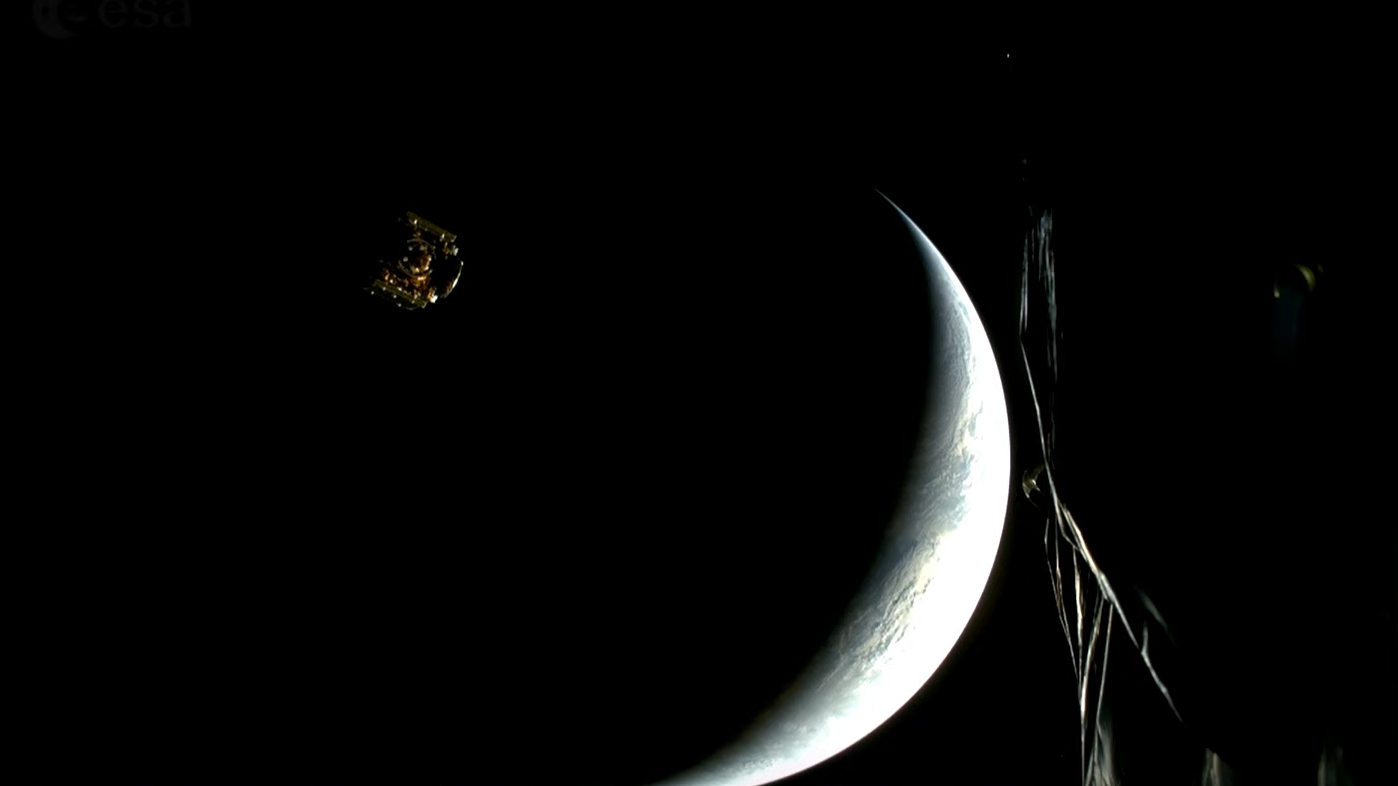
The Moon imaged by ESA’s JUICE on August 19th, 2024, when it completed a fly-by of the Moon, during which it came to within 700 km of the lunar surface. Credit: ESA/Juice/JMC

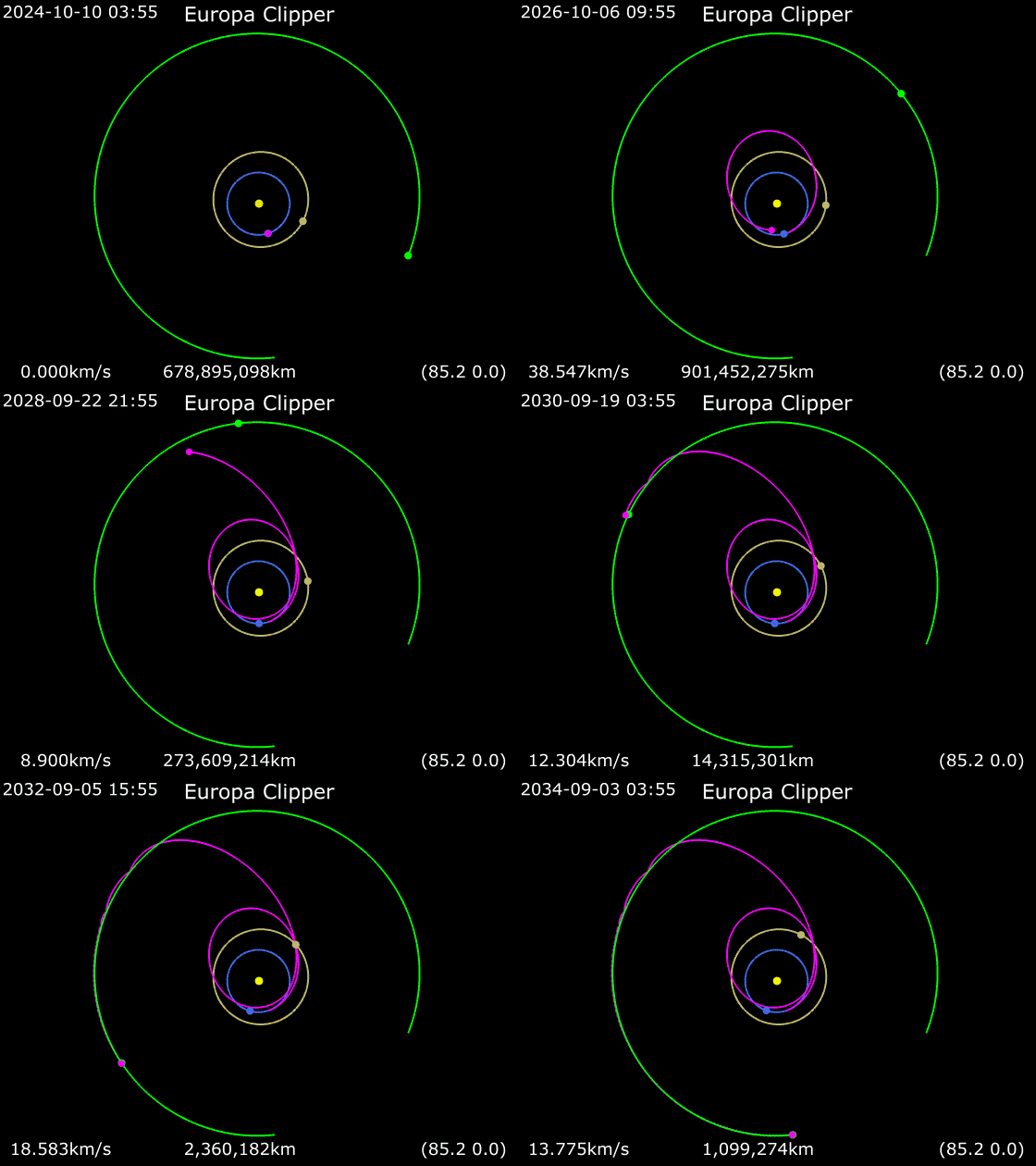
The manoeuvre marked the first of a series of complex fly-bys for the probe – launched in April 2023 – all of which are designed to accelerate it to a speed of 2.7 km per second and throw it out towards Jupiter’s orbit, where it will intercept the planet in 2031. As noted in my previous report, the Moon fly-by on August 19th saw Juice pass around the far side of the Moon at just 700 km above the lunar surface, allowing the spacecraft’s course to be precisely adjusted for its passage around the Earth, which it reached on August 20th, passing around the planet at a distance of 6,807 km.

The manoeuvre acted as a slingshot, accelerating the spacecraft and hurling it back around the Sun ready for its next planetary encounter, this one with Venus in August of 2025. After this, JUICE will swing by Earth twice more, in 2026 and 2029 – the latter of which will boost it away from the inner solar system and an 18-month voyage to Jupiter.

An image of Earth captured by ESA’s JUICE during the second part of the LEGA fly-by on August 20th. Credit: ESA/Juice/JMC

The images here show both the Moon and Earth on August 19th and 20th respectively, with the spacecraft visible in both as a result of its orientation during the fly-bys.

Space Sunday: Water in Mars, and a Juice-y flyby

An artist’s illustration of NASA’s INterior Exploration Using Seismic Investigations, Geodesy and Heat Transport (InSight) lander on Mars (active: 2018-2022), which attempted to give the planet its first thorough check up since it formed 4.5 billion years ago. In particular, the mission sought to understand the planet’s interior composition and monitor things like tectonic activity (marsquakes), meteorite impacts, study how much heat is still flowing through the planet, and track Mars’ wobble as it orbits the Sun. Credit: NASA/JPL

The subject of water on Mars has been a topic of scientific debate and speculation for well over 100 years. Since the earliest reliable observations of Mars via telescope, it had been thought that water ice and water vapour existed on the planet and in its atmosphere as a result of the seeing the polar ice caps (although we now know the major stakeholder in these is carbon dioxide) and cloud formations.

However, the idea that Mars was still subject to liquid water flowing across its surface in our modern era became popularised in the late 1800s. In  1877, respective Italian Astronomer  Giovanni  Schiaparelli – already noted for his observations of Mars in which he correctly identified and named multiple visible surface features – used the Great Opposition of 1877 (when Mars and Earth were both on the same side of the Sun relative to one another and Earth was effectively “overtaking” Mars in their respective orbits, thus bringing the two into “close” proximity to one another) to carry out further observations. During these he noted the presence of multiple canali  on Mars.

One of Schiaparelli’s 1877 surface maps of Mars. Note the looping canali (“channels”) he thought he observed in the northern hemisphere of the planet, and which he saw as entirely natural phenomena, although most were later shown to be optical illusions / the misidentification of other features. Credit: Public domain

Canali is an innocent term, meaning “channel”, and Schiaparelli simply used this term to differentiate what he thought is saw from other features he observed. But in English-speaking newspapers it was later translated as canals, evocative of artificial and intelligent construction. This resulted in wealthy Bostonian businessman Percival Lowell, following his return to the United States in the early 1890s to establish an observatory in Flagstaff, Arizona, specifically (initially at least) so he could observe these “canals” for himself.

Over the course of 15 years (1893-1908), Lowell saw his canals, which grew into a globe-spanning network and led to the publication of three books (Mars (1895), Mars and Its Canals (1906), and Mars As the Abode of Life (1908 – an original copy of which I actually own!) in which he expounded his theory that Mars had a network of canals built by an ancient civilisation in a last-ditch effort to carry liquid water from the planet’s poles to their equatorial and temperature cities as the planet increasingly became more desert-like.

A manuscript globe of Mars made by Danish amateur astronomer, Emmy Ingeborg Brun, presenting an image of Lowell’s network of Martian “canals” (together with the names he assigned individual “canals”), and made by combining sketches of his observations and which were published in Mars and Its Canals (1906), and Mars As the Abode of Life (1908). Credit: Royal Greenwich Observatory

Lowell stuck to this belief throughout his observations in spite of increasing scientific evidence that Mars was likely incapable of supporting liquid water on its surface and observations from other observatories with larger telescopes than his which could not find any evidence of “canals”, and that at least some of what he was seeing was actually (as Schiaparelli had believed) lines of demarcation between different elevations / terrains.

As a result of this belief, Lowell has become regarded as a bit of a crackpot  – which is a same, as he led a remarkable life with multiple achievements as a traveller, diplomat, writer and armchair scientist, and did gain recognition in his lifetime for his work – He was elected a Fellow of the American Academy of Arts and Sciences in 1892 and then to the American Philosophical Society in 1897, whilst the volume of work he carried out as an astronomer outside of his theories about Mars saw him receive the Prix Jules Janssen, the highest award of the Société Astronomique de France, in 1904.

Lowell pictured in 1914 seated at the 61-cm (24-in) Alvan Clark & Sons refracting telescope at the Lowell Observatory, Flagstaff, Arizona, as he observes Venus. Credit: Unknown and reconstructed

This volume of work include daytime studies of Venus and the search for “planet X”, a planetary body believed (and still believed by some) to be orbiting the Sun far out beyond the orbit of Neptune. In fact, the Lowell Observatory became a centre for this work, for which it was rewarded in 1930 when Clyde Tombaugh located Pluto using the observatory’s telescopes and equipment.

Of course, whilst liquid water does not exist on the surface of Mars today and hasn’t for billions of years, we have found plenty of evidence for its past presence on the planet’s surface.

In my previous Space Sunday article, for example, I wrote about the Great Lake of Mars, Lake Eridania, whilst both the Mars Science Laboratory Curiosity and Mars 2020 rover Perseverance have literally been following the evidence for free flowing water in both of the locations on Mars they are exploring. Prior to them, the Mars Exploration Rovers Spirit and Opportunity both uncovered evidence of past liquid water on Mars, as have orbital vehicles from NASA, Europe and other nations. But the two big questions have always been – where did it go, and where did it come from?

In terms of where it went, the most common theories are that the water either evaporated and was lost to space along with Mars’ vanishing atmosphere relatively early in the planet’s life or retreated down into the Martian crust where it froze out into icy “reservoirs”. The first is likely for a certain volume of water, whilst subterranean tracts of water ice have been located not too far under the surface of Mars. However, the latter cannot possibly account for the amount of water believed to have existed on the surface of Mars in its early history, not could simple evaporation account for the disappearance of to greater majority of it. So where did the rest go? And where did it come from originally?

Well, in a new report published this month a team of scientists believe they have the answer, and it lay within data obtained by NASA’s InSight (INterior exploration using Seismic Investigations, Geodesy and Heat Transport) lander.

This ambitious craft landed on Mars in 2018, with the mission running from November of that year through until the end of December 2022. In particular, the lander carried with it two unique instruments it deployed onto the Martian surface using a robot arm. One of these was the French-lead Seismic Experiment for Interior Structure (SEIS), designed to measure marsquakes and other internal activity on Mars and things like the response to meteorite impacts, in order to better understand the planet’s internal structure. The data continues to be studied, and has revealed much about the planet’s internal structure and its history.

Most recently, a US team from the Scripps Institution of Oceanography at the University of California, San Diego and the University of California, Berkeley, have been reviewing the SEIS findings specifically to try to answer the question of where the water went. In particular, they have been using mathematical models employed here on Earth to locate aquifers and oil and gas fields deep underground. By adjusting the models so they provided results consistent what is largely known about the Martian crust down to a depth of several kilometres below the surface, they ran a series of passes on data gathered from deeper and deep within the planet’s crust, In particular, the came across two interesting results. The first indicated that while deposits of water ice do exist below the surface of Mars, and less than 5 km from the surface, they are likely to be far less commonplace than had been thought. The second result they took note of was consistent with those indicative of layers of water-saturated igneous rock deep within the Earth’s crust.

Most interestingly, the results of the SEIS data modelled suggest this deep layer of rock and water – laying some 11.5 to 20 km below the surface of Mars could be widespread across the planet to the extent that it could contain more water than would have been required to fill the oceans and seas of ancient Mars.

Taken together, these result indicate that while the theories about water on Mars being lost to space or frozen into subsurface ice are still valid, the vast majority of the water most likely retreated deep down into the planet, possibly returning to the reserves from which it might have originally burst forth to flood parts of Mars during the planet’s late Noachain / early Hesperian period of extreme volcanic activity.

A “core sample” of the Martian interior beneath NASA’s InSight lander from the Scripps / UC Berkeley study. The top 5km of the crust appear to be dry, with limited large-scale deposits of water ice, while a water-saturated zone of fractured rock lies some 11.5 to 20 km below the surface. This is believed to by a widespread layer within the crust, potentially containing more liquid water than the volume believed to have been present in ancient Martian oceans. Credit: J Tuttle; Keane and Aaron Rodriquez, via Scripps Institution of Oceanography

One intriguing question that arises from this work is related to the potential for Mars to have harboured life, and what happened to it as the water vanished. if the modelling in the study is correct, and the water did retreat deep under the surface of Mars and form aquifers and pools with the rocks there, did any ancient microbial life gone with it, and if so – might it have survived? The pressure and temperatures at the depth which the water appears to reside would keep it both liquid and warm and provide energy, as would mineral deposited within the rock; so the question is not without merit.

Establishing that there is a big reservoir of liquid water provides some window into what the climate was like or could be like. And water is necessary for life as we know it. I don’t see why [the underground reservoir] is not a habitable environment. It’s certainly true on Earth — deep, deep mines host life, the bottom of the ocean hosts life. We haven’t found any evidence for life on Mars, but at least we have identified a place that should, in principle, be able to sustain life.

– Michael Manga, Professor of Earth and Planetary Science, UC Berkeley

But the is a question that’s unlikely be to answered any time soon. Determining if the environment is at the very least amenable to life, much less actually finding evidence for life within it – or even simply reaching any of the water deposits –is going to be pretty much impossible for a good while yet. Current deep drilling techniques here on Earth for extracting oil and gas only go down to around 2 km; getting that sort of equipment to Mars and enabling it to dill down at least 11-12 km will pretty much remain the stuff of dreams for a good while to come.

 JUICE to Swing by the Moon and Earth

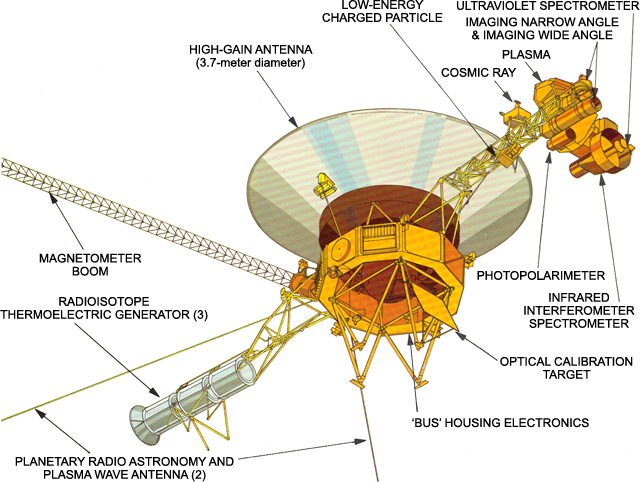
The European Jupiter Icy Moons Explorer (JUICE) mission will be making a first-of-its kind fly-by of the Moon and Earth this week, the first in more than 5 gravity assist manoeuvres the vehicle will make (excluding those made while orbiting Jupiter) during its mission to study the icy moons on the Jovian system.

An artist’s impression of ESA’s Juice mission approaching the Jovian system in 2031. Credit: ESA

Such manoeuvres are often used with space missions and for a variety of reasons. With JUICE, it means the craft could be flown into space using a medium-lift launch vehicle and make (and albeit relatively sedate) flight to Jupiter, involving a total of three fly-bys of Earth and one of Venus to accelerate it to a peak velocity of 2.7 km per second using the minimum of fuel and then slingshot it out to a point in space where it will intercept the Jovian system, and they use further flybys of the planet and its Moons to both slow itself down into orbit around them and then adjust its course so it can study the icy moons of Jupiter – GanymedeCallisto, and Europa.

This first fly-by comes 16 months since the launch of the vehicle, and will be the very first Earth gravity assist which also employs the Moon as a critical component. On August 19th, Juice will as around the Moon at a distance of just 700 km (reaching the altitude at 21:16 UTC), using the Moon’s gravity to swung it onto a trajectory that will see it pass by Earth just over 24 hours later, passing over north-eastern Asia and the Pacific at an altitude of just 6,807 km on the morning of August 20th (local time) before heading back out to loop around the Sun. After this it will get a further gravity assist from Venus in August 2025 and then two more from Earth (without the Moon helping) in 2026 and 2029, that latter of which will  slingshot the vehicle on it way to rendezvous with Jupiter and its moons.

An animated GIF showing Juice’s flightpath as it loops around the inner solar system (2023-2029 – Yellow= Venus; blue = Earth) prior to gain the velocity required to slingshot out to intercept Jupiter, passing by way of asteroid 223 Rosa (teal). Credit: Phoenix777, using NASA HORIZONS system data, via Wikipedia

On August 15th, Juice briefly caused a stir when it was mistaken as a near-Earth object (NEO) on a potential collision course with Earth. At 27 metres across, most of which is some 85 square metres of solar arrays, Juice is a strong reflector of sunlight, and this briefly confused systems at the ATLAS Sky Survey, Hawai’i, which attempts to locate, identify and track potentially threatening NEOs. However, the system’s confusion was quickly identified as actually being the Juice spacecraft and the alert corrected.

This was actually the second time an ESA deep-space vehicle has been mistaken as a hazardous NEO; in November 2007, and as it approached Earth for a flyby, Europe’s Rosettta mission spacecraft  – also with a large span of solar arrays – was also briefly mis-identified as a NEO on a possible collision course with Earth. On that occasion, it was mis-identified by a human observer, and further manual checking was required before it was confirmed the object being tracked was actually the Rosetta spacecraft and not of any threat to Earth.

Following its arrival at the Jovian system, Juice will spend 1259 days orbiting the system, the majority of which will be in Jupiter-centric orbits that will allow it to study Ganymede, Callisto and Europa, with numerous gravity-assists of both Ganymede and Callisto used to alter its trajectory and velocity, allowing it to study them from different orbital inclinations and also to dip down into the inner Jovian system to study Europa.

However, the final 284 days of the time (from early 2035) will be spent in a dedicated orbit around Ganymede, allowing the spacecraft to complete some 6 months of dedicated studies of the moon once it has settled into a 500 km circular orbit around Ganymede. By the end of 2035, the spacecraft is expected to have expended the last of its 3 tonnes of manoeuvring propellants, bringing the mission to an end. without the ability to manoeuvre, Juice is expected to quickly fall victim to further Jupiter gravitational perturbations and crash into Ganymede within weeks of running out of propellants.

Space Sunday: balloon rides to space and alien lakes

A rendering of the Marine Spaceport (MS) Voyager launching a Space Perspective capsule at the start of a 6-hour journey under a balloon to carry passengers to an altitude of 32 km and then bringing them back to a safe splashdown and recovery. Credit: Space Perspective

Back in 2021 I wrote about Space Perspective, a (then) relatively new entry to the field of sub-orbital space tourism and – if I’m honest – the one I’d really like to try (see: Space Sunday: balloons to space, Mars movies and alien water clouds).

At a time when Blue Origin are lobbing place to the edge of space in ballistic capsules and Virgin Galactic has been (although currently on hiatus) chucking them not-quite-so-high on rocket planes, Space Perspective came up with an altogether more sedate – and longer duration approach to giving people a taste of space: send them up in a  balloon.

Space Perspective’s Neptune capsule test article at their hanger in Titusville, Florida. Credit: Space Perspective

When I first wrote about the endeavour, Space Perspective planned to offer flights for up to 8 passengers and 2 crew starting on land, using a purpose-built balloon with a luxury capsule slung beneath it to carry them up to around 30-32 km altitude (not high enough to qualify for astronaut wings but more than enough to witness the curvature of the Earth and see it passing below as the 6-hour flight heads out to sea) before descending to a splashdown and a return to dry land aboard a luxury boat.

Since then things have changed somewhat. Whilst the overall goal remains the same – and the prototype capsule for the flights, called Neptune, has made a number of demonstration flights, once the system is approved and operational, the entire flight will commence and end at sea, launched and recovered via a purpose-equipped vessel.

MS Voyager undergoing sea trails following her refit and renaming. Credit: Guice Offshore / Space Perspective

The MS (Marine Spaceport) Voyager, as the vessel is known, is a former 3,100 tonne displacement oil platform support vessel (OSV) measuring  90 metres in length, 61 metres of which is a flat working deck which has been specifically outfitted for the launch and recovery of the company’s balloons and capsules. The term “Marine Spaceport” replaces the more usual usage of MS (“Motor Vessel”) to indicate the ship is intended to be a fully ocean-going launch and recovery vessel. Initially it will operate of the United States Space Coast, Florida, but Space Perspective is already eyeing the potential to offer flights out of the Caribbean and other wealthy tourist retreats, thus bringing the thrill of edge-of-space flight to the potential travellers, rather than making them travel to the launch pad.

The name Voyager was chosen in direct reference to NASA’s Voyager mission programme, and specifically Voyager 1. Billed as the “first” in its class and operated by specialist marine and aerospace recovery company Guice Offshore on behalf of Space Perspective, both companies have hinted further vessels (Voyager 2?) might be made available in the future.

A rendering of the inside the Neptune Capsule with an added backdrop of the Earth visible through the windows. The cabin sits 10 – 8 passengers + 2 crew and features a “space spa” (washroom) and drinks and snacks. Credit: Space Perspective
The ship was officially unveiled in January 2024 following a 2-year refit and upgrade. This includes outfitting her for balloon and capsule transport, balloon inflation, capsule launch system, capsule recovery system (following splashdown, rather than trying to recover the capsule directly on the deck) and more. In addition, the vessel has been equipped with luxury staterooms for capsule passengers, a passenger lounge and a fully equipped hospital.  Since its official unveiling in its finished looks (the company did reveal snippets of it during the acquisition and conversion process), Voyager has been undergoing final re-certification and licensing trials prior to moving to ita new berth at Port Canaveral, its base of operations.

The capability to launch and retrieve the Neptune capsule at sea creates worldwide scalability along with an unprecedented closure of the routine operations safety case. We are proud to bring a new spaceflight capability to Port Canaveral and the Space Coast.

– Taber MacCallum, founder and co-CEO of Space Perspective

Whilst no dates have been given, Space Perspective has indicated the next phase of work is to test launch and recovery operations using the Neptune capsule. After these, the company expects to move towards obtaining a commercial license for passenger operations and then to offering flights.

Tickets for the latter have already been offered by the company at US $125,000 per head – far less than either Virgin Galactic or Blue Origin, although both of the latter do offer periods in microgravity, which Space Perspectives cannot provide. The company has not revealed how many tickets it has sold in advance of commencing operations.

The Great Lake of Mars

Mars is a small world when compared to Earth, but it likes to do things big. There’s Olympus Mons, the massive shield volcano , rising almost 22km above the Mars datum (compared to Mauna Loa and Mauna Kea rising some 9-10km above the sea floor on Earth), and covering an area as much as 300,000 sq km in size  (compared to the10,430 sq km of the Island of Hawaii). Or there’s the 4,000+ km length of the Vallis Marineris, in places 7 km deep and more than capable of regarding the 447 km long and 1.6 km deep Grand Canyon as a mere tributary.

Both of these feature are very well known to people even with just a passing interest in Mars. But there is another remarkable – if less obvious – feature on Mars which has been the subject of extended study by Europe’s 20-year Mars orbiting veteran, Mars Express.

Located in the planet’s southern hemisphere, and badly scarred and weathered by impact craters and the passage of time, are the remnants of a vast lake – or perhaps sea might be a better description – that at some point in the ancient Martian past may have been up to 1 km deep, a depth similar to the extent of the southern end of the Caspian Sea, Earth’s largest inland sea. However, where the latter covers an area of some 386,400 sq km, Eridania Lake on Mars once covered an area of some 1.1 million square km – big enough to hold three times the volume of water by volume than the Caspian Sea. And if you’re wondering about how this compares to the Great Lakes in North America, the largest bodies of freshwater on Earth, they “merely” cover an area of some 244,100 sq km with a maximum depth of around 406 metres.

However, like the Great Lakes, Lake Eridana consists of several interconnected basins, all of which likely held water as a common lake between 4.1 and 3 billion years ago. These basins are still visible on the surface of Mars today and, and are now officially called the Ariadnes Colles (“hills”), Coralis Chaos, Atlantis Chaos, Simois Colles, and Gorgonum Chaos.

What is particularly interesting about this region is not the fact it was once a vast lake, but that it is exceptionally mineral and clay rich (the clay deposits being up to 2 km thick), with many of the detected minerals showing clear signs of volcanic origins. This means that the lake bed could once have been home to hydrothermal vents; thus Eridana potentially offered everything life needed to bring itself into being back in the Martian pre-history: the right chemicals and minerals, a source of water, and a source of heat / energy.

An illustration of how volcanic activity may have caused the deposition of minerals on the floor of Lake Eridania and chlorides along the shoreline as a result of evaporation. Credit: J Secosky via wikimedia

The clearest evidence for the region being subject to the effects of volcanism is not so much in the presences of ancient volcanic peaks, but from the presence of significant fault lines collectively called the Sirenum Fossae. Over 2,700 km in length, these fault lines sit either side of a trough of land which dropped below the mean surface level to form a graben as the land either side of the faults was pulled apart. It’s believed this occurred when the crust of the planet was under enormous strain as the massive Tharsis bulge with its three huge volcanoes was forcing itself upwards half a world away, allowing liquid magma to channel its way up to the heat the lake bed, giving rise in turn to the hydrothermal venting.

The hills of Ariadnes and Simois Colles are thought to have been mounds of material deposited within the lake during the early-to-mid Noachain period, when Mars is thought to have been most abundant in liquid water. As the water began to recede in the latter part of the Noachian period (round 3.8 to 3.7 billion years ago), material was exposed to the Martian weather and subject to sculpting into mounds.

An annotated image of four of the principle parts of Eridania Lake, showing the likely water depths during the time the lake was at its greatest. Credit: J Secosky via wikimedia

Then, in the Hesperian period (3.7 to around 3.0 billion years ago), the region of the lake were subject to perhaps multiple periods of flood and clearing  (along with other parts of the planet) as volcanism took more widespread hold on the planet and the likes of Olympus Mons formed, whilst the volcanoes of Tharsis and Elysium added their voices to the choir of eruptions and disruptions. This ebb and flow of water further shaped the vast fields of mounds before they were again exposed to the (much calmer by this time) Martian winds, which have been shaping them ever since.

Such is the wealth of potential science there that the region was proposed as a possible landing zone for NASA’s Mars 2020 rover Perseverance.

Despite the fact that Eridania floor has been mapped as a volcanic ridged plain, several sedimentary mineralogies have been recognised there corroborating i) a low-energy and long-lasting (Late Noachian to Early Hesperian) depositional environment characterised by the presence of ponding water, and ii) a warm Martian paleoclimate with a stable highland water table more than ∼3.5 billion years ago.
For all the above reasons, the Eridania surface provides great potential to search for prebiotic chemistry and past exobiological life: thus we are proposing this region as the Mars 2020 landing site.

– Pajola et al, 2016: Eridania Basin: An ancient paleolake floor as the next landing site for the Mars 2020 rover

Ultimately, and for a variety of reasons, the region was passed over in favour of other locations and, eventually, Jezero Crater was selected as the landing zone for Perseverance. However, the continuing study of Eridania is again awakening calls for a robotic mission there – if a suitable landing zone can be located. Not only does the region offer a fascinating mineralogical history of Mars and the potential for studies into both prebiotic chemistry and potential past biological activity, the richness of the minerals and compounds identified within the clays of the region could potentially preserve the characteristics of the ancient atmosphere and climate. Thus studying them even in the absence of any evidence for organic activities within the clays of the region could do much to further unlock the ancient history of Mars.

Starliner to Remain, Crew-9 Delayed and Embarrassment Rises

So the Starliner saga continues. As noted last time out, the decision on when (and how) to return Boeing’s CST-100 Starliner to Earth was awaiting further review of data on the end-of-July “hot fire” tests of the vehicle’s thrusters systems both on Earth and on the International Space Station (ISS).

At the time of that update, things looked good from both a Boeing and a NASA perspective, but NASA delayed detailed commentary on the results for a week to allow further reviews of the data. These have been carried out, and appear to show there are still issues which may or may not be related to the overheating problem. As the precise cause of the additional issues cannot be determined, NASA announced on August 7th that the Starliner vehicle, comprising the reusable capsule Calypso and its non-reusable service module, will remain at the ISS until mid-August at least.

This announcement came a day after NASA indicated that the Crew 9 mission due to launch to the ISS on August 18th would be delayed until no earlier than September 24th (something I indicated might be the case in my last update).  However, during the August 7thbriefing, NASA did make the admission they are now looking at alternate ways to potentially bring the Starliner’s crew of Barry “Butch” Wilmore and Sunita “Suni” Williams home, if necessary.

“Butch” Wilmore and “Suni” Williams slightly ironically imaged within the ISS airlock and the hatchway of the Crew Dragon vehicle docked at the space station, as engineers at NASA and Boeing continue to seek answers to issues with the Boeing Starliner propulsion systems. Credit: NASA

The most likely scenario for this would launching the Crew 9 mission with only two people on board – most likely Commander Zena Cardman and Pilot Nick Hague, leaving 2 seats free for Williams and Wilmore (although their space suits are different to those used by SpaceX, so this would have to be worked through). Wilmore and Williams would then remain aboard the ISS as a part of the Crew 9 rotation (Expedition 72), returning to Earth with Cardman and Hague in March 2025. As veterans of previous ISS crews (Wilmore as a part of the Expedition 41 rotation in 2014 and Williams as part of both the 2006/7 Expedition 14 and Expedition 32 rotations in 2012), they are more than qualified for such an extended stay.

If the case, this would not be the first time a crew has faced an extended stay on the ISS – as many commentators seem to have forgotten.

In September 2022 cosmonauts Sergey Prokopyev, Dmitry Petelin and NASA astronaut Frank Rubio arrived aboard the ISS for a 6-month rotation. Three months into their stay, their space vehicle, Soyuz MS-22 suffered a major coolant leak, rendering it unfit for crewed flight. Instead, in February 2023, Russia launched Soyuz MS-23 to the space station without its crew of three. Rubio, Petelin and Prokopyev then remained on the ISS through the end of September 2023, carrying the work planned for the original MS-23 crew.

However, this would then require the Starliner to make an automated return to Earth. In theory, Starliner is fully capable of doing this (unlike SpaceX Dragon), having a fully automated flight control software suite. This was demonstrated in May 2022 with the unscrewed Orbital flight Test 2 in May 2022. The problem here being that Calypso was launched without some (or all) of the necessary software (notably, the software required for the vehicle to automated undock and move away from the ISS).

Starliner capsule S2 with the hatch for its docking adaptor open, approaches the ISS in May 2022 using its automated flight software to conduct a fully automatic rendezvous and docking with the station. However, some (or all) of this software is not currently available to the Calypso, and would have to be uploaded to the vehicle and configured if the craft is to make an uncrewed return to Earth. Credit: NASA

While this is partially understandable – this flight was, after all, intended to test the vehicle under human control –  it is nevertheless highly embarrassing that neither Boeing nor NASA sought to ensure the automated flight software was available on Calypso just in case it was needed. Instead, the software would have to be uploaded, configured and tested – a process that could take up to 4 weeks to complete.

This lead to something of a public tiff between company and agency, Boeing aggressively stating the craft is fully capable of a crewed return to Earth. NASA, however, isn’t (rightly) open to taking chances with its personnel – so for now the saga will continue.