Space Sunday: of tweets, space stations and helicopters

NASA has linked the Moon with Mars for decades, but only really emphasised the former whilst only talking vaguely about the latter. This lunar “bias” might have been the reason for a confusing tweet by President Trump on June 7th, 2019. Credit: NASA

In December 2017, President Trump signed Space Policy Directive (SPD)-1, directing NASA to focus on returning human to the Moon. More recently this has seen the White House to direct NASA to achieve this return by 2024, and not 2028, the US space agency’s target year. We’ve also seen the programme gain a name – Project Artemis (Artemis being the sister of Apollo in Greek mythology) and the White House and Congress getting into something of a tussle over NASA’s 2020 budget: the former wants to add US $1.6 billion to NASA’s budget specifically for the lunar effort, the latter wants to give NASA an extra US $1.3 billion for programmes other than a return to the Moon.

However, tussles over budget increases aside (and even if it were granted, US $1.6 billion is merely a splash of the level of financing NASA realistically needs to reach the Moon by 2024), the US space agency has at least had a goal to aim for, until President Trump appeared to rock the boat on June 7th, when he issued a tweet that appeared to suggest NASA shouldn’t be aiming for a return to the Moon, but should be focused on Mars.

Donald Trump’s June 7th tweet concerning NASA’s human space flight goals

The tweet drew a huge amount of backlash from people trying to claim that Trump regards the Moon as “part of Mars”. However, those doing so are somewhat misguided. Anyone with any understanding of NASA’s plans / desires over the last 30 years with regards to Mars know that the Moon has been indelibly linked to that effort; it’s been pretty much the view that the one (Mars) cannot be achieved without the other (a return to the Moon).

The cornerstone of this claim has always been that the Moon can be used as a testing ground for technologies that might assist us in the exploration / settlement of Mars.

The Moon provides an opportunity to test new tools, instruments and equipment that could be used on Mars, including human habitats, life support systems.

– NASA website

But how accurate is this assertion? “Not very” is a not unfair summation. Mars is a very different destination to the Moon. Just landing there requires substantially different capabilities to those required for landing on the Moon.

For example, Mars has an atmosphere and the Moon does not. This can be both an advantage (it can be used to help slow an incoming vehicle down on its way to the surface) and a disadvantage (lander vehicles must be capable of withstanding entry into that atmosphere and making use of it during descent, which adds significant complexity to them). Similarly, the technology needed to get off of Mars is different: more powerful motors are required to counter the greater gravity (twice that of the Moon), these in turn require more fuel, which makes the ascent vehicle more complex – which could also feed back into the decent vehicle as well, if a paired system, such as proposed for use with the Moon, is to be used.

That Mars has an atmosphere means that very different technical approaches must be taken for landing there compared to landing on the Moon. Credit: The Mars Society

Similarly, how local resources on the Moon and Mars might be used differ substantially. With the Moon, it is proposed water ice in the southern polar regions is leveraged as a means of producing oxygen, water and fuel stocks. This could also be done on Mars – but there is a far more accessible resource on Mars for this: its carbon-dioxide rich atmosphere.

Using a 19th century technique called the Sabatier Reaction, water, oxygen and methane can literally be produced out of the Martian air. The oxygen and methane can be used a fuel stocks, while the air and water have obvious life-support options.

The Sabatier reaction: (1) hydrogen feedstock carried to Mars is combined with the carbon-dioxide atmosphere to produce methane (CH4), used as propellant, and water (H2O). (2) Te water is split into hydrogen, which is fed back to to help support the first reaction, and oxygen, also used as a propellant. (3) A related reaction takes the CO2 atmosphere and splits it into “waste” carbon, returned to the atmosphere and oxygen, which can be used as propellant or to supplement air supplies.

Tests carried out by the Mars Society – and verified in a 2003 joint NASA / ESA study – show that an automated lander vehicle carrying just 6 tonnes of hydrogen to the surface of Mars could produce 112 tonnes of methane / oxygen fuel by the time a human crew arrives 18 months later – enough to power their ascent vehicle back to Mars orbit or – depending on the mission architecture used – even all the way back to Earth orbit.

And when it comes to things like life support systems and radiation shielding – do we actually need the Moon to test these for an eventual Mars mission? Actually no. In terms of life support systems, we already have the infrastructure in place for testing them, just 400km from the surface of Earth; we call it the International Space Station. And when it comes to testing technologies to protect against radiation – even GCRs (galactic cosmic rays) – this can be done through other, and potentially less costly, means.

Which is not to say that we shouldn’t be going to the Moon; the potential science returns are as significant as those in going to Mars. However, it’s not unfair to say that for the last 30 years, the constant linking of the Moon and Mars has resulted in NASA being unable to achieve either.

Thus, Trump’s tweet shouldn’t be seen as any kind of belief on his part that the Moon is anyway “a part” of Mars, but rather a reflection (or possibly parroting) of the frustration some space advocates feel in the way NASA constantly links the two, with the emphasis perhaps too closely focused on the Moon, rather than looking at the potential and inspiration humans face in going to Mars.

However, where Trump’s tweet is potentially harmful is in the confusion it might cause. Trump’s spur-of-the-moment tweets have an unfortunate habit of becoming “policy”. As such, it was hard to know if the June 7th tweet was simply parroting something heard, or whether it was signalling a genuine change in direction for US space policy. As such, some, such as the Planetary Society, more correctly sought not to belittle the Moon “a part” of Mars element of Trump’s tweet, but to request a clarification of anticipated goals.

The Planetary Society’s response to Trump’s Tweet, highlighting the real concerns, not “he doesn’t know the Moon from Mars” nonsense

This clarification appeared to come at the National Space Society’s International Space Development Conference in Washington DC on June 8th. At that event, Scott Pace, Executive Secretary of the National Space Council, indirectly referenced Trump’s tweet, stating that while efforts to return humans to the lunar surface by 2024 were ongoing, NASA and the administration should devote more attention to long-term aspirations of human Mars missions.

The president’s comments was a criticism not of going back to the moon but rather not paying more attention to that long-term goal.  We’re head down, working on the immediate execution of this [and] I don’t think we always do a good job speaking to the larger vision that this is part of. What he [Trump] is doing is stepping back and expressing, I think, a very understandable impatience with how long all of that takes, and sometimes we miss the bigger picture.

– Scott Pace, Executive Secretary, the National Space Council

Continue reading “Space Sunday: of tweets, space stations and helicopters”

Space Sunday: ExoMars, a magic movie and a “forbidden planet”

A model of the ExoMars rover, Rosalind Franklin, in the ROCC Mars Yard. Credit: ESA

When it comes to Mars rover missions, eyes tend to be firmly on NASA’s Mars Science Laboratory Curiosity vehicle and the upcoming Mars 2020 rover.

However, if all goes according to plan, come 2021, Curosity and Mars 2020 will have a smaller European cousin trundling around Mars with them, thanks to the arrival of ExoMars rover Rosalind Franklin. While the rover isn’t due to be launched for just over 12 months, the European Space Agency (ESA) take two further steps towards the mission in June 2019.

At the start of the month, ESA inaugurated the Rover Operations Control Centre (ROCC) in Turin, Italy. Designed to be the hub that orchestrates all operational elements supporting Rosalind Franklin once it has been delivered to the surface of Mars by its Russian-built landing platform, ROCC is one of the most advanced mission operations centres in the world.

This is the crucial place on Earth from where we will listen to the rover’s instruments, see what she sees and send commands to direct the search for evidence of life on and under the surface.

– Jan Wörner, ESA’s Director General

As well as providing communications with the rover, data processing, and science and engineering support, the ROCC boasts one of the largest “Mars Yard” sandboxes currently available. Filled with 140 tonnes of Martian analogue soil, it offer a range of simulated terrains similar to those the rover might encounter within its proposed landing site. Such simulation capabilities will allow Earth-based teams to carry out a wide range of activities  using the rover’s Earth-bound twin before committing to particular courses of action, or to help assist the rover should it get into difficulties on Mars.

Use of such environments is not new; NASA uses an assortment of indoor and outdoor Mars Yards to help support their static and rover surface operations on Mars. However, the ROCC Mars Yard is somewhat unique in its capabilities.

For example, as ExoMars has a drilling system designed to reach up to 2 metres (6 ft) below the Martian surface, the ROCC Mars Yard includes a “well” that allows rover operators to exercise the full sequence of collecting Martian samples from well below the Martian surface. This well can be filled with different types / densities of material, so if the Rosalind Franklin gets into difficulties in operating its drill, engineers can attempt to replicate the exact conditions and work out how best to resolve problems.

The “well” in the ROCC Mars Yard, as seen from underneath, allowing the ExoMars rover mission team rehearse the full range of sample gathering operations. Credit: ESA

And while it is not part of the main Mars Yard, ROCC rover operations will be assisted by a second simulation centre in Zurich, Switzerland. This 64-metre square platform can be filled with 20 tonnes of simulated Martian surface materials and inclined up to 30-degrees. Engineers can then use another rover analogue to see how the rover might – or might not – be able to negotiate slopes.

For example, what might happen if the Rosalind Franklin tries to ascend / descend a slope covered in loose material? What are the risks of soil slippage that might result in a loss of the rover’s ability to steer itself? What are the risks of the surface material shifting sufficiently enough that the rover might topple over? What’s the best way to tackle the incline? The test rig in Zurich is intended to answer questions like these ahead of committing the Mars rover to a course of action. In fact, it has already played a crucial role in helping to develop the rover’s unique wheels.

Both the Mars Yard and the Zurich facility will be used throughout the rover’s surface mission on Mars, right from the initial deployment of the rover from its Russian landing platform (called Kazachok, meaning “little Cossack”).

With the Mars yard next to mission control, operators can gain experience working with autonomous navigation and see the whole picture when it comes to operating a rover on Mars. Besides training and operations, this fit-for-purpose centre is ideal for trouble shooting.

– Luc Joudrier, ExoMars Rover Operations Manager

The Mars Yard can also simulate the normal daytime lighting conditions on Mars. Credit: ESA

June will see the new centre commence a series of full-scale simulations designed to help staff familiarise themselves the centre’s capabilities before commencing full-scale rehearsals for  the rover’s arrival on Mars in March 2021.

Meanwhile, in the UK – which carries responsibility for assembling the rover – Rosalind Franklin is coming together. The drill and a key set of scientific instruments—the Analytical Laboratory Drawer—have both been declared fit for Mars and integrated into the rover’s body. Next up is the rover’s eyes – the panoramic camera systems. Once integration in the UK has been completed, the rover will be transported to Toulouse, France, where it will be put through a range of tests to simulate its time in space en route to Mars and the conditions its systems will be exposed to on the surface of Mars.

The targeted landing site for Rosalind Franklin is Oxia Planum, a region that preserves a rich record of geological history from the planet’s wetter past. With an elevation more than 3000 m below the Martian mean, it contains one of the largest exposures of clay-bearing rocks that are around 3.9 billion years old. The site sits in an area of valley systems with the exposed rocks exhibiting different compositions, indicating a variety of deposition and wetting environments, marking it as an ideal candidate for the rover to achieve its mission goals.

Continue reading “Space Sunday: ExoMars, a magic movie and a “forbidden planet””

Space Sunday: Venus, Pluto, and a mini round-up

This cylindrical map of Venus reveals the planet’s hostile surface beneath the clouds, a place of volcanoes and vast volcanic plains with few impact craters. The latter demonstrates both how volcanism has played a roll in “smoothing over” the surface of Venus in the past, and how effectively the dense atmosphere acts as a shield in burning-up incoming space debris. Credit: NASA

Once regarded as a planet that may harbour life, Venus – as we know it today – is a hellish place. Cursed with a runaway greenhouse effect, the surface temperatures (averaging 735 Kelvin or 462°C / 863°F) are hot enough to melt lead and mark it was the hottest planetary body in the solar system. The atmosphere is both a toxic cauldron so dense that it exerts a surface pressure 92 times greater than our own – the equivalent of being 900 m (3,000 ft) under water on Earth.

Venus is also unusual in other ways: it has a retrograde rotation (it spins on its axis in the opposite direction to Earth and most of the other planets), and it takes 243 terrestrial days to complete one rotation but only takes 224.7 days to complete an orbit of the Sun, making a “day” on Venus longer than a year.

Despite its hostile conditions, it has long been believed that Venus was at one time in its ancient past a far more hospitable world, potentially warm a wet, and spinning a lot faster on its axis (quite possibly in the same direction as the Earth spins). However, at some point  – so the accepted theories go – Venus experienced a massive impact, one sufficient enough to slow – and even reverse – its rotation and which also left it the broiling, hostile world we know today.

An artist’s impression of how Venus might have appeared some 2.5 – 3 billion years ago, at a time when a globe-spanning ocean might have started to affect the planet’s rotation, slowing it and eventually giving rise to the planet’s runaway greenhouse effect. Credit: NASA

However, a new study involving the University of Bangor, Wales, the University of Washington and NASA, suggests not only did Venus once had a liquid water ocean, but that ocean may have actually been the catalyst that brought about the planet’s dramatic change.

To put it simply, tides act as a brake on a planet’s rotation because of the friction generated between tidal currents and the sea floor. On Earth, this results in the length of a day being shortened by about 20 seconds every million years. Given this. the team responsible for the  study investigated how such interactions might impact Venus. Using a numerical tidal model, the accepted belief that Venus once had a world-girdling ocean, and applying it to planetary rotational periods ranging from 243 to 64 sidereal Earth days, they calculated the tidal dissipation rates and associated tidal torque that would result from each variation in ocean depth and rotational period. Their work revealed that ocean tides on Venus would likely have been enough to slow the planet’s rotation it down by up to 72 terrestrial days every million years.

This might not sound a lot, but of the course of around 10-50 million years, it would have been enough to slow Venus’s rotation and bring it to how we see it today. In turn, this slowing of rotation would have accelerated the evaporation of an ocean waters on the sunward facing side of the planet, both increasing the atmospheric density and trapping more heat within the atmosphere, accelerating the planet’s greenhouse effect, in turn increasing the rate of ocean evaporation in what would have been a closed cycle. Add to that the planet’s known volcanism, and the team estimate that it would have taken around 100-120 million years to turn Venus into the planet we see today.

This work shows how important tides can be to remodel the rotation of a planet, even if that ocean only exists for a few 100 million years, and how key the tides are for making a planet habitable.

– study co-lead Dr. Mattias Green, University of Bangor

The study findings have potentially important implications for the study of extra solar planets, where many “Venus-like” worlds have already been found. From this work, astronomers have a model that could be applied to exoplanets located near the inner edge of their circumstellar habitable zones, helping to determine whether they might have at some point potentially have had liquid water oceans, and how those oceans may have affected their development.

Fly Your Name to Mars

Mid July through August 2020 will see NASA’s next rover mission launched to Mars, and as with a lot of their recent exploratory missions, NASA is giving members of the public the opportunity to have their names flown with the vehicle.

Between now and September 30th, 2019, NASA is inviting one million members of the public to submit their names and postal codes to Send Your Name (Mars 2020). These names will then be laser-etched onto a little chip roughly the size of a penny that will be mounted on the rover and carried to Mars. In return, successful applicants obtain a “boarding pass” similar to the one shown below, indicating their name will be flown on the mission.

My Mars 2020 boarding pass

The Mars 2020 rover is based on the same chassis and power system as used by the Mars Science Laboratory Curiosity rover. It will also use the same type of landing system, featuring a rocket-powered “skycrane” that will hover a few metres above the surface of Mars and then winch the rover down to the surface. However – and for the first time in the history of planetary exploration – Mars 2020 will have the ability to accurately re-target its landing point prior to committing to lower the rover, thus allowing it to avoid last-minute obstructions that might otherwise damage the rover or put it at risk.

Core to this capability is a instrument called the Lander Vision System (LVS), which has been undergoing tests in California’s Death Valley attached to a helicopter. LVS is designed to gather data on the terrain the lander is descending towards, analyse it to identify potential hazards and then feed the information to a guidance system called Terrain-Relative Navigation (TRN), which can then steer the landing system away from hazards, allowing the skycrane to winch the rover to the ground in a (hopefully) a safe location.

The Mars 2020 rover’s LVS under test in Death Valley, California, mounted on the front of a helicopter. Credit: NASA/JPL

Mars 2020 is due to be launched between July 17th and August 5th 2020 to arrive on Mars at Jezero Crater on February 18th, 2021.

Continue reading “Space Sunday: Venus, Pluto, and a mini round-up”

Space Sunday: Moon talk

An artist’s impression of an unpiloted commercial lander leaving a scaled-back LOP-G for a descent to the surface of the Moon ahead of a 2024 human return to the lunar surface.Credit: NASA

On May 13th, 2019, NASA announced that the Trump Administration had requested a US $1.6 billion bump to the space agency’s 2020 budget, to assist it in its efforts to return humans to the Moon by 2024. If approved, the increase will be used by NASA as a “down payment” – or more correctly seed money – that will in particular be put towards studies and projects related to the development of a human-rated lunar lander.

Given just how much needs to be done, US $1.6 billion really isn’t that much; in 2019, NASA was allocated US $4.5 billion of a US $19.2 billion to put towards its lunar efforts, most of which was used in the development of the initial Space Launch System (SLS) rocket and the ongoing work in developing the Orion Multi-Purpose Crew Capsule, with small amounts being allocated to studies such as the Lunar Orbital Platform-Gateway (LOP-G) station, and development of a new generation of lunar-capable space suits.

But these capabilities are just a part of the infrastructure NASA needs to build if it really is to achieve a human return to the Moon by 2024. This includes the LOP-G itself, the need to carry out more extensive robotic exploration of the lunar south pole, the selected location for the landing, the development, testing and deployment of these robot missions, the development of the technologies NASA have touted as being required for a long-term human presence on the Moon (not all of which will be required in the initial phases of the return, admittedly). And, of course, there is the need to develop and test the lunar lander itself.

The Lockheed Martin Orion MPCV Ground Test Article (GTA), a version of the vehicle constructed specifically for testing under simulated conditions to demonstrate the environmental integrity and operational capability of the craft. Credit: NASA / Lockheed Martin

The announcement was used by NASA to springboard a series of new PR videos to help promote their lunar aspirations, including one narrated by William “James T. Kirk” Shatner – are upbeat whilst being light on details. Even so they are useful watching for those wanting to have the agency’s aims painted in the broadest of brush strokes.

Part of this PR drive included the confirmation of the lunar programme’s official title: Artemis. The daughter of Zeus and Leto, Artemis was the Greek goddess of the hunt, the wilderness, wild animals, and chastity, the patron and protector of young girls, and was worshipped as one of the primary goddesses of childbirth and midwifery.

However, in this instance, the most important aspect of Artemis’ legend is that she was regarded as the goddess of the Moon – and the twin sister to Apollo. As such, the name is clearly intended as a way to indirectly echo the can do attitude that marked the Apollo era.

NASA’s plans to send humans to the Moon by 2028 had three parts that could be launched, in part, by commercial rockets, and which used a fully operational LOP-G. If the White House target date of 2024 is to be met, these plans must be vastly accelerated – and NASA budget will require a committed year-on-year increase from the US government. Credit: NASA

With one billion of the additional budget request being specifically for use in lunar lander development, on May 17th, NASA confirmed that it has selected 11 companies to begin studies and initial prototype development of portions of human landers intended for use in the 2024 (and beyond) missions.

Some US $45.5 million has been set aside by NASA in support of all 11 companies, each of which is expected to make its own contribution  – up to 20% of the total cost of their study / prototype programme to the development work. The awards are part of NASA’s Next Space Technologies for Exploration Partnerships (NextSTEP) programme, a series of broad agency announcements that support public-private partnerships to develop technologies needed for NASA’s exploration plans.

The 11 companies selected comprise Aerojet Rocketdyne, Blue Origin, Boeing, Dynetics, Lockheed Martin, Masten Space Systems, Maxar Technologies, Northrop Grumman Innovation Systems, OrbitBeyond, Sierra Nevada Corporation and SpaceX.

Given Lockheed Martin have been working on their own proposals for a lunar lander for some time (see Space Sunday: Moon, Mars, and abort systems), and Blue Origin recently unveiled their own lander, Blue Moon (see Space Sunday: a Blue Moon, water worlds and moving house), their inclusion in the list is unsurprising. Neither is the inclusion of the likes of SpaceX, Boeing, Sierra Nevada Corporation and Northrop Grumman. What is perhaps surprising is the inclusion of start-ups like OrbitBeyond (founded in 2018), which was initially granted a Commercial Lunar Payload Services (CLPS) contract by NASA, allowing it to bid on delivering science and technology payloads to the Moon, rather than being involved in the development of human-rated lander vehicles.

Blue Origin, who recently revealed a full-scale model of their Blue Moon lunar lander, are one of 11 companies selected by NASA to carry out initial work into a human-rated Moon lander. Credit: Blue Origin

The awards require companies to pay at least 20 percent of the overall cost of each study or prototype project, with the work to be completed in six months. To allow the companies to start work immediately, the participating companies are allowed to start work while the contract terms are still being negotiated.

However, it’s not all good news. The 2020 federal budget has yet to be passed by Congress, and on May 16th, the House Appropriations Committee released an updated 2020 federal budget proposal of their own. This includes an additional US $1.3 billion in spending for NASA – but almost none of it is earmarked for NASA’s exploration programmes, which encompass a return to the Moon. Instead, under the House proposal, that programme is effectively cut by US $618 million.

Continue reading “Space Sunday: Moon talk”

Space Sunday: a Blue Moon, water worlds and moving house

Jeff Bezos, the Blue Origin founder, unveils a full-scale model of the company’s Blue Moon lunar lander. Credit: Jeff Foust

On May 9th 2019, and after a lot of speculation following an April tweet (see Space Sunday: asteroid impacts and private space flights), Blue Origin founder Jeff Bezos unveiled the next step in the company’s space aspirations: their Blue Moon lunar lander.

The vehicle has been in development for some three years, with precious few details being given until now, other than it was initially indicated it would be capable of delivering up to 4.5 tonnes of equipment and material to the Moon’s surface in support of human missions. However, the vehicle has apparently been through a number of design cycles, and the unveiling presented a massively capable machine which  – while it wasn’t openly stated at the May 9th event (but is indicated on the Blue Origin website) – could be used in support of NASA’s drive to return humans to the surface of the Moon by 2024.

Somewhat resembling the descent stage of the Apollo Lunar Excursion Module (LEM), Blue Moon has the capability to complete variable missions up to and including landing crews on the Moon’s surface and lifting them off again. In its “basic” form, the lander will be able to land 3.6 tonnes of cargo on the Moon, while a “stretch tank” version will be able to increase that deliverable payload to 6.5 tonnes.

The Blue Moon Lander with a set of four remote landers on its deck, and showing the “bonus payload” bay above the smaller of the distinctive spherical fuel tanks, which will contain liquid oxygen (LOX). Credit: Blue Origin

This payload will be carried on the flat upper deck of the lander, which will also include a robot crane (or cranes) capable of lifting it down to the Moon’s surface. In addition, the lander has an internal payload bay designed to deliver small satellites into lunar orbit as a “bonus mission”.

The most interesting element of the vehicle is perhaps its propulsion / power system. Blue Moon will be powered by the company’s new BE-7 motor, which uses liquid hydrogen and liquid oxygen propellants rather than storable hypergolic fuels. This allows the motor to generate up to 10,000 lbs of thrust, whilst also being “deeply throttlable”. The initial version of the motor will undergo its first “hot fire” test in the summer of 2019.

While the offer better performance capabilities than hypergolic fuels, liquid propellants need to be held at low temperatures, otherwise they can start to “boil off” to a gaseous state if they start to get “warm” (this is why liquid fuelled rockets appear to “steam” on the launch pad: they are venting fuel that has turned to gas that needs to be released to avoid over-pressurising and rupturing tanks).

While Blue Origin believe the exceptional low temperatures of the 2-week lunar night will help keep the lander’s fuel stocks cold and liquid, Blue Moon will still need refrigeration / insulation to prevent undue boil-off of the propellant stocks, which will add some weight to the vehicle. However, Blue Origin sees some boil-off of the liquid hydrogen ad advantageous: they plan to use boiled-off gaseous liquid hydrogen to help keep the liquid oxygen cold in its tanks and also as feedstock for the power cells that will be used to provide electrical power to the vehicle.

Bezos demonstrates Blue Moon’s ability to deliver a rover vehicle (mock-up) to the lunar surface during the May 9th event. Credit: Blue Origin

The latter are important again because of that 2-week lunar night. when there will be no sunlight to provide energy to any solar cells the vehicle might otherwise be equipped with to provide electrical power.

While initially intended to deliver science missions and payloads to the surface of the Moon in readiness for human landings. However, a future development with the vehicle could see it fitted with an upper stage crew / ascent module. Whether or not this might be used as part of NASA’s ambitions to met the goal of returning humans to the Moon by 2024 remains to be seen. However, Bezos has indicated Blur Origin is willing to help NASA to achieve this goal, and pointedly notes that that the company has a three-year headset in developing their lander when compared to others.

An artist’s impression of the Blue Moon crewed lander with the crew / ascent module on top. Credit: Blue Moon

However, even outside of NASA’s plans, Blue Origin has its own hopes to send humans to the Moon. As I noted in my last Space Sunday report, the company’s April tweet about this announcement made an indirect reference to Shackleton Crater close to the Moon’s south pole. This is one of a number of craters believed to have water ice deposits within it, making it an ideal location for establishing a lunar base – and Blue Origin and Bezos have previously indicated it is their target for establishing a lunar base.

Lunar water ice is also another reason for the company opting to use liquid propellants with Blue Moon. Should their aspirations with Shackleton come to pass, then water ice – hydrogen and oxygen  – becomes a feedstock for refuelling Blue Moon landers once they are on the Moon, making them more efficiently reusable.

Blue Moon will be 7 metres (23 ft) across its payload platform, which will stand some 4m (14 ft) above the lunar surface on the basic lander. Fully loaded and fuelled, Blue Moon will weigh 15 tonnes at launch, but having burned the majority of its fuel during its flight and landing, will weigh only 3 tonnes after landing. By comparison, the Apollo LEM weighed 16.4 tonnes fully fuelled and stood 7.07 m tall, including the crewed ascent stage. Meanwhile, Lockheed Martin’s proposed lunar lander could be as much as 62 tonnes fully fuelled and stand 14 m (46 ft) tall.

Bezos declined to answer specifics on the vehicle such as when test flights are likely to commence, what will be the launch vehicle (although Blue Origin’s New Glenn would appear to be the most obvious choice), or how much overall development of the lander and its variants will cost. Doubtless, some of these details will become public in time.

Continue reading “Space Sunday: a Blue Moon, water worlds and moving house”

High Fidelity changes direction (2)

via High Fidelity

In April 2019, as I reported in High Fidelity changes direction: the reality of VR worlds today (& tomorrow?, Philip Rosedale announced that High Fidelity would no longer be sitting within the content creation / public space provisioning area, and would instead switch to focus on software / platform development. This announcement has now been followed with a blog post by Rosedale that expands on the company’s immediate plans for the future.

In the May 7th, 2019 post Rosedale indicated that the company is shifting its emphasis even further and will be downsizing its workforce by 25% (some 20 people) in the process. The blog post is brutally honest – kudos to him for being so open – and its commentary gave me pause to mull a few things over before offering any lay thoughts of my own.

In stating the reason for the change, Rosedale points to the lack of take-up of VR headsets:

If you had asked me when we started the company in 2014, I’d have said that by now there would be several million people using HMDs daily, and we’d be competing with both big and small companies to provide the best platform—but I was wrong. Daily headset use is only in the tens of thousands, almost all for entertainment and media consumption, with very little in the way of general communication, work, or education.

– Philip Rosedale, Toward A Digital World, May 7th 2019

On the one hand, for those of us who never brought into the whole “VR will be a US $70 billion a  year business by 2020” simply on the basis of the “gee whiz” factor ascribed to it, nod knowledgeably and mutter, “told you so”. But this would rather miss a good portion of the point. As I’ve also pointed out in these pages, VR could in time come to have an impact on our lives in a variety of ways, and there are markets available today that could be – dare I say – revolutionised by its presence.

The problem is, no-one has yet found a way to substantially break into those markets for a variety of reasons. Take education, for example (a big focus for High Fidelity in the past): yes, VR could revolutionise teaching in many areas, but until the cost of headsets has come down substantially to the point where schools can afford to equip a class of 25-30, until questions of controlled access and the provisioning of virtual environments for schools and colleges to access (or build for themselves), the widespread integration of VR teaching remains a horizon vision.

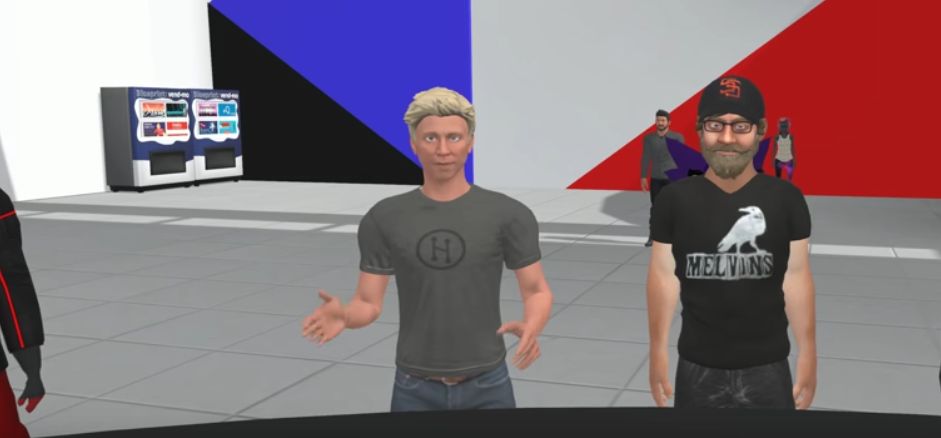
Philip Rosedale, High Fidelity founder and CEO (centre) makes the first of what are now two announcements about the company’s direction, on April 5th, 2019

However, when it comes to the broader metaverse in particular – the starting point of Rosedale’s blog post – VR is really just one component. As he notes, since its inception, High Fidelity has worked hard on many of the foundational requirements for a broader framework in which to set “the metaverse”.

We’ve been working as a company for six years now writing open-source software and creating test events and experiences to enable this imagined place to come into existence. We’ve created a 3D audio engine that can handle large crowds, an open-source graphics engine with live editing, scalable servers, a blockchain-powered currency and marketplace, and more.

– Philip Rosedale, Toward A Digital World, May 7th 2019

Could it be that, moving the focus of VR headsets off to the side until they do gain real, broad-based market traction, some of this additional technology, combined with what had already been achieved through non-VR centric 3D spaces, demonstrate real world uses cases business (and others) might want to adopt? And in doing so, might this further lay practical foundations for wider acceptance of the concepts inherent in a “metaverse” type of setting, one that could in time also more naturally offer VR HMD support if / when the latter does start to become more a part of working environments?

That’s what High Fidelity is now setting out to explore, by delving into the idea of a virtual workspace solution.

For two weeks, we sent everyone home, with their computers, and created a private tropical island where we could work together all day, mostly wearing headphones but not HMDs—we didn’t prescribe the medium of use.

Within the first couple of days it was obvious we were onto something. The 3D audio was always on, perfectly realistic and comfortable. We found ourselves walking around and interacting with each other the same way you would in a physical office. We put up whiteboards and spaces for teams … What if the general trend toward remote and distributed work … could be accelerated even faster by virtual worlds?

– Philip Rosedale, Toward A Digital World, May 7th 2019

Again, for those of us who have been around long enough, this approach might ring a bell. Back in 2008-2010, another company Rosedale founded (but had since departed in an active capacity) tried a similar idea through a product called Second Life Enterprise (SLE), designed to provide companies with a “behind their firewall” implementation of a Second Life based virtual environment for collaborative working.

That idea ultimately failed – although it’s fair to say the reasons for that product’s failure were potentially more rooted in how it was implemented and the walls Linden Lab placed around it to (presumably) protect their IP than in any disinterest in the concept of virtual work spaces or sleazy associations appended to SL itself. And times have moved on a good deal since then; if nothing else eight years on, people are now more au fait with things like virtual spaces, avatars and the like to potentially be more open to virtual working environments.

So time will tell if this new approach works for High Fidelity – again, Rosedale admits there is no certainty in the move. But after six years – most recently with a lot of effort poured into high-profile events – High Fidelity is still struggling to grow an audience, and it really wasn’t clear if anything would substantively change in the next six years if they kept on that road. As such, this a brave move for a start-up to take, and a dose of realism when it comes to the state of play with the VR market. And in the meantime, as the blog post also makes clear, High Fidelity will continue to support its open source VR platform.

Which leads to a final question. Is this a sign that more VR-centric virtual spaces could face some hard decisions? Quite possibly. High Fidelity actually isn’t the first to hit the wall of slow VR take-up. In 2017, Altspace VR announced its imminent closure, but was ultimately saved when Microsoft stepped in.

But again, caution should be exercised if tempted to see this as a sign of the future for something like Sansar. If nothing else, the latter doesn’t have the weight of US $73 million investment sitting on its shoulders, quietly demanding the way be shown towards some kind of future return. Plus, Linden Lab have a viable source of income through Second Life, a platform they are committed to continue to develop and (hopefully) grow. If nothing else, this allows them the potential to throttle / steer the development and growth of Sansar to meet the realities of their potential marketplace without the worry of external pressures.

In the meantime, to High Fidelity, one can only say “good luck” with the new endeavour, and it will hopefully be interesting to see where it leads.