Space Sunday: Starliner’s first orbital flight

Ignition: the United Launch Alliance Atlas V topped by an uncrewed Boeing CST-100 Starliner vehicle lifts-off from Space Launch Complex 41 at Canaveral Air Force Station on its uncrewed Orbital Flight Test mission. Credit: ULA / Boeing

On Friday, December 20th, 2019, NASA and Boeing, together with launch partner United Launch Alliance (ULA), attempted to undertake the first flight of the Boeing CST-100 Starliner commercial crew transportation system to the International Space Station (ISS).

I say “attempted” because while the first part of the mission went precisely to plan and the Starliner successfully reached orbit, a software issue left it unable to reach the ISS. However, while this prevented a core mission objective from being met – that of rendezvousing and docking with the ISS – it did not leave the mission a failure: the ascent to orbit was successful, with a lot of data gathered on the vehicle’s performance, and further data could be gathered while on-orbit and during the vehicle’s return to Earth – also a critical part of the test.

The vehicle was uncrewed for this test flight, but is carrying a range of cargo – including Christmas gifts for the ISS crew; tree seeds that will be planted on Earth after the mission to mark it; a mannequin fitted with a host of sensors to measure the stress placed on a human body during the flight to orbit (the mannequin is called “Rosie the Rocketeer” in reflection of “Rosie the Riveter”, the iconic role model for U.S. women working in factories and on production lines in WWII, and a Snoopy soft toy “zero gee indicator” – Snoopy is the mascot for NASA’s Artemis programme to return humans to the Moon.

The Atlas V, dual Centaur and CST-100 vehicle stack. Credit: ULA

Things started off well enough: following a near-perfect count down, the core booster of the Atlas V and its two strap-on  solid rocket motors ignited precisely on time at 11:36:43 UT (06:36:43EST) on the launch pad of Space Launch Complex 41 at Cape Canaveral Air Force Station, and the vehicle lifted off smoothly into the still-dark early morning sky.

Due to the need to keep the vehicle within a 3.5 G limit during ascent, the Atlas V rose into a “flat” trajectory during its climb, the two solid rocket boosters being  jettisoned some 2 minutes into the flight, the core stage motors continuing to burn for almost three more minutes before BECO – Booster Engine Cut-Off – was called. Shortly after, the core stage of the Atlas V separated from the Centaur upper stage, allowing it to fire its twin RL-10A motors – marking the first time a twin-engined Centaur had been used with the Atlas V booster. Again, the additional power provided by the additional motor was required to push Starliner toward orbit, running for seven minutes in the process.

It was after the Starliner has separated from the Centaur upper stage that the major problem occurred. At this point, the vehicle was supposed to orient itself and then fire the main engine on the service module to push itself into an initial orbit that would allow it to complete further engine burns to both raise its orbit and circularise it, allowing the Starliner to catch-up and rendezvous with the ISS.

However, that initial burn failed to occur on time. Instead the vehicle continued to fire its attitude control thrusters while ignoring commands from Earth to fire the the service module’s motor. Some seven minutes passed before the engine was ignited, allowing Starliner to achieve its initial orbit – but by that time its was “off course” in relation to where it needed to be in order to catch up with the ISS, and had used too much attitude control system fuel to be able to make necessary course corrections and achieve any form of rendezvous with the ISS.

The Boeing Starliner space vehicle experienced an off-nominal insertion. The spacecraft currently is in a safe and stable configuration. Flight controllers have completed a successful initial burn and are assessing next steps. Boeing and NASA are working together to review options for the test and mission opportunities available while the Starliner remains in orbit.

– Kelly Kaplan, Boeing’s spokesperson, after the planned automated engine burn failed

According to initial investigations, it is believed that the mission clock aboard Starliner overseeing all of the vehicle’s automated flight operations – including triggering the engine burn – had incorrect data, causing it to believe the service motor had fired, and thus triggering the use of the attitude control system.  While the issue left Starliner unable to reach the ISS, mission controllers were able to order the vehicle to complete two additional engine burns to put it into a near-circular 250km high orbit, where a range of tests on the vehicle have been made, and from which it could complete its planned EDL – entry, descent and landing.

A couple of important points to highlight here is that had the vehicle been carrying a crew, they would not have been in any danger – in fact, they would likely have been able to correct the initial burn failure, allowing the rendezvous with the ISS to take place.

The stages of a Starliner’s return to Earth. Credit: Boeing

With the issue understood – if not the cause known – the decision was taken to complete the planned orbital tests and then bring the Starliner back to Earth  and a landing at the White Sands Missile Range, New Mexico on Sunday, December 22nd. These orbital test included testing the navigation systems and the vehicle’s flight handling, and communications (including establishing a link with the ISS).

Landing commenced with Starliner turning itself around and using the service module’s motor in a de-orbit burn. This took place at 12:23 UT (06:23 CST at the White Sands landing ground) on December 22nd, slowing the vehicle sufficiently for it to start a decent into the denser part of the Earth’s atmosphere. Three minutes after this, the service module was detached and left to burn-up in the upper atmosphere.

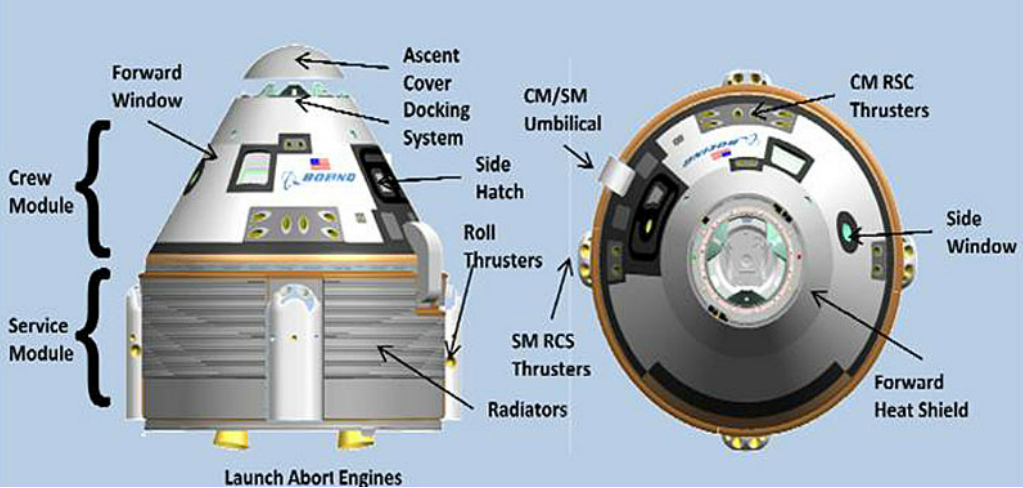
The capsule, protected by a double heat shield system – referred to as the forward heat shield (protecting the upper part of the vehicle: the airlock and the landing system parachutes) and the base heat shield (at the base of the capsule and designed to protect it from the full heat of atmospheric entry) and covered in a thermal protection system – reached “entry interface” some 20 minutes later. This is the point where the atmosphere becomes dense enough to generate friction around the vehicle, both heating up and slowing the vehicle down. At this point, Starliner was some 15 minutes away from landing.

Continue reading “Space Sunday: Starliner’s first orbital flight”

Space Sunday: tiny stars & giant planets, and an interstellar visitor

An artist’s impression of the Neptune-sized world orbiting white dwarf WDJ0914+1914,. While the star is “dead” it is still hot enough for its solar wind to be slowly ripping away the planet’s outer atmosphere, most of which is lost to space, while some of it swirls into a disc, itself accreting onto the white dwarf, further heating it. Credit: ESO / M. Kornmesser

When a star like our own reaches the end of its life, two things happen: first, in a desperate attempt to keep itself burning after using its hydrogen and helium, it expands outwards into a red giant as it burns heavier elements in turn (our Sun will expand to a size sufficient to consume Mercury, Venus and Earth) before it collapses into a hot, white dwarf, a fraction of its former size (perhaps no bigger than the Earth).

But what of any gas giants orbiting the star well beyond the limits of its red giant expansion? What happens to them following the star’s collapse to a white dwarf? Do they simply continue until such time as their own internal heating fails? Might they have some additional interaction with their former parent?

A team from Warwick University, England, appear to have the answer. They’ve discovered a Neptune-sized planet some 4 times larger than its white dwarf host star, and the two have entered into what is – at this point in our understanding of such situations – a unique relationship.

The star is called WDJ0914+1914 and is some 2,000 light years away. Whilst reviewing data on it gathered by the Sloan Digital Sky Survey (SDSS), the astronomers came across something odd: the star was apparently giving off oxygen, sulphur and hydrogen emissions. While the oxygen was to be expected – by this time in a star’s life most of what is left is actually oxygen and carbon – the hydrogen and sulphur simply shouldn’t have been there.

Turning to the Very Large Telescope (VLT), the Warwick team found the emissions corresponded to to a ring of gas surrounding the star. At first they thought they had discovered a binary system in which the mass of one star was being drawn off by the other, forming a dust ring around both. However, further analysis revealed the composition of the disc matches the deeper layers of planets in our own Solar System like Neptune and Uranus, suggesting a planetary body still exists orbiting the star and material from that planet is feeding the disc, allowing it to survive.

While fusion has long since ended at WDJ0914+1914, the star is still radiating at some 28,000ºC – enough energy to tear material from the upper layers of a planet’s atmosphere. Much of this atmosphere would trail outwards from the planet as a hot plume – which the Warwick team detected – while some would collapse to feed the disc of material surrounding the star.

Putting their calculations together, the Warwick team worked out that the planet – which cannot be directly sighted – is likely to be around the size of Neptune, and it is losing its atmosphere at a rate of around 2,700 tonnes per second to both to the disc of material around the star, and eventually onto the star itself – “feeding” it, if you will. Although this sounds a lot, it actually adds up to a relative small amount given the size of the planet, and so the loss is unlikely to alter its overall structure as the star continues to cool.

This discovery at WDJ0914+1914 is unique at the moment – but it makes the case that other white dwarf stars may also be survived by planets, some of which we may be able to detect using the transiting method of observation (WDJ0914+1914 is simply too dim for this to work). Certainly, the Warwick team’s research has opened the door on this form of research, one that could help with our understanding of exoplanet atmospheres.  It also offers a cold look at the far future (roughly 4.5 to 5 billion years from now) of our own solar system.

New Dates For Commercial Crew Test Flights

NASA has issued new dates for the final test flights for the SpaceX Crew Dragon and Boeing CST-100 Starliner that, if passed, should allow both vehicles to move on towards actually transporting astronauts to and from the International Space Station.

On December 20th, 2019, a United Launch Alliance Atlas V will launch the first CST-100 Starliner into orbit on an uncrewed orbital test flight (OTF) to the International Space Station. As well as testing the Starliner’s avionics and flight systems, the flight will also test a new docking system that is intended to become the “”standard docking system for sending humans to Gateway and to Mars” as a part of the Artemis programme, and used to deliver additional supplies and some Christmas / New Year’s extras to the ISS crew.

The first Boeing CST-100 vehicle being transported from Boeing’s fabrication centre at Kennedy Space Centre on its way to the Space Launch Complex 41 Vertical Integration Facility at Cape Canaveral Air Force Station in readiness for its flight, November 21st, 2019. Credit: Boeing

Also flying on the vehicle will be a flight test dummy christened “Rosie the Rocketeer”, named for “Rosie the Riveter”, the iconic role model for U.S. women working in factories and on production lines in WW II. The dummy is fitted with an array of sensors to measure critical data including G-forces endured during the flight to inform the team about the stresses a human crew will experience during an ascent to orbit on the vehicle. Results from this data, and all telemetry gathered during the flight will help inform NASA and Boeing on the Starliner’s readiness to commence crewed flights.

The vehicle will not spend long at the ISS – it will be undocked on December 28th and make a return to Earth in a full dress-rehearsal for a crewed landing for the CST-100 capsule. Should weather interfere with the planned launch, both December 21st and 23rd offer suitable windows for the launch to take place.

The first Boeing CST-100 mounted atop its United Launch Alliance Atlas V booster at Space Launch Complex 41, Cape Canaveral Air Force Station, December 4th, 2019. Credit: Boeing

Then, on January 4th, 2020, SpaceX is expected to complete an in-flight abort test. For that test, a Falcon 9 will lift off from Launch Complex 39A at Kennedy Space Centre carrying a test Crew Dragon vehicle – which has previously performed  a successful static fire test of its SuperDraco escape motors in November. Around 90 seconds into the flight, and the time of maximum dynamic pressure on the vehicle, the escape system will be triggered, the capsule hopefully escaping the rocket to make a safe splash-down under parachute.

SpaceX had hoped to complete this test before the end of the year, but assorted delays – including that of the CRS-19 resupply mission, which launched earlier in December (see: On the ISS – mighty mice and robots) – meant that target could not be met. If the abort flight test is successful, it should allow NASA and SpaceX to determine when crewed flights to the ISS can commence – an uncrewed test flight of the vehicle to the ISS having been completed in March 2019.

Overall. NASA would like both Boeing and SpaceX to complete their first crewed flights to the ISS – also regarded as test flights – by mid-2020.

Continue reading “Space Sunday: tiny stars & giant planets, and an interstellar visitor”

2019 OpenSimulator Community Conference December 14th / 15th

Image courtesy of the OpenSimulator Community Conference

The 2019 OpenSimulator Community  Conference is in progress over the weekend of December 14th and 15th. An annual event, the conference focuses on the developer and user community creating the OpenSimulator software.  It is organised as a joint production by Core Developers of OpenSimuator and AvaCon, and this year is sponsored and supported by University of California, Irvine, Institute for Virtual Environments and Computer Games, together with members of the Opensim community.

The conference once again features business presentations, talks, panel discussions, workshops, social events and hypergrid activities, covering a wide range of subject areas, including education, social VR, using virtual worlds and environments for historical recreations – and much more besides.

You can find the full schedule of events on the OpenSimulator Community Conference website, together with instructions on how to log-in and join and of the sessions.  Those wishing to register and support the conference can do so through the registration page. This is not required, but those who are willing to do so help to cover the cost of running these conferences.

Image courtesy of the OpenSimulator Community Conference

To encourage interest in the conference, there will be two social events held on Friday, December 13th (as well as during the conference itself). These are:

  • 14:00-16:00 PST- Tour of the International Spaceflight Museum in Kitely: ISM Exhibit Building Chair Mike Lorrey will personally lead and narrate a tour of the ISMuseum region in Kitely, with detailed explanations of the many exhibited rockets, spacecraft, and astronaut/pioneer exhibits. Come prepared to listen in voice. The first hour will be a tour with a considerable narrative explanation.Tour will be followed by a dance party in the Rocket Ring with DJ Rosa Alekseev.
    • Grid Name: Kitely – http://kitely.com.
    • Region Name: ISMuseum.
    • Parcel/Venue Name: ISMuseum Southwest,Rocket Ring.
    • HyperGrid URL: grid.kitely.com:8002.
  • 18:00-19:00 PST: Magnolia Gardens Party: explore Magnolia Gardens of Knowledge, interact with the Digital Teaching Assistants designed to guide new users learning to use the SceneGate Viewer, relax, fish, ride the jet skis, or dance the night away with music throughout.
    • Grid Name: Metaverse Depot.
    • Region Name: IMA Outpost Alpha.
    • Parcel/Venue Name: Magnolia Gardens.
    • Grid Website: http://grid.metaversedepot.com:8002/wifi/welcome.html.
    • HyperGrid URL: http://grid.metaversedepot.com:8002:ima%20outpost%20alpha.
    • Note: if you land in the default Depot region, select Magnolia Gardens on the quick teleport board; if you use the teleport system with the image, select Magnolia Gardens in the list then click the picture to teleport; if you arrive inside the lighthouse, click the yellow cylinder to teleport to the venue.

Related Links

High Fidelity changes direction (3): layoffs & shuttering apps and access

via High Fidelity

In April 2019 during a High Fidelity General Assembly meeting, Philip Rosedale announced the company would no longer be sitting within the content creation / public space provisioning area, and would instead switch to focus on software / platform development. He followed-up on that announcement a few days later with a blog post outlining the company’s move to try to develop a virtual workstation / environment that would allow people to work collaboratively whilst geographically separate.

Since that time, the company has been working on the virtual workspace idea, apparently developing it to a point where a desktop versions has been undergoing widespread testing involving teams from some 75 organisations.

However, in a December 11th blog post, Updates and a New Beginning, Rosedale announced that while the company plans to continue use the technology they’ve developed, and hopefully carry it forward into the future, they  do not plan to commercialise it at present, and are again pivoting to a new project.

Simply put, having taken a close look, while we can see that remote work is going to continue on its growth trajectory and we do have customers using it—the opportunity is not big enough today to warrant additional development. 

The work we’ve done over the past six months has been valuable in helping us understand how to make a 3D VR environment usable, stable, and accessible to first-time, non-gaming audiences, and that is intellectual property we will take forward into future work.  

– Philip Rosedale, December 11th, 2019

The pivot means that the company is shedding a further 50% of its staff (approx 40 people, given 20 people, or 25% of staff were let go in May 2019). Further, and as from January 15th, 2020, High Fidelity will be shuttering public access to its code repositories on Github (although users are welcome to fork them, if they wish), and will also be withdrawing all their apps from the Steam and Oculus stores and from the Apple App Store and Google Play.

For now, Rosedale is not revealing what the new project is, but given the shuttering of the current platform code repositories and a comment in the December 11th blog post, it might be related to a more virtual world style of platform / application.

Giving up on the current generation of HMDs doesn’t mean we’re giving up on Virtual Worlds. A team is already working on a new internal project, and although we aren’t going to talk about it now, we will have more to share about what we are doing when we are ready.

– Philip Rosedale, December 11th, 2019

A FAQ has been produced to accompany the blog post, answering core questions existing user might have about platform accessibility, account registrations, blockchain use, buying / selling HFCs, etc. And those who have a High Fidelity account should refer to that document. 

The announcement comes on the heels of a blog post from Rosedale published on December 9th, 2019, in which he continues to ruminate on the hard realities surrounding the state of VR at this point in time.

In Requiem for the HMD, he admits something that many of us have always felt: the the current generation of HMDs can at best only enjoy a modest success, and the technology as a whole still has a long way to go before it is liable to reach a “mainstream” place in the consumer market. In particular, he notes four things he believes the technology requires in order to reach this point: comfort of wearing, the inclusion of see-through displays and at desktop screen resolutions, and the ability of people to be able to type tat normal speeds in VR. To these I’d actually add more fundamental requirements such as cost per unit, overall ergonomics and compelling use cases – but these are topics for another blog post.

In the meantime, Updates and a New Beginning makes for interesting reading, as it offers a further honest evaluation of VR as it is today from someone who has been one of its strongest evangelists. For those who are having to depart High Fidelity as a result of the company’s further shift in direction, the hope is that they are able to transition smoothly into other work opportunities.

For those users who would like to keep the spirit of High Fidelity’s VR platform alive, as noted, they have until January 15th, 2020 to fork the code into their own repositories. There also the likes of Tivoli Cloud in development by former High Fidelity alumni Caitlyn Meeks and Maki Deprez that may blossom into new homes for HiFi users.

Related Articles

Space Sunday: on the ISS – mighty mice and robots


A time-lapse video of the SpaceX CRS-19 cargo Dragon being captured by the Canadarm-2 of the International Space Station (ISS)

The past week has seen two resupply missions launched to the International Space Station (ISS), which between them will deliver 4.6 tonnes of supplies and equipment to the station, including some special visitors.

The first mission, CRS-19, featuring a SpaceX Dragon and Falcon 9 launch vehicle, lifted-off from Cape Canaveral Air Force Station (adjacent to the Kennedy Space Centre) on Thursday, December 5th, after being delayed 25 hours due to high winds over the launch site. It rendezvoused with the ISS at 10:05 GMT on Sunday, December 8th. The second mission features a Russian Progress resupply vehicle, which lifted off from the Baikonur Cosmodrome in Kazakhstan at 09:34 GMT on Friday, December 6th, and is due to dock at the ISS on Monday, December 9th, carrying a mix of food, fuel and supplies.

However, it is the Dragon vehicle that has captured most attention, due to its cargo. As well as carrying the traditional Christmas goodies for the ISS crew, CRS-19 carried 40 passengers in the form of mice and elements of the station’s increasing use of robots.

The mice will spend a month aboard the ISS as a part of research into two of the most debilitating effects of spending extended periods in micro-gravity environments such as orbiting the Earth or something like a 6-month flight to Mars: muscle and bone mass loss.

Several of the mice have been dubbed “mighty mice” on account of their being genetically engineered by scientists at the Jackson Laboratory for Genomic Medicine (JAX-GM) in Maine, USA. Specifically, they have been engineered to inhibit myostatin, a molecule that occurs in mammals that regulates muscle growth (discovered in 1997 by Dr. Se-Jin Lee), allowing them to develop increased muscle mass compared to ordinary mice.

One of the myostatin-inhibited “mighty mice” (l) and a non-inhibited companion. Credit: JAX-GM

The idea is that by inhibiting the myostatin, the mice will be able to maintain both muscle mass and limit bone calcium loss whilst at the station, the lack of myostatin allowing them to continue to convert protein into muscle mass despite the mice being less active on the station than the would be on Earth.

They will spend their time on the ISS with a group of mice that have not had their myostatin blocked, and with two similar group sof enhanced  / non-enhanced mice on Earth, to determine the overall impact of the lack of myostatin in the production / maintenance of muscle  bone mass in micro-gravity compared to how myostatin might contribute to muscle / bone mass loss when allowed to function normally.

As well as helping determine what medical / genetic assistance can be given to humans on long duration, low-gravity space missions (possibly alleviating the need for up to 4 hours a day to be spent in exercise to counter muscle / bone mass loss), it is hoped that controlling / inhibiting myostatin’s function could be used to help treat patients recovering from hip fracture surgery, or those in intensive care where muscle growth could be a major factor in their recovery, and to assist elderly people suffering from muscle loss or osteoporosis.

CIMON Returns to the ISS

In addition to the mighty mice, the CRS-19 mission also delivered CIMON-2 (“Simon-2”), an updated versions of a robot assistant for ISS crews. Developed by Germany’s DLR CIMON (Crew Interactive Mobile CompaniON) is a medicine-sized robot that can float around the ISS using 14 small fans boasting a combination of IBM Watson AI, cloud connectivity, and neural network training. It was first flown aboard the ISS in 2017 / 2018, and is capable of assisting with routine tasks and research projects, displaying instructions on its forward screen, and recording images. It can also recognise, learn from, and bond with crew members through natural language; offer creative solutions to tricky challenges; and even serve as a security guard, noticing potential problems before they become dangerous.

CIMON-2 operates alongside ESA astronaut Alexander Gerst during its first outing to the ISS in November 2018. Credit: NASA / ESA / DLR

Unfortunately, the first outing for CIMON didn’t entirely go according to plan, in an outing with ESA astronaut Alexander Gerst, things started out well enough, with CIMON helping Gerst complete some test tasks, but problems arose when Gerst asked it to play his favourite music. Selecting Man Machine by Kraftwerk, CIMON continued to play the music while accepting other tasks, and when Gerst ordered, “Cancel music” the robot to replied, “I love music you can dance to! Alright, favourite hits incoming.”

While CIMON could still comprehend other commands, it appeared to become confused and not a little stroppy as Gerst communicated with those monitoring the test. “Be nice, please,” it requested at one point, followed a little later by, “Don’t you like it here with me?” and “Don’t be so mean.”

The improved CIMON-2 comes with more sensitive microphones that will hopefully allow it to hear better and not confuse commands, and a more robust AI system to allow it to better understand when it is being addressed and when an astronaut might be talking to someone else. This improved AI system includes IBM Watson Tone Analyser technology, which uses linguistic analysis to detect emotion in the tone of a conversation and respond to it – which given CIMON’s own moodiness noted above, could be interesting!

CIMON-2 is expected to spend up to three years aboard the ISS. As well as serving as a test bed for easing the stress of living and working in limited environments like the ISS and in developing greater understanding of how robots and AI can function to support crews on long duration missions, CIMON-2 is also potentially a stepping stone for developing the necessary trust human crews require to make the routine use of such systems  – which can record, process and store human activities, interactions and moods, raising concerns of privacy and data security – acceptable to crew.

Dextre, RELL and and the “Robot Hotel”

Dextre (highlighted) mounted on one of its Orbit Repair Unit (ORU) “workstations”. The Canadarm-2 robot arm hovers to the right. Credit: NASA

Robots are an important part of future human space activities, and over the years, a number of systems have been employed or tested aboard the ISS, for working both inside and outside the station. The most obvious of these is the Canadarm-2 remote manipulator system used outside of the ISS, while inside the ISS there have been robot system like CIMON and FYODOR (see: Space Sunday: Lunar landers, and robots in space).

Continue reading “Space Sunday: on the ISS – mighty mice and robots”

Space Sunday: budgets, space planes, landers, oxygen and dust

A new ESA budget confirms the space agency’s commitment to the Space RIDER uncrewed space plane Credit: ESA

On Thursday, November 28th, 2019, European Space Agency (ESA) members agreed to a record €14.4 billion, promising to maintain Europe’s place at the top table alongside NASA and China. The four largest contributors to the budget are Germany (€3.3 billion); France (€2.7 billion), Italy (€2.3 billion) and the United Kingdom (€1.7 billion – ESA is not an EU organisation, so the UK’s involvement will remain unchanged when / if Brexit occurs, although EU funding of UK science and technology projects will be impacted).

The funding will allow ESA to move forward on a number of fronts in space exploration and technology development, including:

  • The Laser Interferometer Space Antenna (LISA) – the first space-based gravitational wave observatory, comprising three spacecraft placed in a triangular formation 2.5 million km apart and following the Earth in its orbit around the Sun. LISA will launch in the early 2030s.
  • Transitioning ESA to the next generation of launchers: Ariane 6 and Vega-C.
  • Continued support of the International Space Station, including continued participation in crew missions.
  • Direct involvement in NASA’s Artemis lunar programme, including technology for the Lunar Orbital Platform-Gateway (LOP-G) and crewed missions.
  • A joint Mars sample-return mission with NASA.
  • Development of flexible satellite systems integrated with 5G networks, as well as next-generation optical technology for a fibre-like ‘network in the sky.’
  • The development of a European reusable space vehicle: Space RIDER.

Space RIDER (Reusable Integrated Demonstrator for Europe Return) is a project I first wrote about in 2015, when ESA flew the European Intermediate eXperimental Vehicle (IXV). An uncrewed vehicle weighing just under 2 tonnes, it had the primary objective to research the re-entry and flight characteristics of a lifting body type of vehicle and test the re-entry shielding technologies for such a vehicle.

The Space RIDER vehicle shown in cutaway, showing the open payload bay, forward parasail deployment system and after avionics. Credit: ESA

IXV paved the way for the initial development for Space RIDER, which will be an uncrewed cargo vehicle designed to be launched by the Vega rocket and capable of carrying up to 800 Kg of payload into orbit. All Space RIDER vehicles will be able to carry out around 5 flights apiece, reducing the overall cost of placing payloads into orbit. Following re-entry into the Earth’s atmosphere, the vehicle will descend to Earth under a parasail, allowing it to glide to a nominated landing zone.

As well as being suitable for launching space payloads into orbit, Space RIDER will itself be a technology development vehicle for possible larger reusable vehicles using similar lifting body technology.

Space RIDER will largely be developed by Italy and the first flight is due to take place in 2022.

Happy Anniversary, InSight

On Monday, November 26th, 2018, NASA’s InSight (Interior Exploration using Seismic Investigations, Geodesy and Heat Transport) lander, built with international cooperation, arrived on the surface of Mars. The focus of the mission is to probe the Red Planet’s interior – its crust, mantle and core in order to answer key questions about the early formation of the rocky planets in our inner solar system – Mercury, Venus, Earth, and Mars – more than 4 billion years ago.

A simulation of InSight touching down on Mars using its 16 rocket motors. Credit: NASA

Since that landing, the year has been an eventful one for InSight, the lander’s super-sensitive seismometer suite has detected more than 150 vibration events to date, about two dozen of which are confirmed marsquakes. However, and I’ve I’ve reported a number of times in these pages, InSight’s other primary science instrument, a burrowing heat probe called the Heat Flow and Physical Properties Package (HP³), has had tougher time.

The self-propelled “mole” probe designed to burrow down into the Martian sub-surface having been stuck for most of the year after only penetrating a few centimetres into the ground. Those operations only resumed in October 2019, and were short-lived after the probe inexplicably “bounced” its way almost completely out of the hole it had burrowed, leaving scientists and engineers still trying to work out what happened.

Side-by-side: (l) the first image returned by InSight using the lander-mounted, Instrument Context Camera (ICC), still with its dust cap in place. Note the lander’s leg in the lower right corner. (r) a photo captured by the robot-arm mounted Instrument Deployment Camera (IDC) as the arm is exercised on November 30th, 2018

The solar-powered InSight is scheduled to operate for at least two Earth years.

Continue reading “Space Sunday: budgets, space planes, landers, oxygen and dust”