An artist’s rendering of Chandryaan-3 on the surface of the Moon. Credit: ISRO
On August 23rd, 2023, India became the 4th nation to successfully land a vehicle on the Moon, after Russia, the United States and China – and the first nation to manage to do so within the South Polar Region of the Moon.
Following its separation from the propulsion module on August 17th, the Chandrayaan-3 lander Vikram completed a series of small adjustments to which allowed it to reduce the lowest point in its orbit to just 30km above the Moon. It was from this altitude that the lander fired all four of its landing motors to drop it into a gentle ballistic descent towards the lunar surface easing it down to an altitude of 7.2 km over a period of 11.5 minutes.
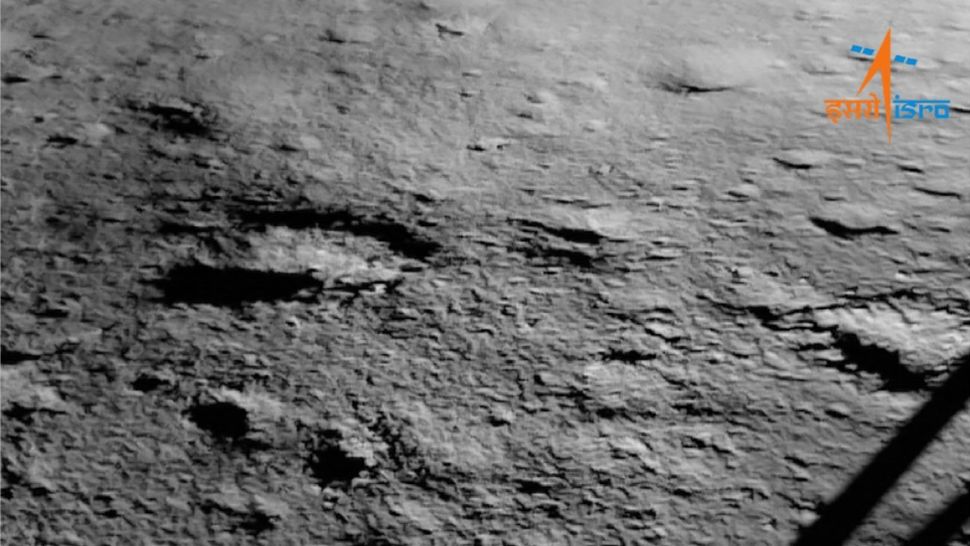
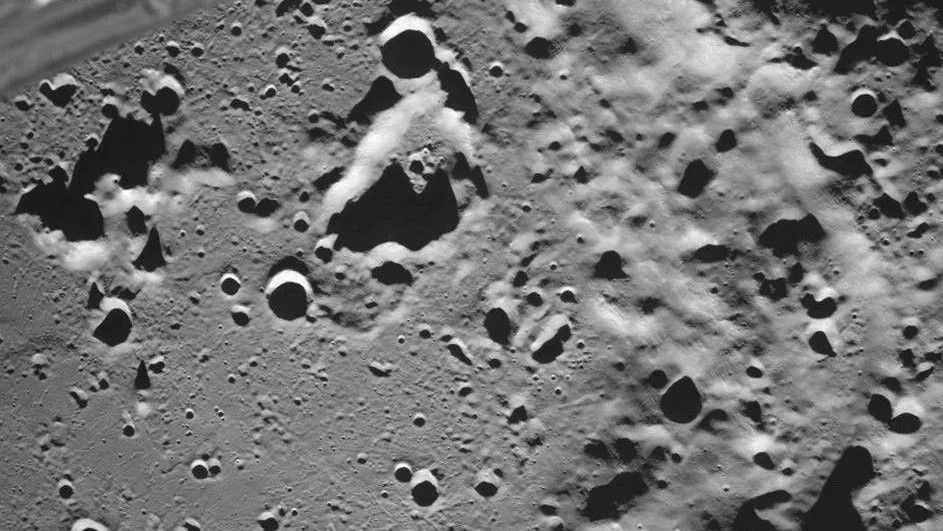
India’s Chandrayaan-3 mission took this photo of the lunar surface shortly after landing on the moon on August 23rd, 2023. Credit: ISRO)
At this point the lander used its thrusters to orient itself into a vertical position in preparation for landing. Then, at 150 metres above the surface the lander held its position using two of its decent engines to hold position for around 30 seconds in order to carry out a final scan of its proposed landing area before continuing to a soft landing at 12:32 UTC.
The landing came as a source of national and international celebration – and some relief for the Indian Space Research Organisation, the mission in part being the result of the loss of the Chandrayann-2 lander / rover combination when they deviated from their planned descent to the surface of the Moon on July 22nd, 2019, striking the Moon at an estimated 50 m/s (180 km/h / 112 mph), rather than the required 2 m/s (7.4 km/h / 4.6 mph) required for a soft landing.
The entire mission operations right from launch until landing happened flawlessly, as per the timeline. I take this opportunity to thank navigation guidance and control team, propulsion team, sensors team, and all the mainframe subsystems team who have brought success to this mission. I also take the opportunity to thank the critical operations review committee for thoroughly reviewing the mission operations right from launch till this date. The target was on spot because of the review process.
– Chandrayaan-3 project director P. Veeramuthuvel
The mission has a number of objectives, with the lander and its small rover – called Pragyan (“wisdom”) – primarily focused on the probing the composition of the lunar surface and attempt to detect the presence of water ice and to examine the evolution of the Moon’s atmosphere. However, the mission is also about the rover itself and demonstrating India’s ability to build and operate a rover vehicle.
Following landing, and after surveying its surroundings, Vikram was ordered to extend a ramp ahead of the rover’s deployment. This occurred at 03:00 UTC on August 24th, 2023, when – after as series of checks, the rover was released from its locked on the lander and commanded to roll down the ramp onto the lunar surface, watched over by the lander’s cameras.
Following initial deployment, the rover paused at the foot of the ramp, before commands were passed for it to roll forward several metres and commit a turn to test its steering.
In all, both lander and rover are expected to operate for a total of 15 days within landing area – the length of time the Sun will be above the horizon in order to provide energy to the solar-powered vehicles. It is hoped that the studies the mission performs will add to our understanding of the Moon’s south pole and its role in host water ice – a resource of enormous potential and importance to future aims for the human exploration of the Moon, and being planned by the US-led Artemis programme (of which India is a member through the Artemis Accords) and China.
This image of the Chandrayaan-3 lander Vikram was taken shortly after the landing by the Chanrayaan-2 orbiter, which has continued to operate successfully in lunar orbit following the loss of that mission’s lander and rover. Credit: ISRO
Yutu-2 Keeps Rocking
Meantime, on the lunar far side, China’s Yutu -2 (“Jade Rabbit”) rover continues to explore Von Kármán crater more than 4.5 years after arriving, making it the longest operational lunar rover to date, and the only rover operating on the far side of the Moon.
A part of the Chang’e-4 mission, the 6-wheeled rover is operating in conjunction with the mission’s lander, with both rover and lander having far exceeded their primary missions of 3 and 12 months respectively. For the rover, which has to contend with the harsh lunar nights, this is a remarkable achievement. During its time on the Moon it has covered a distance of around 1.5 km, exploring features within the crater and probing below the surface.
Footage of Yutu-2 captured from its initial deployment on the Moon in 2019, strung together into a movie. Credit: CNSA
The latter is achieved through the use of a two-channel ground penetrating radar (GPR) capable of “seeing” to depths of around 300-350 metres. This has revealed the Moon’s surface structure under Von Kármán crater to be remarkably complex, with at least 5 layers of rock stacked one above the last in a manner of sedimentation. However, rather than the result of water action, these appear to have been the results of volcanism, with at least three of the five layers primarily comprising basalt.
This points to the region having once been a site of significant volcanism and helps in further understanding of the Moon’s early history. In addition the different degrees to which the layers spread help inform scientists on how the decreasing thermal activity within the Moon directly correlates to the loss of volcanism and the settling of lunar features.
Following missions like Yutu-2 and Chang’e-4 isn’t easy, as the Chinese space programme is mixed in terms of the information and frequency with which it makes information publicly available. However, given the fact that this study is part of broader research into the Moon’s upper layers being carried out by the Planetary Science Institute in Tucson, Arizona utilising data provided by China, demonstrates the latter’s commitment to sharing the results of their robotic space research with science institutes around the world.
An image from 20th December 2011, showing long period comet C/2011 W3 (Lovejoy) as seen from the European Southern Observatory’s Paranal Observatory in the Atacama Desert, Chile (the two structures are two elements of the Very Large Telescope at Paranal). Discovered on 27th November 2011 by Australian amateur astronomer (and comet hunter) Terry Lovejoy, C/2011 W3 is, like C/2023 P1 Nishimura (below), believed to have originated at some point in the past in the Oort Cloud (although it has likely made at least 6 passes around the Sun). Whether C/2023 P1 will have an impressive a tail as it reaches perihelion remains to be seen. Credit: Guillaume Blanchard
Astronomy is a field of observation / science / study that is pretty much open to anyone with a passion and understanding of things celestial to make a contribution, whether amateur or professional in the field.
Take Hideo Nishimura, for example. As an amateur astronomer living in Kakegawa, Japan, he decided to take advantage of the clear skies overhead on August 11th, 2023 and take some photographs of the sky using his telescope and imager. It wasn’t the first time he’s done this – like many other amateur astronomers he gets enormous pleasure out of imaging and studying the night sky. However, the results caused a little more excitement than expected in the Nishimura household when Hideo noticed that in one of his images, taken towards the direction of the setting Sun showed an object that shouldn’t have been there. After contacting the International Astronomical Union, which followed-up his observations via the Minor Planet Centre, Hideo was informed he has discovered a comet making what is likely to be its first – and only – passage through the inner solar system.
Now called C/2023 P1 Nishimura in his honour, the comet is believed to be an object originating in the Oort cloud, and was knocked out of its distant orbit around the Sun by collision or some other interaction, and has been gradually “falling” towards the Sun ever since.
Such objects are not uncommon – the “C” in the title of such objects indicates they likely originate from the Oort cloud and either end up passing through the solar system and long-period comets (i.e. taking anything from a couple of hundred years to several thousand to loop around the Sun) such as C/2011 W3 (Lovejoy) seen at the top of this article. However, occasionally, some end up accumulating sufficient velocity during their inward “fall” towards the Sun that rather than looping around it and staying in an elongated orbit, they are accelerated like a pebble out of a slingshot, escape the Sun’s influence altogether, to eventually vanish into interstellar space.
And that’s exactly what C/2023 P1 Nishimura looks set to do (the 2023/P1 in the title indicated its year of discovery and the fact it was the first such object to be discovered in the first half of August (the IAU splitting the months in two alphabetically for objects like comets – So January 1th through 15th is A; then January 16th to 31st is B, with February 1st through 15th C, and so on, with both I and Z ignored to avoid confusion with 1 and 2).
C/2023 P1 Nishimura (centre and naturally green-tinted), photographed by amateur astronomer Dan Bartlett from his back garden in June Lake California, USA on August 15th, 2023, using a Celestron EdgeHD 35.6 cm Schmitt-Cassegrain telescope and a Zwo ASI2600MC Pro imager. Via Astrobin
Currently, the comet is at a magnitude of around 9.4, meaning it can only be seen using telescopes of 15cm or larger. However, as it approaches the Sun, it is expected to grow much brighter, potentially becoming visible to the naked eye at around a magnitude of 4.9 in the period September 10-15th (during which time it will be at its closest to Earth, around 0.85 AU distant) and may by that time demonstrate a tail.
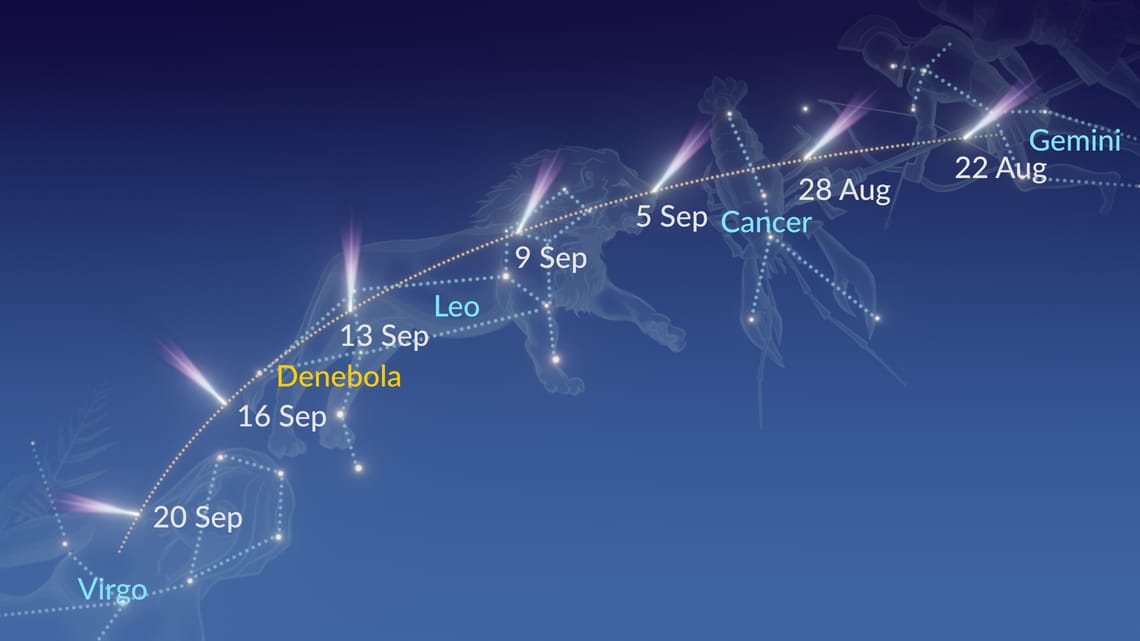
Between September 10th and 12th, period, the comet will be visible for a few hours before dawn in the constellation Leo. From September 13th, it will transition to being an evening object visible immediately after sunset. It will reach perihelion (closest approach to the Sun) on September 18th, when it will appear to be in the constellation of Virgo, about 12° away from the Sun. Perihelion is also the point at which C/2023 P1 Nishimura faces its greatest threat: in passing around the Sun, it is possible the differential forces of its acceleration and the Sun’s gravity might cause it to break up.
C/2023 P1 Nishimura’s progress across the sky. Credit: Vito Technology, Inc.
Following perihelion the comet will start to move away from the Sun – and out of the solar system – offering those in the northern hemisphere with perhaps the best opportunities to view it, although it will diminish in brightness quite rapidly, and once again require a telescope to see it from October onwards.
Those who are interested in astronomy and use apps as an adjunct to their skywatching might like to know that both Sky Tonight and Star Walk 2 apps (the latter may require the purchase of an add-on), provide the comet’s trajectory and brightness in real-time, giving you the most accurate and up-to-date information on where to view it
These are some of the upcoming dates for observations. Note that use of naked eye, binoculars, etc., and visibility in general dependent on factors such as eyesight, location, amount of light pollution, etc.):
Date
Magnitude / Visibility
Approx location / status
August 26
9.2 – telescope
Enters the constellation Cancer
September 5
6.9 – binoculars with 7x magnification or above
Enters the constellation Leo
September 7
6.3 – binoculars / possibly naked eye
Passes 0°16′ away from the star Ras Elased Australis (mag 3.0) in the constellation Leo
September 9
6.3 – binoculars / possibly naked eye
Passes 0°20′ away from the star Adhafera (mag 3.4) in the constellation Leo
September 9
5.6 – binoculars / possibly naked eye
Passes 0°20′ away from the star Adhafera (mag 3.4) in the constellation Leo
September 13
4.3 – naked eye
Reaches its closest approach to the Earth at a distance of 0.29 AU in the constellation Leo
September 15
3.7 – naked eye
Passes 0°10′ away from the star Denebola (mag 2.1) in the constellation Leo
September 16
3.4 – naked eye
Enters the constellation Virgo
September 18
3.2 – naked eye
Reaches perihelion the constellation Virgo (do not use optical aids when looking towards the Sun while it is above the horizon)
September 22
4.3 – naked eye
Passes 1°30′ away from the star Porrima (mag 2.7) in the constellation Virgo
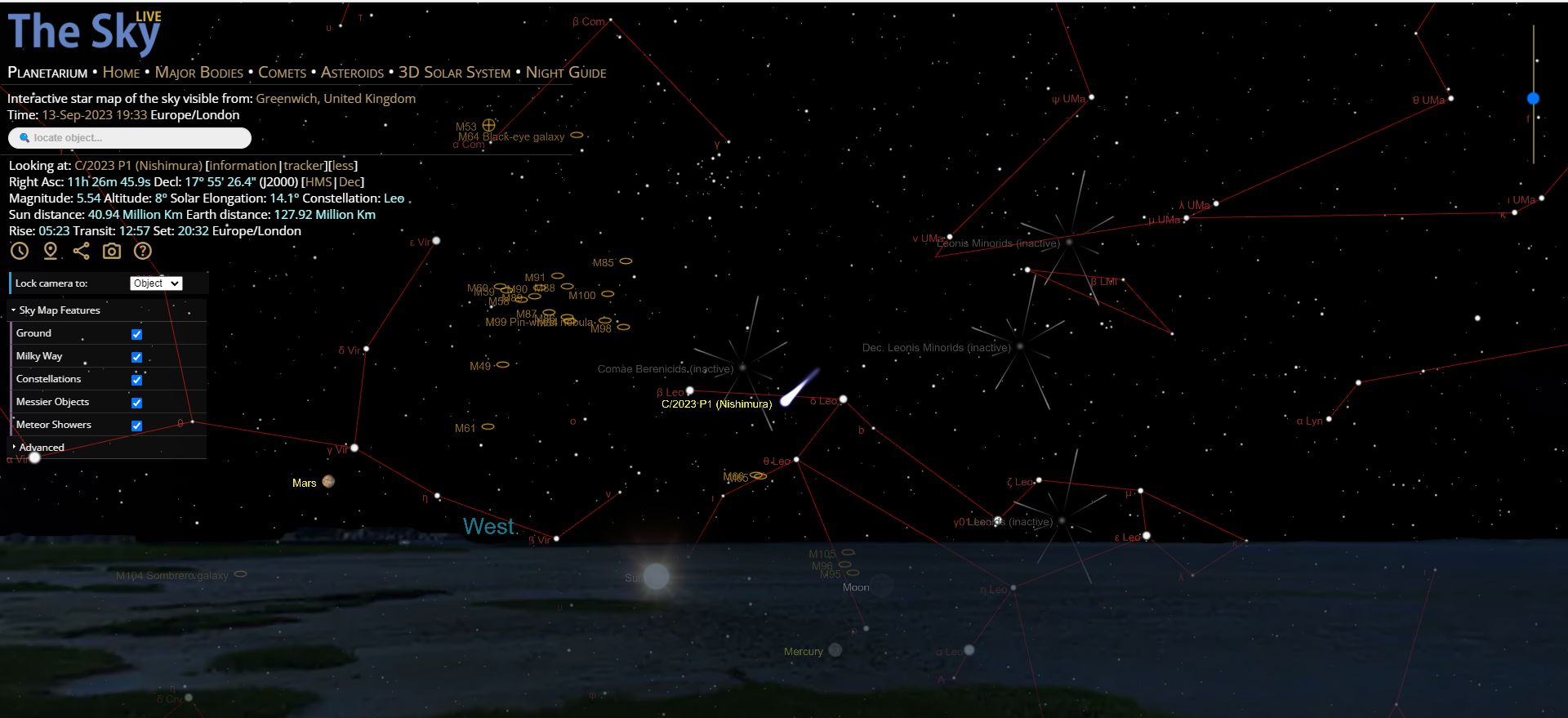
A projection of C/2023-P1’s position at 18:33 UTC, as seen from a location near :London, UK, as offered by The Sky Live – click for full size
Lunar Missions Update
My recent Space Sunday pieces have been in part covering two robotic missions to the surface of the Moon – India’s Chandrayaan-3 and Russia’s Luna-25.
Whilst having launched almost a month after Chanrayaan-3, Luna-25 – by dint of using a more powerful launch vehicle coupled with a somewhat more direct (“spiral”) flight to the Moon – actually arrived in a position from which a landing attempt could be made first.
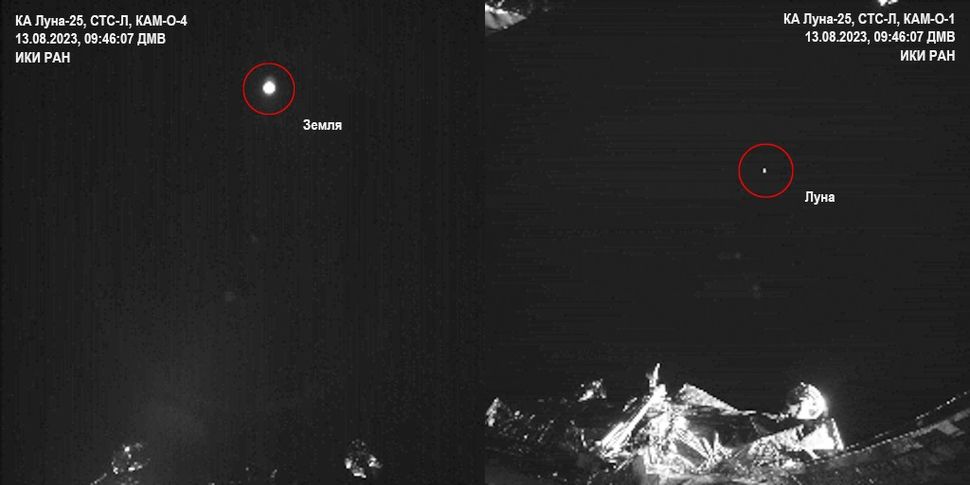
An image taken on August 13th, 2023 from Russia’s Luna-25 mission as the spacecraft spiralled away from both the Earth (circled left) and the Moon (circled right) so it could “drop” towards the latter and enter an orbit from which it could reach the Lunar South Polar Region. Credit: Roscosmos
Thus, on August 19th, 2023 (UTC) the Russian lander – which had performed flawlessly throughout the mission to this point – commenced an engine burn which unfortunately did not go well.
Thrust was released to transfer the probe onto the pre-landing orbit During the operation, an emergency situation occurred on board the automatic station, which did not allow the carrying out of the manoeuvre within the specified conditions.
– Roscosmos statement on Luna-25 released via Russia’s Telegram messaging service
The command to start the manoeuvre was sent at 23:10 UTC on August 19th, the engine burn intended to orient and position the vehicle ready for a decent and landing on August 21st. However, direct communications with the vehicle were lost at or around 23:57 UTC.
Later on August 20th, Roscsomos issued an update in which it was confirmed that all attempts to re-establish communications contact with the vehicle had failed, and the a preliminary review of the flight data received prior to contact terminating suggested the craft had deviated from its flightpath during the engine burn sufficiently that it afterwards crashed into the Lunar surface – although at the time of writing, investigations into the loss were obviously still very much in the initial phases.
The first detailed image of the lunar surface returned by Luna-25, on August 16th, 2023. It shows a portion of the Lunar South Polar Region from the far side of the Moon. Credit: Roscosmos
Meanwhile, on August 17th, the Chanrayaan-3 lander / rover combination launched by the Indian Space Research Organisation (ISRO) in July successfully separated from their propulsion module, 12 days after initially arriving in an extended lunar orbit. Separation placed the lander / rover combination under their own power and allowed them to start their final set of manoeuvres in preparation for a descent and landing. The first of these was performed on August 19th, when the Vikram lander made the first of the small adjustments needed to bring it down to the 100 km altitude from which the landing attempt will be made on August 23rd.
In PR terms, both of these missions are relatively “high stakes” for both Russia and India. Chanrayaan-3 is intended to overcome the loss of the lander/rover combination which crashed onto the Moon on September 6th, 2019 as a part of the highly ambitious Chanrayaan-2 mission. That loss still overshadows the fact that the third element of the mission, the lunar orbiter, continues to orbit the Moon carrying out its own very successful science mission. In this, it will be joined by the Chanrayaan-3 propulsion module, which although not by definition a satellite, nevertheless carries a small suite of instruments intended to study Earth’s atmosphere from afar, and – according to the ISRO – also scan exoplanets to assess their potential for habitability.
Luna 25, meanwhile, was intended to herald Russian’s return to independent deep-space exploration 47 years after its last lunar mission (Luna-24) and 34 years since its last attempt at an interplanetary mission (Phoboos 2) – both of which were soviet-era missions. It was also intended to demonstrate Russia’s ability to be a major player in the China-led International Lunar Research Station (ILRS) – the launch of the mission even having one of the senior Chinese officials for that programme, Wu Yanhua present.
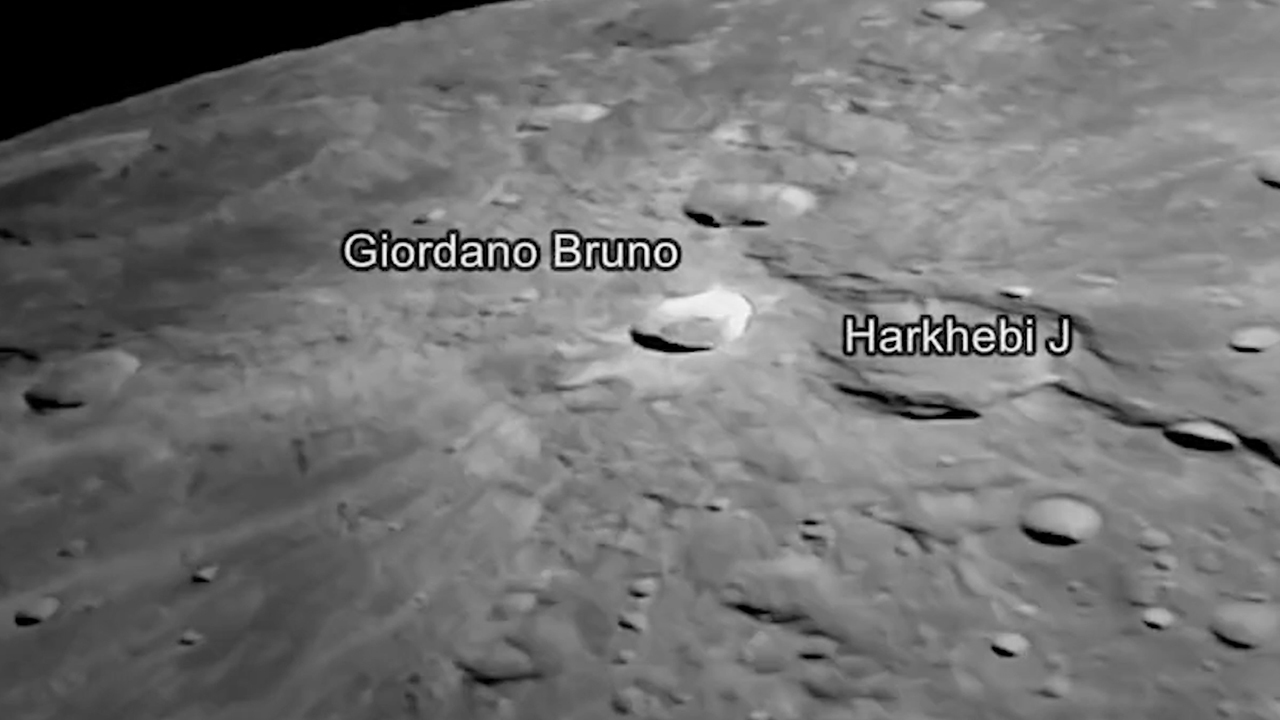
An image returned by the Vikram lander, following its separation (with its rover vehicle) from the Chanrayaan-3 propulsion module on August 17th. This show a portion of the lunar far side, featuring the 22-km wide crater Giordano Bruno. This was created by an impact which may have been witnessed by monks at England’s Canterbury Cathedral in 1178. Close by to the North-west (north is at the bottom of this image) is the much older impact crater Harkhebi-J, lying within the still older Harkhebi walled plain, the remnant of a much older impact site. Credit: ISRO.
These are far from the only missions heading for the Moon over the next few years. Japan, for example, is due to launch its Smart Lander for Investigating Moon (SLIM) vehicle on August 25th (UTC). This is a technology demonstrator designed to make exploration more precise and economical, and which is cadging a ride on the H-IIA launch of Japan’s X-Ray Imaging and Spectroscopy Mission (XRISM, pronounced “crism”) space telescope.
Unlike Luna 25 and Chanrayaan-3, SLIM will not be going to the lunar South Pole, but will be heading for a group of volcanic domes located in Oceanus Procellarum, 18oN of the lunar equator, where it will attempt to guide itself to a landing close to the Marius Hills Hole, a lunar lava tube entrance. Nevertheless, its landing will be as challenging as those for any mission to the Moon, and the loss of Luna 25 reminds us that lunar exploration is still a hazardous undertaking.
Also heading to the Moon – this time in November – will be Nova-C lander, the first private mission to the Moon to be carried out by Intuitive Machines under the mission title IM-1. Selected as a part of NASA’s Commercial Lunar Payload Services (CLPS) programme, the mission will deliver a suite of science instruments and mini-rovers to at Malapert A near the lunar south pole. I’ll likely have more on this mission and Japan’s XRISM and SLIM in a future update.
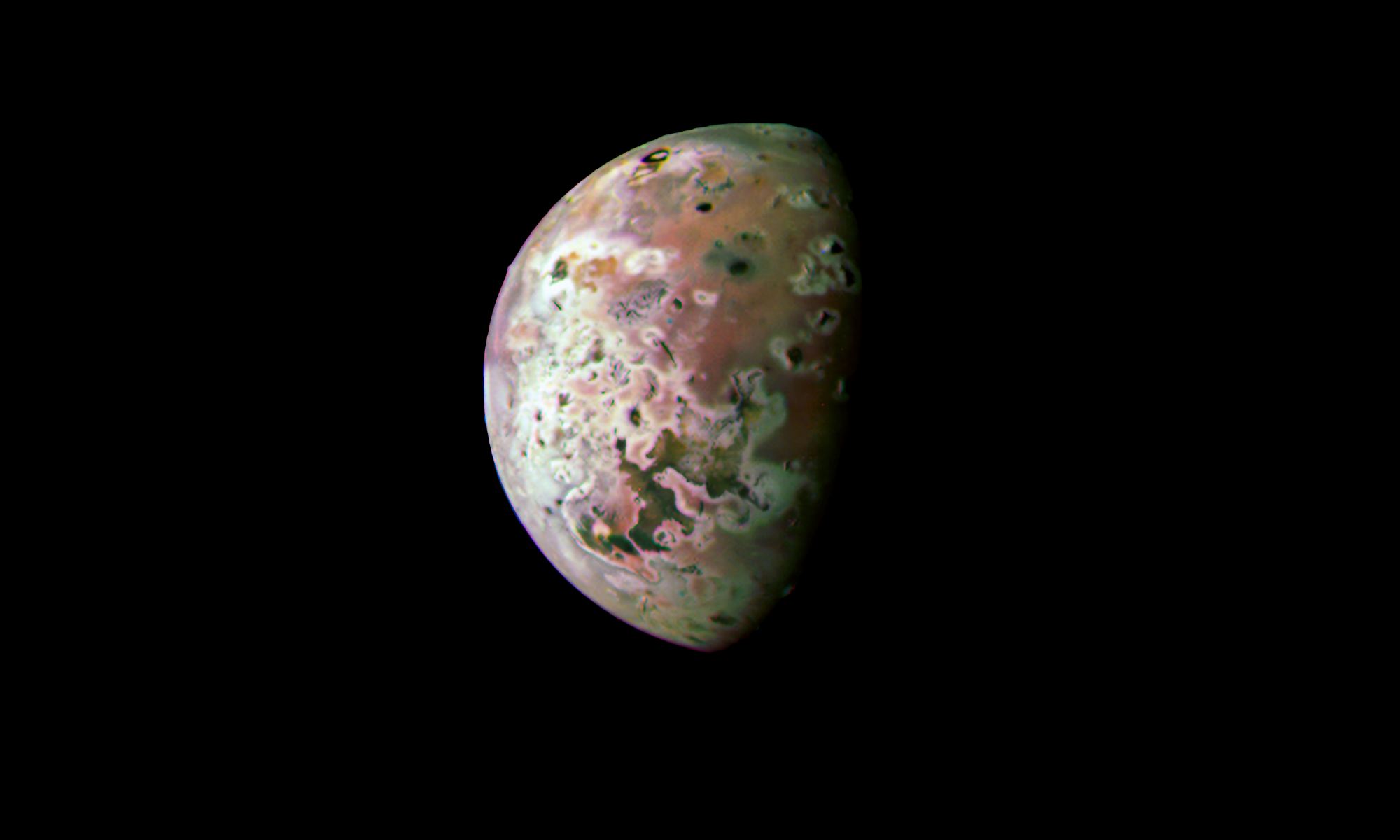
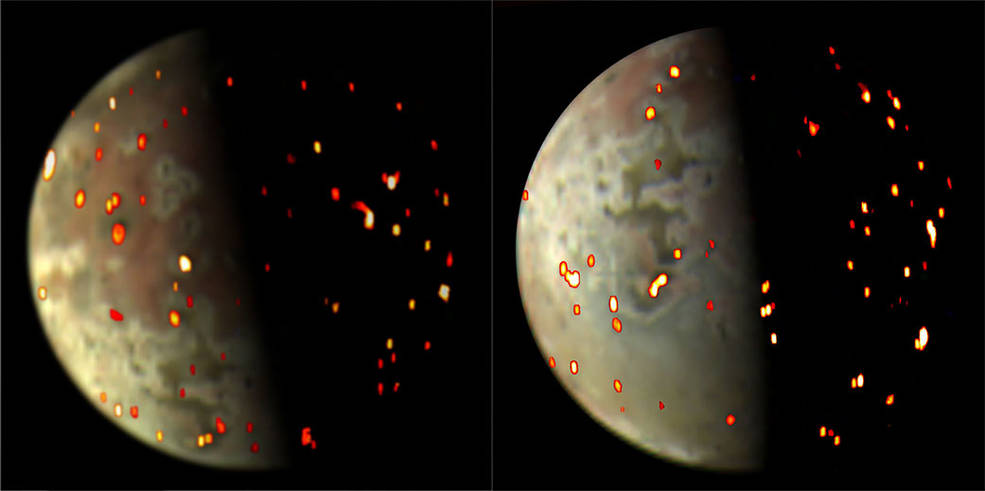
A true colour image of Io’s sunlit limb, imaged by NASA’s Juno spacecraft at the end of July 2023. The image has been subjected to enlargement and clean-up. Credit: NASA/JPL / Thomas Thomopoulos
When it comes to the Galilean moons of Jupiter, we tend to focus a lot of attention on the icy moon of Europa due to the potential of it being home to a subsurface ocean. However, Europa is not alone in being a fascinating place among these four moons; between it and Jupiter sits Io, the most geologically active place in the solar system – and that’s just one of the facts relating to it.
As the 4th largest Moon in the solar system and the third largest of the Jupiter’s Galilean moons, Io is slightly larger than our own Moon and has more than 400 active volcanoes across its surface. In addition, it has both the highest density and strongest surface gravity of any moon in the solar system. Its extreme volcanism is powered by gravitational flexing, the result of Io constantly being pulled in different directions by the gravities of Jupiter and the other three Galilean moons generating tidal heating deep in Io’s core, the same mechanism which is thought give Europa it’s possibly liquid water ocean. but on a much hotter and more violent scale.
Io’s volcanism is such that the almost constant lava flows mean the moon’s surface is constantly being re-formed outside of its volcanic peaks, whilst the allotropes and compounds of sulphur carried to the surface by both eruptions and lava flows give rise to the moon’s unique colouring. In addition, many of the volcanoes pump material high enough above Io to form a strange, tenuous atmosphere, noticeably more dense around such eruptions than elsewhere. This ejecta also gives rise to a large plasma torus around Jupiter.
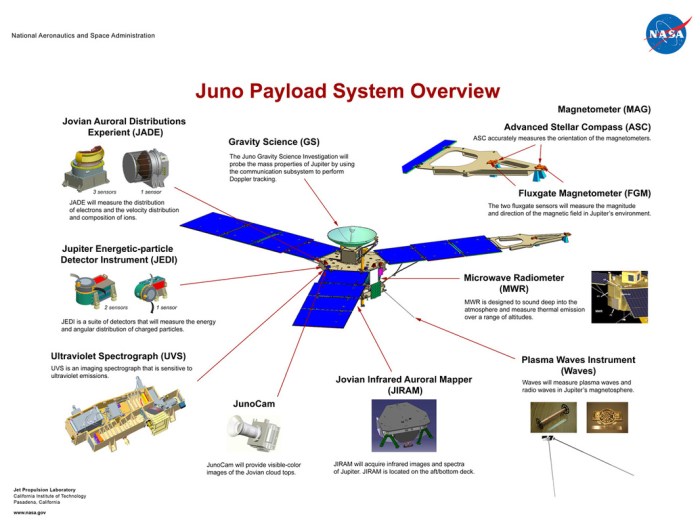
Juno’s science instruments – click for full size. Credit: NASA / JPL
The Jovian system has been the subject of extensive study by NASA’s Juno mission since it originally arrived in its extended orbit around the planet in July 2016. Since then, the vehicle had made more than 50 complete passes around the planet in a roughly polar orbit, and some of those have periodically allowed the spacecraft to observe the major moons of Jupiter, including Io. Two of the most recent of these flybys – in May and July 2023 – focused on Io, once again revealing the moon is incredible detail.
The May 16th, 2023 flyby brought the Juno spacecraft to just 35,500 km of Io, allowing the imagers on the spacecraft to capture the moon simultaneously in both visible light wavelength and in the infrared, revealing a stunning amount of details on the moon’s volcanism.
In July, Juno passed even closer, at just 22,000 km from the moon’s surface. This allowed an actual eruption to be imaged by the spacecraft – not the first time this has happened, but one which captured Io’s “old faithful” once again in action.
Io as seen by the Juno spacecraft in May 2023 in both natural light, overlaid with and infrared image showing hotspots of volcanic activity. Credit: NASA/JPL
“Old faithful” is the name given to the Prometheus Patera, a volcanic pit on the side of the moon facing away from Jupiter (Io is tidally locked to Jupiter), an area given to near-continuous eruptions which have been observed by both of the Voyager spacecraft, together with Galileo, and New Horizons, as well as Juno. Outflow from the eruptions in the pit covers an area of almost 7,000 square km, and it causes an observable plume of material rising up to 100 km above the moon’s surface.
What is particularly remarkable about Juno’s images of Io and the other Galilean moons is not only the amount of information they are providing, but the fact the spacecraft wasn’t ever designed to study them; its instruments were specifically designed to uncover secrets of Jupiter’s atmosphere and interior. But as remarkable as these images are, they are just a foretaste of what is to come.
Three more even closer flybys of Io will come in October and December before the spacecraft makes its closest approach of the mission to date, passing just 1,500 km above the Moon’s surface. Meanwhile, to mark Juno’s May and July 2023 flybys, NASA released a video offering a “starship captain’s” view of Io as the spacecraft passed around Jupiter’s limb. The music featured in the video is from Juno to Jupiter, by Vangelis. This was the Greek composer’s last studio album prior to his passing in May 2022, and the last of a series of albums and shorter pieces he wrote for both NASA and ESA between 2001 and 2021 and born of his almost life-long passion for science and space exploration.
Russia Heads Back to the Moon
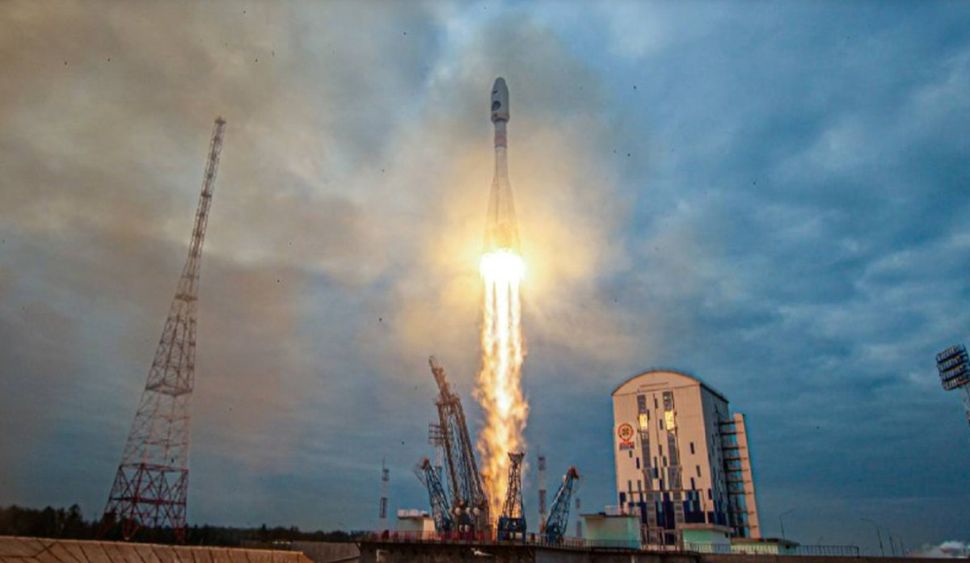
At 23:10 UTC on August 10th, 2023 (09:10, August 11th, local time) a Soyuz 2.1b/Fregat booster lifted-off from Russia’s far eastern Vostochny Cosmodrome to mark the first lunar mission Russia has undertaken in 47 years. Originally called Luna-Glob, the mission is designed to place a robust lander within the crater Boguslawsky in the lunar South Polar Region.
A Soyuz-Fregat rocket lifts off from the Vostochny Cosmodrome, August 10th 2023 (UTC), carrying the Luna 25 mission
Initial concepts for the mission started in 1998, and Russia had planned to garner international involvement, looking to partner with (at various times) the likes of the Indian Space Research Organisation (ISRO), the Japan Aerospace Exploration Agency (JAXA), the European Space Agency and the Swedish National Space Agency (SNSA) and the project gradually matured. However, given the 20+ year gestation for the mission, ISRO and JAXA switched to their own lunar-focused programmes whilst SNSA eventually partnered with China, flying their LINA-XSAN instrument aboard Chang’e 4 in 2019. ESA also withdrew from cooperation with Russia as a result of the invasion of Ukraine.
As a national mission, the project and its lander were renamed Luna 25, intended to suggest a direct lineage back to 1976’s Luna 24 sample return mission. It was launched very much in the public eye: Russia Television broadcast and streamed the event live in a 90-minute programme which featured the launch itself, coupled with a strange mix of a choir of young children singing under a huge photograph of Yuri Gagarin, a candlelit display.
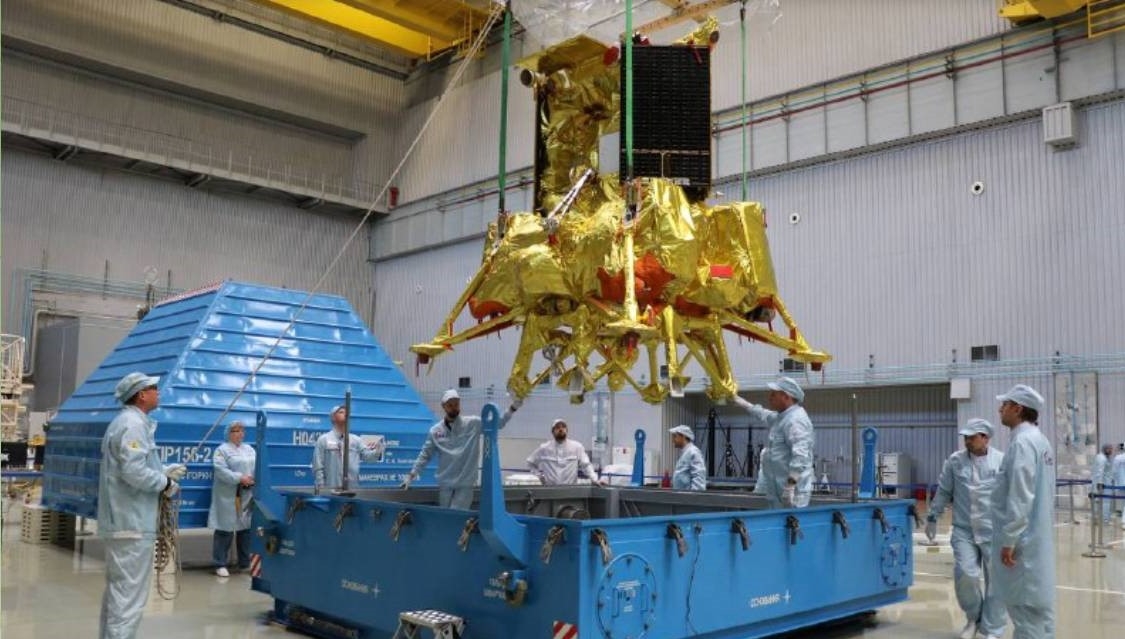
The Luna 25 lander as it is being placed within its shipping container container ready for transfer to the Vostochny Cosmodrome. Credit: NPO Lavochkin
Filmed at the Exhibition of Achievements of National Economy, Moscow, this portion of the programme also featured interviews with cosmonauts Oleg Artemyev and Oleg Blinov and more music, this time from Russian rock/pop group UMA2RMAN.
The mission is seen as the starting point for Russia’s own renewed lunar aspirations. A prime aim of the spacecraft is to test new landing technologies and systems which could be used in future missions to the Moon, including those by crews – in this respect, Artemyev and Blinov discussed the development of lunar habitats from a small-scale outpost (with artwork supplied by Roscosmos) through to a large-scale base (with a rendering by Russia Television, rather than anything official).
A rendering of a Russian lunar outpost, as seen on Russia Television during the Luna 25 launch. Credit: RT / Roscosmos
As well as lander research, the 1.7-tonne lander will conduct studies of the upper layer of the lunar regolith, appraise the ultra-thin lunar atmosphere and search for signs of water ice in the south pole region. To achieve this, the upper platform of the lander contains 30 kg of science payload. The landing itself is scheduled for August 21st, 2023, after a spiral cruise out to the Moon, and which means that Luna 25 should touch down some two days ahead of India’s Chanrayaan-3 lander launched in July and which achieved its initial orbit around the Moon on August 6th.
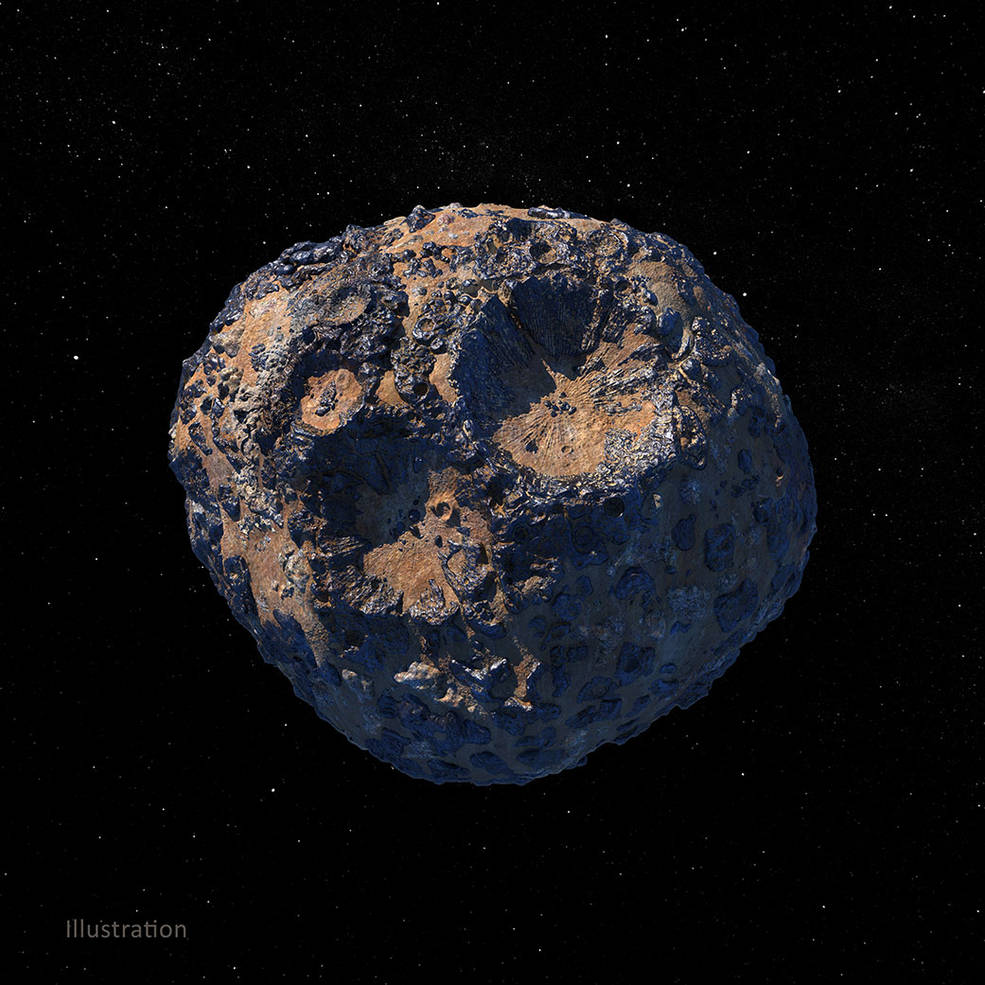
An artist’s impression of the Psyche spacecraft en route to 16 Psyche. Credit: NASA
Due to launch in just under 2 months, on or shortly after October 5th, 2023, NASA’s Pysche mission is intended to explore the origin of planetary cores by studying the metallic asteroid of the same name.
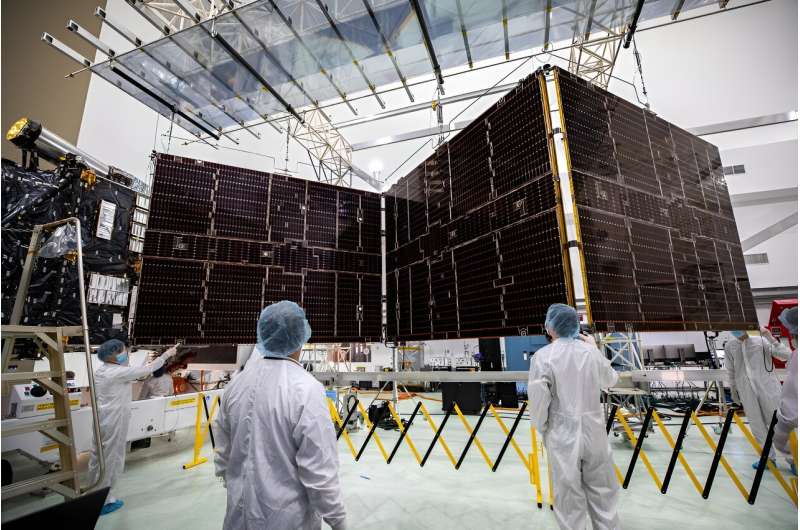
The 14th mission in NASA’s Discovery programme, the spacecraft is currently going through the last of its pre-launch preparations, the latest being the installation and folding of its massive solar arrays.
With a total span of almost 25 metres and covering a total area of 75 square metres, these are among the largest arrays used on a NASA deep-space mission. They will be capable of generating 20 kilowatts of power during the early phases of the mission as the spacecraft departs Earth, where they will be primarily used for the purposes of vehicle thrust. However, Psyche is so far from the Sun that by the time the craft arrives, they will only be able to generate around 2 kilowatts – enough to boil two kettles side-by-side.
Technicians begin to retract one of the two solar arrays following its installation on NASA’s Psyche spacecraft. Credit: NASA/Kim Shiflett
For propulsion, the spacecraft will use four Hall-effect thrusters (HETs). Based on the discovery by Edwin Hall after whom they are named, these are a form of ion propulsion in which the propellant – most often xenon or krypton gas – is accelerated by an electric field. They provide an efficient thrust-to-propellant load ratio, allowing the spacecraft utilise a minimum propellant load – around a tonne – for the 5 year 10 months transit to asteroid 16 Psyche and the 21-month primary science mission.
The overall thrust produced by the HETs is equivalent to holding a single AA battery in the hand. However, as they can run for extended periods, they will be able to gently accelerate the spacecraft to 200,000 km/h during the 4 billion kilometre cruise out to the asteroid belt. They will also provide sufficient thrust to allow the spacecraft to slow itself and enter orbit around the asteroid in readiness to start its science mission.
16 Psyche is the heaviest known M-type asteroid – those with higher concentrations of metal phases (e.g. iron-nickel) than other asteroids – in the solar system. It was in 1852 by Italian astronomer Annibale de Gasparis, who named it for the Greek goddess Psyche, with the “16” prefix indicating it was the sixteenth minor planet to be discovered.
An artist’s rendering of 16 Psyche based on radar studies of the asteroid and albedo-based features witnessed through imaging. Credit: Peter Rubin/NASA
Initially, it was thought that asteroid was the exposed iron core of a protoplanet, exposed after a violent collision with another object that stripped off its mantle and crust. However, more recent studies lean heavily towards ruling this out – but it still might be a fragment of a planetesimal smashed part in the very earliest days of the solar system’s creation. As such, studying the asteroid might answer questions about planetary cores and the formation of our own planet.With the solar arrays installed and stowed, the next significant milestone for the mission will be the loading of the xenon propellant, which will occur over a two-week period starting in mid-August. This will be followed by the spacecraft being mated with its payload mount and then integrated into the upper stage of the SpaceX Falcon Heavy which will launch the mission from Kennedy Space Centre’s Pad 39B.
Euclid Arrives at L2 and Starts Commissioning Tests
The European Space Agency’s (ESA’s) Euclid space telescope has arrived in orbit around the Earth-Sun L2 Lagrange point, and commissioning of its science instruments has commenced.
As I noted in Space Sunday: a “dark” mission, recycling water and a round-up, Euclid is a mission intended to aid understanding of both dark matter and dark energy – neither of which should be confused with the other. Euclid will do this by creating a “3D” map of the cosmos around us, plotting the position of some two billion galaxies in terms of their position relative to the telescope and the redshift evident in their motion.
Animation of Euclid (purple) in a halo orbit around the the Earth-Sun L2 position (light blue), as seen from “above” and following launch from Earth (dark blue). Credit: Phoenix777 utilising data from ESA / NASA
From this, astronomers will be able to study the clustering effects of dark matter, the cosmic expansion of dark energy, and how cosmic structure has changed over time. It will be the largest and most detailed survey of the deep and dark cosmos ever done.
Following a 30-day transit from Earth, Euclid entered into orbit around the Earth-Sun L2 Lagrange point, 1.5 million km from Earth, at the end of July, and commissioning of its instruments – which had undergone power tests whilst en-route – commenced almost at once, with early result being released.
Over the next 6 years, Euclid will observe the extragalactic sky (the sky facing away from the bulk of our own galaxy) in what is called a “step and stare” method: identifying a section of sky and training both of its camera systems, one of which images in visible wavelengths and the other in infrared, before moving on to the next, generating “strips” on imaged squares.
The grid-like “step and stare” observation method Euclid will use to survey the extragalactic sky. Credit: NASA
In doing so, Euclid will capture light from galaxies that has taken up to 10 billion of the universe’s estimated 13.8 billion-year lifespan to reach us. In doing so, it will measure their shape and the degree of red shift evident, whilst also using the effects of gravitational lensing on some to reveal more data about them.
The data gathered is intended to help astrophysicists construct a model to explain how the universe is expanding which might both explain the nature and force of dark energy and potentially offer clues as to the actual nature of dark matter – the mass of which must be having some impact on dark energy as it pushes a the galaxies.
Commissioning images for Euclid’s near-infrared camera. Credit: ESA
In all, it is anticipated that Euclid will produce more than 170 petabytes of raw images and data during its primary 6-year mission, representing billions of stars within the galaxies observed. This data will form a huge database that will be made available globally to astronomers and researchers to help increase our understanding of the cosmos and in support for current and future missions studying the universe.
Curiosity Celebrates 11 Years on Mars by Completing Tough Challenge
Since arriving on Mars in February 2021, the Mars 2020 mission with Perseverance and Ingenuity has tended to overshadow NASA’s other operational rover mission on Mars, that of the Mars Science Laboratory Curiosity, which arrived within Gale Crater on August 6th, 2011.
In that time, the mission has scored success after success, doing much to reveal the water-rich history of the crafter – and the history of Mars as a whole. For the last several years the rover has been slowly climbing “Mount Sharp” – the 5 km tall mound at the centre of the crater – and officially called Aeolis Mons – revealing how it is the result of the crater being the home of several lakes during Mars’ ancient history.
With lower slopes at the top and upper sloped at the bottom, this image of Aeolis Mons (from NASA’s Mars Reconnaissance Orbiter) charts Curiosity’s climb to the ridge which caused it so much trouble (white lines, the dots showing individual Sols), with the multiple attempts to drive over it (the collection of dots in the middle of the image) and the eventually diversion around it which allowed the rover to enter the “Jau” crater field. Credit: NASA/JPL
Most recently, the rover has faced its toughest challenge yet: attempting to ascend a ridgeline setting between it and an area of geological interest dubbed “Jau”. From orbit, the ridge appeared to be difficult, but not impossible for the rover. However, it combined three obstacles which proved troublesome: a steep slope averaging 23o and which comprises a mix of sand dunes and boulders large enough to pose a threat to the rover’s already battered wheels.
Initial attempts to get over this ridge in April and June resulted in the rover hitting “faults”: stoppages triggered automatically as the wheels start slipping, either as a result of the ground beneath them being too soft to offer traction meeting a resistance such as a too-large boulder they could not overcome. These forced the mission team to take a chance on a 300 metre diversion to try a point on the ridge which appeared to be less challenging.
The diversion proved worthwhile; despite taking several weeks to plan and execute, Curiosity managed to reach “Jau” – an area of multiple impact craters in close proximity to one another – in early July, and has been studying it at length.
Overcoming the ridge is a significant achievement for the rover, and clearly it means Curiosity should have something of a smoother passage to its next destination.
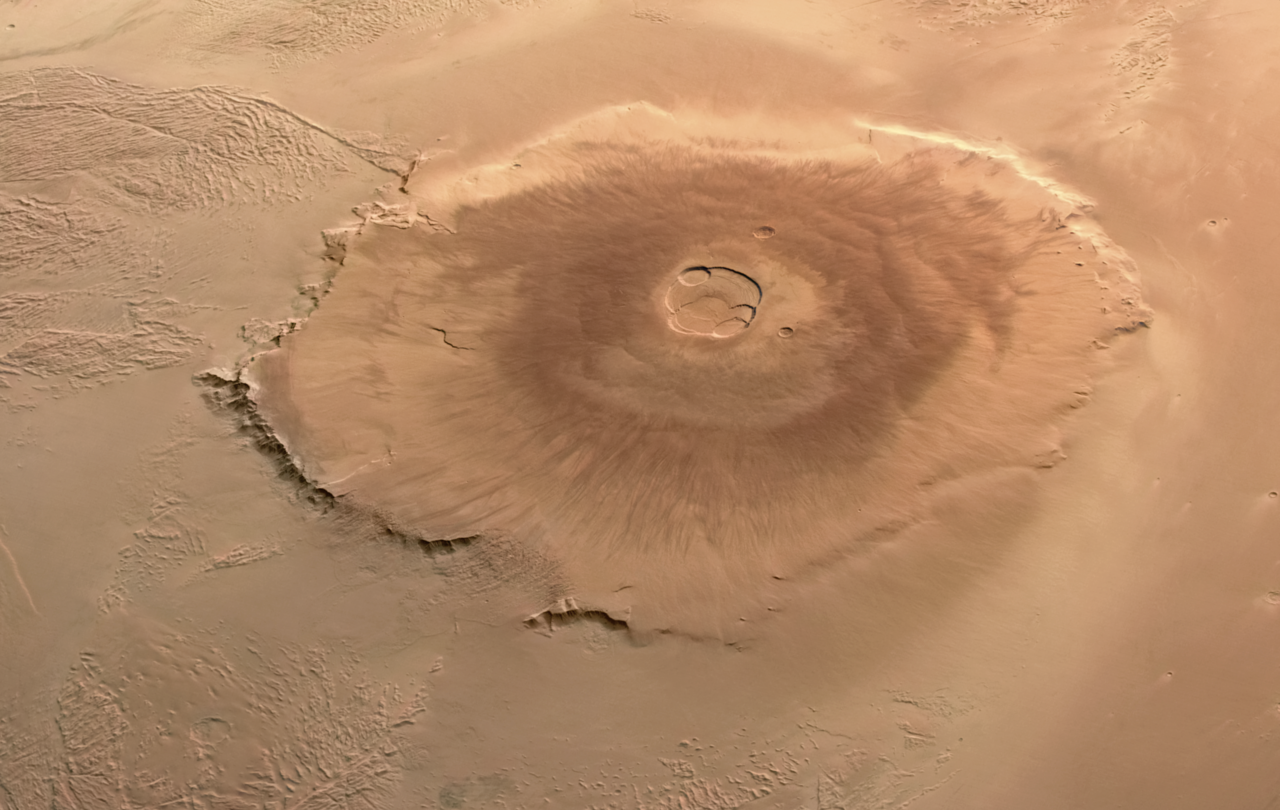
Olympus Mons via ESA Mars Express Credit: ESA /DLR / Andrea Luck
Olympus Mons is one of the many reasons I have an abiding fascination with Mars. Located to the northwest of the Tharsis Montes (Tharsis Mountains), a chain of super volcanoes marching across the planet’s northern hemisphere, Olympus Mons is the largest of all the volcanoes so far discovered in the solar system and boasts some incredible statistics.
For example, it rises a huge 26 km above the surrounding plains, or 21.9 km above datum for the planet, marking it as being around twice the height on Hawaii’s Mauna Kea as it rises from the sea bed. It is over 600km, covering an area almost the size of Poland. The volcano’s peak comprises a series of nested caldera craters which all speak to a violent volcanic past, and which at their widest measure some 60 km x 80 km and are up to 3.2 km deep.
So broad is the volcano that its slopes would not be at all mountain-like, but rather a continuous incline rising for the most part at an angle of just 5% from the horizontal; outside of the base escarpment that is. The latter, running around the volcano forms a near-continuous set of cliffs rising up to 8 km from the plains on which it sits.
Olympus Mons overlaying a map of Poland to give an idea of its surface area. Credit: NASA / Seddon / Szczureq
Precisely how Olympus Mons formed has been open to some debate. While it and the three volcanoes of the Tharsis Montes – Arsia Mons, Pavonis Mons, and Ascraeus Mons (all of which are as impressive as Olympus Mons, if each somewhat smaller) – formed in the same period of Mars’ early history some 3.7 to 3 billion years ago, Olympus Mons is potentially the eldest. Now a team led by Anthony Hildenbrand of Université Paris-Saclay in France believe they can show that a major contributing factor in the formation of Olympus Mons was water.
Using data from a range of missions in orbit around Mars, the team has carried out an extensive comparative study between Olympus Mons and volcanic island chains such as the Azores, the Canary Islands and the Hawaiian islands. In doing so, they have found evidence which strongly supports the idea of the escarpment around Olympus Mons were laid over thousands of years through the interaction of lava from the volcano and a surround ocean.
That an ocean once existing in the northern lowland of Mars – called the Vastitas Borealis – has long been known. However, given the elevation at which Olympus Mons sits, it had long been assumed it was above this ancient ocean. However, in their work, Hildenbrand’s team suggest Olympus Mons actually grew out of the ocean, rising through successive eruptions in much the same way as, say, Mauna Kea, until it broke the surface of the sea, and the interaction of the hot lava and cold water giving rise to the escarpment as the volcano contained to rise.
In support of this, the team found evidence that the flanks of Alba Mons, another huge, but much flatter – a mere 6.8 km in elevation – volcano further north along the edge of Vastitas Borealis and much older than Olympus Mons, suffered a series of violent tsunamis. These were likely the result of the violence of the eruptions which raised Olympus Mons.
An oblique view of Olympus Mons seen from the N-NE, created using a Viking Orbiter from 1976, overlain on data gathered by the Mars Orbiter Laser Altimeter (MOLA) on the Mars Global Surveyor orbiter (1997-2006). The vertical elevation has been exaggerated to show the 6-8 km base escarpment in sharp relief. Credit: NASA / MOLA Science Team
If Hildenbrand’s team are correct in piecing their evidence together, it could help explain one of the many mysterious of Mars. The edge of Vastitas Borealis has two shorelines differing substantially in elevation. Until this study, it had been widely accepted that the two shorelines were the result of two different oceans having once occupied the lowlands. The first, much higher (and older) shoreline marked a time very early on in Mars’ history when Vastitas Borealis was home to a broad, deep ocean which, due to climatic changes was almost completely lost.
Then, as volcanism again took hold, warming the planet again a few hundred million years later, a new, much shallower sea formed within Vastitas Borealis, evening rise to the younger shoreline at the lower elevation. However, this idea has always had its problems; in particular, it seems unlikely a vast, globe-circling ocean would form, and then almost complete recede, only to return again, even during Mars’ somewhat cyclical warm, wet period of history.
Olympus Mons: a flash colour image intended to present it as volcanic island in the middle of a vanished Martian ocean. Credit: A.Hildenbrand / Geops / CNRS
Instead, Hildenbrand’s work suggests that both shorelines belonged to the same ocean, one which was continuously present on Mars for perhaps close to a billion years. What changes was that in that period, the massive volcanic activity that gave rise to first Alba Mons and then to Olympus Mons and the Tharsis Montes and Tharsis Bulge, pushed up the overall elevation of the northwest quadrant of the planet to a far greater extent than thought.
Again, if this theory is correct, and Mars likely had a single, continuous northern ocean directly interacting with the volcanic activity in the region, it would have had a significant impact on the development of the planet’s climate and environment, including the development of any life which may have also developed.
The volcanic shorelines proposed in our paper may be an unambiguous witness for past sea level, where research for traces of early life (organic matter) could be targeted. More generally speaking, knowing where and when past Martian oceans may have been has significant implications for climatic models, because this would give decisive constraints on the initial amount of stable liquid water, the physical conditions for the persistence of a stable atmosphere, until when magmatic degassing associated with major planet activity may have occurred.
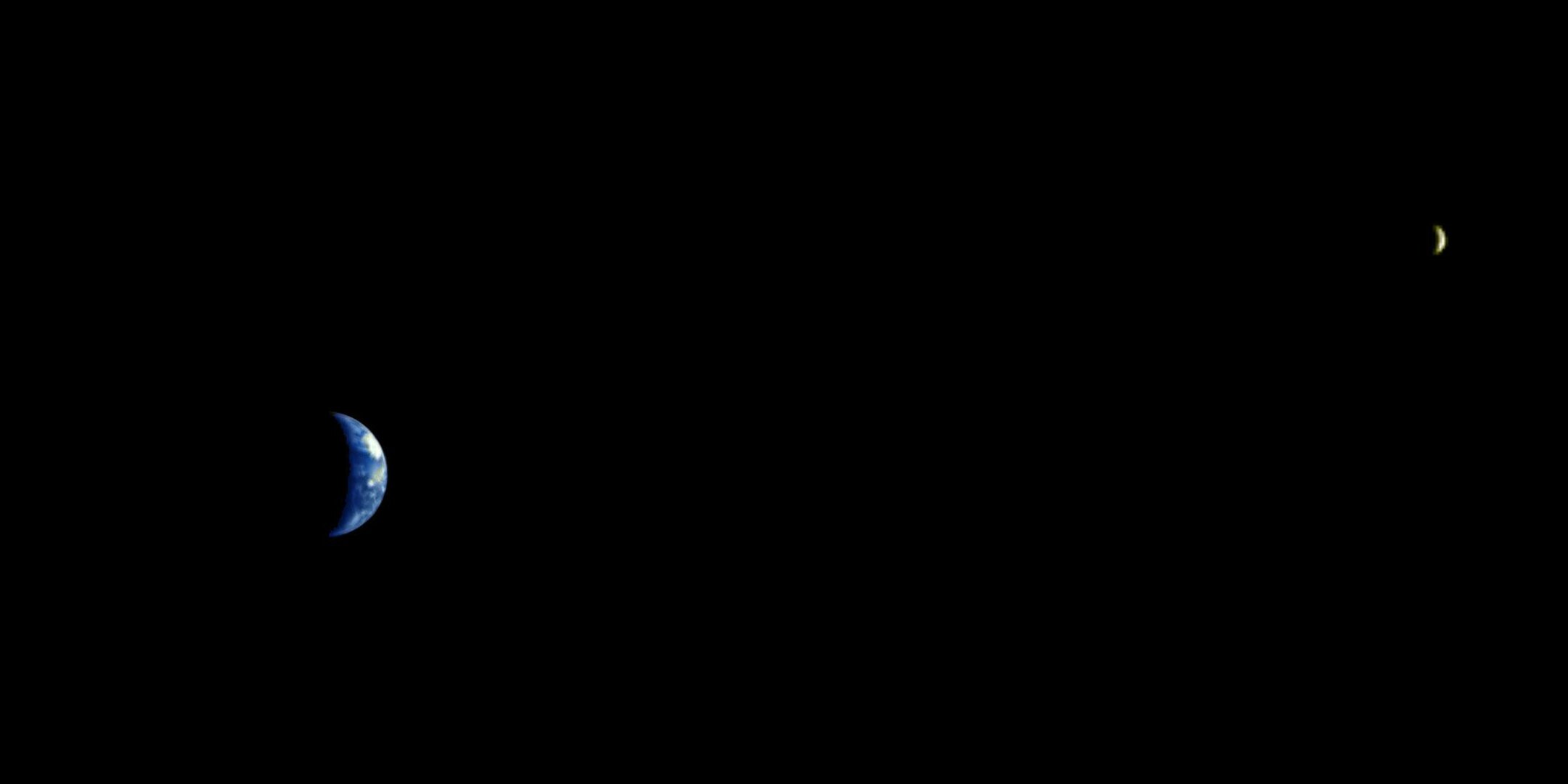
A farewell to Earth: an image of our Earth and her Moon, captured by ESA’s Mars Express mission as it heads towards Mars, June 2003. Credit: ESA
When discussing the robotic exploration of Mars, the focus tends to be on the current NASA missions: the Mars Science Laboratory (MSL) rover Curiosity and the Mars 2020 rover Perseverance and its flight-capable companion, Ingenuity. This is because of all the active Mars missions, these are the most visually exciting. But it does mean the other missions still operating around Mars – a total of 8, including China’s Tainwen-1 orbiter and Zhurong rover and UAE’s Hope mission – tend to get overlooked.
One of those that tends to get overlooked is actually the second longest running of the current batch, the European Space Agency’s Mars Express, the orbital component of a 2-part mission using the same name. This recently celebrated the 20th anniversary of its launch (June 2nd, 2003) and will reach the 20th anniversary of its arrival in its operational orbit around Mars on December 25th, 2023.
The mission’s title – “Mars Express” – was selected for a two-fold reason. The first was the sheer speed with which the mission was designed and brought together as a successor to the orbital component of the failed Russian Mars 96 mission, for which a number of European Space Agency member nations had supplied science instruments, using an ESA-designed satellite unit (based on the Rosetta mission vehicle).
An artist’s impression of Mars Express passing over Mars in its extended elliptical orbit. The two long booms extending fore-and0aft from the vehicle are part of the MARSIS sounding radar designed to locate frozen bodies of water beneath the planet’s surface. Credit: ESA
The second was the fact that 2003 marked a particularly “close” approach of Earth and Mars in their respective orbits around the Sun, allowing the journey time from one to the other to be at the shorter end of a scale which sees optimal Earth-Mars transit times vary between (approx.) 180-270 days. In fact, Earth and Mars were at the time the “closest” they have been in 60,000 years, hence why NASA also chose that year to launch the twin Mars Exploration Rover (MER) mission featuring the Spirit and Opportunity rovers.
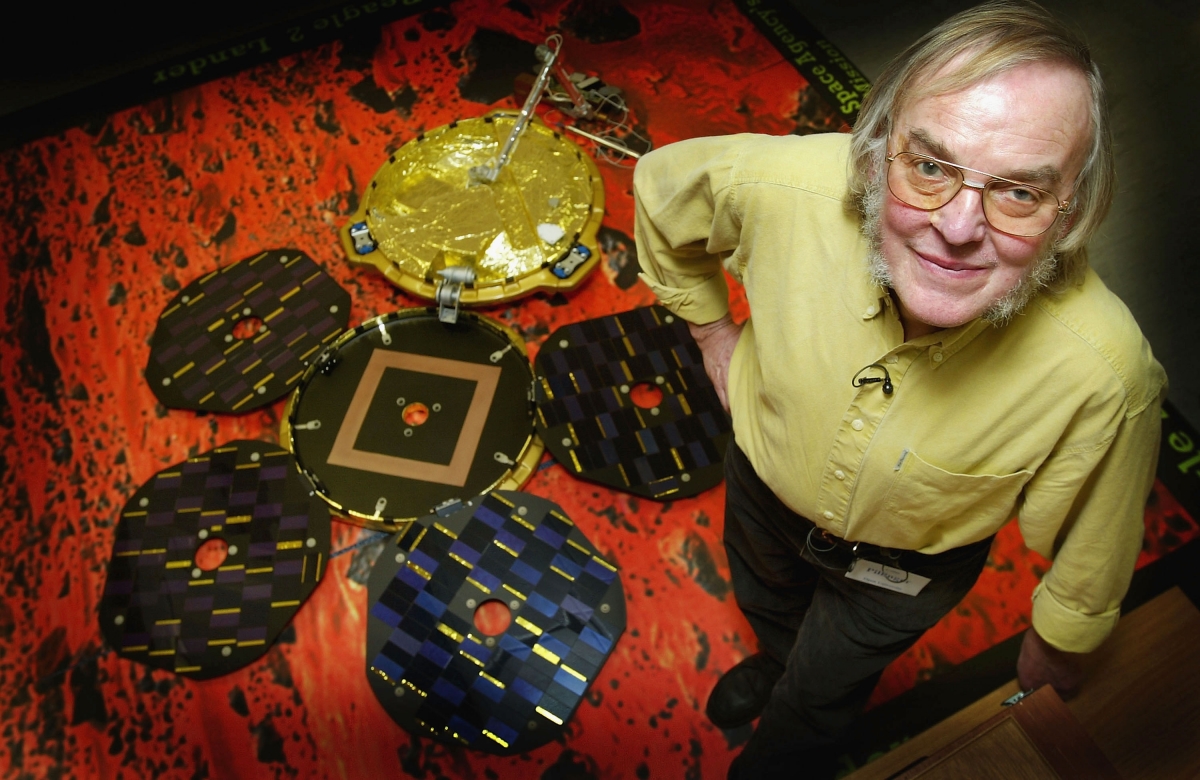
Taken as a whole, the Mars Express mission is perhaps more noted for its one aspect that “failed”: the British-built Beagle 2 lander (named for the ship that carried Charles Darwin on his famous voyage). This was a late addition to the mission, and the brainchild of the late Professor Colin Pillinger (whom I had the esteemed honour to know ); given it was effectively a “bolt on” to an established ESA mission, it was subject to extremely tight mass constraints (which tended to change as the Mars Express orbiter evolved). These constraints led to a remarkable vehicle, just a metre across and 12 cm high when folded and massing just 33 kg, yet carrying a considerable science package capable of searching for evidence of past or present microbial life on Mars.
Sadly, following its separation from Mars Express on December 19th, 2003, ahead of both vehicles entering orbit around the planet and a successful passage through the upper reaches of Mars’ atmosphere, Beagle 2 never made contact following its planned arrival on the planet’s surface. For two months following the landing, repeated attempts to make contact with it were made before it was finally officially declared lost. While multiple theories were put forward as to what had happened, it wasn’t until 12 years later, in 2016 – and a year after Collin Pillinger had sadly passed away – that evidence was obtained for what appeared to have happened.
The late Professor Colin Pillinger pictured with a full-scale model of the Beagle 2 lander in its deployed mode, showing the four solar array “petals” unfolded from the vehicles “cover” to expose the communications antenna, the the power and science instruments – including the little’s landers robot arm and “PAW” – the Payload Adjustable Workbench – designed to study the rocks around the lander and obtain samples of rock and soil for on-board analysis. Credit: Getty Images
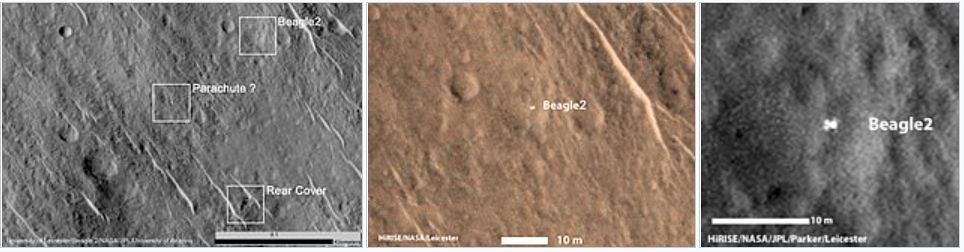
Using a technique called super-resolution restoration (SRR) on images obtained by NASA’s Mars Reconnaissance Orbiter in 2015 and which appeared to show the lander intact on the surface of Mars, experts were able to enhance them to a point where they appeared to show it had in fact managed to land safely on Mars and had partially deployed its solar arrays.
The significance here is that due to its mass and size constraints, Beagle 2 was of a unique design, resembling an oversized pocket-watch and its cover. The “watch” contained the science and battery power systems, and the “cover” the communications system and flat antenna, with four round solar arrays stacked on top of it.
Following landing, Beagle 2 was supposed to fold back its “lid”, and then deploy the four arrays like petals around a flower. This would allow the arrays to recharge the lander’s batteries so it could operate for at least a Martian year, and expose the communications antenna. However, after enhancement using SRR, the NASA images appeared to show only two of the solar array petals had actually deployed; the other two remaining in their “stowed” position, blocking the lander’s communications antenna and denying it with a sufficient means to recharge its batteries.
Left: the MRO image of the Beagle 2 landing site captured in 2015 showing the lander, what appears to be its parachute and its backshield. Centre: an enlargement of the orbiter using traditional processing enhancements, including the use of false colour to try to increase the available detail. Right: the SRR work, appearing to show the lander with 2 (of 4) solar arrays deployed. Credit: NASA / ESA
However, there is one further element of intrigue: because it was known initial communications with Earth might be delayed – Beagle 2 was reliant on either Mars Express itself to be above the horizon post-deployment, or failing that NASA’s venerable Mars Odyssey orbiter – the lander was programmed to go into an automated science-gathering mode following landing. As the science instruments were quite possibly able to function, some of them might actually have deployed, allowing data to be recorded Solid State Mass Memory (SSMM) – data which might still be available for collection were the lander to ever be recovered by a human mission to Mars.
The mystery over the lack of contact with Beagle 2, coupled with the arrival of NASA’s Spirit and Opportunity on Mars at the start of 2004 combined to mean that Mars Express received very little attention following its arrival in its science orbit on December 25th, 2003 – and apart from occasional reporting on its findings, this has continued to be the case for the last 20 years.
The 82 km wide Korolev crater located in the northern lowlands of Mars, home to a body of water ice 1.8 km deep and up to 60 km across. This image was created from a series captured by the High Resolution Stereo Camera (HRSC) on Mars Express, and has a resolution of roughly 21 metres per pixel. Credit: ESA / DLR
Which is a shame, because in the time, Mars Express has carried out a remarkable amount of work and has been responsible for some of the most remarkable images of Mars seen from orbit. 0For example, and just as a very abbreviated list intended to outlines the diversity of the orbiter’s work, within two months of its arrival around Mars, it was able to confirm the South Polar icecap is 15% water ice (the rest being frozen CO2).
In April and June 0f 2003, the vehicle confirmed both methane and ammonia to be present in the Martian atmosphere; two important finds, as both break down rapidly in Mars’ atmosphere, as so required either a geological or biological source of renewal.
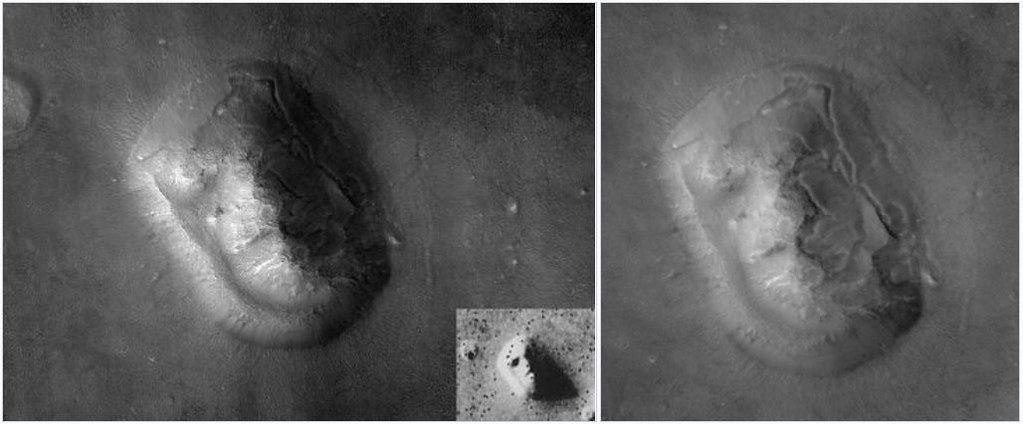
Pareidolia at work: the Cydonia mesa said to be carved into a “human face” following the Viking missions of the 1970s, as seen by NASA’s Mars Reconnaissance Orbiter (2007 – left) and Mars Global Surveyor (2001- right), compared to the Viking image which gave birth to the myth of the “face”. Credit for all images: NASA
In 2006, the orbiter put another nail in the coffin of the “ancient Martians” theories which abounded following the the Viking missions in the 1970s. In one set of images of the Cydonia region of Mars taken by the orbiter vehicles, there was a was a mesa which, thanks to the fall of sunlight, and the angle at which the image was taken, appeared to give it the appearance of a “face”. This quickly spiralled into ideas the 2 km long mesa had been intentionally carved as a “message” to us, together with claims of pyramids and the ruins of a city close by.
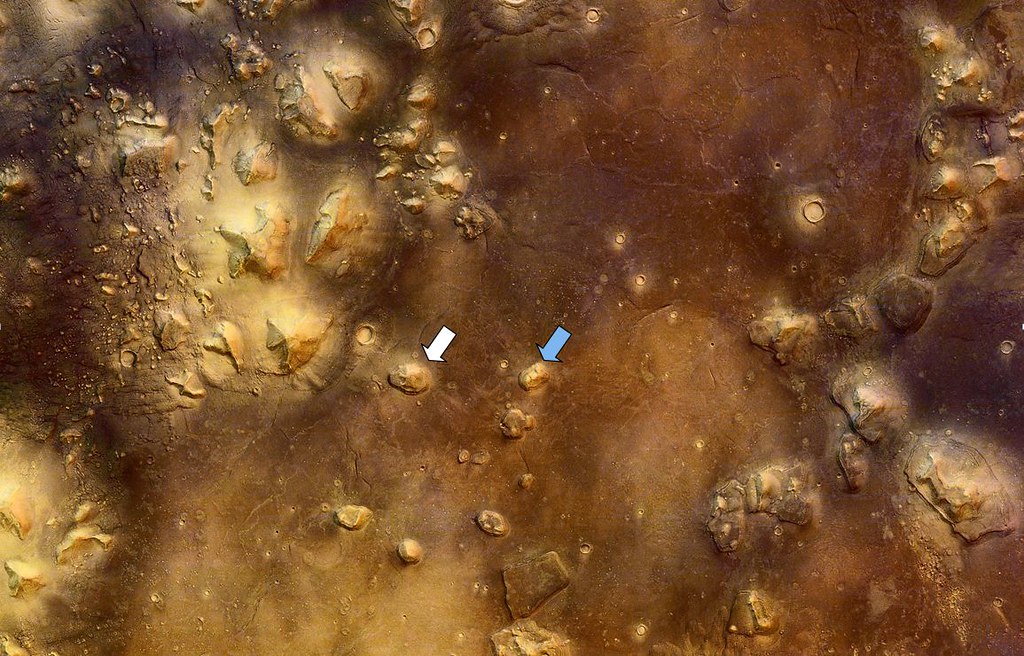
All of this was the result of pareidolia rather than any work by ancient Martians – as evidenced by much higher resolutions of the mesa taken by NASA’s Mars Global Surveyor orbiter in 2001, and Mars Reconnaissance Orbiter in 2007 (above). Mars Express further demonstrated the effects of pareidolia in an image of Cydonia captured in 2006, which showed both the “face” mesa, and – around 50 km to the west – another which looks like a skull. While the latter mesa is also visible in some of the Viking era images, it is no way resembles a skull; the resemblance on the Mars Express image again being the result of natural influences – the fall of light, etc., – coupled with the human brain’s propensity to impose recognisable form and meaning to shapes where none actually exists.
A 2006 image of the Cydonia region, captured by Mars Express, demonstrating the pareidolia effect associated with the so-called “face”. Arrowed in blue is the mesa supposedly carved into the form of a “face” in a similar manner to how it was “seen” by Viking in 1976, together with a “skull” mesa close by (some 50 km away), which looked nothing like at skull when reviewed in the Viking images. Credit: ESA











 Inara Pey: Living in a Modemworld