Kitely opens their marketplace for business

Kitely-logoIlan Tochner, CEO of Kitely, dropped me an e-mail on Friday August 30th to let me know the Kitely Marketplace is now open for business.  There’s also an official announcement from the Kitely team on their blog as well, which is recommended reading for those interested in the Marketplace.

First announced at the start of the year, the Kitely Marketplace has taken eight months to reach the point of launch – and with good reason. The Kitely team have been working to develop an online experience which is initially available within Kitely, but which can be expanded in time to support other OpenSim grids.

The new Marketplace can be accessed directly from the toolbar displayed on the Kitely website

The Market combines features familiar to those used to using the SL Marketplace or markets such as the (now defunct) Apez and Metaverse Exchange: items can be browsed on-line, then purchased (using Kitely Credits (KCs) or US dollars), prior to being delivered directly to the purchaser’s in-world inventory in a similar manner to SL’s Direct Delivery mechanism. Additionally, the Market functions more like e-commerce sites such as Amazon, where items can be searched for using attributes as well as a category hierarchy, making the search process and drill-down easier and more flexible for both merchants and consumers.

The Marketplace allows for flexible serach using a combination of category, attribute and filter-based searches
The Marketplace allows for flexible search using a combination of category, attribute and filter-based searches

In addition, the Kitely  Marketplace allows for multiple versions of a product to be listed as a single item, thus simplifying the listing, viewing and reviewing of products. So rather than having five individual listings for an outfit which is available in five different colours, a merchant can create a single listing for the outfit, which includes the 5 different colours, allowing consumers to buy any of the five from the one product listing.

Products can include multiple variations in a single listing - in this case five versions of the same mesh dress
Products can include multiple variations in a single listing – in this case five versions of the same mesh dress

A further aspect of the Marketplace is that demo items can be “built-in” in the main product listing, eliminating the need for additional, separate listings to deal with product demos.  Where a merchant offers a demo (indicated in the product listing), the potential buyers can try it by adding the item to their Shopping Cart, where they’ll  get a link called “Try demo”. When they click this link, the demo version is immediately added to their inventory.

There are other subtle touches as well, some of which may be familiar to users of virtual world marketplaces  – such as the ability to click on a store name either in a list of multiple products or within an individual product listing, in order to display and browse the contents of that store. Other touches aren’t so obvious, but are nevertheless pleasing to find – such as rolling the mouse cursor over the thumbnails of any variations of an item to see each of their full-sized images displayed in the product listing.

In developing the Marketplace, Kitely have focused not only on the usability / functionality aspects of the system, but also on optimising the servers and putting in place strong automated capabilities and additional safeguards.

Kitely CEO Ilan Tochner (via Google+)

“We spent a lot of time optimizing the backend so it will be able to provide a snappy user experience even thou each page returns multiple dynamic counters (the number of results given the existing filters in each category and attribute that contains relevant search results),” Ilan informed me in announcing the launch. “Kitely Market remained fast even when we tested it on databases of more than 1 million different products and many concurrent bots (and this is without starting to scale up the hardware we use for the marketplace or distributing it to multiple servers).”

Continue reading “Kitely opens their marketplace for business”

Kitely Market opens for merchants

Kitely-logoOn Saturday May 11th 2013, Kitely announced they are opening their new Market to merchants so that the latter can start to build their stores.

The move comes five months after Kitely first announced they would be developing the Market (see my report from January 2013), and marks a further significant step forward in Kitely’s plans to establish a web-based marketplace which will initially allow merchants to sell products to other Kitely users, but which it is hoped will eventual be available to users across multiple grids.

The Market will combine features familiar to those used to using the SL Marketplace or markets such as the (now defunct) Apez and Metaverse Exchange: items can be browsed on-line, then purchased (using Kitely Credits (KCs) or US dollars), prior to being delivered directly to the purchaser’s in-world inventory in a similar manner to SL’s Direct Delivery mechanism. Additionally, the Market will function more like e-commerce sites such as Amazon, where items can be searched for using attributes as well as a category hierarchy, making the search process and drill-down easier and more flexible for both merchants and consumers.

The new Marketplace button on the Kitely toolbar

The Market is accessed via a new shopping cart button which appears on the main toolbar which is displayed when users are logged-in to Kitely. Once the Market is fully open, the button will allow users to start browsing stores and goods. However, until then, the button will display an introductory message which explains that access to the Market is currently limited to merchants wishing to create a store.

The blog post provides detailed instructions to merchants on creating their store, using the store home page, and managing, editing and modifying products and listings. Additionally, Kitely are also providing on-line documentation for the Market, which provides information on important aspects of the Market such as product pricing options and listing guidelines.

Adding products to a Kitely Marketplace store - image courtesy of Kitely
Adding products to a Kitely Marketplace store (image courtesy of Kitely)

The Market also enables merchants to include multiple variations of a product within a single listing. So rather than having 5 individual listings for an outfit which is available in 5 different colours, a merchant will be able to create a single listing for the outfit, which includes the 5 different colours. The merchant will also be able to define individual prices, permissions and search attributes against each variation, if required.

One item which merchants will not initially be able to sell through the Market is OAR files.

“You can’t sell OAR files directly,” Ilan Tochner, Kitely’s CEO said, “but you’ll eventually be able to sell entire Virtual Worlds so instead of just having the two virtual world templates we offer you now when you create a new world, you’ll be able to find and buy the perfect virtual world for the activity you have in mind. Once you buy that world a new world will be automatically created inside the My Worlds page in your account, at which point you’ll be able to export it to an OAR file.”

Export Permissions

An important element within the Market is Kitely’s new “Export” permissions flag, which is separate to the familiar modify / copy / transfer permissions associated with a product, and allows a merchant to specify whether or not a purchased item can leave the grid. This means, for example, that if a user buys an OAR file for a Kitely world and attempts to save it to their hard drive, only those elements of the OAR file which have the Export flag set will actually be saved – anything which does not have the flag set will be ignored.

Currency Options and Fees

Products in the Market can be sold using either Kitely Credits (KCs), Kitely’s own non-exchangeable virtual currency, or using US dollars (USD), where payments are handled directly via PayPal.

Continue reading “Kitely Market opens for merchants”

Kitely move to offer new marketplace

Kitely-logoKitely, the on-demand virtual world provide has issued more details on their upcoming new marketplace, including an “early bird” promotional offer.

Announcing the company’s plans for the new marketplace on Sunday 20th January, Ilan Tochner, Kitely’s CEO had the following to say:

We are currently developing an advanced content marketplace. Since most OpenSim users are familiar with the Second Life marketplace, we asked our users what they like and don’t like about it. Using these insights we intend to deliver a great user experience that addresses the main usability issues with existing online marketplaces. At first the market will be used only for buying and selling inside the Kitely grid, but eventually it will be used for selling to multiple grids from a single online shop.

In order to attract good content creators we are now offering various benefits for merchants that bring their content to our market before it opens to the public.

The Kitely Marketplace will combine features familiar to those used to using the SL Marketplace or markets such as the (now defunct) Apez and Metaverse Exchange: items can be browsed on-line, then purchased (using Kitely Credits (KCs) or US dollars), prior to being delivered directly to the purchaser’s in-world inventory.

Additionally, the Kitely Marketplace will function more like e-commerce sites such as Amazon, where items can be searched for using attributes, rather than a rigid category hierarchy, making the search process and drill-down easier and more flexible for both merchants and consumers. Kitely will also allow for multiple versions of a product to be listed as a single item, thus simplifying the lists, viewing and reviewing of products. For example, rather than having 5 individual listings for an outfit which is available in 5 different colours, a merchant will be able to create a single listing for the outfit, which includes the 5 different colours, allowing consumers to buy any of the five from the one listing. Kitely call this capability “variations”, and it was a major attraction within the old Metaverse Exchange marketplace. Reviews and ratings for any variation of a product will be recorded in the one listing.

Merchants will be charged a one-off fee of 100 KCs for listing an original item on the marketplace, and a one-off fee of 25 KCs for each variation on that item also listed. There are no ongoing fees associated with listed items or their variations once listed. So for example, in the case of an outfit with 5 colours as mentioned above, the merchant will be charged 100 KC when creating the initial listing for the outfit (which will obviously include one colour variation) and then a one-off fee of 25 KC for listing each of the remaining 4 colours. Further charges will only apply if the merchant uploads additional variations (additional colours) to the item.

Commenting on this approach, Ilan Tochner stated, “The listing fees are designed to prevent low quality content from being added to the marketplace and were supported by our mentors group so that high quality content can be more easily found. This can increase sales for high quality items that are currently hard to find in marketplaces, such as the SL Marketplace, that include many low quality items that aren’t likely to be bought. Those low quality items make it harder to find desirable items which in turn means that good content providers see less money coming in. One way merchants can view listing fees is as a type of low-cost advertising that helps increase the visibility of their wares by eliminating a lot of the noise that prevents finding it.”

Kitely will charge a 10% transaction fee on content sales. Purchases made using US Dollars are paid directly into the merchant’s PayPal account (without going through Kitely), therefore PayPal’s fees will also apply.

Please use the page numbers below to continue reading

The obsession returns…

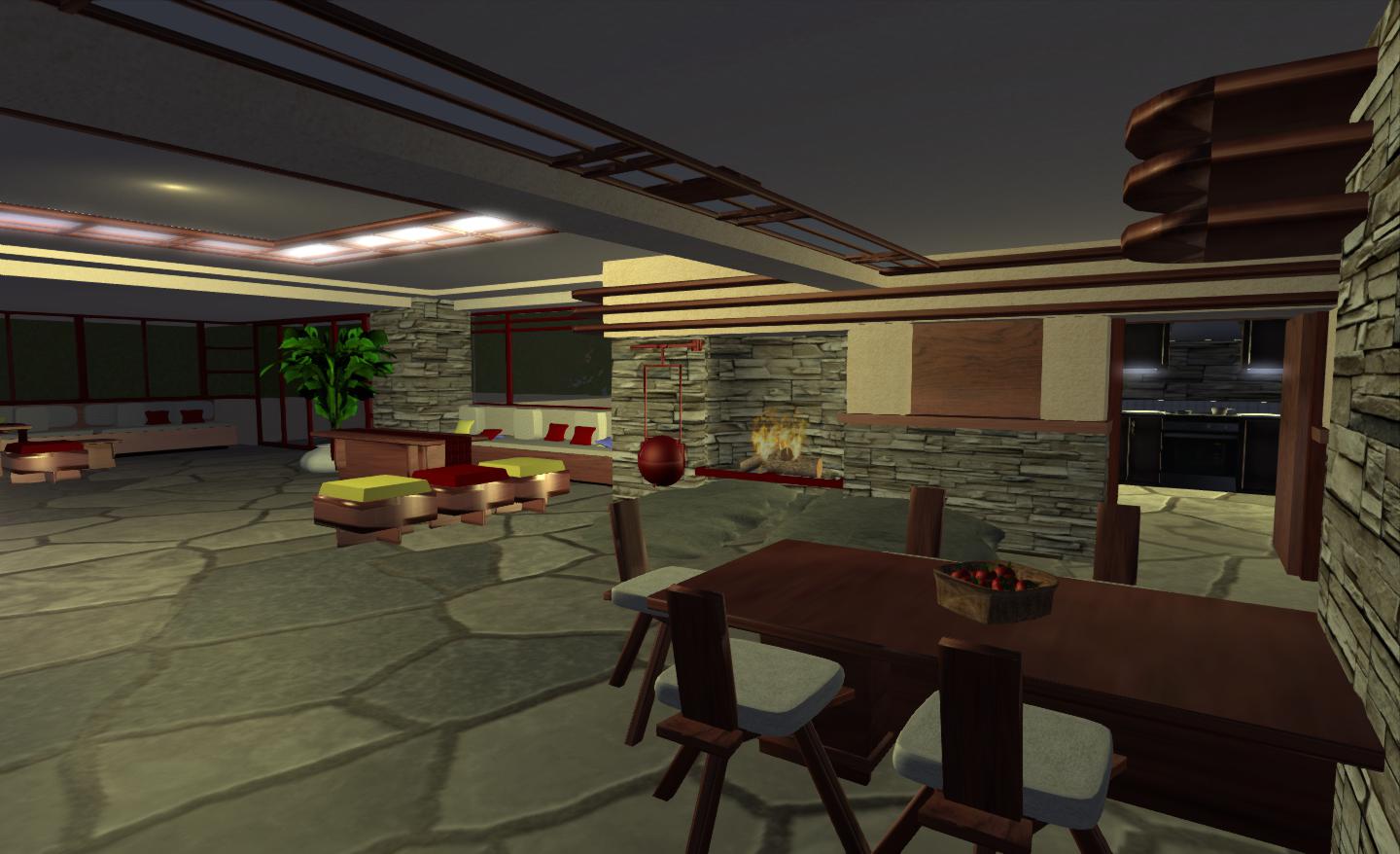
In 2012, the first part of my SL year was spent re-working my take on Frank Lloyd Wright’s famous “Fallingwater“, which eventually wound-up in a quarter-sim in-world for a few weeks.

That build is now boxed for a rainy day, but as I indicated later in the year, I’ve reproduced Fallingwater in Kitely, where it has a full region of its own, allowing me to develop a landscape more in keeping with that of the original. Since then, I’ve been tinkering around with it, adding a region windlight and generally tightening things up. There are still some parts I want to rework, once I have better source material by way of photos (most notably Bear River and the falls), but for now the house is just about done.

Fallingwater on Kitely

With the Second Life build, I produced a modest video; however the result wasn’t overly brilliant – largely because I didn’t really appreciate what I was doing in terms of the technical side of producing the video. Recently, I’ve had some good advice and help from Fuzonacid via YouTube, prompting me to have a further go, this time focusing on the Kitely build.

As it is the start of a new year, I could hardly let it pass without reference to my obsession :), so I hope you enjoy the video (and the Flickr slideshow has also been updated!).

Of mayflies and waterfalls

Today, and on a whim, I decided to drop back into Kitely and my home there – Fallingwater. It’s been a while since I’ve been back, as I’ve been busy in SL and elsewhere, and I didn’t really want to revisit until I’d got a couple of scripting issues sorted (still haven’t) and I’d decided on a suitable windlight preset (I have).

The Guest House

The windlight preset I’ve gone for – at least until I can get scripting issues sorted – is Bryn Oh’s “Mayfly”. I’ve opted for it partly because I love the sunset it provides, but mainly because I believe the dusk half-light it provides works well with the lighting I’ve installed in the house, which isn’t really suited to full daylight (again, something I hope to change in the future). As I want to be able to show-off the house, simply setting the region environment to night doesn’t work either, as people will likely flick over to daytime in their viewer. So my hope is that Mayfly will provide the best for everyone. I do tend to tink it does bring the place to life….but then I would, wouldn’t I? 🙂

Fallingwater

I also finally got around to putting in the footpath and steps from the drive to the river bank facing the house. This isn’t 100% to my satisfaction, and I’m liable to be returning to it and fiddling with things on-and-off, but it’s a start, and in slipping it in, I’ve gained a fair idea as to what I actually want to do when I have sufficient time to spare.

The Great Room and kitchen beyond

There are a few more things I want to do interior-wise as well. A couple of the rooms in the main house are a tad spartan, and the terraces could probably do with a little furnishing. Certainly, a few more pictures around the place would give more of a feeling of homeliness.

Foggy morning

I don’t know what the state-of-play is vehicle-wise in Kitely. I’m not actually after one for driving, but I can’t help feeling having a big old American 1930s Packard parked out under the rear car port would also add to the place as well.

Ilan has been asking my what I’d do if I had one of the new Kitely advanced megaregions. I think that if I did, it would likely become the home to not one, but four of my interpretations of FLW’s houses – I’ve always wanted to try my hand at the Robie House, and I have a couple of other candidates in mind as well. Although I think that were I ever to tackle anything so ambitious, they’d have to be 100% accurate reproductions, just for the heck of it :).

Fallingwater

Ah, well. Such is the stuff of dreams. In the meantime, if you’d like to visit the place yourself, please do. I did notice a couple more issues I need to fix in the place. You can reach it via my Kitely world page

Related Links

Kitely offer fixed-price worlds from $40 a month

Until now, Kitely, the on-demand virtual world service, has offered worlds (regions) based on a subscription basis, with prices starting from $5 a month, inclusive of two regions and 30 hours a month in-world (additional time can be paid for / covered separately).

From today, however, Kitely are offering regions with unlimited use for a fixed monthly fee, in much the same way as other grid-based virtual worlds offer regions of their own. Kitely’s fees for worlds are :

  • $40 a month for an individual world (1 standard 256mx256m region)
  • $60 a month for 2×2 megaregion (equivalent to 4 standard regions)
  • $80 a month for a 3×3 megaregion (equivalent to 9 standard regions)
  • $100 a month for a 4×4 megaregion (equivalent to 16 standard regions).

Each world type has free unlimited access for visitors and supports up to 100 avatars and 100,000 prims (i.e. the 2×2, 3×3, 4×4 megaregions all support 100 avatars and 100,000 prims, not multiples thereof).

Commenting on the move, Oren Hurvitz, Kitely’s co-founder and VP of R&D states:

Our virtual worlds run on powerful multi-core, 7.5 GB servers, and each world can support up to 100,000 prims and 100 concurrent users. This means that our 1-Region worlds, which cost $40 / month, are both cheaper and more powerful than equivalent private islands on other grids, which cost up to $75 / month. And if you decide to host larger worlds then the price becomes ridiculously low, costing as little as $6.25 per region for a 16-region world. Remember that these are not regions running on overcrowded or underpowered servers: each of our cloud-based servers hosts between 1 and 4 worlds, depending on the amount of users in the worlds. This means that if your world has enough users inside it then it will get its own dedicated server at no extra cost!

Kitely subscribers can opt to lease a fixed-price region option, should they so wish, without it counting against their free region allowance

This move may wide broaden Kitely’s appeal  among users who wish to have large number of visitors and who don’t wish to have concerns about direct charging for in-world time, etc.

SL Viewer Support Removed

On September 27th, Kitely ceased supporting the Second Life viewer for accessing their worlds. This move is somewhat inevitable where OpenSim is concerned, following Linden Lab’s decision to enter into a Havok sub-licence arrangement, a move which subsequently saw the -loginURI capability disabled within the SL viewer.